
Study Guides
O Level World History: How Secure Was the USSR's Control Over Eastern Europe, 1948-c.1989? (Cambridge 2147)
Study guide to Cambridge O Level History 2147 key question 2.6: Hungary 1956, Czechoslovakia 1968, the Berlin Wall, Solidarity and the end of Soviet control.
- Subject
- World History
- Level
- O LEVELS
- Topic
- Core Content – Option B: The Twentieth Century, 1919–1989
- Author
- Marlbridge Academic Team
- Updated
- Reviewed by
- Azam Siddique (what this means)
Aligned to Cambridge O Level World History (2147), 2024-2026. Official specification .
Syllabus page (what it covers and how it is assessed): Cambridge O Level World History.
Syllabus points this page covers
2147
- 2.6 How Secure Was the USSR’s Control Over Eastern Europe, 1948–c.1989?
This page covers 1 of the 6 subtopics recorded here in topic 2, Core content: Option B – The twentieth century: international relations since 1919.
Found an error? Report a correction.
Need help with this topic? Request a free trial class for O Level World History (2147).
Key question 2.6 asks how secure Soviet control over Eastern Europe was between 1948 and about 1989. In Cambridge O Level History (2147) you need to explain the risings in Hungary (1956) and Czechoslovakia (1968) and the Soviet response, compare the two, explain why the Berlin Wall was built in 1961, assess the significance of Solidarity in Poland, and judge how far Gorbachev was personally responsible for the collapse of Soviet control. The central argument is that control looked strong because it rested on force – and collapsed once Moscow would no longer use force.
Where this fits in 2147
This is the final key question of Core Content Option B (The twentieth century: international relations since 1919). It is examined in Paper 1 Section A as a three-part structured question (4, 6 and 10 marks), and it was not one of the Paper 2 (Document Questions) prescribed topics for the 2147 2024-2026 series. Related pages: Twentieth Century revision notes, Twentieth Century study guide and USSR control of Eastern Europe practice questions.
Syllabus coverage
CAMBRIDGE O LEVEL HISTORY (2147), 2024-2026 – OPTION B, KEY QUESTION 6
Focus points:
- Why was there opposition to Soviet control in Hungary in 1956 and Czechoslovakia in 1968, and how did the USSR react?
- How similar were events in Hungary in 1956 and in Czechoslovakia in 1968?
- Why was the Berlin Wall built in 1961?
- What was the significance of Solidarity in Poland for the decline of Soviet influence?
- How far was Gorbachev personally responsible for the collapse of Soviet control over Eastern Europe?
Specified content: resistance in Hungary (1956) and Czechoslovakia (1968); the Berlin Wall; Solidarity in Poland; Gorbachev and the collapse of Soviet control.
How did the USSR control Eastern Europe after 1948?
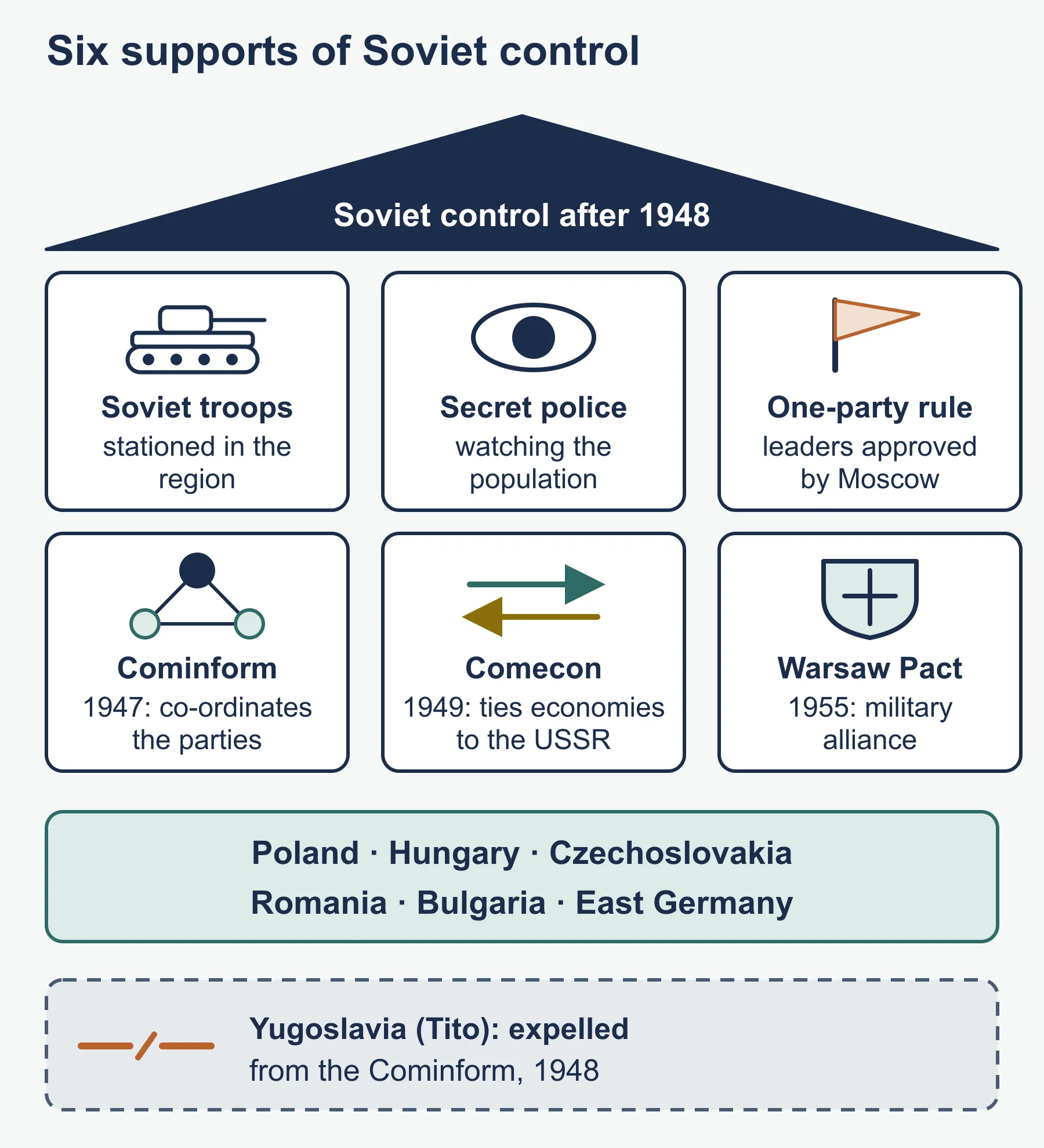
By 1948 communist parties loyal to Moscow ruled Poland, Hungary, Czechoslovakia, Romania, Bulgaria and East Germany. Control rested on several supports: Soviet troops stationed in the region; secret police forces; one-party rule with leaders approved by Moscow; the Cominform (1947) to co-ordinate communist parties; Comecon (1949) to tie economies to the USSR; and from 1955 the Warsaw Pact military alliance. Yugoslavia under Tito was expelled from the Cominform in 1948 – an early sign that not every communist state would obey.
Why was there opposition in Hungary in 1956, and how did the USSR react?
Causes. Hungarians resented the harsh rule of Mátyás Rákosi, the secret police (AVH), low living standards, the removal of food and goods to the USSR, and restrictions on the Catholic Church. Hopes rose after Khrushchev’s “Secret Speech” of February 1956 denounced Stalin, and after Polish protests that year won concessions.
Events. Student demonstrations in Budapest on 23 October 1956 grew into a national rising; Stalin’s statue was pulled down. Imre Nagy became prime minister, released political prisoners and promised free elections. On 1 November he announced Hungary would leave the Warsaw Pact and become neutral.
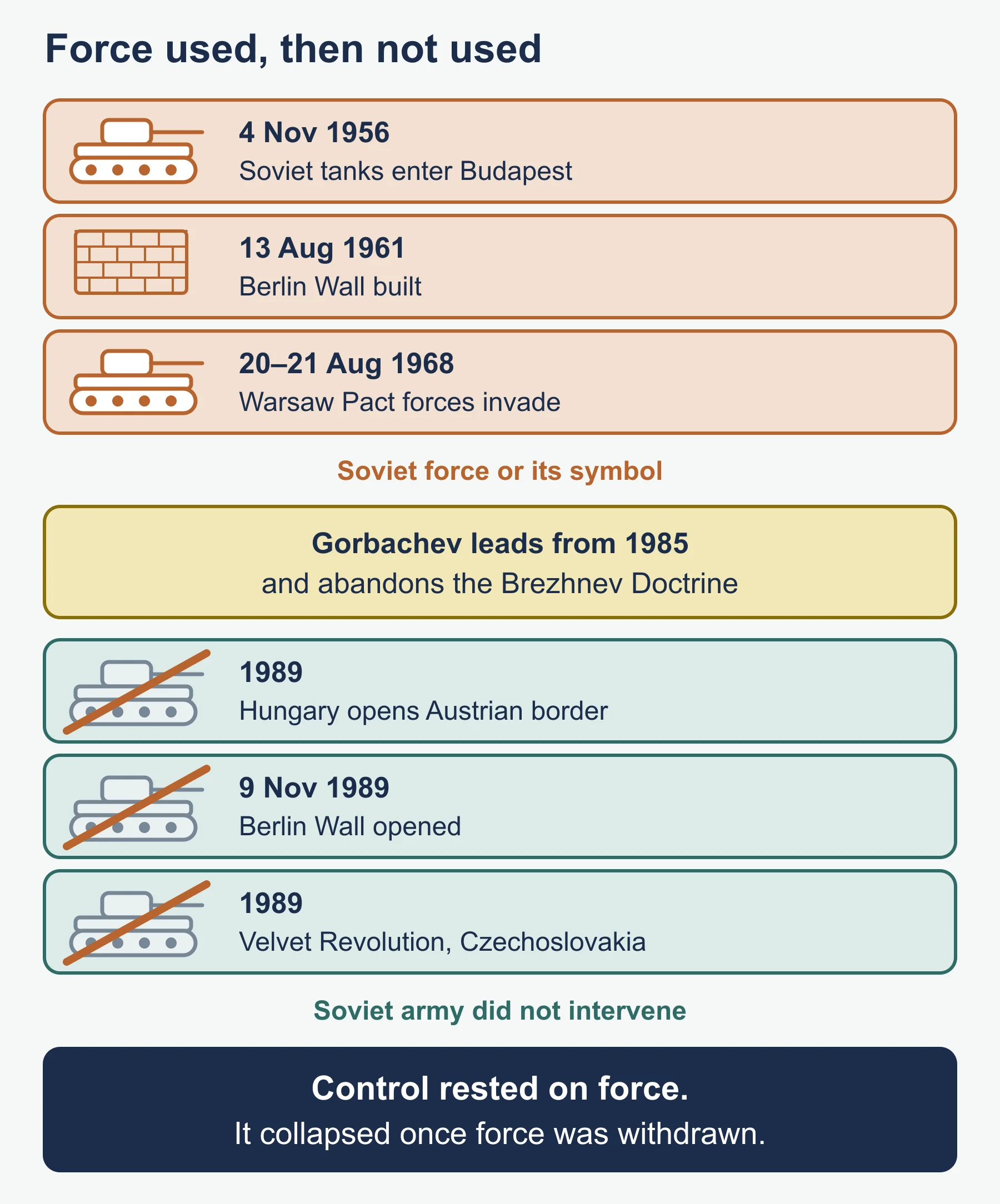
Soviet reaction. On 4 November Soviet tanks entered Budapest. Thousands of Hungarians were killed and about 200,000 fled abroad. János Kádár was installed, and Nagy was later executed (1958). The West protested but did not intervene: it was distracted by the Suez Crisis and unwilling to risk war in the Soviet sphere.
Why was there opposition in Czechoslovakia in 1968, and how did the USSR react?
Causes. Economic stagnation and resentment of censorship and Soviet dominance led reformers inside the Communist Party to elect Alexander Dubček as leader in January 1968.
Events. The Prague Spring brought “socialism with a human face”: censorship was lifted, criticism allowed and economic reform planned in the April Action Programme. Dubček insisted Czechoslovakia would stay in the Warsaw Pact.
Soviet reaction. Brezhnev and other Warsaw Pact leaders feared reform would spread. On the night of 20-21 August 1968 Warsaw Pact forces led by the USSR invaded. Czechs and Slovaks resisted mainly by non-violent means – removing road signs, arguing with soldiers. Dubček was removed in 1969. The Brezhnev Doctrine declared that the socialist states had the right to intervene where socialism was threatened.
How similar were Hungary 1956 and Czechoslovakia 1968?
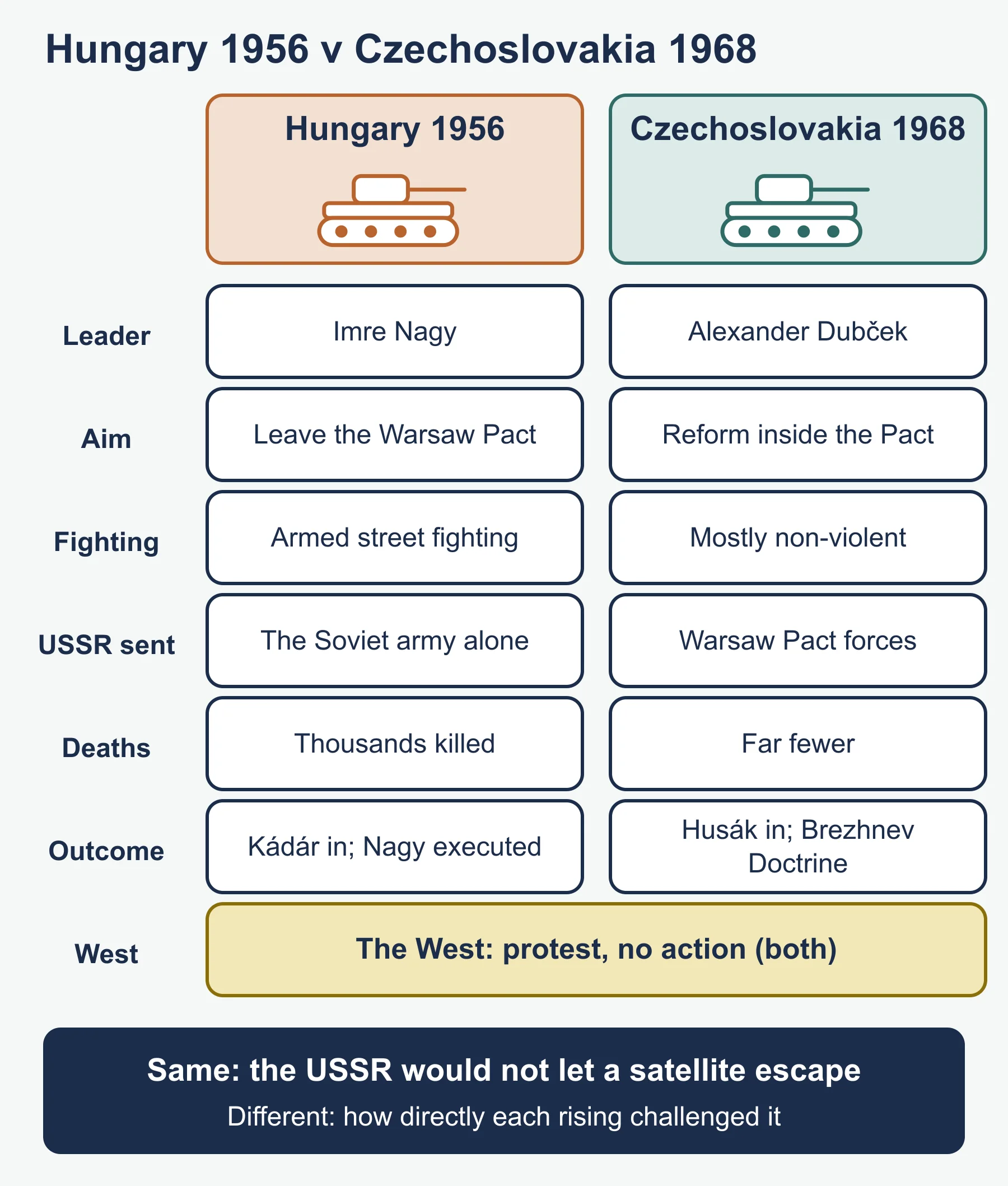
| Hungary 1956 | Czechoslovakia 1968 | |
|---|---|---|
| Leader | Imre Nagy | Alexander Dubček |
| Aim | Free elections, neutrality, leaving the Warsaw Pact | Reform communism within the Warsaw Pact |
| Resistance | Armed street fighting | Mostly passive, non-violent |
| Soviet response | Soviet army alone; heavy fighting | Warsaw Pact invasion; far fewer deaths |
| Outcome | Kádár installed; Nagy executed | Husák replaced Dubček; Brezhnev Doctrine |
| Western reaction | Protest, no action | Protest, no action |
The key similarity is that the USSR would not allow a satellite to escape its control; the key difference is how far each rising challenged that control directly.
Why was the Berlin Wall built in 1961?
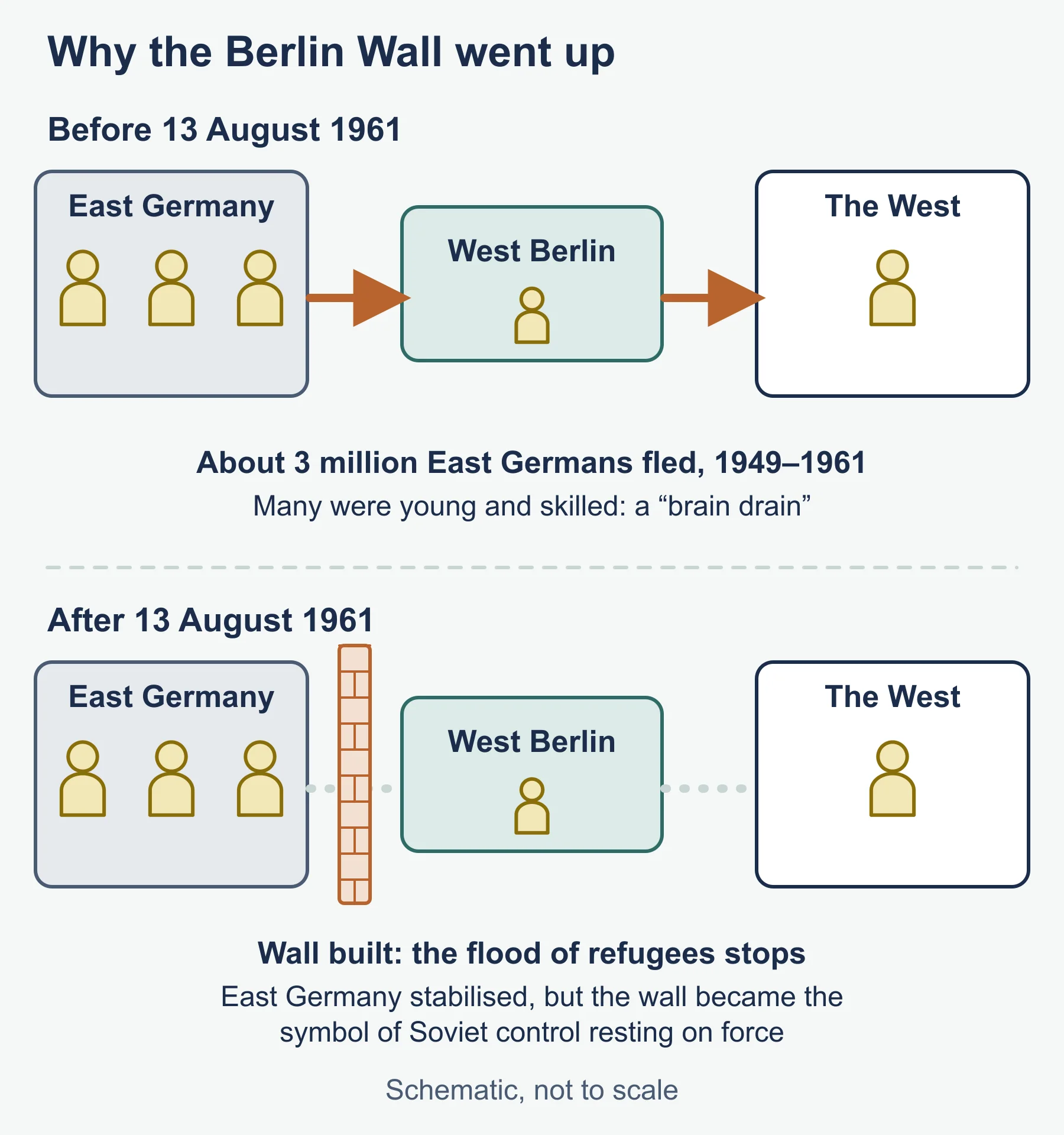
By 1961 around three million East Germans had fled to the West since 1949, many through West Berlin – a large share of them young and skilled. This “brain drain” damaged the East German economy and showed the world that people were voting with their feet against communism. After Khrushchev’s pressure on the West over Berlin failed, the East German government began building the wall on 13 August 1961. It stopped the flood of refugees and stabilised East Germany, but it became the most visible symbol of Soviet control resting on force. The USA protested but accepted the wall rather than risk war, and Kennedy visited West Berlin in June 1963.
What was the significance of Solidarity?
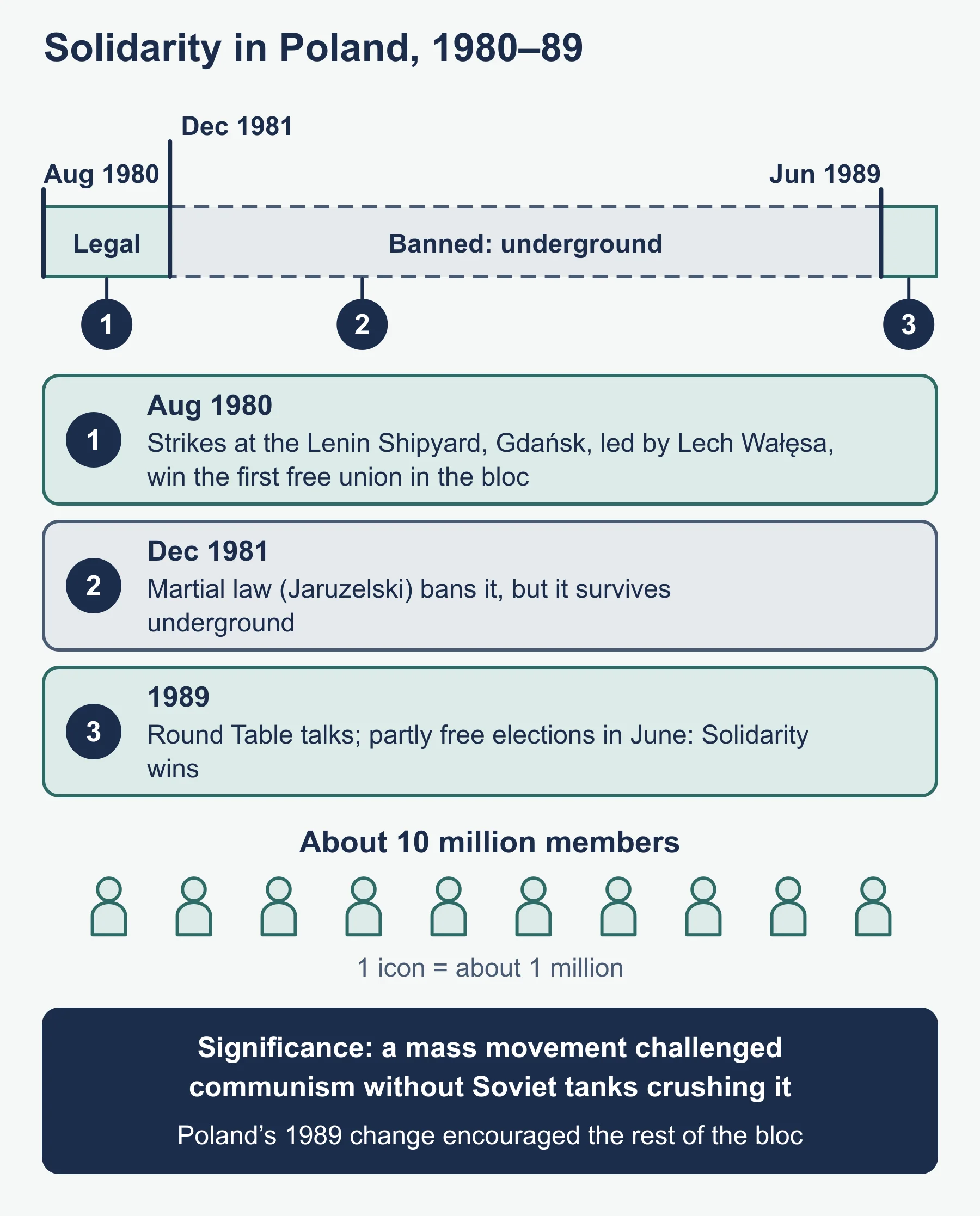
In August 1980 strikes at the Lenin Shipyard in Gdańsk, led by electrician Lech Wałęsa, won the right to form Solidarity, the first independent trade union in the Soviet bloc. It grew to around ten million members, drawing strength from Polish Catholicism and the election of a Polish pope, John Paul II, in 1978. General Jaruzelski declared martial law in December 1981, and Solidarity was banned – but it survived underground. In 1989 Round Table talks led to partly free elections in June, which Solidarity won overwhelmingly, and a Solidarity-led government was formed. Significance: it showed that a mass movement could challenge a communist government without being crushed by Soviet tanks, and Poland’s 1989 change encouraged the rest of the bloc.
How far was Gorbachev personally responsible for the collapse?
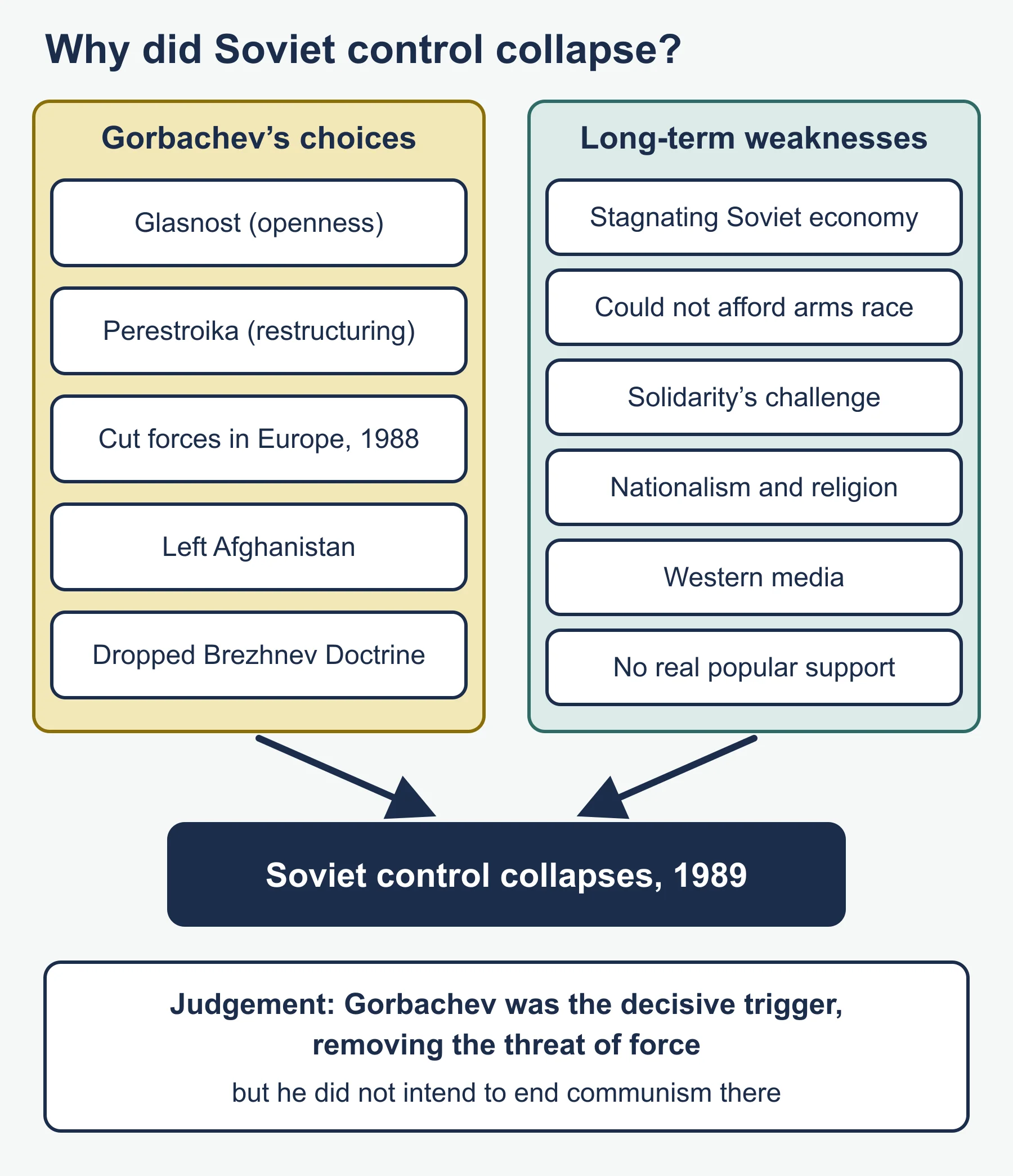
Gorbachev’s role. Leader from 1985, he introduced glasnost (openness) and perestroika (restructuring), which encouraged criticism across the bloc. He announced cuts in Soviet forces in Europe (1988), withdrew from Afghanistan, and abandoned the Brezhnev Doctrine – leaving each state to choose its own path. When Hungary opened its border with Austria in 1989, when the Berlin Wall was opened on 9 November 1989, and during the Velvet Revolution in Czechoslovakia, the Soviet army did not intervene.
Other factors. The Soviet economy was stagnating and could not afford the arms race of the 1980s or subsidies to Eastern Europe; Solidarity had already weakened communist authority in Poland; nationalism and religion kept opposition alive; Western media showed Eastern Europeans what they lacked; and the earlier repressions of 1956 and 1968 had left communism without real popular support.
Judgement. Gorbachev was the decisive trigger: control had always depended on Moscow’s willingness to use force, and he removed it. But he did not intend to end communism in Eastern Europe, and the long-term weaknesses explain why it collapsed so quickly once force was withdrawn.
Worked example: answering the (b) question
Explain why the Berlin Wall was built in 1961. [6]
A top answer explains two or three reasons, each with evidence: (1) the brain drain of skilled workers through West Berlin weakened East Germany’s economy; (2) the contrast with prosperous West Berlin embarrassed communism; (3) Khrushchev had failed to force the West out of Berlin and needed another solution. Link each reason to the decision, not just to Berlin in general.
Common mistakes
- Saying Czechoslovakia tried to leave the Warsaw Pact (it was Hungary that announced this).
- Treating Gorbachev as planning the end of communism.
- Describing Solidarity without explaining its wider significance.
- Using 1989 events without dates or names.
Frequently asked questions
Why didn’t the West help Hungary in 1956? It was divided by the Suez Crisis, and intervention inside the Soviet sphere risked nuclear war.
What was the Brezhnev Doctrine? The 1968 statement that the socialist countries could intervene in any member state where socialism was under threat.
Is “how secure” asking for a judgement? Yes. Weigh the strength shown in 1956, 1961 and 1968 against the weakness revealed by Solidarity and the speed of the 1989 collapse.
Official syllabus
Cambridge O Level History (2147) syllabus for examination in 2024, 2025 and 2026 – cambridgeinternational.org (Core content Option B, key question 6). Always check the current syllabus before an exam.
Get free revision emails (optional)
Occasional emails with practice questions, worked explanations and links to free resources for the qualification and subjects you choose. No spam, and you can unsubscribe from any email. The free tools on this site never need an email.
Related resources
-
Practice questions
O Level History: USSR Control of Eastern Europe, 1948-c.1989 — Practice Questions (Cambridge 2147)
Original Cambridge O Level History 2147 practice on USSR control of Eastern Europe: Hungary 1956, Prague Spring, Berlin Wall, Solidarity and Gorbachev.
World History · Cambridge · O Level
Try questions -
Subject guides
Cambridge O Level World History (2147): Subject Overview
An overview of Cambridge O Level History 2147: its two core options, five depth studies, two written papers and a practical way to plan the course.
World History · Cambridge · O Level
Read course guide -
Exam preparation
Cambridge O Level World History: Paper-by-Paper Exam Preparation
How to prepare for Cambridge O Level World History 2147: Paper 1 Structured Questions, Paper 2 Document Questions, weighting, timing and a worked answer.
World History · Cambridge · O Level
Read guide
Related articles
-
teaching
A Level tuition in Dubai: Cambridge or Pearson Edexcel International A Level?
Schools in Dubai and Abu Dhabi teach either Cambridge International AS & A Level or Pearson Edexcel International A Level. How the two are structured, why it matters for tuition, and how online classes from Lahore work.
9 October 2026
-
curriculum guides
Choosing subjects at IGCSE and A Level
How subject choices at 14 and 16 affect university options later, and how to keep pathways open without overloading a timetable.
28 July 2026
Studying this with a teacher
Working through World History O LEVELS?
This page is free and stays free. If you would rather be taught it, Marlbridge runs World History classes one-to-one and in small groups of up to 15, online in your own time zone. The first trial class is free. WhatsApp replies within an hour (8am–11pm Pakistan time, every day); email the same day.
Cambridge World History teachers at Marlbridge
