
Revision Notes
OxfordAQA International A-level Geography (9635): 3.2.2 Resource security – Revision Notes
Condensed OxfordAQA 9635 notes on 3.2.2: resource security, renewable and non-renewable resources, scarcity, energy mix, conflict, sustainable management and a self-test.
- Subject
- Geography
- Level
- AS LEVEL
- Topic
- Unit 2 – Human Geography 1
- Author
- Marlbridge Academic Team
- Updated
- Reviewed by
- Azam Siddique (what this means)
Aligned to OxfordAQA A Level Geography (9635), Version 3.2. Official specification .
Syllabus page (what it covers and how it is assessed): OxfordAQA A Level Geography.
Syllabus points this page covers
9635 (AS Level)
- 3.2.2 Section B: Resource security
Condensed recall for 3.2.2 Section B: Resource security (OxfordAQA International AS and A-level Geography 9635, Unit 2). There is no separate study guide for this section yet, so read it alongside the 9635 subject guide and the Global Systems and Governance study guide, whose flows and power relations recur here. These notes work from the key concepts; check the exact content list against the specification.
The specification’s sub-headings are resource development, natural resource issues, water security, energy security, resource futures and two case studies. It centres on water and energy; you may concentrate on one of them in your case studies.
Key terms
| Term | Meaning |
|---|---|
| Resource security | Reliable access to enough of a resource (such as water, energy or minerals) at an affordable price and acceptable quality for a population or country |
| Renewable | Replenished naturally on human timescales (solar, wind, water) |
| Non-renewable | Finite on those timescales (fossil fuels, minerals) |
| Energy mix | The combination of energy sources a country uses |
| Sustainable management | Using resources so supplies last for future generations |
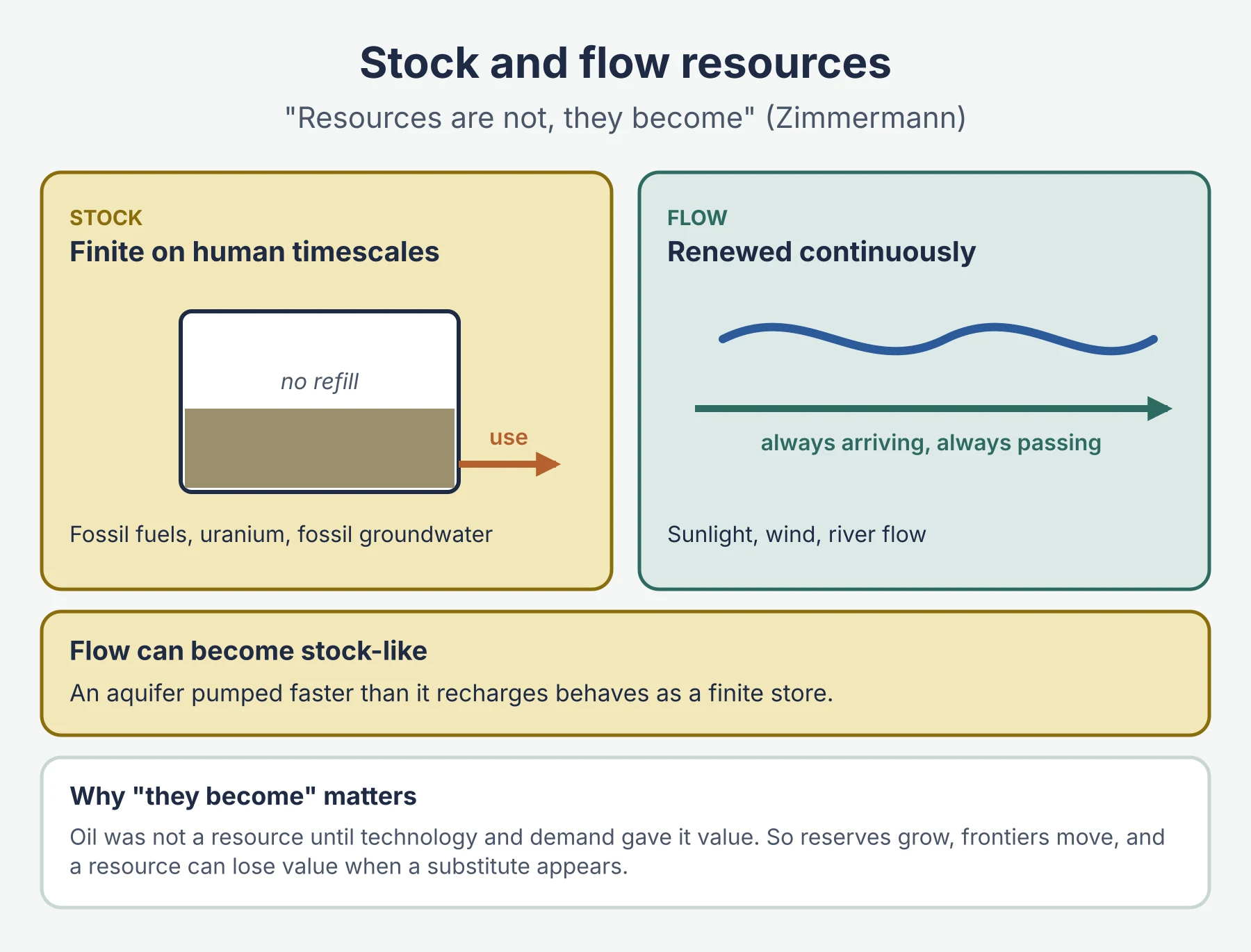
| Stock resource | A finite store that is used up as it is exploited (coal, oil, gas, uranium, fossil groundwater) |
| Flow resource | A resource renewed continuously by natural flows (sunlight, wind, river flow, tides) |
| Water stress | Demand for water approaches or exceeds the renewable supply available |
| Primary / secondary energy | Energy in its natural form (coal, crude oil, wind) / energy converted into a usable carrier (electricity, petrol) |
| Virtual water | The water used to produce a good, traded invisibly when the good is traded |
Resource development
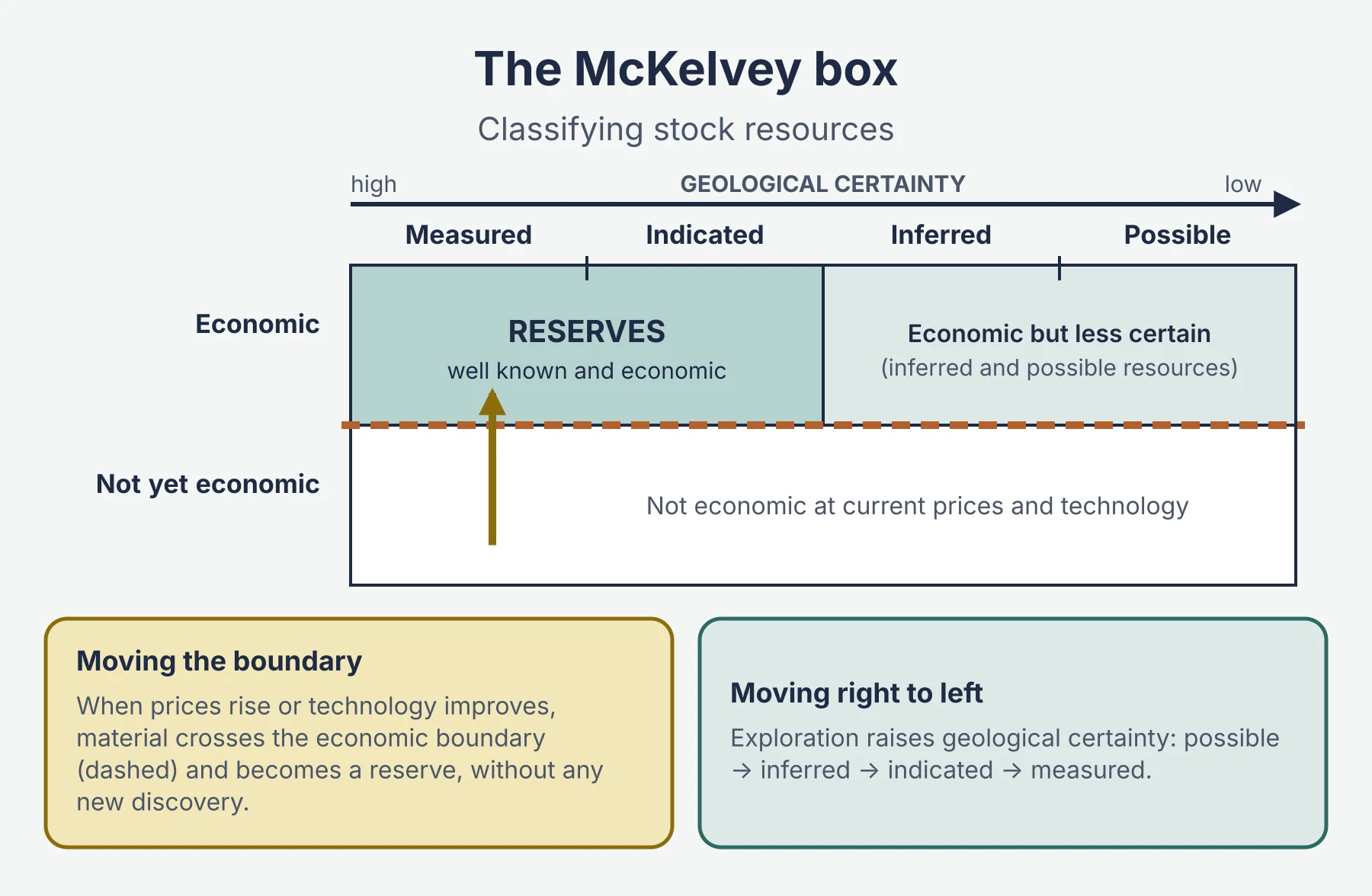
Stock resource evaluation – from most to least certain:
- Measured reserves – quantity known with confidence and economic to extract.
- Indicated reserves – estimated from more widely spaced sampling.
- Inferred resources – suggested by limited evidence, quantity uncertain.
- Possible resources – may exist from geological reasoning but are unproven.
Reserves are not fixed: higher prices and new technology turn resources into reserves.
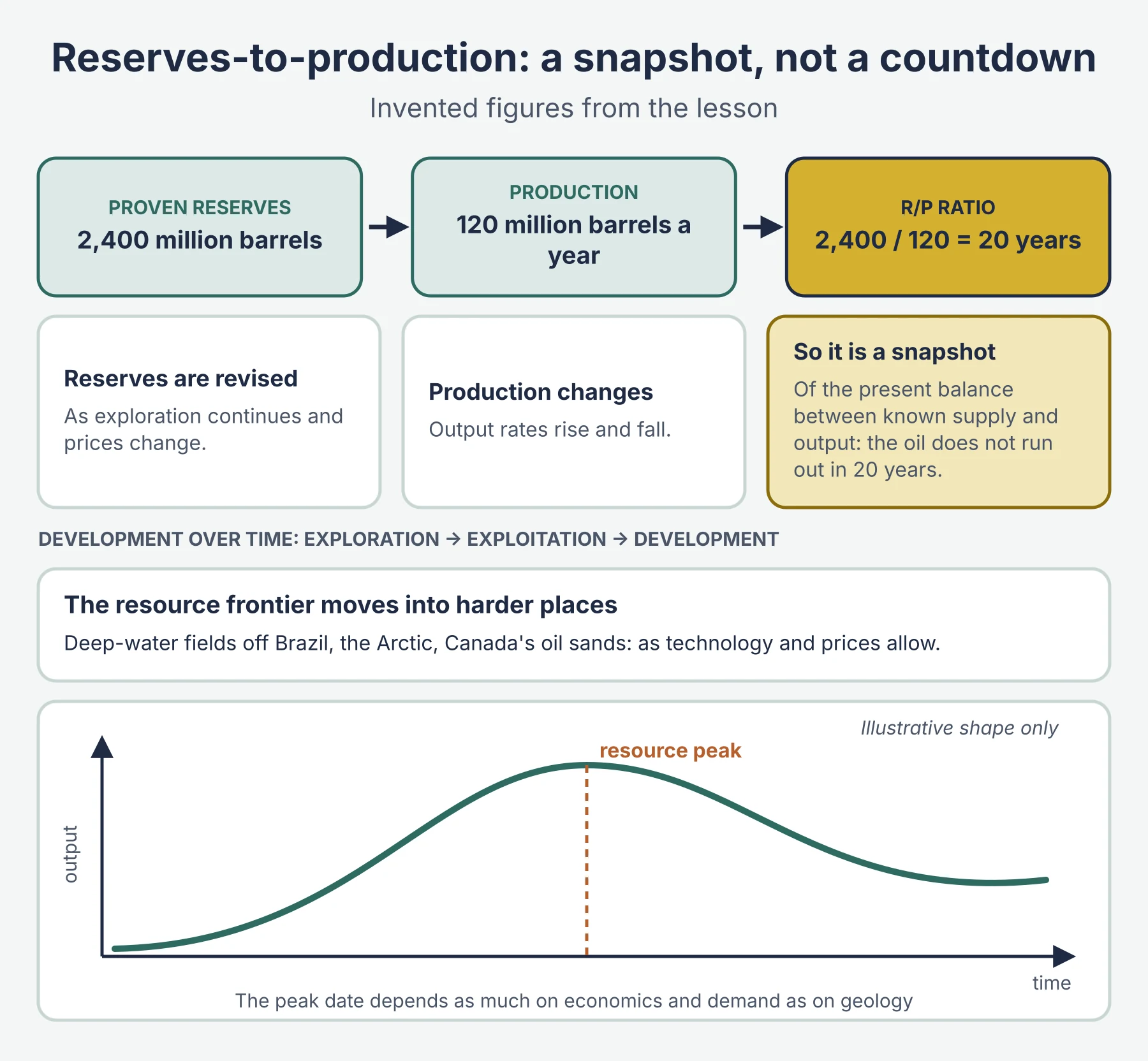
Development over time: exploration → exploitation → development. The resource frontier is the edge of current exploitation, pushed into new places (deep water, the Arctic, oil sands) as technology and prices allow. Resource peak is the point at which output of a finite resource reaches its maximum before declining, as in the idea of “peak oil”.
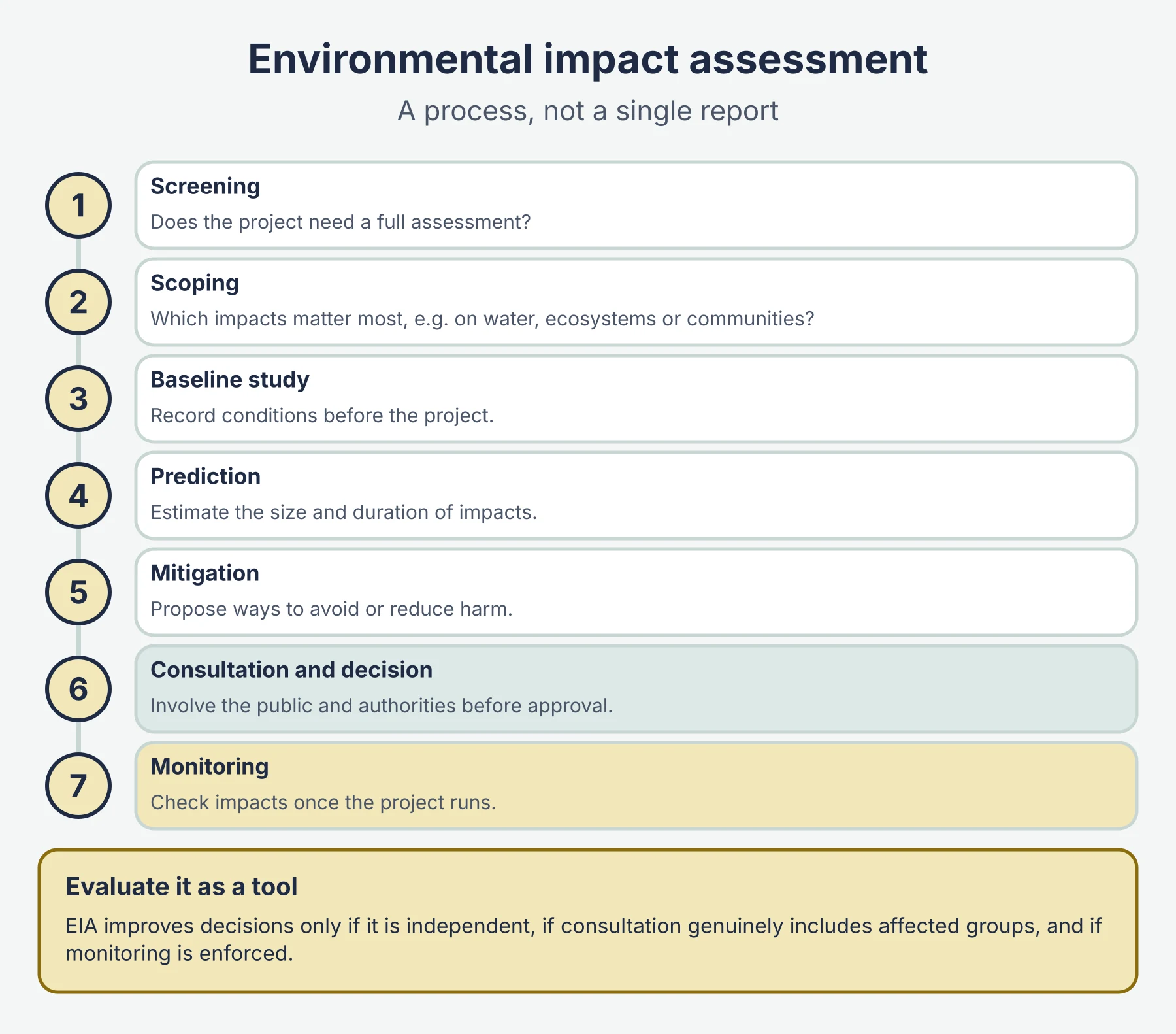
Environmental impact assessment (EIA) evaluates the likely effects of a project – on ecosystems, water, air, communities – before approval, and proposes mitigation.
Why supply and demand differ between places
Resources are unevenly distributed physically, while demand varies with population, income and development. This mismatch drives trade, dependence and geopolitical tension.
Global patterns: much oil and gas is produced in the Middle East, Russia and North America, while large consumers include China, the USA, the EU, India and Japan, so energy moves through pipelines and shipping routes. Water availability is high in humid tropical and temperate regions and low in arid regions such as the Middle East and North Africa, where demand from irrigation and growing cities causes stress.
Water, energy, minerals
- Water: physical scarcity means not enough water to meet demand; economic scarcity means water exists but people lack the investment or infrastructure to use it.
- Energy: a diverse energy mix reduces dependence on one fuel or supplier and so improves energy security.
- Minerals: finite and unevenly distributed, so supply can depend on a few producers.
Water security
- Sources: surface water (rivers, lakes, reservoirs), groundwater (aquifers), desalinated water and recycled water.
- Components of demand: agriculture (usually the largest user worldwide, mainly irrigation), industry and domestic use.
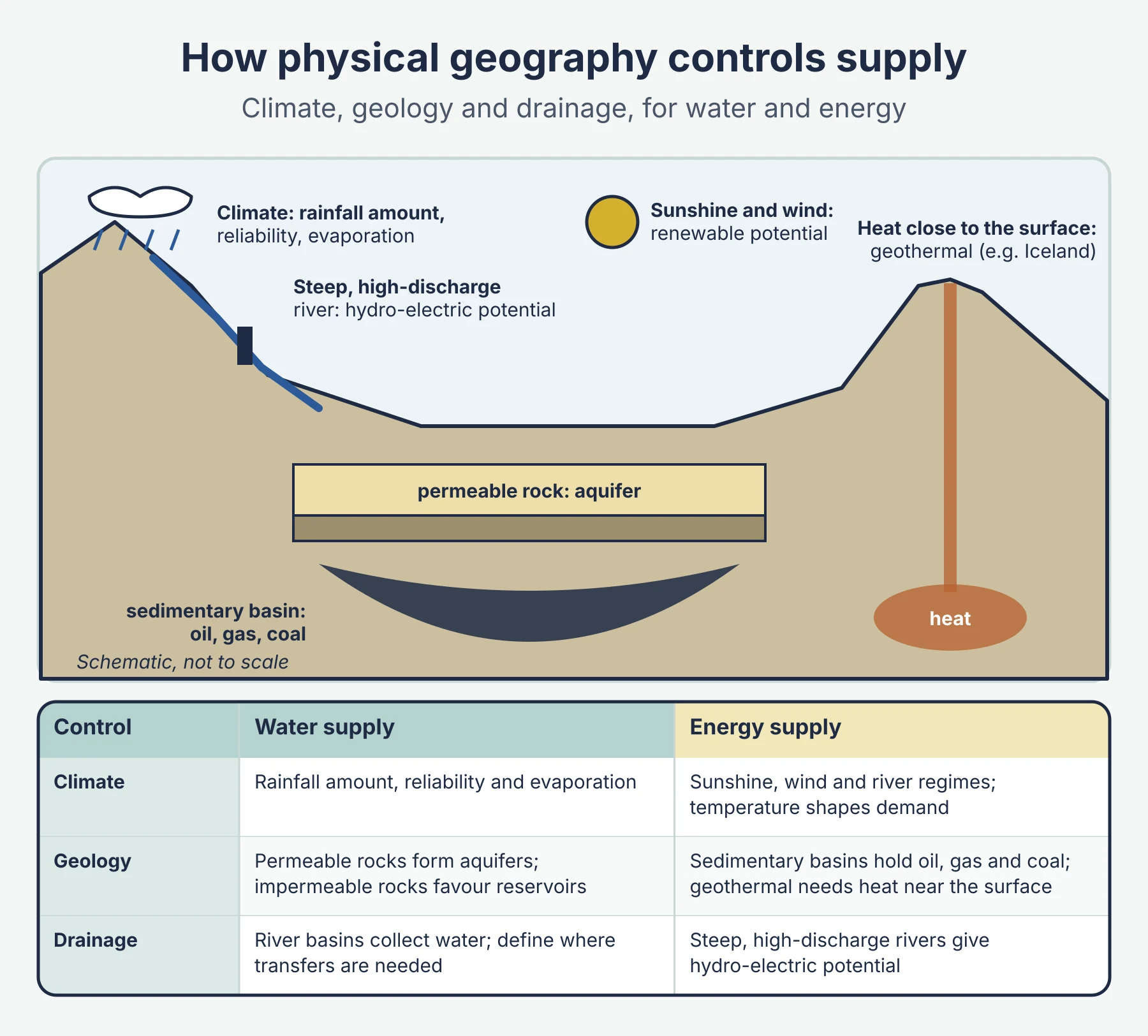
- Physical controls on supply: climate (rainfall amount and reliability, evaporation), geology (permeable rocks store groundwater; impermeable rocks favour surface reservoirs) and drainage (river networks and basins determine where water collects).
Increasing supply: catchment protection, river diversion, storage in reservoirs, water transfers between basins and desalination.
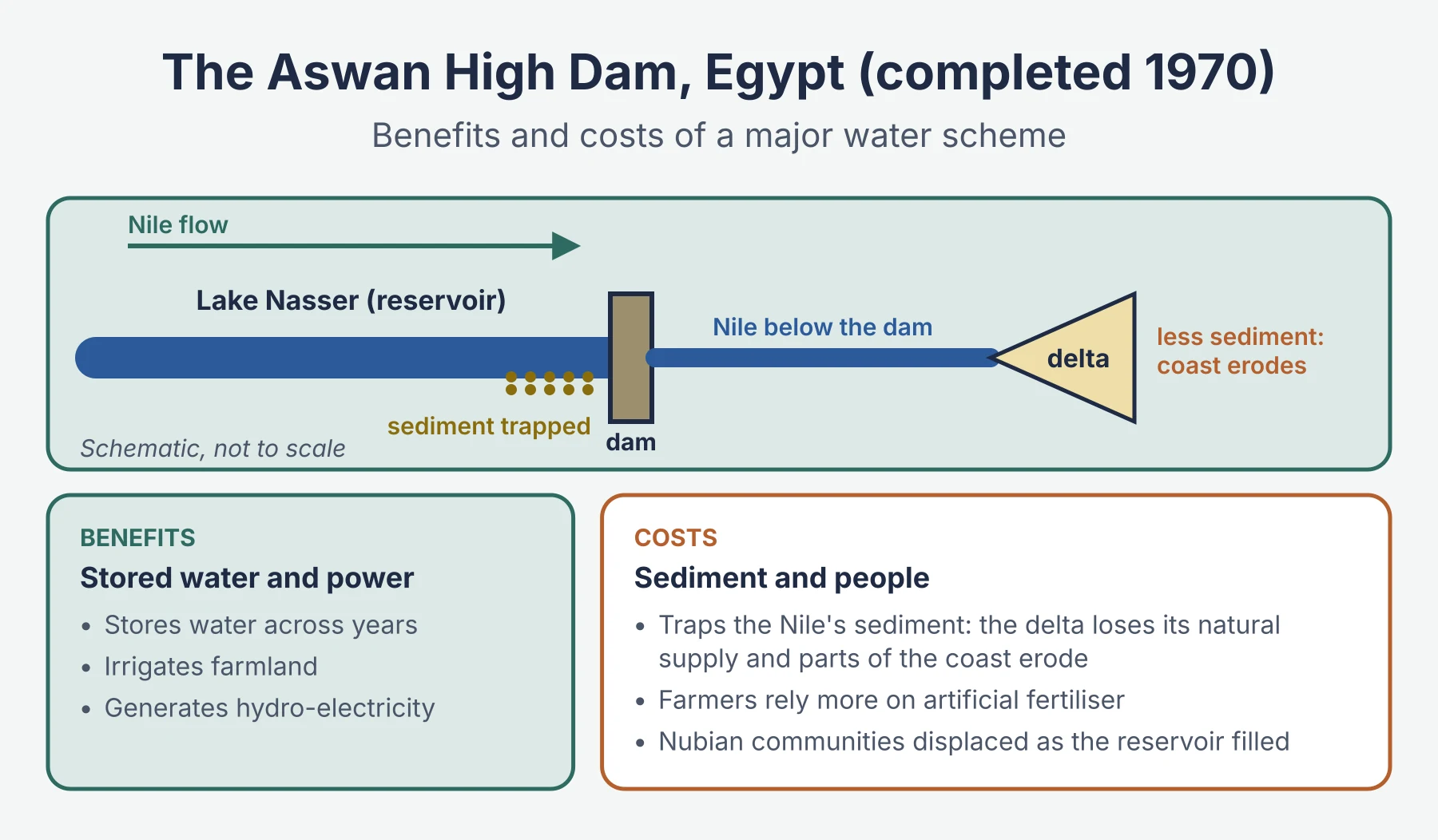
Example of a major scheme – the Three Gorges Dam, Yangtze, China: the world’s largest power station by installed capacity and a major flood-control and storage scheme. Environmental impacts: flooding of the valley and displacement of over a million people, trapped sediment, changes to river ecology and fisheries, and slope instability around the reservoir.
Managing consumption: metering and pricing, efficient irrigation (drip systems), fixing leaks, water-saving appliances, public campaigns.
Sustainability issues: virtual water trade (water-scarce countries import water-intensive food instead of growing it), conservation, recycling, grey water reuse (household wastewater from sinks and showers reused for toilets or gardens), and groundwater management to stop aquifers being drawn down faster than they recharge.
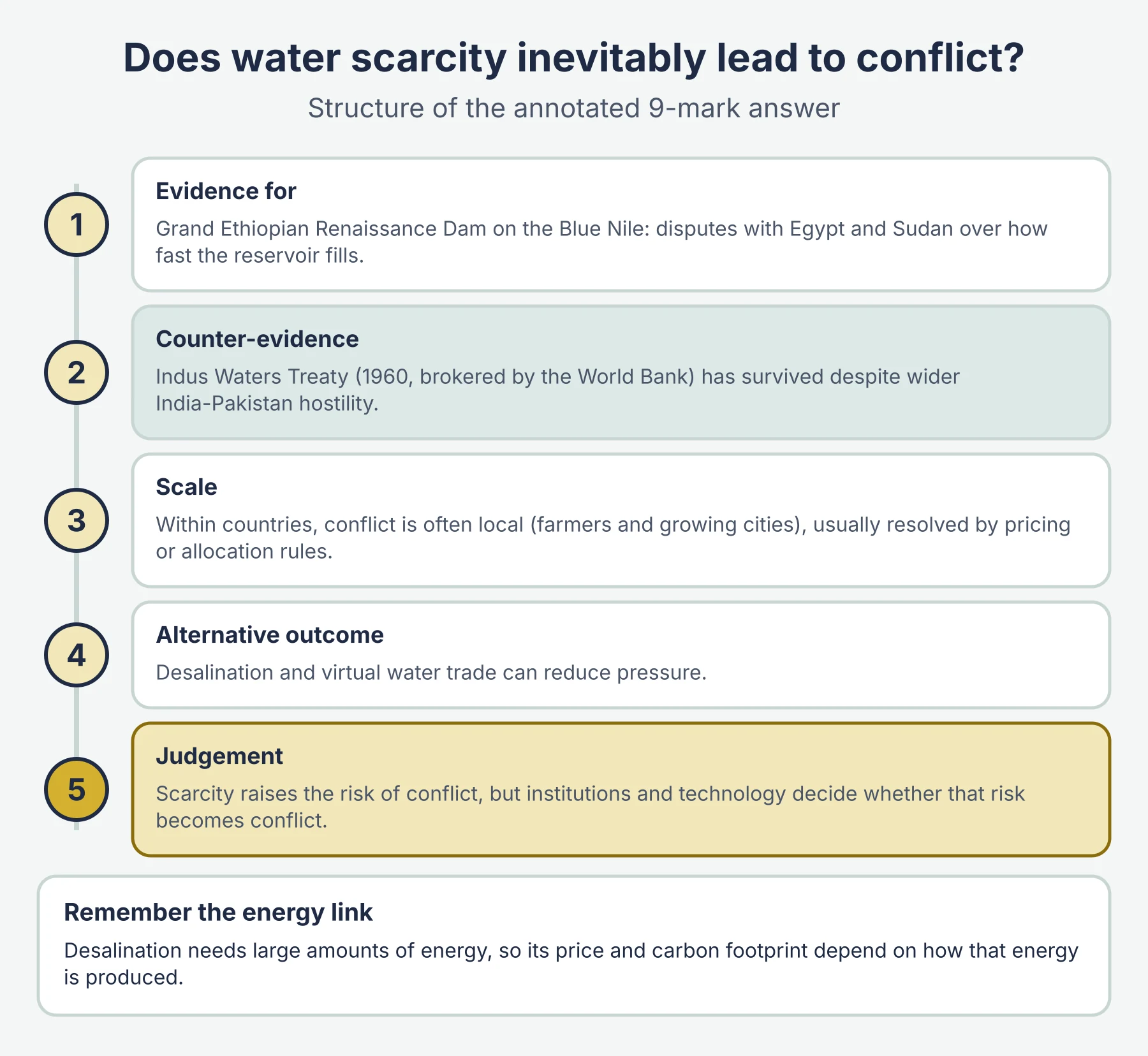
Water conflict at different scales: local (farmers versus cities over irrigation water), national (upstream and downstream states within a country) and international – for example the Grand Ethiopian Renaissance Dam on the Blue Nile, which has caused long-running tension between Ethiopia, Sudan and Egypt over how quickly the reservoir is filled.
Energy security
- Energy mixes differ: France relies heavily on nuclear power for electricity; Norway on hydro-electric power; many Gulf states on oil and gas; China has depended largely on coal while expanding renewables rapidly.
- Physical controls: geology decides where fossil fuels and uranium occur; climate affects solar and wind potential and heating demand; drainage and relief decide hydro-electric potential.
- Globalising world: competing national interests and transnational corporations (oil majors and state energy companies) control production, refining and distribution. Supply can be used as political leverage: Russia’s cuts to gas supplies to Europe after its 2022 invasion of Ukraine forced European states to find new suppliers, including liquefied natural gas by ship.
- Environmental impacts of a major development: oil, coal or gas fields cause land disturbance, habitat loss, water pollution and spills along pipelines and shipping routes – the Deepwater Horizon blowout in the Gulf of Mexico in 2010 is a well-documented example.
- Increasing supply: oil and gas exploration, nuclear power, renewable sources.
- Managing consumption: insulation, efficient appliances and vehicles, public transport, pricing and taxes.
- Sustainability issues: acid rain, the enhanced greenhouse effect, nuclear waste, energy conservation.
Insecurity and conflict
Competition for scarce or shared resources, dependence on imports and control by a few producers can create tension between and within states. Evaluate with named examples; do not assume scarcity always causes conflict, since cooperation and trade can also follow.
Managing resources sustainably
- Efficiency, recycling, substitution and demand management, alongside increased supply.
- Trade-offs: extraction and supply bring economic benefits and jobs, but may carry environmental damage and social costs. Weigh costs against benefits and reach a judgement.
Resource futures and the water-energy link
Alternative futures depend on technology (cheaper renewables, storage, efficient desalination), economics (prices, investment), environment (climate change altering rainfall and demand) and politics (agreements, conflict). Desalination shows the link between energy and water: it supplies water in arid coastal states such as Saudi Arabia, the UAE and Israel, but needs large amounts of energy, so its cost and carbon footprint depend on the energy source – which is why solar-powered desalination is being developed.
Answer structure
Claim → named example → consequence → balance (for whom, in the short and long term). Show both outcomes where the evidence allows.
Exam traps
- Treating “renewable” as “unlimited” or “always sustainable”.
- Confusing physical scarcity with economic scarcity.
- Assuming resource-rich countries are always secure.
- Generic points about “energy” with no named place.
- Describing costs and benefits without a final judgement.
- Treating reserves as fixed: they change with price and technology.
Self-test
- Define resource security.
- Distinguish renewable from non-renewable resources.
- What is the difference between physical and economic water scarcity?
- How does a diverse energy mix improve energy security?
- Name two ways to manage resources sustainably.
- Distinguish a stock resource from a flow resource.
- Why can measured reserves increase without any new discovery?
- What is the resource frontier?
- What is virtual water, and how can trade in it help a water-scarce country?
- Give two environmental impacts of a major dam scheme.
- Why is desalination an example of the link between energy and water security?
- Give one example of a resource being used as political leverage.
Answers: 1. Reliable access to enough of a resource at an affordable price and acceptable quality. 2. Renewable resources are replenished on human timescales; non-renewable are finite on those timescales. 3. Physical: not enough water; economic: water exists but cannot be used for lack of investment or infrastructure. 4. It reduces dependence on one fuel or supplier. 5. For example efficiency and recycling. 6. A stock resource is finite and used up; a flow resource is renewed continuously by natural flows. 7. Higher prices or new technology make known resources economic to extract. 8. The edge of current exploitation, extended into new areas as technology and prices allow. 9. The water used to produce goods; importing water-intensive food saves domestic water. 10. For example flooding of land and displacement of people, and trapped sediment. 11. It provides water but needs large amounts of energy, so its cost depends on energy supply. 12. For example Russia cutting gas supplies to Europe after 2022.
More resources on this topic
Related resources
-
Practice questions
OxfordAQA A Level Geography: Globalisation and Global Systems — Practice Questions
Original exam-style practice questions with full worked answers on the dimensions and drivers of globalisation, and global economic, political, social and environmental interdependence.
Geography · OxfordAQA · AS Level
Try questions -
Revision notes
OxfordAQA A Level Geography: Globalisation and Global Systems — Revision Notes
Condensed recall notes on the dimensions and drivers of globalisation, and global economic, political, social and environmental interdependence, for OxfordAQA International A-Level Geography (9635), sub-topics 3.2.1.1 and 3.2.1.2.
Geography · OxfordAQA · AS Level
Revise topic -
Study guides
OxfordAQA A-Level Geography: Globalisation and Global Systems (9635)
The dimensions and drivers of globalisation, and the form and consequences of global economic, political, social and environmental interdependence – 3.2.1.1 and 3.2.1.2 of OxfordAQA International AS and A-Level Geography (9635).
Geography · OxfordAQA · AS Level
Read guide
Studying Geography?
This page is free and stays free. Marlbridge is not offering Geography classes at the moment, so there is no tuition to book for it. The free study resources stay open to everyone.
Get free revision emails (optional)
Occasional emails with practice questions, worked explanations and links to free resources for the qualification and subjects you choose. No spam, and you can unsubscribe from any email. The free tools on this site never need an email.