
Revision Notes
OxfordAQA International A-level Psychology (9685): 3.2.2 Cognitive Development – Revision Notes
Condensed OxfordAQA 9685 cognitive development notes: Piaget's mechanisms and stages, key tasks, Baillargeon, Vygotsky, theory of mind and a self-test.
- Subject
- Psychology
- Level
- AS LEVEL
- Topic
- Unit 2 – Biopsychology, Development and Research Methods 1
- Author
- Marlbridge Academic Team
- Updated
- Reviewed by
- Kanwal Aslam (what this means)
Aligned to OxfordAQA A Level Psychology (9685), Version 3.1. Official specification .
Syllabus page (what it covers and how it is assessed): OxfordAQA A Level Psychology.
Syllabus points this page covers
9685 (AS Level)
- 3.2.2 Cognitive development
Condensed recall for 3.2.2 Cognitive development (OxfordAQA International AS and A-level Psychology 9685, Unit 2, Section B). For explanation, evaluation and a worked answer, read the cognitive development study guide; then try the cognitive development practice questions.
What the specification lists
- Piaget’s theory: schemas, assimilation, accommodation, equilibration, stages of intellectual development; object permanence, conservation, egocentrism and class inclusion.
- Baillargeon’s violation of expectation research.
- Vygotsky’s theory, including the zone of proximal development and scaffolding.
- Social cognition: theory of mind and the Sally-Anne studies; the role of the mirror neuron system.
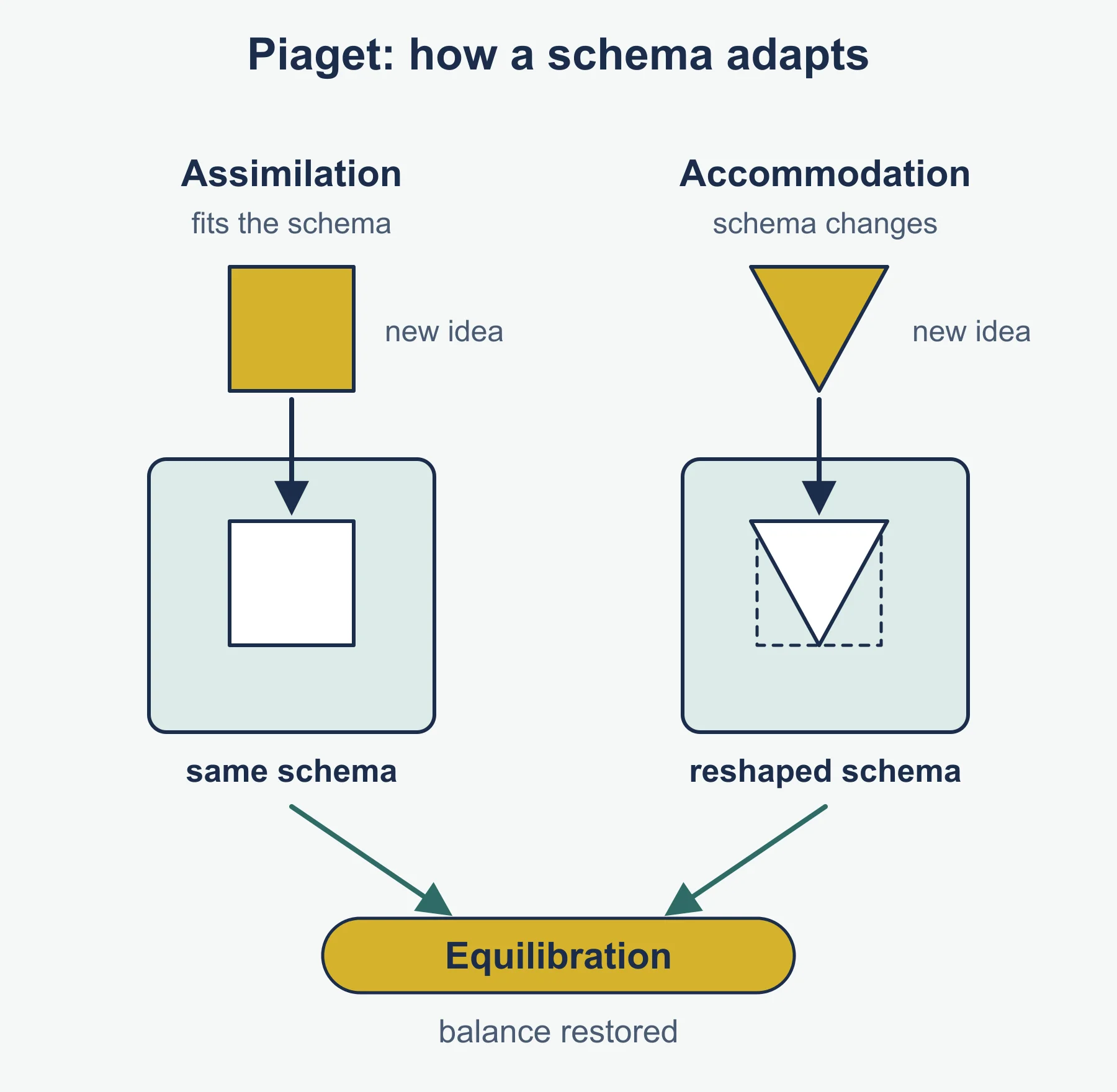
Piaget’s mechanisms
| Term | Meaning | Example |
|---|---|---|
| Schema | Mental structure for an object, action or idea | A “dog” schema |
| Assimilation | Fitting new information into an existing schema | Calling a fox a dog |
| Accommodation | Changing or creating a schema to fit new information | Forming a separate “fox” schema |
| Equilibration | Drive to restore balance after disequilibrium | Discomfort when the fox is not a dog motivates accommodation |
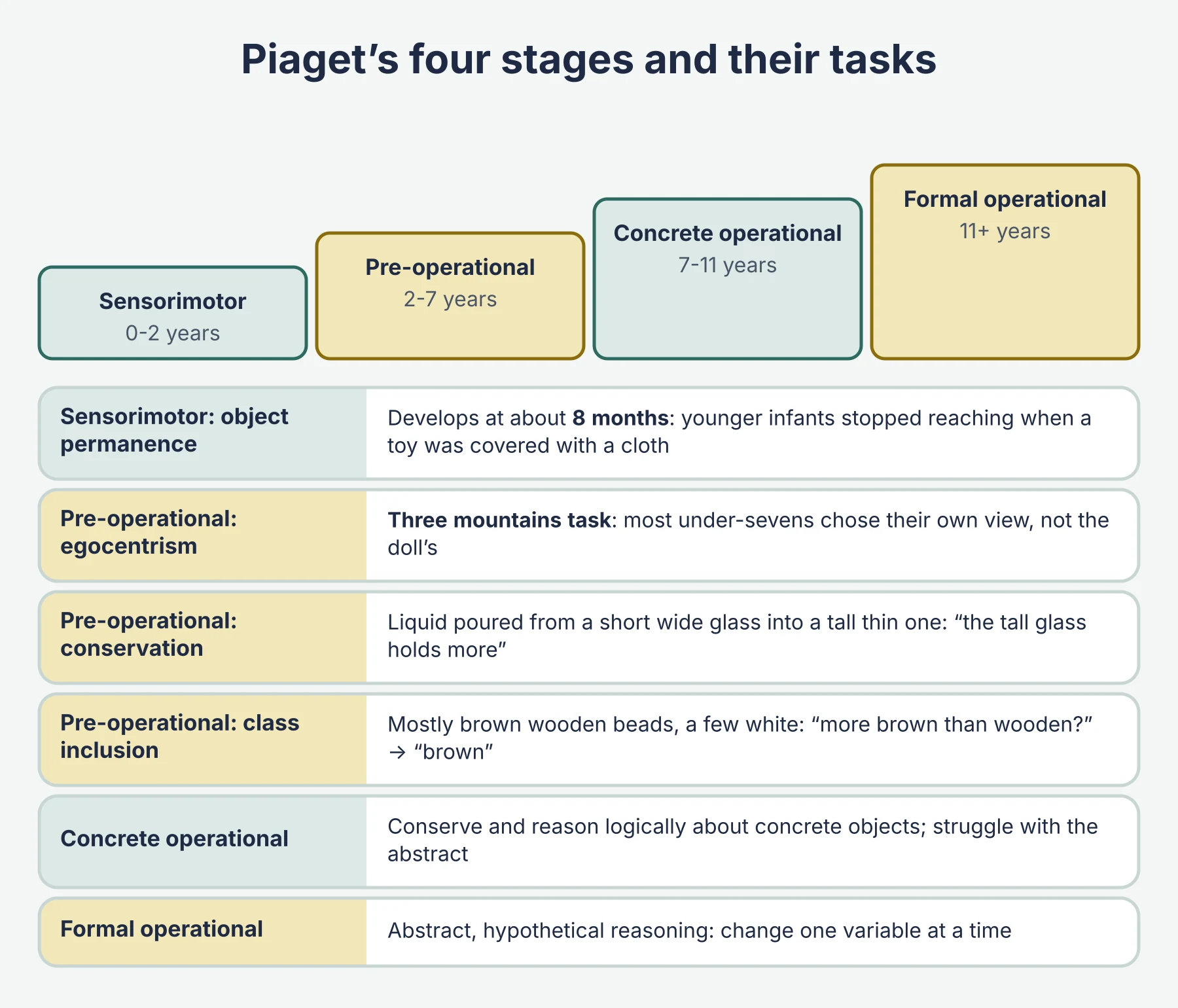
Piaget’s stages
| Stage | Age | Key features | Classic task |
|---|---|---|---|
| Sensorimotor | 0-2 | Learning through senses and actions; object permanence at about 8 months | Toy hidden under a cloth |
| Pre-operational | 2-7 | Symbols and language; egocentrism; no conservation; class inclusion errors | Three mountains; liquid conservation; brown and white beads |
| Concrete operational | 7-11 | Conservation; logic applied to concrete objects | Passes conservation tasks |
| Formal operational | 11+ | Abstract and hypothetical reasoning | Systematic problem solving |
Challenges to Piaget
| Study | Finding | Implication |
|---|---|---|
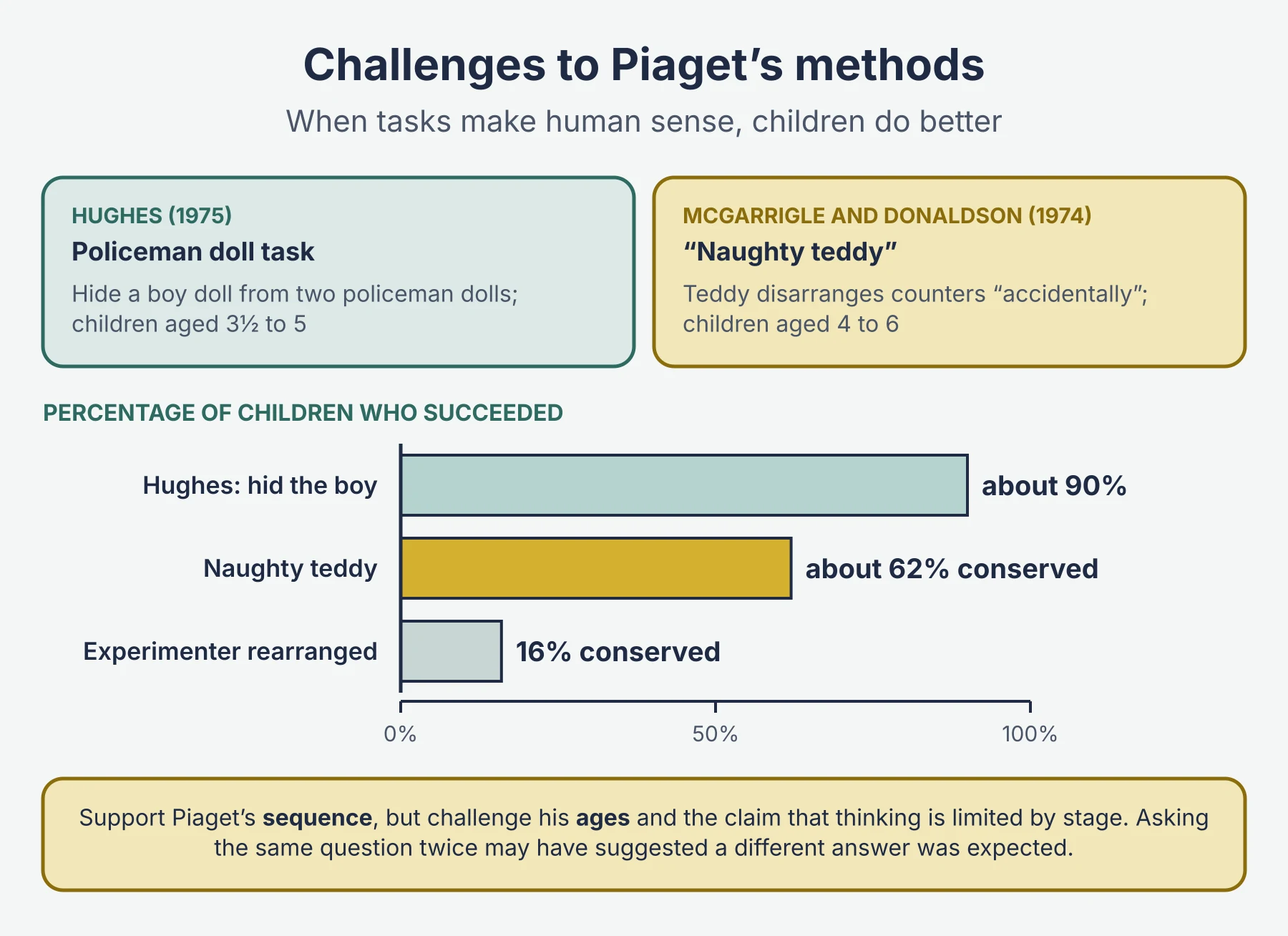
| Hughes (1975), policeman doll | About 90% of 3.5- to 5-year-olds hid the boy correctly | Egocentrism declines earlier when tasks make sense |
| McGarrigle and Donaldson (1974), naughty teddy | About 62% conserved with accidental change, 16% with deliberate change | Piaget’s method may have misled children |
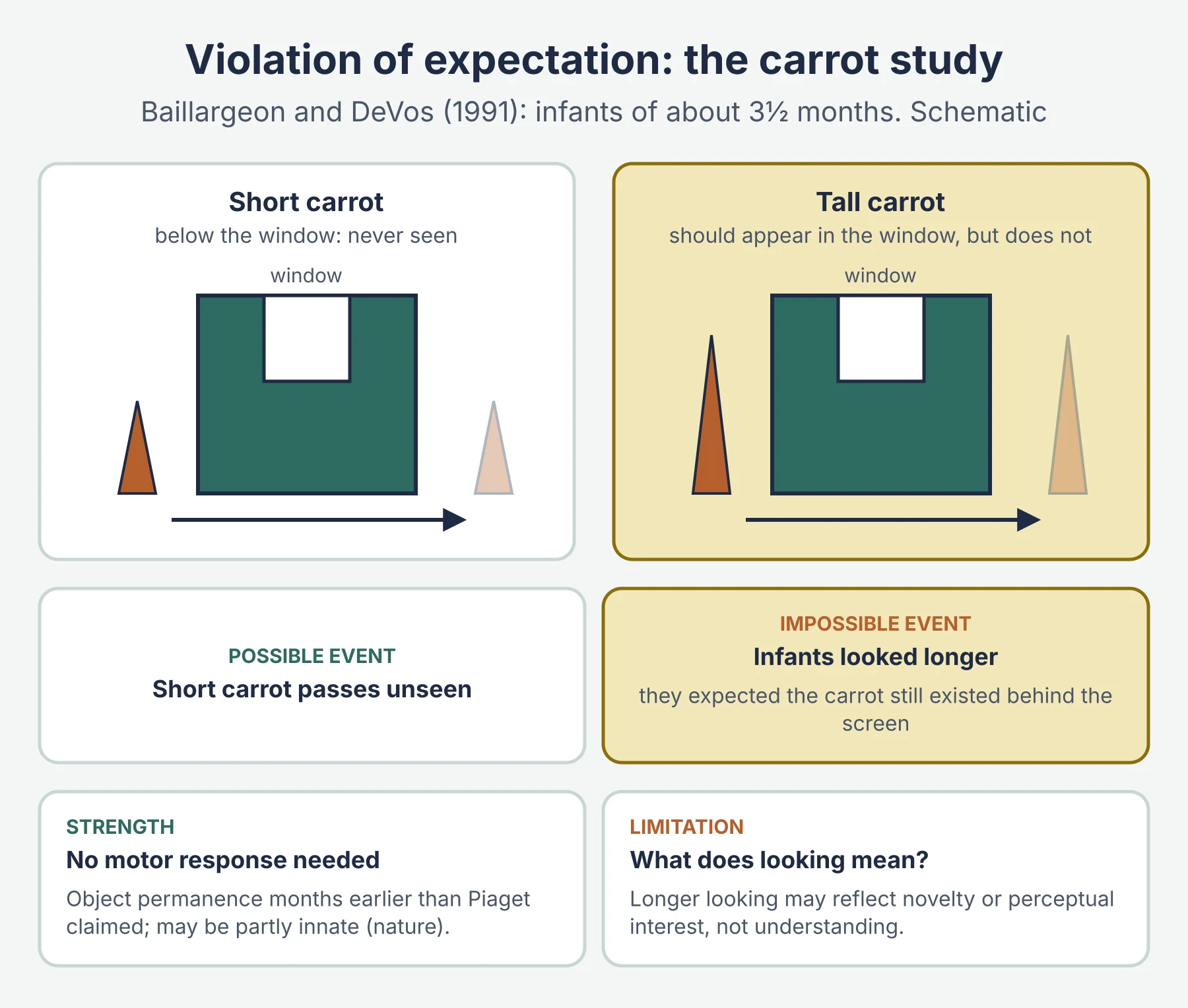
| Baillargeon and DeVos (1991), carrots | Infants of about 3.5 months looked longer at the impossible event | Object permanence earlier than Piaget claimed |
Vygotsky
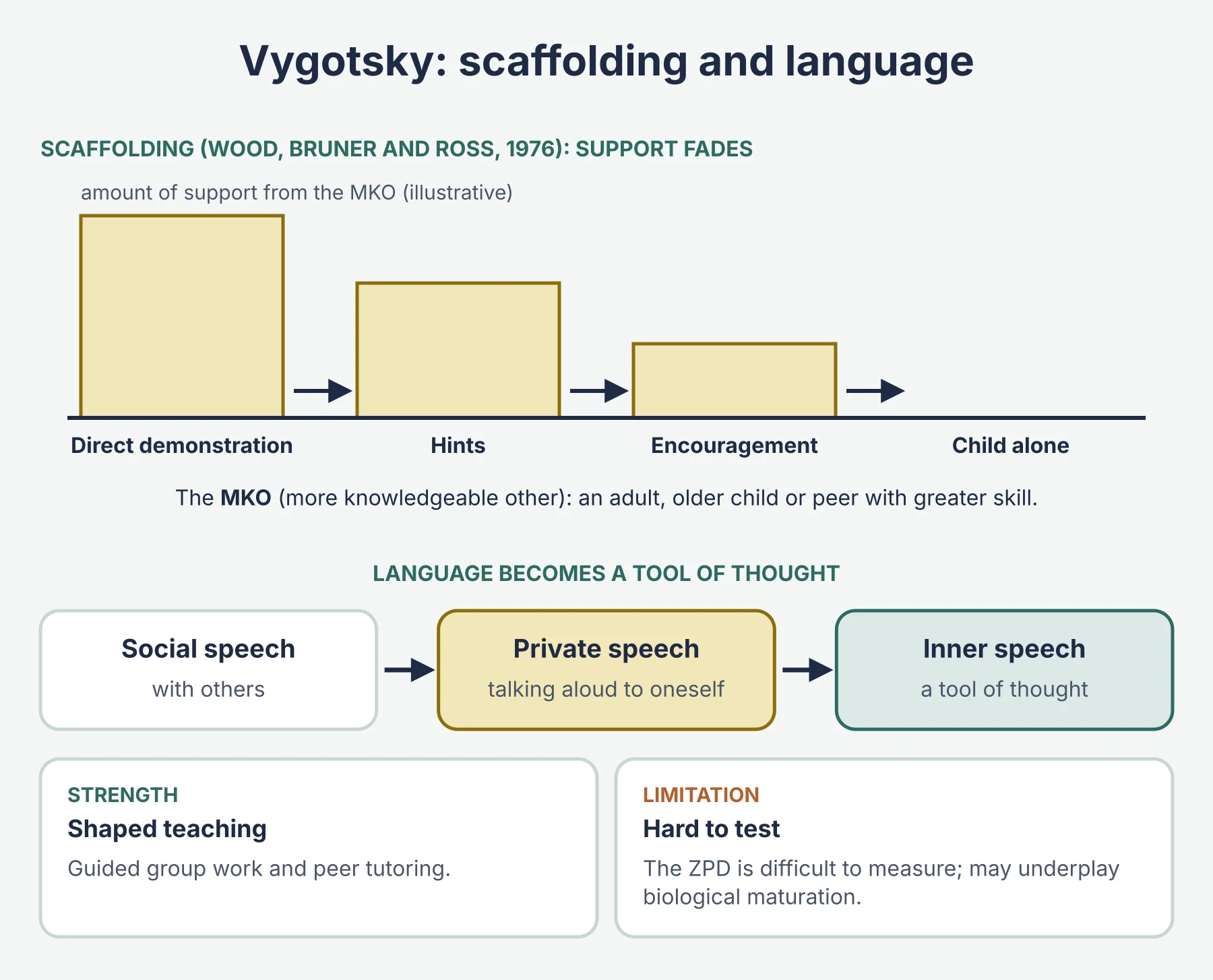
- Elementary mental functions develop into higher mental functions through social interaction and cultural tools, especially language.
- More knowledgeable other (MKO): anyone with greater skill who guides learning.
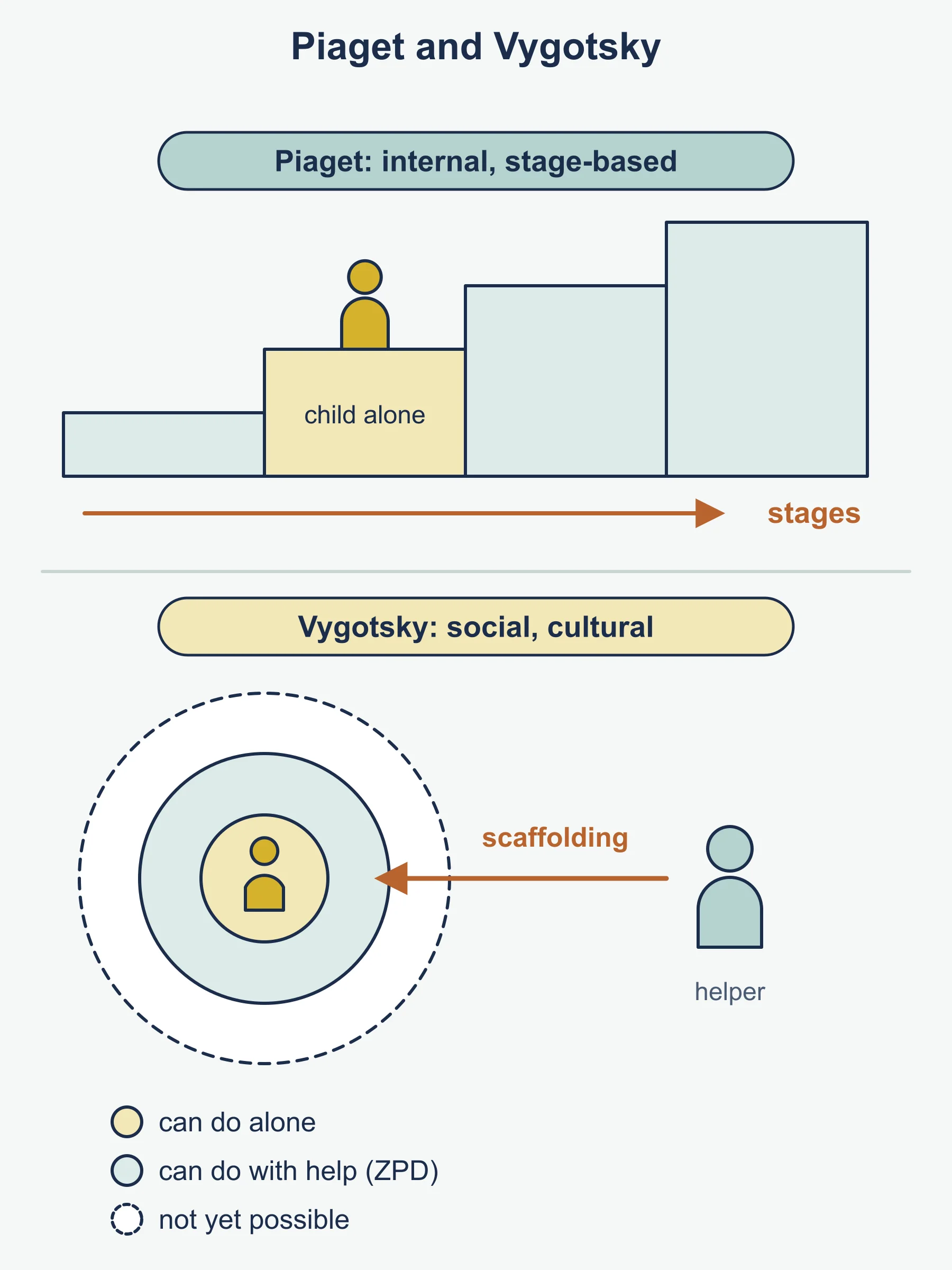
- Zone of proximal development (ZPD): the gap between what a child can do alone and with help.
- Scaffolding (Wood, Bruner and Ross, 1976): support within the ZPD, gradually withdrawn.
- Speech: social speech to private speech to inner speech.
Piaget versus Vygotsky
| Piaget | Vygotsky | |
|---|---|---|
| Child as | Lone scientist | Apprentice |
| Driver of development | Maturation and interaction with objects | Social interaction and culture |
| Stages | Universal, fixed sequence | No fixed stages |
| Language | Product of thought | Tool that shapes thought |
| Teaching implication | Discovery learning, readiness | Guided learning, scaffolding |
Social cognition
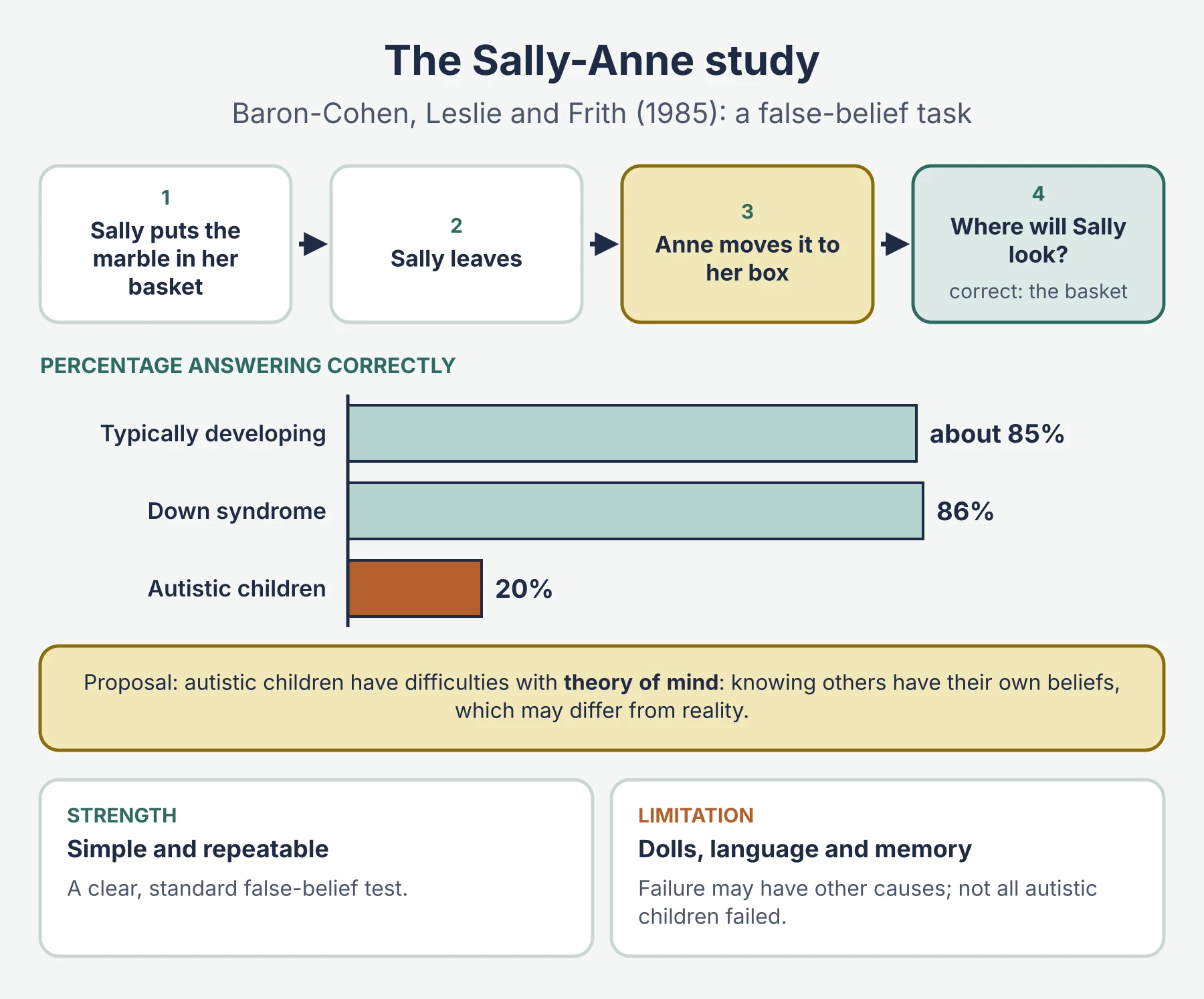
- Theory of mind: understanding that others have beliefs and intentions that may differ from one’s own and from reality. Most children pass false-belief tasks at around age four (Wimmer and Perner, 1983).
- Sally-Anne (Baron-Cohen, Leslie and Frith, 1985): about 85% of typically developing children and 86% of children with Down syndrome passed; about 20% of autistic children passed.
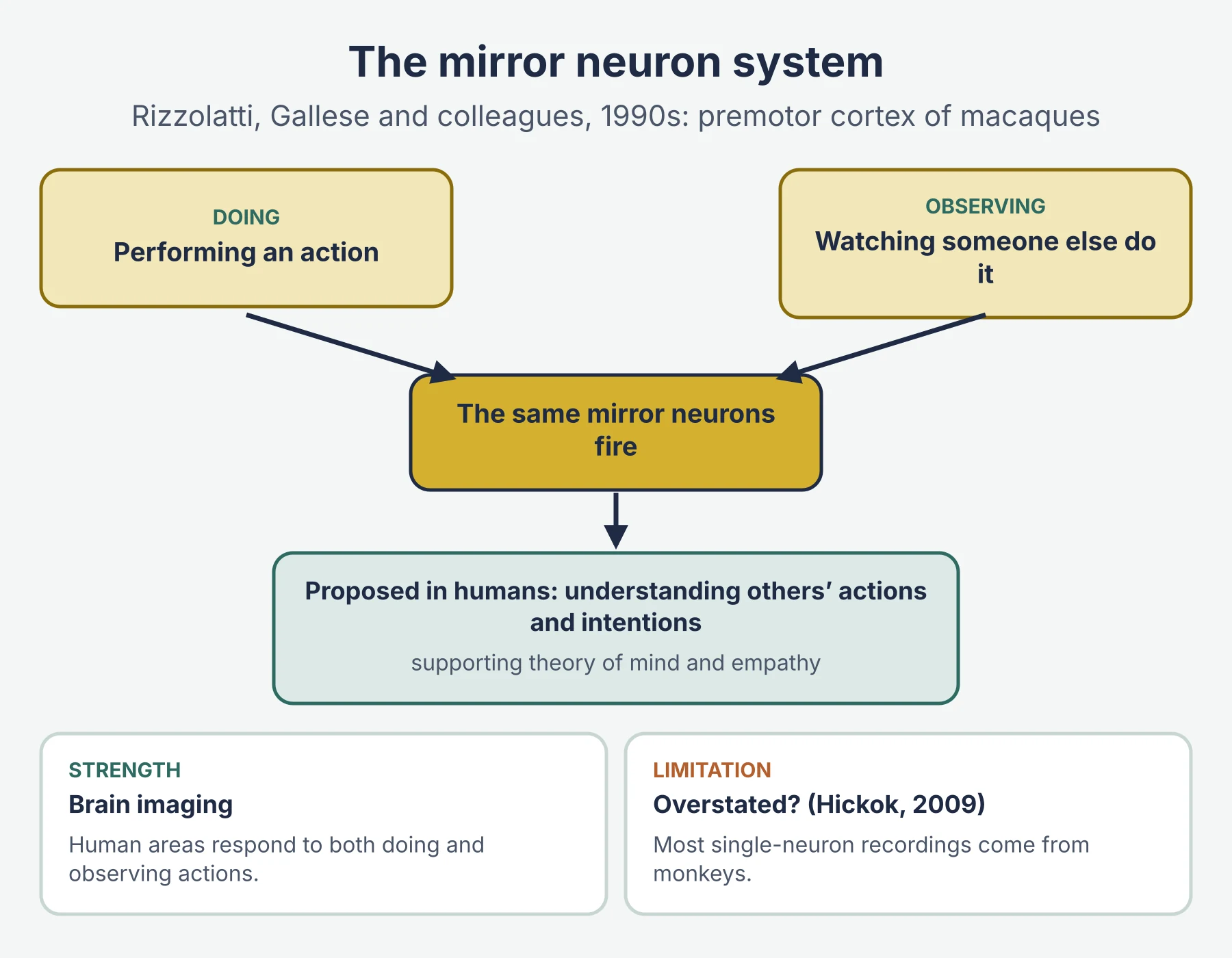
- Mirror neurons: fire both when acting and when observing the same action; first identified in macaque premotor cortex (Rizzolatti, Gallese and colleagues, 1990s); proposed to support understanding intentions.
Key terms
| Term | Meaning |
|---|---|
| Object permanence | Knowing objects exist when out of sight |
| Egocentrism | Seeing the world only from one’s own viewpoint |
| Conservation | Understanding quantity stays the same despite changes in appearance |
| Class inclusion | Understanding that a class can include subclasses |
| Violation of expectation | Measuring looking time at possible and impossible events |
| False belief | A belief that does not match reality |
Evaluation points
- Piaget: hugely influential; sequence broadly supported; ages underestimated; tasks sometimes confusing; small, often middle-class samples.
- Baillargeon: avoids motor demands; looking time may reflect novelty rather than understanding.
- Vygotsky: shaped teaching practice; ZPD hard to measure; may underplay biology.
- Sally-Anne: simple and replicable; uses dolls; failure may reflect language or memory demands; not all autistic children failed.
- Mirror neurons: human evidence mostly indirect; Hickok (2009) argues their role is overstated.
Exam traps
- Swapping assimilation and accommodation.
- Giving stage ages with no characteristics.
- Saying Baillargeon “proved” infants understand objects.
- Treating the ZPD and scaffolding as the same thing.
- Reporting the Sally-Anne study without the three groups.
- Claiming mirror neurons have been directly recorded in many humans.
Self-test
- Define equilibration.
- What is the difference between assimilation and accommodation?
- At what age did Piaget say object permanence develops?
- Describe the three mountains task.
- What did McGarrigle and Donaldson (1974) find?
- What is the logic of the violation of expectation method?
- What is the zone of proximal development?
- Who introduced the term scaffolding?
- Give one difference between Piaget’s and Vygotsky’s views of language.
- What percentage of autistic children passed the Sally-Anne task?
- What is a mirror neuron?
- Give one limitation of the Sally-Anne study.
Answers: 1. The drive to restore balance between existing schemas and new information. 2. Assimilation fits information into an existing schema; accommodation changes the schema. 3. About 8 months. 4. Children chose a picture of a model of three mountains showing what a doll would see from another position; young children chose their own view. 5. About 62% of children conserved when a naughty teddy changed the row accidentally, against 16% when the experimenter did. 6. If infants look longer at an impossible event, they are assumed to have expected something different. 7. The gap between what a child can do alone and with help from an MKO. 8. Wood, Bruner and Ross (1976). 9. Piaget saw language as a product of thought; Vygotsky saw it as a tool that shapes thought. 10. About 20%. 11. A neuron that fires both when an individual acts and when it observes the same action. 12. It uses dolls rather than real people (or it may require language and memory skills, or not all autistic children failed).
More resources on this topic
Related resources
-
Study guides
OxfordAQA International A-level Psychology (9685): 3.2.3 Research Methods 1
Study guide to OxfordAQA 9685 section 3.2.3 Research methods 1: methods, designs, variables, sampling, ethics, descriptive statistics and a worked study design.
Psychology · OxfordAQA · AS Level
Read guide -
Practice questions
OxfordAQA International A-level Psychology (9685): 3.2.3 Research Methods 1 – Practice Questions
Twelve original OxfordAQA 9685 research methods 1 questions: methods, designs, variables, descriptive statistics, observation and study design, with answers.
Psychology · OxfordAQA · AS Level
Try questions -
Revision notes
OxfordAQA International A-level Psychology (9685): 3.2.3 Research Methods 1 – Revision Notes
Condensed OxfordAQA 9685 research methods 1 notes: methods, designs, sampling, variables, ethics, descriptive statistics, distributions and a self-test.
Psychology · OxfordAQA · AS Level
Revise topic
Studying Psychology?
This page is free and stays free. Marlbridge is not offering Psychology classes at the moment, so there is no tuition to book for it. The free study resources stay open to everyone.
Get free revision emails (optional)
Occasional emails with practice questions, worked explanations and links to free resources for the qualification and subjects you choose. No spam, and you can unsubscribe from any email. The free tools on this site never need an email.