
Study Guides
OxfordAQA International A-level Psychology (9685): 3.2.2 Cognitive Development
Study guide to OxfordAQA 9685 section 3.2.2 Cognitive development: Piaget's stages and tasks, Baillargeon, Vygotsky, theory of mind and mirror neurons.
- Subject
- Psychology
- Level
- AS LEVEL
- Topic
- Unit 2 – Biopsychology, Development and Research Methods 1
- Author
- Marlbridge Academic Team
- Updated
- Reviewed by
- Kanwal Aslam (what this means)
Aligned to OxfordAQA A Level Psychology (9685), Version 3.1. Official specification .
Syllabus page (what it covers and how it is assessed): OxfordAQA A Level Psychology.
Syllabus points this page covers
9685 (AS Level)
- 3.2.2 Cognitive development
This guide covers 3.2.2 Cognitive development of the OxfordAQA International AS and A-level Psychology (9685) specification, Version 3.1. It is Section B of the Unit 2 exam: 30 marks of compulsory questions within a 1 hour 30 minute, 90-mark paper. The specification lists four areas: Piaget’s theory (schemas, assimilation, accommodation, equilibration and the stages of intellectual development, with object permanence, conservation, egocentrism and class inclusion); Baillargeon’s violation of expectation research; Vygotsky’s theory, including the zone of proximal development and scaffolding; and social cognition – theory of mind, the Sally-Anne studies and the role of the mirror neuron system.
The Unit 2 study guide summarises each theory. This guide adds the classic tasks, the studies that challenged them and the evaluation needed for extended answers. Condense it with the cognitive development revision notes and test yourself with the cognitive development practice questions.
Piaget’s theory: the mechanisms
Piaget saw children as active learners who construct understanding through interaction with the world.
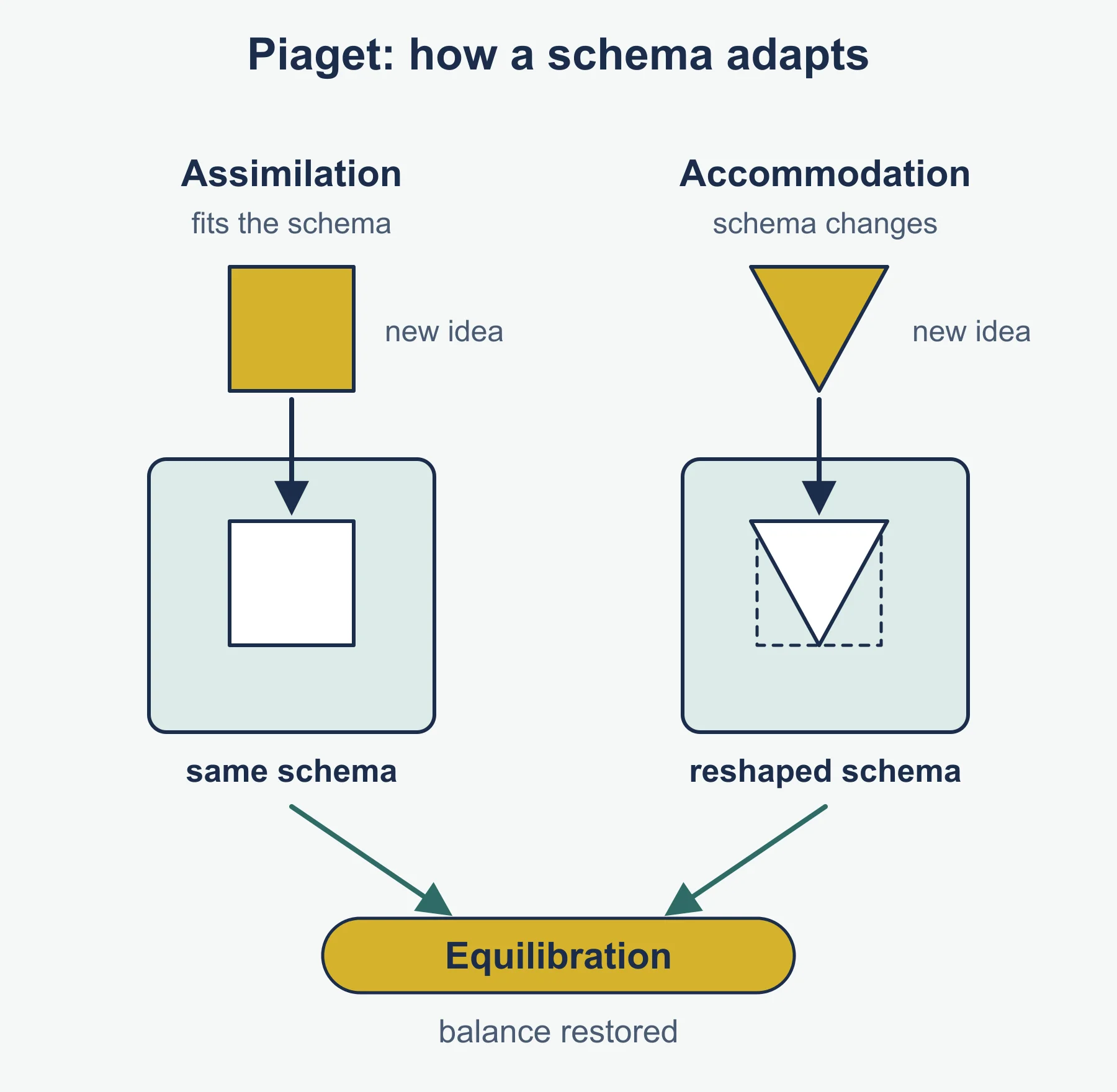
- Schemas are mental structures representing knowledge about an object, action or idea. A baby has a schema for grasping; an older child has a schema for “dog”.
- Assimilation fits new information into an existing schema: a child who knows dogs calls a fox a “dog”.
- Accommodation changes a schema, or creates a new one, when information does not fit: told the fox is not a dog, the child forms a separate schema.
- Equilibration is the drive towards balance. New information that does not fit creates disequilibrium, an uncomfortable state that motivates accommodation until balance is restored.
Piaget’s stages and the tasks behind them
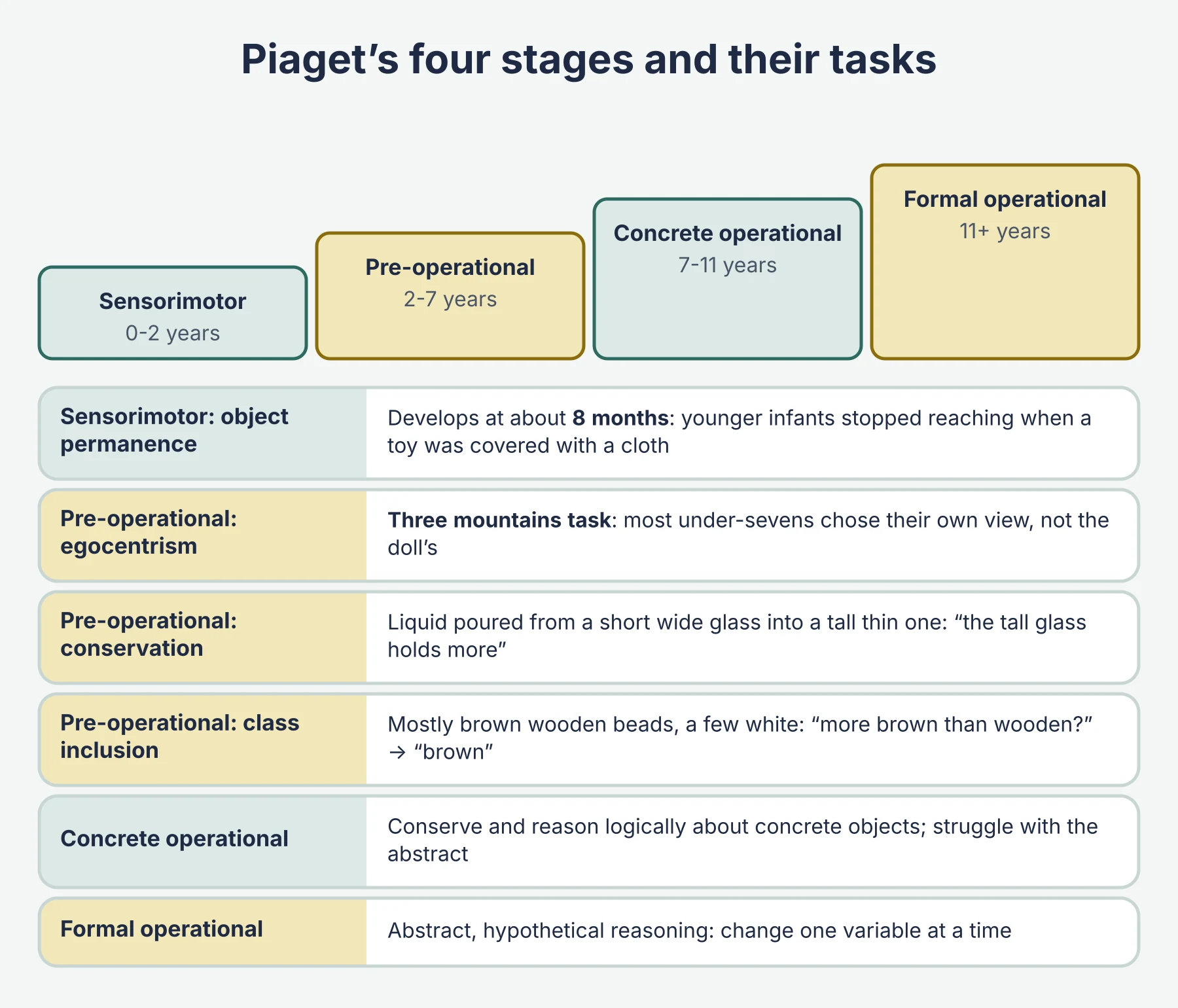
Sensorimotor (0-2 years). Infants learn through senses and actions. Object permanence – understanding that objects continue to exist when out of sight – develops at around 8 months: Piaget found younger infants stopped reaching for a toy when it was covered with a cloth.
Pre-operational (2-7 years). Children use symbols and language but lack logical operations.
- Egocentrism: in the three mountains task (Piaget and Inhelder, 1956), children were asked to choose a picture showing what a doll would see from another position around a model of three mountains. Most children under seven chose their own view.
- Conservation: children do not understand that quantity stays the same when appearance changes. When liquid is poured from a short wide glass into a tall thin one, they say the tall glass holds more.
- Class inclusion: children struggle to understand that a class can contain subclasses. Shown a set of beads, most brown and a few white, and asked whether there are more brown beads or more wooden beads, they answer “brown”, focusing on the subclass.
Concrete operational (7-11 years). Children conserve and reason logically about concrete objects, but struggle with abstract or hypothetical ideas.
Formal operational (11 and over). Abstract and hypothetical reasoning becomes possible, such as solving problems systematically by changing one variable at a time.
Challenges to Piaget’s methods
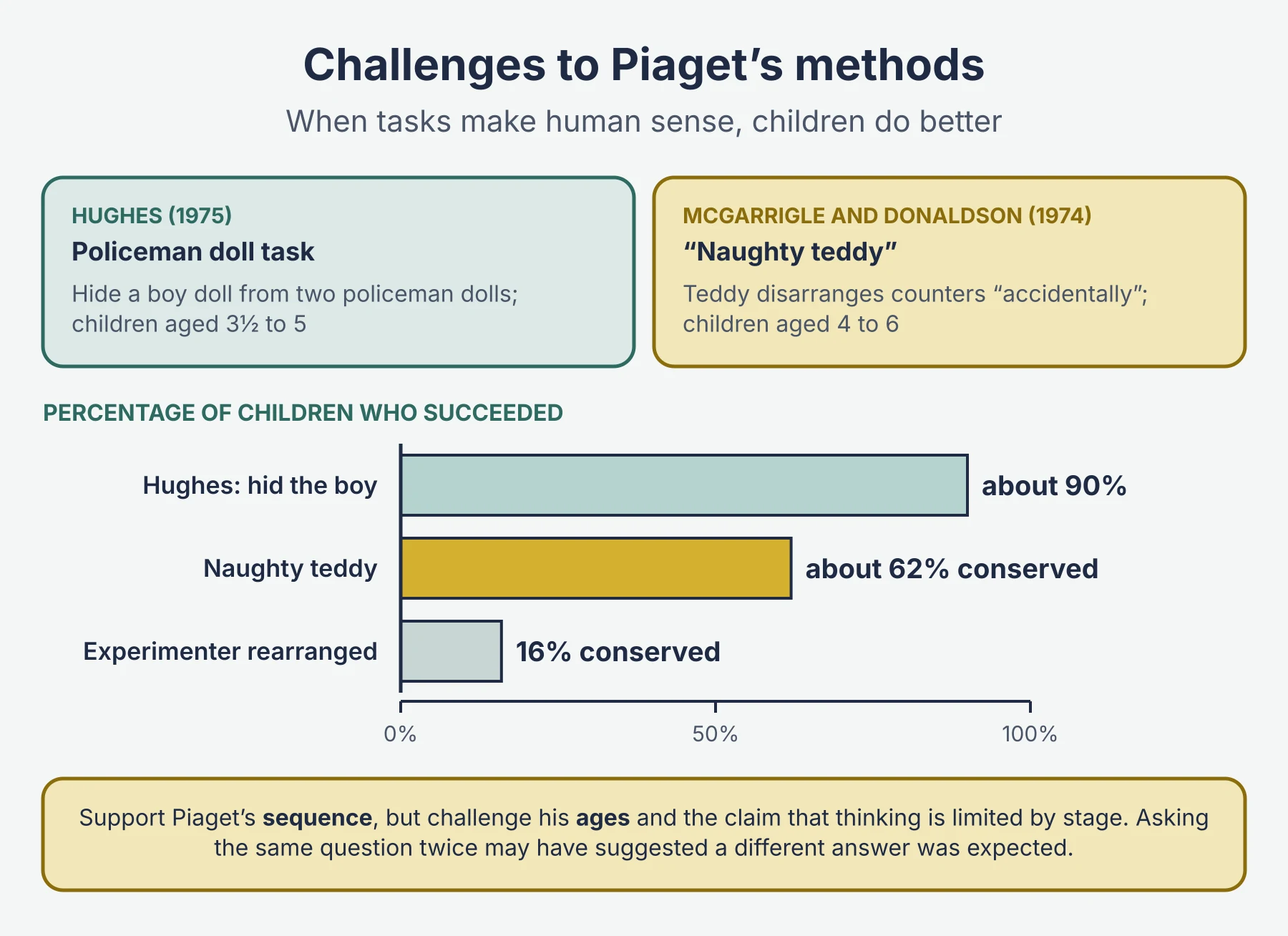
Several studies suggest Piaget underestimated children because his tasks were confusing or lacked human sense.
- Hughes (1975) used a “policeman doll” task: children hid a boy doll from two policeman dolls. About 90% of children aged three and a half to five succeeded, suggesting they could take another’s view when the task made sense to them.
- McGarrigle and Donaldson (1974) had a “naughty teddy” disarrange a row of counters “accidentally”. About 62% of children aged four to six conserved number, compared with 16% when the experimenter rearranged the counters deliberately. Asking the same question twice in Piaget’s version may have suggested a different answer was expected.
These studies support Piaget’s sequence but challenge his ages and his claim that thinking is limited by stage.
Baillargeon’s violation of expectation research
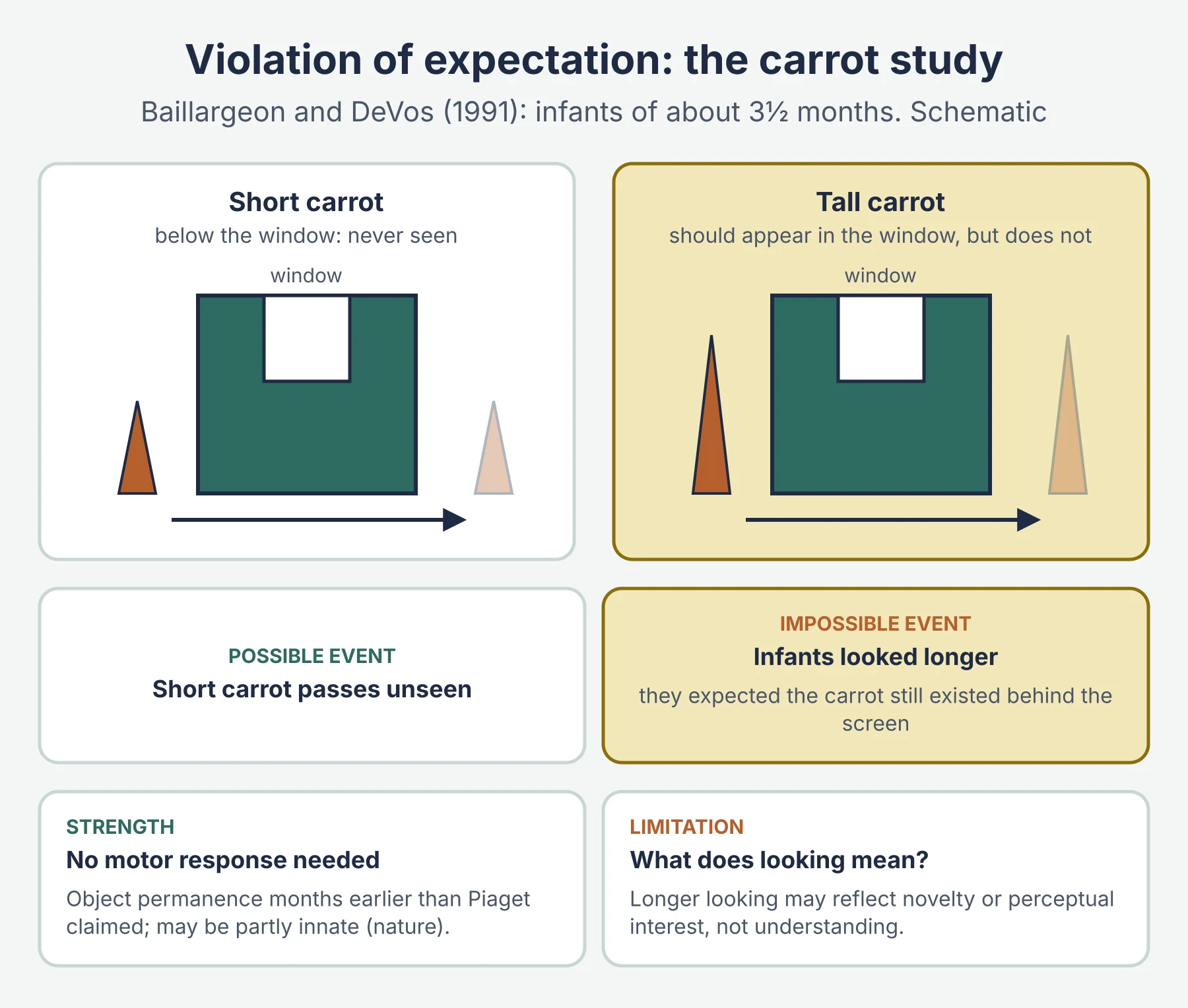
Baillargeon developed the violation of expectation method because reaching tasks require motor skills that young infants lack. Infants are shown a “possible” and an “impossible” event; if they look longer at the impossible one, they are assumed to have expected something else – and therefore to understand something about objects.
In the “carrot” study (Baillargeon and DeVos, 1991), infants of about three and a half months watched short and tall carrots slide behind a screen with a window in its upper half. A tall carrot should have appeared in the window. When it did not (the impossible event), infants looked longer, suggesting they knew the carrot still existed behind the screen – object permanence months earlier than Piaget claimed.
Evaluation. The method removes the need for motor responses and shows infants know more than reaching tasks suggest. However, longer looking may reflect novelty or perceptual interest rather than understanding, so interpretation is debated. It suggests early knowledge may be partly innate, which supports a nature position in the nature-nurture debate.
Vygotsky’s theory
Vygotsky argued that cognitive development is fundamentally social and cultural.
- Children begin with elementary mental functions shared with other animals; higher mental functions, such as reasoning, develop through interaction with others and the culture’s tools, especially language.
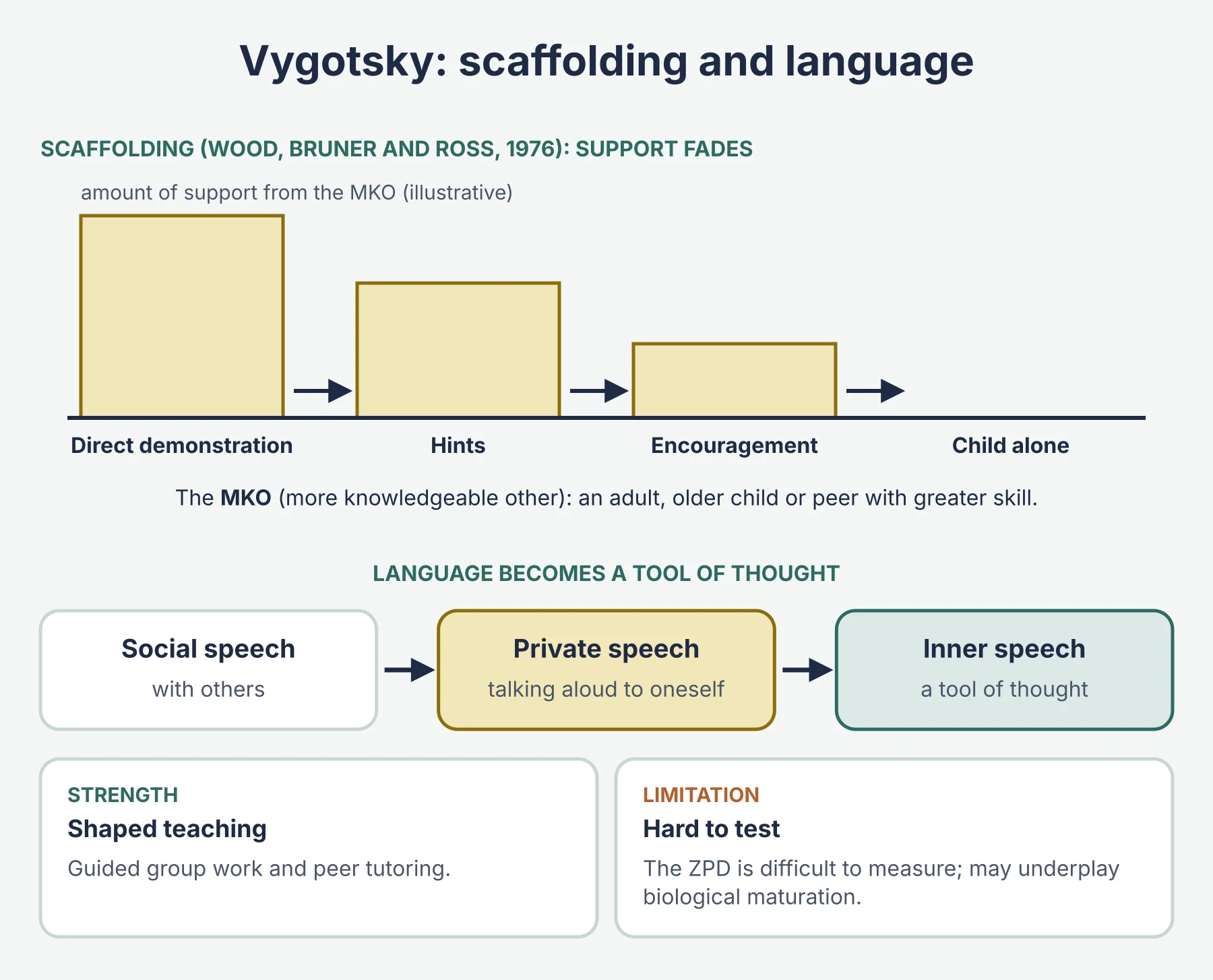
- The more knowledgeable other (MKO) – an adult, older child or peer with greater skill – guides learning.
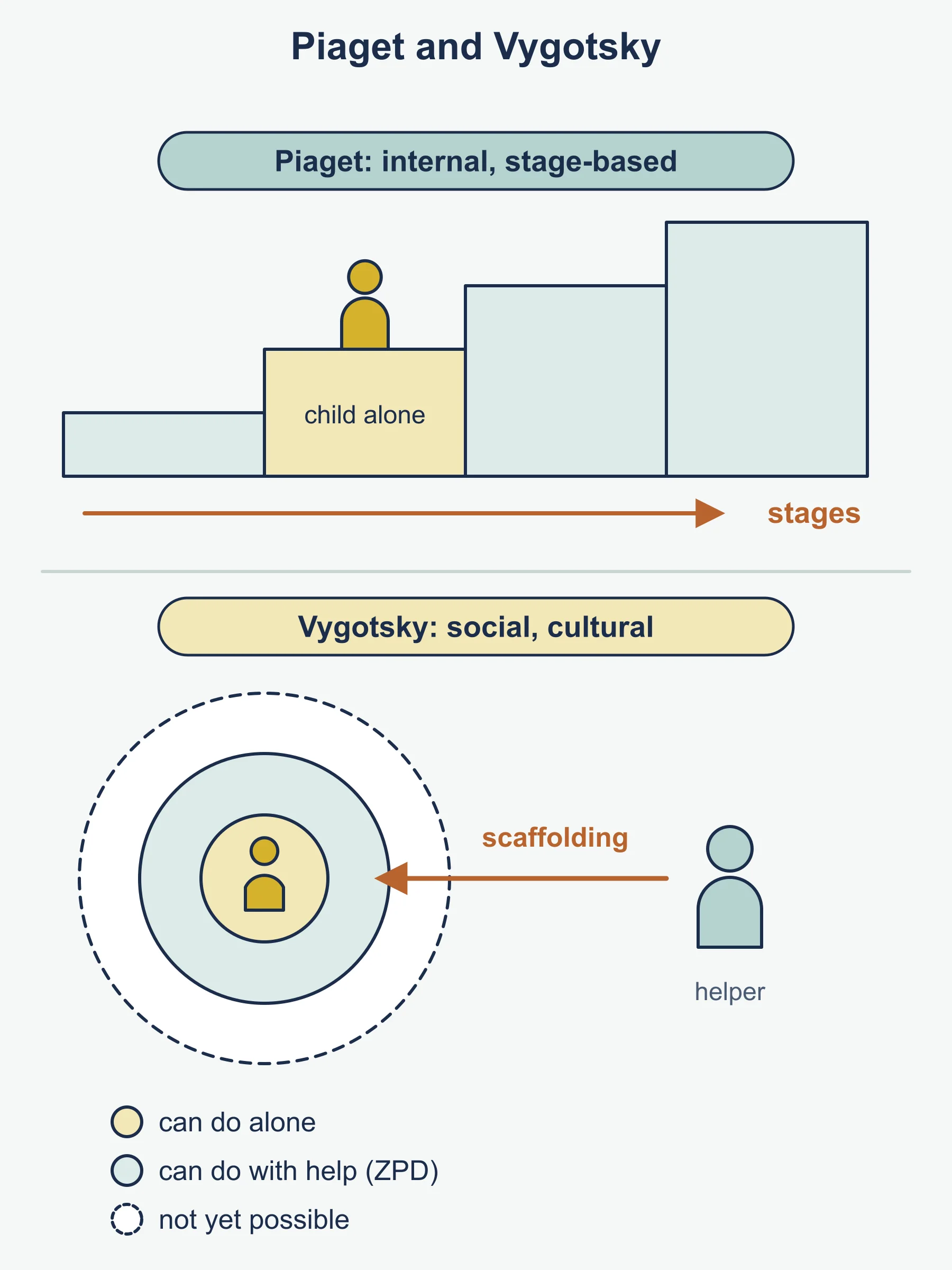
- The zone of proximal development (ZPD) is the range of tasks a child cannot yet manage independently but can complete with guidance. Learning is most effective within this zone.
- Scaffolding, a term introduced by Wood, Bruner and Ross (1976), describes the support an MKO gives within the ZPD, reduced as the child becomes competent. Support moves from direct demonstration to hints and encouragement.
- Language moves from social speech to private speech (talking aloud to oneself) to inner speech, which becomes a tool of thought.
Evaluation. Vygotsky’s ideas have shaped teaching methods such as guided group work and peer tutoring. However, the theory is harder to test than Piaget’s, because concepts such as the ZPD are difficult to measure, and it may underplay biological maturation.
Comparing Piaget and Vygotsky. Piaget saw the child as a lone scientist moving through universal stages, with language a product of thought; Vygotsky saw the child as an apprentice whose thinking develops through social interaction, with language a cause of thought. Both see children as active participants.
Social cognition
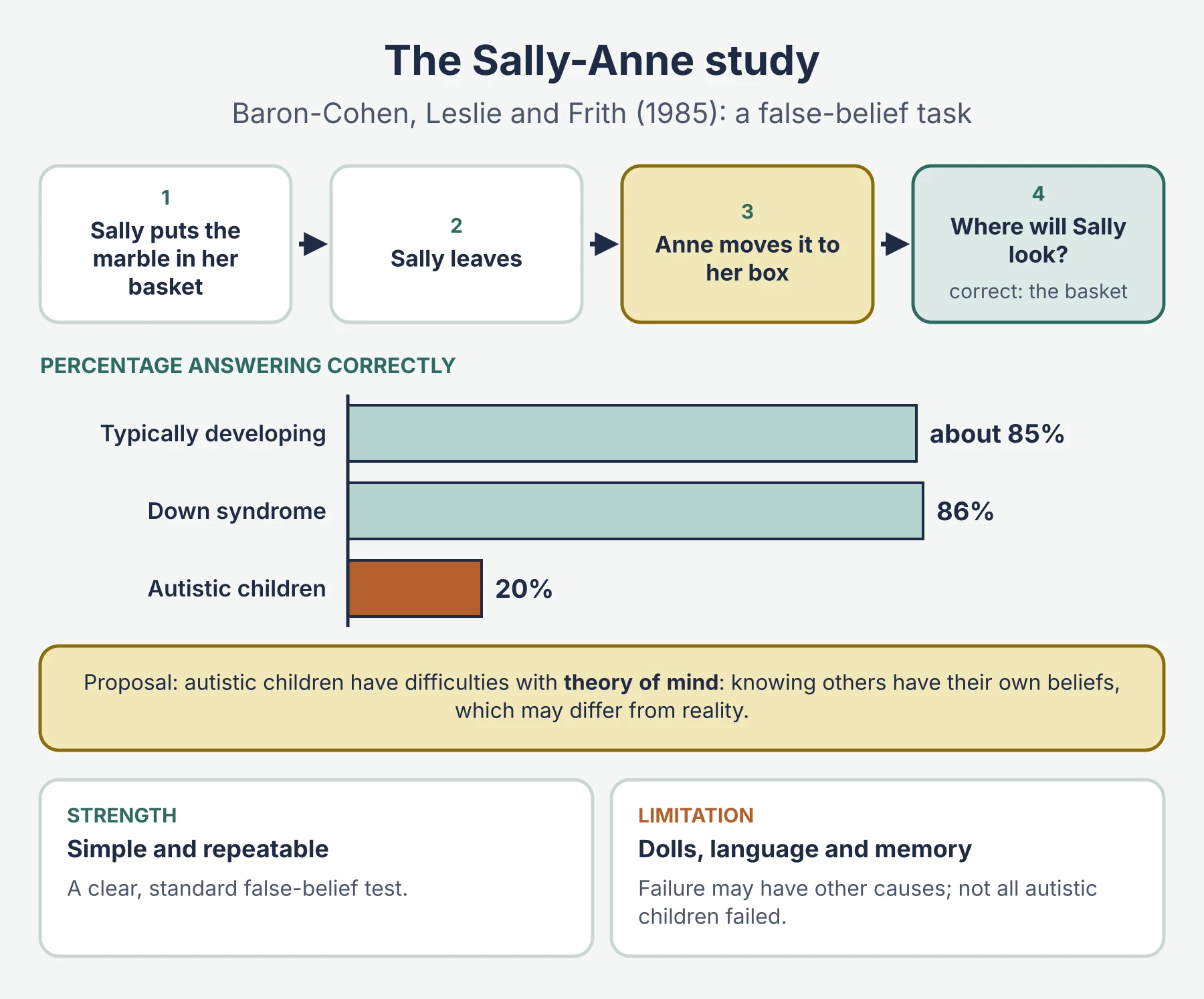
Theory of mind means recognising that each person has their own mental states – beliefs, desires and intentions – which may differ from one’s own and from reality. It is usually tested with false-belief tasks. Wimmer and Perner (1983) found that most children pass such tasks at around four years of age.
The Sally-Anne study (Baron-Cohen, Leslie and Frith, 1985). A scene was acted out with two dolls: Sally put a marble in her basket and left; Anne moved it to her box. When Sally returned, children were asked where she would look for the marble. About 85% of typically developing children and 86% of children with Down syndrome answered correctly (the basket), compared with only 20% of autistic children. The researchers proposed that autistic children have difficulties with theory of mind.
Evaluation. The task is simple and repeatable. But it uses dolls rather than real people and may require language and memory skills beyond theory of mind itself, so failure may have other causes. Not all autistic children failed, so theory of mind difficulties cannot be the whole explanation of autism.
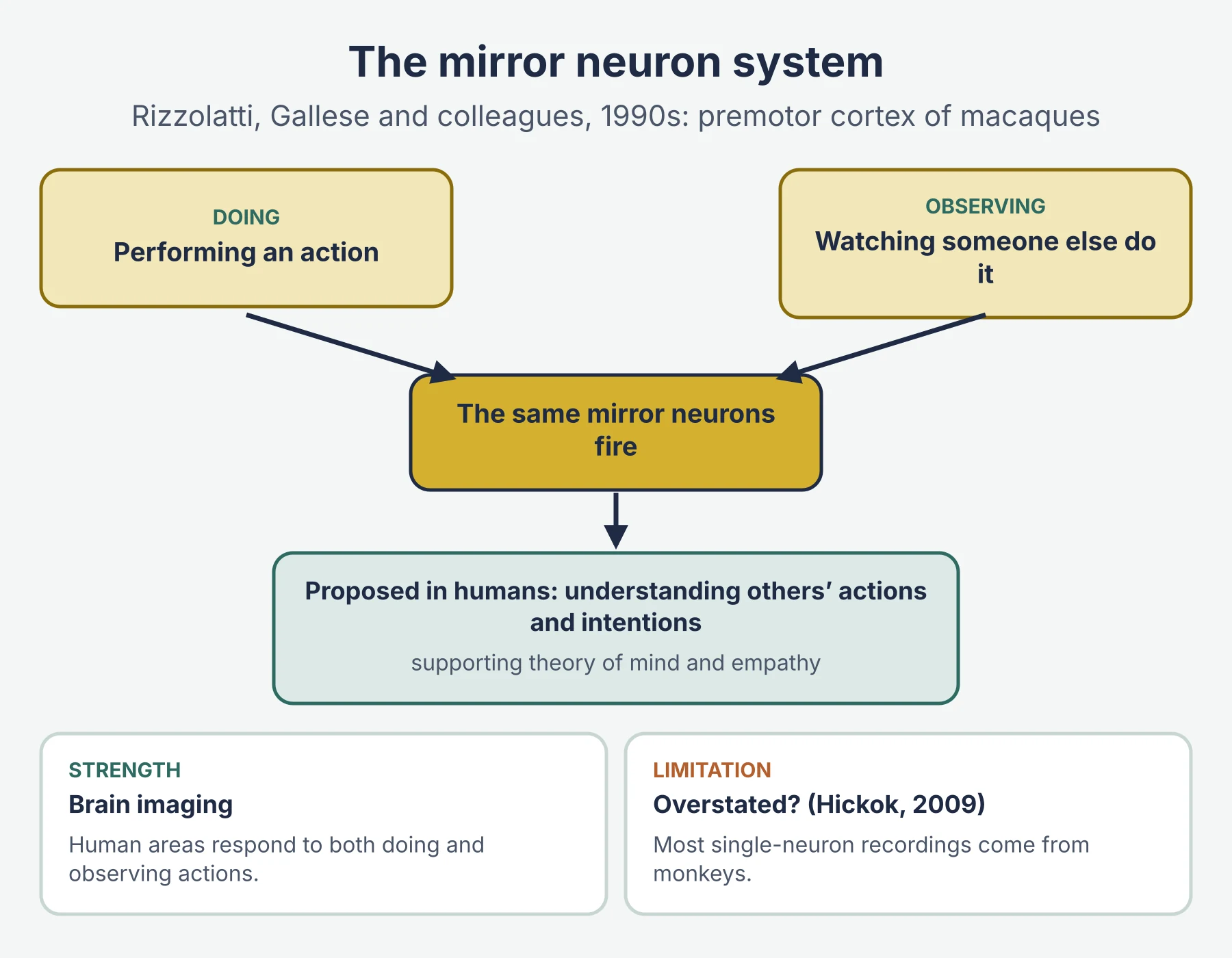
The mirror neuron system. Mirror neurons fire both when an individual performs an action and when it observes someone else performing the same action. They were first identified in the premotor cortex of macaque monkeys by Rizzolatti, Gallese and colleagues in the 1990s. It has been proposed that a similar system in humans helps us understand others’ actions and intentions, and so supports theory of mind and empathy.
Evaluation. Brain imaging suggests areas in humans respond to both doing and observing actions. However, most direct recordings of single mirror neurons come from monkeys, and critics such as Hickok (2009) argue that the role of mirror neurons in understanding intentions has been overstated.
Worked example: an application answer
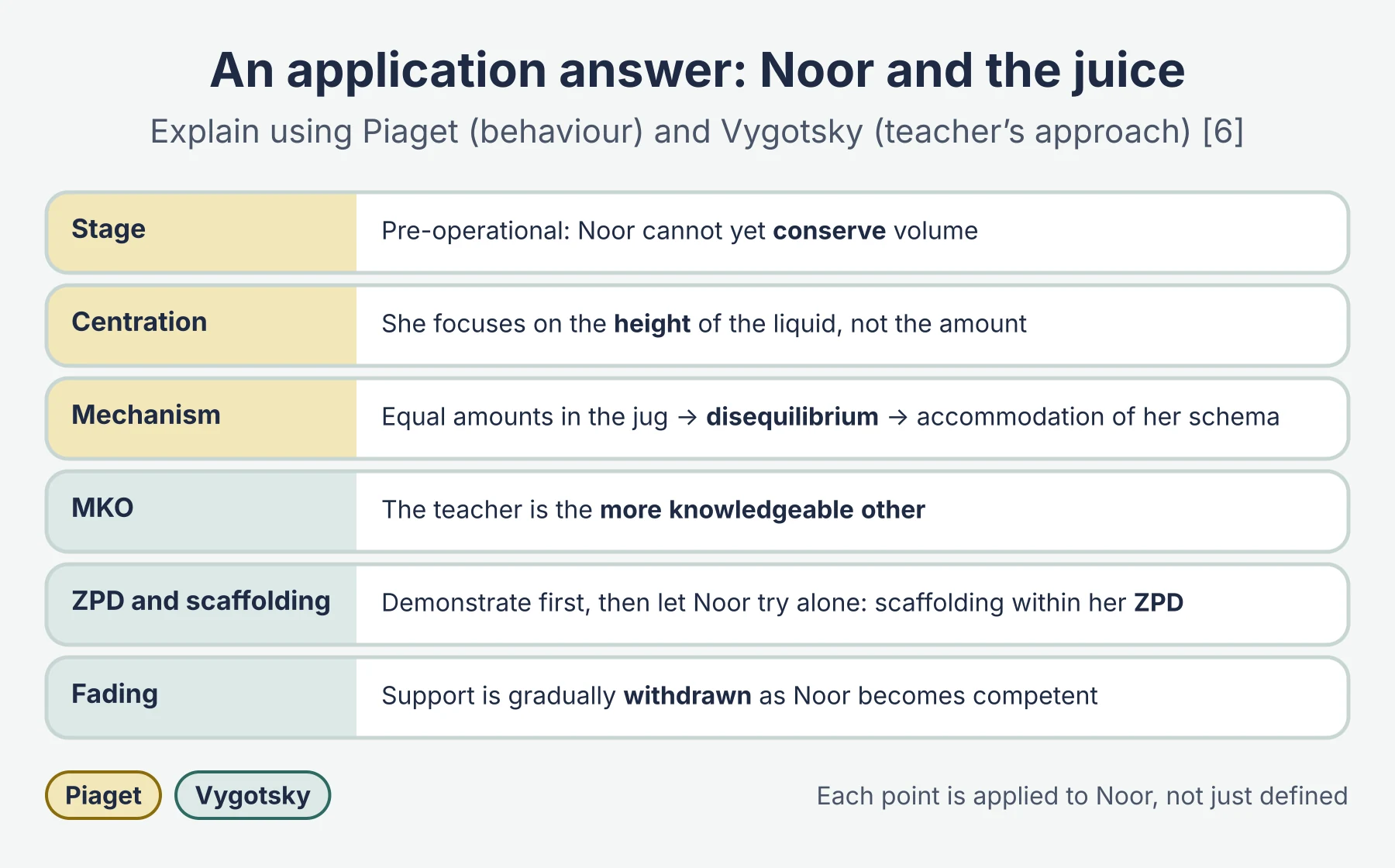
Scenario: Five-year-old Noor insists that her brother has more juice after it is poured from her short, wide cup into his tall, thin glass. Her teacher shows her how to measure the juice using a jug, then asks her to try it alone. Explain Noor’s behaviour using Piaget’s theory, and the teacher’s approach using Vygotsky’s theory. [6]
Noor is in the pre-operational stage, so she cannot yet conserve volume (stage, applied). She focuses on the height of the liquid rather than recognising that pouring does not change the amount (centration on one feature). When the measured jug shows the amounts are equal, this may cause disequilibrium, prompting accommodation of her schema (mechanism). The teacher acts as a more knowledgeable other (Vygotsky term). By demonstrating first and then letting Noor try alone, she scaffolds the task within Noor’s zone of proximal development (ZPD and scaffolding). The support is gradually withdrawn as Noor becomes competent (fading).
Common mistakes
- Confusing assimilation and accommodation.
- Giving stage names without their characteristics or tasks.
- Describing Baillargeon’s findings without explaining what longer looking is taken to mean.
- Treating the ZPD as the same as scaffolding: the ZPD is the gap, scaffolding is the support.
- Quoting the Sally-Anne findings without the three groups.
More resources on this topic
- Cognitive development revision notes
- Cognitive development practice questions
- Unit 2 study guide
- Issues and debates study guide
Official syllabus
OxfordAQA International AS and A-level Psychology (9685) specification, Version 3.1, section 3.2.2 Cognitive development, assessed in Unit 2: Biopsychology, development and research methods 1, Section B.
Related resources
-
Practice questions
OxfordAQA International A-level Psychology (9685): 3.2.2 Cognitive Development – Practice Questions
Twelve original OxfordAQA 9685 cognitive development questions: Piaget's stages, looking-time and conservation data, scaffolding and essays, with answers.
Psychology · OxfordAQA · AS Level
Try questions -
Revision notes
OxfordAQA International A-level Psychology (9685): 3.2.2 Cognitive Development – Revision Notes
Condensed OxfordAQA 9685 cognitive development notes: Piaget's mechanisms and stages, key tasks, Baillargeon, Vygotsky, theory of mind and a self-test.
Psychology · OxfordAQA · AS Level
Revise topic -
Study guides
OxfordAQA International A-level Psychology (9685): 3.2.3 Research Methods 1
Study guide to OxfordAQA 9685 section 3.2.3 Research methods 1: methods, designs, variables, sampling, ethics, descriptive statistics and a worked study design.
Psychology · OxfordAQA · AS Level
Read guide
Studying Psychology?
This page is free and stays free. Marlbridge is not offering Psychology classes at the moment, so there is no tuition to book for it. The free study resources stay open to everyone.
Get free revision emails (optional)
Occasional emails with practice questions, worked explanations and links to free resources for the qualification and subjects you choose. No spam, and you can unsubscribe from any email. The free tools on this site never need an email.