
Revision Notes
OxfordAQA International GCSE Geography (9230): Climate Change – Evidence, Causes, Effects and Management – Revision Notes
Condensed notes on climate change for OxfordAQA IGCSE Geography 9230: evidence types and timescales, natural and human causes, effects and management.
- Subject
- Geography
- Level
- IGCSE
- Topic
- Component 1 – Living With the Physical Environment
- Author
- Marlbridge Academic Team
- Updated
- Reviewed by
- Azam Siddique (what this means)
Aligned to OxfordAQA IGCSE Geography (9230), Version 4.3. Official specification .
Syllabus page (what it covers and how it is assessed): OxfordAQA IGCSE Geography.
Syllabus points this page covers
9230
- 3.1.1.4 Climate change
These notes cover section 3.1.1.4, Climate change, of the OxfordAQA International GCSE Geography (9230) specification, Version 4.3: “Climate change is the result of natural and human factors, and has a range of effects” and “Managing climate change involves both mitigation (reducing causes) and adaptation (responding to change).” For the whole unit, see the Living with the Physical Environment study guide; for full explanations, read the climate change study guide.
Key facts
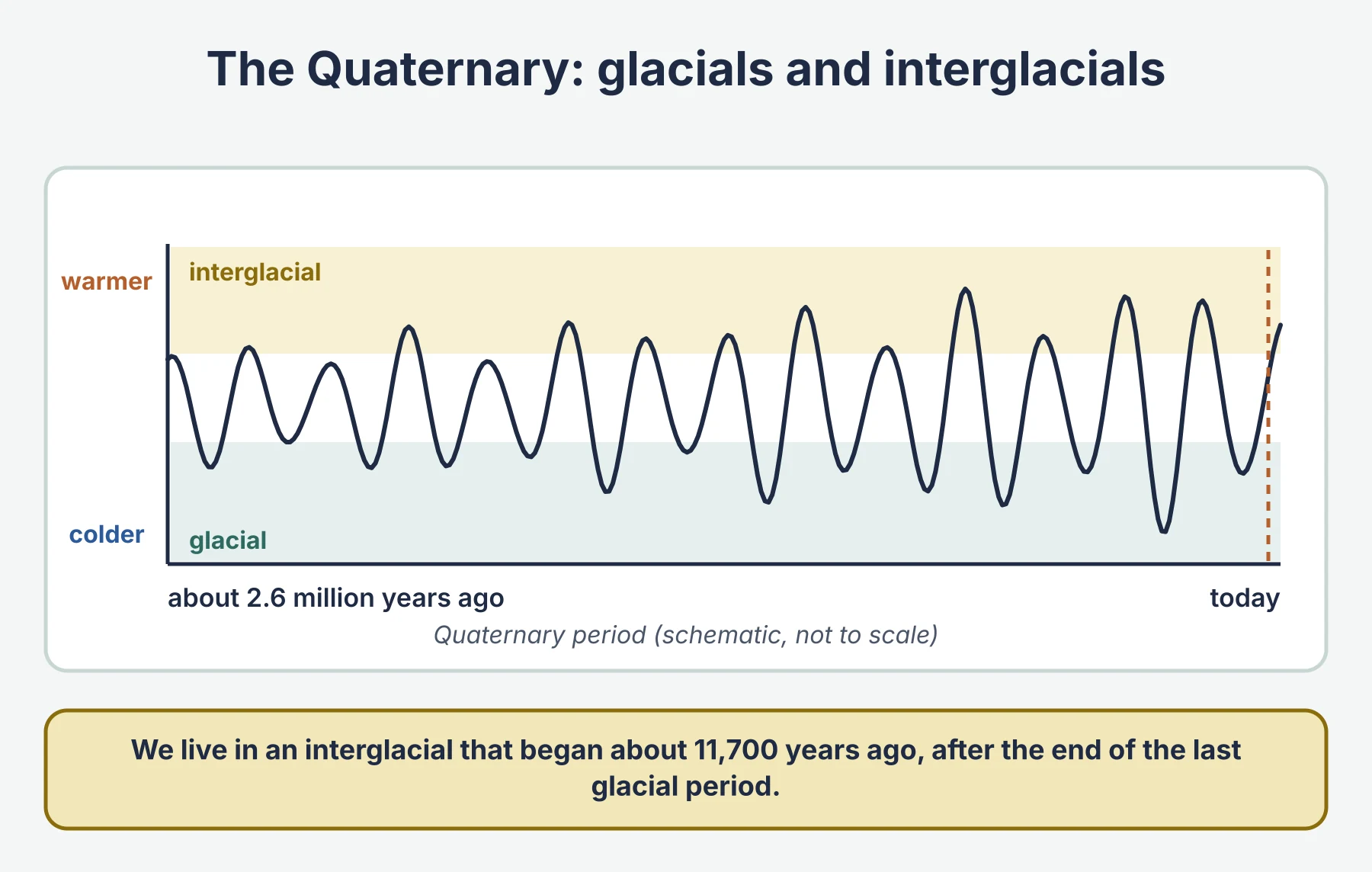
- The Quaternary period began about 2.6 million years ago and continues today: repeated glacial and interglacial periods.
- The current interglacial began about 11,700 years ago.
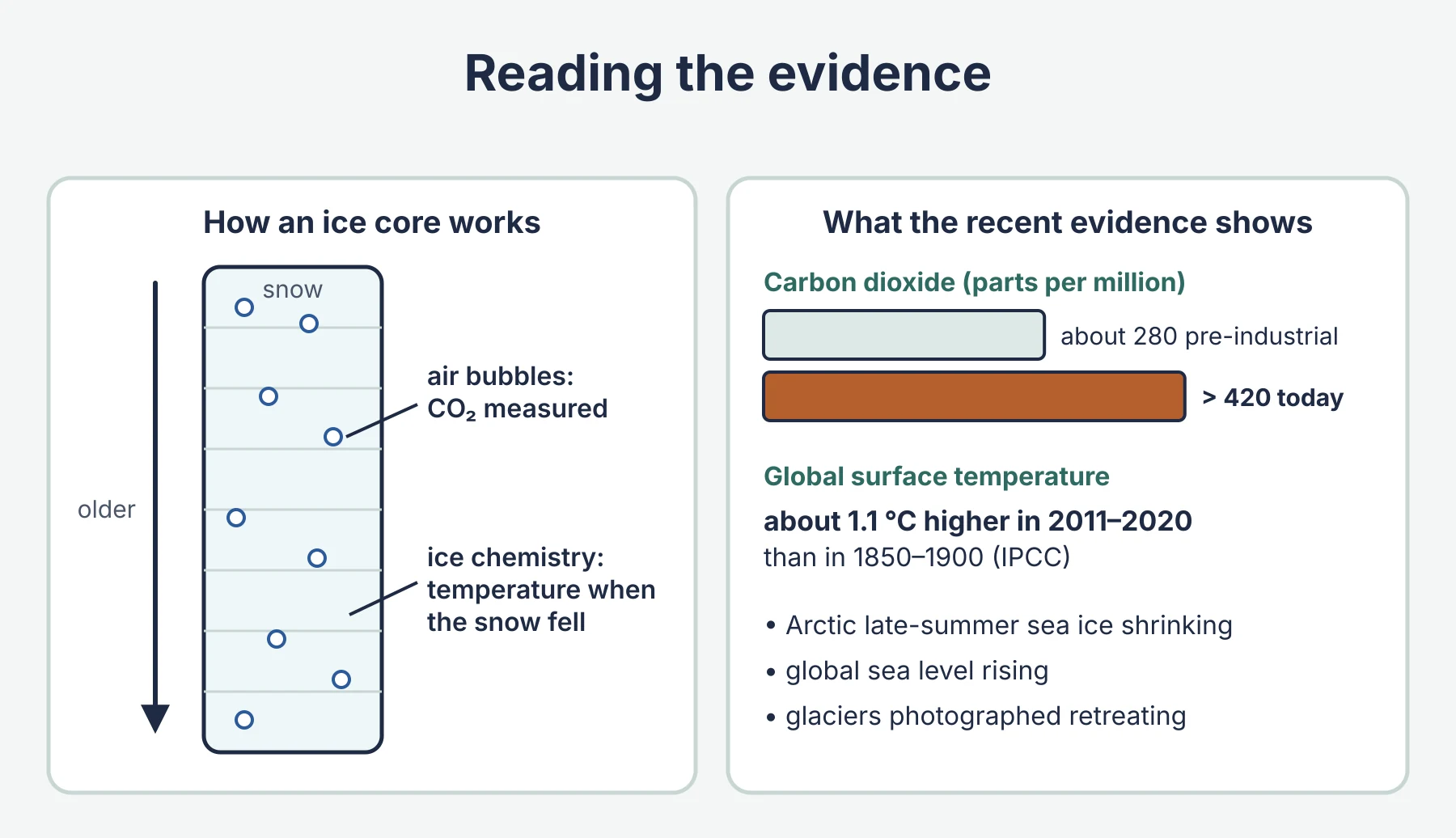
- IPCC: global surface temperature in 2011-2020 was about 1.1 °C above 1850-1900.
- Carbon dioxide: about 280 ppm before the industrial era; more than 420 ppm today.
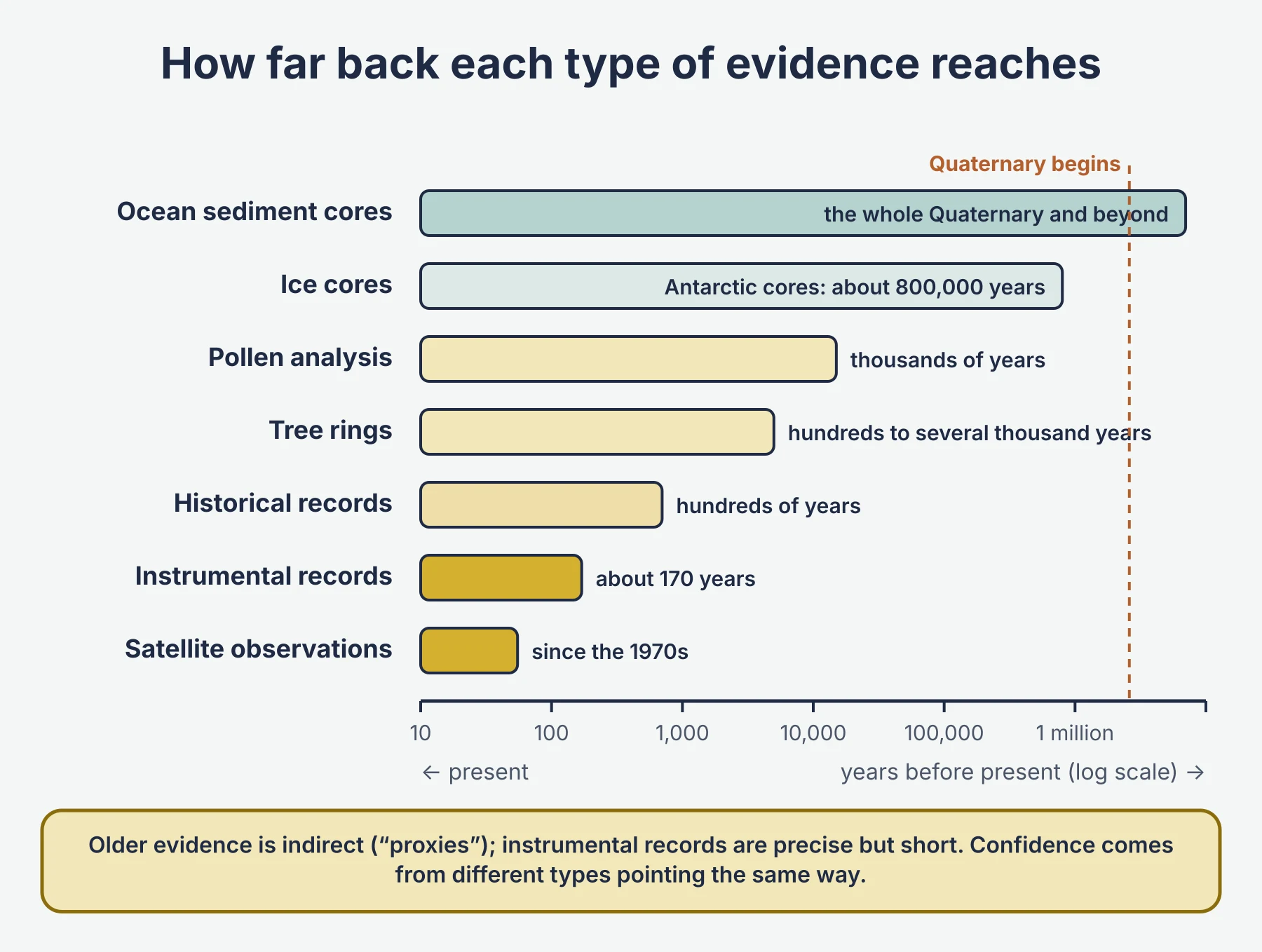
- Antarctic ice cores reach back about 800,000 years.
Evidence at a glance
| Evidence | What it shows | Timescale | One limitation |
|---|---|---|---|
| Ice cores | Past carbon dioxide (air bubbles) and temperature (ice chemistry) | Up to about 800,000 years | Only from ice sheets; indirect measure of temperature |
| Ocean sediment cores | Ocean temperature and ice volume from shell chemistry | Whole Quaternary | Indirect; needs careful dating |
| Pollen analysis | Past vegetation, so past climate | Thousands of years | Pollen can travel; some species hard to tell apart |
| Tree rings | Good or poor growing years | Hundreds to several thousand years | Local; affected by things other than climate |
| Historical records | Past weather, such as frost fairs on the Thames | Hundreds of years | Local, descriptive, not measured |
| Instrumental records | Measured temperature and carbon dioxide | Since about 1850 (CO2 at Mauna Loa since 1958) | Short; early records cover fewer places |
| Satellites and photographs | Sea ice, ice sheets, sea level, glacier retreat | Since the 1970s | Very short |
Confidence comes from different kinds of evidence agreeing.
Natural causes
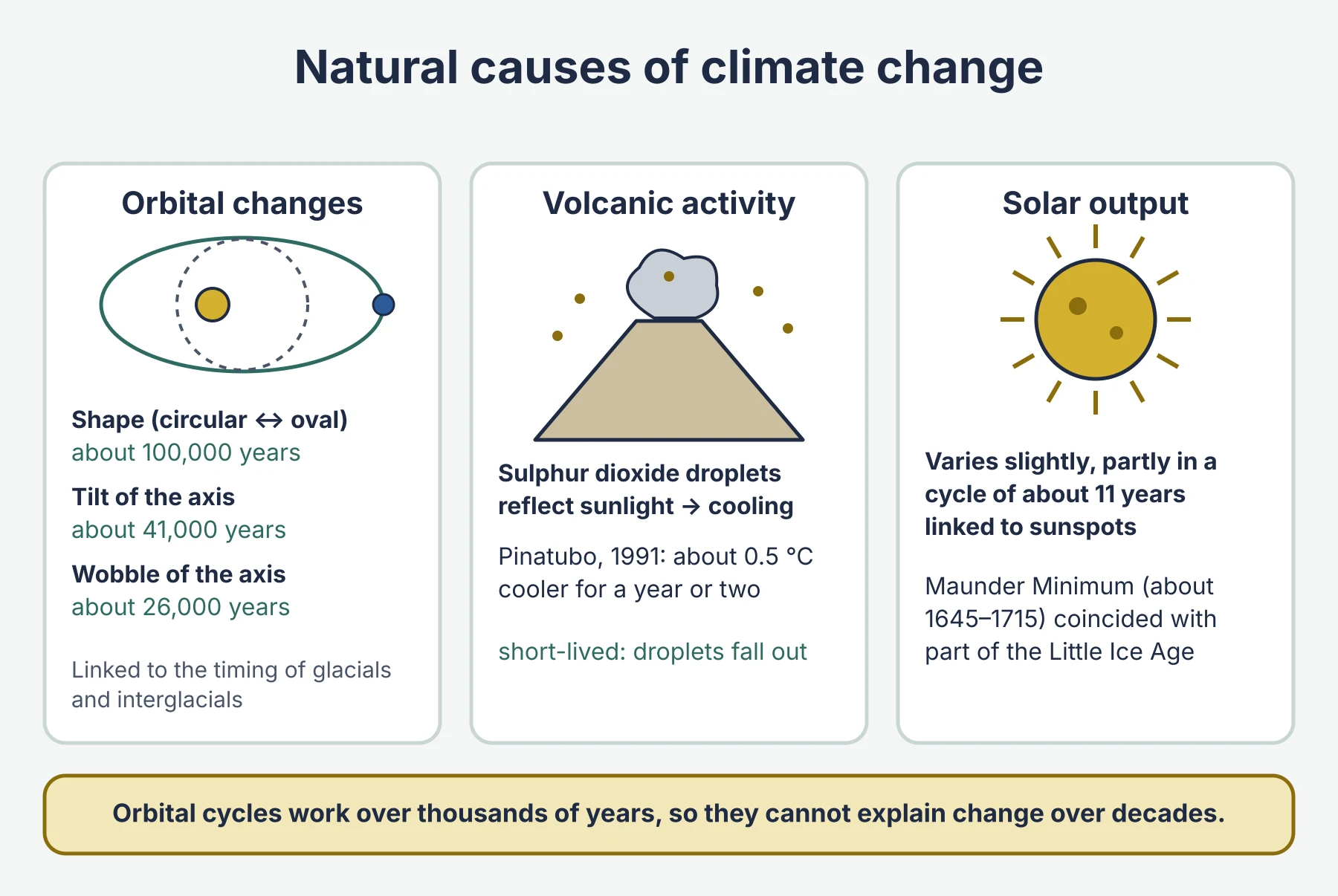
| Cause | How it works | Timescale |
|---|---|---|
| Orbital changes (Milankovitch cycles) | Orbit shape (about 100,000 years), tilt (about 41,000 years) and wobble (about 26,000 years) change how solar energy is spread | Thousands of years |
| Volcanic activity | Sulphur dioxide forms droplets that reflect sunlight; cooling (Pinatubo 1991: about 0.5 °C) | One to a few years |
| Solar output | Small variations, including an 11-year sunspot cycle; Maunder Minimum about 1645-1715 | Years to centuries |
Human causes
| Cause | Gas | How |
|---|---|---|
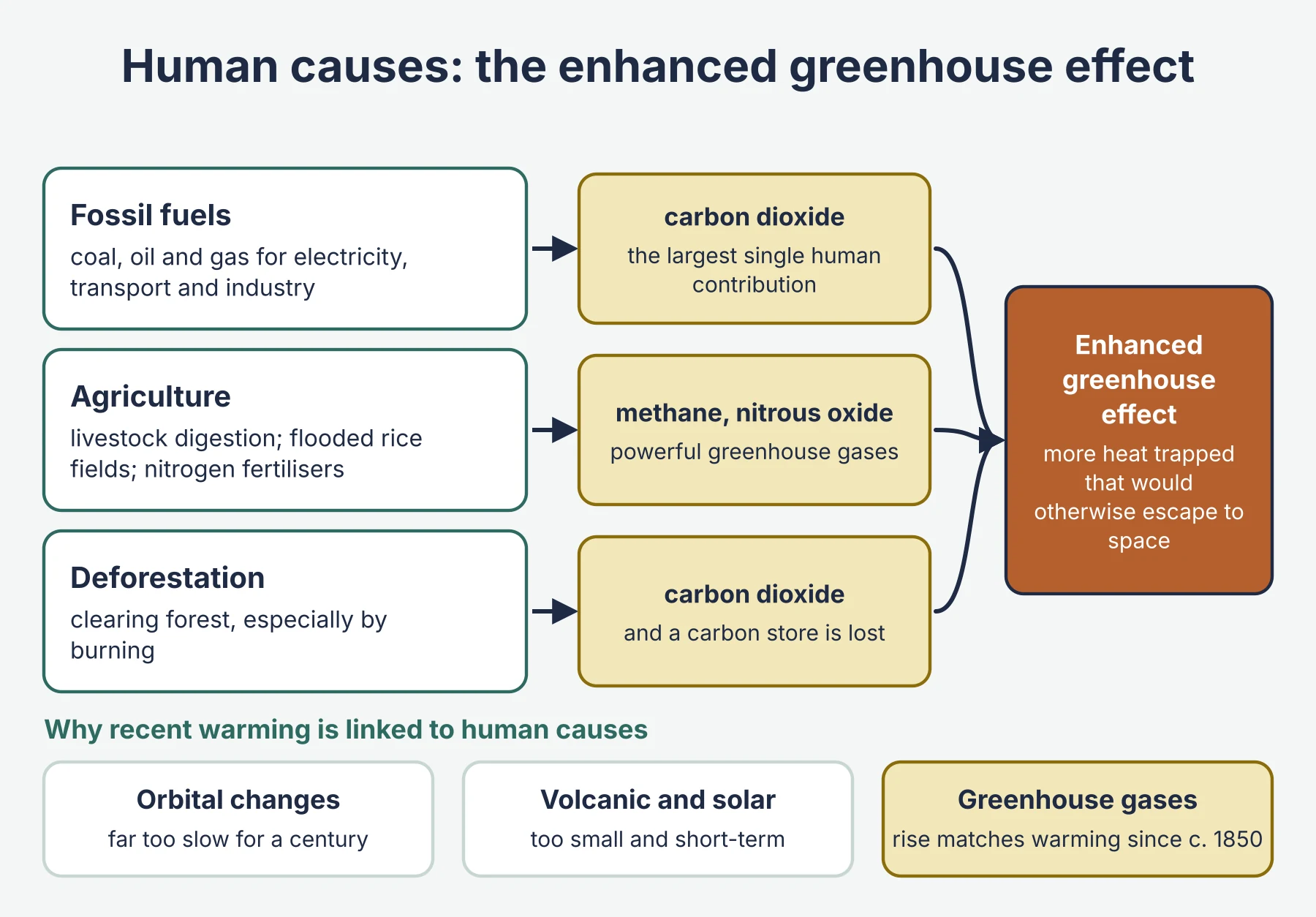
| Fossil fuels | Carbon dioxide | Burning coal, oil and gas for power, transport, industry |
| Agriculture | Methane, nitrous oxide | Livestock digestion, flooded rice fields, nitrogen fertilisers |
| Deforestation | Carbon dioxide | Burning releases stored carbon; fewer trees to absorb it |
Enhanced greenhouse effect: more greenhouse gases trap more heat radiated from the Earth’s surface.
Why recent warming is human-caused: orbital changes are too slow; volcanic and solar effects are too small and short-lived; the warming since about 1850 matches the rise in greenhouse gases.
Effects (overview)
- Environment: sea-level rise; sea-ice loss and glacier retreat; coral bleaching; species shifting range; more extreme heat, drought and heavy rain in many regions.
- People: coastal flooding and erosion; changes to crop yields; water shortages where rivers depend on glaciers; heat stress and spread of insect-borne disease.
- Effects fall hardest on those with fewest resources to cope.
Management
| Mitigation (reduce causes) | Adaptation (respond to change) |
|---|---|
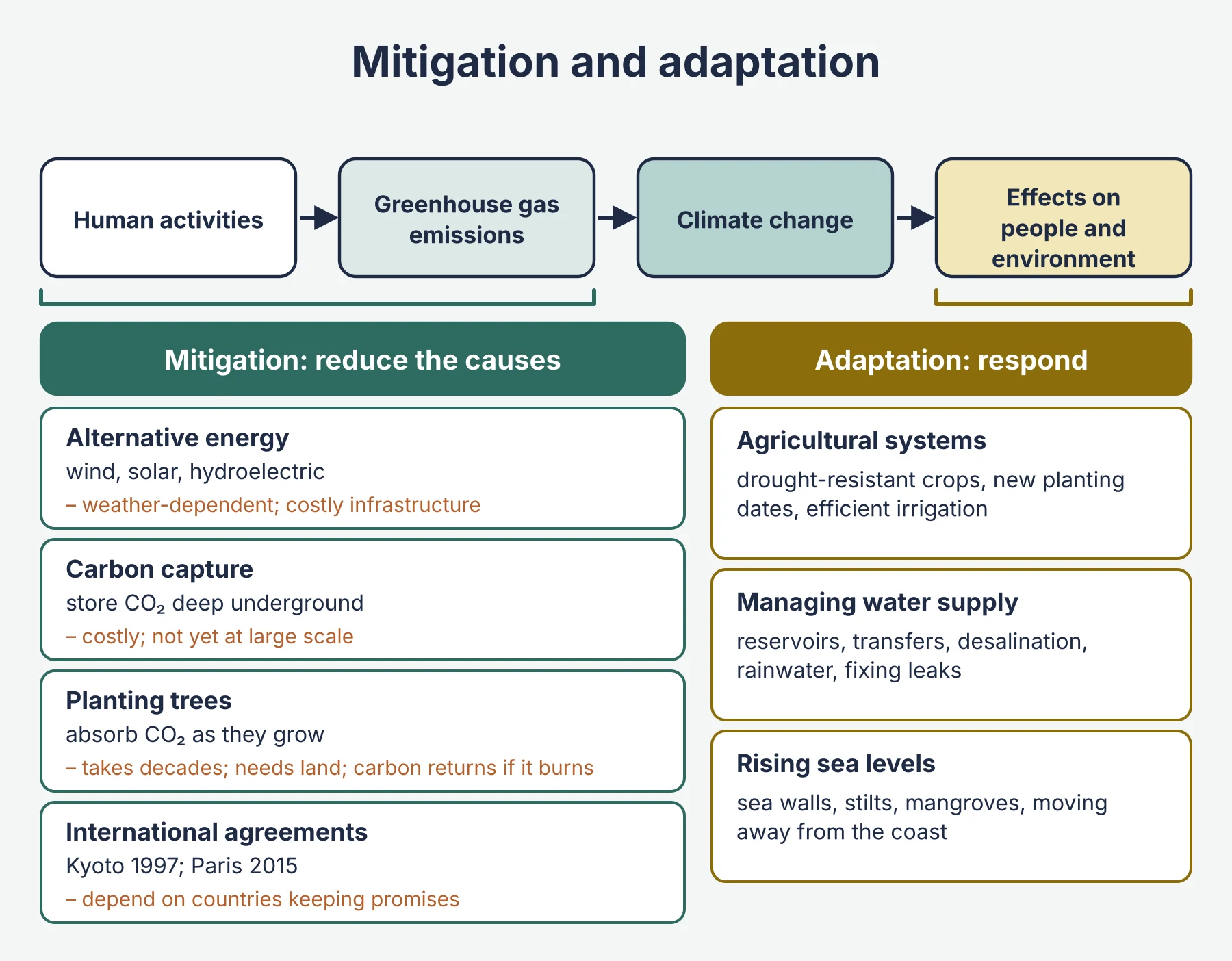
| Alternative energy production: wind, solar, hydroelectric | Change agricultural systems: drought-resistant crops, new planting dates, efficient irrigation |
| Carbon capture: capture CO2 and store it underground | Manage water supply: reservoirs, transfers, desalination, rainwater collection, metering |
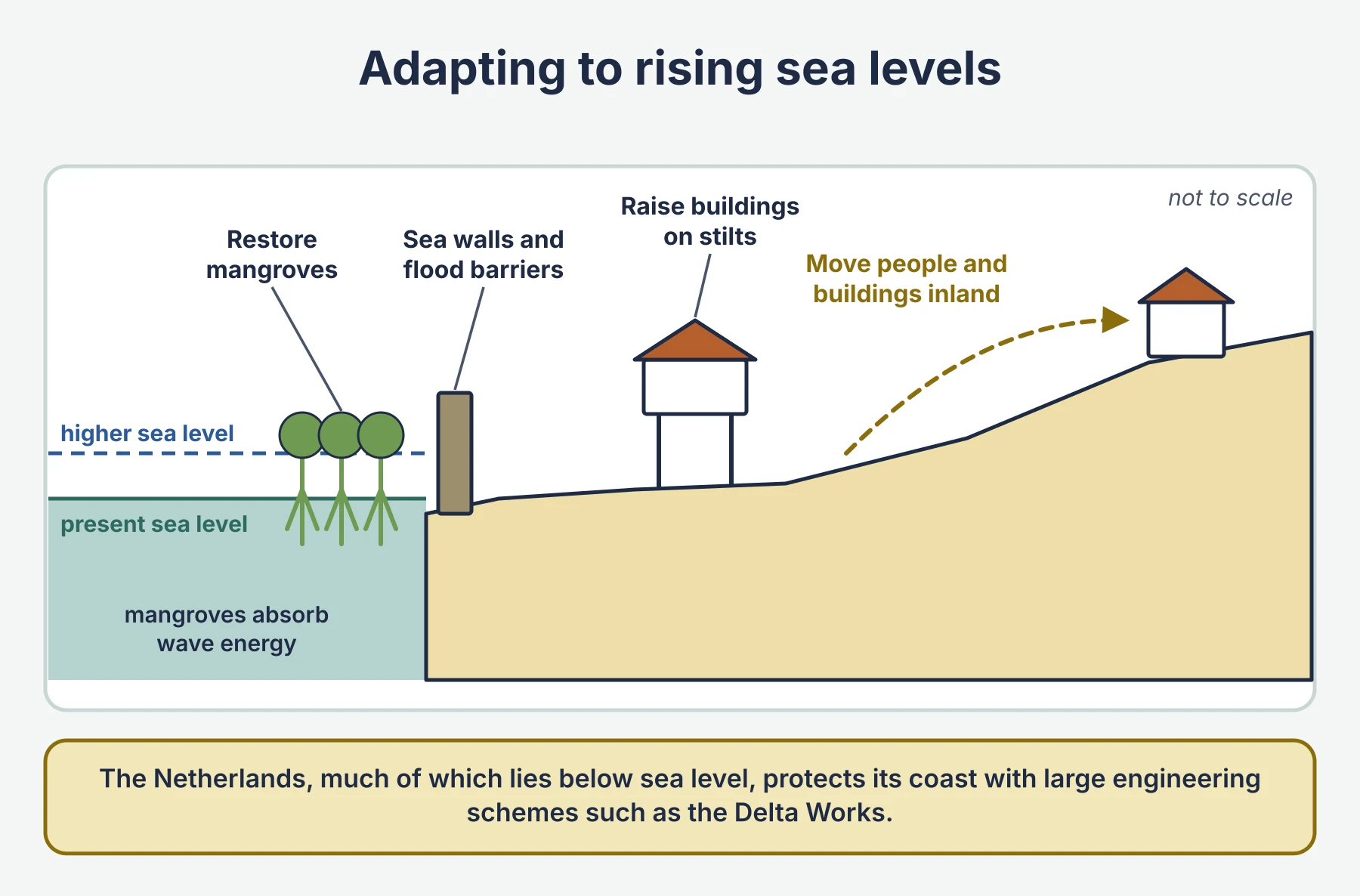
| Planting trees: absorb CO2 as they grow | Reduce sea-level risk: sea walls, flood barriers, buildings on stilts, mangroves, moving away from at-risk coasts |
| International agreements: Kyoto Protocol (1997), Paris Agreement (2015: well below 2 °C, aim for 1.5 °C) | Example: the Netherlands’ Delta Works |
Exam traps
- Calling tree planting adaptation (it is mitigation) or sea walls mitigation (they are adaptation).
- Saying volcanoes cause long-term warming; big eruptions usually cool the climate briefly.
- Mixing up climate change and the ozone hole.
- Listing evidence types without saying how each records past climate.
- Giving effects without a place, group or example.
- Explaining human causes without linking activity, gas and warming.
Self-test
- When did the Quaternary period begin?
- How do ice cores show past carbon dioxide levels?
- Name one type of evidence that covers the whole Quaternary.
- What does pollen analysis tell us about past climate?
- Give the three orbital cycles and their approximate lengths.
- Why does a large volcanic eruption cool the climate?
- What was the Maunder Minimum?
- Name two greenhouse gases released by agriculture and their sources.
- Why is deforestation a double contribution to climate change?
- Classify: wind farms, drought-resistant crops, carbon capture, raising homes on stilts.
- What does the Paris Agreement aim for?
- Why do scientists link recent warming to human activity rather than orbital changes?
Answers
- About 2.6 million years ago.
- Air bubbles trapped in the ice preserve samples of the atmosphere, whose carbon dioxide can be measured.
- Ocean sediment cores.
- Which plants grew, and so what the climate was like.
- Orbit shape about 100,000 years; tilt about 41,000 years; wobble about 26,000 years.
- Sulphur dioxide forms droplets high in the atmosphere that reflect sunlight back to space.
- A period of very few sunspots, about 1645-1715, which coincided with part of the Little Ice Age.
- Methane from livestock and flooded rice fields; nitrous oxide from nitrogen fertilisers.
- Burning releases stored carbon, and the lost trees can no longer absorb carbon dioxide.
- Wind farms and carbon capture: mitigation. Drought-resistant crops and homes on stilts: adaptation.
- To keep warming well below 2 °C and pursue efforts to limit it to 1.5 °C.
- Orbital changes act over thousands of years, too slowly to explain warming over about 170 years, which matches rising greenhouse gases.
Practise with the climate change practice questions.
Related resources
-
Study guides
OxfordAQA International GCSE Geography (9230): Coastal Processes and Landforms
Coasts for OxfordAQA IGCSE Geography 9230: wave types, weathering, mass movement, erosion, longshore drift, deposition, geology and coastal landforms.
Geography · OxfordAQA · IGCSE
Read guide -
Practice questions
OxfordAQA International GCSE Geography (9230): Coastal Processes and Landforms – Practice Questions
Original coastal questions for OxfordAQA IGCSE Geography 9230: waves, weathering, mass movement, erosion, longshore drift, geology and landforms, with answers.
Geography · OxfordAQA · IGCSE
Try questions -
Revision notes
OxfordAQA International GCSE Geography (9230): Coastal Processes and Landforms – Revision Notes
Condensed coastal notes for OxfordAQA IGCSE Geography 9230: wave types, the five process groups, geology, landform sequences, exam traps and a self-test.
Geography · OxfordAQA · IGCSE
Revise topic
Studying Geography?
This page is free and stays free. Marlbridge is not offering Geography classes at the moment, so there is no tuition to book for it. The free study resources stay open to everyone.
Get free revision emails (optional)
Occasional emails with practice questions, worked explanations and links to free resources for the qualification and subjects you choose. No spam, and you can unsubscribe from any email. The free tools on this site never need an email.