
Revision Notes
OxfordAQA International GCSE Psychology (9218): Mental Health – Revision Notes
Mental health recall notes for OxfordAQA IGCSE Psychology 9218: incidence, effects, OCD and PTSD diagnosis, explanations, therapies, evaluation and a self-test.
- Subject
- Psychology
- Level
- IGCSE
- Topic
- Paper 2 – Social Context and Behaviour
- Author
- Marlbridge Academic Team
- Updated
- Reviewed by
- Kanwal Aslam (what this means)
Aligned to OxfordAQA IGCSE Psychology (9218), Version 1.1. Official specification .
Syllabus page (what it covers and how it is assessed): OxfordAQA IGCSE Psychology.
Syllabus points this page covers
9218
- 3.2.3 Mental health
Quick-recall notes for 3.2.3 Mental health, Section C of Paper 2 in OxfordAQA International GCSE Psychology (9218). These notes add evaluation points and application practice to the core content. For full explanations, use the Mental Health study guide.
Key terms
| Term | Meaning |
|---|---|
| Incidence | How many new cases of a problem occur in a population over a period |
| Stigma | Negative attitudes and shame attached to a condition |
| ICD | International Classification of Diseases, published by the World Health Organization |
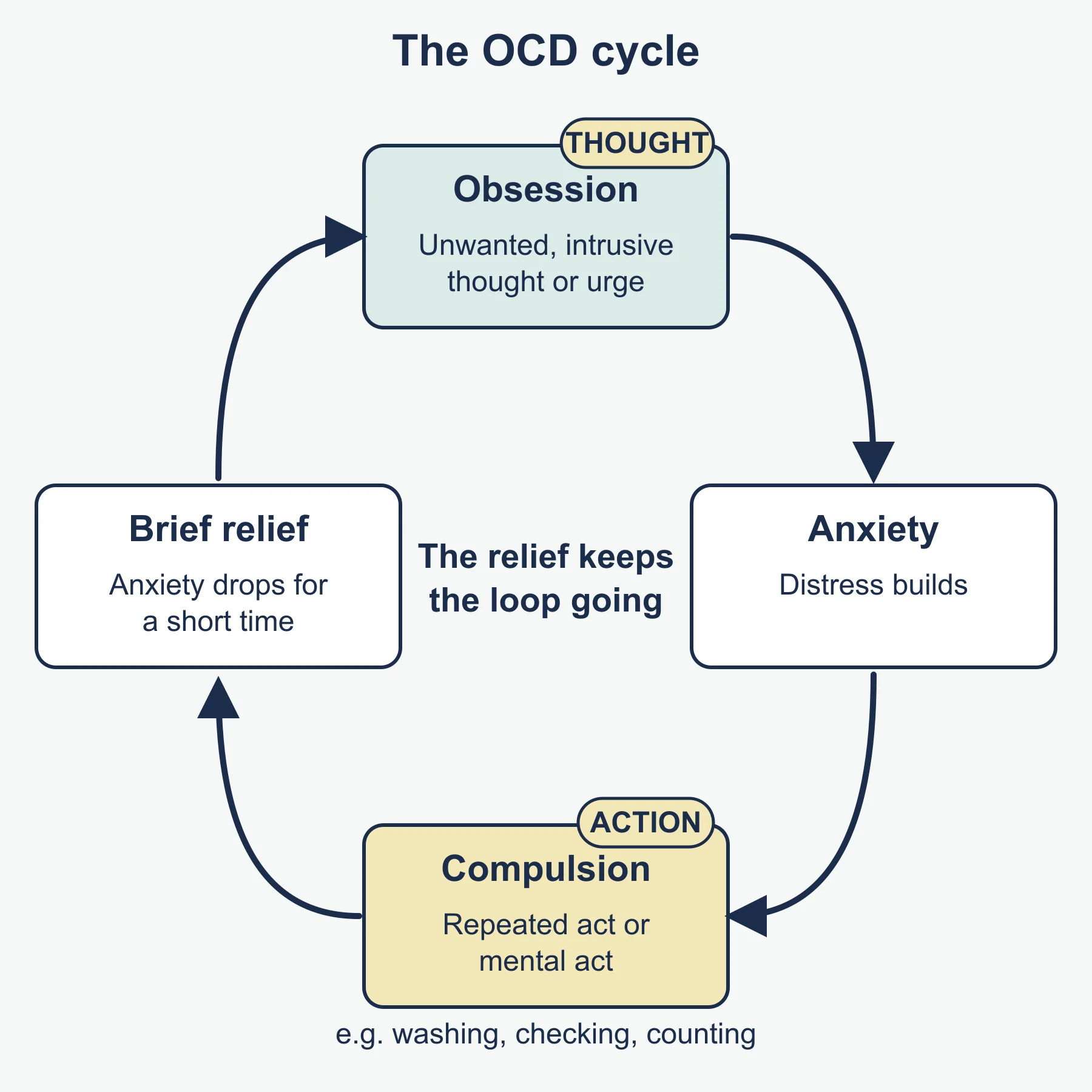
| Obsession | Persistent, unwanted, intrusive thought, image or urge causing anxiety |
| Compulsion | Repetitive behaviour or mental act performed to reduce anxiety |
| Concordance | How often both twins share a condition |
| Serotonin | Neurotransmitter linked to OCD when levels are low |
| Inflated responsibility | Believing you alone must prevent harm (cognitive explanation of OCD) |
| Re-experiencing | Reliving trauma through flashbacks, nightmares or intrusive memories |
| Hypervigilance | Constantly being on guard for danger |
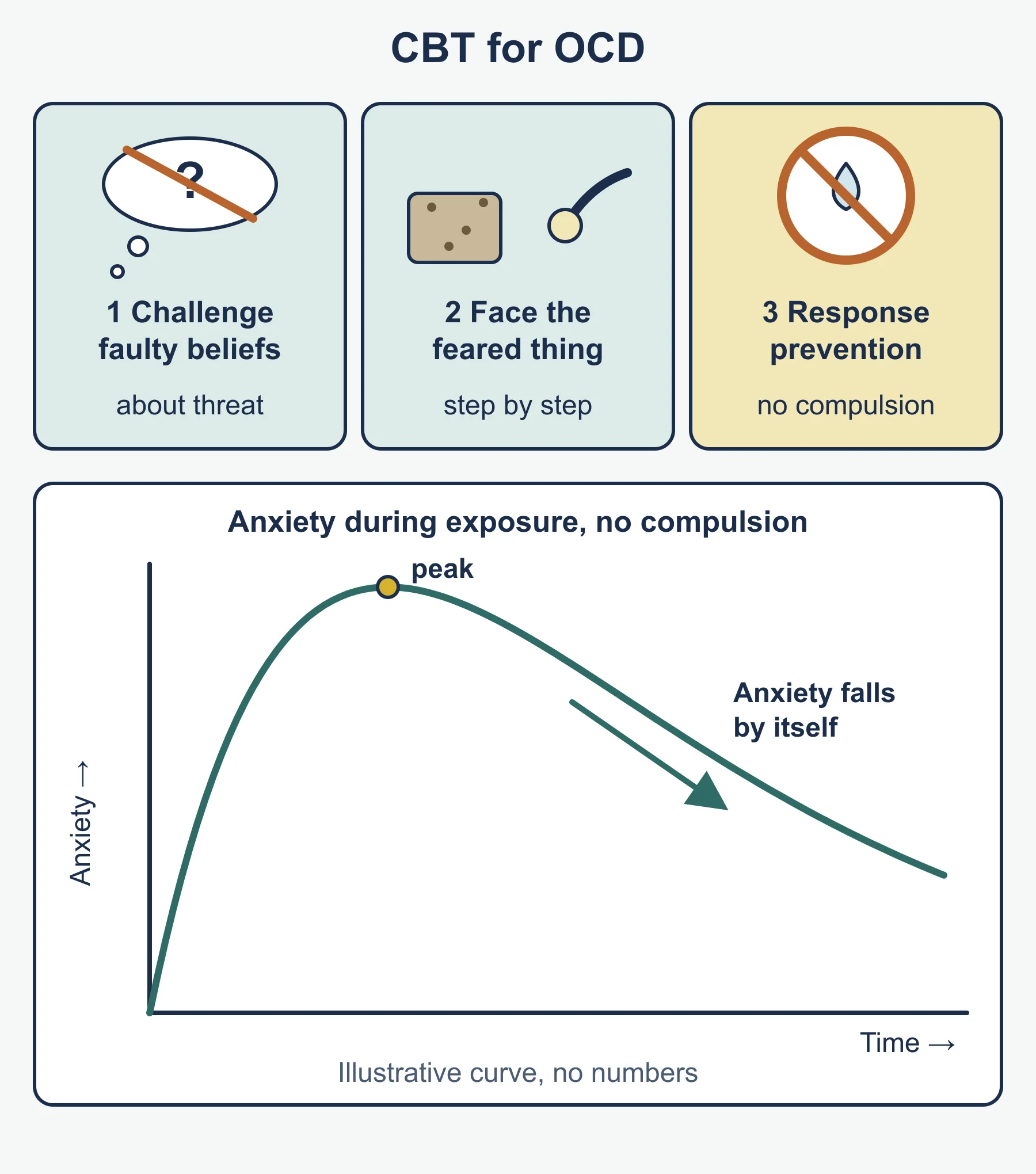
| Exposure | Facing feared thoughts or situations without escaping |
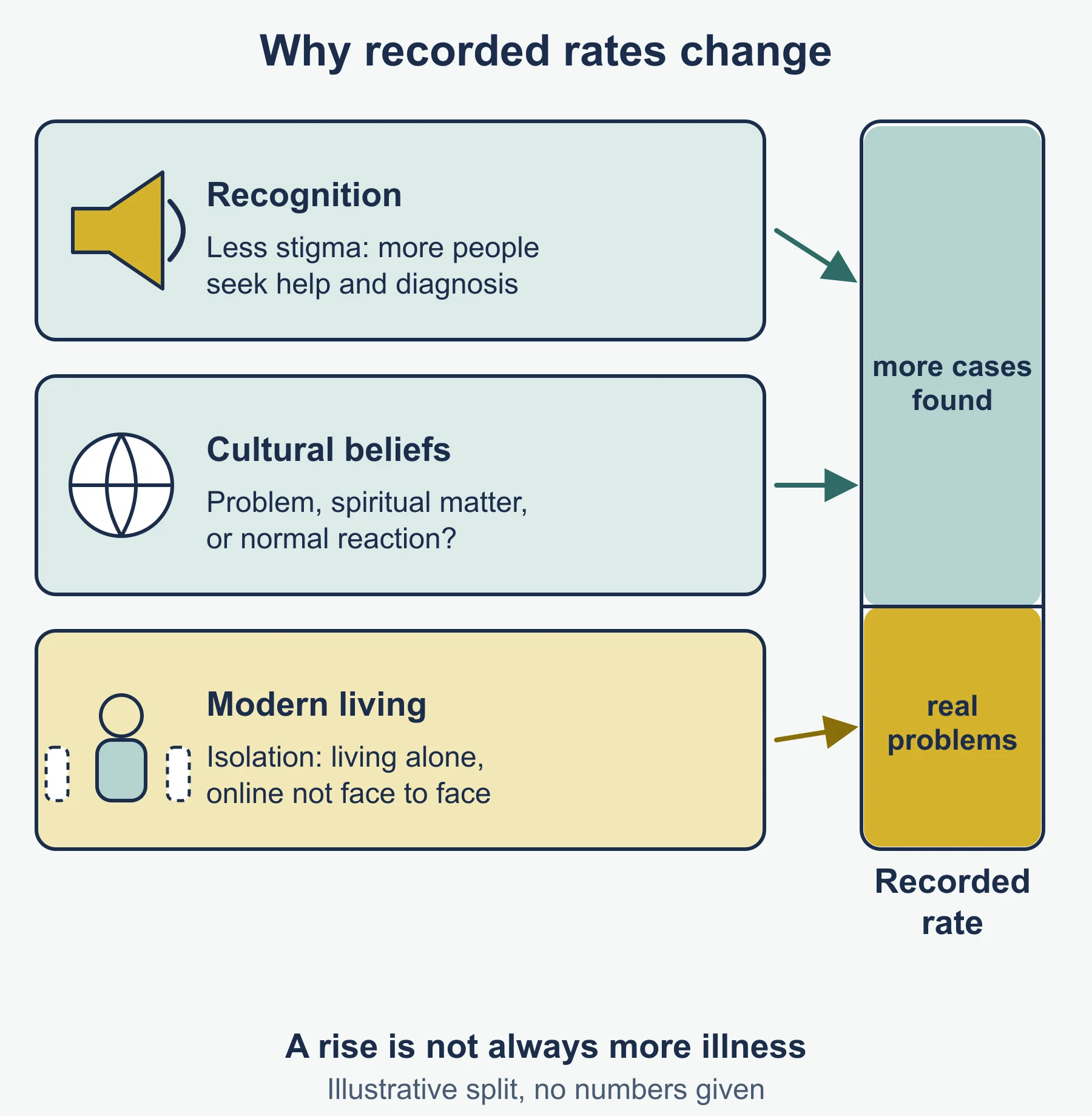
Incidence: why recorded rates change
| Reason | Effect on recorded rate | Real or recorded? |
|---|---|---|
| Cultural variations in beliefs | What counts as a “problem” differs, so reporting differs | Mostly recorded |
| Challenges of modern living, such as isolation | More people may actually experience problems | Real |
| Increased recognition, less stigma | More people seek help and are diagnosed | Mostly recorded |
Characteristics of mental health: positive engagement with society; coping effectively with challenges.
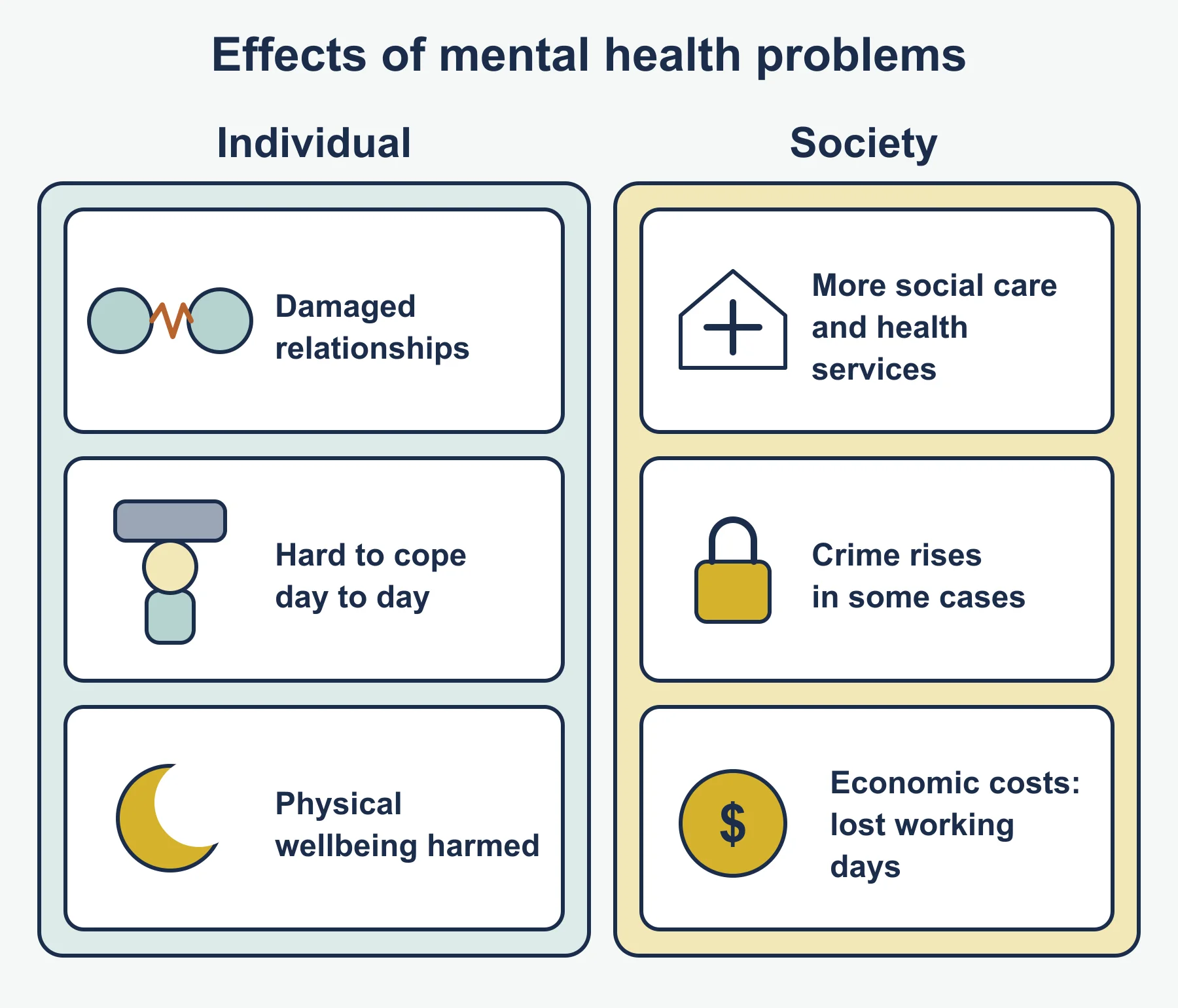
Effects: individuals — relationships, day-to-day coping, physical wellbeing. Society — social care, crime, the economy. In a scenario, choose effects that match the details given.
OCD summary
ICD diagnosis: obsessions, compulsions or both, which take up a lot of time or produce marked distress, and get in the way of work, study or relationships.
| Explanation | Key points | Evaluation |
|---|---|---|
| Biological: genetic | Runs in families; higher concordance in identical than non-identical twins | Concordance is not 100%, so environment matters too |
| Biological: neurochemical | Low serotonin | Drugs that raise serotonin help many patients, though not all |
| Biological: neural | Unusual activity in frontal brain circuits | Hard to tell if brain differences cause OCD or result from it |
| Cognitive | Overestimating threat; inflated responsibility; treating a thought as being as bad as an action; suppressing thoughts makes them return | Supported by the success of CBT; but does not explain where the faulty thinking comes from |
Therapy: CBT — identify and challenge irrational beliefs, then exposure and response prevention (face the trigger, resist the compulsion, learn anxiety falls on its own).
- For: targets both thinking and behaviour; skills can be used after therapy ends.
- Against: exposure is distressing, so some people drop out; it needs motivation and regular sessions.
Named study: Kearns’s study of the effectiveness of CBT for OCD. Learn its aim, method, findings and one strength and limitation from your course textbook.
PTSD summary
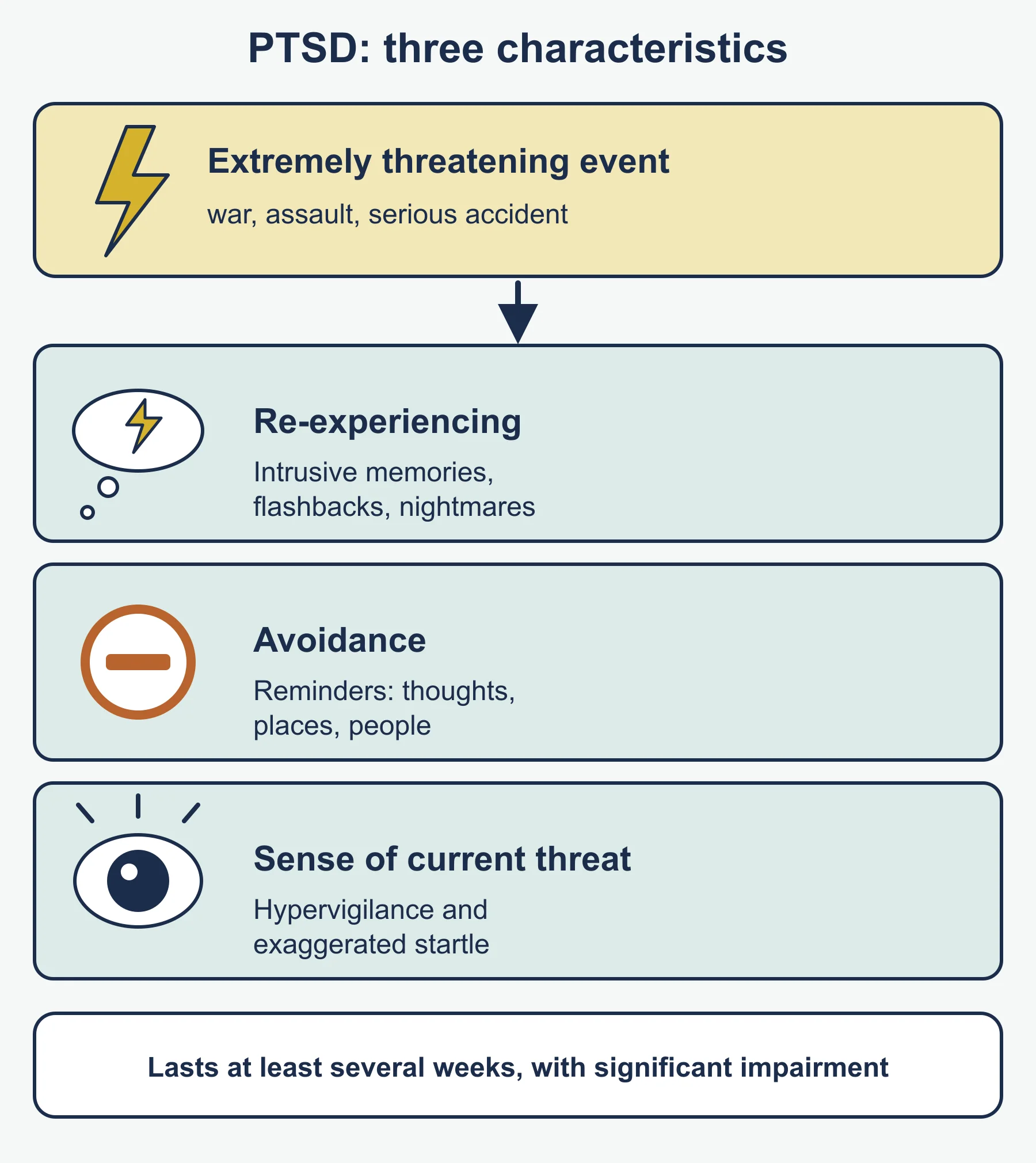
ICD diagnosis: after an extremely threatening or horrific event — re-experiencing in the present, avoidance of reminders, and a persistent sense of current threat — lasting at least several weeks and causing significant impairment.
| Explanation | Key points | Evaluation |
|---|---|---|
| Biological | Genetic vulnerability; over-active amygdala; hippocampus and stress hormones affect how memories are stored | Explains why only some people exposed to trauma develop PTSD; but trauma is still needed, so biology is not the whole story |
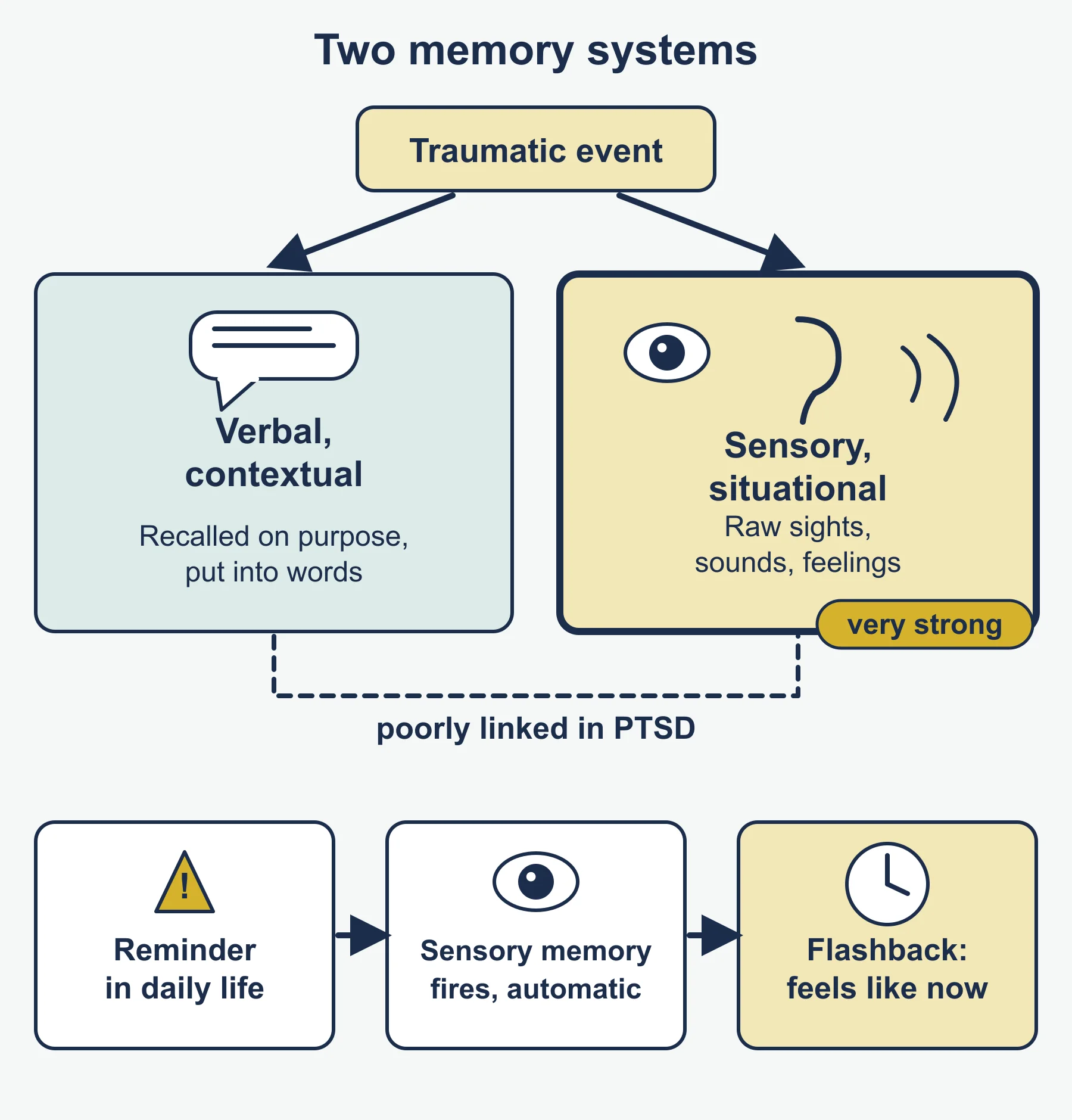
| Dual representation theory | Verbally accessible memory (contextual, can be put into words) versus situationally accessible memory (sensory, triggered by cues); in PTSD the sensory memory is strong and poorly linked | Explains flashbacks well and why exposure helps; but memory systems are hard to observe directly |
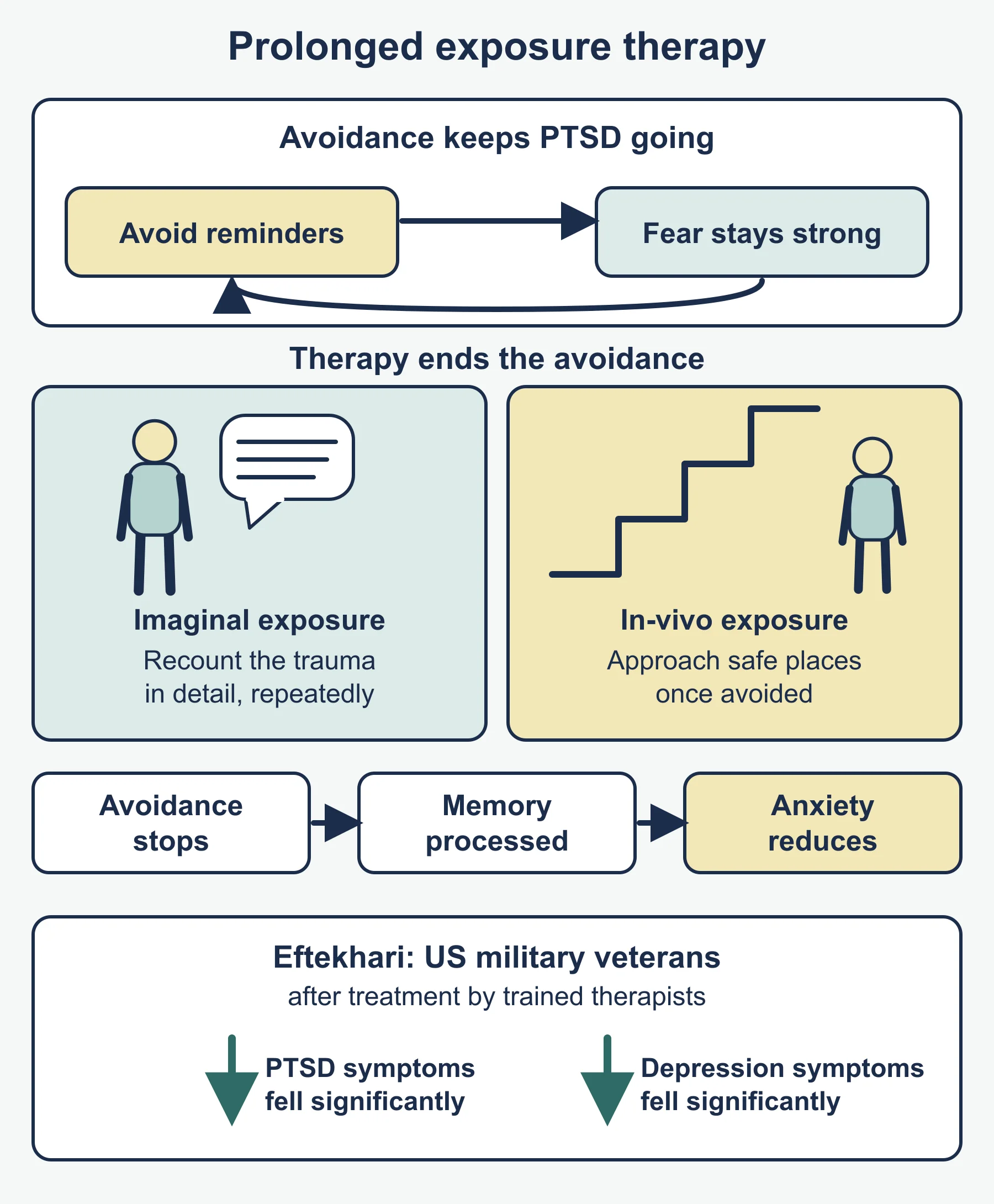
Therapy: prolonged exposure — explain how avoidance maintains PTSD; imaginal exposure (repeatedly recounting the trauma); in-vivo exposure (gradually approaching avoided but safe situations).
- For: directly targets avoidance; helps the trauma memory become linked to its context.
- Against: reliving trauma is very distressing, so some people do not complete it.
Named study: Eftekhari — evaluated a nationwide scheme that trained therapists to give prolonged exposure to US military veterans; both PTSD and depression scores fell significantly. Strength: real clinical setting, so findings apply to everyday treatment. Limitation: veterans only, so findings may not generalise to civilians; it evaluated a programme rather than comparing patients with a control group.
Matching therapy to explanation
| Disorder | Explanation targeted | How therapy targets it |
|---|---|---|
| OCD | Cognitive | Challenges faulty beliefs about threat and responsibility |
| OCD | Behavioural maintenance | Response prevention breaks the compulsion-relief cycle |
| PTSD | Dual representation | Exposure links the sensory memory to the verbal, contextual memory |
| PTSD | Avoidance | In-vivo exposure ends avoidance, so fear can reduce |
Exam traps
- Obsessions are thoughts; compulsions are actions (including mental acts such as counting).
- A rise in recorded incidence is not proof of a real rise.
- The ICD is published by the World Health Organization.
- Dual representation is a psychological explanation; amygdala and genes are biological.
- Prolonged exposure is for PTSD; CBT with exposure and response prevention is for OCD.
- In a “describe a therapy” scenario, use the person’s actual trigger in every step.
Self-test
- Give two characteristics of mental health named in the specification.
- Why might increased recognition raise the recorded incidence of mental health problems?
- Give one effect of significant mental health problems on the economy.
- What does ICD stand for?
- Give one piece of evidence for a genetic explanation of OCD.
- What is inflated responsibility?
- What happens in response prevention?
- Name the three core characteristics of PTSD.
- Which brain structure is linked to fear responses in PTSD?
- In dual representation theory, which type of memory is triggered automatically by cues?
- What is the difference between imaginal and in-vivo exposure?
- Give one limitation of Eftekhari’s study.
Answers:
- Positive engagement with society and effective coping with challenges.
- People are more willing to seek help and clinicians are better at identifying problems, so more cases are diagnosed.
- Lost working days or lower productivity (accept the cost of treatment).
- International Classification of Diseases.
- Concordance is higher for identical twins than for non-identical twins.
- The belief that you are personally responsible for preventing harm.
- The person is exposed to the trigger but supported not to carry out the compulsion.
- Re-experiencing, avoidance and a persistent sense of current threat.
- The amygdala.
- The situationally accessible (sensory) memory.
- Imaginal exposure involves recounting the trauma in the mind; in-vivo exposure involves facing real, safe situations that have been avoided.
- The sample was veterans only, so the findings may not generalise (accept: no control group).
More resources on this topic
Related resources
-
Study guides
OxfordAQA International GCSE Psychology (9218): Research Methods (Paper 2)
Self-report, case studies, observation, correlation and data handling for OxfordAQA IGCSE Psychology 9218 Paper 2, applied to social and mental health research.
Psychology · OxfordAQA · IGCSE
Read guide -
Practice questions
OxfordAQA International GCSE Psychology (9218): Research Methods (Paper 2) – Practice Questions
Original Paper 2 research methods questions with answers for OxfordAQA IGCSE Psychology 9218: correlation data, calculations, observation and self-report.
Psychology · OxfordAQA · IGCSE
Try questions -
Revision notes
OxfordAQA International GCSE Psychology (9218): Research Methods (Paper 2) – Revision Notes
Recall notes for OxfordAQA IGCSE Psychology 9218 Paper 2 research methods: self-report, case studies, observation, correlation, data handling and a self-test.
Psychology · OxfordAQA · IGCSE
Revise topic
Studying Psychology?
This page is free and stays free. Marlbridge is not offering Psychology classes at the moment, so there is no tuition to book for it. The free study resources stay open to everyone.
Get free revision emails (optional)
Occasional emails with practice questions, worked explanations and links to free resources for the qualification and subjects you choose. No spam, and you can unsubscribe from any email. The free tools on this site never need an email.