
Revision Notes
OxfordAQA International GCSE Psychology (9218): Communication – Revision Notes
Communication recall notes for OxfordAQA IGCSE Psychology 9218: language and thought, Von Frisch, non-verbal behaviour, Darwin and Yuki, with a self-test.
- Subject
- Psychology
- Level
- IGCSE
- Topic
- Paper 2 – Social Context and Behaviour
- Author
- Marlbridge Academic Team
- Updated
- Reviewed by
- Kanwal Aslam (what this means)
Aligned to OxfordAQA IGCSE Psychology (9218), Version 1.1. Official specification .
Syllabus page (what it covers and how it is assessed): OxfordAQA IGCSE Psychology.
Syllabus points this page covers
9218
- 3.2.1 Communication
Quick-recall notes for 3.2.1 Communication, Section A of Paper 2 in OxfordAQA International GCSE Psychology (9218). These notes add evaluation points and scenario practice to the core content. For full explanations, use the Communication study guide.
Key terms
| Term | Meaning |
|---|---|
| Linguistic determinism | Strong Sapir-Whorf: language determines what we can think |
| Linguistic relativity | Weak Sapir-Whorf: language influences how easily we think or remember |
| Object permanence | Knowing an object still exists when out of sight (Piaget) |
| Round dance | Bee dance signalling food close to the hive |
| Waggle dance | Bee dance signalling the direction and distance of further food |
| Open posture | Uncrossed arms and legs, facing the other person |
| Closed posture | Crossed arms or legs, body turned away |
| Postural echo | Mirroring another person’s posture |
| Personal space | The area around us that we treat as our own |
| Innate | Present from birth, not learned |
| Adaptive | Helping survival and reproduction, so passed on genetically |
Language and thought: evaluation
| Theory | Supporting point | Challenging point |
|---|---|---|
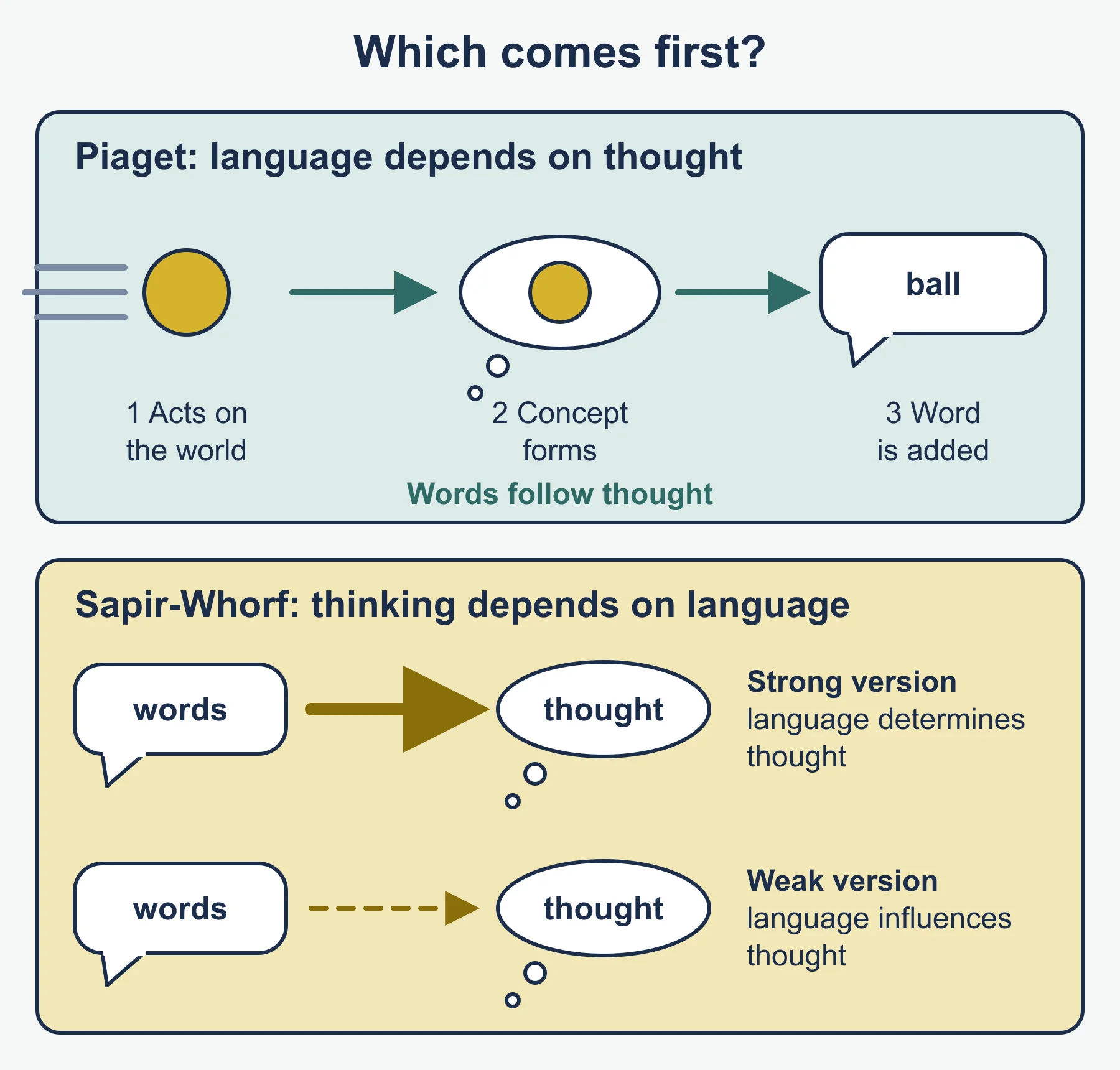
| Piaget (language depends on thought) | Infants show understanding, such as object permanence, before they can speak | Language may help children develop concepts faster, so the link may run both ways |
| Sapir-Whorf, strong (determines) | Some cultures describe concepts that others lack words for | People can think about things they have no word for and can learn new words, so language cannot completely limit thought |
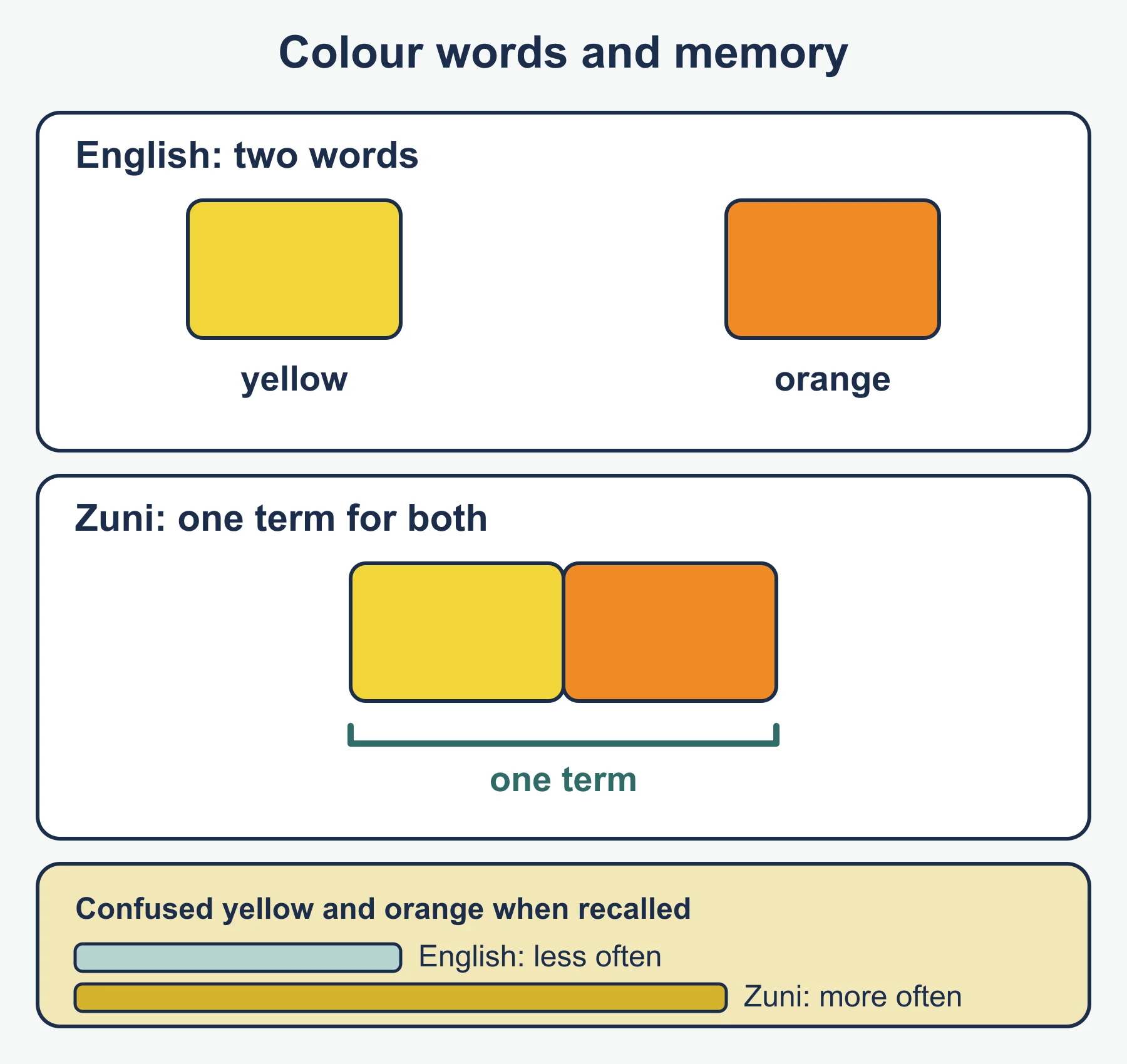
| Sapir-Whorf, weak (influences) | Native American colour research: one term for yellow and orange led to more confusion when recognising those colours from memory | Effects are small and mainly on memory, not on what people can actually see |
Recall of events: the specification also points to variation in how events are recalled across cultures and languages. Use it in the same way as colour: having words for a distinction makes it easier to notice and remember.
Animal versus human communication
| Animal | Human |
|---|---|
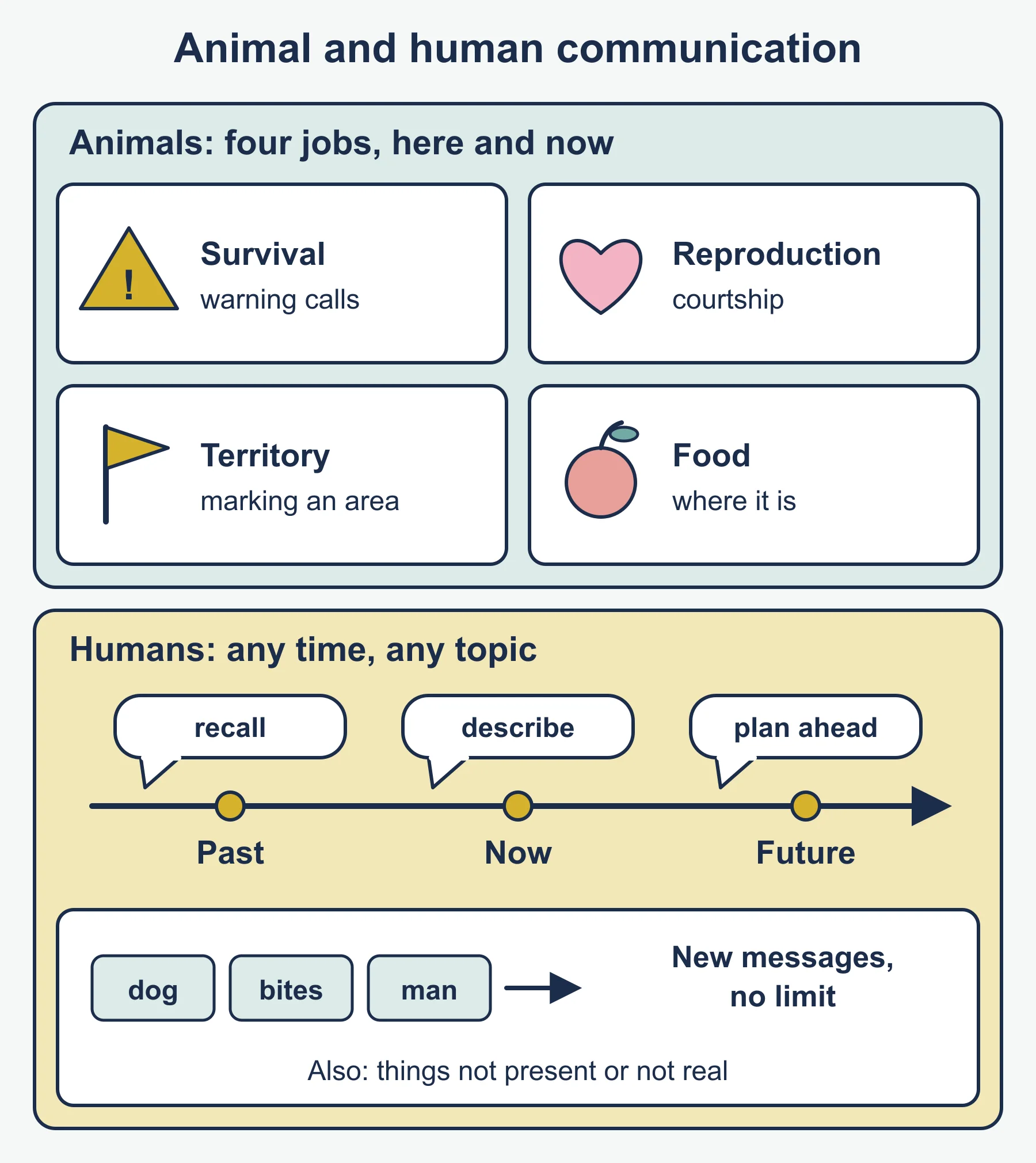
| Limited to four functions: survival, reproduction, territory, food | Can communicate about anything, including feelings and abstract ideas |
| Tied to the here and now | Can plan ahead and discuss future events, and talk about the past |
| A fixed set of signals | Words combine to create unlimited new sentences |
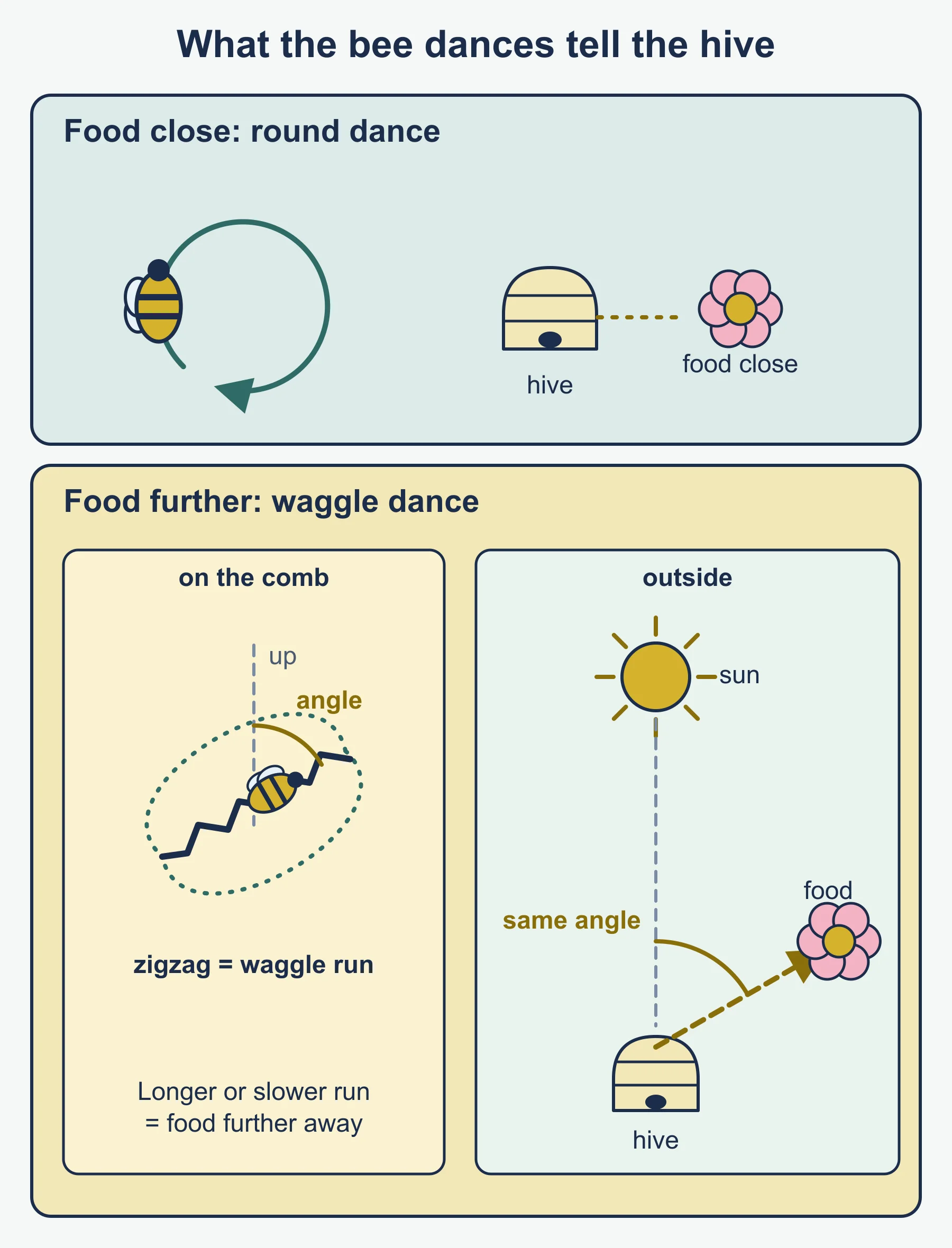
Von Frisch evaluation: carefully controlled field experiments, moving food sources to see how dances changed, gave strong evidence that bees communicate distance and direction. However, findings about bees show complex signalling, not language, and may not apply to other species.
Function examples for application:
- Survival: a bird’s alarm call when a hawk appears.
- Reproduction: a peacock displaying its tail.
- Territory: a cat scent-marking a fence.
- Food: a bee’s waggle dance.
Non-verbal communication
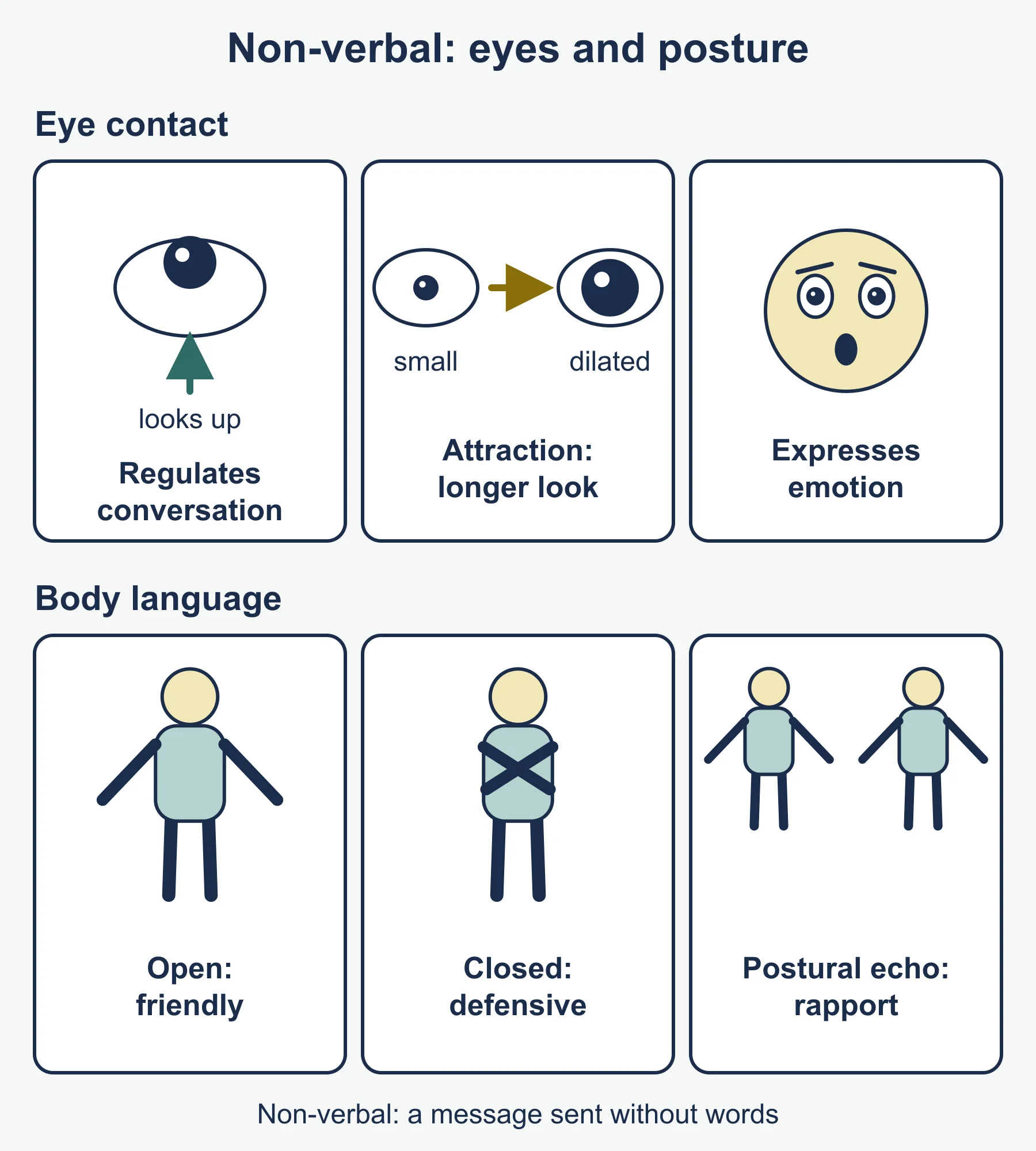
Verbal = spoken or written words. Non-verbal = messages without words.
| Feature | What to remember | Scenario signal |
|---|---|---|
| Eye contact: flow | Speakers look away as they start and look back to hand over | A pause plus a glance means “your turn” |
| Eye contact: attraction | More gazing; pupils dilate | A couple holding each other’s gaze |
| Eye contact: emotion | Wide eyes for fear, narrowed eyes for anger | A wide-eyed child at a loud noise |
| Open / closed posture | Open = friendly; closed = defensive | Crossed arms during an argument |
| Postural echo | Mirroring shows rapport | Friends both leaning forward on the table |
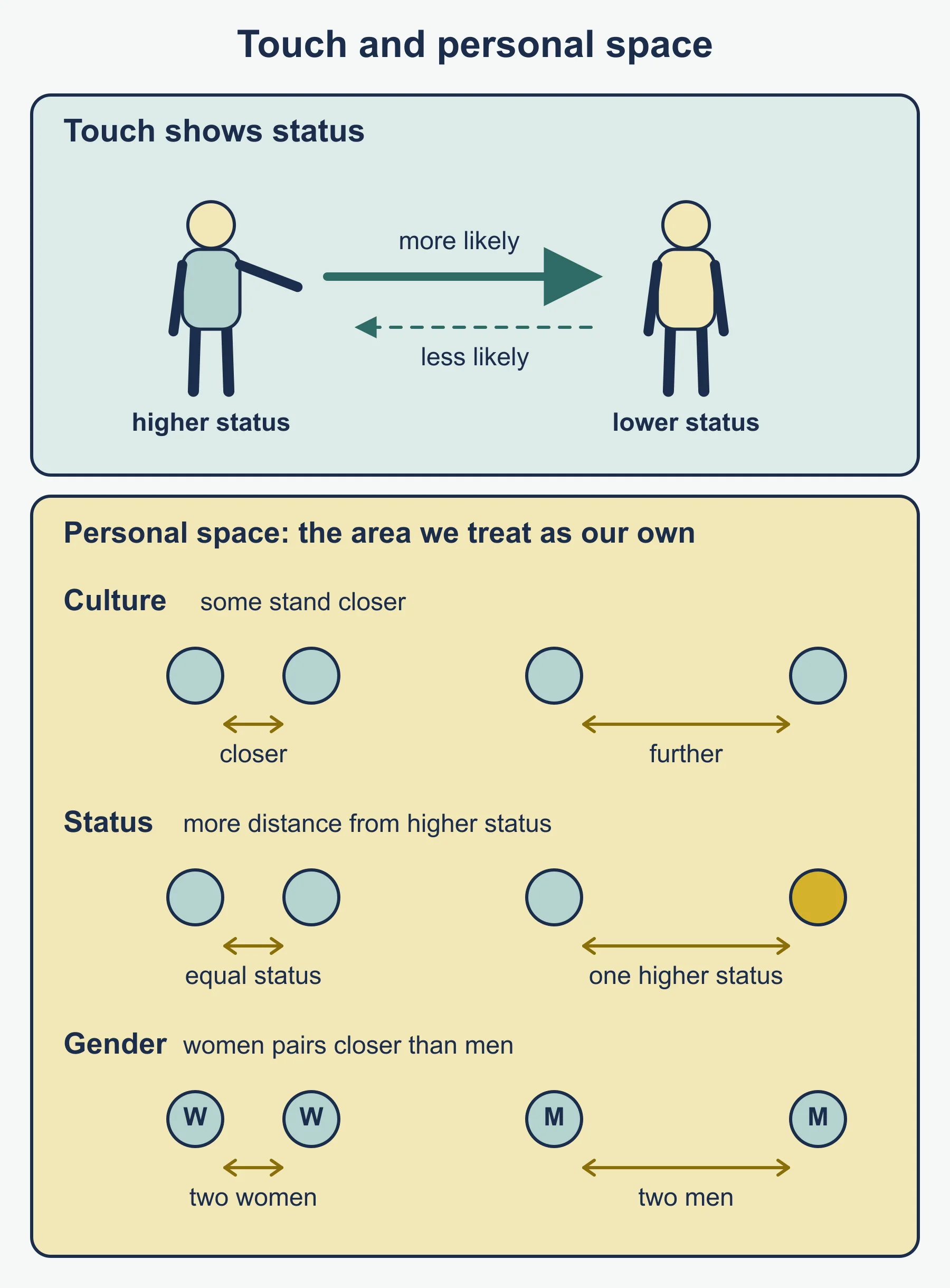
| Touch | Support, affection and status | A manager patting a junior’s shoulder |
| Personal space | Varies with culture, status and gender | A student standing further from the head teacher |
Innate or learned?
| Innate (Darwin) | Learned |
|---|---|
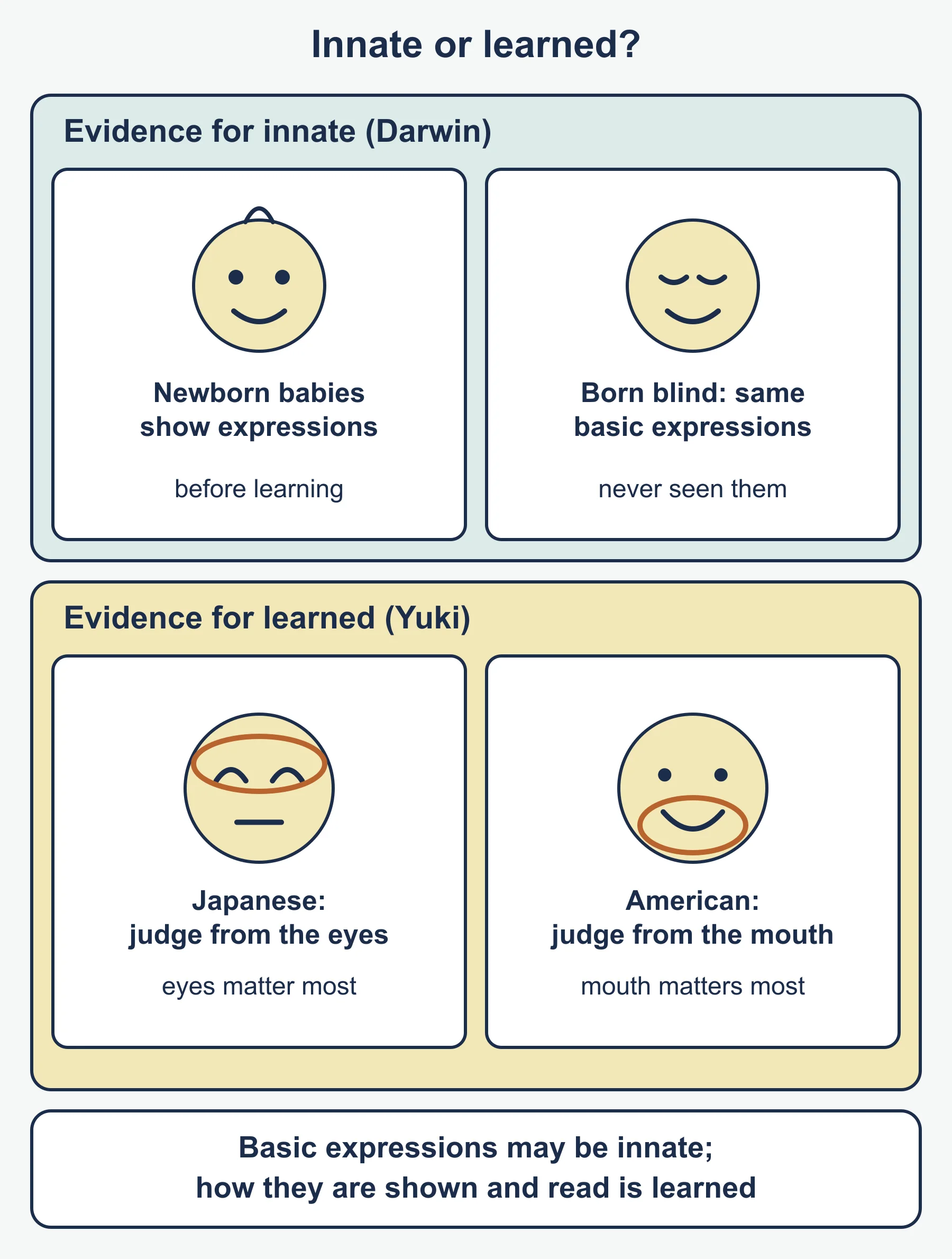
| Expressions evolved because they were adaptive (for example, baring teeth warned rivals) | Gestures and display rules differ between cultures |
| Neonates show basic expressions and respond to faces too early to have learned them | Yuki’s emoticon study: eyes mattered more to Japanese judges of emotion; the mouth mattered more to American judges |
| Sensory-deprived people, such as those born blind, produce basic expressions they have never seen | Children copy the non-verbal style of those around them |
Yuki evaluation: a strength is that it used both emoticons and photographs of faces, so results were not limited to one kind of image; a limitation is that participants were university students from two countries, so the findings may not represent whole cultures.
Best conclusion: basic expressions may be innate, but how they are displayed and interpreted is shaped by learning and culture.
Exam traps
- Piaget: thought first. Sapir-Whorf: language first. Do not reverse them.
- Name the version of Sapir-Whorf the evidence supports (usually the weak version).
- When describing Von Frisch, always state what each dance communicates.
- Do not confuse postural echo (mirroring) with an open posture.
- Personal space has three named differences: cultural, status and gender. Give the direction of each difference, not just its name.
- Yuki supports learning; neonates and the sensory deprived support Darwin.
- “Verbal” includes written words, not just speech.
Self-test
- Which theory says thinking depends on language?
- What is the difference between the strong and weak versions of the Sapir-Whorf hypothesis?
- Give one criticism of the strong version.
- What does the waggle dance show?
- Give one property of human communication not found in animal communication.
- Define non-verbal communication.
- Give the three functions of eye contact on the specification.
- What is postural echo and what does it usually signal?
- Describe one status difference in personal space.
- Why do neonates provide evidence that non-verbal behaviour is innate?
- What did Yuki find about Japanese and American participants?
- Give one limitation of Yuki’s study.
Answers:
- The Sapir-Whorf hypothesis.
- The strong version says language determines thought; the weak version says it only influences thought.
- People can think about things they have no word for, and can learn new words, so language does not completely limit thought.
- The direction of the food (angle relative to the sun) and its distance.
- Planning ahead and discussing future events (accept talking about the past or absent things).
- Communicating without words, for example through eye contact, posture, touch and personal space.
- Regulating the flow of conversation, signalling attraction and expressing emotion.
- Mirroring another person’s posture; it usually signals rapport or agreement.
- People keep more distance from someone of higher status.
- They show expressions before they have had the chance to learn them.
- Japanese participants’ emotion ratings depended more on the eyes; American participants’ ratings depended more on the mouth.
- Participants were students from two countries, so the results may not represent whole cultures.
More resources on this topic
Related resources
-
Study guides
OxfordAQA International GCSE Psychology (9218): Social and Dispositional Factors Affecting Conformity
Study guide to group size, anonymity, task difficulty, personality and expertise in conformity for OxfordAQA IGCSE Psychology 9218, with Asch's variations.
Psychology · OxfordAQA · IGCSE
Read guide -
Practice questions
OxfordAQA International GCSE Psychology (9218): Social and Dispositional Factors Affecting Conformity – Practice Questions
Original questions on group size, anonymity, task difficulty, personality and expertise in conformity for OxfordAQA IGCSE Psychology 9218, with answers.
Psychology · OxfordAQA · IGCSE
Try questions -
Revision notes
OxfordAQA International GCSE Psychology (9218): Social and Dispositional Factors Affecting Conformity – Revision Notes
Condensed notes on conformity factors for OxfordAQA IGCSE Psychology 9218: group size, anonymity, task difficulty, personality, expertise and a self-test.
Psychology · OxfordAQA · IGCSE
Revise topic
Studying Psychology?
This page is free and stays free. Marlbridge is not offering Psychology classes at the moment, so there is no tuition to book for it. The free study resources stay open to everyone.
Get free revision emails (optional)
Occasional emails with practice questions, worked explanations and links to free resources for the qualification and subjects you choose. No spam, and you can unsubscribe from any email. The free tools on this site never need an email.