
Revision Notes
Cambridge International AS & A Level Geography (9696): 2.1 Diurnal energy budgets – Revision Notes
Revision notes for Cambridge 9696 Geography 2.1 Diurnal energy budgets: key terms, processes, worked examples, exam traps and a self-test with answers.
- Subject
- Geography
- Level
- AS LEVEL
- Topic
- Topic 2 – Atmosphere and weather
- Author
- Marlbridge Academic Team
- Updated
- Reviewed by
- Azam Siddique (what this means)
Aligned to Cambridge A Level Geography (9696), 2025-2026. Official specification .
Syllabus page (what it covers and how it is assessed): Cambridge A Level Geography.
Syllabus points this page covers
9696 (AS Level)
- 2.1 Diurnal energy budgets
Condensed recall for 2.1 Diurnal energy budgets (the energy balance of a surface over 24 hours). For full explanations, read the Core Physical Geography study guide.
Key terms
| Term | Meaning |
|---|---|
| Insolation | Incoming solar radiation (shortwave) |
| Albedo | Proportion of incoming radiation reflected by a surface |
| Longwave radiation | Heat radiated by the Earth’s surface and atmosphere |
| Sensible heat | Heat transferred by conduction and convection; changes air temperature |
| Latent heat | Heat absorbed or released when water changes state |
| Ground (subsurface) heat flux | Heat conducted into or out of the ground |
| Net radiation | Incoming minus outgoing radiation at the surface |
| Diurnal | Over a 24-hour day-night cycle |
| Temperature inversion | Air temperature rising with height near the ground, usually after a clear night |
| Radiation fog | Fog formed when surface cooling chills moist air to its dew point |
Daytime budget
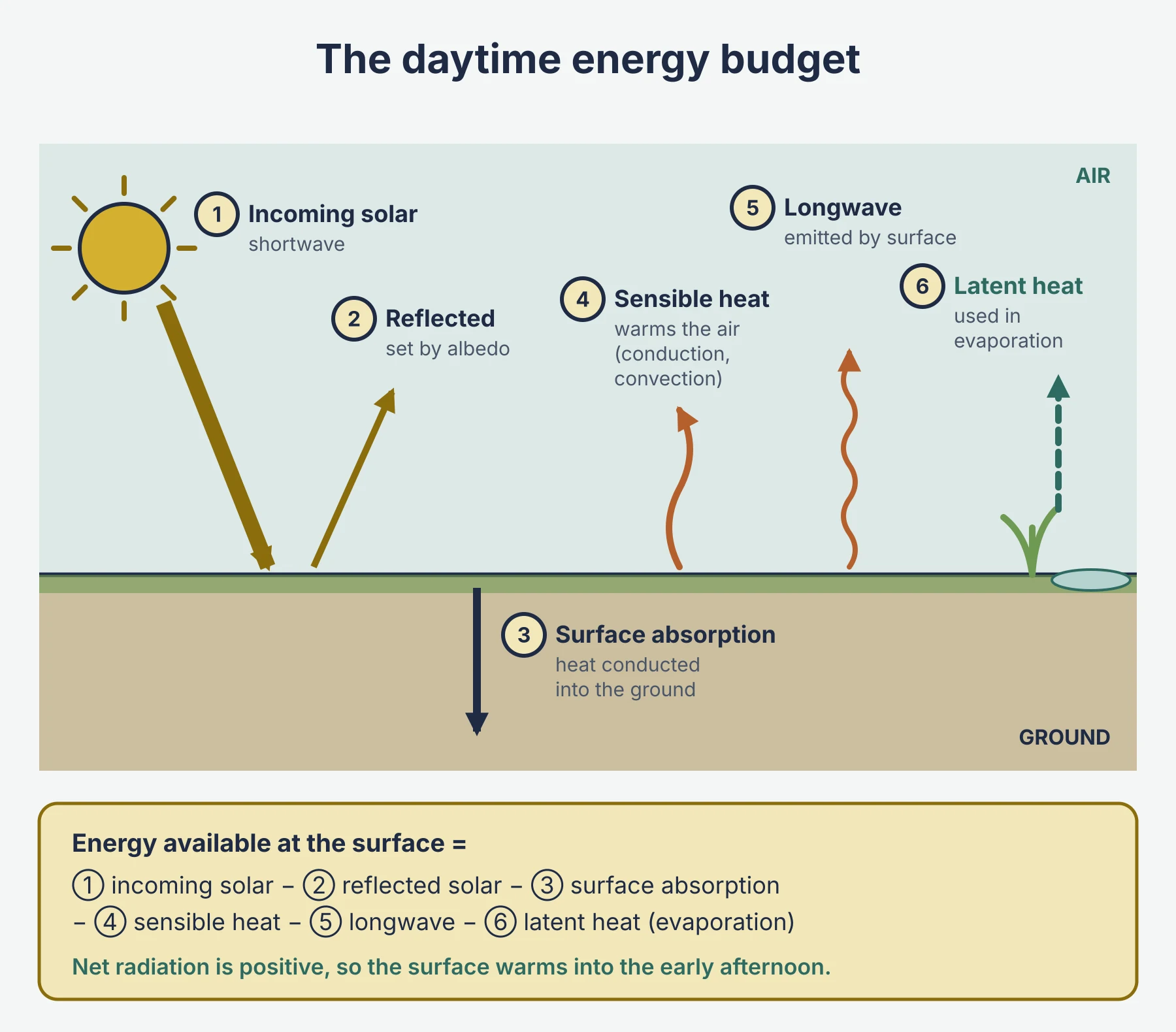
Inputs: shortwave solar radiation (plus longwave from the atmosphere). Losses and uses:
- reflected shortwave (set by albedo);
- energy absorbed into the surface and ground;
- sensible heat transferred to the air;
- latent heat used in evaporation (from soil, water and plants);
- longwave radiation emitted.
Net radiation is positive, so the surface warms and temperature rises towards early afternoon.
The daytime budget as an equation (the six-component model often used, after T. R. Oke):
Energy available at the surface = incoming solar radiation - reflected solar radiation - surface absorption (into the ground) - sensible heat transfer - longwave radiation - latent heat transfer (evaporation)
The surface is in balance when inputs equal all the uses and losses. Learn each term, which way it goes, and what controls its size.
Why the warmest time is after midday: insolation peaks around noon, but net radiation stays positive into the early afternoon, so the surface and air keep gaining energy until incoming and outgoing flows balance.
Night-time budget
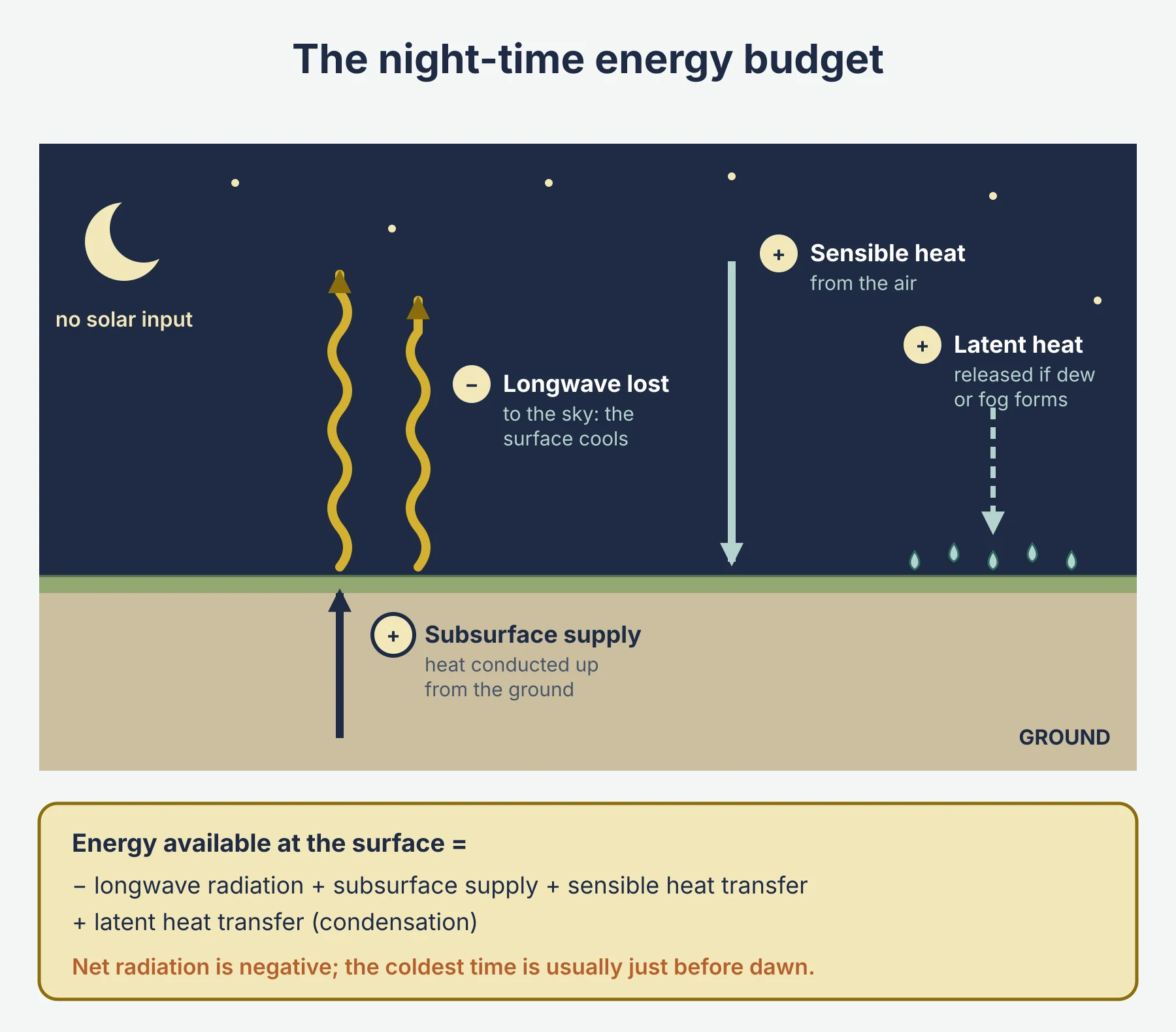
There is no solar input. The surface loses energy by longwave radiation, and cools. Offsetting gains: heat conducted up from the subsurface, sensible heat from the air, and latent heat released if dew or fog forms. Net radiation is negative.
The night-time budget as an equation:
Energy available at the surface = - longwave radiation + subsurface supply + sensible heat transfer + latent heat transfer (condensation)
The coldest time is usually just before dawn, after a whole night of longwave loss.
Albedo values (approximate)
| Surface | Typical albedo |
|---|---|
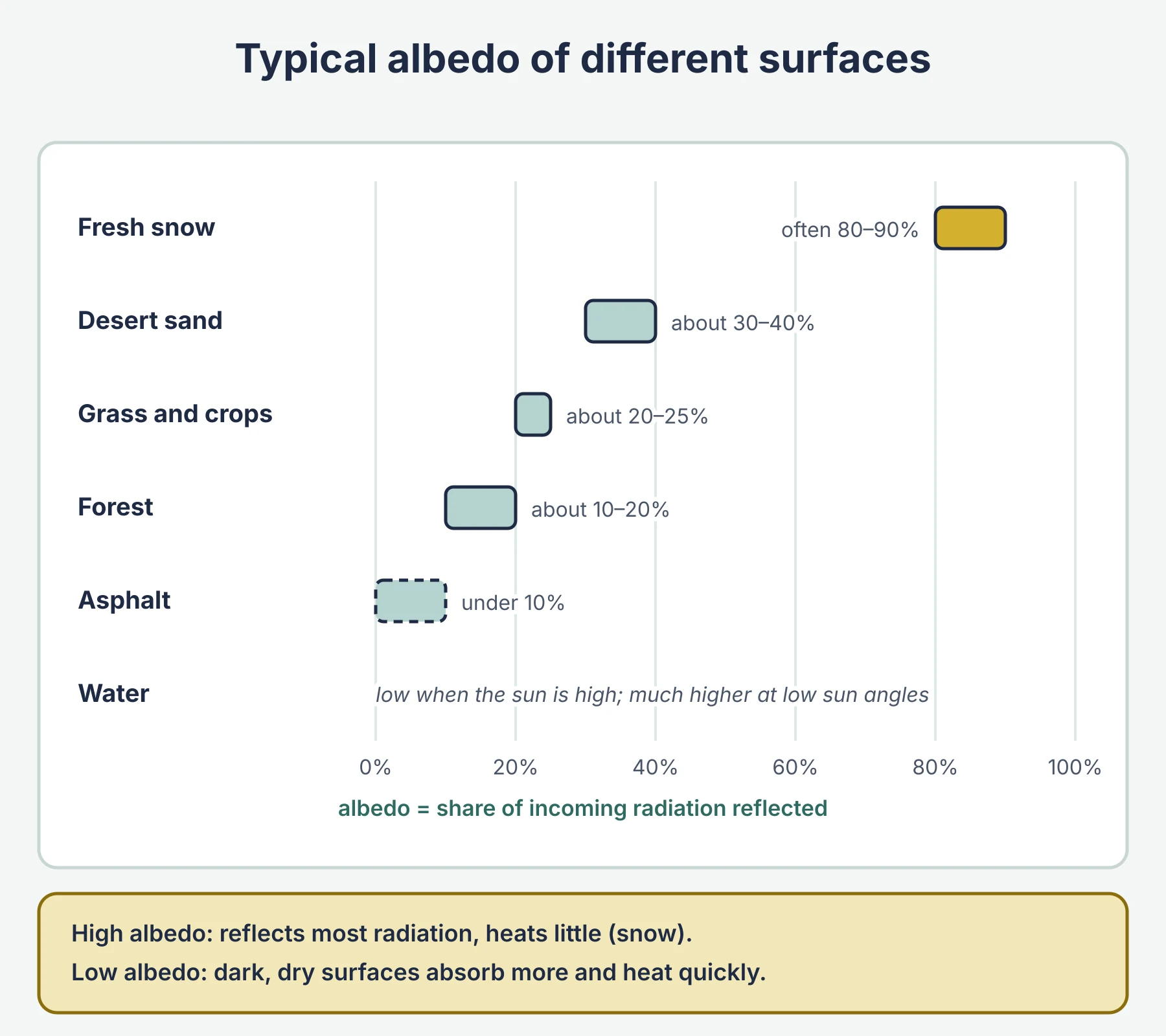
| Fresh snow | Very high, often 80 to 90 per cent |
| Desert sand | Fairly high, about 30 to 40 per cent |
| Grass and crops | About 20 to 25 per cent |
| Forest | Low, about 10 to 20 per cent |
| Asphalt | Very low, under 10 per cent |
| Water | Low when the sun is high; much higher at low sun angles |
These are typical ranges; use the figures given in a question if they differ.
What changes the budget
| Factor | Effect |
|---|---|
| Surface type | Dark, dry surfaces have low albedo and heat quickly; snow reflects most radiation |
| Moisture | Wet surfaces use energy for evaporation, so heat less |
| Cloud | By day reflects insolation; by night traps longwave, so nights are warmer |
| Vegetation | Shades the ground, transpires, alters albedo |
| Urban areas | Dark materials store heat and release it at night |
| Wind | Mixes air, spreading sensible heat and limiting both daytime heating and night cooling |
| Season and latitude | Sun angle and day length control the size of the solar input |
Contrasting two surfaces
| Hot desert | Tropical rainforest | |
|---|---|---|
| Daytime | Little moisture, so almost no latent heat; most energy heats the ground and air; very high surface temperatures | Much energy used in evaporation and transpiration; temperatures high but moderated |
| Night | Clear skies and dry air allow strong longwave loss; rapid cooling | Cloud and humid air trap longwave; small night cooling |
| Diurnal range | Very large | Small |
Night-time phenomena
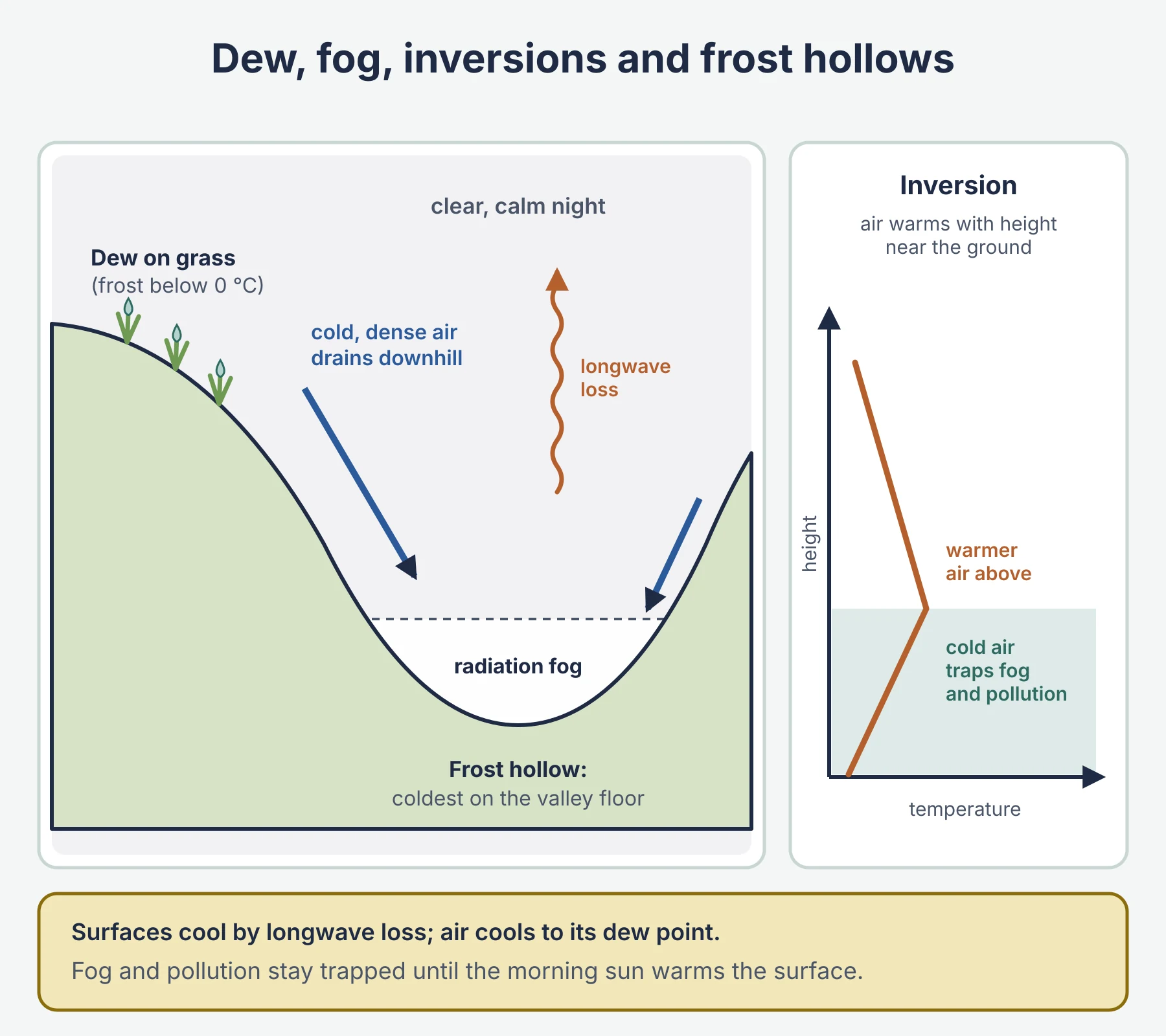
- Dew: on a clear, calm night, surfaces cool by longwave radiation; air in contact cools to its dew point and water vapour condenses on grass and other surfaces, releasing latent heat. Below 0 degrees C, frost forms instead.
- Radiation fog: if the air is moist and there is a light breeze, cooling spreads through a shallow layer and droplets form in the air.
- Temperature inversion: air near the cold ground becomes colder than the air above it. Pollution and fog are trapped beneath the inversion until the morning sun warms the surface.
- Frost hollows: cold, dense air drains downhill at night and collects in valley floors, which are colder than the slopes above.
Annotated model paragraph
“Explain why the diurnal temperature range is greater on clear days than cloudy ones.”
By day, clear skies let more insolation reach the surface, so it heats strongly (daytime input). At night, no cloud absorbs and returns longwave radiation, so heat escapes and the surface cools sharply (night loss). Cloud reflects insolation by day and traps longwave by night (contrast). So the range is larger under clear skies (conclusion).
Exam traps
- Albedo is the reflected share, not the absorbed amount.
- Cloud acts in both directions: cooler days, warmer nights.
- Latent heat is not a temperature change you can feel; sensible heat is.
- Describe both day and night if a question says “diurnal”.
- Insolation is shortwave; terrestrial radiation is longwave. Do not mix them up.
- The ground stores heat by day and returns it at night: the subsurface flux changes direction.
Self-test
- Define albedo.
- Which heat transfer is released when dew forms?
- Why are clear nights colder than cloudy nights?
- Name two daytime uses of absorbed energy.
- Why is net radiation negative at night?
- Why do wet surfaces warm more slowly than dry ones?
- List the six components of the daytime energy budget.
- Why is the hottest time of day after noon?
- Why do deserts have a large diurnal temperature range?
- What is a temperature inversion, and why does it trap pollution?
- How does wind affect night-time cooling?
- Which surface has the higher albedo: fresh snow or asphalt?
Answers: 1. The proportion of incoming solar radiation reflected by a surface. 2. Latent heat. 3. Cloud returns longwave radiation to the surface; clear skies let it escape. 4. Heating the ground, sensible heat to the air, evaporation (latent heat). 5. There is no shortwave input but longwave is still lost. 6. Energy goes into evaporation as latent heat. 7. Incoming solar radiation, reflected solar radiation, surface absorption, sensible heat transfer, longwave radiation, latent heat transfer. 8. Net radiation stays positive into the early afternoon. 9. Dry air and clear skies: little latent heat use by day and strong longwave loss at night. 10. Air warming with height near the ground; the cold, dense layer does not rise, so pollutants stay trapped. 11. It mixes warmer air down to the surface, reducing cooling. 12. Fresh snow.
More resources on this topic
Related resources
-
Revision notes
Cambridge International AS & A Level Geography (9696): 2.2 The global energy budget – Revision Notes
Revision notes for Cambridge 9696 Geography 2.2 The global energy budget: key terms, processes, worked examples, exam traps and a self-test with answers.
Geography · Cambridge · AS Level
Revise topic -
Revision notes
Cambridge International AS & A Level Geography (9696): 2.3 Weather processes and phenomena – Revision Notes
Revision notes for Cambridge 9696 Geography 2.3 Weather processes and phenomena: key terms, processes, exam traps and a self-test with answers.
Geography · Cambridge · AS Level
Revise topic -
Study guides
Cambridge International AS & A Level Geography (9696): 2.1 Diurnal energy budgets
Study guide to Cambridge 9696 Geography 2.1 Diurnal energy budgets: each day and night component explained, worked energy budgets and exam technique.
Geography · Cambridge · AS Level
Read guide
Studying Geography?
This page is free and stays free. Marlbridge is not offering Geography classes at the moment, so there is no tuition to book for it. The free study resources stay open to everyone.
Get free revision emails (optional)
Occasional emails with practice questions, worked explanations and links to free resources for the qualification and subjects you choose. No spam, and you can unsubscribe from any email. The free tools on this site never need an email.