
Revision Notes
Cambridge International AS & A Level Geography (9696): 5.4 The management of international migration – Revision Notes
Revision notes for Cambridge 9696 Geography 5.4 The management of international migration: key terms, processes, exam traps and a self-test with answers.
- Subject
- Geography
- Level
- AS LEVEL
- Topic
- Topic 5 – Migration
- Author
- Marlbridge Academic Team
- Updated
- Reviewed by
- Azam Siddique (what this means)
Aligned to Cambridge A Level Geography (9696), 2025-2026. Official specification .
Syllabus page (what it covers and how it is assessed): Cambridge A Level Geography.
Syllabus points this page covers
9696 (AS Level)
- 5.4 The management of international migration
Condensed recall for 5.4 The management of international migration, including the required migration stream case study. For full explanations, read the Core Human Geography study guide.
Key terms
| Term | Meaning |
|---|---|
| Quota | Cap on the number of entrants |
| Points-based system | Entry granted by scoring skills, language and age |
| Work permit / visa | Legal authority to enter or work |
| Border control | Checks and barriers to limit entry |
| Irregular migration | Entering or staying without legal permission |
| Integration | Settling migrants into the economy and society |
| Assimilation | Migrants adopt the culture of the host society |
| Multiculturalism | Groups keep distinct cultures within a shared society |
| Guest worker scheme | Temporary labour recruitment, with workers expected to return |
| Amnesty (regularisation) | Granting legal status to people already living in a country irregularly |
| Remittances | Money sent home by migrants |
How states manage migration
- Restrict: quotas, border controls, visa requirements, detention and deportation, carrier checks.
- Select: points systems and skills lists to meet labour needs.
- Encourage: targeted recruitment, work visas, reunification.
- Protect: asylum and refugee procedures, resettlement.
- Integrate: language training, access to work and services.
- Cooperate: agreements between origin, transit and destination countries; managing migration by tackling its causes.
Source countries manage migration too. Some, such as the Philippines, actively organise and protect workers going overseas because remittances matter to the national economy. Others try to slow a brain drain by bonding trained doctors to public service for a period, or try to attract the diaspora home with investment incentives.
Comparing approaches
| Approach | Strength | Weakness |
|---|---|---|
| Points-based selection | Matches entrants to labour needs; transparent | Excludes low-paid workers that some sectors still need |
| Temporary worker schemes | Fills seasonal gaps, such as harvests | Workers can be tied to one employer and exploited; many stay on |
| Physical barriers and patrols | Visible; can cut crossings at a given point | Costly; routes shift to more dangerous areas; smuggling grows |
| Amnesty | Brings people into the tax system and protects workers | Criticised for rewarding irregular entry |
| Development aid to origins | Tackles root causes | Slow; development can increase migration in the short term, as people gain the means to move |
Challenges
Irregular crossings and smuggling, enforcement cost, human-rights concerns, conflicting views within a population, labour dependence on migrants, and difficulty predicting flows.
Required case study
Know one international migration stream: its causes, character, scale, pattern and impacts. Structure it as:
- Origin and destination.
- Causes (push and pull) and history.
- Character: who moves, how, legal or irregular.
- Scale and trend, with checked figures.
- Pattern: routes and where migrants settle.
- Impacts on source and destination.
- Management and your evaluation of it.
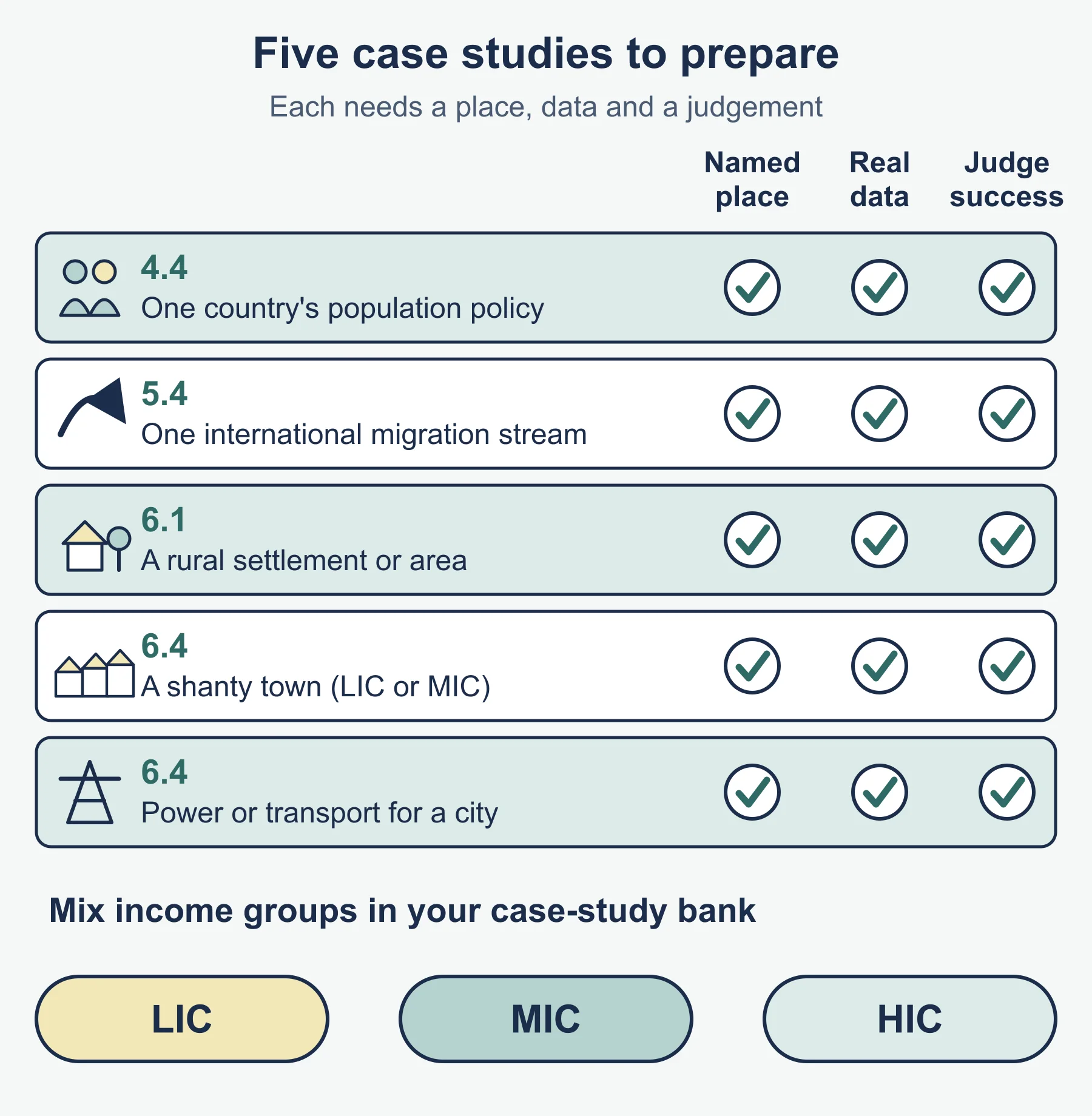
Worked case study outline: Mexico to the United States
This is one of the most widely documented migration streams in the world. Use it as a model and add figures only from a source you have checked, with its year.
- Origin and destination: Mexico to the USA, across a long shared land border.
- Causes and history: a large wage gap between the two countries; US demand for labour in farming, construction and services. The Bracero Program (1942 to 1964) recruited Mexican farm workers and built networks that later migrants followed. After the North American Free Trade Agreement (1994), cheaper US maize imports put pressure on small Mexican farmers, adding a push factor. Chain migration through family and village networks kept the stream going.
- Character: historically dominated by young working-age men from rural central and western Mexico, later more families and women; a mix of legal and irregular movement.
- Scale and trend: Mexicans became the largest foreign-born group in the USA. Net migration from Mexico slowed sharply after the 2007 to 2009 recession, as US jobs fell, border enforcement tightened and Mexico’s birth rate had fallen. Research by the Pew Research Center reported that more Mexicans left the USA than arrived between 2009 and 2014. Since then, a growing share of people crossing the border have come from Central America and further afield, often travelling through Mexico.
- Pattern: settlement concentrated in California and Texas, with large communities in cities such as Los Angeles, Chicago and Houston, then spreading to other states.
- Impacts on Mexico: remittances are a major source of foreign income and support household spending, education and house building; loss of young workers from some rural areas; ageing and female-headed households left behind.
- Impacts on the USA: labour for agriculture, construction and services; tax revenue and consumer spending; cultural influence; political debate over wages, public services and irregular status.
- Management: the Immigration Reform and Control Act (1986) combined an amnesty for many irregular residents with penalties for employers; border enforcement was stepped up from the 1990s, with fencing in urban sectors and more Border Patrol agents; the H-2A visa allows temporary agricultural workers; the Deferred Action for Childhood Arrivals programme (2012) protected some people brought to the USA as children.
Evaluation: enforcement in cities pushed crossings into remote desert areas, where more migrants died and smuggling became more organised. The amnesty legalised many residents but did not stop later irregular migration. The fall in net Mexican migration after 2008 owed at least as much to economic and demographic change in both countries as to policy, which is a strong evaluation point.
Annotated model paragraph
“Assess the success of attempts to manage one international migration stream.”
Stronger border controls reduced crossings in some urban sectors (evidence of success), but crossings moved to more dangerous desert routes (unintended effect). The later fall in net migration was linked to fewer jobs in the USA and lower fertility in Mexico (other factors). So policy had limited success on its own (judgement).
Exam traps
- Describe the stream, then evaluate: who benefits, who loses.
- Avoid out-of-date figures; give the year or write in general terms.
- Do not treat government views as the only viewpoint.
- Separate the stream’s features (causes, character, scale, pattern) from its management; questions may ask for only one.
- A change in flows is not automatic proof that a policy worked: check for economic and demographic causes.
Self-test
- What is a points-based system?
- Name two ways of restricting immigration.
- Give one challenge of controlling migration.
- Name two things the 5.4 case study must include.
- Why might a state encourage immigration?
- What does integration mean?
- What was the Bracero Program?
- How can stronger border control at one point increase deaths elsewhere?
- Give one way a source country might manage emigration.
- What is an amnesty, and why is it controversial?
- Give two reasons why net migration from Mexico to the USA slowed after 2008.
Answers: 1. Entry decided by scoring factors like skills, language and age. 2. Quotas and border controls. 3. Irregular crossings, cost, human rights, differing views. 4. Causes, character, scale, pattern or impacts. 5. To fill labour shortages or offset an ageing population. 6. Settling migrants into society and the economy. 7. A 1942 to 1964 scheme recruiting Mexican farm workers to the USA, which built later migration networks. 8. Migrants shift to remote, dangerous routes such as deserts. 9. Organising and protecting overseas workers, bonding trained staff, or diaspora investment incentives. 10. Granting legal status to irregular residents; critics say it rewards irregular entry. 11. Fewer US jobs after the recession, tighter enforcement, and lower fertility in Mexico.
More resources on this topic
Related resources
-
Revision notes
Cambridge International AS & A Level Geography (9696): 5.1 Migration as a component of population change – Revision Notes
Revision notes for Cambridge 9696 Geography 5.1 Migration as a component of population change: key terms, processes, exam traps and a self-test with answers.
Geography · Cambridge · AS Level
Revise topic -
Study guides
Cambridge International AS & A Level Geography (9696): 5.2 Internal migration (within a country)
Study guide for Cambridge 9696 Geography 5.2: rural-urban, urban-rural, stepped, urban-urban and intra-urban moves, with causes and impacts.
Geography · Cambridge · AS Level
Read guide -
Practice questions
Cambridge International AS & A Level Geography (9696): 5.2 Internal migration (within a country) – Practice Questions
Original practice questions with marked answers on Cambridge 9696 Geography 5.2: rural-urban and urban-rural flows, stepped and intra-urban moves.
Geography · Cambridge · AS Level
Try questions
Studying Geography?
This page is free and stays free. Marlbridge is not offering Geography classes at the moment, so there is no tuition to book for it. The free study resources stay open to everyone.
Get free revision emails (optional)
Occasional emails with practice questions, worked explanations and links to free resources for the qualification and subjects you choose. No spam, and you can unsubscribe from any email. The free tools on this site never need an email.