
Revision Notes
Cambridge International AS & A Level Geography (9696): 4.3 Population-resource relationships – Revision Notes
Revision notes for Cambridge 9696 Geography 4.3 Population-resource relationships: key terms, processes, exam traps and a self-test with answers.
- Subject
- Geography
- Level
- AS LEVEL
- Topic
- Topic 4 – Population
- Author
- Marlbridge Academic Team
- Updated
- Reviewed by
- Azam Siddique (what this means)
Aligned to Cambridge A Level Geography (9696), 2025-2026. Official specification .
Syllabus page (what it covers and how it is assessed): Cambridge A Level Geography.
Syllabus points this page covers
9696 (AS Level)
- 4.3 Population–resource relationships
Condensed recall for 4.3 Population-resource relationships (food security, carrying capacity, optimum population). For full explanations, read the Core Human Geography study guide.
Key terms
| Term | Meaning |
|---|---|
| Food security | Reliable access to enough safe, nutritious food |
| Food insecurity | Lacking reliable access, whether short-term (a bad harvest) or long-term (chronic poverty) |
| Carrying capacity | Maximum population an environment can support indefinitely |
| Optimum population | Size giving the highest standard of living with available resources and technology |
| Overpopulation | More people than resources and technology can support at a good standard of living |
| Underpopulation | Fewer people than needed to use resources fully |
| Malnutrition | Poor diet: too little, or lacking nutrients |
| Undernutrition | Too few calories or too little protein for health and growth |
| Famine | Extreme food shortage with high death rates |
| Intensification | Getting more output from the same land through more labour, capital or technology |
| Entitlement | A household’s ability to command food, by growing, buying, trading or receiving it |
Food security: the four parts
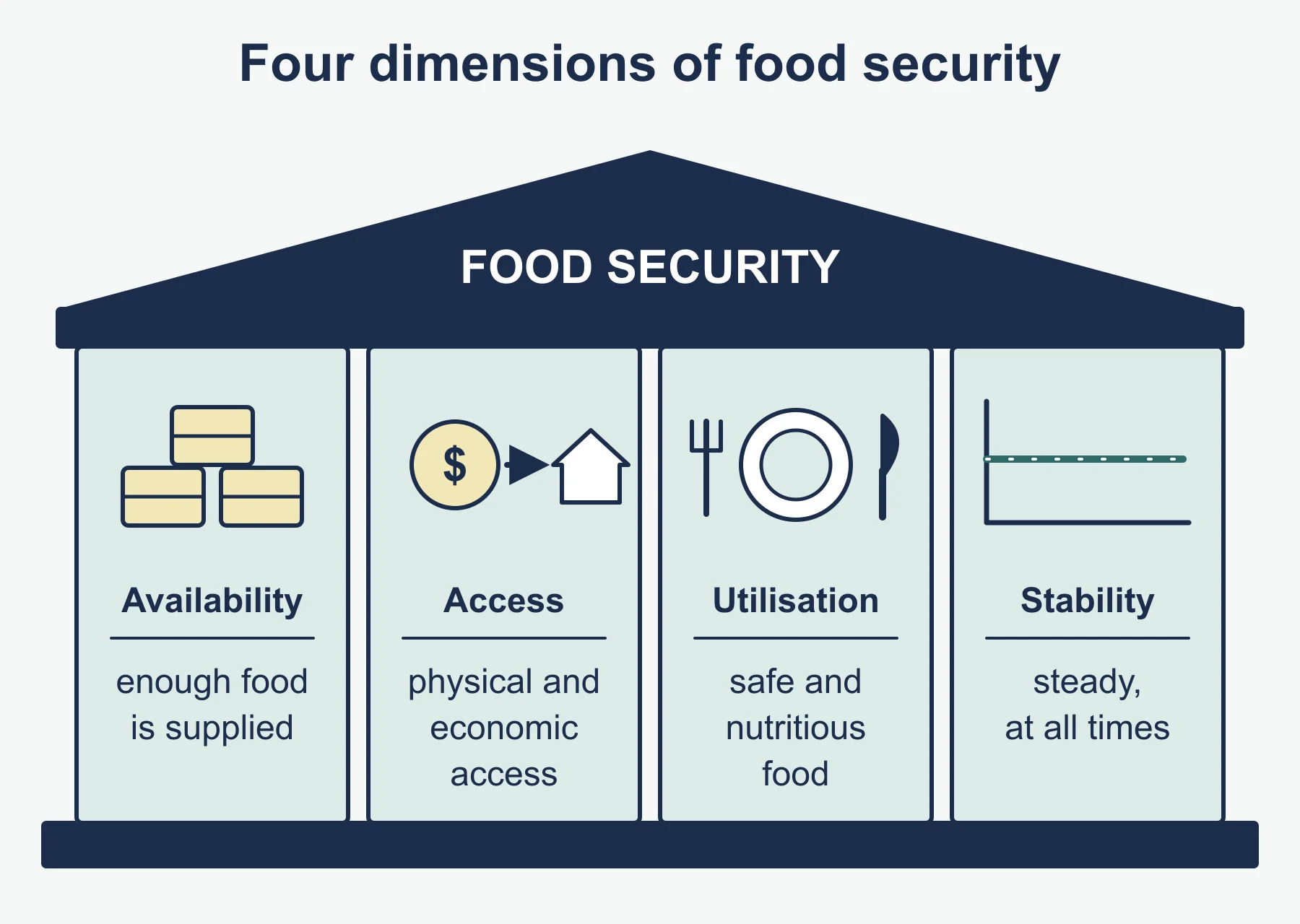
Food security is more than the amount of food grown. It is usually broken into four parts, and a shortage can start in any of them:
- Availability: enough food produced or imported.
- Access: people can afford it or obtain it, and can physically reach it.
- Utilisation: food is safe and nutritious, and people are healthy enough to absorb it (clean water and sanitation matter).
- Stability: the first three hold through bad seasons, price spikes and shocks.
This framework helps in evaluation questions: a country can have high national availability and still have hungry households because access is unequal.
Causes of food shortage
- Drought, flood, pests and other climatic hazards;
- war and conflict, which disrupt farming and distribution;
- poverty and lack of access, even when food exists;
- poor infrastructure and storage losses;
- population growth outpacing production;
- soil degradation and water shortage.
The syllabus names war and climatic hazards as constraints on food production. War destroys crops, livestock and markets, displaces farmers, blocks aid routes and is sometimes used deliberately to cut off supplies. Climatic hazards act through both availability (a failed harvest) and access (food prices rise, so the poorest cannot buy). The two often combine: a drought in a conflict zone is far more likely to become a famine than the same drought in a stable country.
Consequences
Malnutrition, disease, higher mortality, migration, political unrest, and reduced economic output. Undernourished children suffer stunting (low height for age), which lowers learning and adult earnings, so the effect lasts a generation. Households cope by selling livestock and tools, eating seed grain or taking children out of school, which makes them more vulnerable to the next shock.
Technology and innovation
Irrigation, fertilisers, improved seed varieties (green revolution), mechanisation and better storage can raise yields. Costs include environmental damage and unequal access.
Example: the Green Revolution in India. From the mid-1960s high-yielding varieties of wheat and rice, developed from work associated with Norman Borlaug and international research centres, were spread with irrigation, fertiliser and government price support. Punjab became the leading example. India moved from dependence on food imports towards self-sufficiency in grain.
| Gains | Costs and limits |
|---|---|
| Much higher grain yields per hectare | Needed irrigation, fertiliser and pesticide, which poorer farmers struggled to afford |
| Lower food prices and fewer famines | Falling water tables where groundwater was over-pumped |
| Rural employment in some areas | Loss of crop diversity and of traditional varieties |
| Food self-sufficiency in grain | Gains concentrated in irrigated regions; rain-fed areas benefited less |
Other innovations: drought-resistant and genetically modified crops, drip irrigation, cold storage that cuts post-harvest losses, mobile phone price information for farmers, and aquaculture. Each raises carrying capacity only if people can access it.
Theories
| Theory | Idea | Weakness |
|---|---|---|
| Malthus | Population grows geometrically, food arithmetically; checks result | Underestimated technology |
| Boserup | Pressure on resources stimulates innovation and intensification | Intensification can harm the environment |
- Malthus (1798): population tends to grow geometrically (1, 2, 4, 8) while food grows arithmetically (1, 2, 3, 4), so population eventually outstrips food. He described positive checks (famine, disease, war, raising the death rate) and preventive checks (later marriage and abstinence, lowering the birth rate).
- Boserup (1965): “necessity is the mother of invention”. As population density rises, farmers shorten fallow periods, irrigate, terrace and adopt new tools, so food output rises to meet demand.
- Neo-Malthusians in the 1960s and 1970s, such as the Club of Rome’s Limits to Growth report (1972), argued that resource limits and pollution would eventually constrain growth.
Evaluation: global food output has so far kept ahead of population, supporting Boserup, and most modern famines are linked to conflict and loss of access rather than an absolute shortage. But soil degradation, falling water tables and climate change suggest limits may be real locally, which is where the Malthusian view still has force.
Food shortage without a food shortage
The economist Amartya Sen argued that famines are often a failure of entitlement rather than of supply. In the Bengal famine of 1943, food was still available in the region, but wartime price rises meant landless labourers could no longer buy it. This is why an exam answer on food shortage should consider income, prices and distribution as well as harvests.
Overpopulation, underpopulation and optimum
These ideas are relative, not absolute. A densely populated, high-income country can have a high standard of living because it trades for food and uses advanced technology, while a sparsely populated area with poor soils and little capital may be overpopulated. Optimum population is hard to measure: it depends on which resources are counted, on technology and trade, and it shifts over time. Underpopulation is often argued for countries with large resources and labour shortages, which may encourage immigration.
Annotated model paragraph
“Evaluate the view that population growth is the main cause of food shortages.”
Population growth can create shortage where output cannot rise quickly, as Malthus predicted (theory applied). However, many shortages occur where food exists but poor households cannot afford it, as Sen showed for Bengal in 1943 (counter-evidence). War and drought also reduce both production and access (other causes). So population growth is a pressure, but access, conflict and hazards are usually the trigger (judgement).
Command words
- Explain: give the cause and link it to the effect, for example drought, crop failure, higher prices, reduced access.
- Assess / evaluate: weigh evidence for and against, then reach a supported judgement.
Exam traps
- Optimum population changes as technology and resources change.
- Overpopulation is about balance with resources, not density alone.
- Food shortage is not always a shortage of food: distribution and income matter.
- Evaluate: both Malthus and Boserup have supporting and opposing evidence.
- Carrying capacity is not fixed: technology and trade can raise it, degradation can lower it.
- Do not treat the Green Revolution as wholly positive or wholly negative; weigh gains against costs.
Self-test
- Define carrying capacity.
- Give two causes of food shortage.
- Summarise Malthus.
- Summarise Boserup.
- What is optimum population?
- Why can technology raise carrying capacity?
- Name the four parts of food security.
- What is the difference between positive and preventive checks?
- Give one benefit and one cost of the Green Revolution in India.
- What did Sen mean by entitlement failure?
- Why is overpopulation described as relative?
Answers: 1. Maximum population an environment can support indefinitely. 2. Drought, conflict, poverty, poor storage. 3. Population grows faster than food supply, so checks limit it. 4. Population pressure stimulates innovation and higher food output. 5. Number giving the highest standard of living for the resources and technology. 6. It increases output from the same resources. 7. Availability, access, utilisation and stability. 8. Positive checks raise the death rate (famine, disease, war); preventive checks lower the birth rate (later marriage). 9. Benefit: higher grain yields and self-sufficiency. Cost: falling water tables, or unequal gains for poorer farmers. 10. People cannot obtain food, for example because prices rise or incomes fall, even though food is available. 11. It depends on resources, technology and trade, not on numbers or density alone.
More resources on this topic
Related resources
-
Study guides
Cambridge International AS & A Level Geography (9696): 4.2 Demographic transition
Study guide to Cambridge 9696 Geography 4.2: birth and death rate change, a critical view of the DTM, youthful and ageing populations, and development links.
Geography · Cambridge · AS Level
Read guide -
Practice questions
Cambridge International AS & A Level Geography (9696): 4.2 Demographic transition – Practice Questions
Original practice questions with marked answers on Cambridge 9696 Geography 4.2: DTM stages, critical appraisal, youthful and ageing populations, development.
Geography · Cambridge · AS Level
Try questions -
Study guides
Cambridge International AS & A Level Geography (9696): 4.1 Natural increase as a component of population change
Study guide to Cambridge 9696 Geography 4.1: birth, death, fertility and infant mortality rates, their causes, age/sex diagrams and dependency ratios.
Geography · Cambridge · AS Level
Read guide
Studying Geography?
This page is free and stays free. Marlbridge is not offering Geography classes at the moment, so there is no tuition to book for it. The free study resources stay open to everyone.
Get free revision emails (optional)
Occasional emails with practice questions, worked explanations and links to free resources for the qualification and subjects you choose. No spam, and you can unsubscribe from any email. The free tools on this site never need an email.