
Revision Notes
Cambridge International AS & A Level Geography (9696): 3.4 The human impact – Revision Notes
Revision notes for Cambridge 9696 Geography 3.4 The human impact: key terms, processes, worked examples, exam traps and a self-test with answers.
- Subject
- Geography
- Level
- AS LEVEL
- Topic
- Topic 3 – Rocks and weathering
- Author
- Marlbridge Academic Team
- Updated
- Reviewed by
- Azam Siddique (what this means)
Aligned to Cambridge A Level Geography (9696), 2025-2026. Official specification .
Syllabus page (what it covers and how it is assessed): Cambridge A Level Geography.
Syllabus points this page covers
9696 (AS Level)
- 3.4 The human impact
Condensed recall for 3.4 The human impact on slope stability, and the strategies used to reduce mass movement. For full explanations, read the Core Physical Geography study guide.
Key terms
| Term | Meaning |
|---|---|
| Slope stability | How resistant a slope is to failure |
| Grading | Reshaping a slope to a gentler angle |
| Pinning | Fixing rock in place with bolts or anchors |
| Netting | Mesh over a rock face to hold loose material |
| Afforestation | Planting trees, whose roots bind soil |
| Gabion | Wire basket of stones used as a retaining wall |
| Soil nailing | Steel bars drilled into a soil slope and grouted, to reinforce it |
| Shotcrete | Concrete sprayed onto a slope surface to seal it against water |
| Terracing | Cutting a slope into a series of flat steps |
| Spoil tip | Heap of waste rock from mining |
How human activity reduces stability
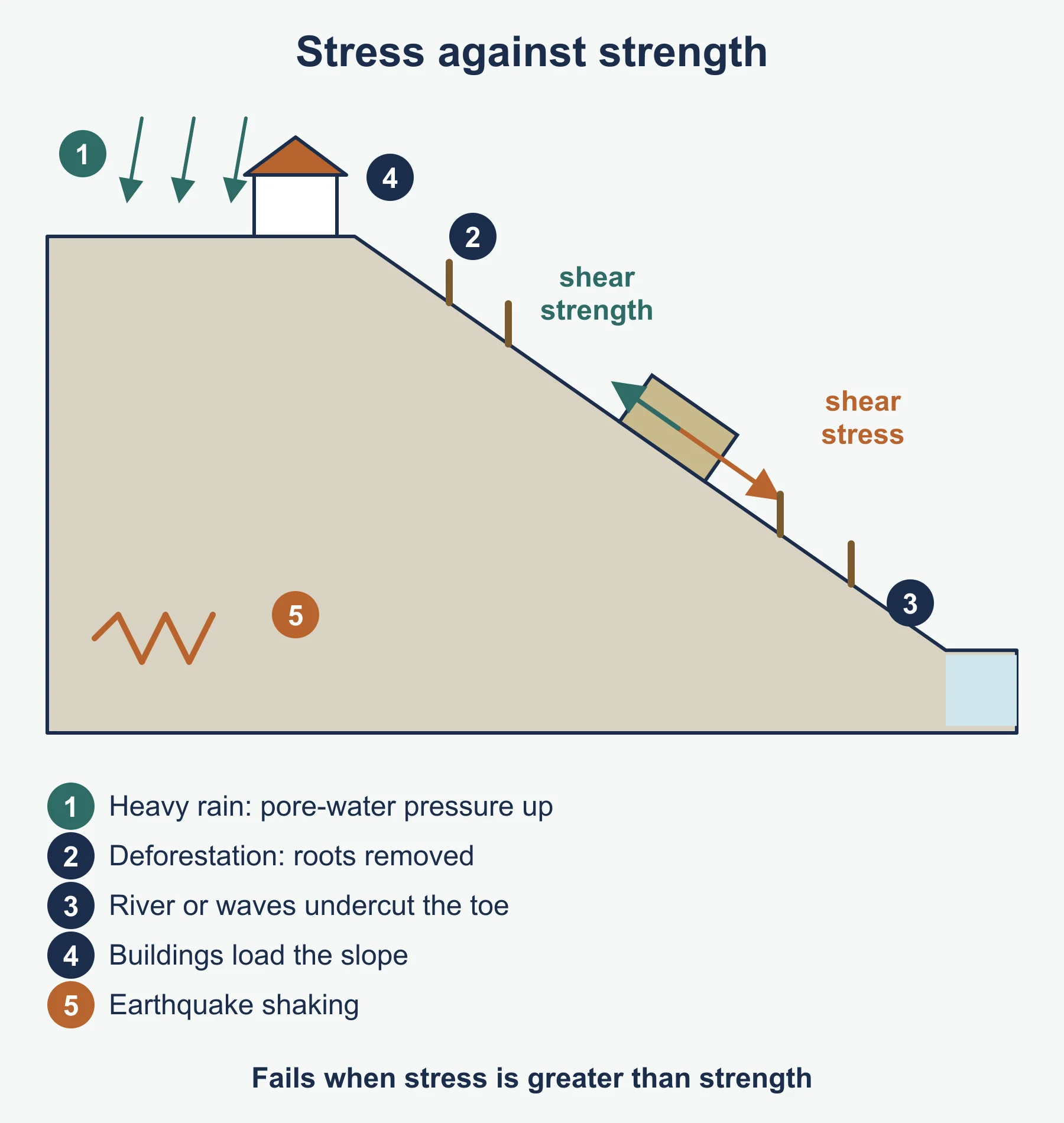
- Deforestation: removes root strength and interception.
- Building and loading: extra weight at the top of a slope.
- Cutting into slopes for roads, quarries and building plots: steepens the slope and removes support.
- Altering drainage: leaking pipes, irrigation and blocked drains raise pore water pressure.
- Mining, blasting and vibration.
- Overgrazing and ploughing downslope: expose soil.
Linking each activity to the stress-strength balance:
| Activity | Raises stress | Lowers strength |
|---|---|---|
| Cutting a road into the base | Removes support, steepens the slope | Exposes weak layers and joints |
| Building at the crest | Adds weight | Concentrates runoff from roofs and paving |
| Deforestation | More water in the soil adds weight | Roots rot, so cohesion falls |
| Leaking water pipes | Adds weight | Raises pore water pressure |
| Dumping mine waste | Adds a steep, loose load | Waste is unconsolidated and may hold water |
| Blasting and traffic | Vibration adds short pulses of stress | Loosens joints |
How people can increase stability
- Vegetation: planting trees and grass.
- Drainage: surface and sub-surface drains, to lower pore water pressure.
- Slope regrading and terracing: lower stress.
- Retaining walls and gabions at the base: add support.
- Pinning and netting rock faces.
- Controlling construction and avoiding unstable sites through planning.
The syllabus names four modification strategies to know in detail:
- Pinning: steel bolts or anchors are drilled through loose blocks into stable rock behind, holding them in place. Used on road cuttings and coastal cliffs.
- Netting: steel mesh draped or anchored over a rock face; it does not stop weathering, but it holds falling fragments against the face so they cannot bounce onto roads.
- Grading: cutting the slope back to a lower angle (often in steps), which lowers shear stress; it needs space at the crest and removes land.
- Afforestation: roots add cohesion and anchor soil; the canopy intercepts rain; transpiration dries the soil, lowering pore water pressure. Effective mainly on shallow soils and slow to take effect.
Evaluating strategies
| Consideration | Point |
|---|---|
| Cost | Engineering works are expensive; vegetation is cheaper but slow |
| Effectiveness | Drainage addresses the cause; walls and nets address symptoms |
| Environment | Works change appearance and habitats |
| Scale | Small slopes can be treated; large landslide-prone areas often cannot |
| Maintenance | Drains block, nets fill with debris and bolts corrode; all need inspection |
Required case study
Know one place where human activity affected slope stability: the activities, the effect on stability, and an evaluation of attempts to reduce mass movement.
Worked case study outline: Hong Kong
- Setting: steep hillsides of granite and volcanic rock, deeply weathered into weak soil in a hot, wet climate; intense rainfall in summer storms and typhoons; a dense population with little flat land.
- Human impact: rapid growth after the 1950s led to many slopes being cut back for housing estates, roads and squatter huts, and to loose fill being placed on hillsides. Leaking water pipes and blocked drains added water. Many of these slopes were steep and poorly engineered.
- Effect on stability: cuts removed support and steepened slopes; fill was loose and saturated easily; rainfall raised pore water pressure. On 18 June 1972, landslides at Sau Mau Ping and Po Shan Road killed well over one hundred people in total, and another disaster at Sau Mau Ping followed in 1976.
- Attempts to reduce mass movement: in 1977 the government set up the Geotechnical Control Office (later the Geotechnical Engineering Office) to regulate slope design and start a long-term Landslip Preventive Measures programme. Methods include soil nailing, surface drains and deep drains, retaining walls, rock bolts and netting, sealing slopes with sprayed concrete, regrading and, increasingly, planting vegetation. The government also registered man-made slopes, required regular maintenance and introduced a landslip warning system that alerts the public during heavy rain.
- Evaluation: landslide deaths have fallen sharply compared with the 1970s, despite continued development, which shows a strong and sustained system can work. However, the programme has been costly over decades; early grey concrete surfaces were criticised as ugly, leading to greener designs; natural hillsides beyond engineered slopes can still fail in extreme rain; and maintenance must continue for ever.
Contrast: at Aberfan in Wales in 1966, a colliery spoil tip built over springs on a hillside became saturated and flowed onto the village school, killing 144 people, most of them children. It shows how loading a slope with loose waste and ignoring drainage can be catastrophic, and it led to new laws on the safety of tips.
Annotated model paragraph
“Evaluate attempts to reduce mass movement in one area.”
In Hong Kong, soil nailing and drainage have stabilised thousands of man-made slopes (method and success). Landslide deaths are much lower than in the 1970s (evidence). But the work is expensive and must be maintained, and natural slopes can still fail in extreme storms (limitations). Overall it is highly effective for engineered slopes (judgement).
Exam traps
- Link each activity to stress or strength.
- Planting trees is not instant; mention time.
- Avoid unsupported statistics from memory.
- Netting does not prevent rockfall; it controls where fragments go.
- Human activity can increase stability as well as reduce it; the syllabus asks for both.
Self-test
- Give two human causes of slope instability.
- What is grading?
- Why does drainage help?
- Name a way to stabilise a rock face.
- Why might afforestation be a limited solution alone?
- What must the 3.4 case study evaluate?
- How does cutting a road into a slope reduce stability?
- What is soil nailing?
- Why were Hong Kong’s slopes so vulnerable in the 1970s?
- Name two parts of Hong Kong’s slope safety system besides engineering works.
- What caused the Aberfan disaster?
- Give one limitation of netting.
Answers: 1. Deforestation, cutting into slopes, adding weight, altering drainage. 2. Reshaping a slope to a gentler angle. 3. It lowers pore water pressure and weight. 4. Pinning or netting. 5. Slow to establish and ineffective on deep or large failures. 6. Attempts to reduce mass movement. 7. It steepens the slope and removes support at the base. 8. Steel bars drilled and grouted into a soil slope to reinforce it. 9. Deeply weathered rock, intense rain, and many steep, poorly engineered cuts and fills. 10. Registering and maintaining slopes, and landslip warnings. 11. A spoil tip on a hillside over springs became saturated and flowed downhill. 12. It does not stop rock breaking away and needs clearing and maintenance.
More resources on this topic
Related resources
-
Revision notes
Cambridge International AS & A Level Geography (9696): 3.2 Weathering – Revision Notes
Revision notes for Cambridge 9696 Geography 3.2 Weathering: key terms, processes, worked examples, exam traps and a self-test with answers.
Geography · Cambridge · AS Level
Revise topic -
Study guides
Cambridge International AS & A Level Geography (9696): 3.1 Plate tectonics
Study guide to Cambridge 9696 Geography 3.1 Plate tectonics: plates and their patterns, boundaries, sea floor spreading, subduction, ridges, trenches and arcs.
Geography · Cambridge · AS Level
Read guide -
Practice questions
Cambridge International AS & A Level Geography (9696): 3.1 Plate tectonics – Practice Questions
Original practice questions with marked answers on Cambridge 9696 Geography 3.1: plates, boundaries, sea floor spreading, subduction and fold mountain building.
Geography · Cambridge · AS Level
Try questions
Studying Geography?
This page is free and stays free. Marlbridge is not offering Geography classes at the moment, so there is no tuition to book for it. The free study resources stay open to everyone.
Get free revision emails (optional)
Occasional emails with practice questions, worked explanations and links to free resources for the qualification and subjects you choose. No spam, and you can unsubscribe from any email. The free tools on this site never need an email.