
Revision Notes
Cambridge International AS & A Level Geography (9696): 6.2 Urban trends and issues of urbanisation – Revision Notes
Revision notes for Cambridge 9696 Geography 6.2 Urban trends and issues of urbanisation: key terms, processes, exam traps and a self-test with answers.
- Subject
- Geography
- Level
- AS LEVEL
- Topic
- Topic 6 – Settlement dynamics
- Author
- Marlbridge Academic Team
- Updated
- Reviewed by
- Azam Siddique (what this means)
Aligned to Cambridge A Level Geography (9696), 2025-2026. Official specification .
Syllabus page (what it covers and how it is assessed): Cambridge A Level Geography.
Syllabus points this page covers
9696 (AS Level)
- 6.2 Urban trends and issues of urbanisation
Condensed recall for 6.2 Urban trends and issues of urbanisation. For full explanations, read the Core Human Geography study guide.
Key terms
| Term | Meaning |
|---|---|
| Urbanisation | Increase in the proportion of people living in towns and cities |
| Urban growth | Increase in the number of people in urban areas |
| Suburbanisation | Outward growth as people move to the edges |
| Counterurbanisation | Movement from cities to smaller towns and rural areas |
| Re-urbanisation | Return of people and investment to city centres |
| Urban renewal | Improvement or redevelopment of run-down areas |
| World (global) city | City with major influence on the global economy, culture and politics |
| Primate city | City far larger than the next in the country |
| Megacity | Urban area with more than 10 million people |
| Urban sprawl | Unplanned outward spread of low-density building |
| Informal sector | Work that is unregistered and untaxed, such as street vending |
Causes of urbanisation
Rural-urban migration (push and pull), natural increase in cities, and economic change toward industry and services. It is fastest in LICs and MICs; in many HICs the share is already high.
Natural increase matters more than many students think. Migrants are mostly young adults, so they raise the urban birth rate, while better urban health care lowers the death rate. In many fast-growing cities of LICs and MICs, natural increase now contributes as much to growth as migration does.
The urbanisation curve
Plotting the percentage urban against time gives an S-shaped curve:
- Early stage: low share urban, slow growth (mainly agricultural economy).
- Acceleration: rapid rise as industry grows and people move from farming (where many LICs and MICs are now).
- Terminal stage: the curve levels off at a high share; most people already live in towns, and counterurbanisation and re-urbanisation shape change (most HICs).
The global urban share passed half of the world’s population in the late 2000s, according to UN estimates, and continues to rise.
Consequences
- Pressure on housing, services, water, sanitation and transport;
- informal settlements;
- traffic and pollution;
- unemployment or informal work;
- but also economic growth, services and opportunities.
Cities concentrate jobs, markets and services, so urbanisation is linked with rising national income. The challenge is the speed of growth: when population rises faster than a city can build housing, pipes and roads, the gap is filled by informal settlements and informal work.
Processes within cities
- Suburbanisation and decentralisation: housing, shops and offices move outward.
- Counterurbanisation: population loss from large cities.
- Re-urbanisation: regeneration, city-centre living, often with gentrification.
- Competition for land: the centre has high land values; uses outbid each other.
- Urban renewal: redevelopment or refurbishment, with gains and displacement.
These processes often follow one another in HIC cities: suburbanisation as transport improved and incomes rose; counterurbanisation as people moved beyond the suburbs; inner-city decline as industry closed; and then re-urbanisation as former industrial land was redeveloped.
Example of renewal: London Docklands. When the docks closed during the 1960s to the early 1980s, a large area of east London lost jobs and population. The London Docklands Development Corporation (1981 to 1998) used public money and relaxed planning to attract private investment, creating the Canary Wharf office district, new housing and the Docklands Light Railway. Evaluation: a huge rise in investment and jobs, but many new jobs suited commuters rather than former dockworkers, and house prices rose beyond the reach of many long-standing residents. It is a classic case of renewal that brought gains and displacement together.
World cities
Cities with a high concentration of headquarters, finance, services and connections form a hierarchy, often described as global, major and regional levels. Know the criteria rather than memorising rankings, which change.
Criteria often used:
- headquarters of transnational corporations and major banks;
- a stock exchange and global financial services;
- international airport hubs and transport links;
- global media, culture, universities and tourism;
- political influence, such as international organisations.
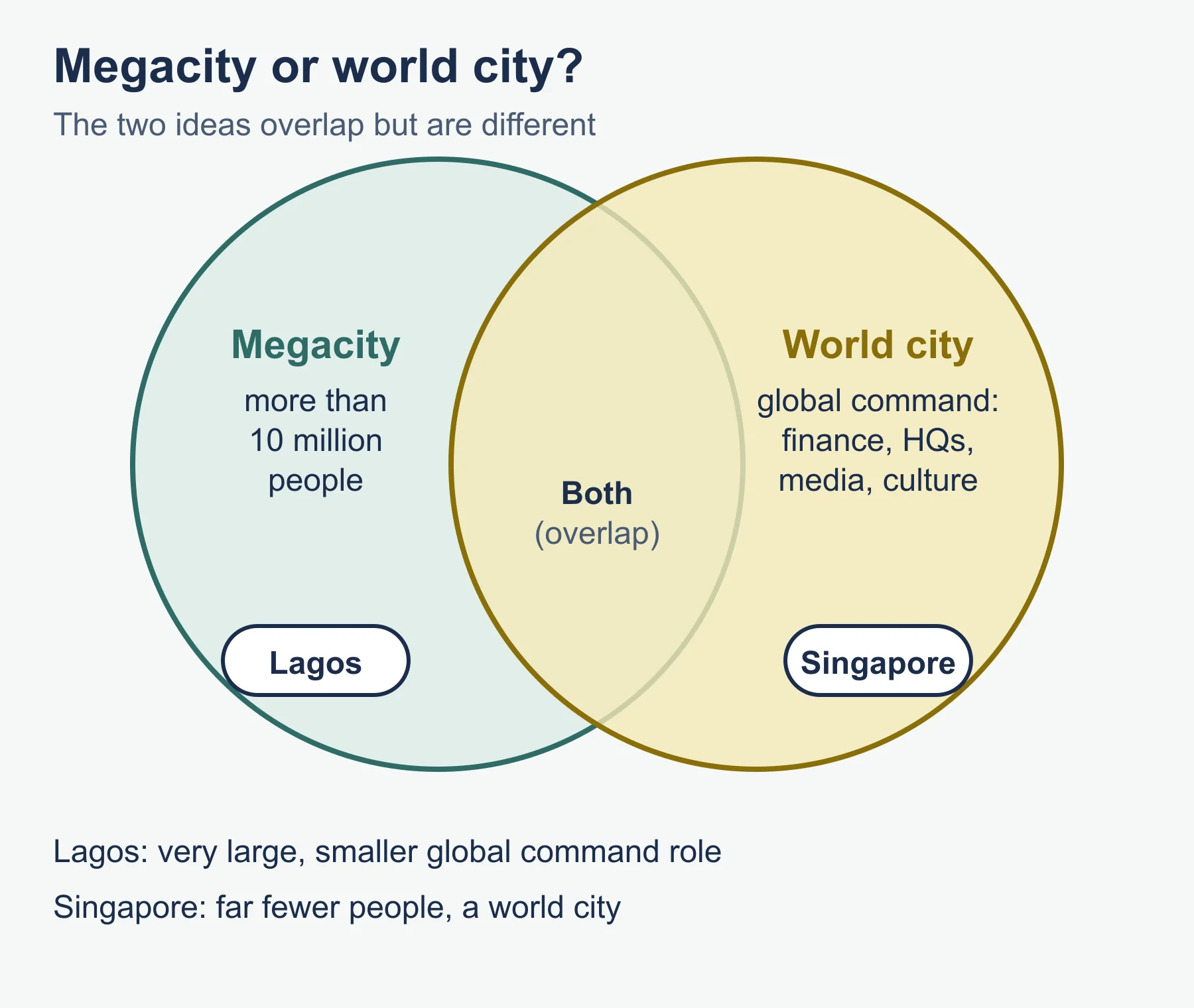
The idea was developed in work by John Friedmann (the world city hypothesis, 1986) and Saskia Sassen (The Global City, 1991). The Globalization and World Cities (GaWC) network classifies cities by their links in advanced business services; London and New York are placed at the top of its hierarchy. Note that a megacity is not automatically a world city: size and global influence are different measures.
Annotated model paragraph
“Explain why urbanisation is fastest in LICs and MICs.”
Push factors such as rural poverty and pull factors such as urban jobs drive large rural-urban flows (migration). Because migrants are young, urban birth rates are high, adding natural increase (second cause). These countries are on the steep part of the urbanisation curve, while HICs have levelled off (comparison).
Exam traps
- Urbanisation is a proportion; urban growth is a number.
- Counterurbanisation and suburbanisation are different: one leaves the city region, one stays within it.
- Rankings of world cities vary between sources; state your source.
- Do not equate megacity and world city.
- Re-urbanisation is not simply the opposite of counterurbanisation; it usually involves different groups, such as young professionals.
Self-test
- Difference between urbanisation and urban growth?
- What is re-urbanisation?
- Give two consequences of rapid urbanisation.
- Define a primate city.
- What is a world city?
- Why is land more expensive in city centres?
- Why does natural increase contribute to urban growth in LICs?
- Describe the three stages of the urbanisation curve.
- Give three criteria used to identify world cities.
- Give one gain and one cost of the London Docklands renewal.
- What is a megacity, and why is it not the same as a world city?
Answers: 1. Urbanisation is the rising proportion urban; urban growth is the rising number. 2. Return of people and investment to central city areas. 3. Housing shortage, informal settlements, traffic, pollution. 4. A city much larger than the next largest in a country. 5. A city with a major role in global economy, culture or politics. 6. High accessibility and strong competition for space. 7. Migrants are young adults, so birth rates are high, while death rates are low. 8. Early (low, slow), acceleration (rapid rise), terminal (levels off at a high share). 9. Headquarters, financial services, international air links, global media and culture. 10. Gain: investment and jobs. Cost: displacement of local residents by rising prices. 11. An urban area of over 10 million; size does not guarantee global influence.
More resources on this topic
Related resources
-
Study guides
Cambridge International AS & A Level Geography (9696): 6.1 Changes in rural settlements
Study guide for Cambridge 9696 Geography 6.1: rural depopulation, service provision, urban growth at the fringe and evaluating responses to rural change.
Geography · Cambridge · AS Level
Read guide -
Practice questions
Cambridge International AS & A Level Geography (9696): 6.1 Changes in rural settlements – Practice Questions
Original practice questions with marked answers on Cambridge 9696 Geography 6.1: rural depopulation, thresholds, second homes and the rural case study.
Geography · Cambridge · AS Level
Try questions -
Study guides
Cambridge International AS & A Level Geography (9696): 6.3 The changing structure of urban settlements
Study guide for Cambridge 9696 Geography 6.3: location of urban activities, the changing CBD, bid rent, functional zonation and residential segregation.
Geography · Cambridge · AS Level
Read guide
Studying Geography?
This page is free and stays free. Marlbridge is not offering Geography classes at the moment, so there is no tuition to book for it. The free study resources stay open to everyone.
Get free revision emails (optional)
Occasional emails with practice questions, worked explanations and links to free resources for the qualification and subjects you choose. No spam, and you can unsubscribe from any email. The free tools on this site never need an email.