
Revision Notes
AQA A-Level Accounting: The double entry model (7127) – Revision Notes
Condensed recall notes for the double entry model in AQA A-Level Accounting: documents, journals, ledgers, adjustments and statements, with a self-test.
- Subject
- Accounting
- Level
- A LEVELS
- Topic
- The double entry model
- Author
- Marlbridge Academic Team
- Updated
- Reviewed by
- Javaid Iqbal Sabri (what this means)
Aligned to AQA A Level Accounting (7127), 2017-onwards. Official specification .
Syllabus page (what it covers and how it is assessed): AQA A Level Accounting.
Syllabus points this page covers
7127
- 3 The double entry model (whole topic)
Found an error? Report a correction.
Need help with this topic? Request a free trial class for A Level Accounting (7127).
These notes condense the double entry content of the AQA A-level Accounting (7127) specification, subject content 3.3, for A-level exams from June 2019 onwards. The specification lists this topic (section 3 in its list of subject content areas) among the content assessed on both papers. Full explanations are in the study guide. Test yourself with the practice questions, check progress on the printable checklist, and find the course on the AQA A-level Accounting hub. For the checks that follow recording, see verification of accounting records; for full sole trader statements, see preparation of financial statements of sole traders. If you are unsure where to start, take a free diagnostic. All amounts on this page are in pounds (£) and every business is invented.
The chain in one line
Source document, then book of prime entry, then ledger account, then balancing, then income statement and statement of financial position. A question can begin at any link, so practise moving in both directions.
Source documents and where they go
| Source document | Book of prime entry | Ledger effect |
|---|---|---|
| Sales invoice | Sales journal | Debit receivable, credit sales |
| Purchase invoice | Purchases journal | Debit purchases, credit payable |
| Credit note issued to a customer | Sales returns journal | Debit sales returns, credit receivable |
| Credit note received from a supplier | Purchases returns journal | Debit payable, credit purchases returns |
| Till roll | Three column cash book (cash column) | Debit cash, credit sales |
| Cash receipt | Three column cash book | Debit cash, credit the source of the cash |
| Paying-in slip counterfoil | Three column cash book (bank column) | Debit bank, credit the account named |
| Cheque counterfoil | Three column cash book (bank column) | Credit bank, debit the account named |
| Bank statement | Three column cash book | See the next table |
Anything that has no special journal (buying a non-current asset on credit, opening entries, corrections) goes through the general journal. The six books of prime entry are the three column cash book, the general journal, and the journals for sales, purchases, sales returns and purchases returns.
Bank statement items
| Item on the statement | Cash book entry |
|---|---|
| Standing order paid | Credit bank, debit the expense or liability |
| Direct debit paid | Credit bank, debit the expense or liability |
| Credit transfer received | Debit bank, credit the receivable or income |
| Dishonoured cheque from a customer | Credit bank, debit the receivable (the debt is owed again) |
| Debit card transaction | Credit bank, debit the item bought |
| Direct transfer | Debit or credit bank, depending on direction |
Ledgers
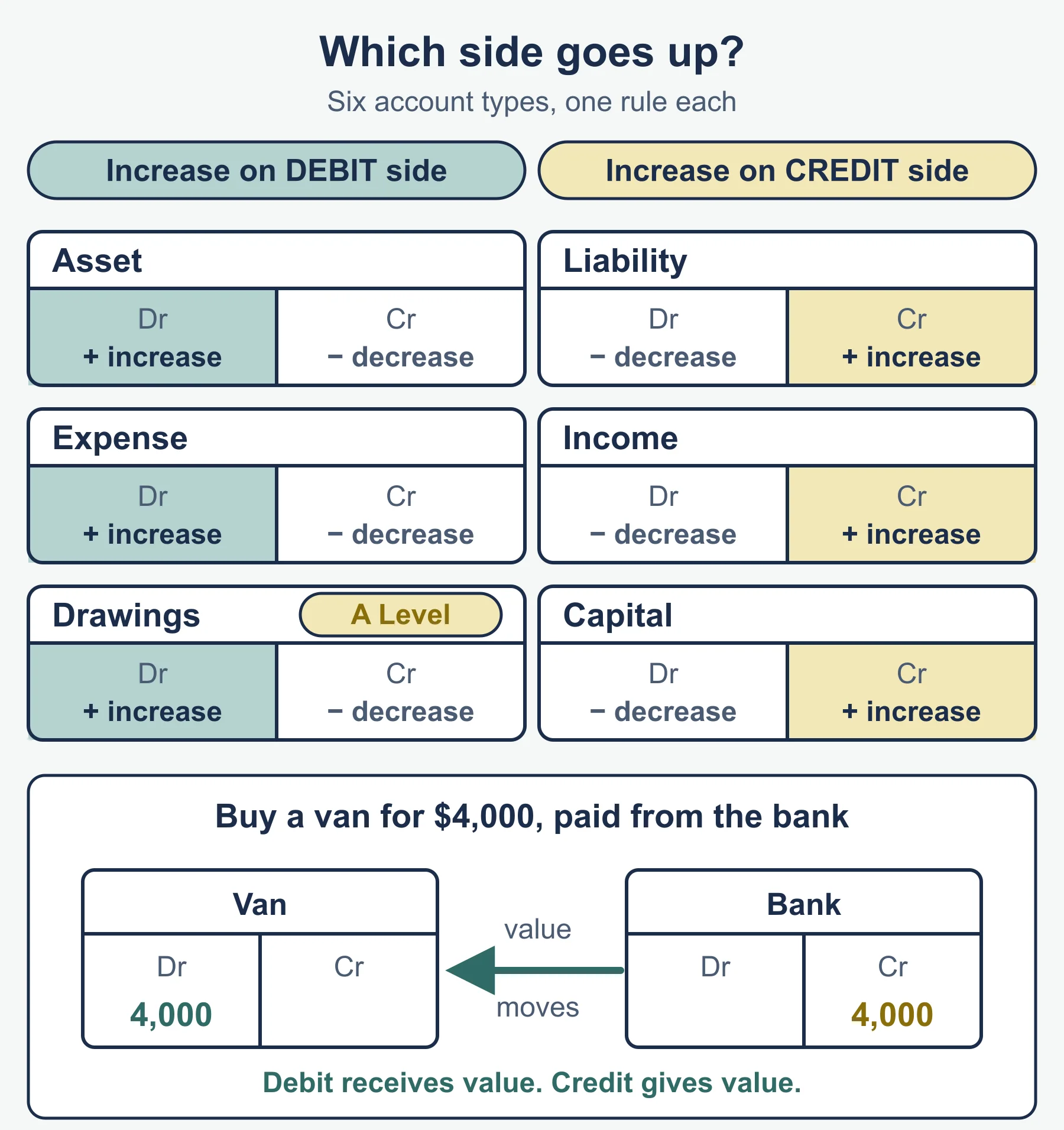
The receivables ledger holds one account per credit customer. The payables ledger holds one account per credit supplier. The general ledger holds everything else: sales, purchases, expenses, assets, liabilities, capital and drawings. Debit the receiving account, credit the giving account. Balance each account by totalling the larger side and inserting the difference on the smaller side, then carry it down to the opposite side on the first day of the next period.
Transactions to know
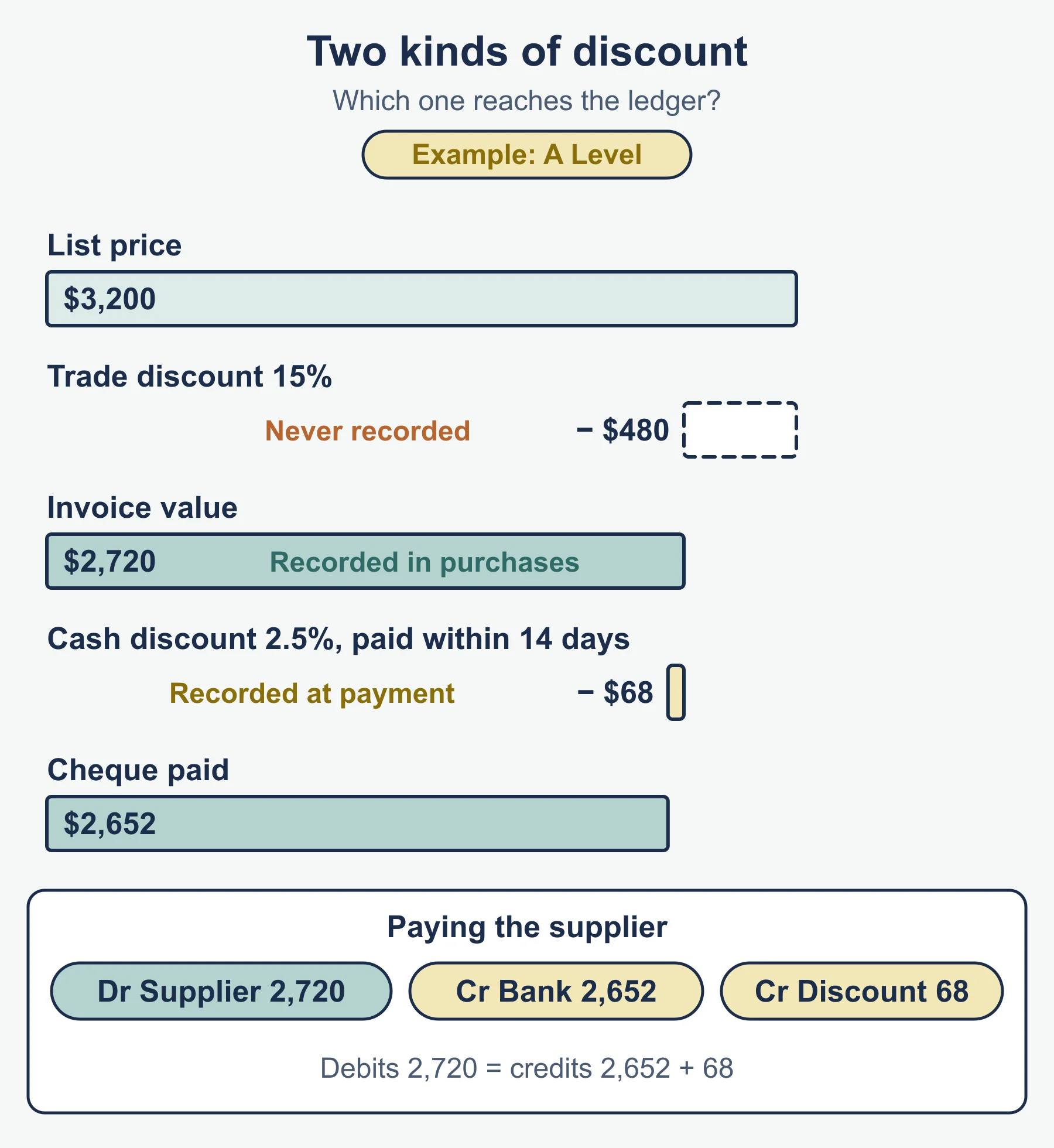
- Trade discount is a reduction in list price. It is not recorded in the books; the invoice shows the net price. List £640 less 25% gives an invoice of £480.
- Cash discount rewards early payment. Discount allowed (to customers) is an expense; discount received (from suppliers) is income. Both are entered in the discount columns of the three column cash book and totalled to the general ledger.
- Contra entry: when a customer is also a supplier, set one balance against the other. If they owe you £900 and you owe them £650, debit the payables ledger account £650, credit the receivables ledger account £650. They now owe you £250.
- Irrecoverable debt: debit irrecoverable debts, credit the receivable. Recovery of a debt written off earlier: reinstate it (debit the receivable, credit irrecoverable debts recovered), then record the cash received (debit bank, credit the receivable).
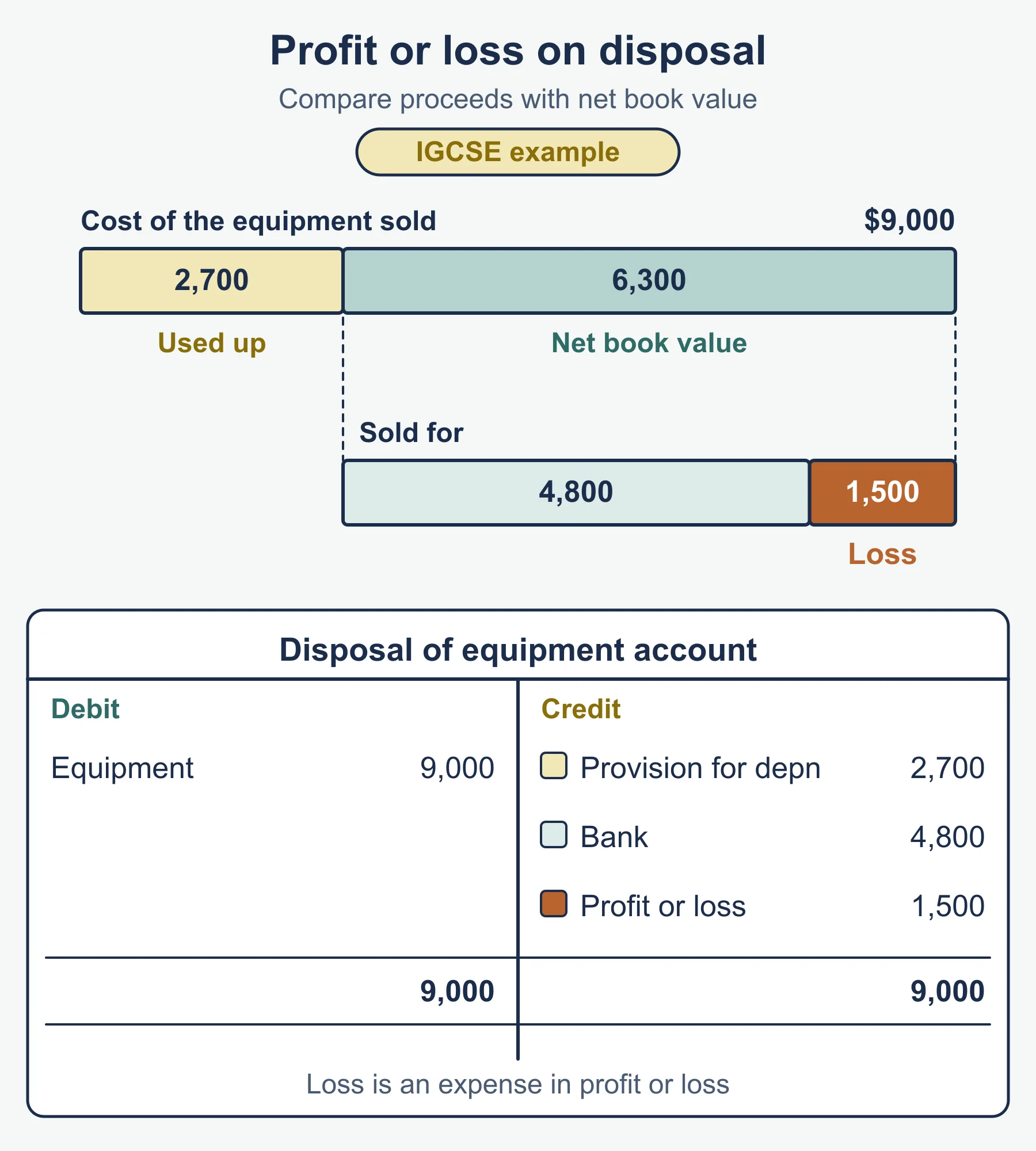
- Disposal of a non-current asset: open a disposal account. Debit it with cost, credit it with accumulated depreciation and with proceeds. The balancing figure is a profit or loss on disposal, taken to the income statement.
Disposal reminder: machine cost 12,000, accumulated depreciation 7,200, sold for 5,500. Net book value is 4,800, so the profit is 700.
Disposal of machine
Dr                          Cr
Machine at cost   12,000    Accumulated depreciation  7,200
Profit on disposal   700    Bank                      5,500
                  12,700                             12,700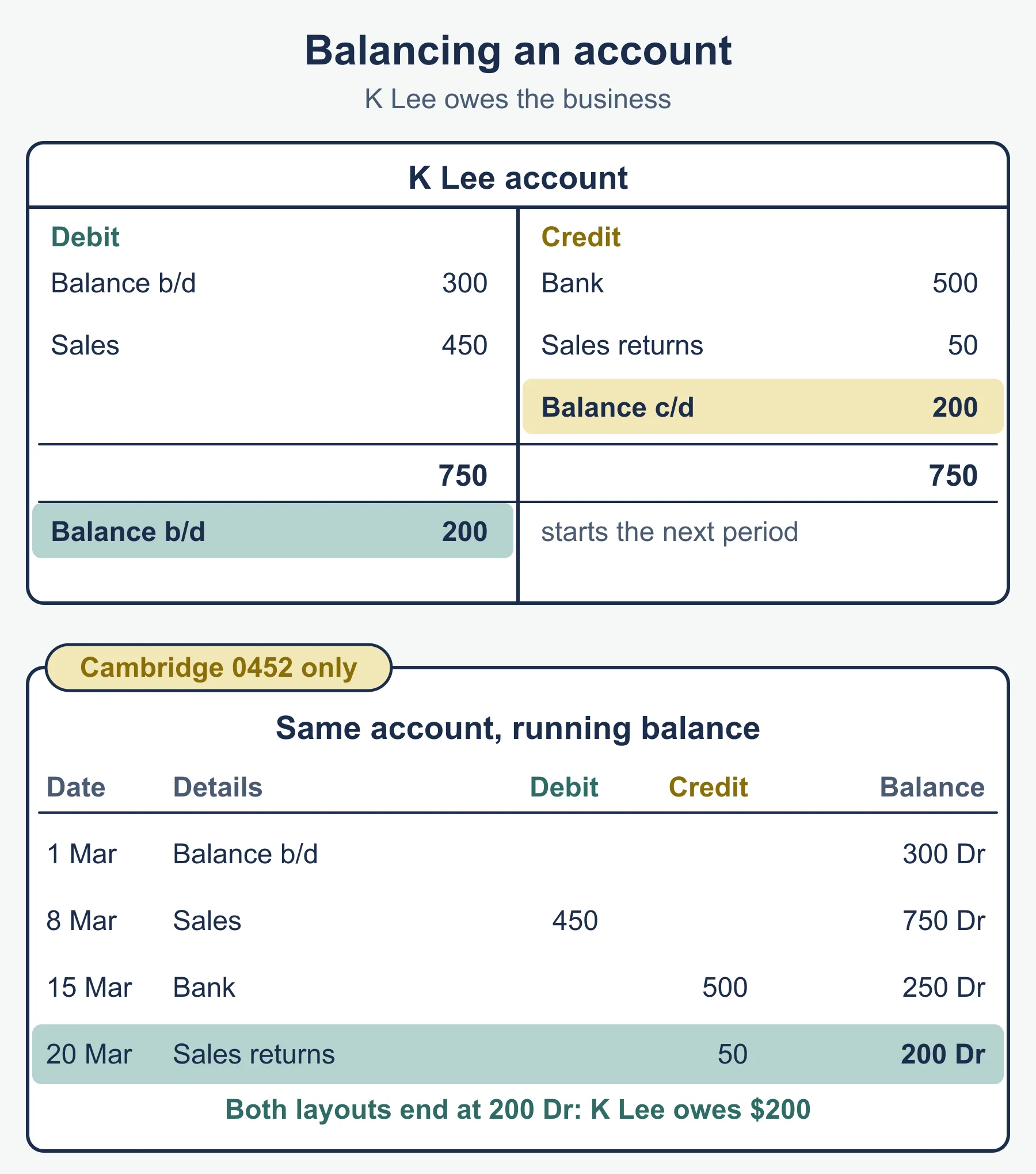
Revenue and capital
| Revenue | Capital | |
|---|---|---|
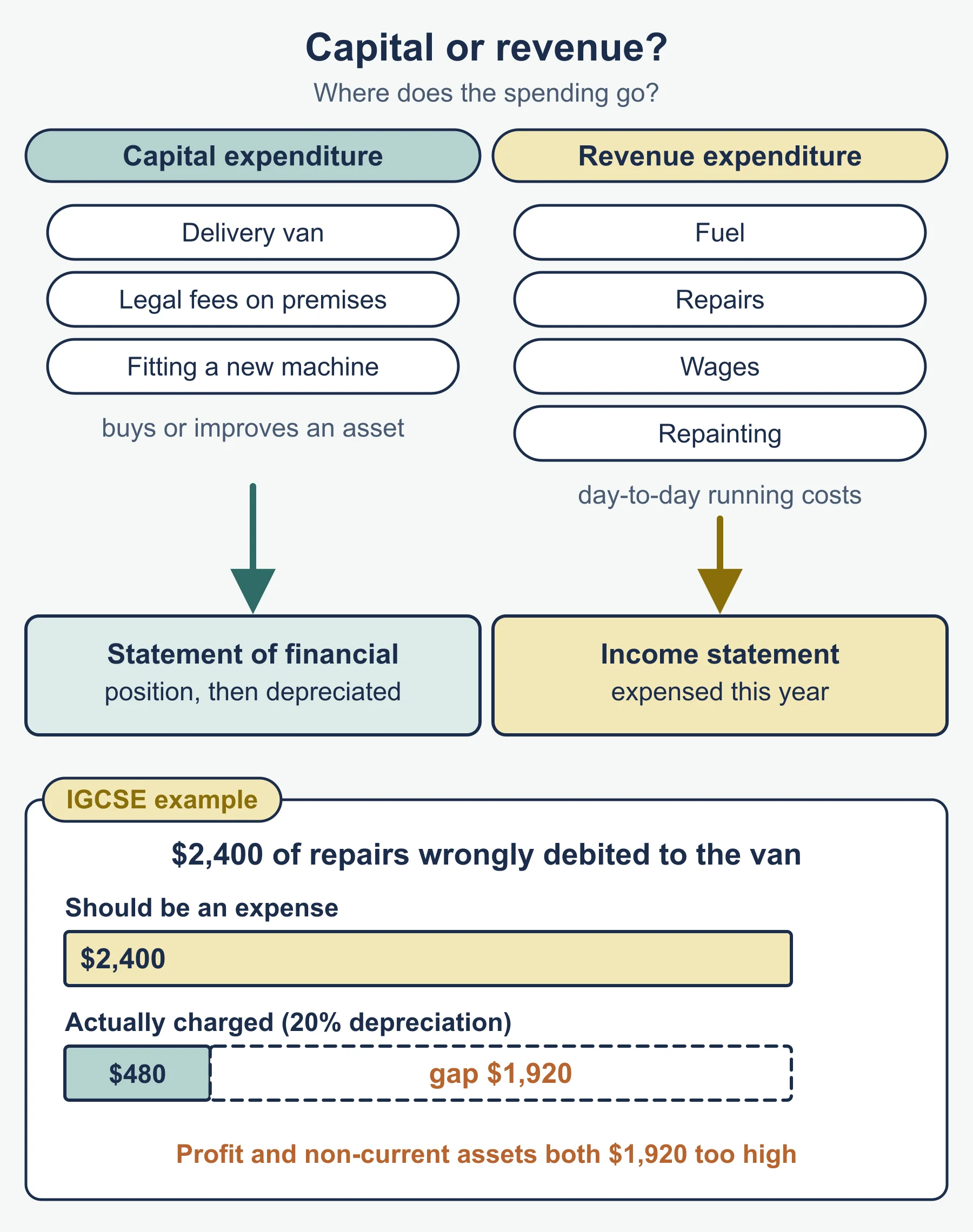
| Expenditure | Running costs: repairs, wages, fuel, routine decoration. Charged to the income statement | Buying, improving or extending a non-current asset. Added to the asset and depreciated |
| Income | Day-to-day trading income: sales, fees, rent receivable, commission | Proceeds of selling a non-current asset, and money paid in by the owner |
Mistaking one for the other changes profit and the statement of financial position at once.
Adjustments
| Adjustment | Ledger entry at the year end | Income statement | Statement of financial position |
|---|---|---|---|
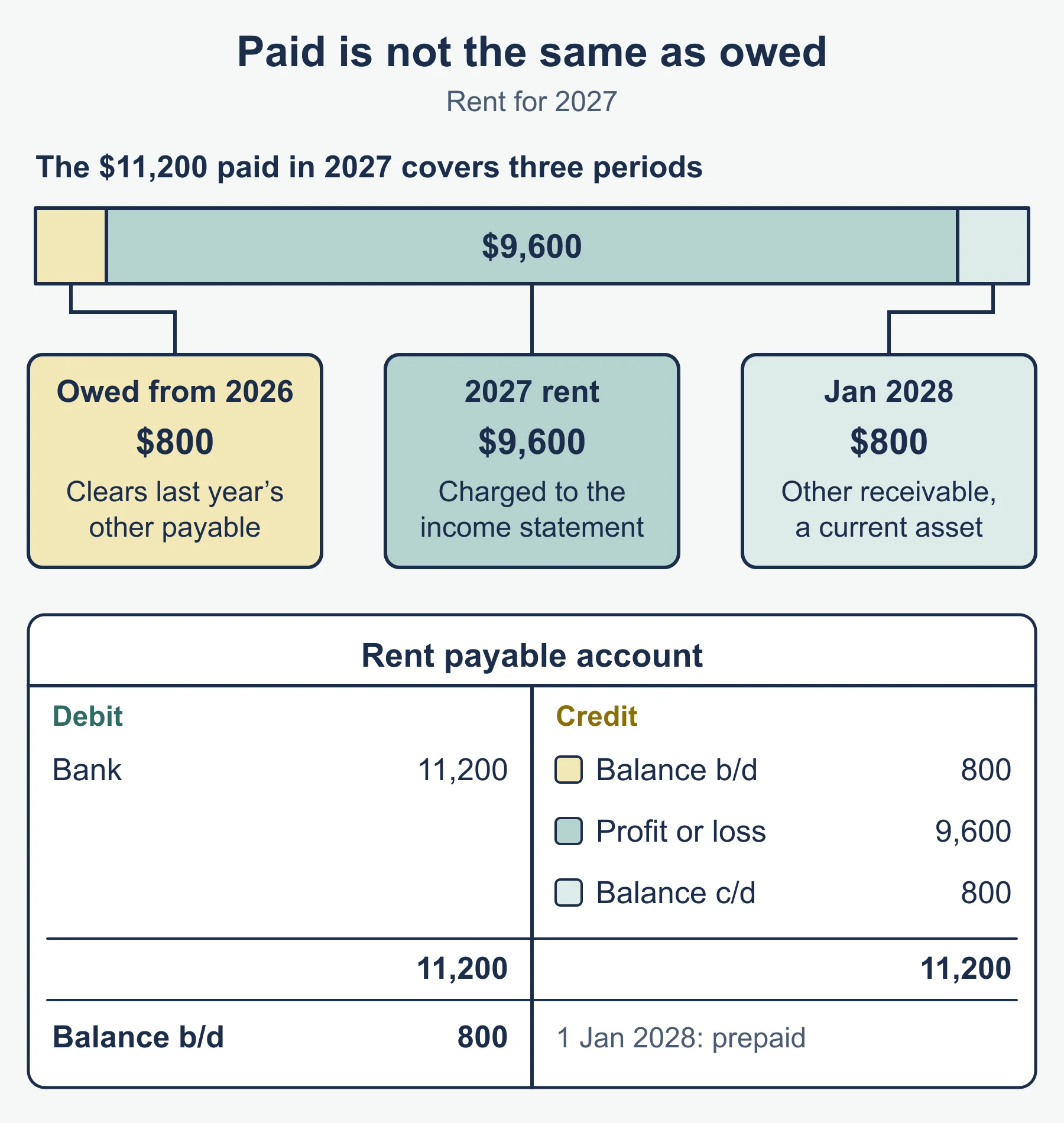
| Accrual (expense owing) | Debit expense, credit accruals | Expense is higher | Current liability |
| Prepayment (expense paid ahead) | Debit prepayments, credit expense | Expense is lower | Current asset |
| Income due | Debit income due, credit income | Income is higher | Current asset |
| Income received in advance | Debit income, credit income received in advance | Income is lower | Current liability |
| Depreciation | Debit depreciation expense, credit accumulated depreciation | Expense | Deducted from cost of the asset |
| Increase in provision for doubtful debts | Debit income statement, credit provision | Expense | Deducted from receivables |
| Closing inventory | Debit inventory, credit income statement | Deducted in cost of sales | Current asset |
Expense charge = amount paid + accrued at close - accrued at start. For a prepayment, take prepaid at close away and add prepaid at start. Rates example: prepaid 500 at start, paid 3,000, prepaid 750 at close, so the charge is 500 + 3,000 - 750 = 2,750.
Depreciation methods
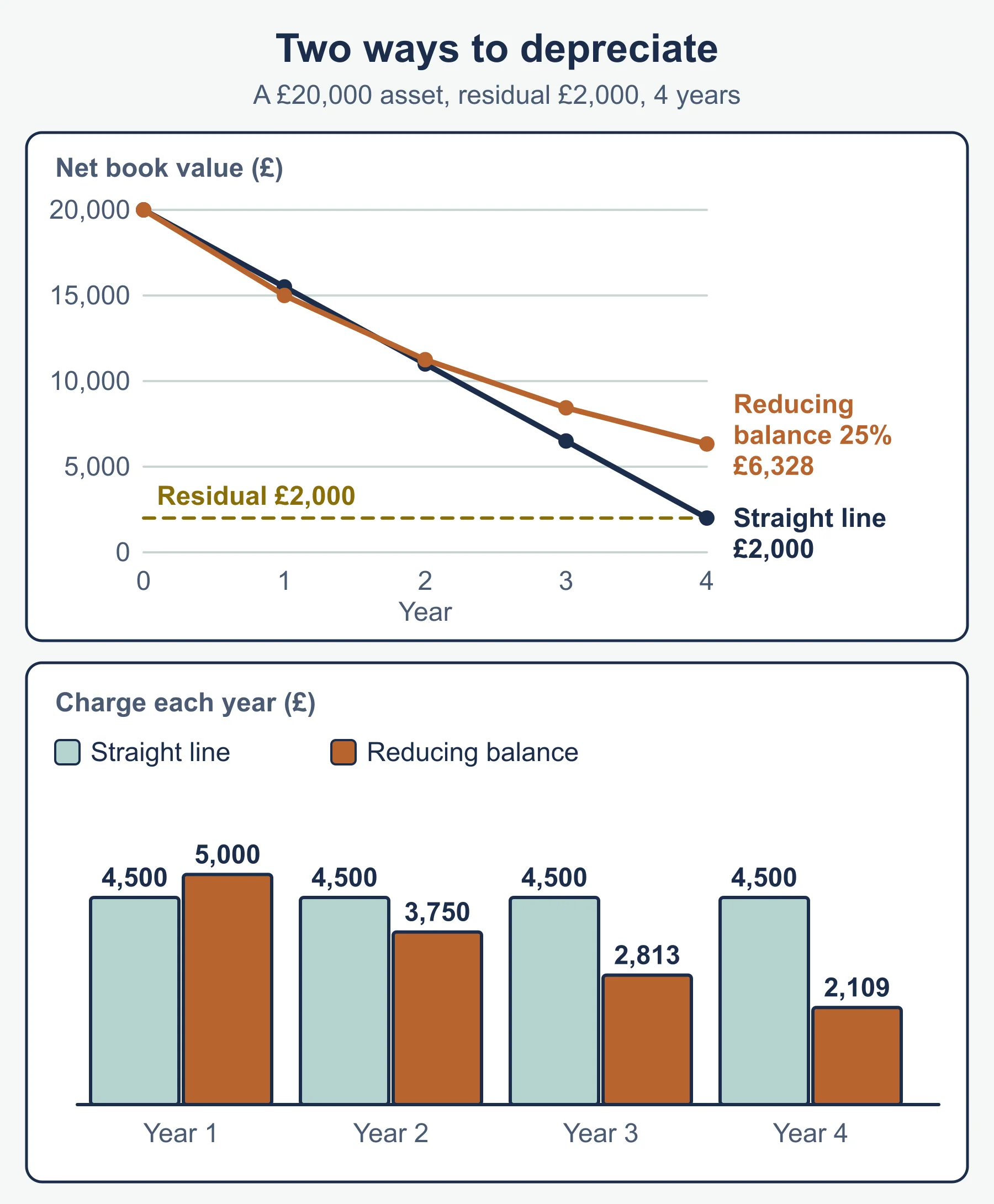
- Straight line: (cost - residual value) / useful life. The charge is equal every year.
- Reducing balance: fixed percentage of the net book value at the start of the year. The charge gets smaller every year.
Reminder: cost 9,000, 20% reducing balance. Year 1 charge 1,800, net book value 7,200. Year 2 charge 1,440. Straight line on the same cost with residual value 1,000 over 4 years gives 2,000 a year.
Provision for doubtful debts
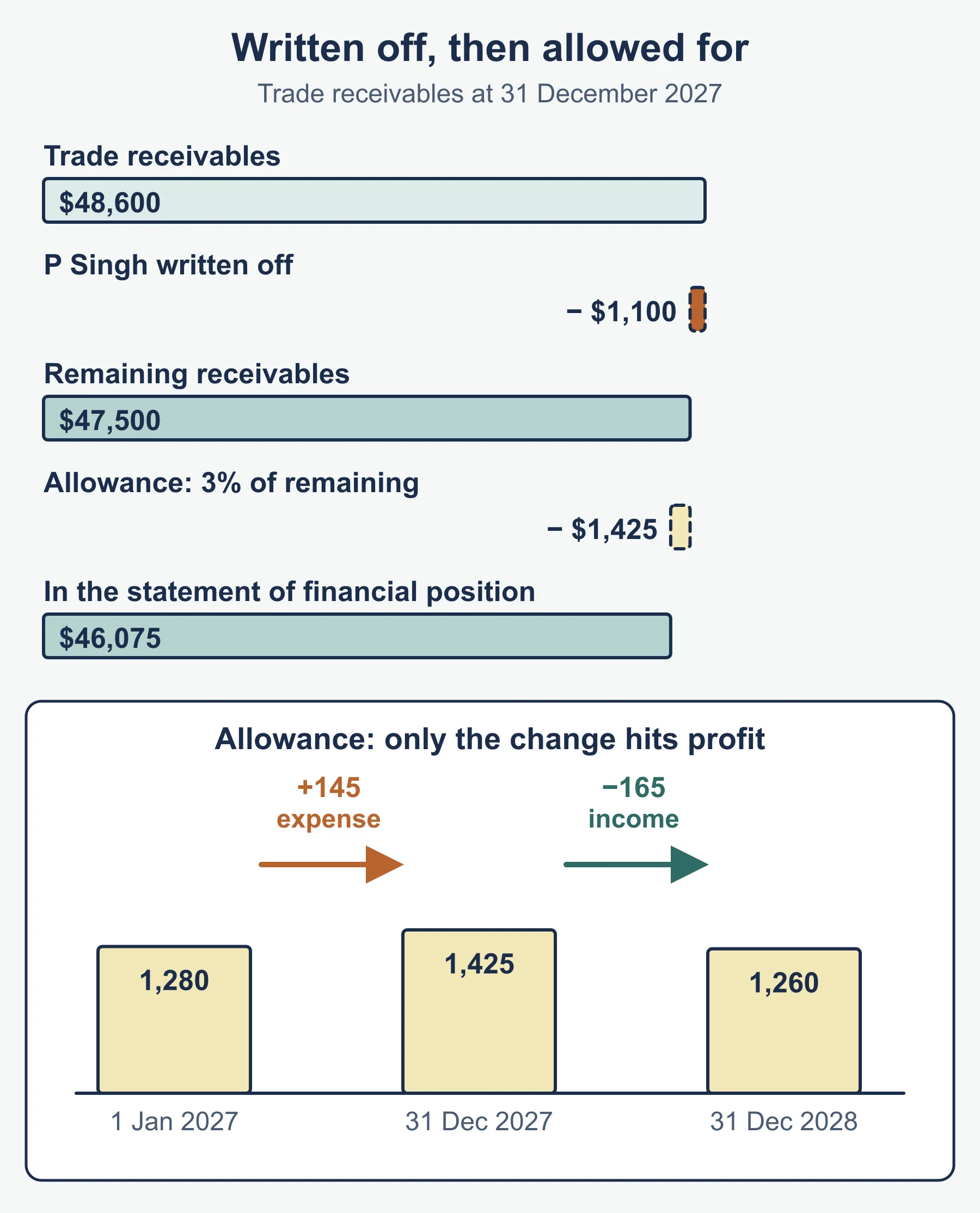
Apply the percentage to receivables after irrecoverable debts are written off. Compare with the existing provision. Only the change in the provision is taken to the income statement, as an expense if it rises and as income if it falls.
Statements
Cost of sales starts from opening inventory, adds purchases, then deducts purchases returns and closing inventory. Gross profit = net sales - cost of sales. Profit for the year equals gross profit, with other income added and expenses taken off. Manufacturing accounts are not examined; the statements are for service and trading businesses only. A service business has no cost of sales, so it starts with fees or other income.
The statement of financial position uses these subheadings, in this order:
Non-current assets            (cost less accumulated depreciation)
Current assets                (inventory, receivables, prepayments, bank, cash)
Current liabilities           (payables, accruals, overdraft)
Net current assets / liabilities
Non-current liabilities       (long-term loans)
Capital (equity)              (opening capital + profit - drawings)
Net assets (non-current assets + net current assets - non-current liabilities) must equal capital.
Quick self-test
- Name the book of prime entry for goods returned by a customer.
- A customer’s cheque for 310 is returned unpaid. Give the entry.
- What is the invoice price for list 640 less 25% trade discount?
- Where is discount received shown in the financial statements?
- A customer owes 900 and the same business is owed 650 by you as supplier. What is the balance after a contra?
- Electricity: owing at start 120, paid 1,560, owing at close 180. What is the charge?
- Rent income received in advance at the year end is 400. Where does it appear on the statement of financial position?
- Cost 15,000, 40% reducing balance. Give the year 2 charge.
- Cost 18,000, residual value 3,000, 5 years, straight line. Annual charge?
- Opening provision 400; receivables at close 12,000; provision 5%. What goes to the income statement?
- Is fitting a new heating system to an owned building capital or revenue expenditure?
Answers
- Sales returns journal.
- Debit the receivable’s account 310; credit bank 310.
-
- As income, added to other income in the income statement.
- 250, owed by the customer.
- 1,560 + 180 - 120 = 1,620.
- Current liability.
- Year 1 is 6,000, net book value 9,000, so year 2 is 3,600.
- 3,000.
- Required provision 600, so the increase of 200 is an expense.
- Capital expenditure, because it improves a non-current asset.
Where marks are usually lost
- Posting from a source document straight to the ledger without naming the book of prime entry.
- Debiting the wrong side for a dishonoured cheque.
- Recording trade discount in the books.
- Treating discount allowed as income and discount received as an expense.
- Charging the whole provision to the income statement instead of only the change.
- Applying reducing balance to original cost instead of net book value.
- Showing a prepayment as a liability, or income received in advance as an asset.
- Leaving out closing inventory from either the income statement or the statement of financial position.
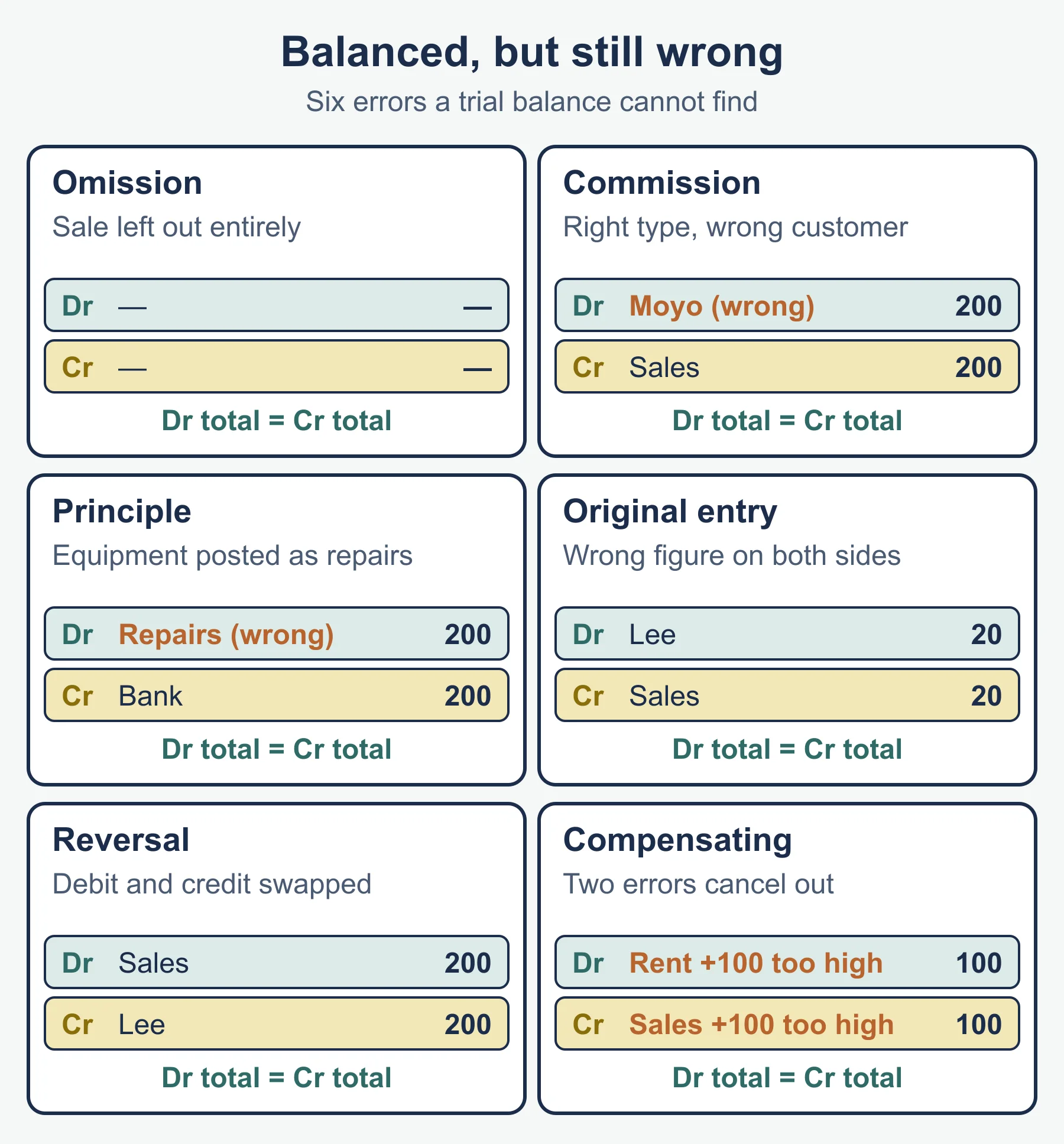
- Using the wrong headings, or leaving subtotals off the statement of financial position, so net assets and capital cannot be compared.
- Leaving the profit or loss on disposal out of the income statement after finding it in the disposal account.
Clear labels make your entries easier to follow and to credit, so write the account name and a narrative against every entry.
Frequently asked questions
Is trade discount recorded in the books? No. Trade discount is deducted before the transaction is recorded, so it never reaches the ledger. Recording trade discount in the books is a common mistake.
Is discount allowed income or an expense? Discount allowed, given to customers, is an expense; discount received, from suppliers, is income. Swapping the two is a common way to lose marks.
How much of a provision for doubtful debts goes to the income statement? Only the change in the provision is charged to, or credited in, the income statement, not the whole provision. The full provision is deducted from receivables in the statement of financial position.
How is reducing balance depreciation calculated? Apply the fixed percentage to the net book value, cost less accumulated depreciation, each year, not to the original cost.
Official syllabus
Based on the AQA A-level Accounting (7127) specification, subject content 3.3 The double entry model, for A-level exams June 2019 onwards, published by AQA.
Get free revision emails (optional)
Occasional emails with practice questions, worked explanations and links to free resources for the qualification and subjects you choose. No spam, and you can unsubscribe from any email. The free tools on this site never need an email.
Related resources
-
Study guides
AQA A-Level Accounting: The Double Entry Model (7127)
Source documents, books of prime entry, ledger accounts and the recording of adjustments – the full content of Topic 3 for AQA A-Level Accounting (7127).
Accounting · AQA · A Level
Read guide -
Practice questions
AQA A-Level Accounting: The double entry model (7127) – Practice Questions
Original practice questions with worked answers on the double entry model for AQA A-Level Accounting: journals, ledgers, adjustments and statements.
Accounting · AQA · A Level
Try questions -
Exam preparation
AQA A-Level Accounting: Paper-by-Paper Exam Preparation
How the two identical AQA A-Level Accounting 7127 papers, with 30, 40 and 50 mark sections and different content, should shape revision, timing and workings.
Accounting · AQA · A Level
Read guide
Related articles
-
teaching
A Level tuition in Dubai: Cambridge or Pearson Edexcel International A Level?
Schools in Dubai and Abu Dhabi teach either Cambridge International AS & A Level or Pearson Edexcel International A Level. How the two are structured, why it matters for tuition, and how online classes from Lahore work.
9 October 2026
-
curriculum guides
Choosing subjects at IGCSE and A Level
How subject choices at 14 and 16 affect university options later, and how to keep pathways open without overloading a timetable.
28 July 2026
Studying this with a teacher
Working through Accounting A LEVELS?
This page is free and stays free. If you would rather be taught it, Marlbridge runs Accounting classes one-to-one and in small groups of up to 15, online in your own time zone. The first trial class is free. WhatsApp replies within an hour (8am–11pm Pakistan time, every day); email the same day.
AQA Accounting teachers at Marlbridge

