
Revision Notes
AQA A-Level English Literature B (7717): Aspects of Comedy – Revision Notes
Revision notes for AQA English Literature B (7717) Aspects of Comedy: set texts, comic aspects, key terms, text links, exam traps and a self-test.
- Subject
- English Literature
- Level
- A LEVELS
- Topic
- Paper 1 – Literary Genres
- Author
- Marlbridge Academic Team
- Updated
- Reviewed by
- Ammar Bilal (what this means)
Aligned to AQA A Level English Literature (7717), For first teaching 2025. Official specification .
Syllabus page (what it covers and how it is assessed): AQA A Level English Literature.
Found an error? Report a correction.
Need help with this topic? Request a free trial class for A Level English Literature (7712 / 7717).
Condensed notes for the comedy option of Paper 1. For full explanations and model writing, use the Aspects of Comedy study guide.
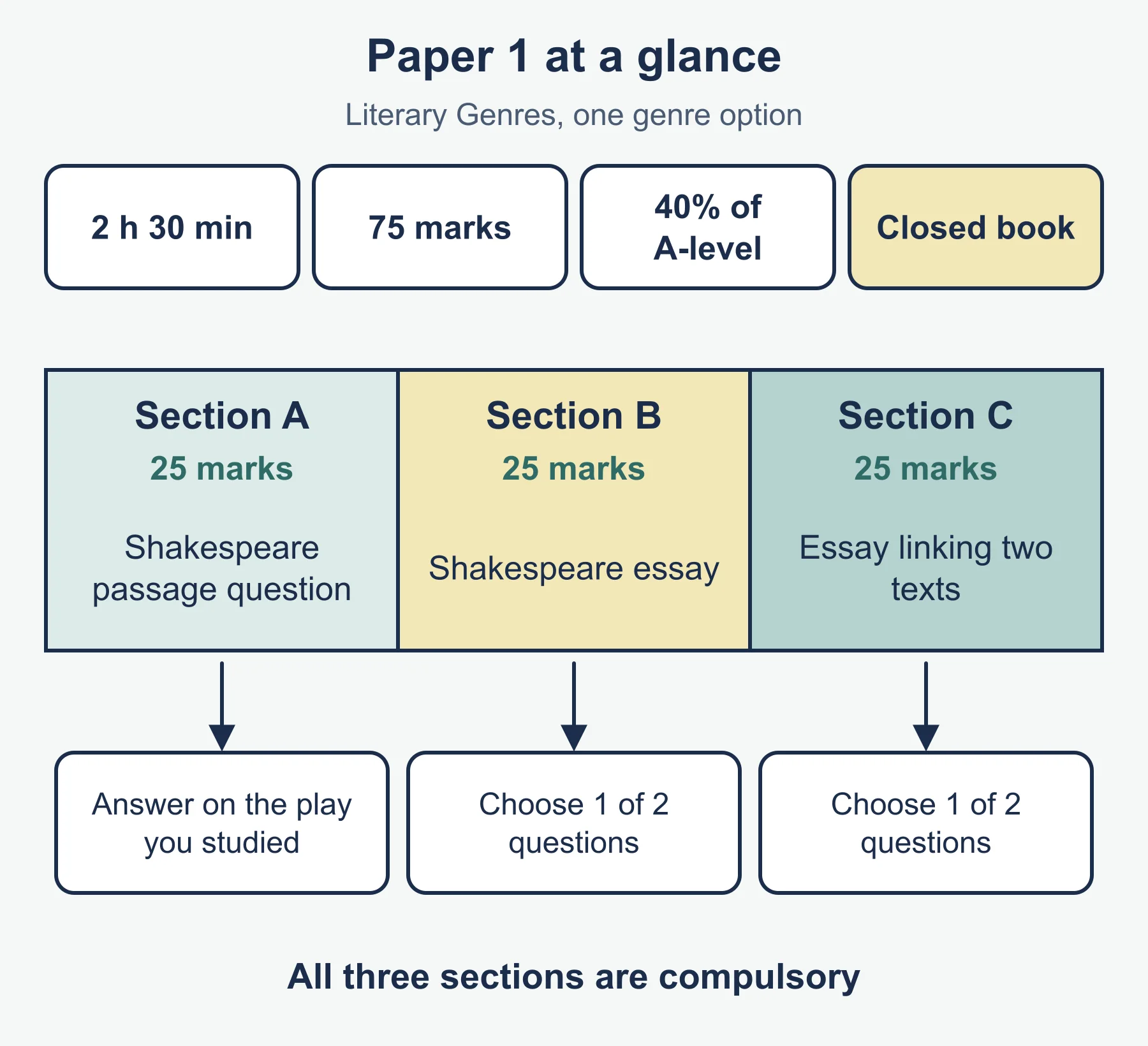
The option in one box
- Three texts: one Shakespeare play, one pre-1900 drama and one further text.
- Closed book.
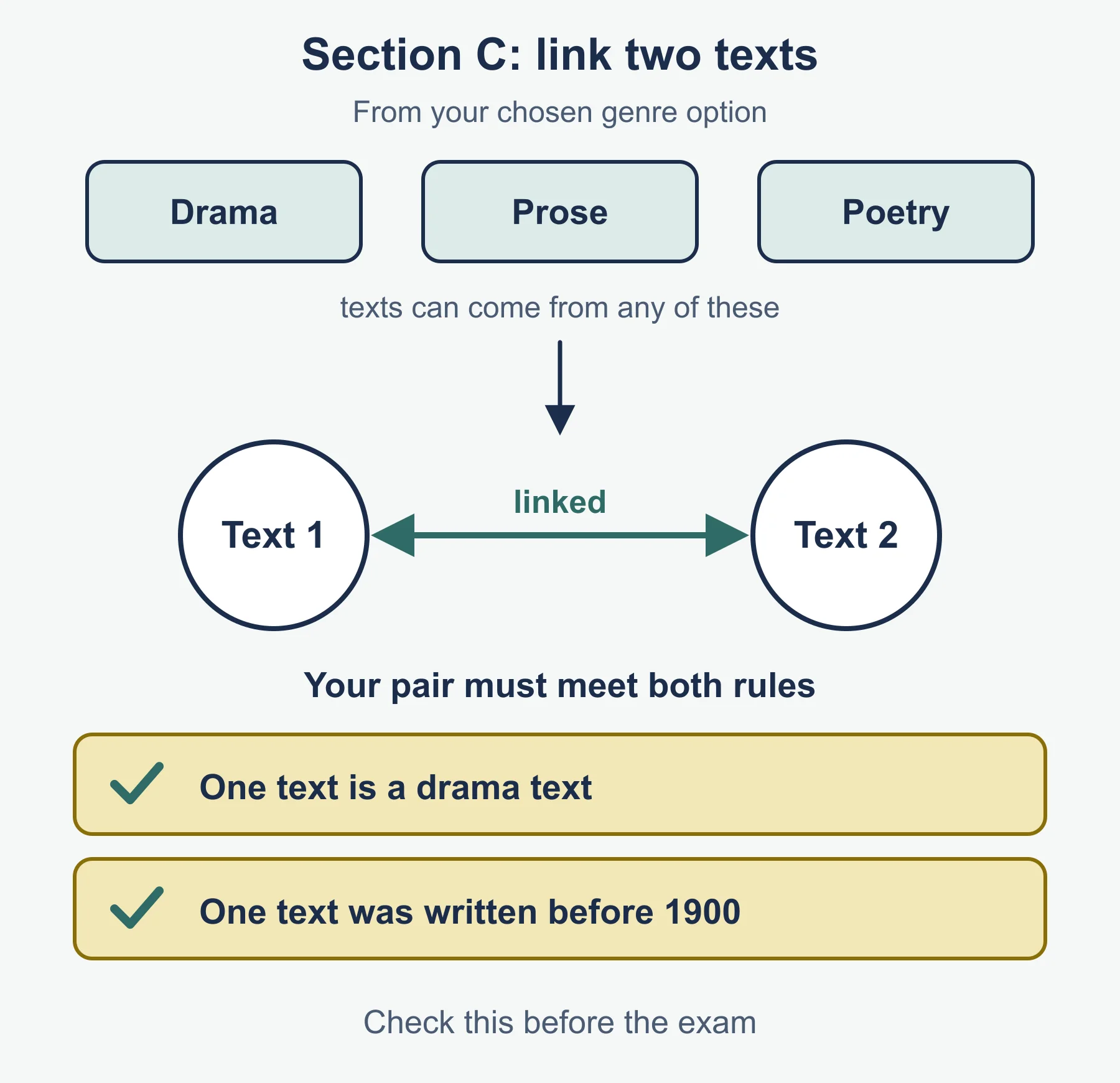
- Three answers: Shakespeare passage (Section A), Shakespeare essay (Section B), link between the other two texts (Section C, one drama and one pre-1900 text).
Set texts
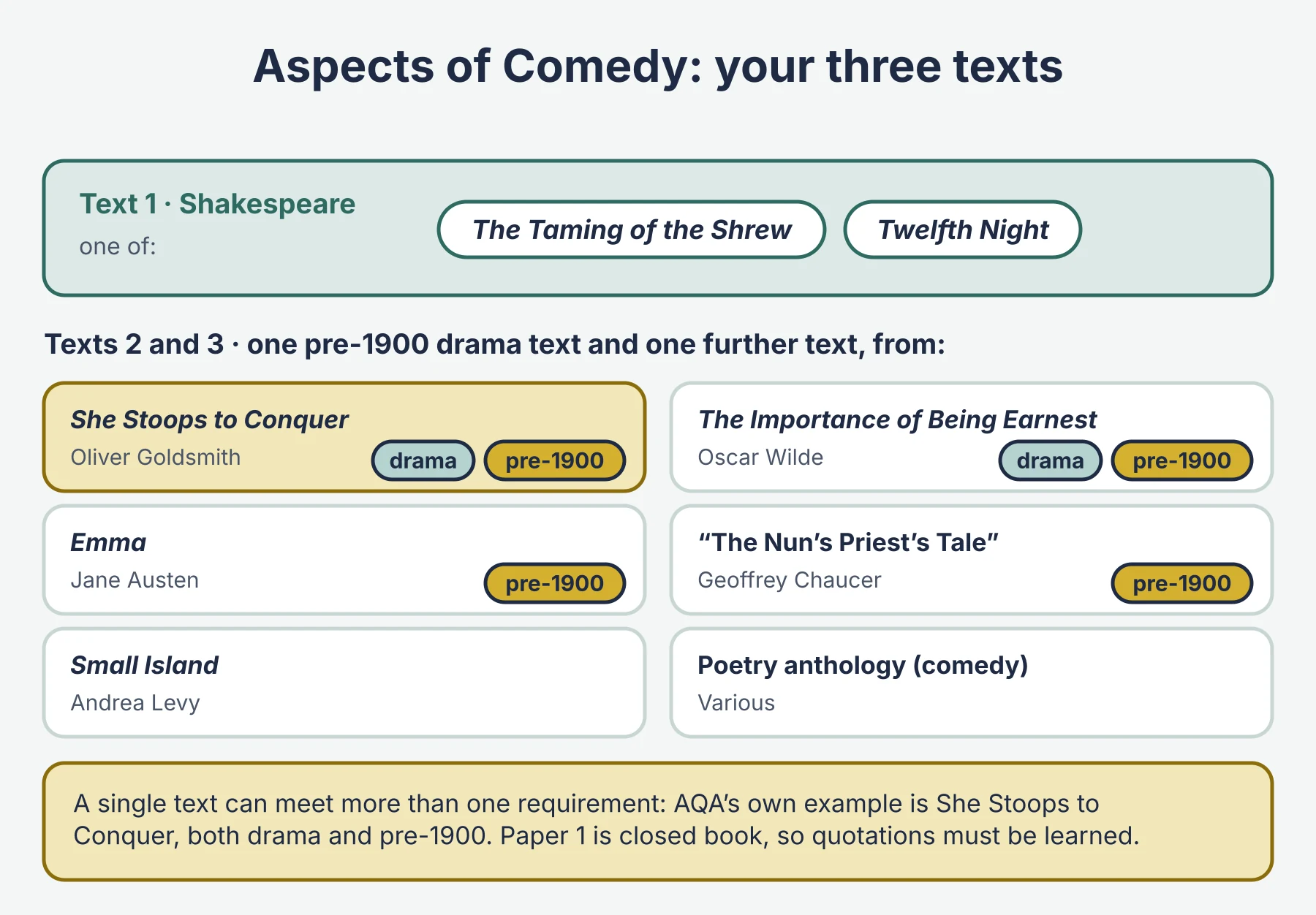
- Shakespeare (one): The Taming of the Shrew; Twelfth Night.
- Pre-1900 drama: She Stoops to Conquer (Goldsmith); The Importance of Being Earnest (Wilde).
- Further text: Emma (Austen); “The Nun’s Priest’s Tale” with Prologue and Epilogue (Chaucer); Small Island (Levy); the AQA poetry anthology (comedy).
Confirm the list with your teacher, as AQA reviews set texts.
AQA’s definition in three sentences
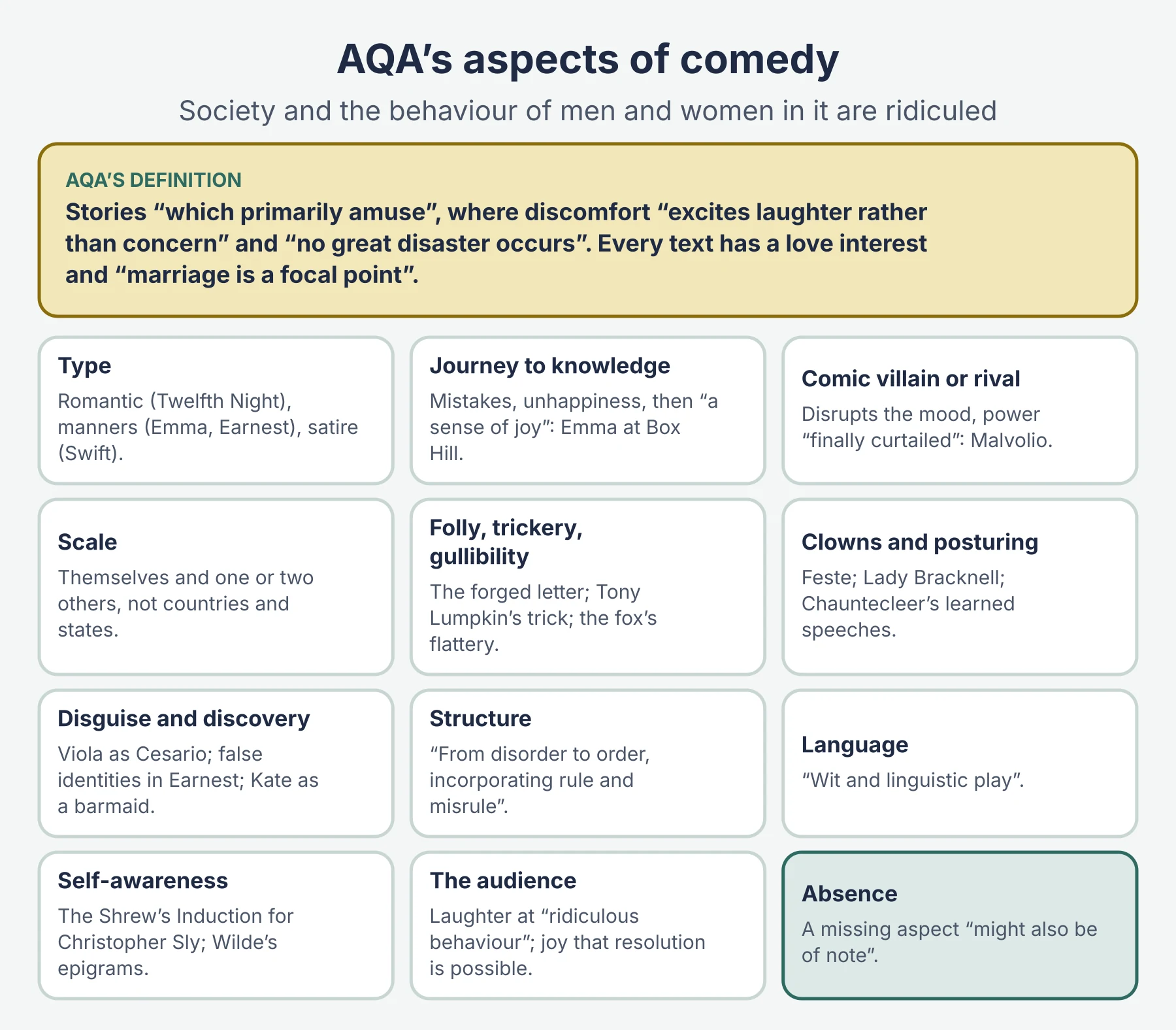
The texts “primarily amuse”; characters’ discomfort excites “laughter rather than concern”; “no great disaster occurs”. Every text has a love interest and marriage is “a focal point”. Society and the behaviour of men and women in it are ridiculed.
AQA’s aspects in short
| Aspect | Question to ask |
|---|---|
| Type | Romantic comedy, satire or comedy of manners? |
| Setting | How do place and time free or restrict the characters? |
| Journey | What mistakes lead to knowledge and happiness? |
| Comic villain or rival | How is their power “finally curtailed”, and at what cost? |
| Fortune | Do we sense that all will end well? |
| Scale | Do actions affect a few people, not states? |
| Folly and trickery | Who is gulled, and who laughs? |
| Clowns and stereotypes | Who exaggerates, poses or postures? |
| Disguise and discovery | Which identities are hidden and revealed? |
| Structure | Disorder to order; rule and misrule; opposites reconciled |
| Plotting | How do sub-plots multiply misunderstanding? |
| Language | Wit, puns, epigrams, linguistic play |
| Self-awareness | How does the comedy draw attention to itself? |
| Audience | Laughter and joy that “positive resolutions are possible” |
Key terms
| Term | Meaning |
|---|---|
| Romantic comedy | Comedy centred on love and courtship ending in marriage |
| Comedy of manners | Satire of the codes and pretensions of polite society |
| Satire | Ridicule aimed at correcting folly or vice |
| Farce | Comedy of improbable situations and physical action |
| Mock-heroic | Treating a trivial subject in grand style (“The Nun’s Priest’s Tale”) |
| Gull | A character tricked by others (Malvolio) |
| Misrule | Temporary overturning of order, as in festive comedy |
| Epigram | A short, witty, paradoxical statement (Wilde) |
| Dramatic irony | Audience knows more than characters, essential to disguise plots |
| Dramatic monologue | Poem spoken by a character to a silent listener (“Mrs Sisyphus”) |
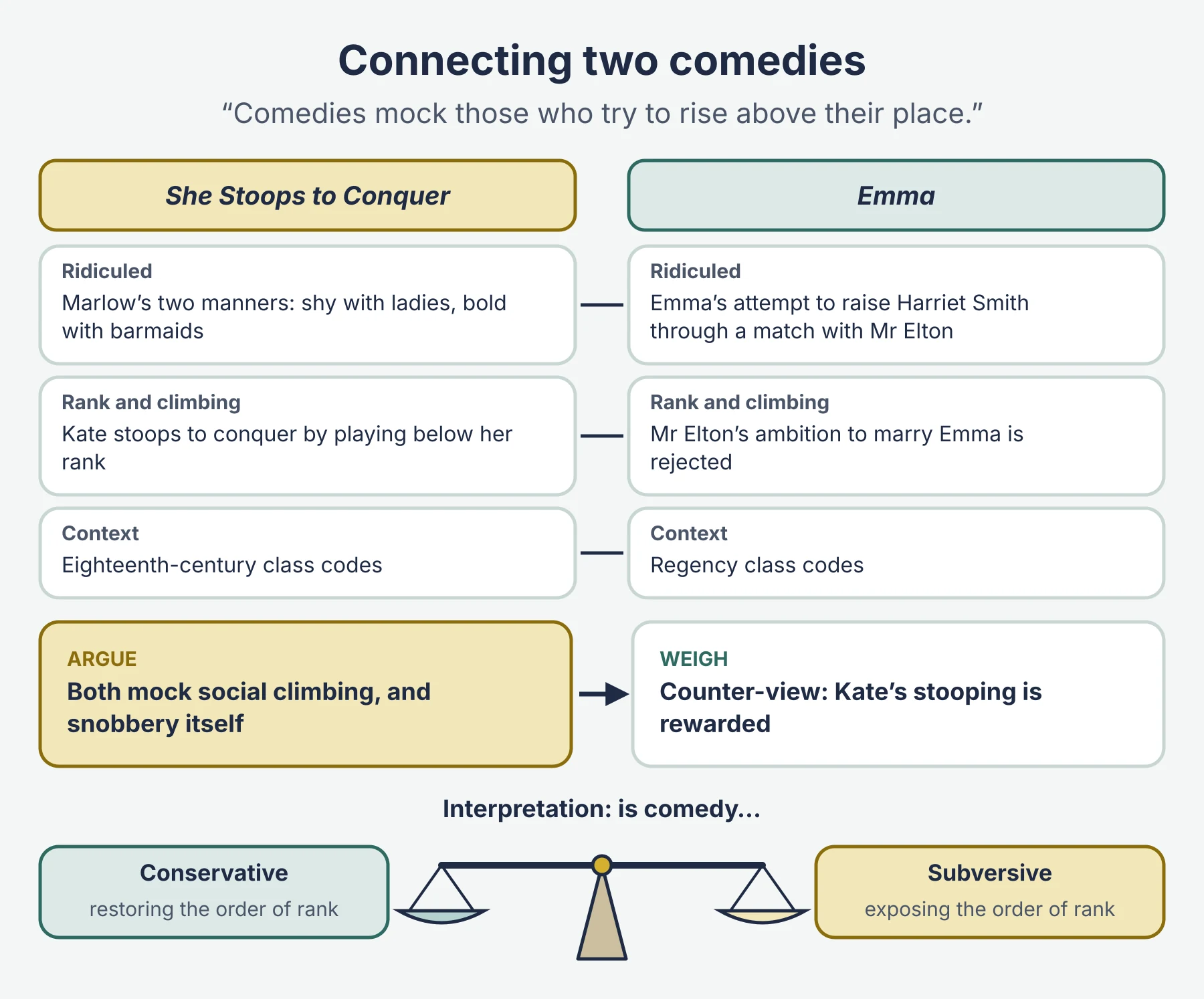
Useful links between texts
- Disguise and mistaken identity: Twelfth Night; She Stoops to Conquer; Earnest.
- Marriage and power: The Taming of the Shrew; Emma; “My Rival’s House”; “Mrs Sisyphus”.
- Pride brought low: Malvolio; Emma; Chauntecleer.
- Seduction and wit: “The Flea”; Wilde’s epigrams.
- Comedy and pain: Small Island; “Sunny Prestatyn”; Malvolio’s ending.
- Satire of public figures: Swift’s elegy.
- Comedy drawing attention to itself: the Sly Induction; “Not My Best Side”, where the painted figures answer back.
Contexts worth linking
- Elizabethan festive comedy and Twelfth Night revels of misrule.
- Early modern marriage and gender in The Taming of the Shrew.
- Eighteenth-century class codes in Goldsmith.
- Regency village society in Emma.
- Late Victorian respectability in Wilde.
- Post-war migration from the Caribbean to Britain in Small Island.
Answer shape for any section
- A one-sentence judgement on the question’s view of comedy.
- Close analysis of how laughter is produced, not a retelling of the joke.
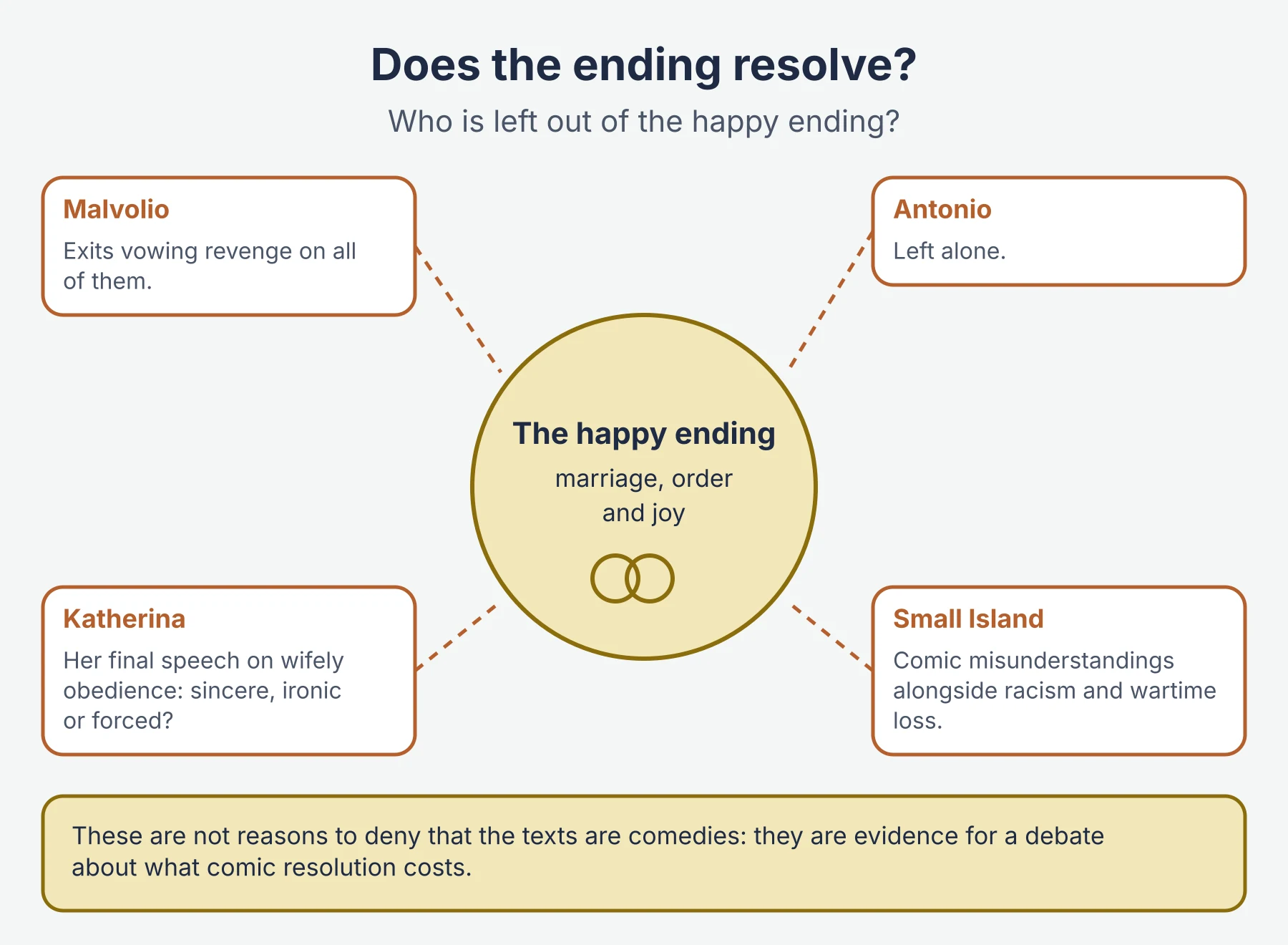
- One moment where comedy is troubled by pain or exclusion.
- Context and a second interpretation tied to specific scenes.
Exam traps
- Describing what is funny instead of analysing how the comedy is made.
- Forgetting the darker edges: exclusion, humiliation, cruelty.
- Ignoring marriage, which AQA makes central.
- Treating Section C as two separate essays.
- Arguing a text “isn’t a comedy” without weighing AQA’s definition.
- Misquoting in a closed-book paper.
Self-test
- Which two Shakespeare plays can be studied for Option 1B?
- What kind of text must one of the two further texts be?
- Name the two drama texts on the further-text list.
- According to AQA, what is a focal point in every comedy set text?
- What happens to the comic villain’s power, according to AQA?
- How does AQA contrast the scale of comedy and tragedy?
- Define comedy of manners and name one set text that fits.
- What is mock-heroic, and which set text uses it?
- Which character in Twelfth Night is gulled by a forged letter?
- What frame opens The Taming of the Shrew?
- Name two anthology poems that could be linked through marriage.
- Give one reason why a comic ending may be read as unresolved.
Answers
- The Taming of the Shrew and Twelfth Night.
- A pre-1900 drama text.
- She Stoops to Conquer and The Importance of Being Earnest.
- Marriage.
- It is “finally curtailed”.
- Comic behaviour affects mainly the characters themselves and perhaps one or two others, not countries and states.
- Comedy satirising the codes and pretensions of polite society; for example Emma or The Importance of Being Earnest.
- A trivial subject treated in a grand style; “The Nun’s Priest’s Tale”, with its learned rooster.
- Malvolio.
- The Induction, in which a drunken tinker, Christopher Sly, is tricked into believing he is a lord and watches the play.
- Any two: “Mrs Sisyphus”; “My Rival’s House”; “The Flea” (courtship).
- Any one: a character is excluded or humiliated (Malvolio, Antonio); a final speech can be read ironically (Katherina); social problems such as racism remain (Small Island).
Try the Aspects of Comedy practice questions, and use the Paper 1 revision notes for the paper’s overall structure.
Related resources
-
Study guides
AQA A-Level English Literature B (7717): Disguise, Escapes, Discovery and the Supernatural
Disguise, escapes, discovery and the supernatural in the Aspects of Comedy texts for AQA English Literature B (7717), with a model recognition-scene paragraph.
English Literature · AQA · A Level
Read guide -
Practice questions
AQA A-Level English Literature B (7717): Disguise, Escapes, Discovery and the Supernatural – Practice Questions
Twelve original questions on disguise, escapes, discovery and the supernatural for AQA English Literature B (7717) Aspects of Comedy, with an invented poem.
English Literature · AQA · A Level
Try questions -
Revision notes
AQA A-Level English Literature B (7717): Disguise, Escapes, Discovery and the Supernatural – Revision Notes
Revision notes on disguise, escapes, discovery and the supernatural in AQA English Literature B (7717) Aspects of Comedy: examples, key terms and a self-test.
English Literature · AQA · A Level
Revise topic
Get free revision emails (optional)
Occasional emails with practice questions, worked explanations and links to free resources for the qualification and subjects you choose. No spam, and you can unsubscribe from any email. The free tools on this site never need an email.