
Study Guides
AQA A-Level English Literature B (7717): Aspects of Comedy
Option 1B Aspects of Comedy for AQA English Literature B (7717): set texts, AQA's comic aspects, passage and linking-essay method, model writing.
- Subject
- English Literature
- Level
- A LEVELS
- Topic
- Paper 1 – Literary Genres
- Author
- Marlbridge Academic Team
- Updated
- Reviewed by
- Ammar Bilal (what this means)
Aligned to AQA A Level English Literature (7717), For first teaching 2025. Official specification .
Syllabus page (what it covers and how it is assessed): AQA A Level English Literature.
Found an error? Report a correction.
Need help with this topic? Request a free trial class for A Level English Literature (7712 / 7717).
Option 1B Aspects of Comedy is the second genre option for Paper 1 Literary Genres in AQA A-level English Literature B (7717). As with tragedy, you study three texts for a closed-book exam, but the genre asks different questions: what makes us laugh, who is laughed at, and whether the happy ending really resolves anything. The Paper 1 Literary Genres overview covers the paper; this guide covers the comedy option only.
What you study
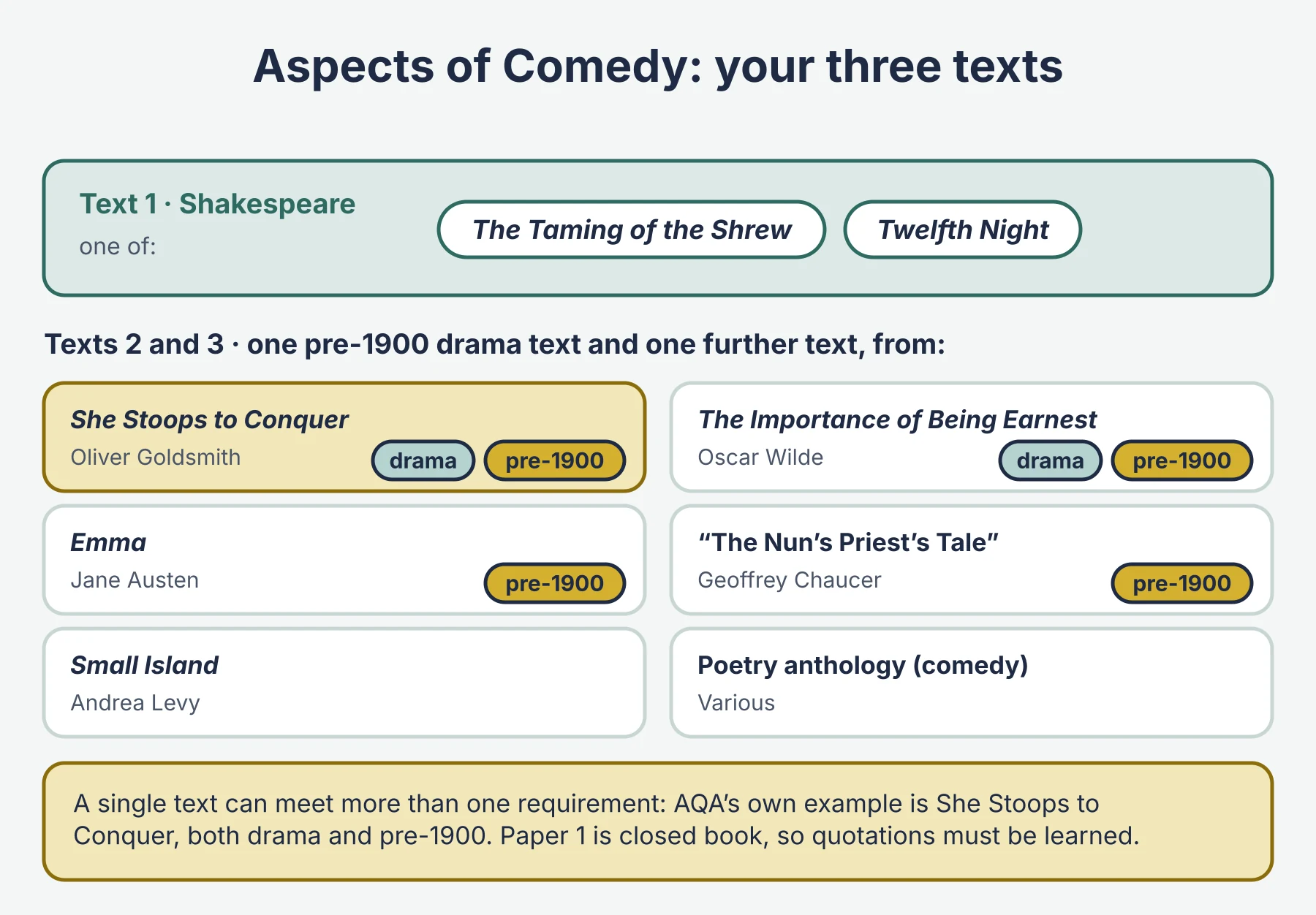
You study one Shakespeare play and two texts from AQA’s list: one pre-1900 drama text and one further text. A single text can meet more than one requirement; AQA’s own example is She Stoops to Conquer, which is both drama and pre-1900.
Shakespeare (one of): The Taming of the Shrew; Twelfth Night.
Two further texts from:
| Text | Author | Notes |
|---|---|---|
| She Stoops to Conquer | Oliver Goldsmith | Drama, pre-1900 |
| The Importance of Being Earnest | Oscar Wilde | Drama, pre-1900 |
| Emma | Jane Austen | Novel, pre-1900 |
| “The Nun’s Priest’s Tale”, with Prologue and Epilogue | Geoffrey Chaucer | Poetry, pre-1900 |
| Small Island | Andrea Levy | Novel |
| AQA English Literature B Poetry anthology (comedy) | Various | Poetry |
The anthology contains “The Flea” (Donne), “Tam o’ Shanter” (Burns), “A Satirical Elegy on the Death of a Late Famous General” (Swift), “Sunny Prestatyn” (Larkin), “Mrs Sisyphus” (Duffy), “Not My Best Side” (Fanthorpe) and “My Rival’s House” (Lochhead).
Paper 1 is closed book, so quotations must be learned. Set texts are reviewed periodically; confirm your list with your teacher.
AQA’s definition of comedy
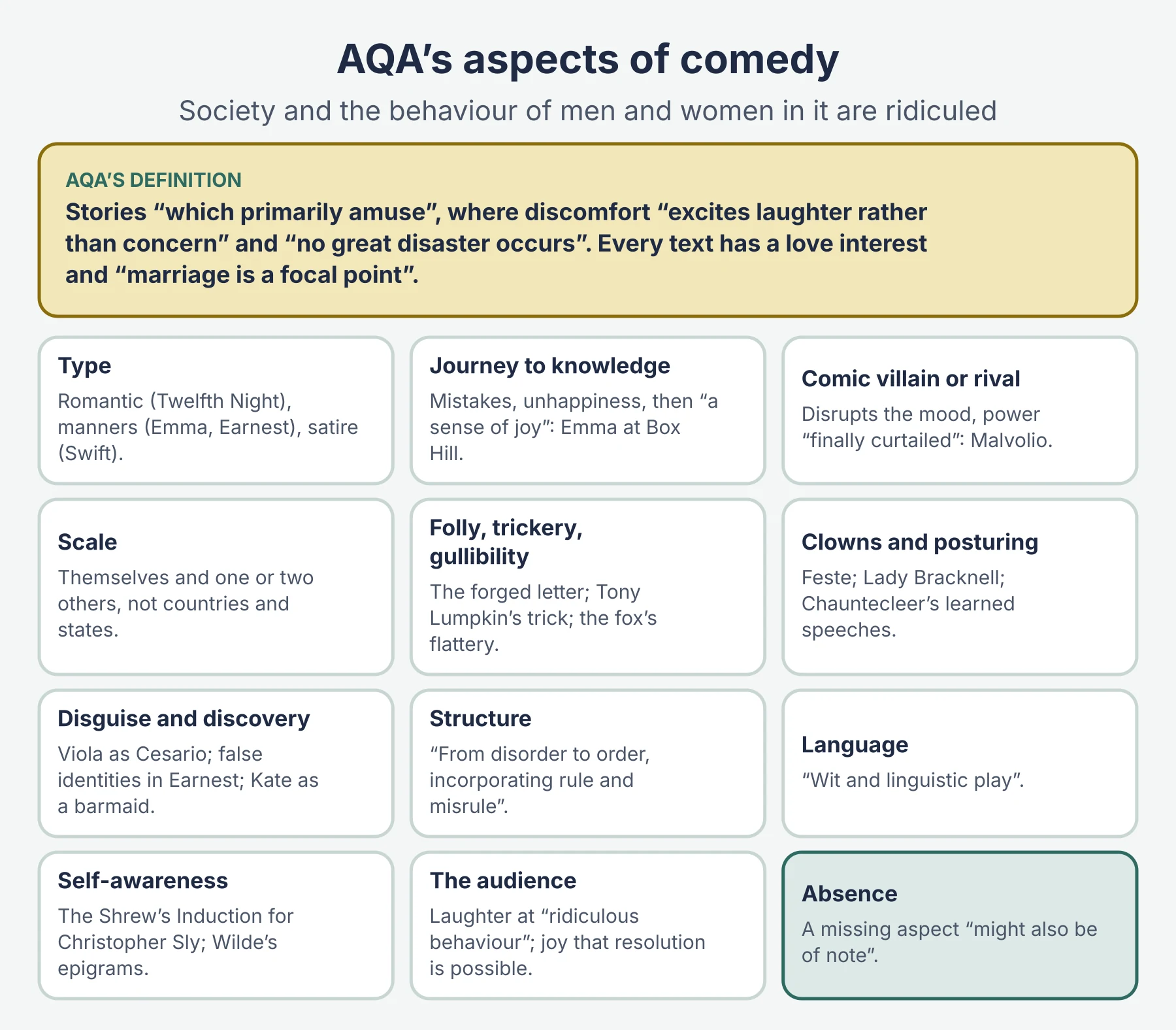
AQA’s set texts are stories “which primarily amuse, where the discomfort of characters generally excites laughter rather than concern and where no great disaster occurs”. In every text there is a love interest, “marriage is a focal point”, and “society itself … and the behaviour of men and women in it, are ridiculed”. The absence of an aspect “might also be of note”.
From AQA’s list of areas to explore, these do most work in essays:
- Type: “classic romantic drama, a satire, a comedy of manners”. Twelfth Night is romantic comedy; Emma and The Importance of Being Earnest are comedies of manners; Swift’s elegy is satire.
- The journey to knowledge and happiness: mistakes and misunderstandings on the way, moments of unhappiness, and a final “sense of joy”. Emma’s humiliation at Box Hill after insulting Miss Bates is a moment of unhappiness that leads to self-knowledge.
- The comic villain or rival, who disrupts the mood “but whose power is finally curtailed”. Malvolio is the classic test case.
- Scale: comic behaviour affects “primarily themselves and perhaps one or two others rather than countries and states, as in tragedy”.
- Folly, trickery and gullibility: the forged letter in Twelfth Night; Tony Lumpkin’s trick in She Stoops to Conquer; the fox’s flattery in “The Nun’s Priest’s Tale”.
- Clowns, exaggeration, stereotypes, posturing: Feste; Lady Bracknell; Chauntecleer’s learned speeches.
- Disguise, escapes and discovery: Viola as Cesario; the false identities in Earnest; Kate Hardcastle playing a barmaid.
- Structure: “from disorder to order, incorporating rule and misrule”, with competition “set up and resolved” and opposites “reconciled”.
- Language: “wit and linguistic play”.
- Self-awareness: “the way that comedy draws attention to itself”, from the Induction of The Taming of the Shrew, where the play is staged for the drunken Christopher Sly, to Wilde’s epigrams.
- The audience: laughter at “ridiculous behaviour” and “a sense of joy that positive resolutions are possible”.
The central debate: does the ending resolve?
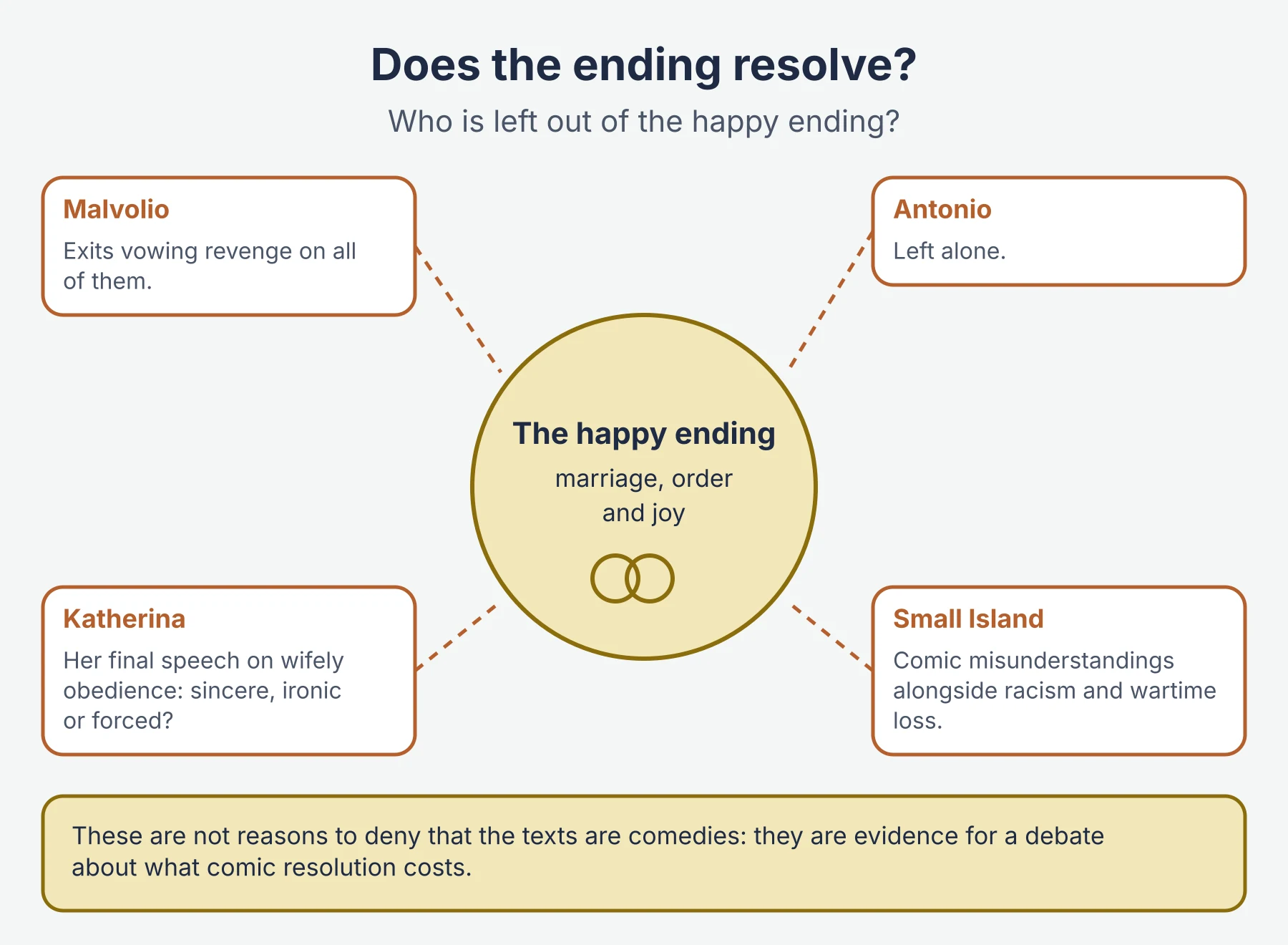
AQA’s emphasis on marriage, order and joy invites a question that strong answers always raise: who is left out of the happy ending? Malvolio exits vowing revenge on all of them; Antonio is left alone; Katherina’s final speech on wifely obedience has been read as sincere, ironic or forced. In Small Island, comic misunderstandings sit alongside racism and wartime loss, so the novel tests how far comedy can contain pain. These are not reasons to deny that the texts are comedies; they are evidence for a debate about what comic resolution costs.
How the three sections use the texts
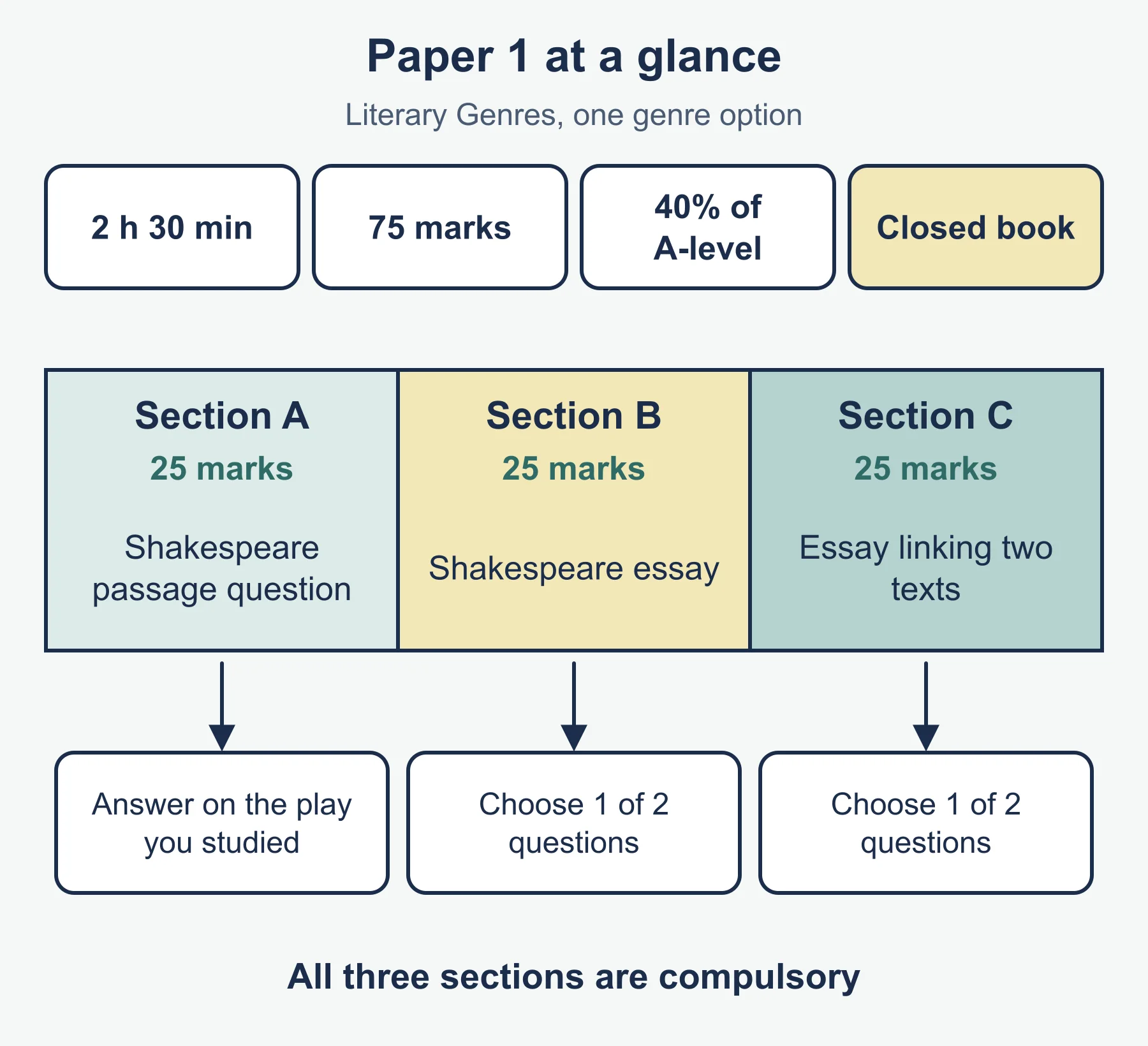
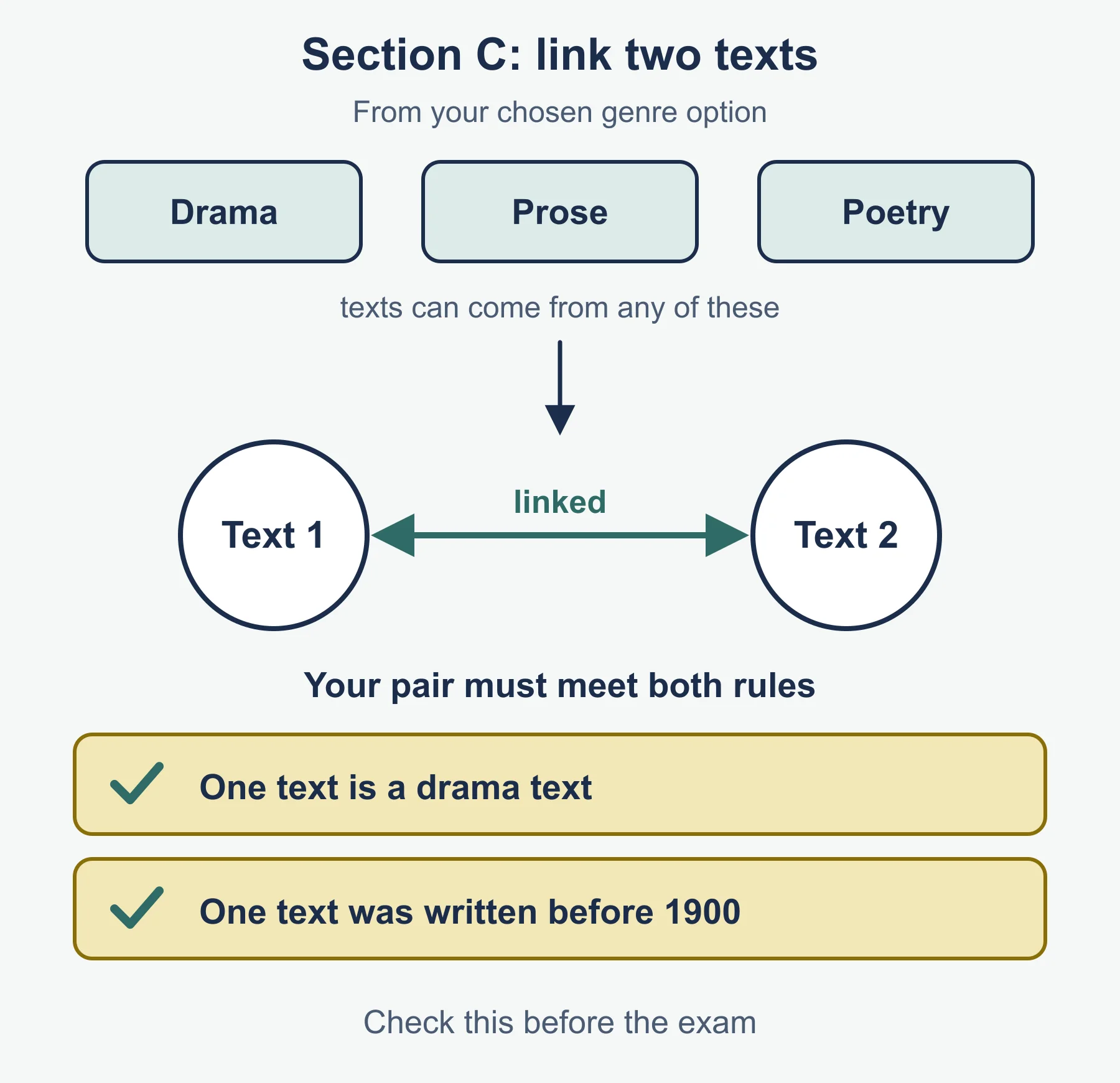
Section A prints a passage from your Shakespeare play: analyse it closely as comedy and link it to the whole play. Section B is an essay on the same play. Section C connects your two other texts; its rubric requires one drama and one pre-1900 text. Assessment objectives: AO1 (informed, personal response, concepts and accurate writing), AO2 (how meanings are shaped), AO3 (contexts), AO4 (connections) and AO5 (interpretations).
Worked example: a Section A-style paragraph
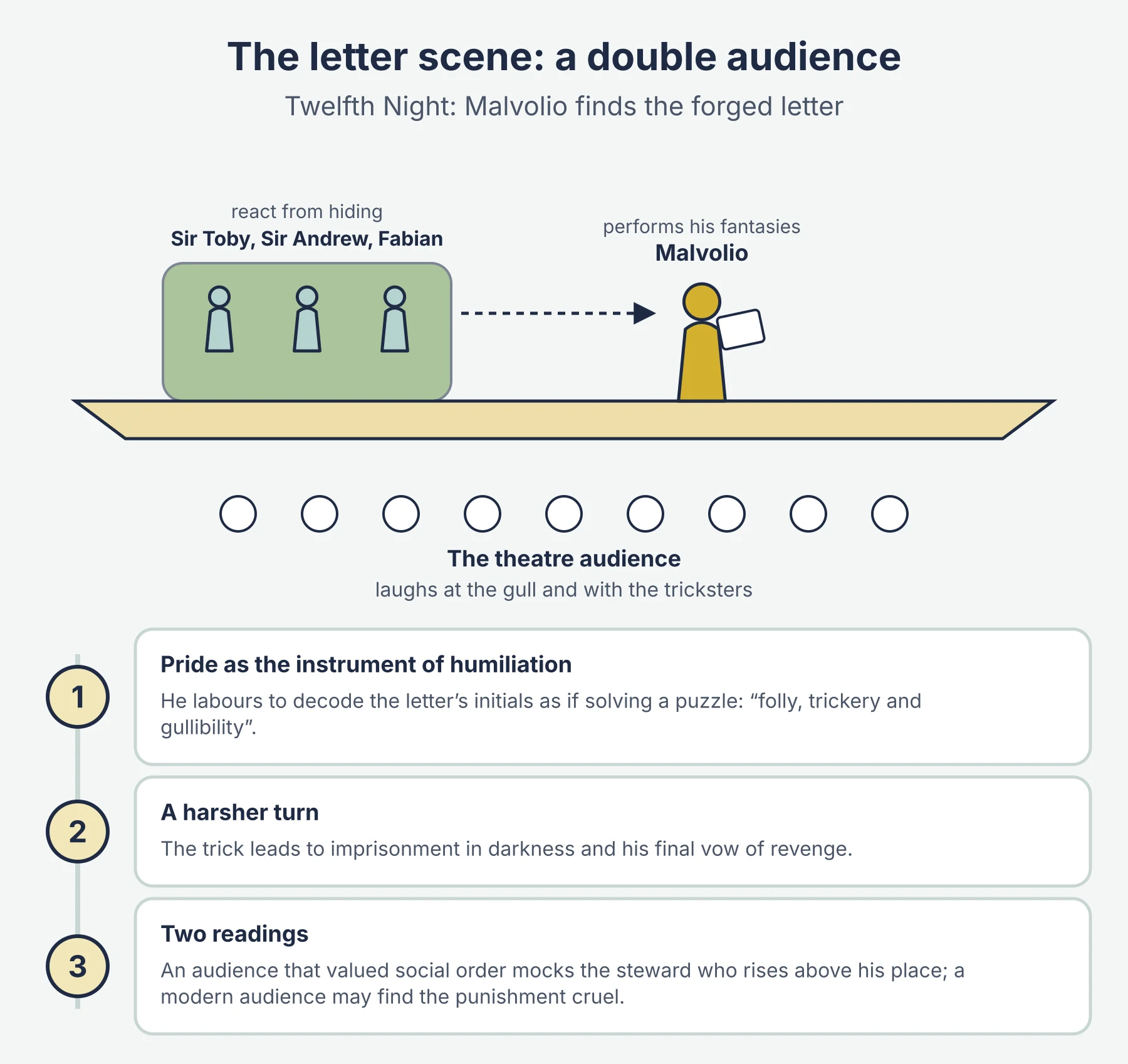
Suppose the passage is the letter scene in Twelfth Night, in which Malvolio finds the forged letter while the tricksters watch from hiding.
The comedy depends on a double audience: Malvolio performs his fantasies of marrying Olivia to an empty garden, while Sir Toby, Sir Andrew and Fabian react from their hiding place, so the theatre audience laughs both at the gull and with the tricksters. Shakespeare builds the scene on the gap between Malvolio’s self-importance and his gullibility; he labours to decode the letter’s initials as if solving a puzzle, so his pride becomes the instrument of his humiliation. This fits AQA’s emphasis on “folly, trickery and gullibility”, yet it also anticipates the play’s harsher turn: the trick that is funny here leads to his imprisonment in darkness and his final vow of revenge. Read in context, the steward who wants to rise above his place is mocked by an audience that valued social order, but a modern audience may find the cruelty of the punishment uncomfortable, so the scene can be read as comedy that tests its own limits.
The paragraph combines close analysis (AO2), genre terms from AQA’s list (AO1), context (AO3) and a second interpretation (AO5).
Worked example: Section C plan
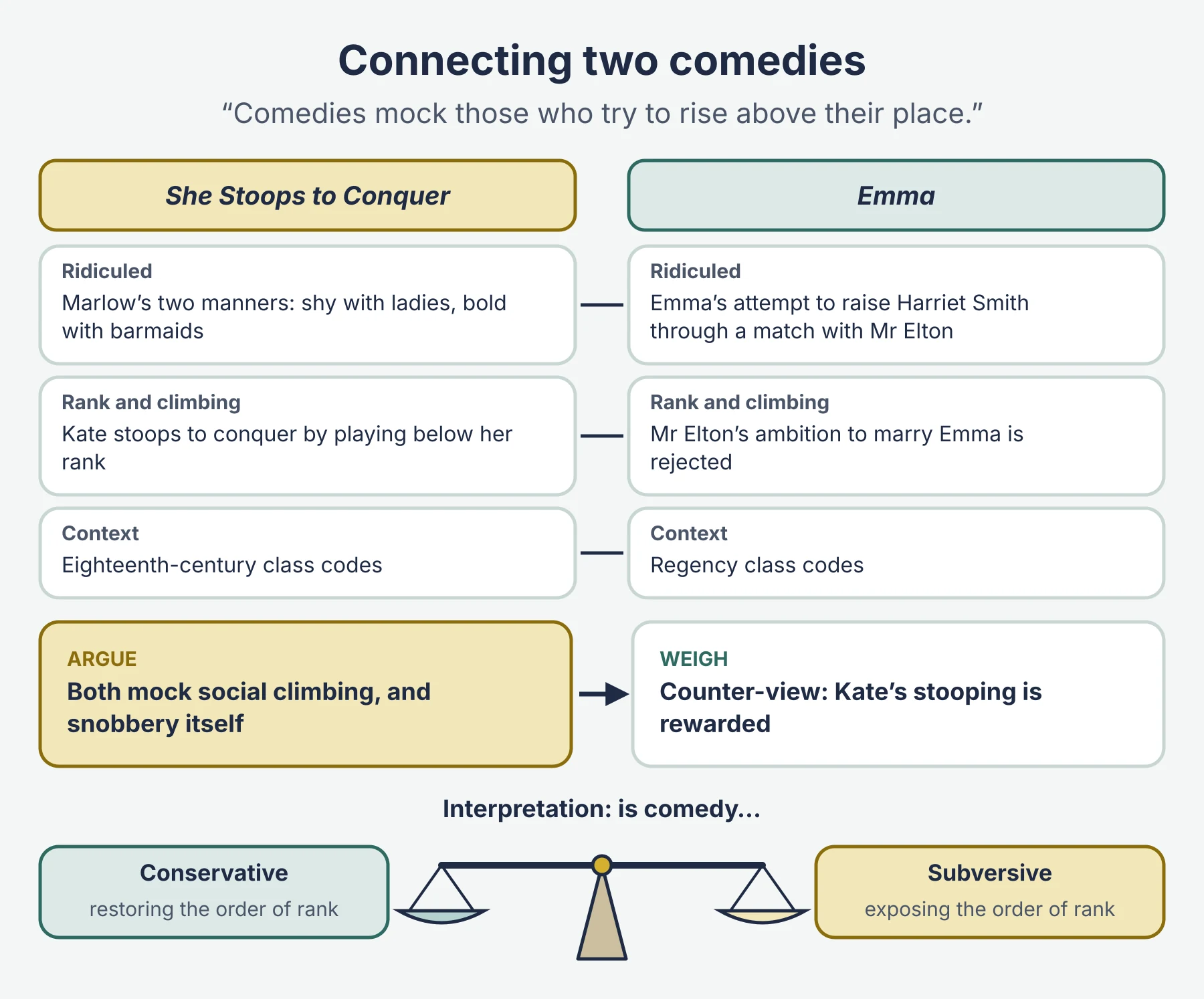
Question shape (original): “Comedies mock those who try to rise above their place.” Discuss with reference to two texts.
Plan using She Stoops to Conquer and Emma: in Goldsmith, Marlow’s two manners, shy with ladies and bold with barmaids, are ridiculed, and Kate stoops to conquer by playing below her rank; in Austen, Emma’s attempt to raise Harriet Smith through a match with Mr Elton is mocked, and Mr Elton’s ambition to marry Emma is rejected. Argue that both comedies mock social climbing but also mock snobbery itself, then weigh the counter-view that Kate’s stooping is rewarded. Context: eighteenth-century and Regency class codes. Interpretation: comedy as conservative (restoring the order of rank) or subversive (exposing it).
Common mistakes
- Retelling the jokes instead of analysing how the comedy works.
- Ignoring darker moments, which AQA’s “moments of unhappiness” invites you to discuss.
- Forgetting marriage, the focal point AQA names in every text.
- Treating comedy as trivial: comic structure and wit deserve the same analysis as tragic language.
- Section C as two separate essays.
Exam technique
Questions often offer a view to debate or ask about the significance of an aspect; both need an argued judgement. Allow about 50 minutes for each of the three 25-mark answers in the 2 hour 30 minute paper.
More resources on this topic
- Aspects of Comedy revision notes
- Aspects of Comedy practice questions
- Aspects of Tragedy study guide
Specification
AQA A-level English Literature B (7717), section 3.1.2 Aspects of comedy — aqa.org.uk.
Related resources
-
Practice questions
AQA A-Level English Literature B (7717): Aspects of Comedy – Practice Questions
Twelve original questions for AQA English Literature B (7717) Aspects of Comedy, with an invented scene and poem and linking-essay tasks, plus answers.
English Literature · AQA · A Level
Try questions -
Revision notes
AQA A-Level English Literature B (7717): Aspects of Comedy – Revision Notes
Revision notes for AQA English Literature B (7717) Aspects of Comedy: set texts, comic aspects, key terms, text links, exam traps and a self-test.
English Literature · AQA · A Level
Revise topic -
Study guides
AQA A-Level English Literature B (7717): Disguise, Escapes, Discovery and the Supernatural
Disguise, escapes, discovery and the supernatural in the Aspects of Comedy texts for AQA English Literature B (7717), with a model recognition-scene paragraph.
English Literature · AQA · A Level
Read guide
Get free revision emails (optional)
Occasional emails with practice questions, worked explanations and links to free resources for the qualification and subjects you choose. No spam, and you can unsubscribe from any email. The free tools on this site never need an email.