
Study Guides
AQA A-Level English Literature B (7717): Aspects of Tragedy
Option 1A Aspects of Tragedy for AQA English Literature B (7717): set texts, AQA's tragic aspects, passage and linking-essay method, model writing.
- Subject
- English Literature
- Level
- A LEVELS
- Topic
- Paper 1 – Literary Genres
- Author
- Marlbridge Academic Team
- Updated
- Reviewed by
- Ammar Bilal (what this means)
Aligned to AQA A Level English Literature (7717), For first teaching 2025. Official specification .
Syllabus page (what it covers and how it is assessed): AQA A Level English Literature.
Found an error? Report a correction.
Need help with this topic? Request a free trial class for A Level English Literature (7712 / 7717).
Option 1A Aspects of Tragedy is one of the two genre options for Paper 1 Literary Genres in AQA A-level English Literature B (7717). You study three texts and write about them in a closed-book exam. The Paper 1 Literary Genres overview explains the paper as a whole; this guide is only about the tragedy option, its texts and how AQA’s idea of tragedy should shape your answers.
What you study
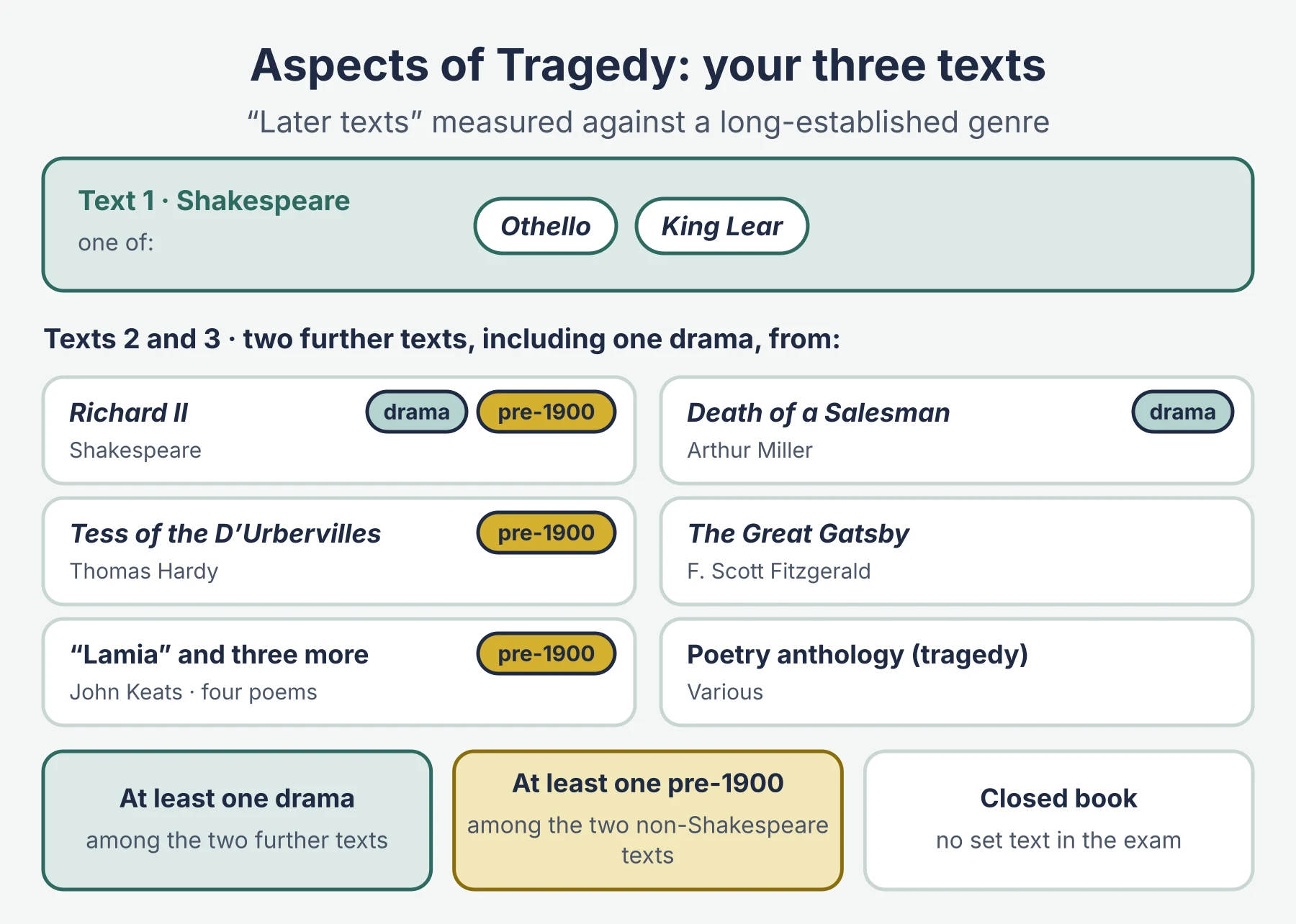
AQA describes the option as measuring later texts “against a literary genre which is long established”. You study three texts: one Shakespeare play, a second drama text and one further text, and at least one of the two non-Shakespeare texts must be written before 1900.
Shakespeare (one of): Othello; King Lear.
Two further texts, including one drama, from:
| Text | Author | Notes |
|---|---|---|
| Richard II | Shakespeare | Drama, pre-1900 |
| Death of a Salesman | Arthur Miller | Drama |
| Tess of the D’Urbervilles | Thomas Hardy | Novel, pre-1900 |
| The Great Gatsby | F. Scott Fitzgerald | Novel |
| “Lamia”, “Isabella or The Pot of Basil”, “La Belle Dame Sans Merci”, “The Eve of St. Agnes” | John Keats | Poetry, pre-1900 |
| AQA English Literature B Poetry anthology (tragedy) | Various | Poetry |
The anthology contains extracts from the Prologue of “The Monk’s Tale” and “The Monk’s Tale” (Chaucer), “Jessie Cameron” (Christina Rossetti), an extract from Paradise Lost (Milton), “Tithonus” (Tennyson), “The Convergence of the Twain” (Hardy), “The Death of Cuchulain” (Yeats), “‘Out, out…’” (Frost), “Death in Leamington” (Betjeman) and “Miss Gee” (Auden).
Paper 1 is closed book: you may not take any set text into the exam. Set texts are reviewed periodically, so confirm your list with your teacher.
AQA’s aspects of tragedy
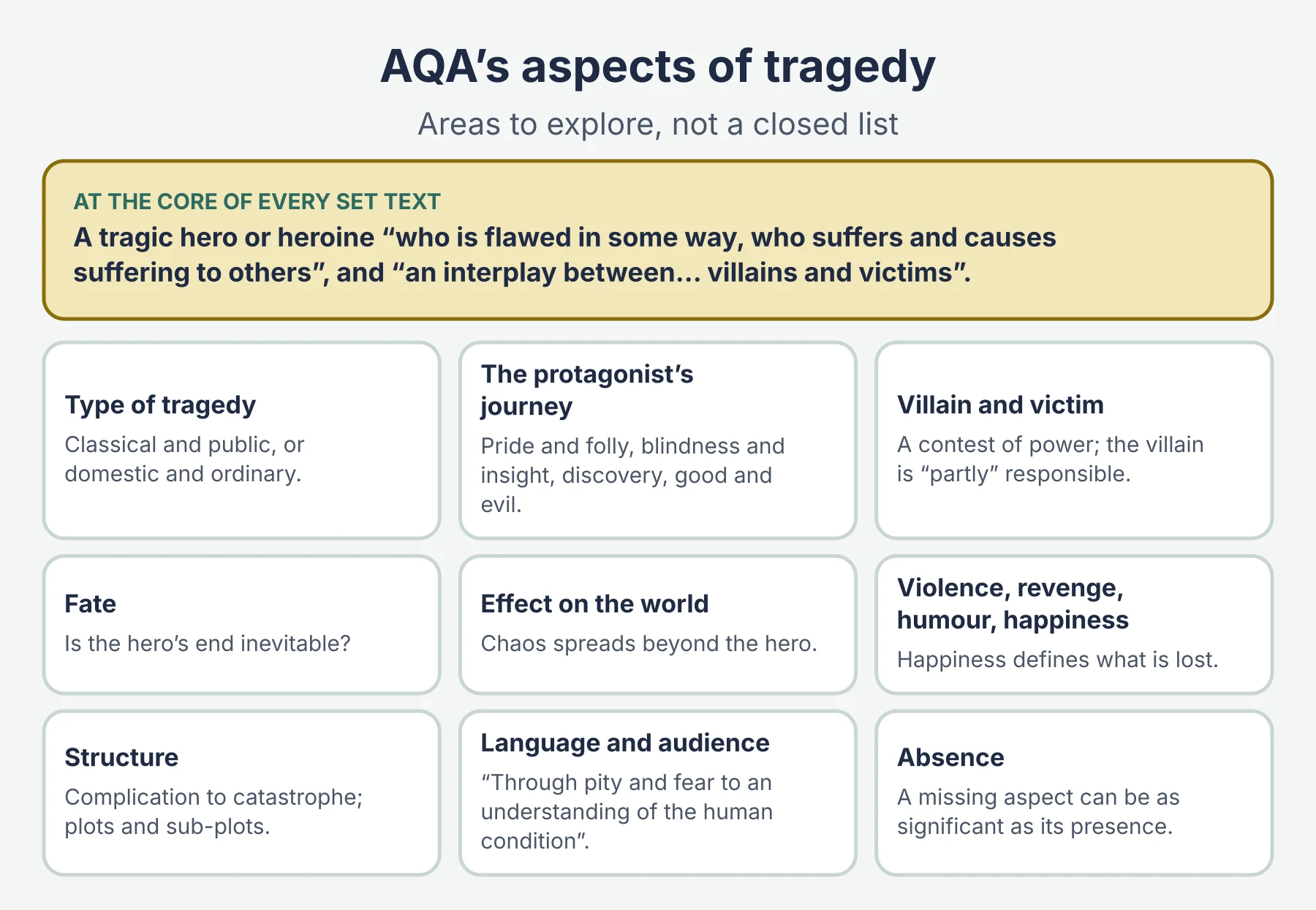
AQA’s starting point is that “at the core of all the set texts is a tragic hero or heroine who is flawed in some way, who suffers and causes suffering to others”, and that in all of them “there is an interplay between what might be seen as villains and victims”. It then offers areas to explore, not a closed list. The ones that most often decide the quality of an answer are these.
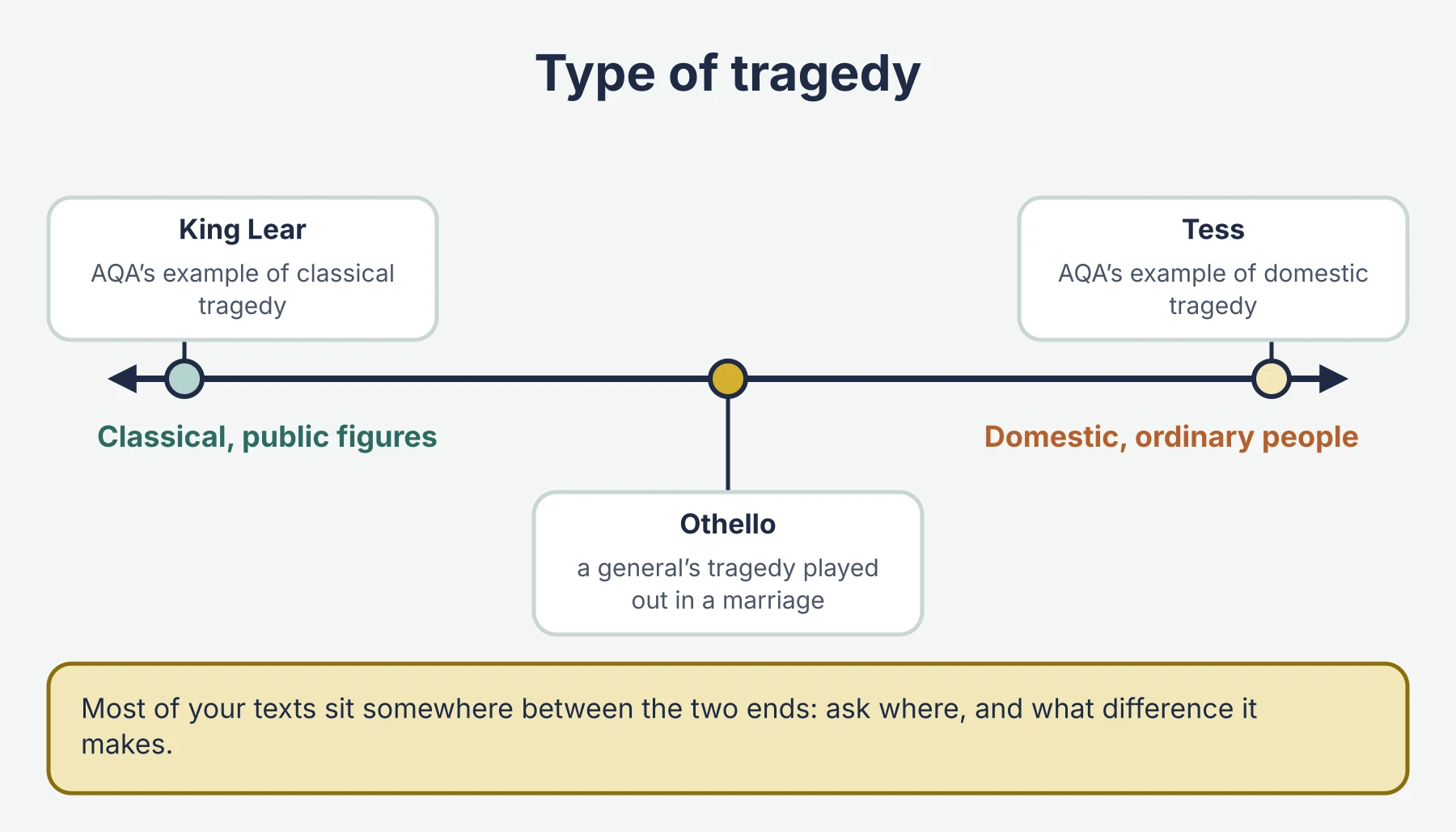
Type of tragedy. AQA contrasts tragedy that is “classical and about public figures, like Lear” with tragedy that is “domestic and about representations of ordinary people, like Tess”. Most of your texts sit somewhere between: Othello is a general’s tragedy played out in a marriage.
The protagonist’s journey. Flaws, “pride and folly”, “blindness and insight”, “discovery and learning”, and being “a mix of good and evil”. Ask whether recognition comes, and at what cost.
Villain and victim. The villain “engages in a contest of power and is partly responsible for the hero’s demise”. “Partly” is the important word: an essay that blames Iago or Edmund entirely loses the hero’s responsibility.
Fate. Whether “the hero’s end is inevitable”. Hardy’s narrator in Tess ends by ironically crediting the President of the Immortals, so fate becomes a target of the novel’s anger.
Effect on the world. How the hero’s behaviour spreads chaos, from Lear’s divided kingdom to the deaths that follow Gatsby’s.
Violence, revenge, humour and happiness. AQA includes “humour and moments of happiness”. The Fool in King Lear, the comic touches in “Miss Gee”, and the lovers’ escape at the end of “The Eve of St. Agnes” all matter, because happiness defines what is lost and can test whether a text is tragic at all.
Structure. “Complication to catastrophe, from order to disorder, through climax to resolution.” Plots and sub-plots, such as the Gloucester plot in King Lear, mirror and intensify the main action.
Language and audience. Language that heightens the tragedy, and the audience moved “through pity and fear to an understanding of the human condition”.
Absence. “The absence of an ‘aspect’ can be as significant as its presence.” A villain-less tragedy, or a poem with no catastrophe, is still worth analysing as tragedy.
How the three sections use the texts
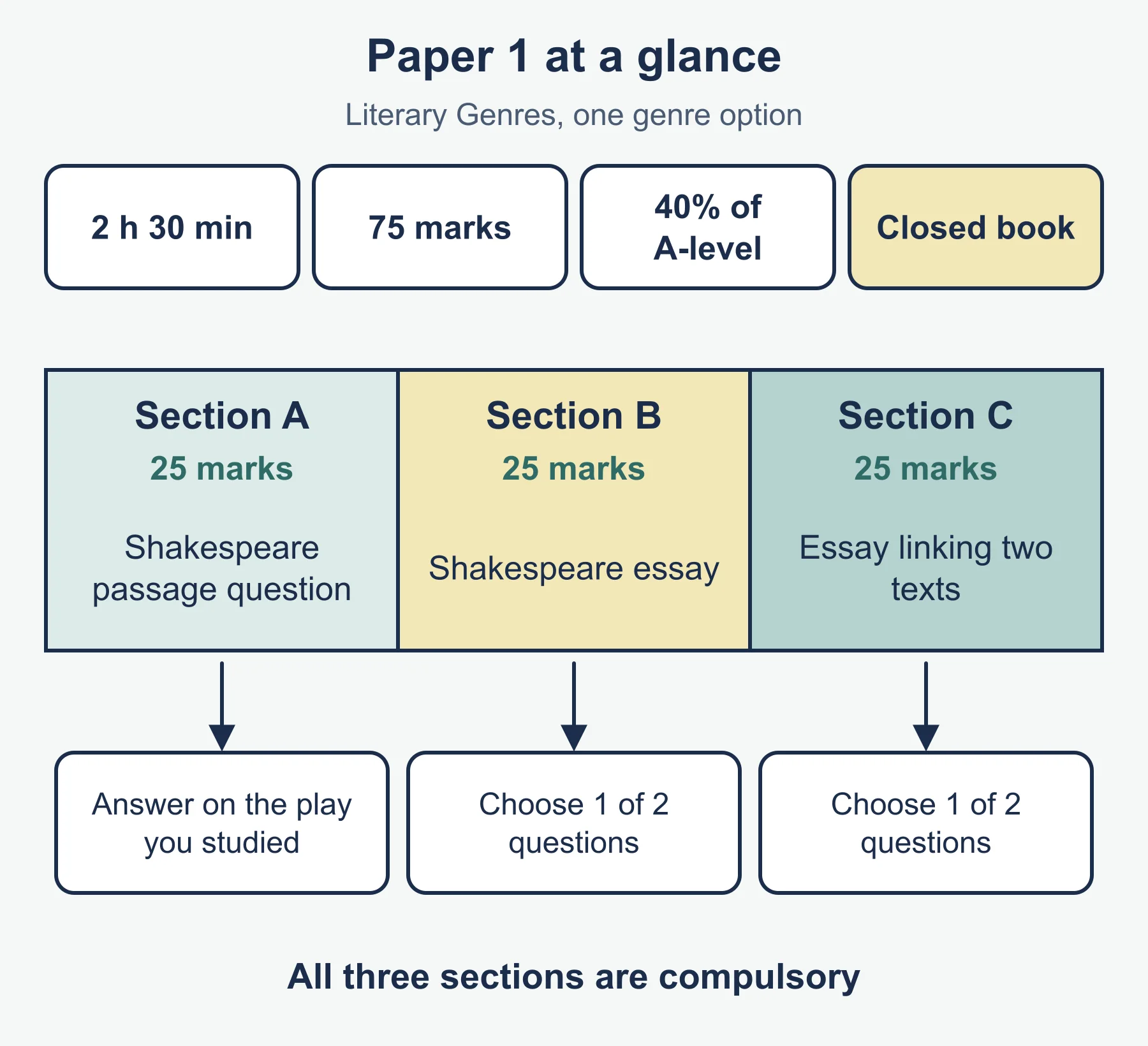
Section A prints a passage from your Shakespeare play. Analyse the passage closely as tragedy, then connect it to the play as a whole from memory.
Section B is an essay on the same Shakespeare play, built from evidence across the whole text.
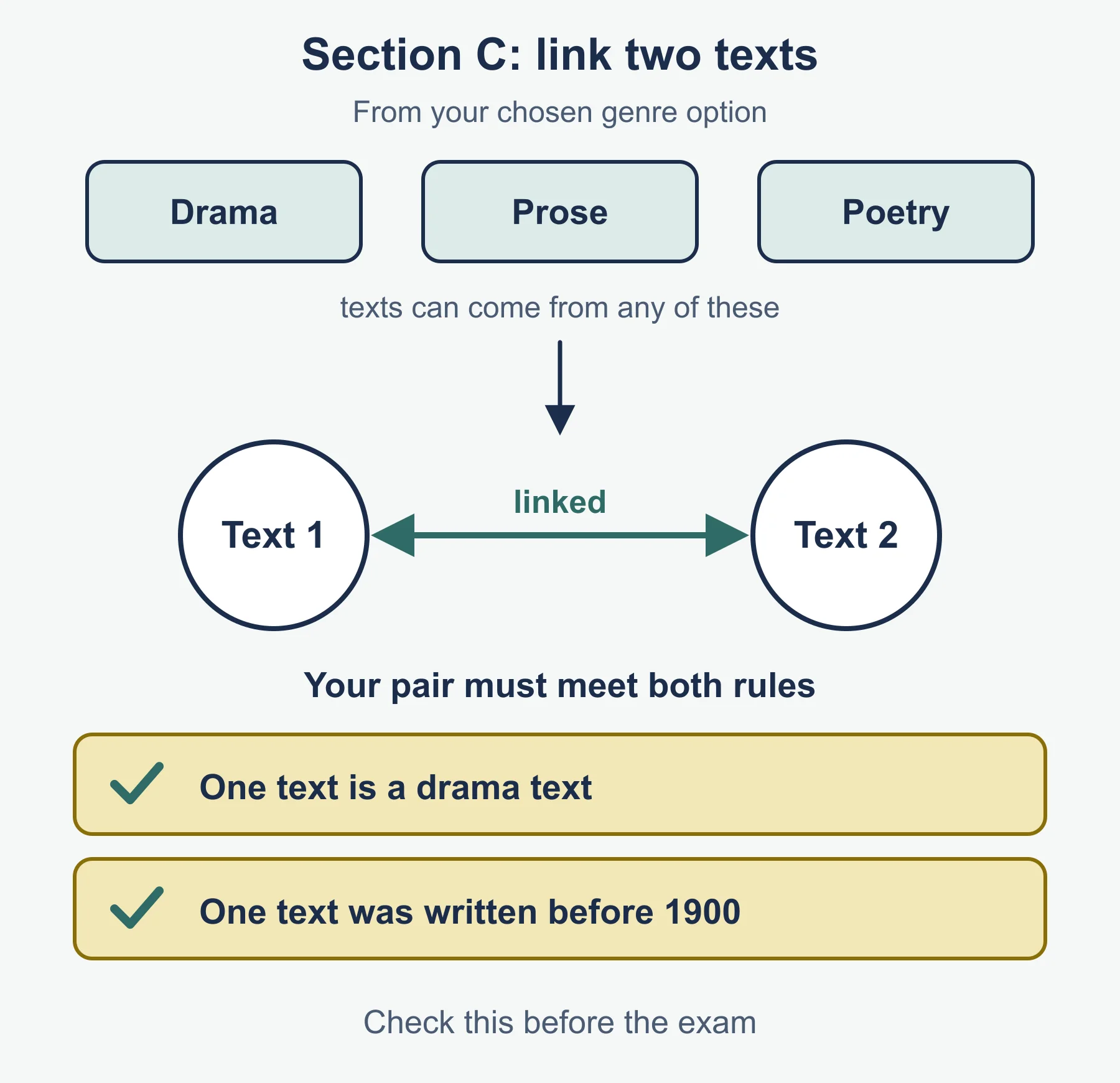
Section C asks you to connect your two other texts. Its rubric requires that one of the two texts be a drama text and one written before 1900, which your text choices are designed to meet. Connections (AO4) need to be argued, not listed.
All five assessment objectives can apply across the paper: AO1 (an informed, personal response in accurate writing, using concepts and terminology), AO2 (how meanings are shaped), AO3 (contexts), AO4 (connections across texts) and AO5 (different interpretations).
Worked example: passage analysis
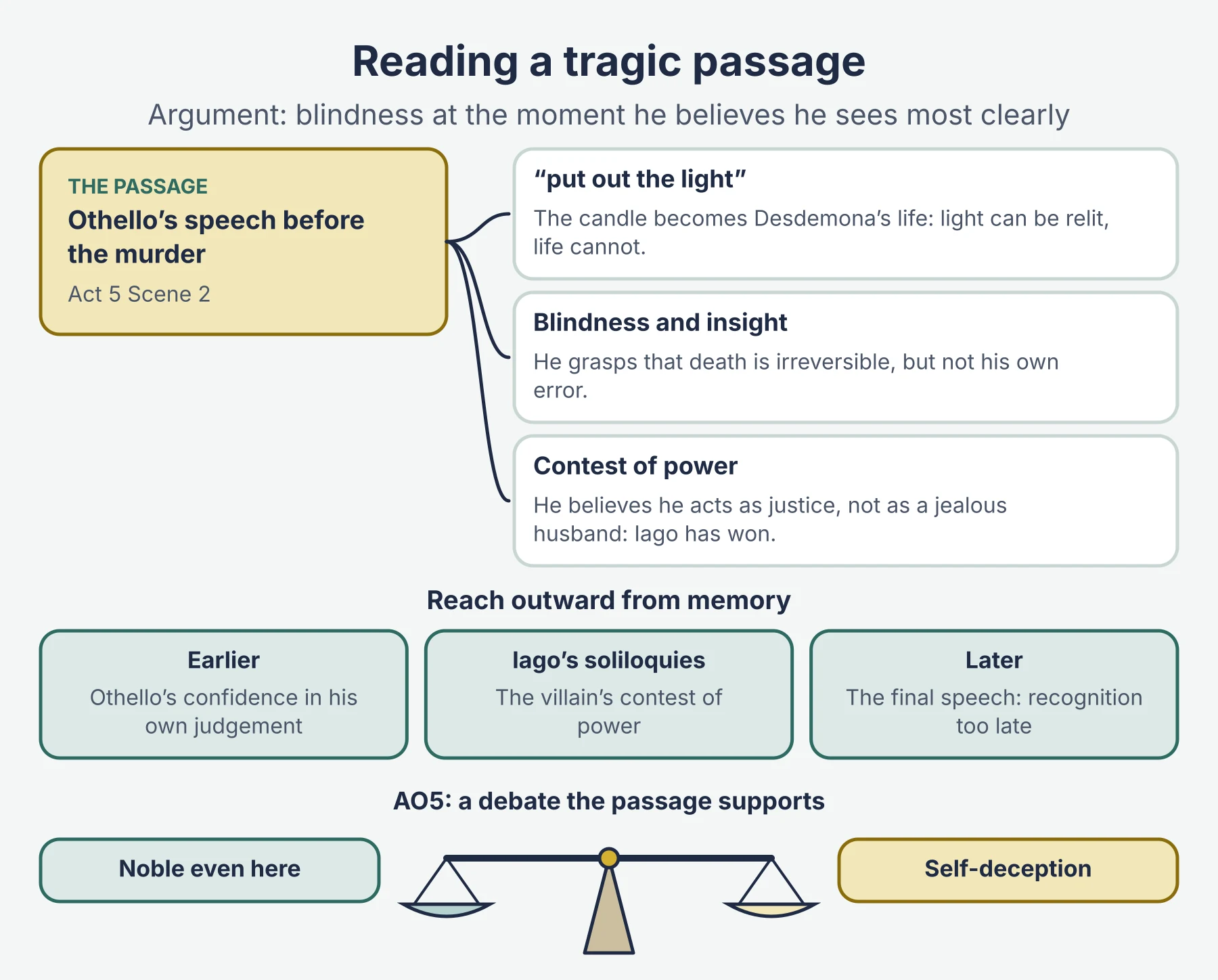
Suppose the passage is Othello’s speech before the murder in Act 5 Scene 2. A strong answer might argue that the speech shows the hero’s blindness at the very moment he believes he sees most clearly. The repeated “put out the light” turns the candle into an image for Desdemona’s life, and the contrast between the light that can be relit and the life that cannot reveals insight arriving within the delusion: Othello understands the irreversibility of death but not his own error. His sense that he acts as justice, rather than as a jealous husband, shows how fully Iago’s contest of power has been won. Connecting outward, the answer would link this to Othello’s earlier confidence in his own judgement, to Iago’s soliloquies, and to the final speech, where recognition comes too late. AO5 enters naturally: some readers find Othello noble even here, others see self-deception, and the passage supports a debate between them.
Worked example: Section C link
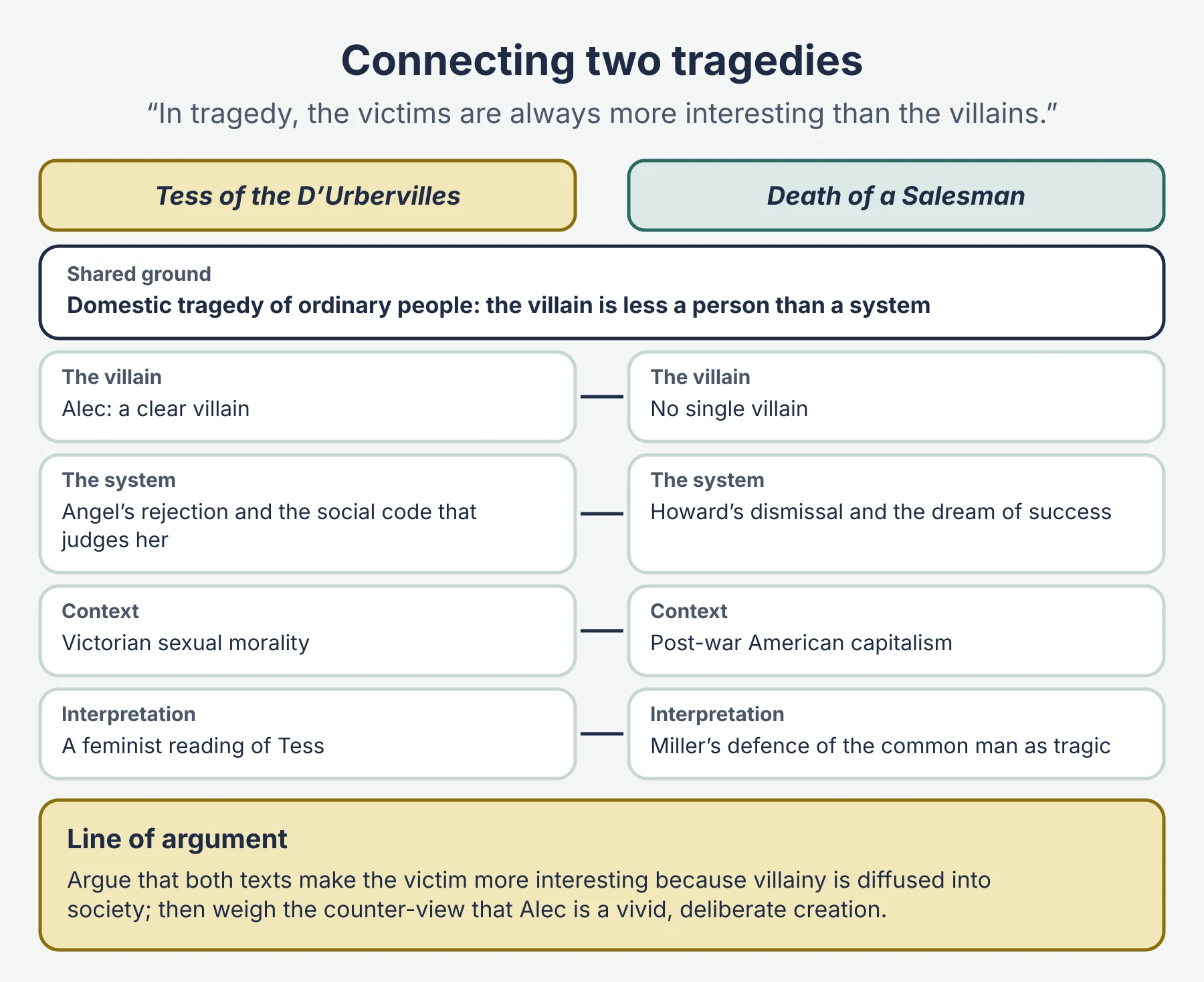
Question shape (original): “In tragedy, the victims are always more interesting than the villains.” Discuss with reference to two texts.
Plan using Tess of the D’Urbervilles and Death of a Salesman: both texts are domestic tragedies of ordinary people, so the villain is less a person than a system. In Tess, Alec is a clear villain, but Angel’s rejection and the social code that judges her are as destructive; in Salesman there is no single villain, but Howard’s dismissal of Willy and the dream of success play the opponent’s role. Argue that both texts make the victim more interesting because the villainy is diffused into society, then weigh the counter-view that Alec is a vivid, deliberate creation. Contexts: Victorian sexual morality; post-war American capitalism. Interpretation: a feminist reading of Tess; Miller’s defence of the common man as tragic.
Common mistakes
- Applying a checklist. Labels such as hamartia are useful only if you argue how the text uses, bends or rejects the idea.
- Blaming the villain entirely. AQA’s wording is that the villain is “partly responsible”.
- Treating Section C as two mini-essays. Organise by point of connection.
- Ignoring happiness and humour, which AQA names explicitly.
- Misquoting from memory. Paper 1 is closed book; short, accurate quotations are best.
Exam technique
Questions on tragedy often turn on a critical view or on the significance of an aspect, and reward debate rather than agreement. Paper 1 lasts 2 hours 30 minutes for three answers of equal value, so about 50 minutes each is proportionate. Plan Section C with care: choosing the right moments from two texts takes longer than it seems.
More resources on this topic
- Aspects of Tragedy revision notes
- Aspects of Tragedy practice questions
- Aspects of Comedy study guide
Specification
AQA A-level English Literature B (7717), section 3.1.1 Aspects of tragedy — aqa.org.uk.
Related resources
-
Practice questions
AQA A-Level English Literature B (7717): Aspects of Tragedy – Practice Questions
Twelve original questions for AQA English Literature B (7717) Aspects of Tragedy, with two invented extracts and linking-essay tasks, plus answers.
English Literature · AQA · A Level
Try questions -
Revision notes
AQA A-Level English Literature B (7717): Aspects of Tragedy – Revision Notes
Revision notes for AQA English Literature B (7717) Aspects of Tragedy: set texts, tragic aspects, key terms, text links, exam traps and a self-test.
English Literature · AQA · A Level
Revise topic -
Study guides
AQA A-Level English Literature B (7717): Aspects of Comedy
Option 1B Aspects of Comedy for AQA English Literature B (7717): set texts, AQA's comic aspects, passage and linking-essay method, model writing.
English Literature · AQA · A Level
Read guide
Get free revision emails (optional)
Occasional emails with practice questions, worked explanations and links to free resources for the qualification and subjects you choose. No spam, and you can unsubscribe from any email. The free tools on this site never need an email.