
Revision Notes
AQA A-Level English Literature B (7717): Aspects of Tragedy – Revision Notes
Revision notes for AQA English Literature B (7717) Aspects of Tragedy: set texts, tragic aspects, key terms, text links, exam traps and a self-test.
- Subject
- English Literature
- Level
- A LEVELS
- Topic
- Paper 1 – Literary Genres
- Author
- Marlbridge Academic Team
- Updated
- Reviewed by
- Ammar Bilal (what this means)
Aligned to AQA A Level English Literature (7717), For first teaching 2025. Official specification .
Syllabus page (what it covers and how it is assessed): AQA A Level English Literature.
Found an error? Report a correction.
Need help with this topic? Request a free trial class for A Level English Literature (7712 / 7717).
Condensed notes for the tragedy option of Paper 1. For full explanations and model writing, use the Aspects of Tragedy study guide.
The option in one box
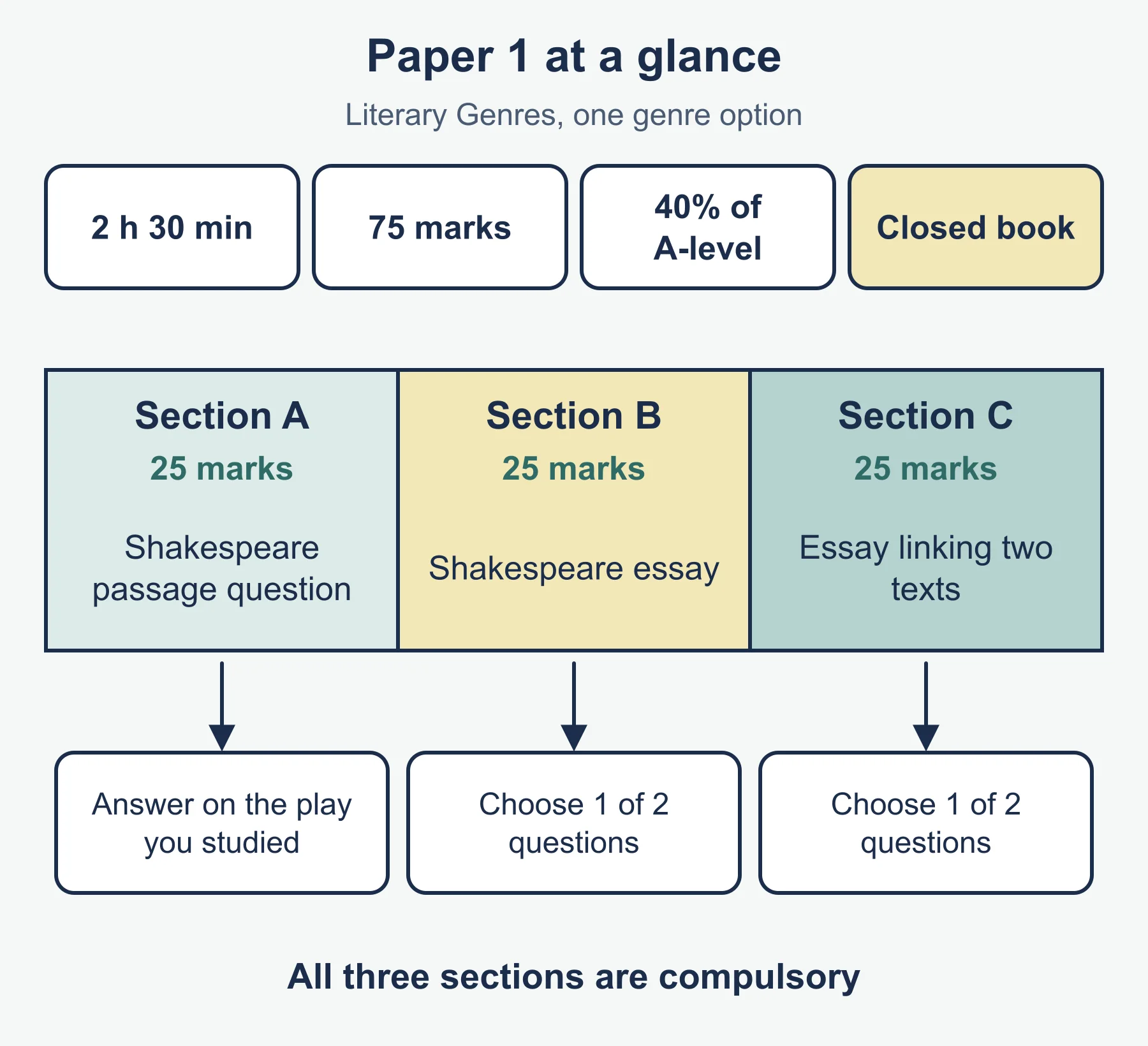
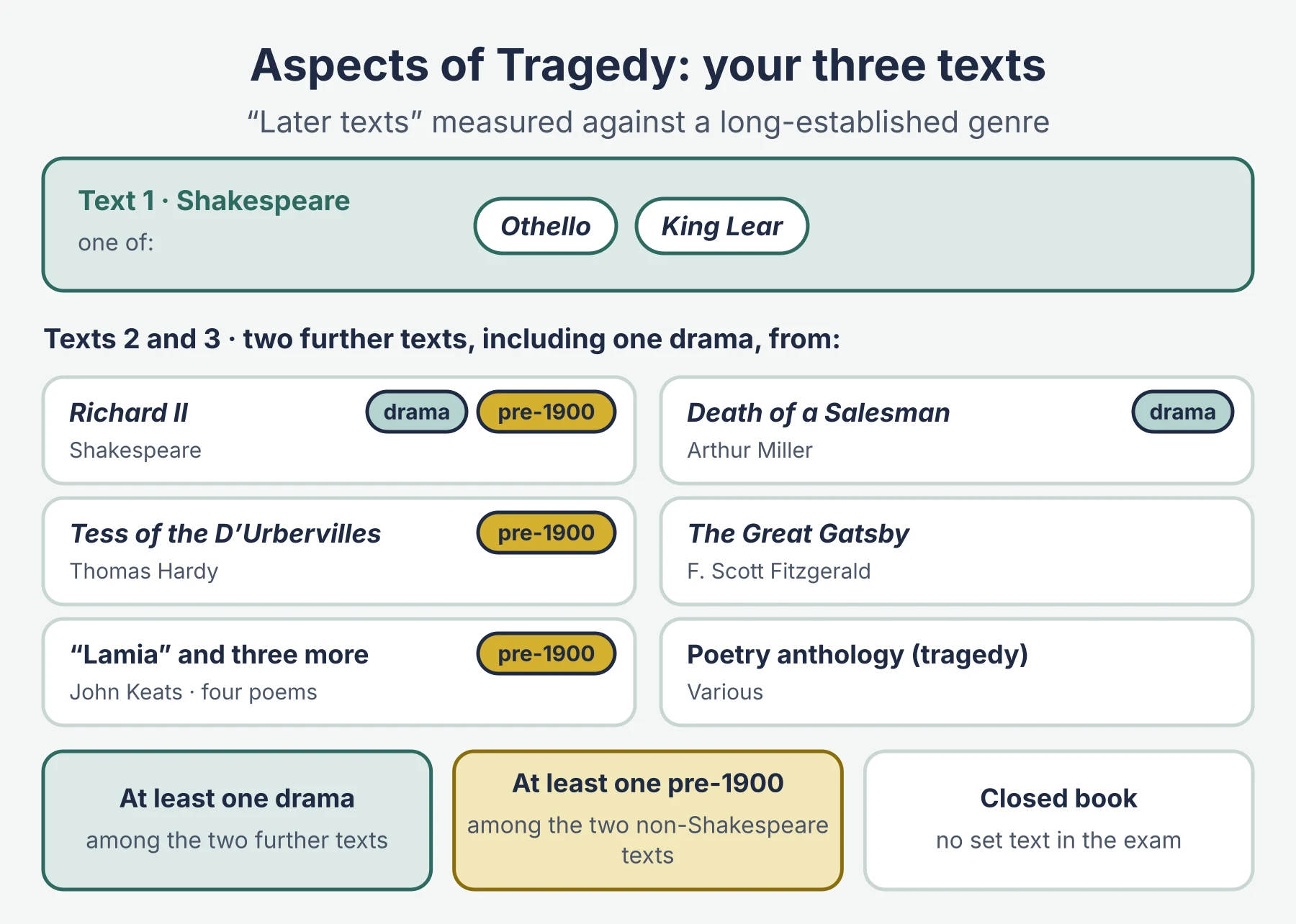
- Three texts: one Shakespeare play, a second drama and one further text; at least one of the two non-Shakespeare texts written pre-1900.
- Closed book: no set texts in the exam.
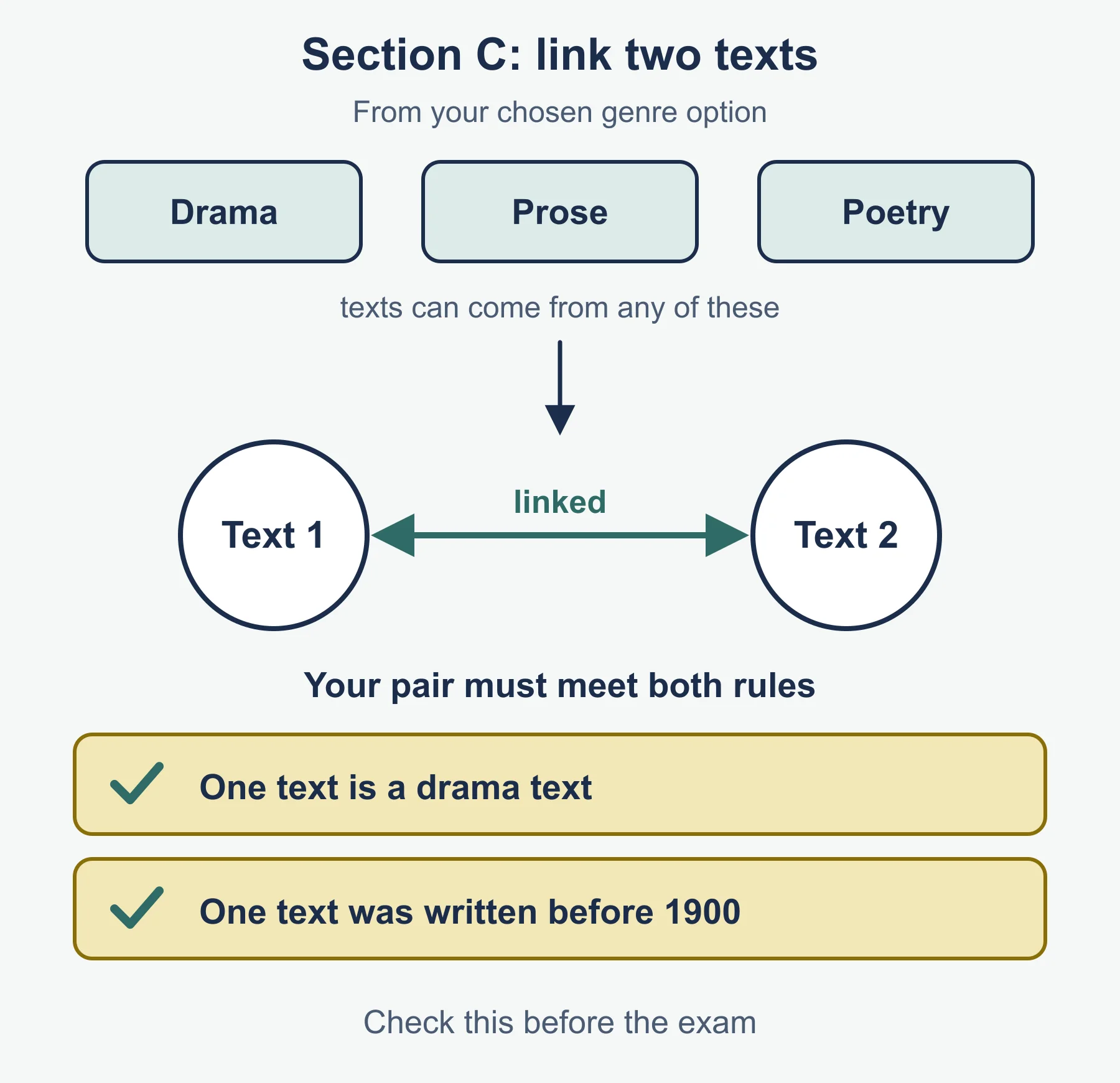
- Three answers: a Shakespeare passage (Section A), a Shakespeare essay (Section B) and a link between the other two texts (Section C, one drama and one pre-1900 text).
Set texts
- Shakespeare (one): Othello; King Lear.
- Two more, one of them drama: Richard II (drama, pre-1900); Death of a Salesman (drama); Tess of the D’Urbervilles (pre-1900); The Great Gatsby; Keats’s “Lamia”, “Isabella or The Pot of Basil”, “La Belle Dame Sans Merci” and “The Eve of St. Agnes” (pre-1900); the AQA poetry anthology (tragedy).
Confirm the list with your teacher, since AQA reviews set texts.
AQA’s aspects in short
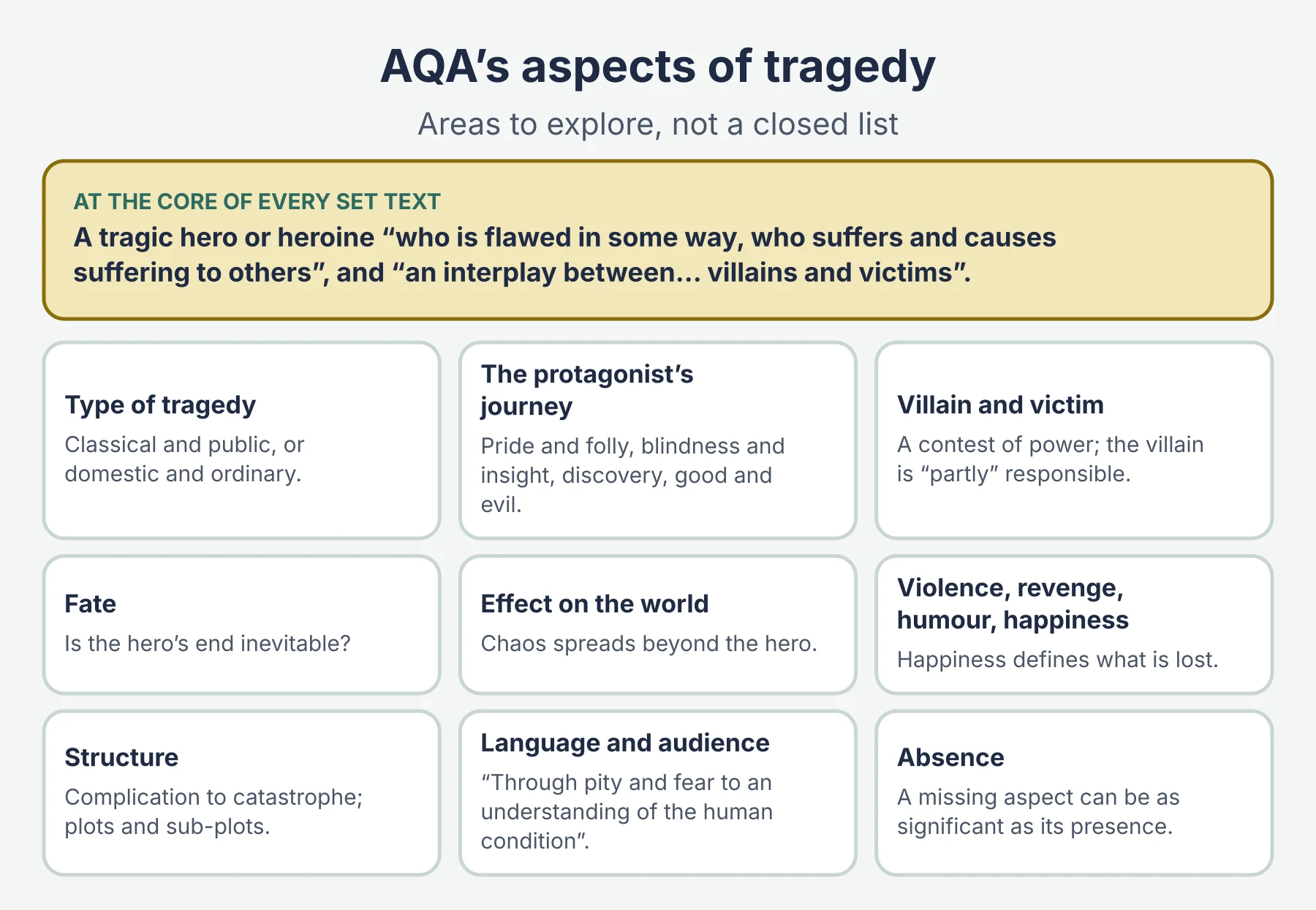
| Aspect | Question to ask of each text |
|---|---|
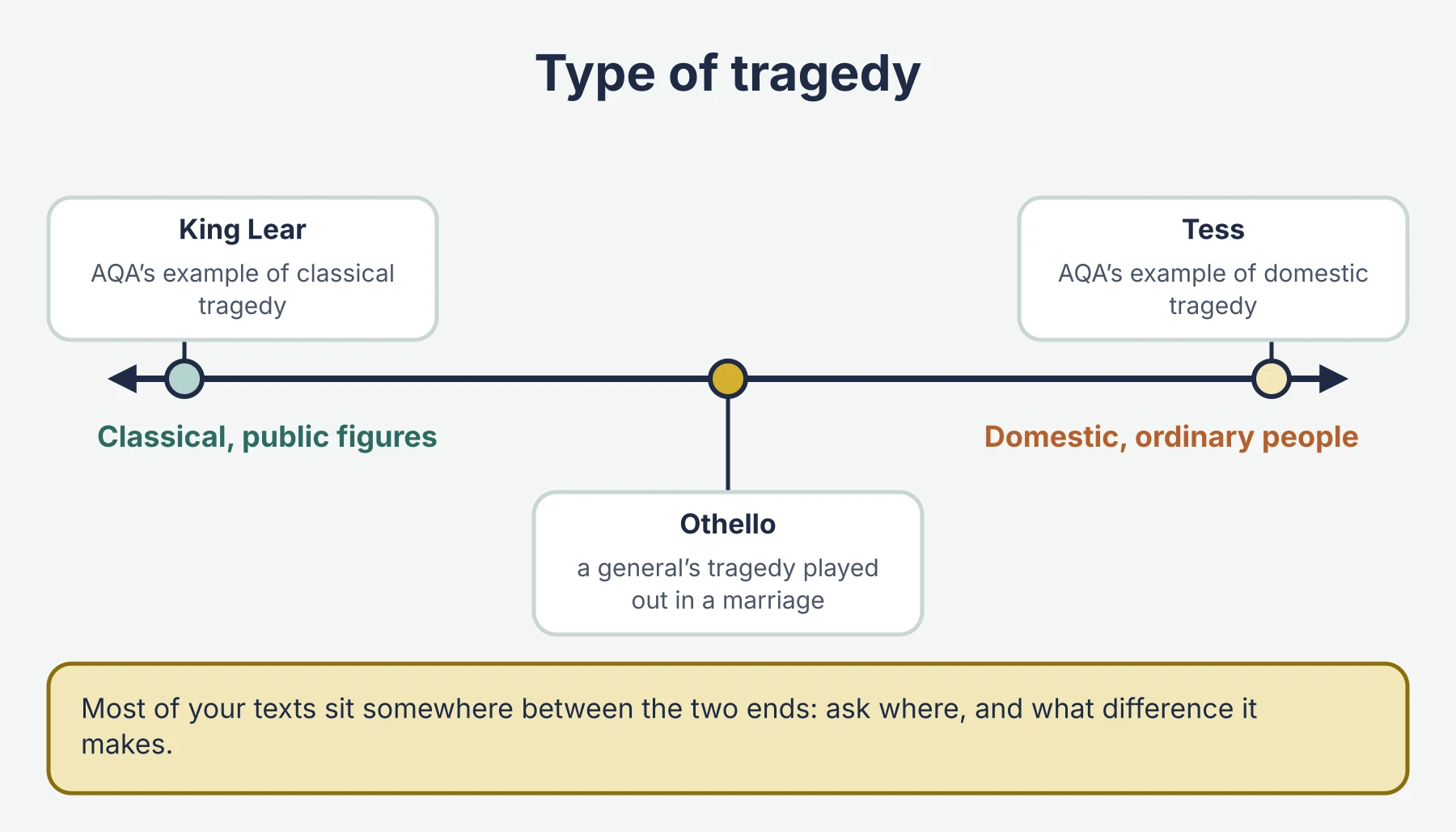
| Type | Classical and public (like Lear) or domestic and ordinary (like Tess)? |
| Setting | How do place and time shape the tragedy? |
| Journey to death | Flaws, pride, folly, blindness, insight, learning; a mix of good and evil? |
| Villain | Who engages the hero in a contest of power, and how far are they “partly” responsible? |
| Fate | Is the end inevitable, and who or what decides it? |
| The world | How does the hero’s behaviour spread chaos to others? |
| Violence, revenge, humour, happiness | What moments of joy or comedy define what is lost? |
| Structure | Order to disorder; complication to catastrophe; climax to resolution |
| Plots and sub-plots | How does a second plot mirror the first? |
| Language | How does language heighten the tragedy? |
| Audience | Pity, fear, understanding of the human condition |
Remember: the absence of an aspect can be as significant as its presence.
Key terms
| Term | Meaning |
|---|---|
| Tragic hero or heroine | Flawed protagonist who suffers and causes suffering |
| Hamartia | Error or flaw contributing to the fall |
| Hubris | Excessive pride or self-confidence |
| Anagnorisis | Recognition of the truth, often too late |
| Peripeteia | Reversal of fortune |
| Catharsis | The release of pity and fear in the audience |
| De casibus | Medieval tradition of the falls of great people, as in “The Monk’s Tale” |
| Domestic tragedy | Tragedy of ordinary, private lives |
| Machiavel | Scheming villain figure, such as Iago or Edmund |
| Divine right | Belief that kings rule by God’s will, central to Richard II |
Useful links between texts
- Fall of a king: King Lear and Richard II; “The Monk’s Tale” for the medieval pattern.
- Love destroyed: Othello, Tess, The Great Gatsby, “Isabella”, “La Belle Dame Sans Merci”.
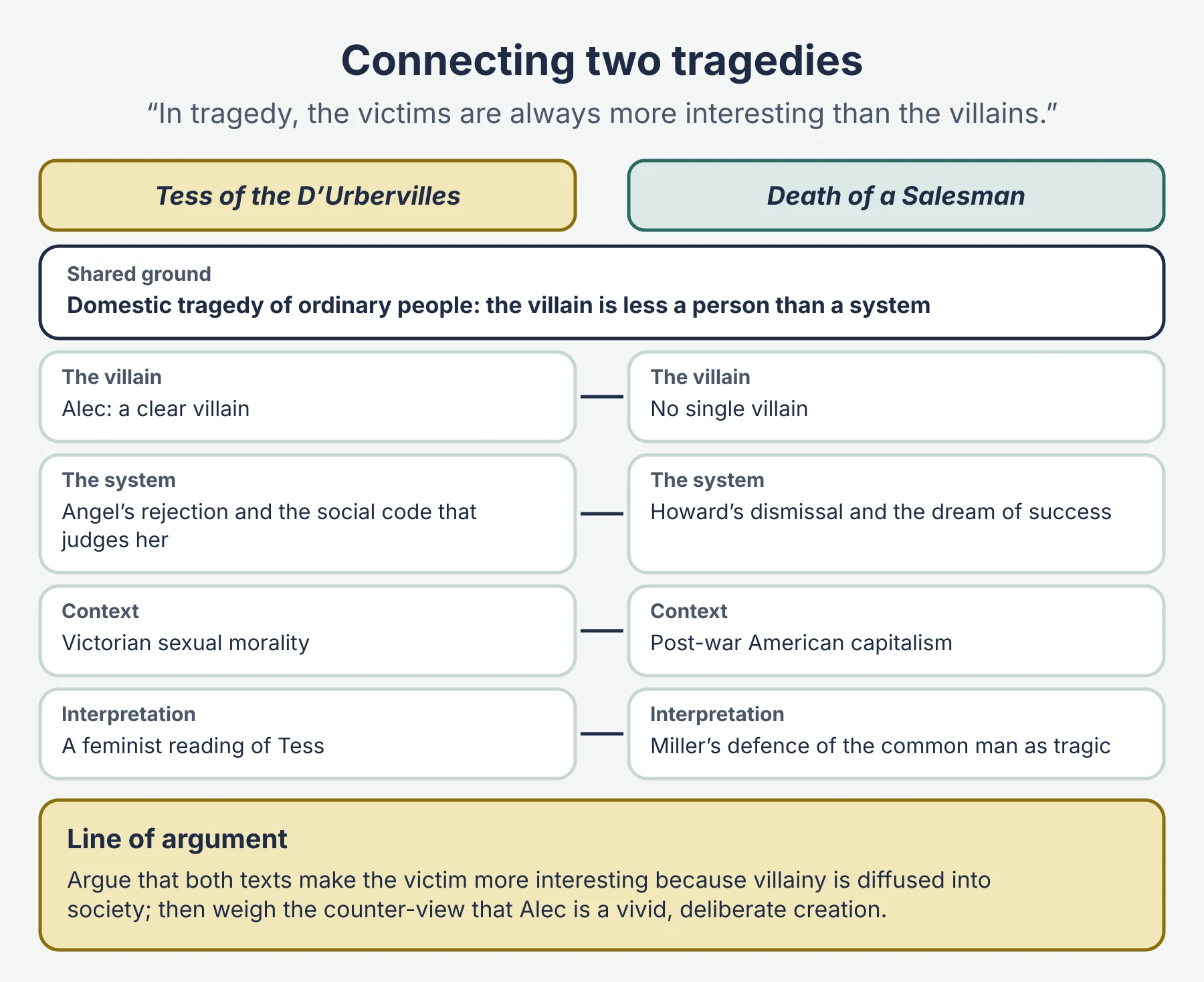
- Ordinary tragedy: Death of a Salesman, Tess, “Miss Gee”, “Death in Leamington”, “‘Out, out…’”.
- Fate and chance: Tess, “The Convergence of the Twain”.
- The cost of immortality or desire: “Tithonus”, “Lamia”.
- Tragedy averted or absent: “The Eve of St. Agnes”, where the lovers escape, tests AQA’s point about absence.
Contexts worth linking
- Jacobean: kingship, inheritance and order in King Lear; race and outsiderhood in Othello.
- Elizabethan politics behind the deposition in Richard II.
- Victorian: sexual morality and class in Tess.
- Romantic: Keats’s sensuous, medieval-inspired narratives.
- Twentieth-century America: wealth in the 1920s; post-war success culture in Salesman.
Exam traps
- A checklist of Greek terms with no argument about how the text uses them.
- Blaming the villain completely, ignoring AQA’s “partly responsible”.
- Section A answers that leave the passage behind.
- Section C written text by text instead of by connection.
- No alternative interpretation (AO5) or only a token critic’s name.
- Misquoting in a closed-book exam: short, accurate quotations are safer.
Self-test
- Which two Shakespeare plays can be studied for Option 1A?
- What must be true of the two non-Shakespeare texts?
- Is Paper 1 open or closed book?
- Which two characters does AQA use to contrast classical and domestic tragedy?
- Why is the word “partly” important in AQA’s description of the villain?
- Name two anthology poems that present ordinary rather than public tragedy.
- Which Keats poem can be used to discuss the absence of a tragic catastrophe?
- What is the de casibus tradition, and which anthology text illustrates it?
- Which assessment objective covers connections between texts, and which covers different interpretations?
- Give one link between King Lear and Richard II.
- Why does AQA list “humour and moments of happiness” among aspects of tragedy?
- How should a Section C answer be organised?
Answers
- Othello and King Lear.
- One must be a drama text, and at least one must be written before 1900.
- Closed book.
- Lear (classical, public) and Tess (domestic, ordinary).
- It means the villain shares responsibility with the hero, so the hero’s own flaws and choices must also be weighed.
- Any two: “Miss Gee”; “Death in Leamington”; “‘Out, out…’”; “Jessie Cameron”.
- “The Eve of St. Agnes”.
- The medieval tradition of narratives of the falls of great people from prosperity; “The Monk’s Tale”.
- AO4 for connections; AO5 for different interpretations.
- Either: both show a king losing power and identity; both question kingship and order, as each king learns too late what power was.
- Happiness and humour show what is lost and heighten the tragedy by contrast; their presence can also test whether a text is fully tragic.
- By points of connection, with both texts discussed in each section of the argument.
Try the Aspects of Tragedy practice questions, and use the Paper 1 revision notes for the paper’s overall structure.
Related resources
-
Study guides
AQA A-Level English Literature B (7717): Aspects of Comedy
Option 1B Aspects of Comedy for AQA English Literature B (7717): set texts, AQA's comic aspects, passage and linking-essay method, model writing.
English Literature · AQA · A Level
Read guide -
Practice questions
AQA A-Level English Literature B (7717): Aspects of Comedy – Practice Questions
Twelve original questions for AQA English Literature B (7717) Aspects of Comedy, with an invented scene and poem and linking-essay tasks, plus answers.
English Literature · AQA · A Level
Try questions -
Revision notes
AQA A-Level English Literature B (7717): Aspects of Comedy – Revision Notes
Revision notes for AQA English Literature B (7717) Aspects of Comedy: set texts, comic aspects, key terms, text links, exam traps and a self-test.
English Literature · AQA · A Level
Revise topic
Get free revision emails (optional)
Occasional emails with practice questions, worked explanations and links to free resources for the qualification and subjects you choose. No spam, and you can unsubscribe from any email. The free tools on this site never need an email.