
Revision Notes
AQA A-Level English Literature B (7717): Elements of Political and Social Protest Writing – Revision Notes
Revision notes for AQA English Literature B (7717) protest writing: set texts, elements of power by text, key terms, unseen checklist and a self-test.
- Subject
- English Literature
- Level
- A LEVELS
- Topic
- Paper 2 – Texts and Genres
- Author
- Marlbridge Academic Team
- Updated
- Reviewed by
- Ammar Bilal (what this means)
Aligned to AQA A Level English Literature (7717), For first teaching 2025. Official specification .
Syllabus page (what it covers and how it is assessed): AQA A Level English Literature.
Found an error? Report a correction.
Need help with this topic? Request a free trial class for A Level English Literature (7712 / 7717).
Condensed notes for the protest option of Paper 2. For full explanations and a worked unseen reading, use the Elements of Political and Social Protest Writing study guide.
The option in one box
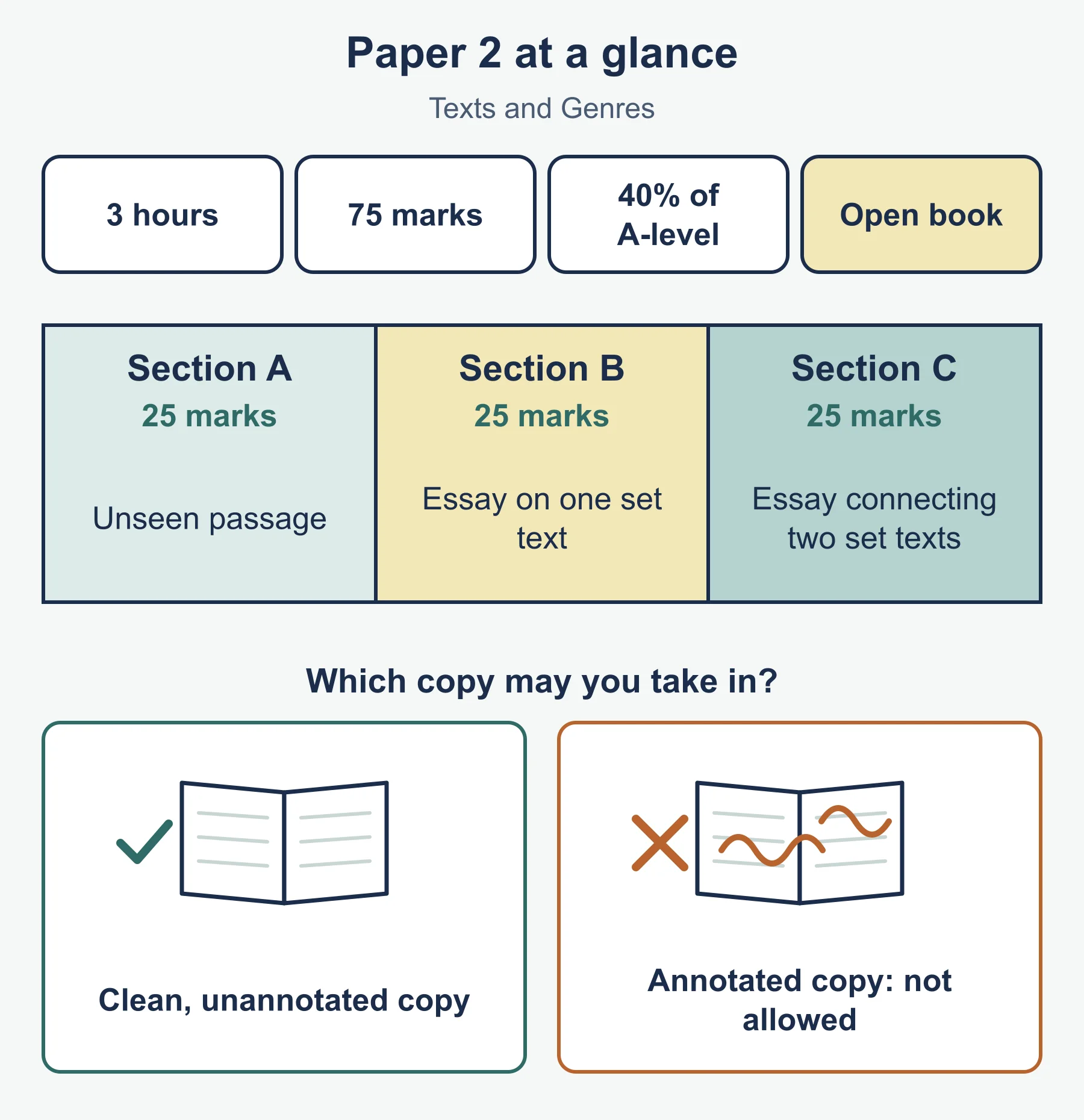
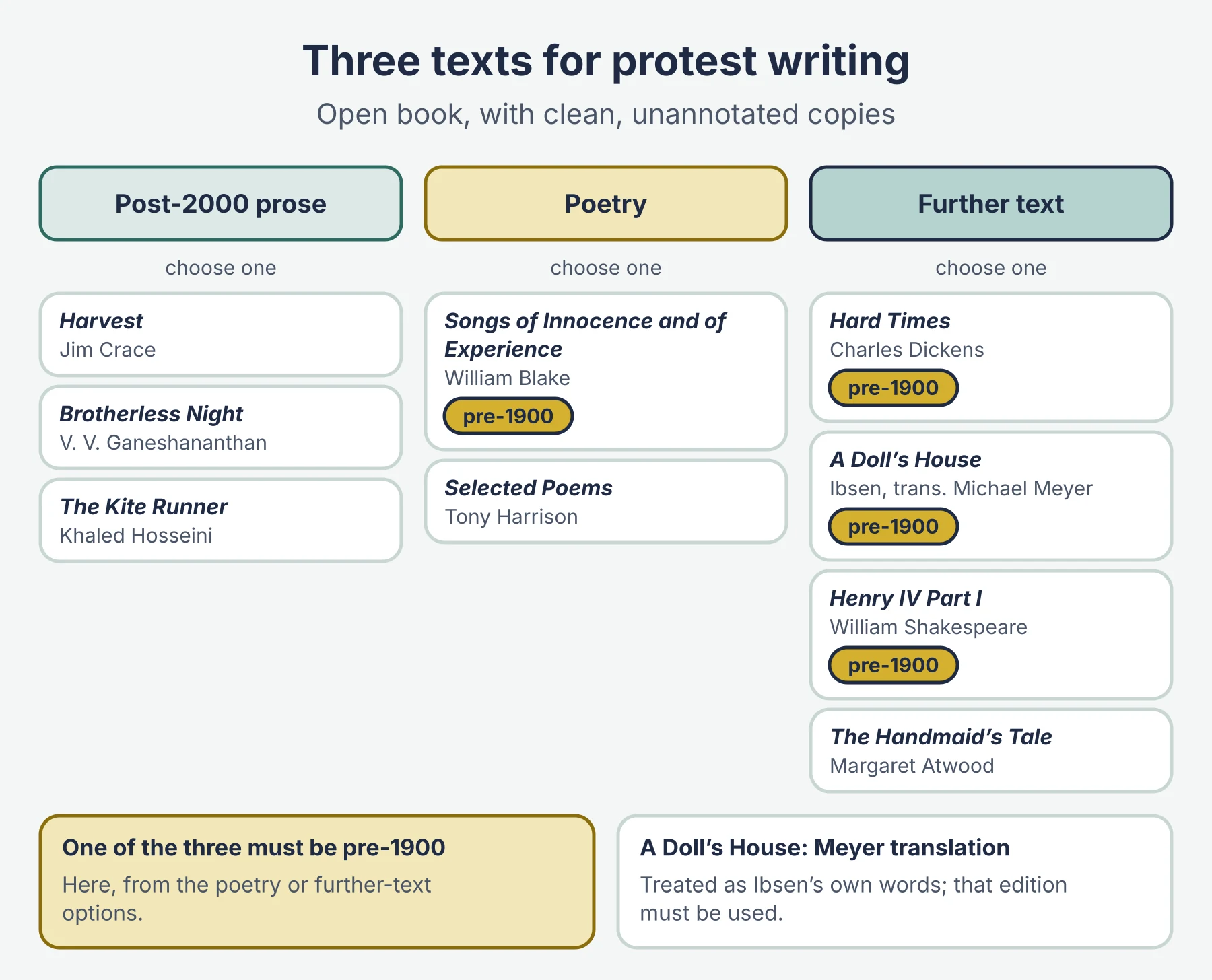
- Three texts: one post-2000 prose, one poetry and one further text; one of the three pre-1900.
- Open book: clean copies only, no annotations or added notes.
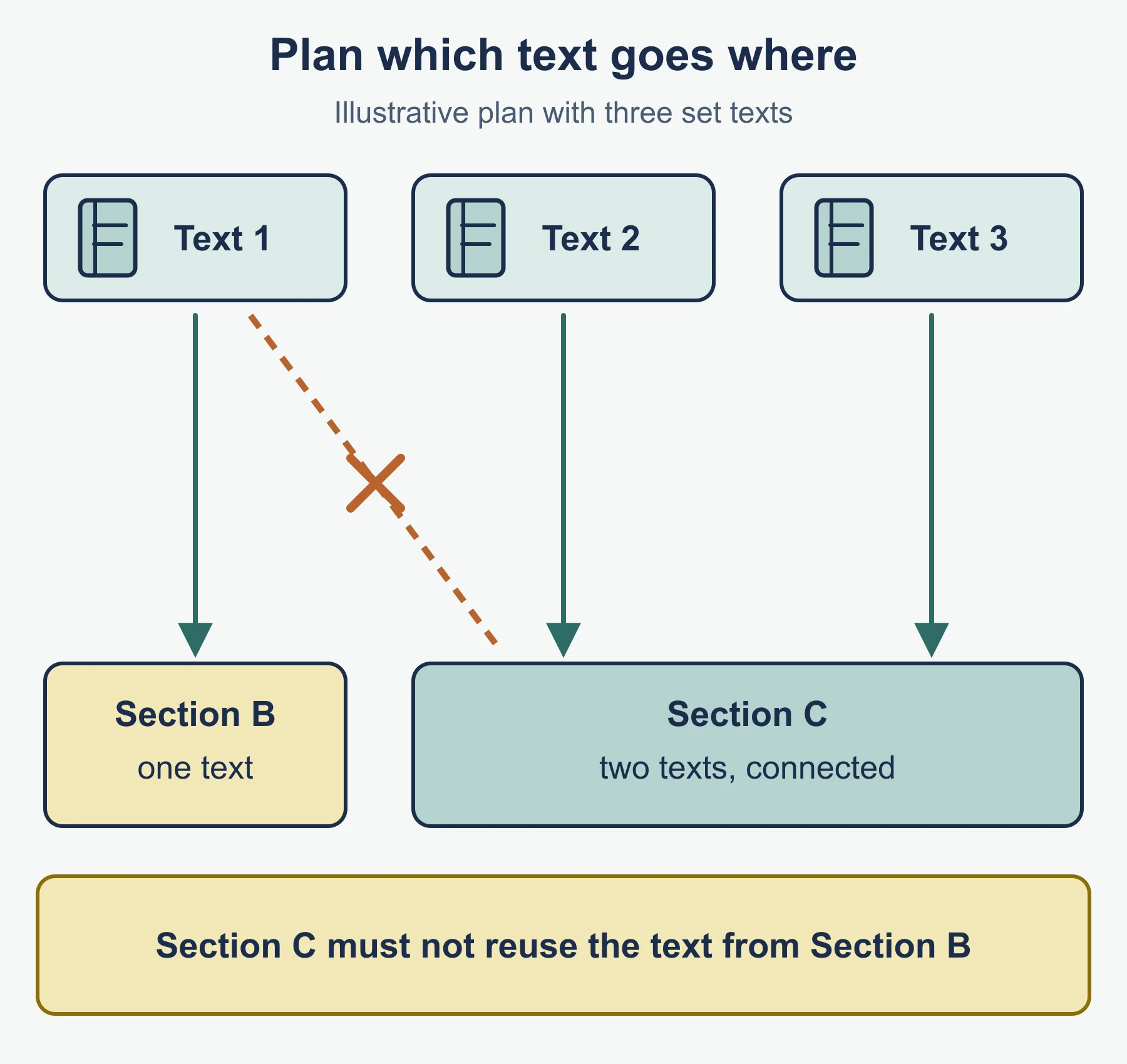
- Three answers: unseen (Section A), one set text (Section B), two other set texts connected (Section C).
AQA’s core idea
The texts have “issues of power and powerlessness at their core”. They “foreground oppression and domination”, in public and private settings, and protest is “central to each text’s structure”. The key word is elements.
Set texts and their strongest elements
| Text | Strongest elements |
|---|---|
| Harvest (Crace) | Enclosure of common land; outsiders punished; a narrator complicit in the village’s violence |
| Brotherless Night (Ganeshananthan) | Civil war in Sri Lanka; militancy and its costs; a young woman’s moral choices |
| The Kite Runner (Hosseini) | Ethnic hierarchy (Pashtun and Hazara); war and the Taliban; guilt and redemption |
| Songs of Innocence and of Experience (Blake) | Child labour; Church and state; contrary states of the soul |
| Harrison, Selected Poems | Class and accent; working lives; industrial decline; political anger in strict forms |
| Hard Times (Dickens) | Utilitarian education; industrial labour; imagination against facts |
| A Doll’s House (Ibsen, trans. Meyer) | Gender politics in marriage; law and money; a woman’s rebellion |
| Henry IV Part I (Shakespeare) | Rebellion; legitimacy of a usurping king; tavern against court |
| The Handmaid’s Tale (Atwood) | Theocratic control of women’s bodies; language as power; the framing epilogue |
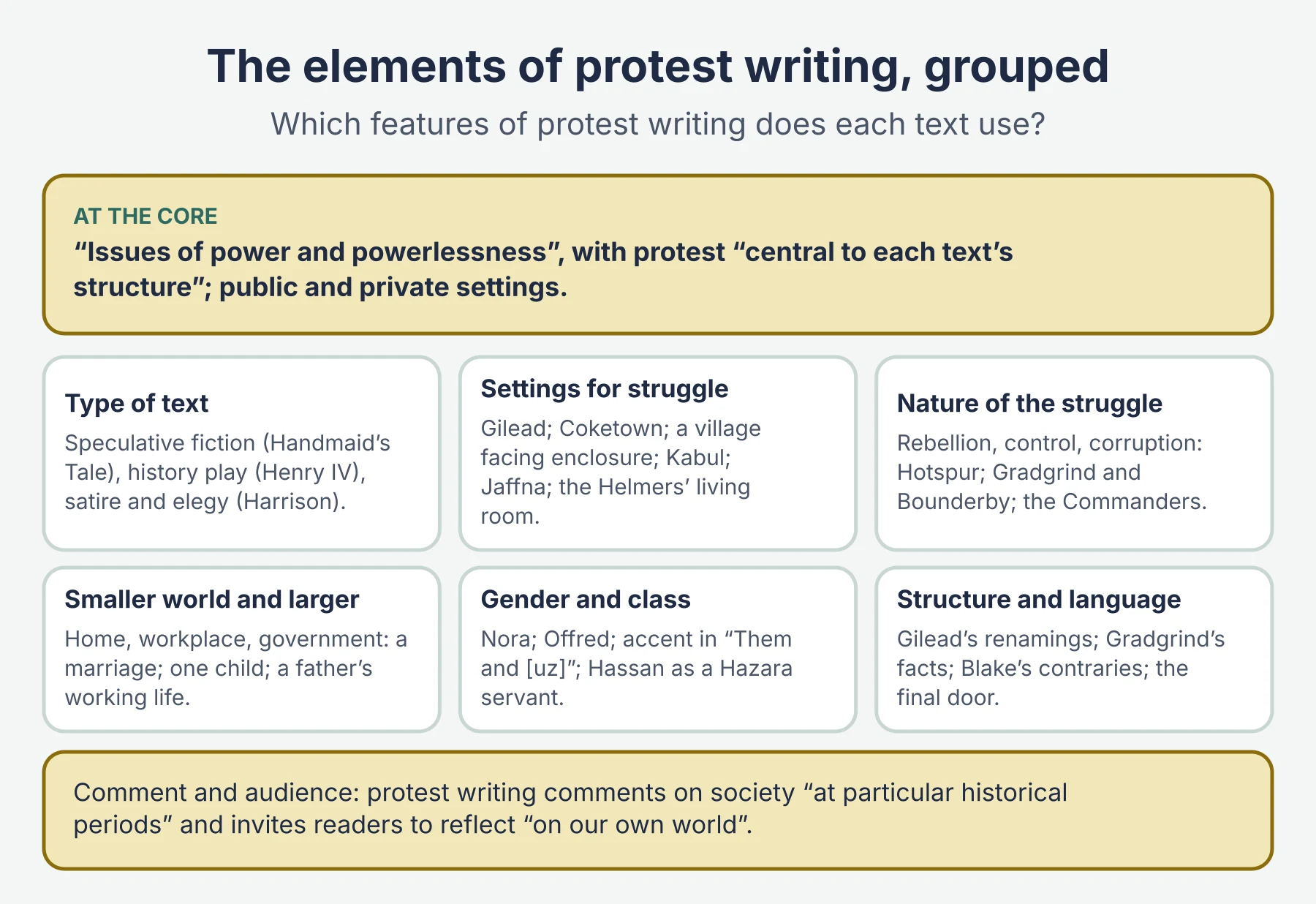
AQA’s elements in six groups
- Type: post-modern novel, science fiction, satirical poetry, historical and political drama.
- Settings: real and imagined places and times where power struggles play out.
- The struggle: the powerful and the powerless; pursuit of power, rebellion, warfare; ruling classes; corruption, conspiracy, control.
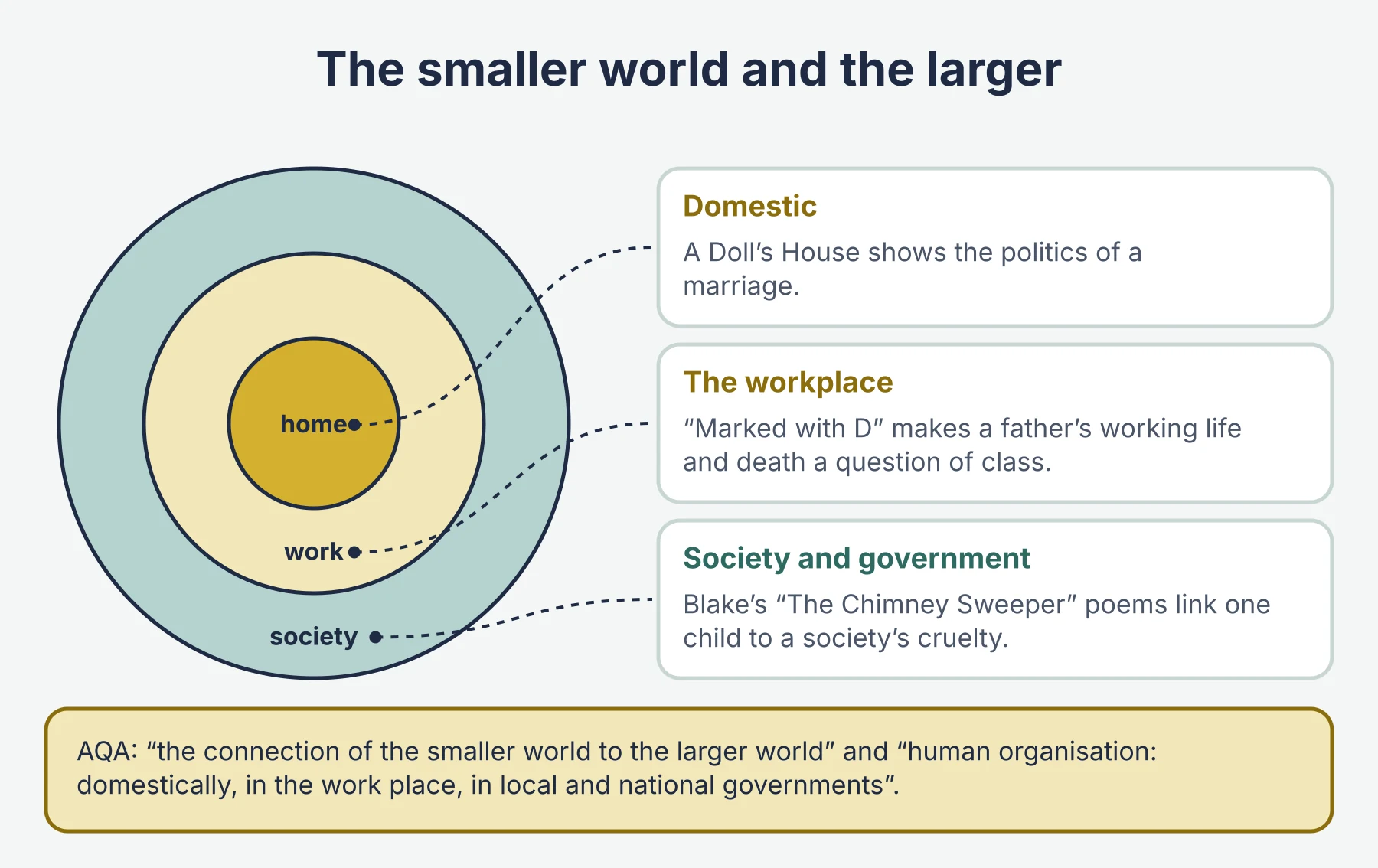
- Scale: the smaller world connected to the larger; human organisation at home, at work, in government.
- Gender and class: gender politics and issues of social class.
- Form and effect: structure heightening and perhaps resolving tension; language of the created world; comment on a historical society; inviting reflection on our own world.
Key terms
| Term | Meaning |
|---|---|
| Dystopia | An imagined society organised around oppression |
| Speculative fiction | Fiction imagining a possible future or alternative world |
| Satire | Ridicule exposing folly or abuse of power |
| Utilitarianism | Philosophy judging actions by usefulness; satirised in Hard Times |
| Enclosure | Fencing of common land for private use, as in Harvest |
| Patriarchy | A social system in which men hold power |
| Hegemony | Power maintained through consent and cultural dominance |
| Polemic | Forceful argument against an idea or institution |
| Contraries | Blake’s paired states, innocence and experience |
| Received Pronunciation | The prestige accent Harrison confronts in “Them and [uz]” |
Unseen checklist
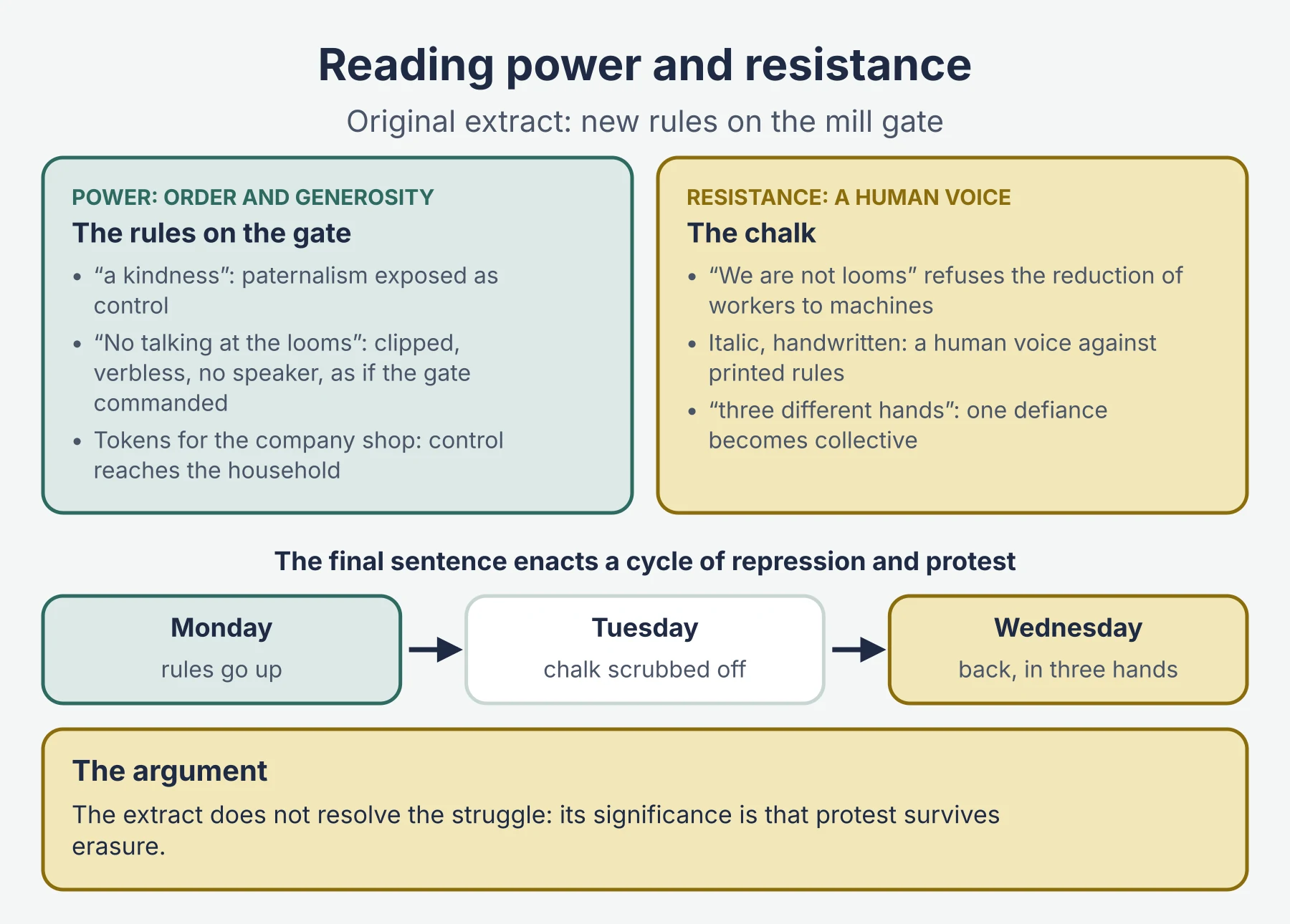
- Who has power, who lacks it, and how do we know?
- Is the setting public, private or both?
- Whose voice tells the story, and is resistance given a voice?
- Which register belongs to the powerful, and which to the powerless?
- Does the structure heighten, resolve or leave open the tension?
- One argument about significance, not a list.
Text pairings for Section C
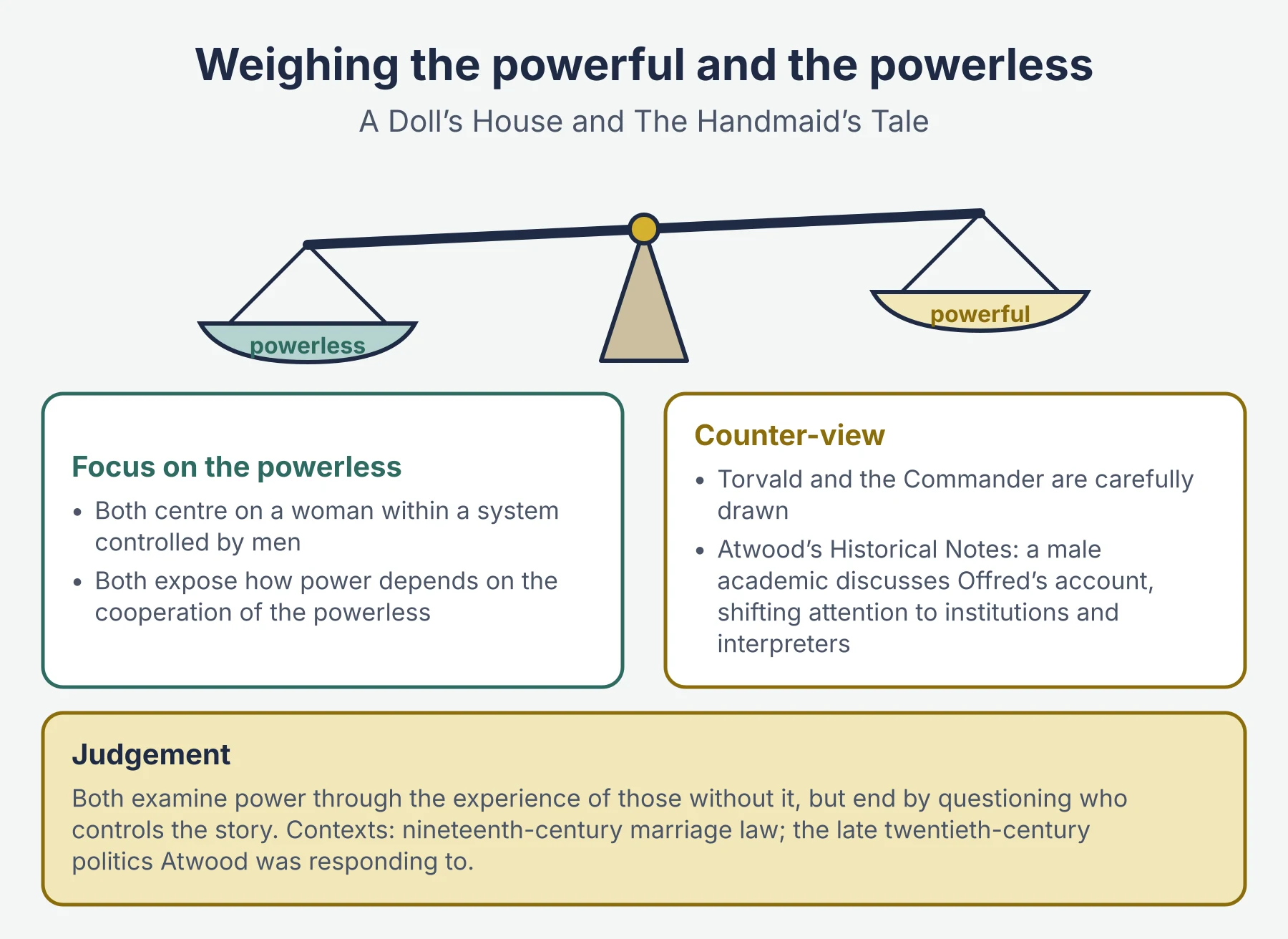
- Gender: A Doll’s House with The Handmaid’s Tale.
- Class and labour: Hard Times with Harrison, or with Blake’s chimney sweepers.
- Rebellion and legitimacy: Henry IV Part I with Brotherless Night.
- Land and dispossession: Harvest with Blake’s “London”.
- Ethnic hierarchy and guilt: The Kite Runner with Harvest.
Remember: Section C must use two texts you did not use in Section B.
Exam traps
- Summarising a text’s message without analysing its methods.
- Forgetting the private and domestic forms of power.
- Context as history with no link to the words.
- An unseen answer with no overall reading.
- Reusing the Section B text in Section C.
- Using an edition of A Doll’s House other than the Meyer translation AQA requires.
Self-test
- What three types of text are studied for Option 2B, and what date requirement applies?
- How does AQA narrow the claim that “all texts are political”?
- Which edition of A Doll’s House must be used?
- Name the three post-2000 prose texts.
- Which set text satirises utilitarian education?
- Which Harrison poem confronts the prestige of Received Pronunciation?
- Which text ends with an academic lecture about the narrator’s account?
- What does “the connection of the smaller world to the larger world” mean?
- Which set text is a history play about rebellion against a usurping king?
- What is enclosure, and which set text explores it?
- Give two settings for power struggles from different set texts.
- Is The Handmaid’s Tale a post-2000 text?
Answers
- One post-2000 prose text, one poetry text and one further text, one of which must be pre-1900.
- By defining the set texts as those with power and powerlessness at their core and protest central to their structure.
- The Bloomsbury Methuen Drama edition translated by Michael Meyer.
- Harvest, Brotherless Night and The Kite Runner.
- Hard Times.
- “Them and [uz]”.
- The Handmaid’s Tale, through its Historical Notes.
- Private or local experience (a home, a workplace, a village) linked to national or political structures of power.
- Henry IV Part I.
- Fencing common land for private use; Harvest.
- Any two: Gilead; Coketown; the village in Harvest; Kabul; Jaffna; the Helmers’ home; the tavern and the court in Henry IV Part I.
- No; it was published in 1985, so it can only be the further text.
Use the Option 2B practice questions for full unseen and essay practice, and the Paper 2 revision notes for the paper’s structure.
Related resources
-
Study guides
AQA A-Level English Literature B (7717): Gender Politics and Social Class
Gender politics and social class across the protest writing set texts for AQA English Literature B (7717), with intersections, contexts and a model paragraph.
English Literature · AQA · A Level
Read guide -
Practice questions
AQA A-Level English Literature B (7717): Gender Politics and Social Class – Practice Questions
Twelve original questions on gender politics and social class for AQA English Literature B (7717) protest writing, with an invented unseen extract and answers.
English Literature · AQA · A Level
Try questions -
Revision notes
AQA A-Level English Literature B (7717): Gender Politics and Social Class – Revision Notes
Revision notes on gender politics and social class in AQA English Literature B (7717) protest writing: systems of power by text, key terms and a self-test.
English Literature · AQA · A Level
Revise topic
Get free revision emails (optional)
Occasional emails with practice questions, worked explanations and links to free resources for the qualification and subjects you choose. No spam, and you can unsubscribe from any email. The free tools on this site never need an email.