
Study Guides
AQA A-Level English Literature B (7717): Elements of Political and Social Protest Writing
Option 2B protest writing for AQA English Literature B (7717): AQA's elements of power in each set text, unseen method and essay planning.
- Subject
- English Literature
- Level
- A LEVELS
- Topic
- Paper 2 – Texts and Genres
- Author
- Marlbridge Academic Team
- Updated
- Reviewed by
- Ammar Bilal (what this means)
Aligned to AQA A Level English Literature (7717), For first teaching 2025. Official specification .
Syllabus page (what it covers and how it is assessed): AQA A Level English Literature.
Found an error? Report a correction.
Need help with this topic? Request a free trial class for A Level English Literature (7712 / 7717).
Option 2B Elements of Political and Social Protest Writing is the second option for Paper 2 Texts and Genres in AQA A-level English Literature B (7717). The Paper 2 Texts and Genres overview covers the paper’s structure and rules. This guide explains what AQA means by protest “elements”, shows how they work in each set text, and models the unseen and connecting essays.
What makes a protest text
AQA acknowledges that “it could be claimed that all texts are political”, so it defines this option more narrowly: the set texts “have issues of power and powerlessness at their core, with political and social protest issues central to each text’s structure”. They “foreground oppression and domination”, cover “both public and private settings”, and “look at the cultures we live in and have lived in over time”. As with crime, the key word is elements: you ask which features of protest writing each text uses.
The set texts
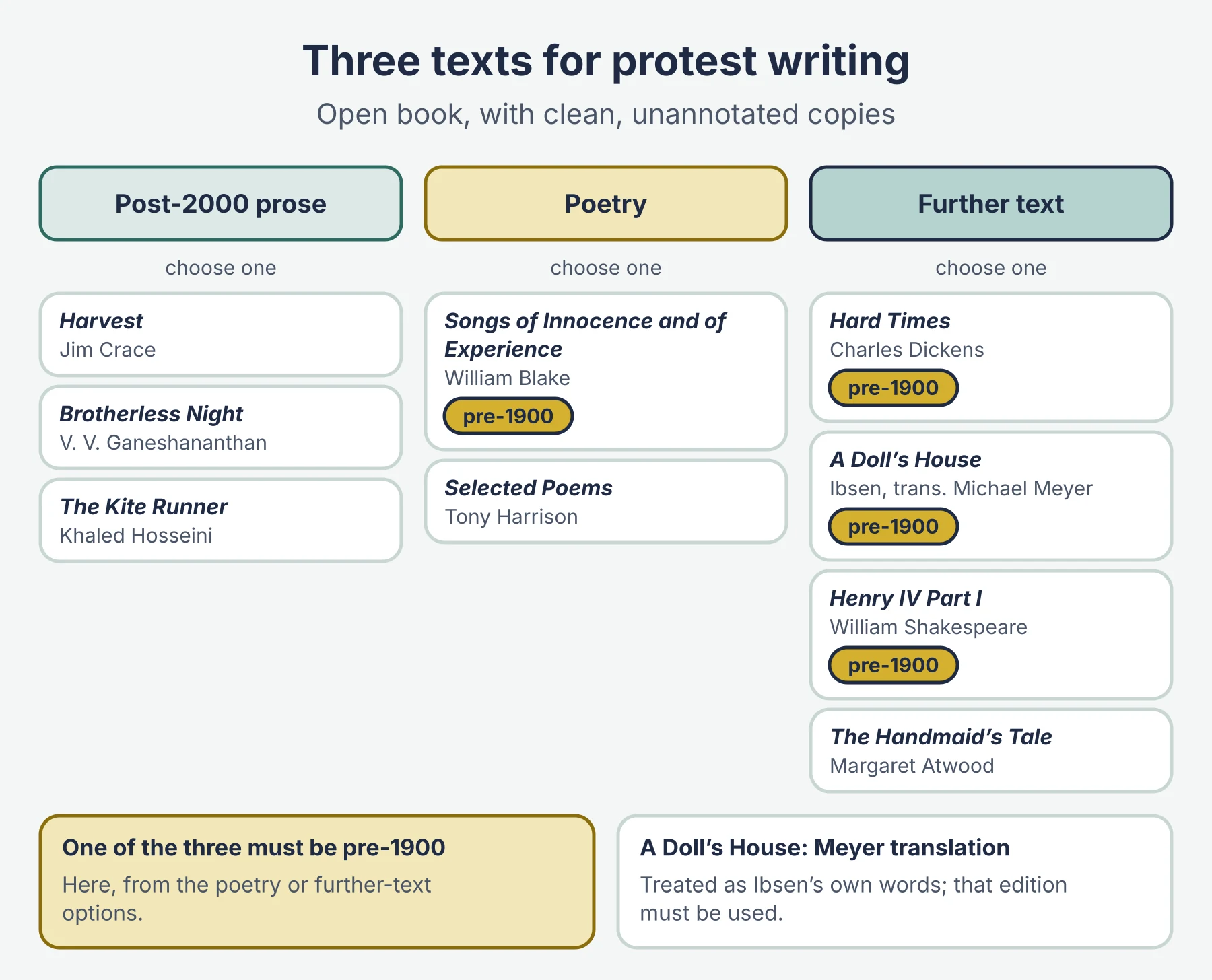
You study three: one post-2000 prose text, one poetry text and one further text, one of which must be written pre-1900.
| Text | Author | Requirement it can meet |
|---|---|---|
| Harvest | Jim Crace | Post-2000 prose |
| Brotherless Night | V. V. Ganeshananthan | Post-2000 prose |
| The Kite Runner | Khaled Hosseini | Post-2000 prose |
| Songs of Innocence and of Experience | William Blake | Poetry, pre-1900 |
| Selected Poems: “V”, “National Trust”, “Them and [uz]”, “Divisions”, “Working”, “Marked with D” | Tony Harrison | Poetry |
| Hard Times | Charles Dickens | Further text, pre-1900 |
| A Doll’s House (Bloomsbury Methuen Drama edition, translated by Michael Meyer) | Henrik Ibsen | Further text, pre-1900 |
| Henry IV Part I | William Shakespeare | Further text, pre-1900 |
| The Handmaid’s Tale | Margaret Atwood | Further text |
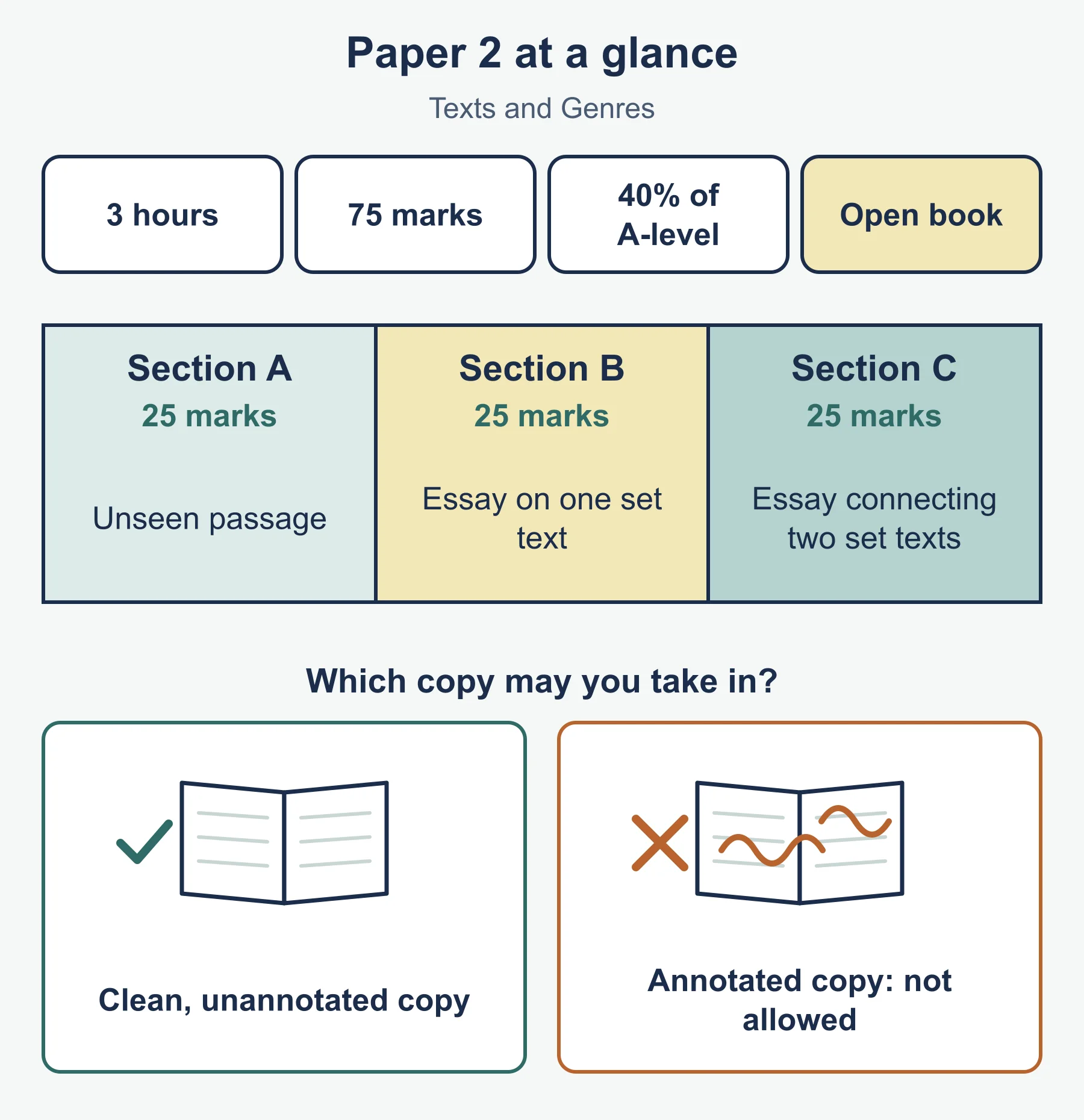
AQA treats the Meyer translation of A Doll’s House as Ibsen’s own words for assessment, and that edition must be used. The paper is open book with clean, unannotated copies.
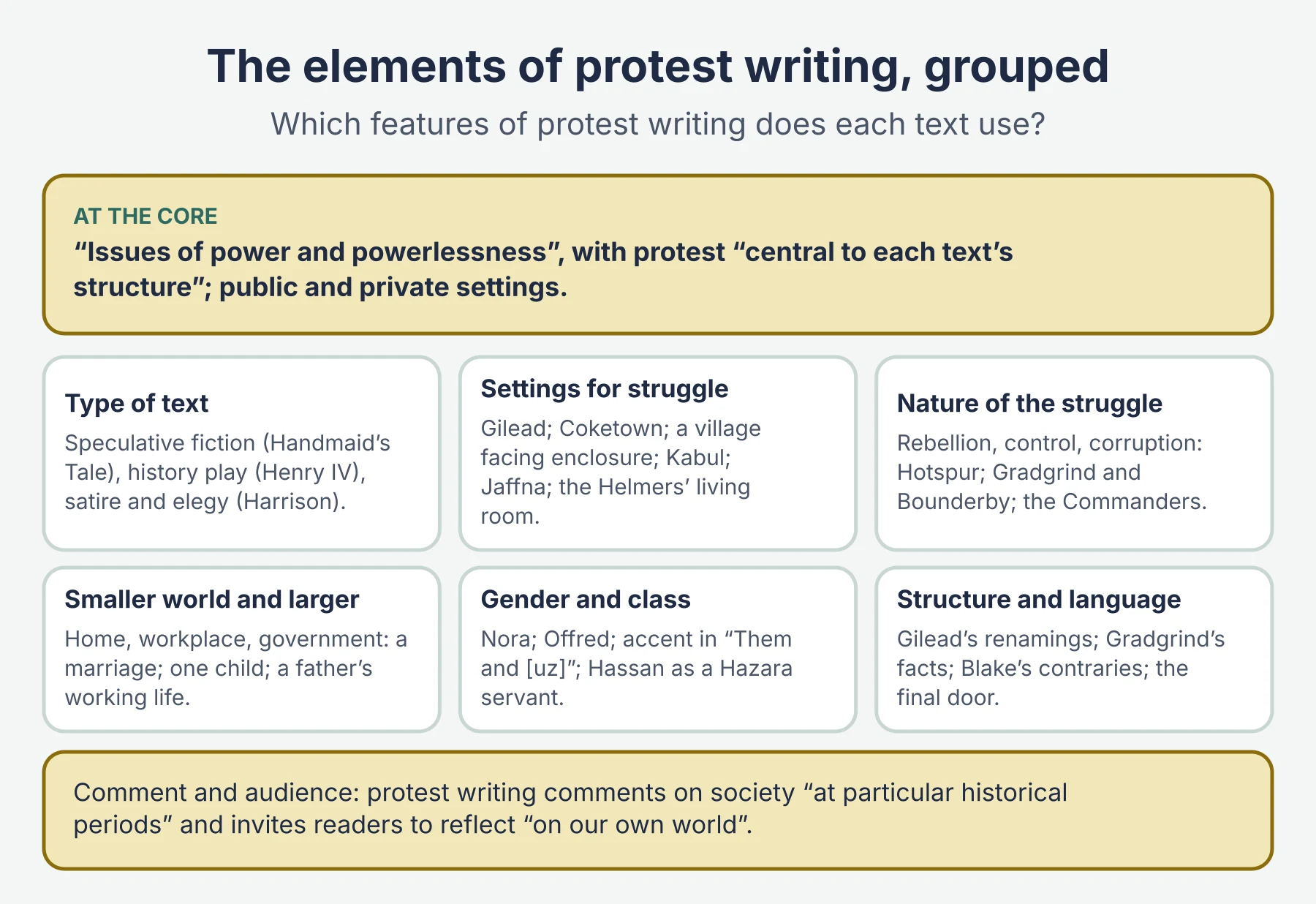
The elements, grouped
The type of text. “Post-modern novel, science fiction, satirical poetry, historical and political drama.” The Handmaid’s Tale is speculative fiction framed by a future academic lecture; Henry IV Part I is a history play; Harrison writes satire and elegy in strict verse forms.
Settings for power struggles, “real and imagined”, in place and time: the theocratic state of Gilead; Coketown’s factories and schoolroom; an English village facing enclosure in Harvest; Kabul before and after invasion in The Kite Runner; Jaffna during the Sri Lankan civil war in Brotherless Night; the Helmers’ living room.
The nature of the struggle. “The behaviours of those with power and those without”; “the pursuit of power itself, rebellion against those with power, warfare”; “the workings of the ruling political classes”; “corruption, conspiracy, control”. Hotspur’s rebellion against King Henry, Gradgrind’s and Bounderby’s control of minds and labour, the Commanders’ regime in Gilead.
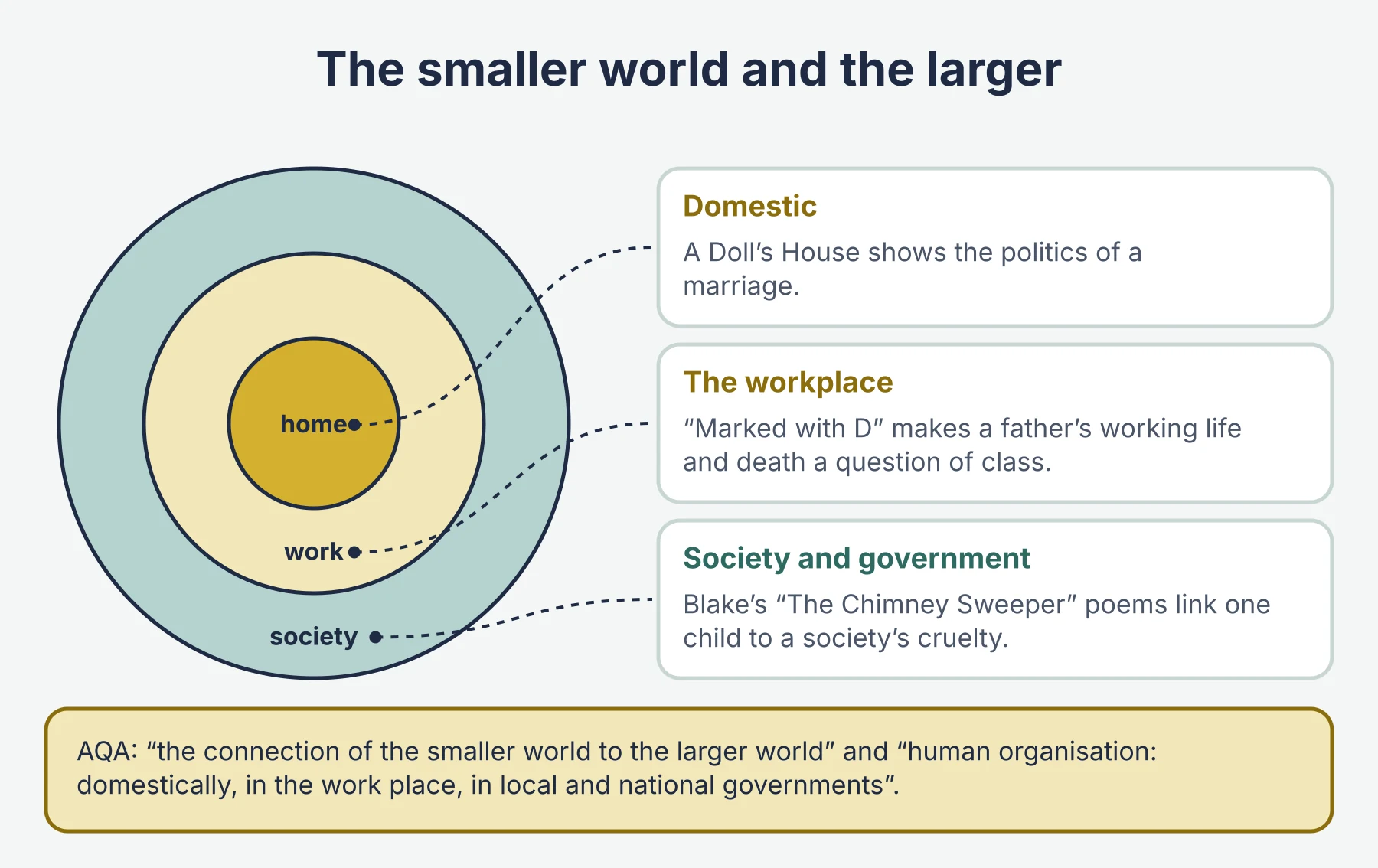
The smaller world and the larger. “The connection of the smaller world to the larger world” and “human organisation: domestically, in the work place, in local and national governments”. A Doll’s House shows the politics of a marriage; Blake’s “The Chimney Sweeper” poems link one child to a society’s cruelty; “Marked with D” makes a father’s working life and death a question of class.
Gender politics and social class. Nora’s discovery that she has been a doll-wife; Offred’s reduction to a reproductive function; Harrison’s “Them and [uz]”, where accent becomes a battle over who is allowed to speak poetry; Hassan’s position as a Hazara servant in The Kite Runner.
Structure and language. “How political tensions are heightened and perhaps resolved”, and “the way that language is used in the worlds that are created”. Gilead’s renamed people and places, Gradgrind’s insistence on facts, Blake’s paired contrary poems, the final door in A Doll’s House.
Comment and audience. Protest writing comments on society “at particular historical periods” and invites readers to reflect “on our own world”.
The unseen passage
Section A prints an unseen extract from the protest genre: poetry, prose or drama, including literary non-fiction. Identify who has power and who lacks it; how the setting stages the struggle; which language and methods construct the oppression or resistance; and whether the extract resolves the tension. Then turn the notes into one argument about significance.
Worked example on an original prose extract. The passage below is original, written for this guide.
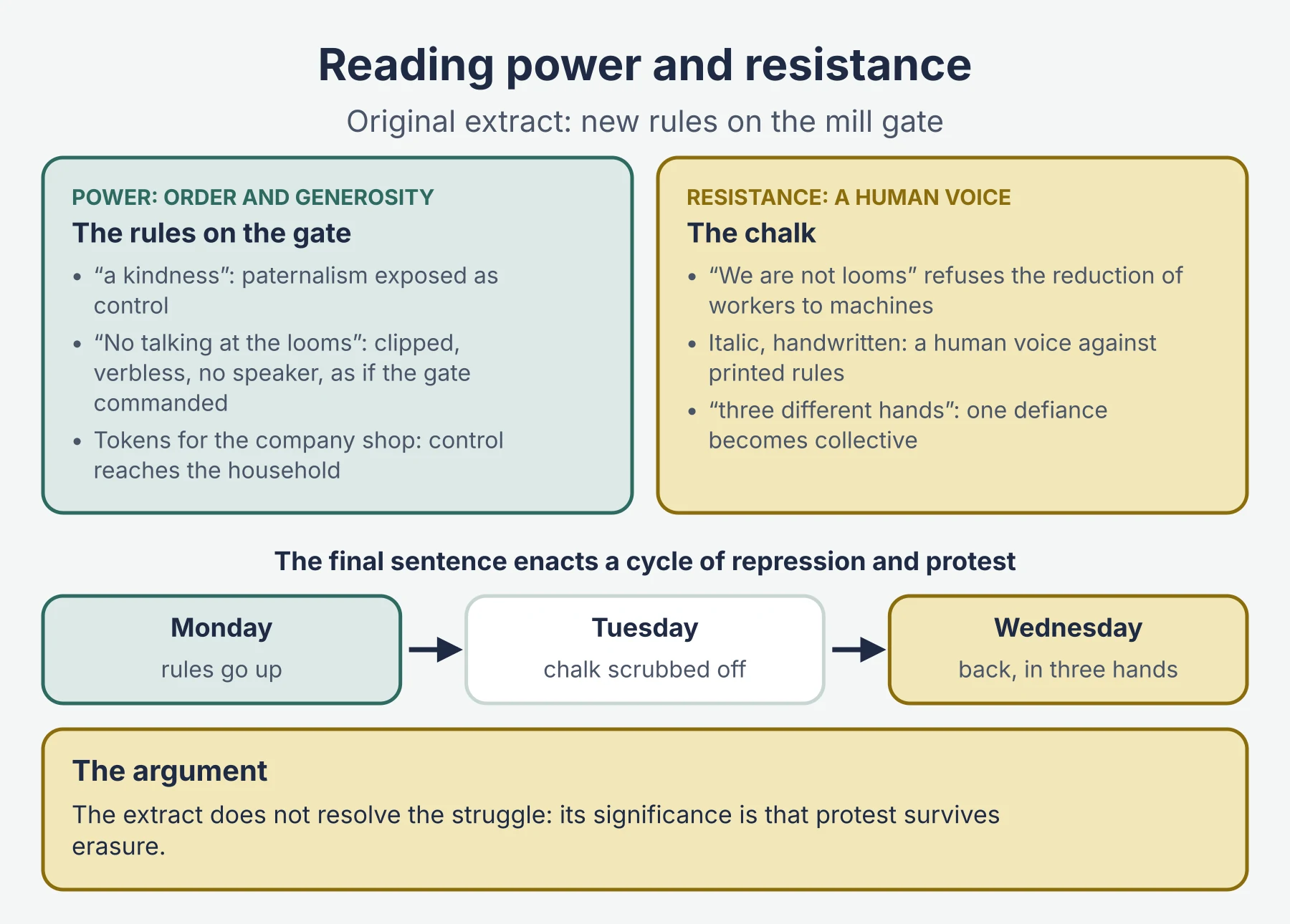
The new rules went up on the mill gate on a Monday, which Mr Haldane said was a kindness, since it gave the women the whole week to learn them. No talking at the looms. No children in the yard. Wages to be paid in tokens, redeemable at the company shop. Underneath, someone had written in chalk, We are not looms, and by Tuesday it had been scrubbed off, and by Wednesday it was back, in three different hands.
Model reading: The extract presents power through the language of order and generosity. Mr Haldane’s claim that a Monday notice is “a kindness” exposes paternalism as control, and the clipped, verbless rules (“No talking at the looms”) reproduce the voice of authority without a speaker, as if the gate itself commanded. Payment in tokens for the company shop shows economic control reaching into private life, the smaller world of the household bound to the larger world of the mill. Resistance appears in a different register: the chalked We are not looms refuses the reduction of workers to machines, and its italic form sets a human voice against the printed rules. The structure of the final sentence, moving from Monday to Wednesday, enacts a cycle of repression and protest, and the “three different hands” turn one act of defiance into collective action. The extract does not resolve the struggle; its significance is that protest survives erasure.
Set-text and connecting essays
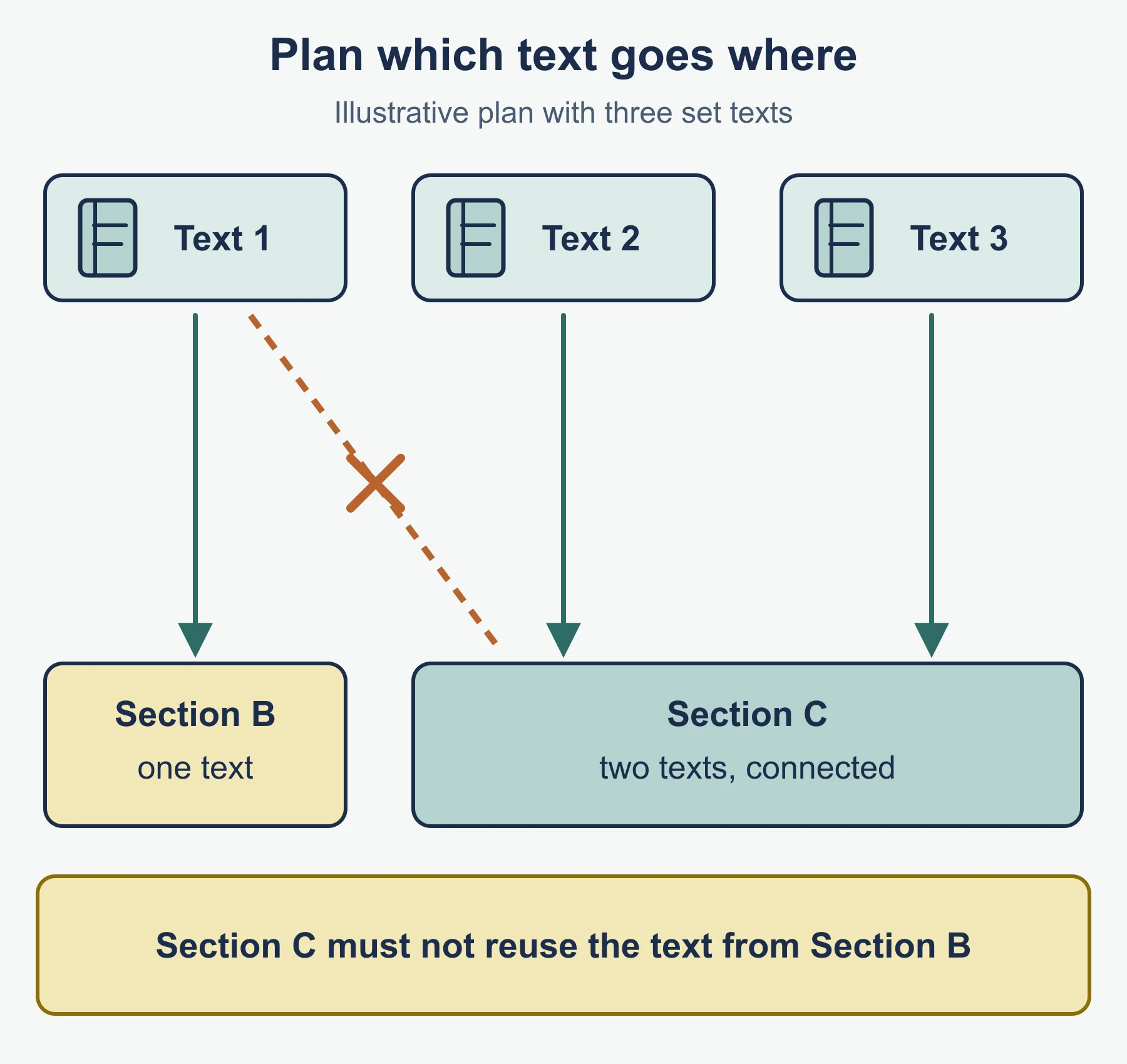
Section B is an essay on one set text; Section C connects two texts you have not used in Section B.
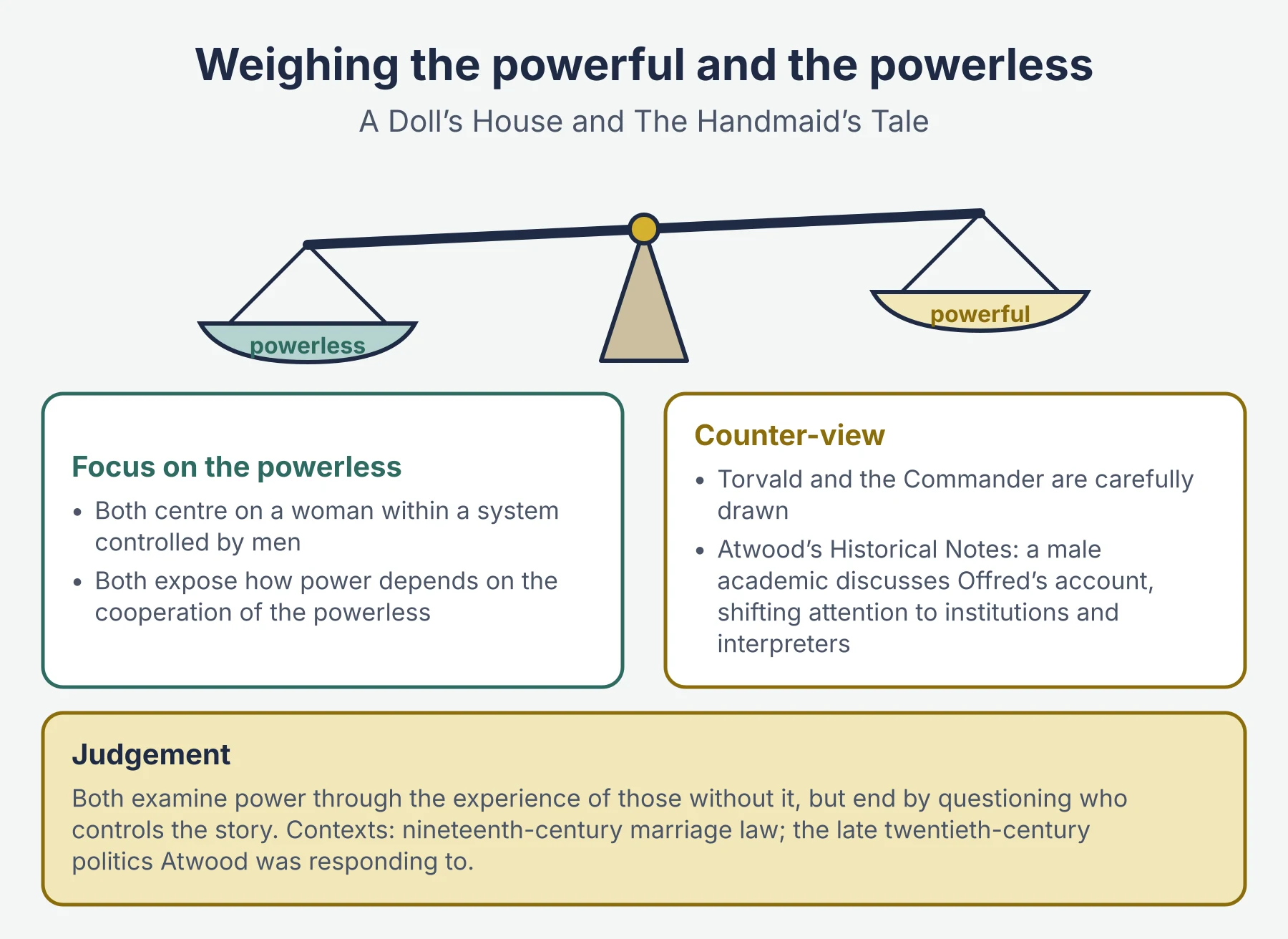
Section C plan (original question shape): “Protest writing is more interested in the powerful than the powerless.” Discuss with reference to two texts. Using A Doll’s House and The Handmaid’s Tale: both are told from or centred on a woman within a system controlled by men, so the powerless are the focus; yet Torvald and the Commander are carefully drawn, and both texts expose how power depends on the cooperation of the powerless. Counter-view: Atwood’s Historical Notes, in which a male academic discusses Offred’s account, shift attention back to institutions and interpreters. Contexts: nineteenth-century marriage law; the late twentieth-century politics Atwood was responding to. Judgement: both texts examine power through the experience of those without it, but end by questioning who controls the story.
Common mistakes
- Reducing protest to a message: analyse how the text constructs power, not only what it condemns.
- Ignoring private settings: AQA includes domestic and workplace power.
- Generalised context: tie history to specific words and scenes.
- Unseen answers that list techniques without a reading.
- Reusing the Section B text in Section C.
Exam technique
Allow about an hour for each answer in the 3-hour paper. Use the open book for short, precise quotations. The five assessment objectives apply: response and terminology (AO1), methods (AO2), contexts (AO3), connections (AO4) and interpretations (AO5).
More resources on this topic
- Elements of Political and Social Protest Writing revision notes
- Option 2B protest writing practice questions
- Elements of Crime Writing study guide
Specification
AQA A-level English Literature B (7717), section 3.2.2 Elements of political and social protest writing — aqa.org.uk.
Related resources
-
Revision notes
AQA A-Level English Literature B (7717): Elements of Political and Social Protest Writing – Revision Notes
Revision notes for AQA English Literature B (7717) protest writing: set texts, elements of power by text, key terms, unseen checklist and a self-test.
English Literature · AQA · A Level
Revise topic -
Study guides
AQA A-Level English Literature B (7717): Gender Politics and Social Class
Gender politics and social class across the protest writing set texts for AQA English Literature B (7717), with intersections, contexts and a model paragraph.
English Literature · AQA · A Level
Read guide -
Practice questions
AQA A-Level English Literature B (7717): Gender Politics and Social Class – Practice Questions
Twelve original questions on gender politics and social class for AQA English Literature B (7717) protest writing, with an invented unseen extract and answers.
English Literature · AQA · A Level
Try questions
Get free revision emails (optional)
Occasional emails with practice questions, worked explanations and links to free resources for the qualification and subjects you choose. No spam, and you can unsubscribe from any email. The free tools on this site never need an email.