
Study Guides
AQA A-Level English Literature B (7717): Elements of Crime Writing
Option 2A Elements of Crime Writing for AQA English Literature B (7717): AQA's crime elements in each set text, unseen method and essay planning.
- Subject
- English Literature
- Level
- A LEVELS
- Topic
- Paper 2 – Texts and Genres
- Author
- Marlbridge Academic Team
- Updated
- Reviewed by
- Ammar Bilal (what this means)
Aligned to AQA A Level English Literature (7717), For first teaching 2025. Official specification .
Syllabus page (what it covers and how it is assessed): AQA A Level English Literature.
Found an error? Report a correction.
Need help with this topic? Request a free trial class for A Level English Literature (7712 / 7717).
Option 2A Elements of Crime Writing is one of the two options for Paper 2 Texts and Genres in AQA A-level English Literature B (7717). The Paper 2 Texts and Genres overview sets out the paper, the set-text rules and the exam structure. This guide concentrates on what AQA means by crime “elements”, how they appear in each set text, and how to use them in the unseen passage, the set-text essay and the connecting essay.
Why “elements”
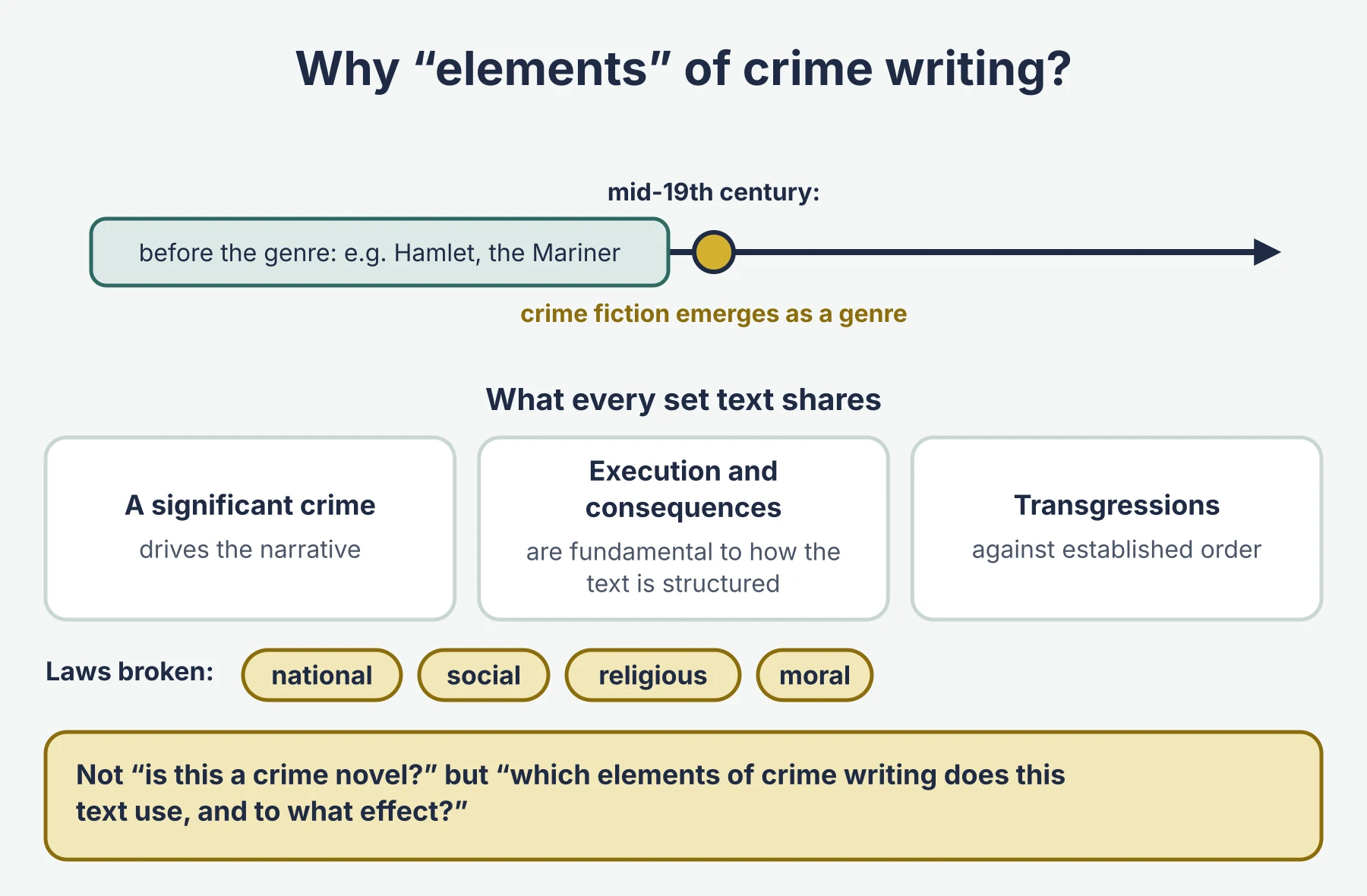
AQA notes that many of the set texts “pre-date the crime fiction genre that emerged as a recognisable literary genre in the mid-19th century”. Hamlet and The Rime of the Ancient Mariner are not crime novels, but in every text “a significant crime drives the narrative” and “the execution and consequences of the crime are fundamentally important to the way the text is structured”. All the texts focus on “transgressions against established order”: the breaking of national, social, religious or moral laws. So you are not asking “is this a crime novel?” but “which elements of crime writing does this text use, and to what effect?”
The set texts
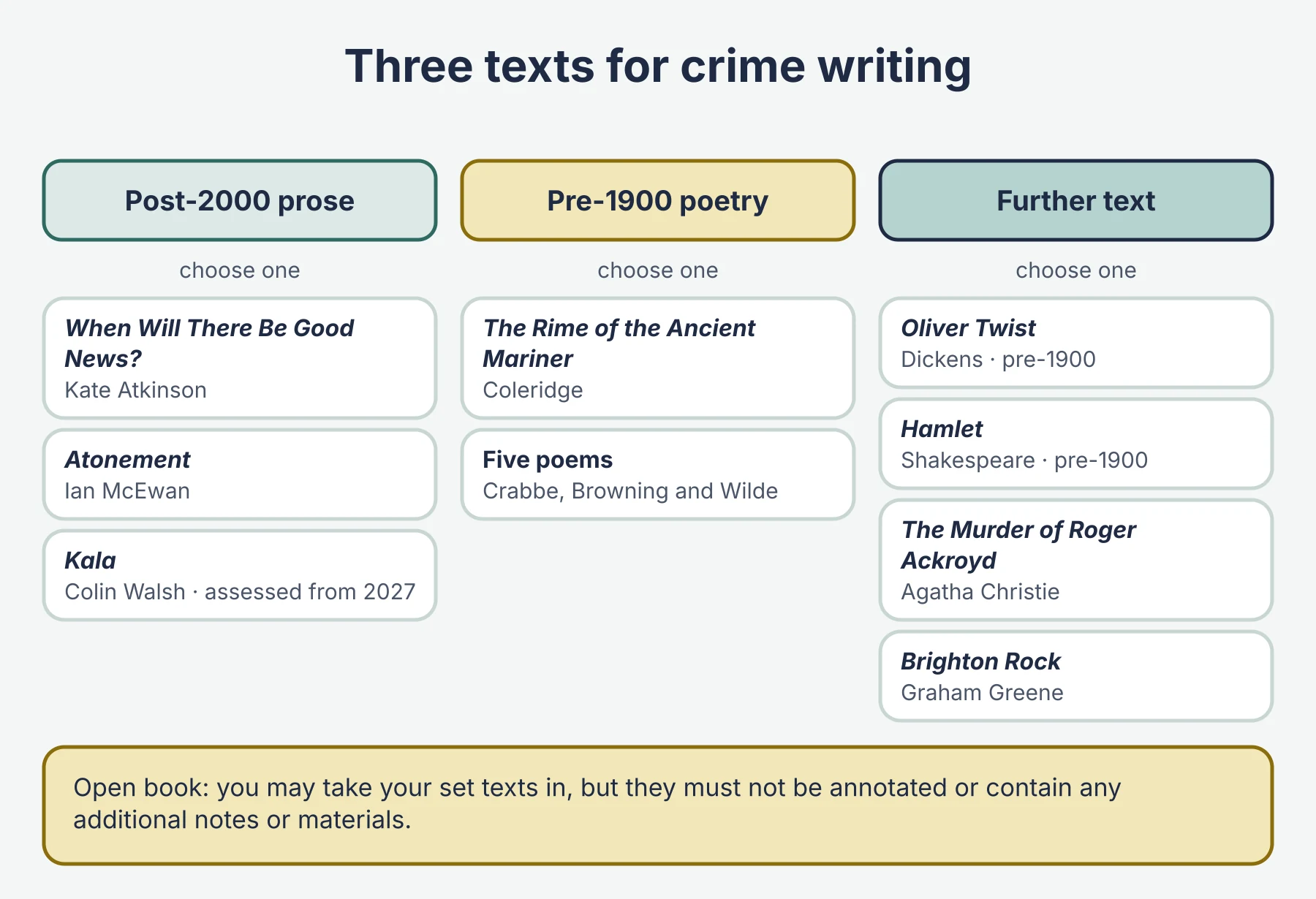
You study three: one post-2000 prose text, one pre-1900 poetry text and one further text.
| Text | Author | Requirement it can meet |
|---|---|---|
| When Will There Be Good News? | Kate Atkinson | Post-2000 prose |
| Atonement | Ian McEwan | Post-2000 prose |
| Kala (first assessment 2027) | Colin Walsh | Post-2000 prose |
| The Rime of the Ancient Mariner | Samuel Taylor Coleridge | Pre-1900 poetry |
| “Peter Grimes”, “The Laboratory”, “My Last Duchess”, “Porphyria’s Lover”, “The Ballad of Reading Gaol” | Crabbe, Browning and Wilde | Pre-1900 poetry |
| Oliver Twist | Charles Dickens | Further text (pre-1900) |
| Hamlet | William Shakespeare | Further text (pre-1900) |
| The Murder of Roger Ackroyd | Agatha Christie | Further text |
| Brighton Rock | Graham Greene | Further text |
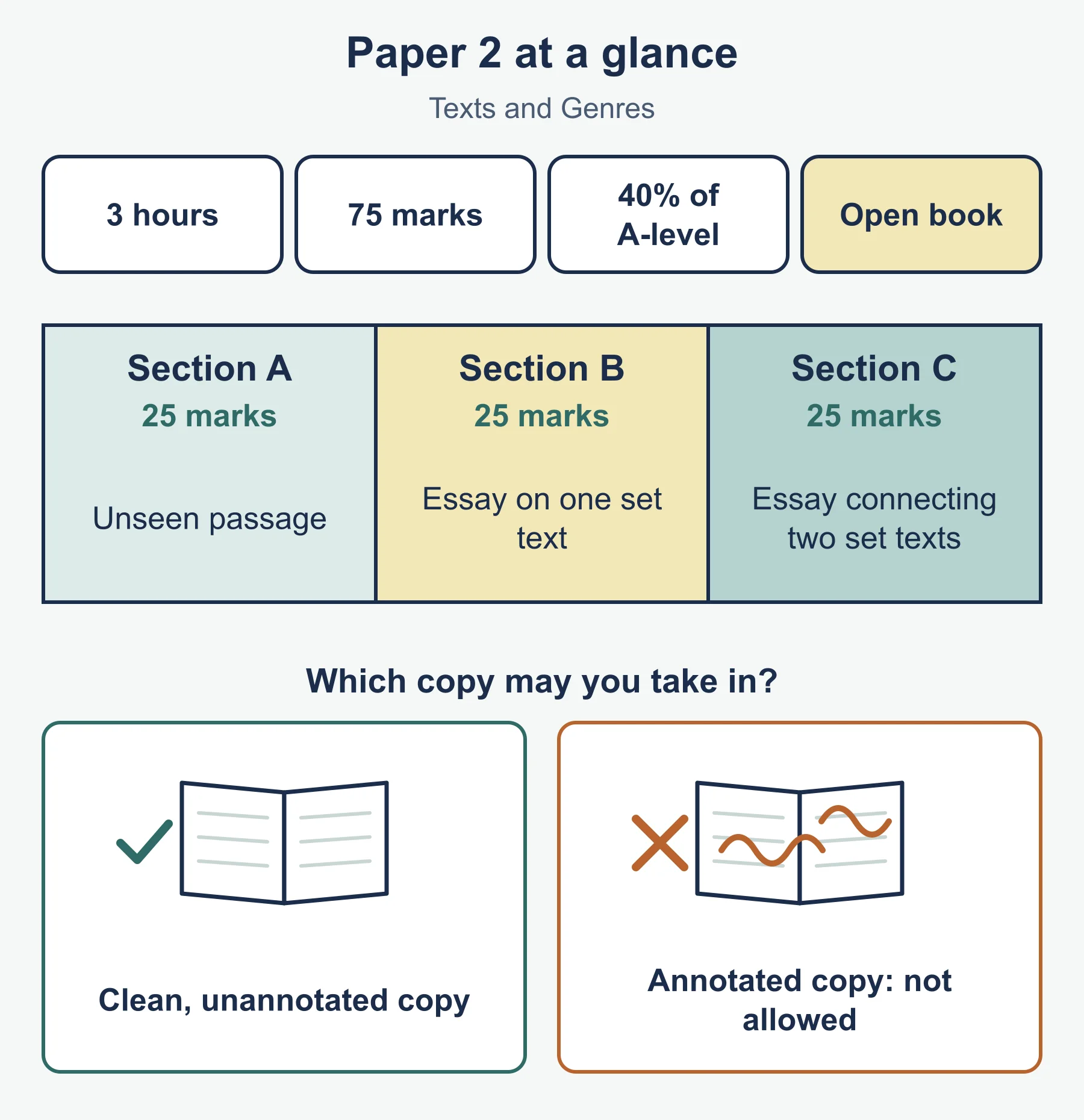
The paper is open book: you may take your set texts in, but they must not be annotated or contain any additional notes or materials.
The elements, grouped
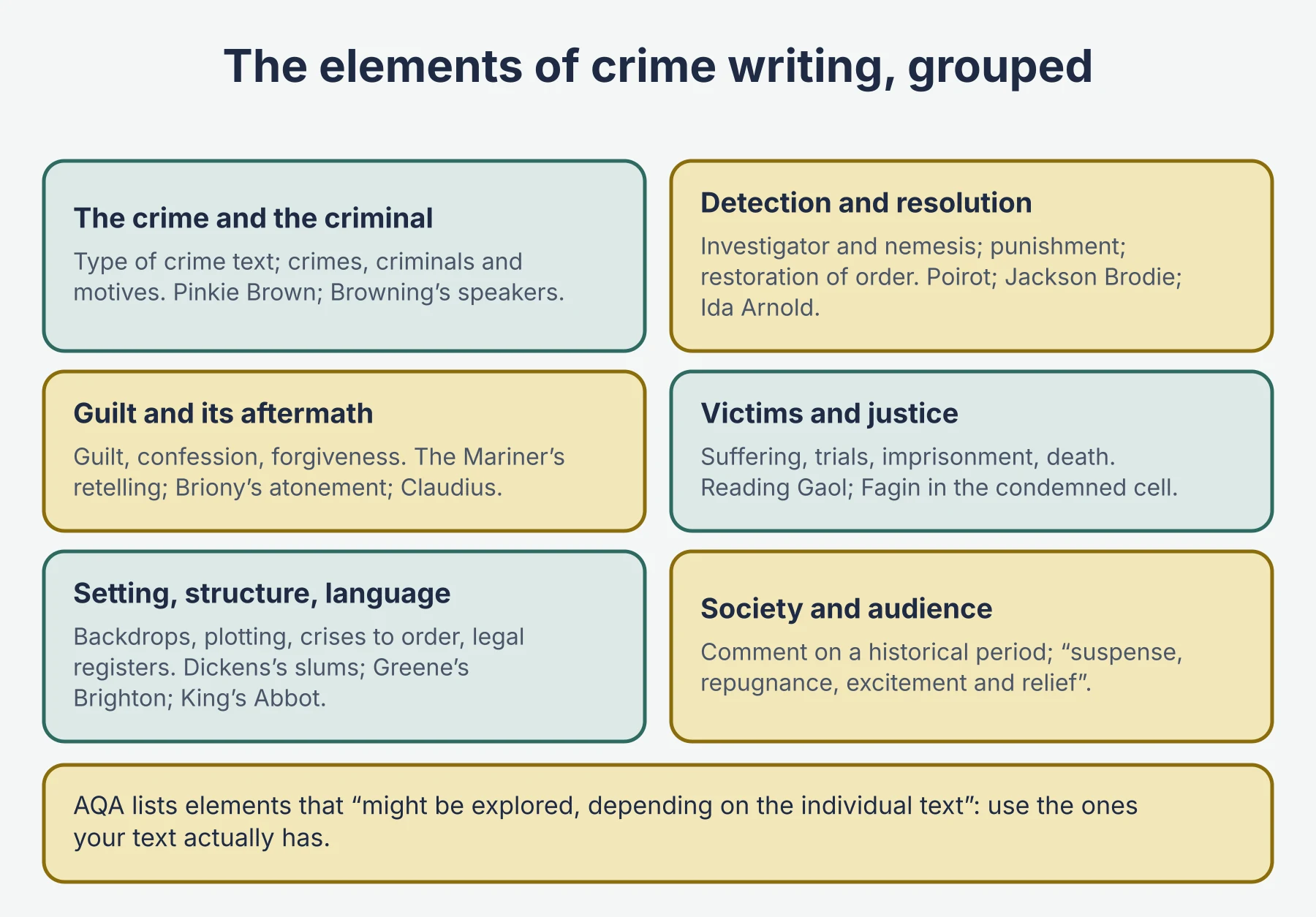
AQA lists the elements that “might be explored, depending on the individual text”. Grouping them makes them easier to use.
The crime and the criminal. The type of crime text (detective fiction, post-modern novel, revenge tragedy, “an account of a life lost to crime”); the nature of crimes and criminals and their motives; violence, murder, theft and betrayal. Pinkie Brown in Brighton Rock is a criminal whose motives Greene ties to faith, class and fear; Browning’s speakers reveal their crimes in their own voices.
Detection and resolution. Detection and investigation; “the creation of the criminal and their nemesis, the typical detective hero”; “the sense that there will be a resolution and the criminal will be punished”; “how far there is a moral purpose and restoration of order”. Poirot restores order in The Murder of Roger Ackroyd; Jackson Brodie in When Will There Be Good News? is a damaged investigator in a world where resolution is partial. Ida Arnold pursues Pinkie less as a detective than as a force of ordinary moral judgement.
Guilt and its aftermath. “Guilt and remorse, confession and the desire for forgiveness”. The Mariner’s compulsion to retell his story is confession without end; in Atonement, Briony’s false accusation of Robbie leads to a lifetime of attempted atonement through writing; Claudius’s guilt breaks out when the play-within-the-play is staged.
Victims and justice. “The victims of crime and the inclusion of suffering”; punishment, justice, retribution, injustice, accusation, trials, imprisonment and death. “The Ballad of Reading Gaol” places the reader inside a prison during the days before an execution; Fagin’s last night in the condemned cell confronts readers of Oliver Twist with punishment as well as crime.
Setting, structure and language. Settings “as backdrops for criminal action and for the pursuit of the perpetrators”; “structural patterning … through a series of crises to some sense of order”; “the specific focus on plotting”; criminal, legal or police registers. Dickens’s London slums, Greene’s Brighton of racecourses and the pier, and the closed village of King’s Abbot in Christie each shape what crime means.
Society and audience. How crime writing “comment[s] on society, particularly the representation of society at particular historical periods”, and how it affects readers, “creating suspense, repugnance, excitement and relief”.
The unseen passage
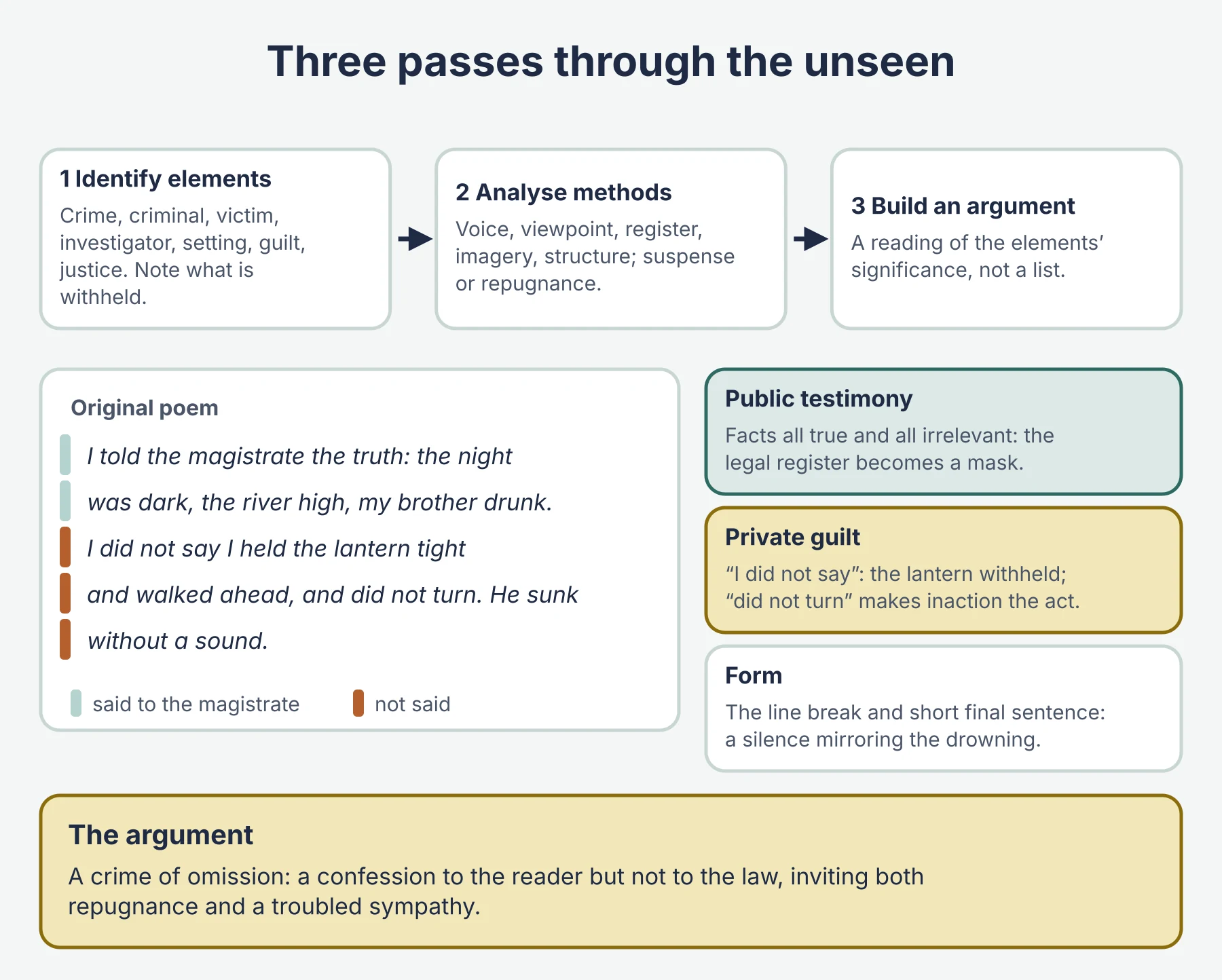
Section A is a compulsory question on an unseen extract from the crime genre, which may be prose, poetry or drama, including literary non-fiction. Work through it in three passes:
- Identify the elements present: crime, criminal, victim, investigator, setting, guilt, justice. Note what is withheld as well, such as an unseen victim or a crime not yet named.
- Analyse methods: narrative voice, viewpoint, register, imagery, structure, and how suspense or repugnance is created.
- Build an argument about the significance of the elements, so the answer is a reading rather than a list.
Worked example on an original poem. The lines below are original, written for this guide.
I told the magistrate the truth: the night was dark, the river high, my brother drunk. I did not say I held the lantern tight and walked ahead, and did not turn. He sunk without a sound.
Model reading: The speaker’s confession is built on what is omitted. The first line’s claim to “the truth” is undercut at once by a list of facts that are all true and all irrelevant, so the legal register becomes a mask. The turn comes with “I did not say”, which divides public testimony from private guilt; the lantern, a symbol of guidance, becomes the instrument of the crime because it is withheld, and “did not turn” makes inaction the act. The ungrammatical “He sunk” may reflect the speaker’s rough voice, and the line break and short final sentence create a silence that mirrors the drowning. The extract therefore presents a crime of omission, a confession to the reader but not to the law, inviting both repugnance and a troubled sympathy.
Set-text and connecting essays
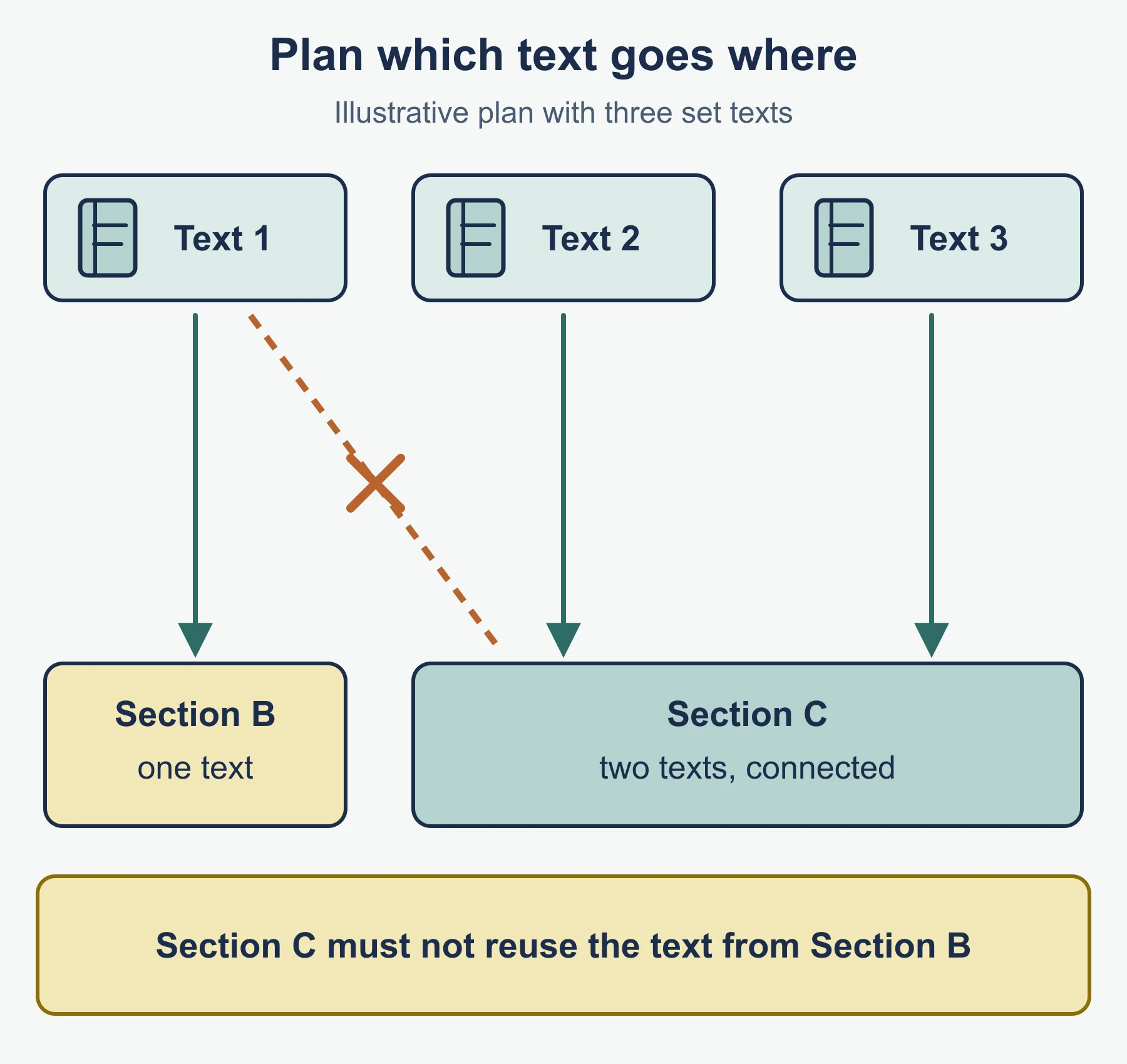
In Section B you answer on one set text. In Section C you connect two texts, and the rubric on AQA’s papers says these must be texts you did not use in Section B. Plan in advance which text goes where.
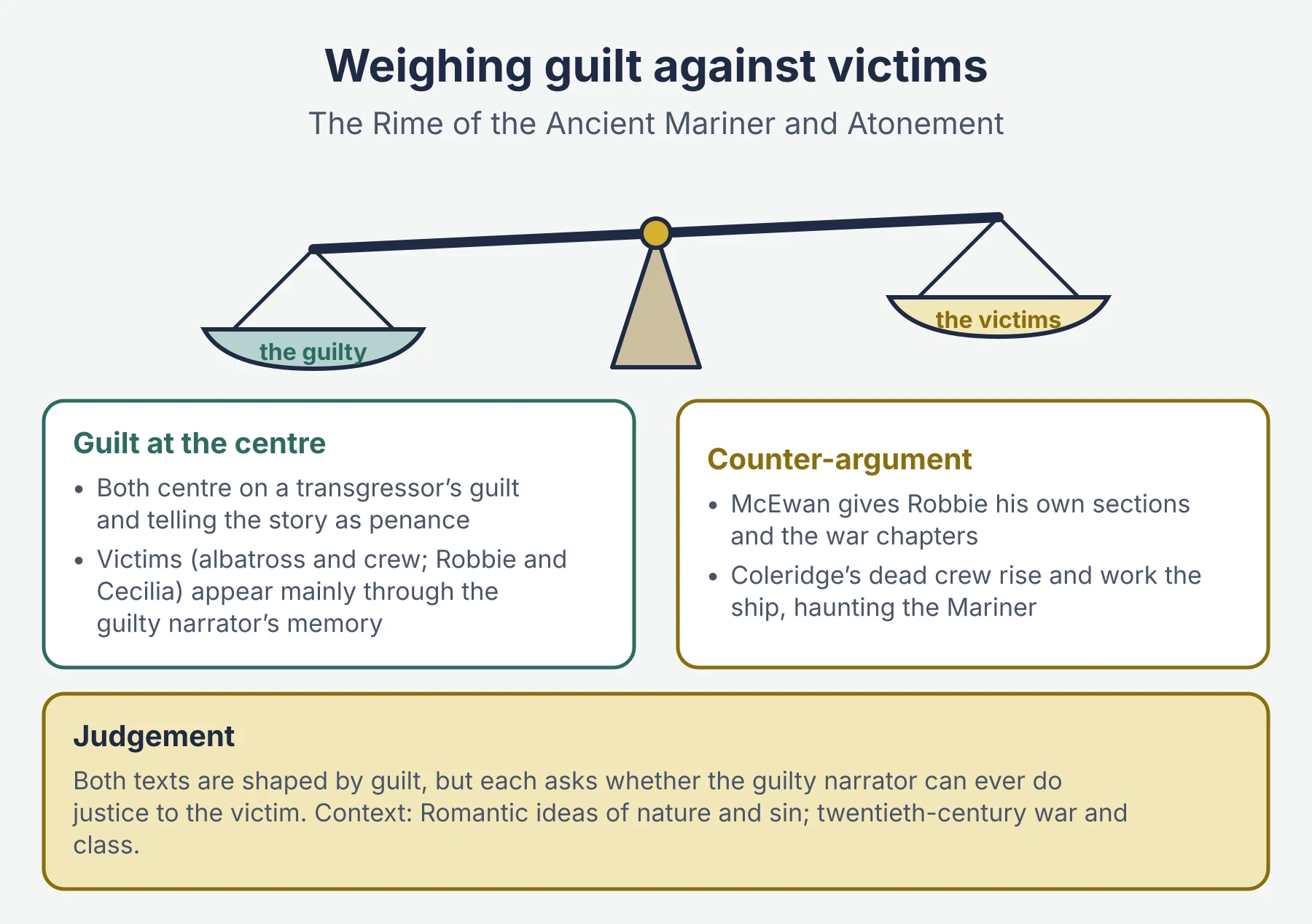
Section C plan (original question shape): “Crime writing is more interested in the guilty than in the victims.” Discuss with reference to two texts. Using The Rime of the Ancient Mariner and Atonement: both centre on a transgressor’s guilt and the telling of the story as penance; the victims (the albatross and the crew, Robbie and Cecilia) are present mainly through the guilty narrator’s memory. Counter-argument: McEwan gives Robbie his own sections and the war chapters, so the victim’s suffering is directly represented; Coleridge’s dead crew rise and work the ship, haunting the Mariner. Context: Romantic ideas of nature and sin; twentieth-century war and class. Judgement: both texts are shaped by guilt, but each asks the reader to question whether the guilty narrator can ever do justice to the victim.
Common mistakes
- Forcing every text into detective fiction. Use the elements the text actually has.
- Plot summary of the crime instead of analysis of how it is presented.
- Treating the unseen as a comprehension exercise without an argument.
- Using the same text in Section B and Section C.
- Copying long quotations from the open book instead of selecting short ones.
Exam technique
Paper 2 lasts 3 hours for three 25-mark answers, so about an hour each is proportionate; allow reading time for the unseen within its hour. The assessment objectives are the same five as Paper 1: response and terminology (AO1), methods (AO2), contexts (AO3), connections (AO4) and interpretations (AO5).
More resources on this topic
- Elements of Crime Writing revision notes
- Option 2A crime writing practice questions
- Elements of Political and Social Protest Writing study guide
Specification
AQA A-level English Literature B (7717), section 3.2.1 Elements of crime writing — aqa.org.uk.
Related resources
-
Revision notes
AQA A-Level English Literature B (7717): Elements of Crime Writing – Revision Notes
Revision notes for AQA English Literature B (7717) Elements of Crime Writing: texts, elements by text, key terms, unseen checklist and a self-test.
English Literature · AQA · A Level
Revise topic -
Study guides
AQA A-Level English Literature B (7717): Elements of Political and Social Protest Writing
Option 2B protest writing for AQA English Literature B (7717): AQA's elements of power in each set text, unseen method and essay planning.
English Literature · AQA · A Level
Read guide -
Revision notes
AQA A-Level English Literature B (7717): Elements of Political and Social Protest Writing – Revision Notes
Revision notes for AQA English Literature B (7717) protest writing: set texts, elements of power by text, key terms, unseen checklist and a self-test.
English Literature · AQA · A Level
Revise topic
Get free revision emails (optional)
Occasional emails with practice questions, worked explanations and links to free resources for the qualification and subjects you choose. No spam, and you can unsubscribe from any email. The free tools on this site never need an email.