
Revision Notes
AQA A-Level English Literature B (7717): Elements of Crime Writing – Revision Notes
Revision notes for AQA English Literature B (7717) Elements of Crime Writing: texts, elements by text, key terms, unseen checklist and a self-test.
- Subject
- English Literature
- Level
- A LEVELS
- Topic
- Paper 2 – Texts and Genres
- Author
- Marlbridge Academic Team
- Updated
- Reviewed by
- Ammar Bilal (what this means)
Aligned to AQA A Level English Literature (7717), For first teaching 2025. Official specification .
Syllabus page (what it covers and how it is assessed): AQA A Level English Literature.
Found an error? Report a correction.
Need help with this topic? Request a free trial class for A Level English Literature (7712 / 7717).
Condensed notes for the crime option of Paper 2. For full explanations and a worked unseen reading, use the Elements of Crime Writing study guide.
The option in one box
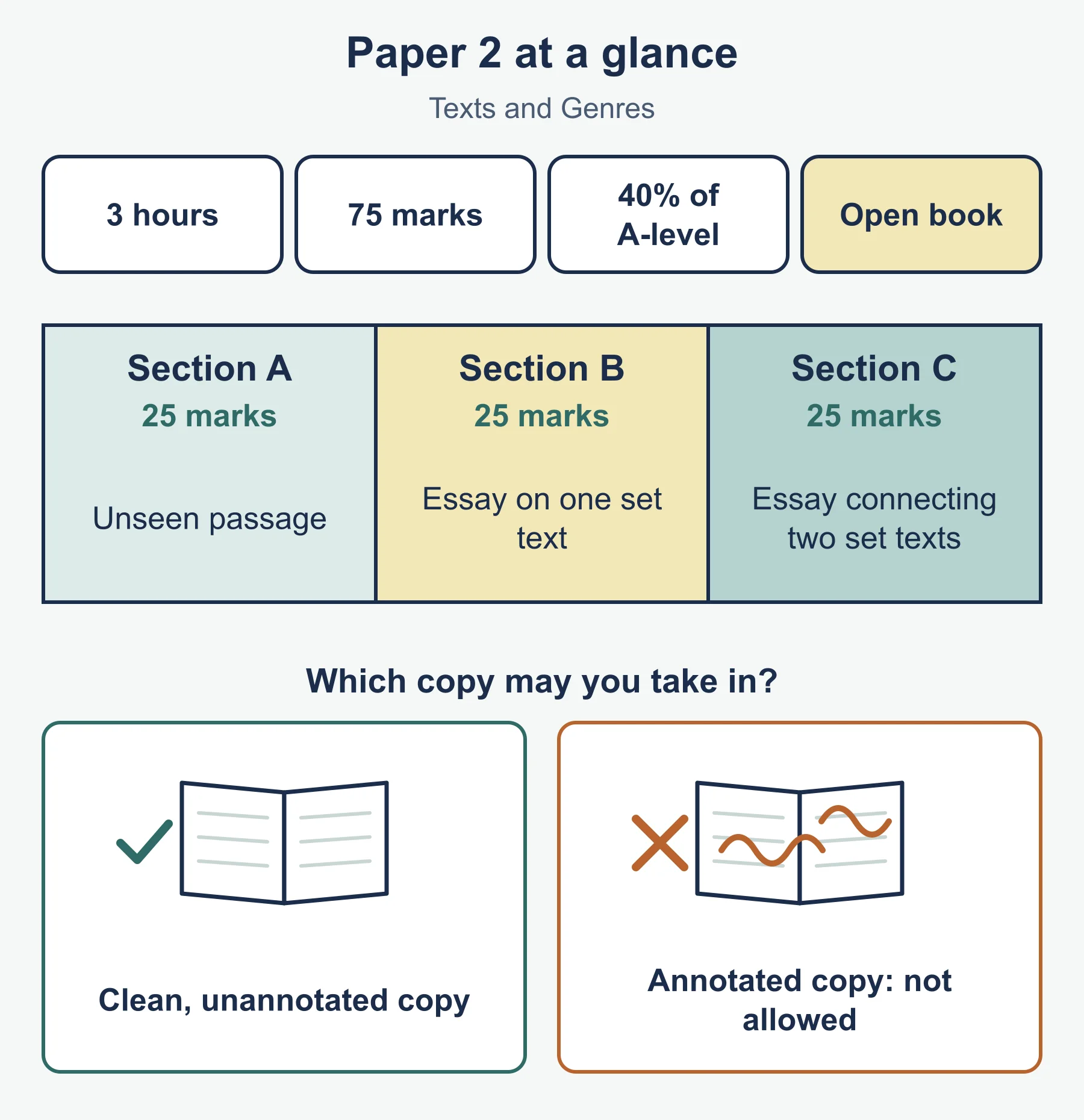
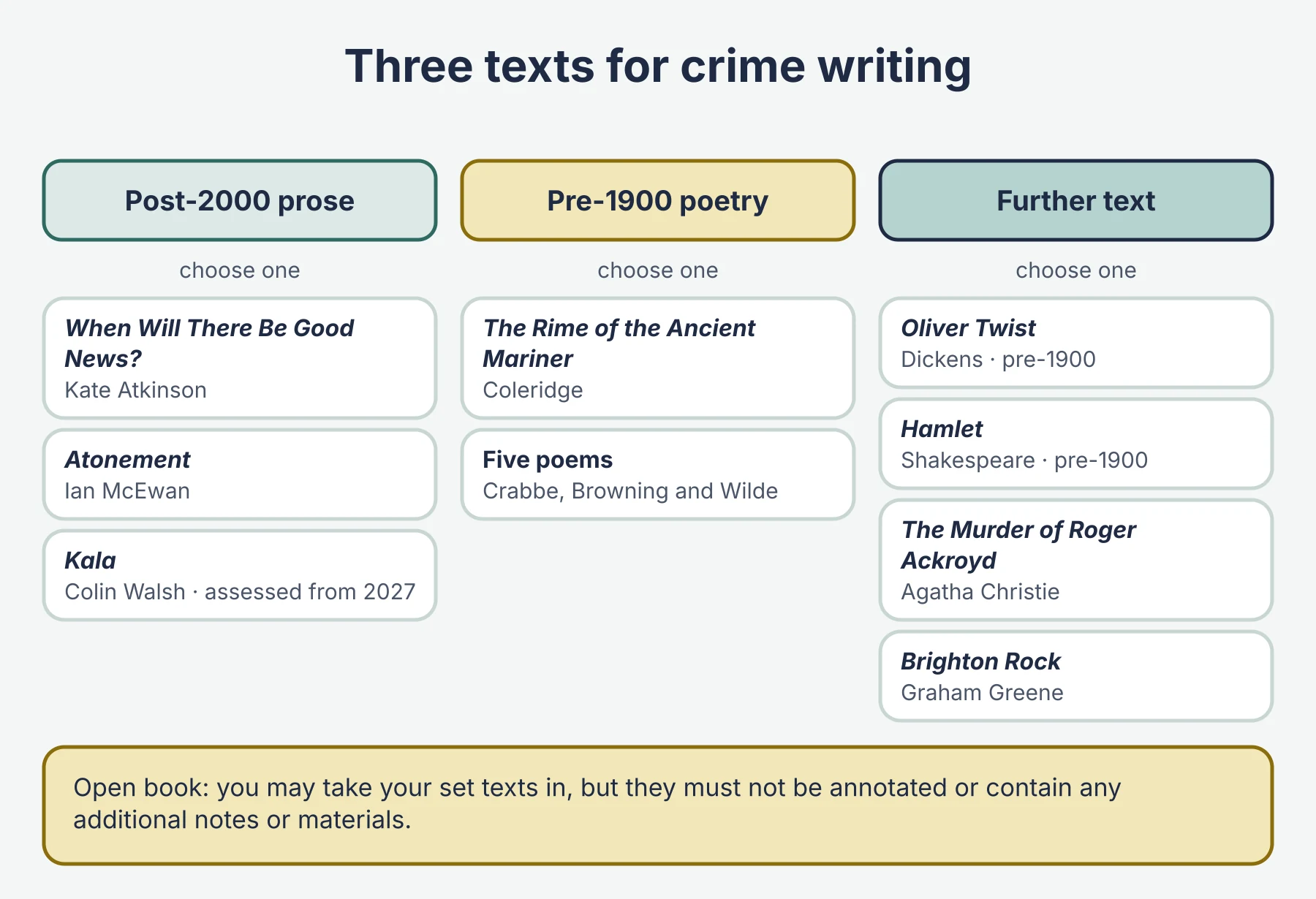
- Three texts: one post-2000 prose, one pre-1900 poetry and one further text.
- Open book: clean copies only, with no annotations or added notes.
- Three answers: unseen passage (Section A), one set text (Section B), two other set texts connected (Section C).
- The unseen can be poetry, prose or drama, including literary non-fiction.
AQA’s core idea
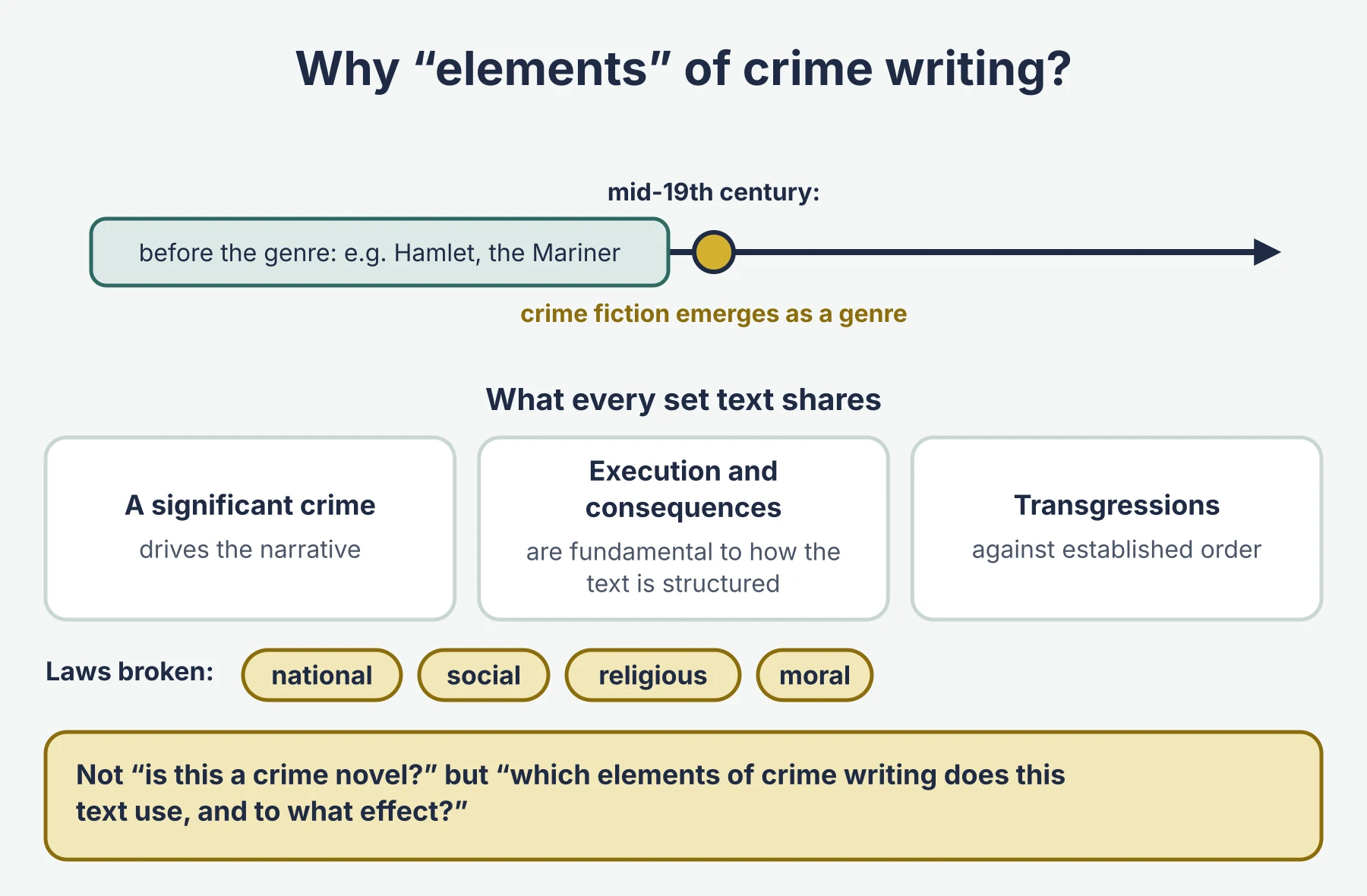
In every text “a significant crime drives the narrative”, and the crime’s “execution and consequences” shape the structure. The texts focus on “transgressions against established order”. Many pre-date crime fiction as a genre, hence elements, not rules.
Set texts and their strongest elements
| Text | Strongest elements |
|---|---|
| When Will There Be Good News? (Atkinson) | Damaged detective; victims and survivors; chance; partial resolution |
| Atonement (McEwan) | False accusation; guilt and atonement; injustice; the writer as confessor |
| Kala (Walsh, first assessment 2027) | Check focus with your teacher |
| The Rime of the Ancient Mariner (Coleridge) | Transgression against nature; penance; compulsive confession |
| Crabbe, Browning, Wilde poems | Criminal voices; punishment and prison; guilt and haunting |
| Oliver Twist (Dickens) | Criminal underworld; setting; punishment; social comment |
| Hamlet (Shakespeare) | Revenge tragedy; a hidden murder; detection through the play-within-the-play |
| The Murder of Roger Ackroyd (Christie) | Detective fiction; the narrator-murderer; restoration of order |
| Brighton Rock (Greene) | The young criminal; sin and damnation; a pursuer of ordinary justice |
AQA’s elements in six groups
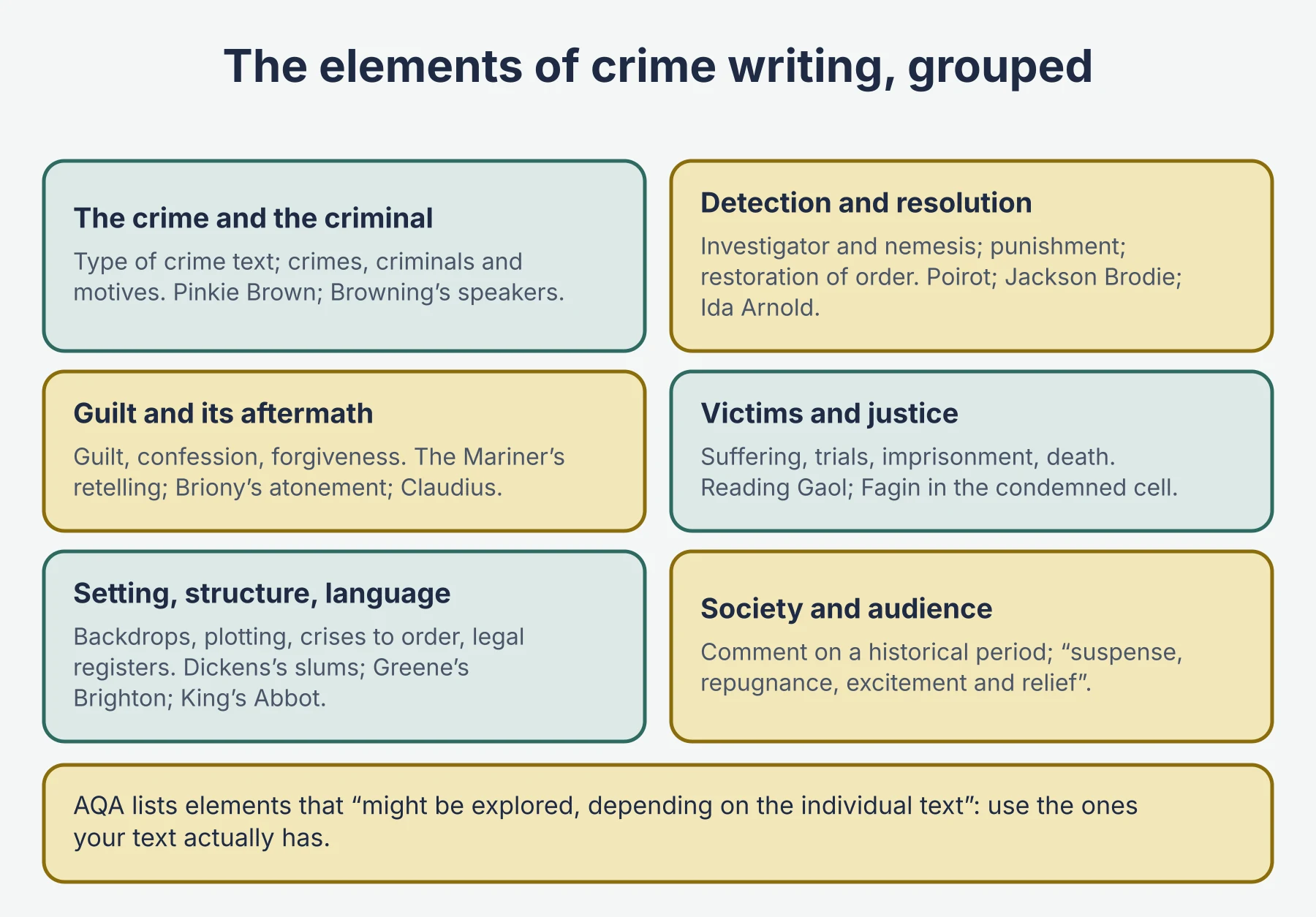
- Crime and criminal: type of crime text; crimes, criminals, motives; violence, murder, theft, betrayal.
- Detection and resolution: investigation; criminal and nemesis; the expectation of punishment; moral purpose and restored order.
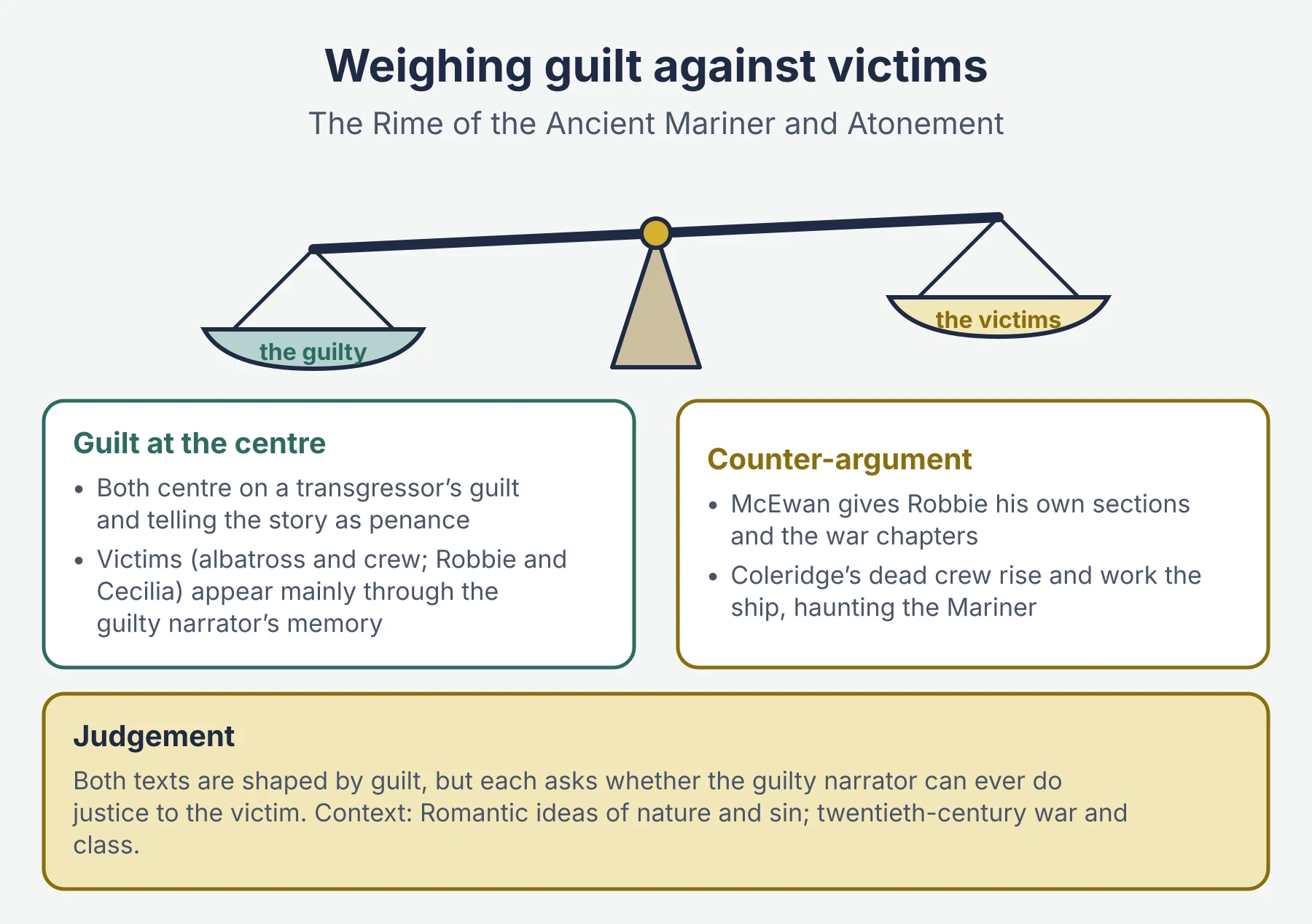
- Guilt: remorse, confession, the desire for forgiveness.
- Victims and justice: suffering; punishment, retribution, injustice; trials, prison, death.
- Setting, structure, language: backdrops for crime and pursuit; crises to order; plotting; criminal, legal and police registers; motifs of love, money, danger and death.
- Society and audience: comment on a historical society; suspense, repugnance, excitement, relief.
Key terms
| Term | Meaning |
|---|---|
| Whodunnit | Detective story built on concealing the culprit’s identity |
| Fair play | Convention that clues are available to the reader |
| Unreliable narrator | A narrator whose account is misleading (Dr Sheppard) |
| Revenge tragedy | Drama of wrong, delay and bloody revenge (Hamlet) |
| Dramatic monologue | Poem in a character’s voice to a silent listener (Browning) |
| Frame narrative | Story told within another (the Mariner and the Wedding-Guest) |
| Metafiction | Fiction aware of itself as fiction (Atonement’s ending) |
| Register | Vocabulary of a field, such as legal or police language |
| Nemesis | The opponent who pursues and punishes the criminal |
| Restoration of order | Return to stability once the crime is solved or punished |
Unseen checklist
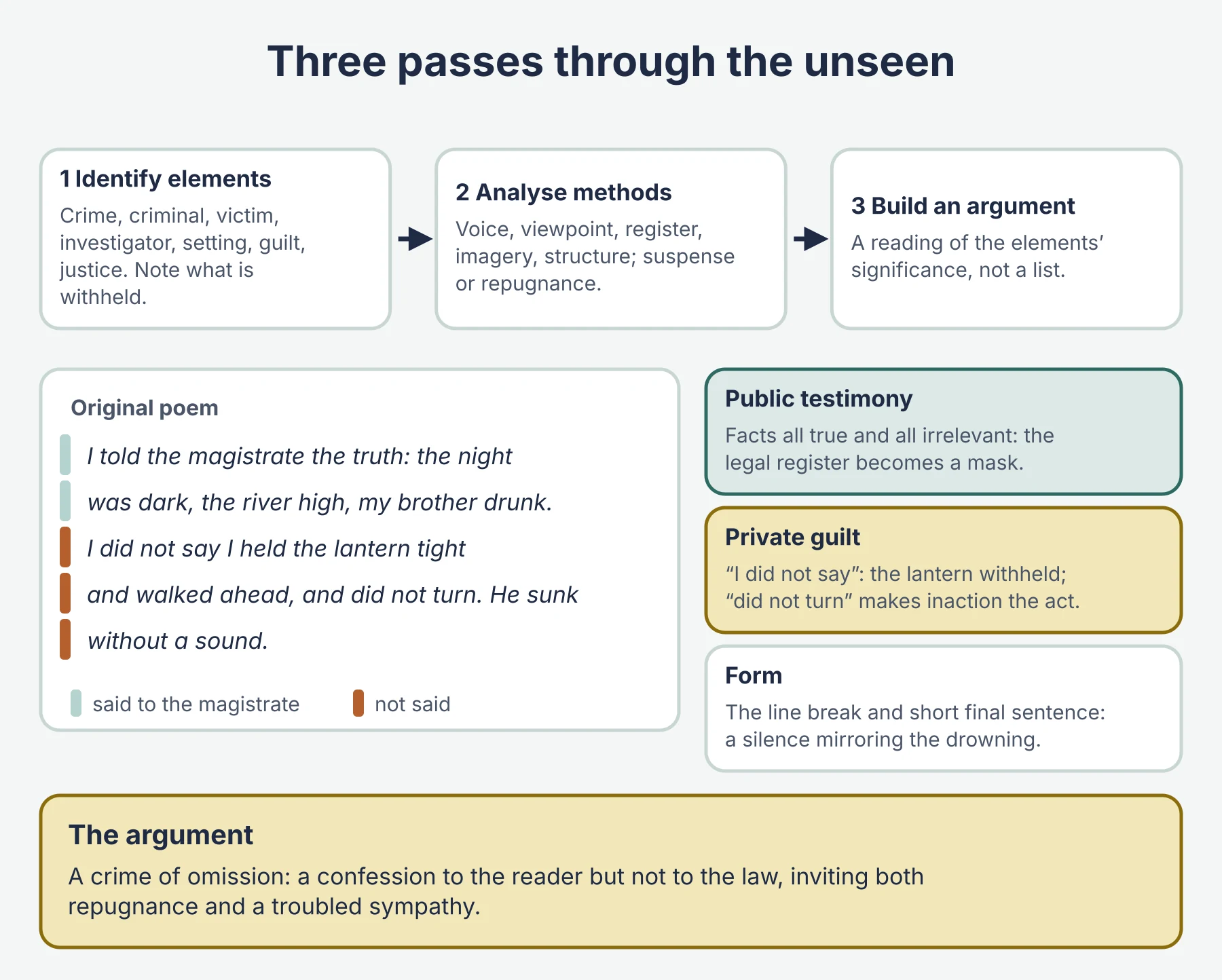
- What crime, if any, has happened, and what is withheld?
- Who sees, and whose voice controls the account?
- Which register is used, and is it a mask?
- How is suspense or repugnance created?
- Is order restored, threatened or impossible?
- What is the overall significance: one argument, not a list?
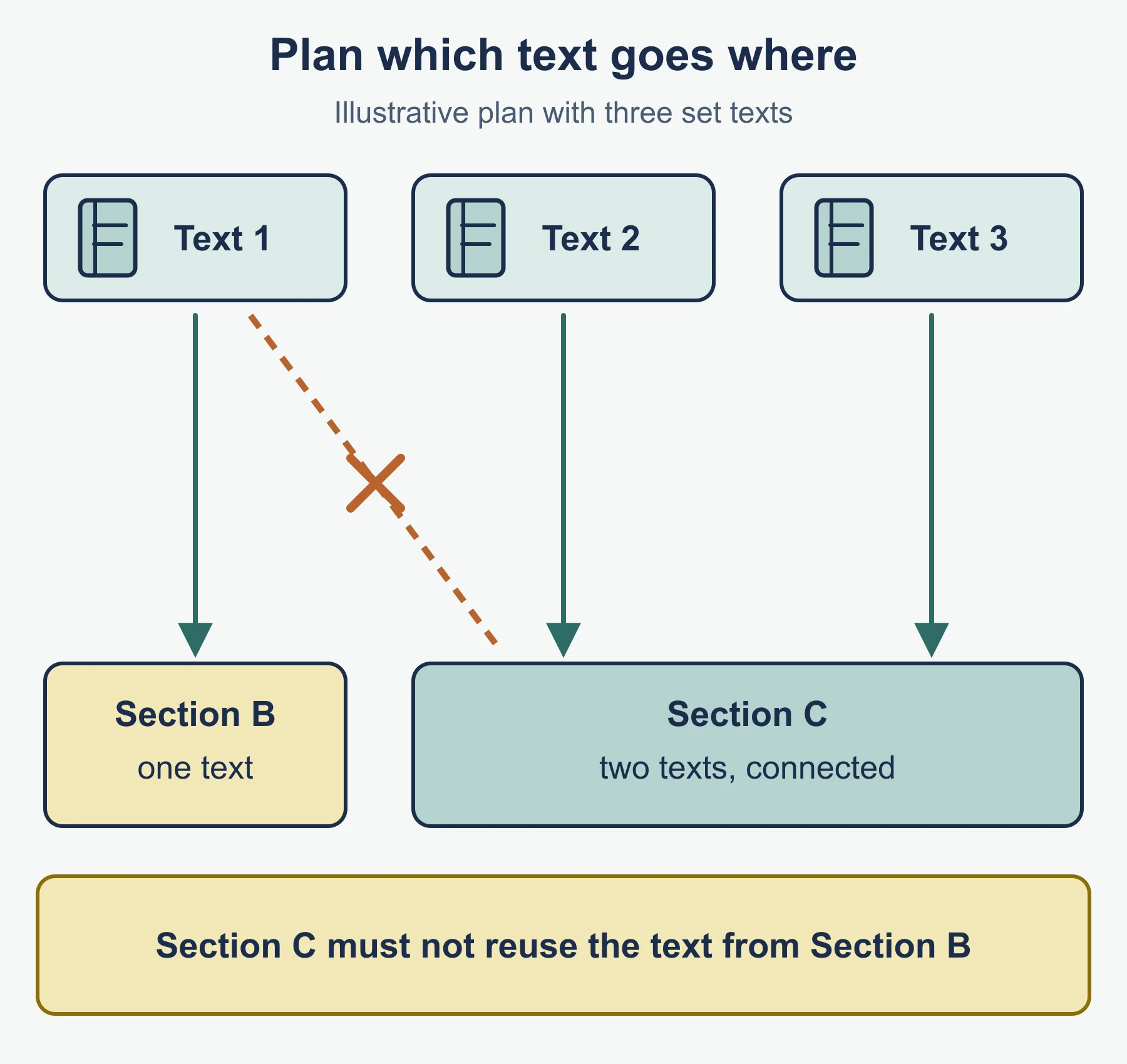
Planning Section B and C
- Decide in advance which text is for Section B and which two are for Section C; Section C must use two texts not used in Section B.
- For Section C, choose a shared element and argue across both texts paragraph by paragraph.
- Keep two or three short passages per text you can find quickly in the open book.
Text pairings for Section C
- Guilt and confession: The Rime of the Ancient Mariner with Atonement.
- The criminal’s voice: Browning’s monologues with Brighton Rock.
- Detection and order: The Murder of Roger Ackroyd with When Will There Be Good News?.
- Punishment and the state: “The Ballad of Reading Gaol” with Oliver Twist.
- Hidden murder and revenge: Hamlet with “My Last Duchess”.
Exam traps
- Calling every text a detective story.
- Retelling the crime instead of analysing its presentation.
- A list of elements in the unseen with no overall reading.
- Reusing the Section B text in Section C.
- Long quotations copied from the open book.
- Ignoring AO5: give and weigh more than one reading.
Self-test
- What three text types must you study for Option 2A?
- What may the unseen extract be?
- What does AQA say drives the narrative in every set text?
- Why does AQA use the word “elements”?
- Which set text has a narrator who turns out to be the murderer?
- Which poem’s speaker compulsively retells the story of his crime?
- Name two of Browning’s poems on the list.
- Which set text includes a play staged to catch a murderer’s conscience?
- What is the rule about texts in Section B and Section C?
- What is metafiction, and which set text uses it?
- Give two reader responses AQA says crime stories create.
- What may and may not be in the copies of set texts you take into the exam?
Answers
- One post-2000 prose text, one pre-1900 poetry text and one further text.
- Poetry, prose or drama, including literary non-fiction.
- A significant crime.
- Because many texts pre-date crime fiction as a genre, so students consider the elements each text contains rather than fixed genre rules.
- The Murder of Roger Ackroyd.
- The Rime of the Ancient Mariner.
- Any two: “The Laboratory”; “My Last Duchess”; “Porphyria’s Lover”.
- Hamlet.
- Section C must use two texts not used in Section B.
- Fiction that draws attention to its own status as fiction; Atonement, whose ending reveals Briony as the author of the story.
- Any two: suspense; repugnance; excitement; relief.
- Clean copies of the set texts are allowed; they must not be annotated or contain additional notes or materials.
Use the Option 2A practice questions for full unseen and essay practice, and the Paper 2 revision notes for the paper’s structure.
Related resources
-
Study guides
AQA A-Level English Literature B (7717): Elements of Political and Social Protest Writing
Option 2B protest writing for AQA English Literature B (7717): AQA's elements of power in each set text, unseen method and essay planning.
English Literature · AQA · A Level
Read guide -
Revision notes
AQA A-Level English Literature B (7717): Elements of Political and Social Protest Writing – Revision Notes
Revision notes for AQA English Literature B (7717) protest writing: set texts, elements of power by text, key terms, unseen checklist and a self-test.
English Literature · AQA · A Level
Revise topic -
Study guides
AQA A-Level English Literature B (7717): Gender Politics and Social Class
Gender politics and social class across the protest writing set texts for AQA English Literature B (7717), with intersections, contexts and a model paragraph.
English Literature · AQA · A Level
Read guide
Get free revision emails (optional)
Occasional emails with practice questions, worked explanations and links to free resources for the qualification and subjects you choose. No spam, and you can unsubscribe from any email. The free tools on this site never need an email.