
Revision Notes
AQA A Level Law (7162): Restrictions – Revision Notes
Condensed recall on Articles 8.2, 10.2 and 11.2 ECHR for AQA A Level Law 7162: the three-part test, Bank Mellat proportionality and the margin of appreciation.
- Subject
- Law
- Level
- A LEVELS
- Topic
- Topic 5: Human Rights
- Author
- Marlbridge Academic Team
- Updated
- Reviewed by
- Aizaz Raoof Ali (what this means)
Aligned to AQA A Level Law (7162), For teaching from September 2017 onwards, A-level exams 2019 onwards. Official specification .
Syllabus page (what it covers and how it is assessed): AQA A Level Law.
Syllabus points this page covers
7162
- Restrictions
Found an error? Report a correction.
Need help with this topic? Request a free trial class for A Level Law (7162).
Condensed notes on how qualified rights may be restricted. For full explanation and a worked scenario, use the Restrictions study guide.
The three-part test (Articles 8.2, 10.2, 11.2)
| Step | Question | Authority |
|---|---|---|
| 1. Law | Is the interference in accordance with / prescribed by law: a legal basis that is accessible and foreseeable? | Sunday Times v UK (1979); Malone v UK (1984); Gillan and Quinton v UK (2010) |
| 2. Aim | Does it pursue a legitimate aim listed in the second paragraph? | Lists are exhaustive; Article 18 |
| 3. Necessity | Is it necessary in a democratic society: pressing social need, relevant and sufficient reasons, proportionate? | Handyside v UK (1976) |
The state must justify the interference. Failure at any step means a breach.
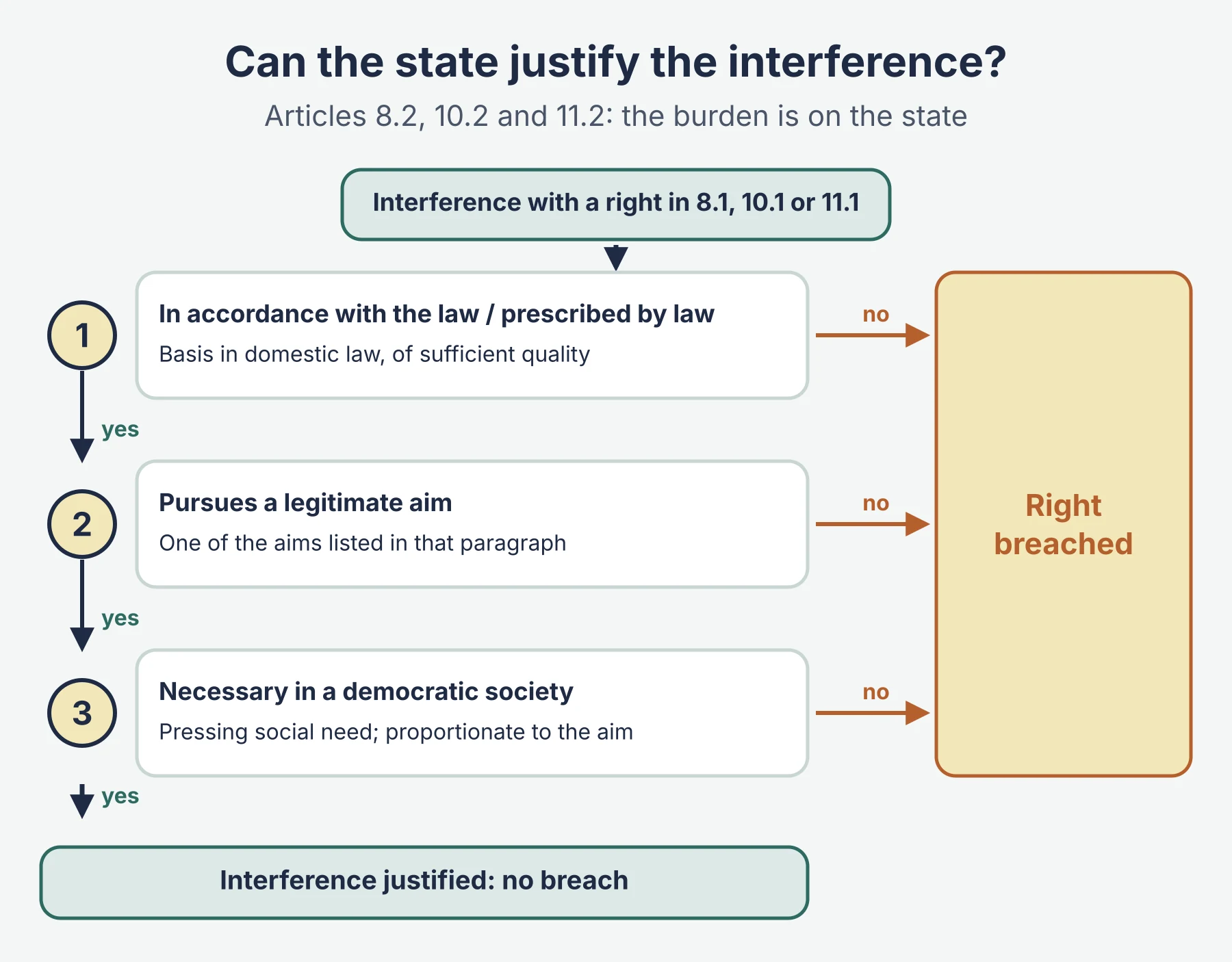
The aims at a glance
- All three Articles: national security; public safety; prevention of disorder or crime; protection of health or morals; protection of the rights (and freedoms) of others.
- 8.2 only: economic well-being of the country.
- 10.2 only: territorial integrity; protection of reputation; preventing disclosure of information received in confidence; maintaining the authority and impartiality of the judiciary. Also “duties and responsibilities” and “formalities, conditions, restrictions or penalties”.
- 11.2 last sentence: lawful restrictions on the armed forces, police and administration of the state.
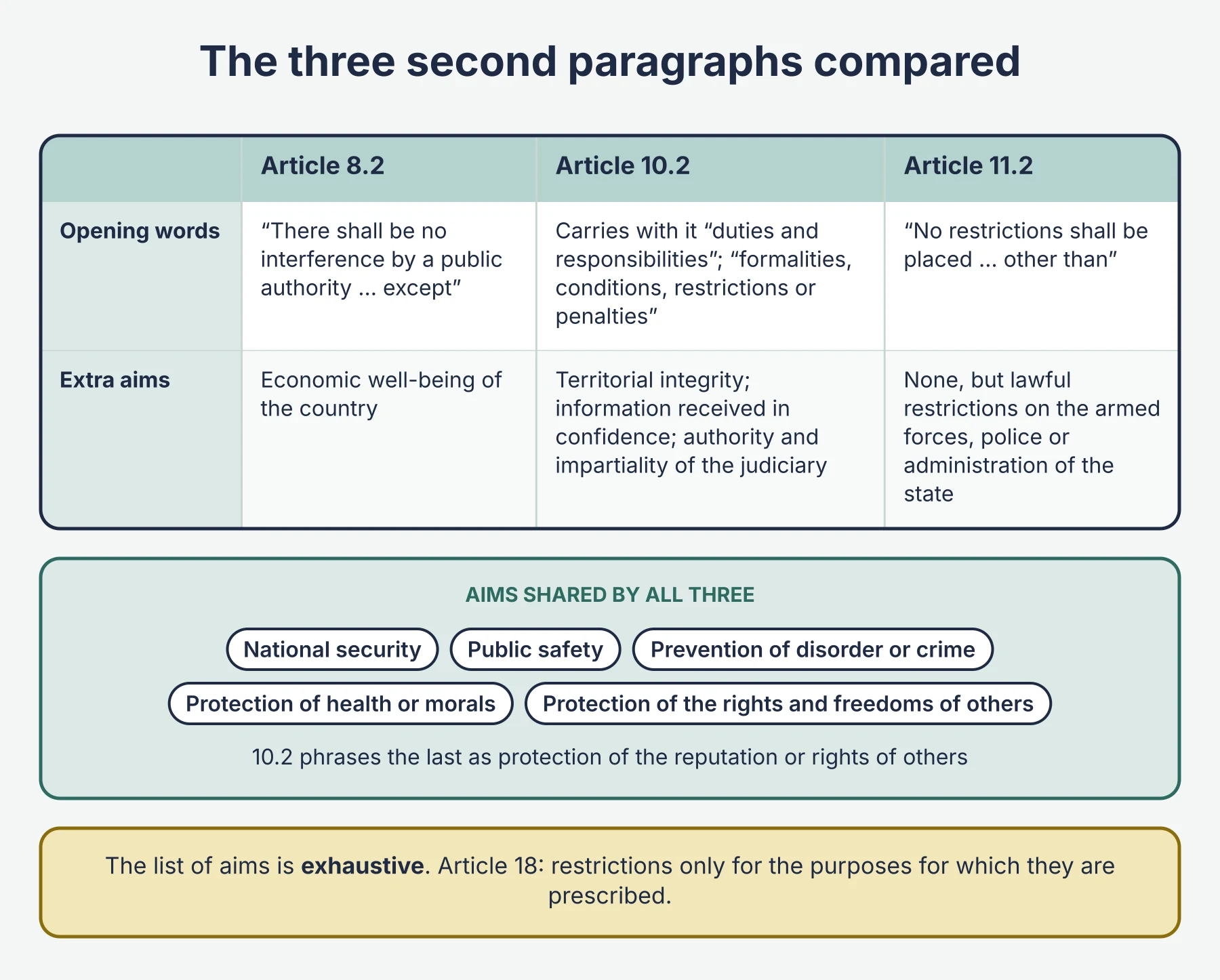
“Prescribed by law” in detail
- Accessible and precise enough to let a person regulate their conduct (Sunday Times). Common law can qualify.
- No legal basis: Malone (telephone tapping).
- Too broad, no safeguards: Gillan and Quinton (suspicionless stop and search under the Terrorism Act 2000 ss44 to 47); replaced under the Protection of Freedoms Act 2012.
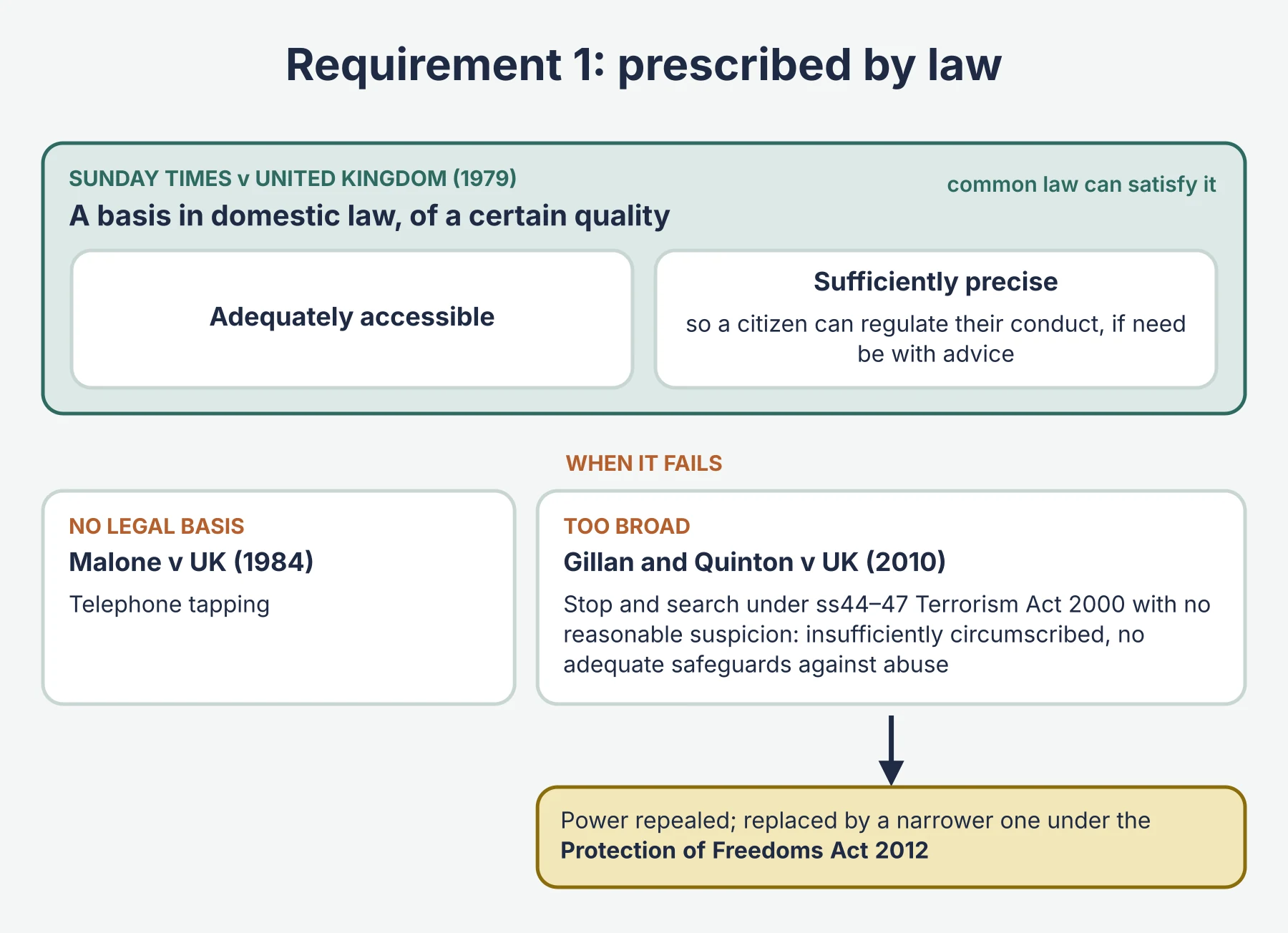
“Necessary” in detail
- Not “indispensable”, but not as loose as “reasonable” or “useful”: a pressing social need (Handyside).
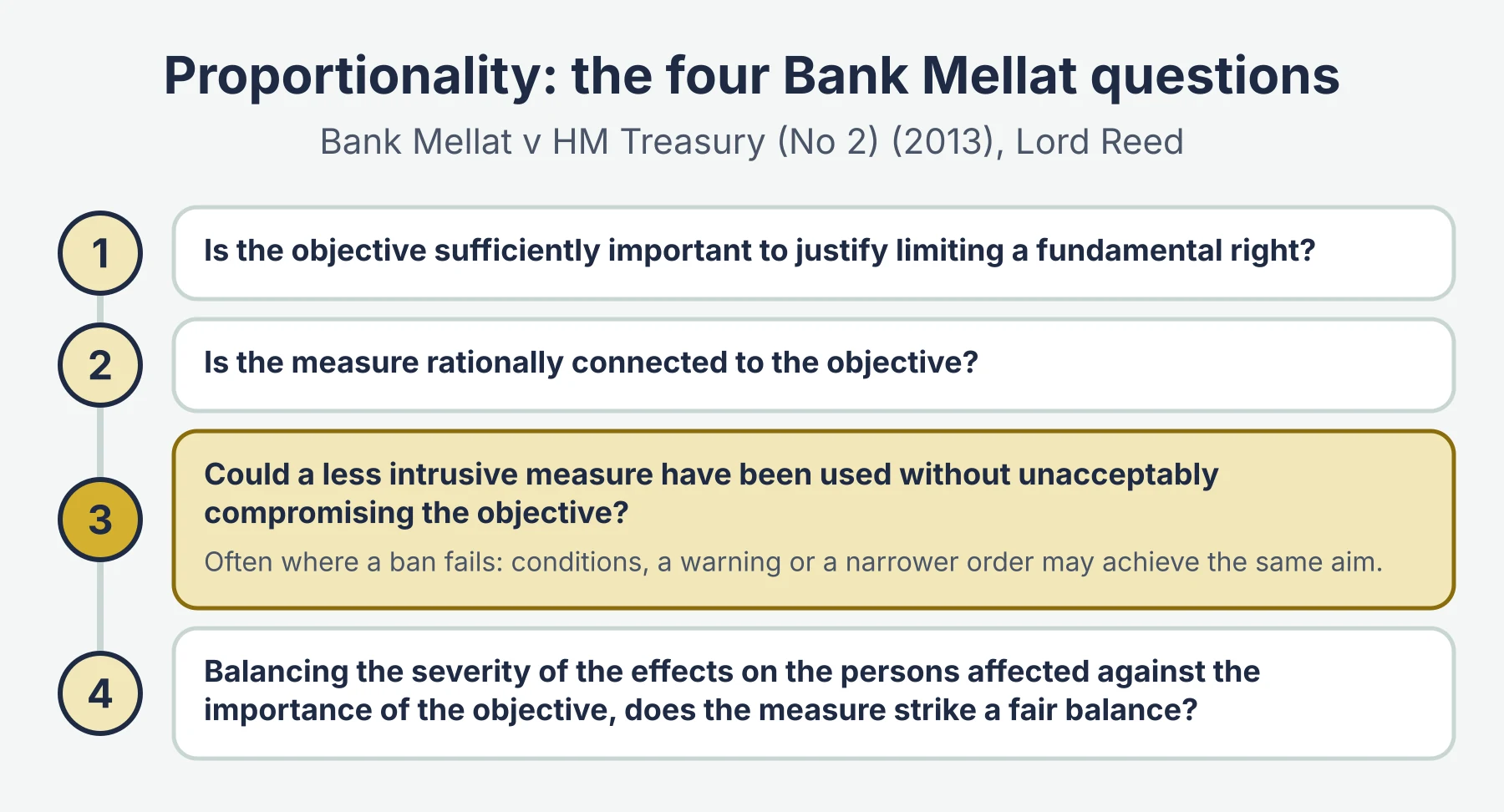
- Bank Mellat v HM Treasury (No 2) (2013), four questions:
- Sufficiently important objective?
- Rational connection?
- Less intrusive measure available without unacceptably compromising the objective?
- Fair balance between the individual’s rights and the community’s interests?
Margin of appreciation
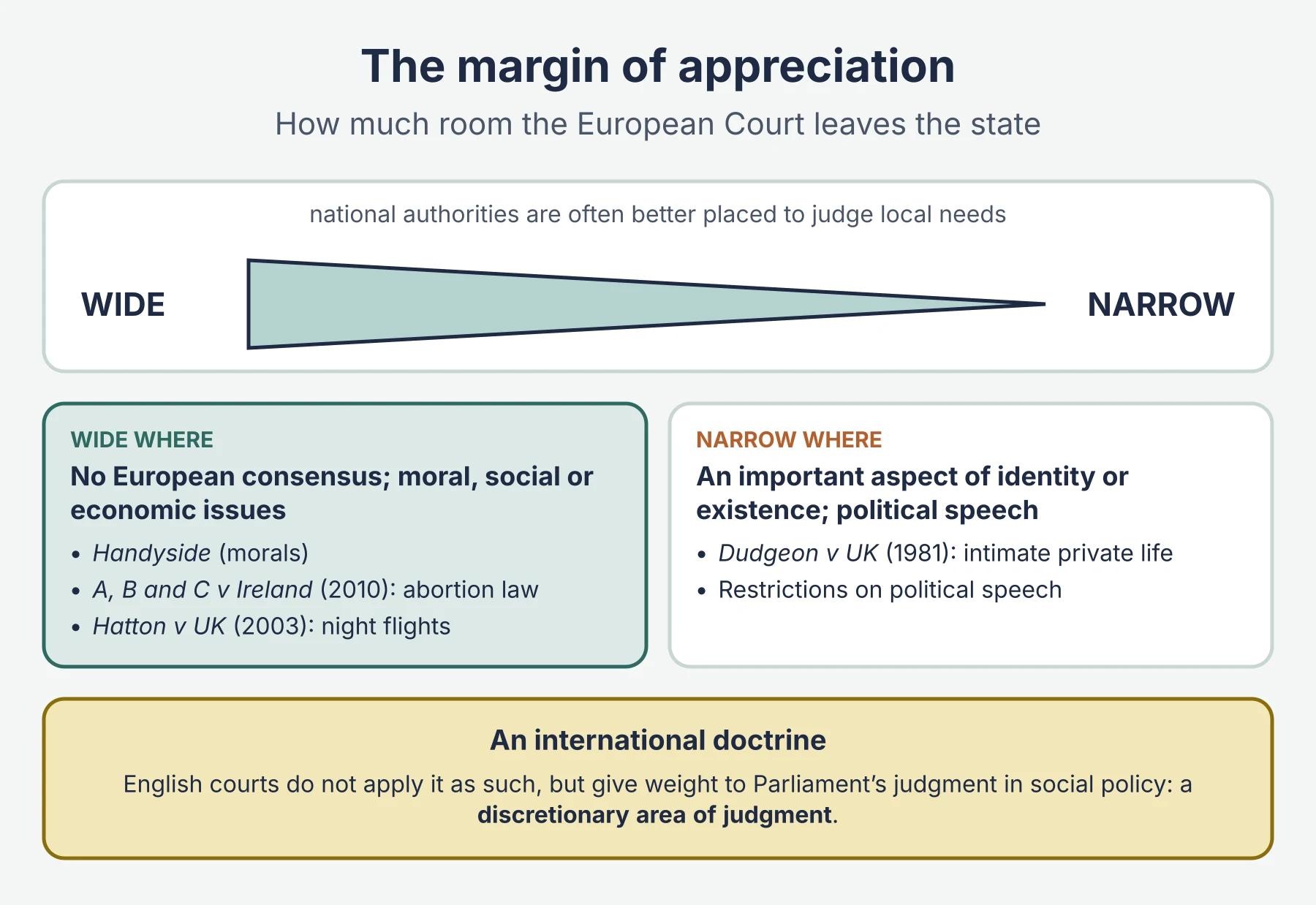
| Wide | Narrow |
|---|---|
| Morals: Handyside | Intimate private life: Dudgeon v UK (1981) |
| Abortion: A, B and C v Ireland (2010) | Political speech: Lingens v Austria (1986) |
| Economic and environmental policy: Hatton v UK (2003) | Core press freedom: Goodwin v UK (1996) |
An international doctrine; English courts instead give weight to Parliament’s judgment (discretionary area of judgment).
Other general limits
- Article 14: no discrimination in securing rights.
- Article 15: derogation in war or public emergency, strictly required.
- Article 17: no use of rights to destroy others’ rights. Norwood v UK (2004): anti-Muslim poster, inadmissible.
- Article 18: restrictions only for their prescribed purposes.
Conflicting rights
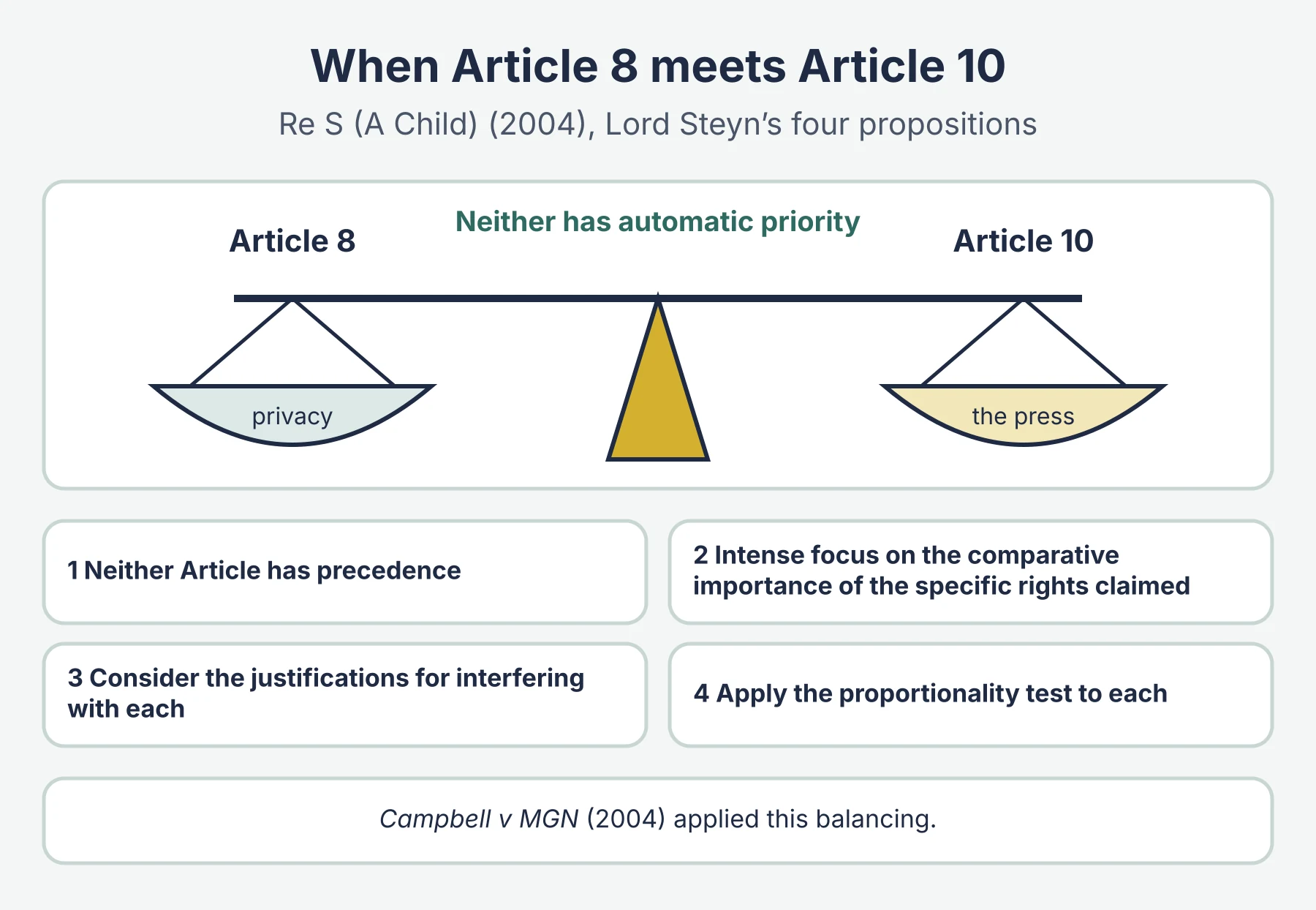
Re S (A Child) (2004): neither Article 8 nor Article 10 has precedence; intense focus on the comparative importance of the specific rights; consider the justifications for interfering with each; apply proportionality to each. Applied in Campbell v MGN (2004).
Key terms
| Term | Meaning |
|---|---|
| Qualified right | A right whose second paragraph permits justified interference |
| Prescribed by law | Legal basis that is accessible and foreseeable |
| Legitimate aim | One of the purposes listed in the second paragraph |
| Pressing social need | The meaning of “necessary” from Handyside |
| Proportionality | The measure goes no further than needed and strikes a fair balance |
| Margin of appreciation | Latitude the European Court allows national authorities |
| Discretionary area of judgment | Weight English courts give to Parliament or ministers on policy |
Exam traps
- Do not use this test for Article 5; it is limited, not qualified.
- Name the precise aim that fits the facts; “public interest” alone is not an aim.
- Proportionality usually turns on less restrictive alternatives; look for them in the facts.
- The margin of appreciation is used in Strasbourg, not in English courts.
- In 8 v 10 cases, say expressly that neither right has automatic priority.
Self-test
- List the three requirements for a lawful restriction of a qualified right.
- What did Sunday Times v UK say about “prescribed by law”?
- Why did Gillan and Quinton v UK find a breach of Article 8?
- Which aim appears in Article 8.2 but not in 10.2 or 11.2?
- Give two aims found only in Article 10.2.
- What does the last sentence of Article 11.2 permit?
- How did Handyside explain “necessary”?
- State Bank Mellat’s third question.
- When is the margin of appreciation wide? Give a case.
- What did Norwood v UK decide?
- What are the four propositions in Re S (A Child)?
- Who bears the burden of justifying a restriction?
Answers: 1. In accordance with or prescribed by law; legitimate aim; necessary in a democratic society. 2. The law must be adequately accessible and precise enough for a person to regulate their conduct. 3. The stop and search power was insufficiently circumscribed with inadequate safeguards, so it was not in accordance with the law. 4. Economic well-being of the country. 5. Any two of: territorial integrity; protection of reputation; preventing disclosure of information received in confidence; maintaining the authority and impartiality of the judiciary. 6. Lawful restrictions on members of the armed forces, police or administration of the state. 7. Not indispensable, nor as flexible as reasonable or useful; it implies a pressing social need. 8. Could a less intrusive measure have been used without unacceptably compromising the objective? 9. On moral, social or economic questions without European consensus, e.g. Handyside, A, B and C v Ireland or Hatton. 10. Article 17 prevented reliance on Article 10 for an anti-Muslim poster; inadmissible. 11. Neither right has precedence; intense focus on the comparative importance of the rights; consider the justifications for interfering with each; apply proportionality to each. 12. The state.
More resources on this topic
Restrictions study guide | Restrictions practice questions | Human Rights revision notes
Related resources
-
Study guides
AQA A Level Law (7162): Rules in Human Rights law
How human rights rules work for AQA A Level Law 7162: sources, absolute, limited and qualified rights, positive duties, interpretation principles and a method.
Law · AQA · A Level
Read guide -
Practice questions
AQA A Level Law (7162): Rules in Human Rights law – Practice Questions
Original practice on the general rules of human rights law for AQA A Level Law 7162, with mark-scheme answers on types of right and positive duties.
Law · AQA · A Level
Try questions -
Revision notes
AQA A Level Law (7162): Rules in Human Rights law – Revision Notes
Condensed recall on the general rules of human rights law for AQA A Level Law 7162: sources, types of right, positive duties, interpretation, horizontal effect.
Law · AQA · A Level
Revise topic
Get free revision emails (optional)
Occasional emails with practice questions, worked explanations and links to free resources for the qualification and subjects you choose. No spam, and you can unsubscribe from any email. The free tools on this site never need an email.