
Study Guides
AQA A Level Law (7162): Rules in Human Rights law
How human rights rules work for AQA A Level Law 7162: sources, absolute, limited and qualified rights, positive duties, interpretation principles and a method.
- Subject
- Law
- Level
- A LEVELS
- Topic
- Topic 5: Human Rights
- Author
- Marlbridge Academic Team
- Updated
- Reviewed by
- Aizaz Raoof Ali (what this means)
Aligned to AQA A Level Law (7162), For teaching from September 2017 onwards, A-level exams 2019 onwards. Official specification .
Syllabus page (what it covers and how it is assessed): AQA A Level Law.
Syllabus points this page covers
7162
- Rules in Human Rights law
Found an error? Report a correction.
Need help with this topic? Request a free trial class for A Level Law (7162).
This guide covers Rules in Human Rights law, the opening row of section 3.5 Human Rights in AQA A-level Law (7162). The specification describes it as the “rules and principles of law relating to the right to life, to liberty and security of person, to privacy, to freedom of expression, and to freedom of assembly and association, as recognised by the European Convention on Human Rights and in the United Kingdom”. This page explains the rules that apply across all five rights; each Article has its own guide, such as the Article 5 study guide. For the whole option in outline, start with the Human Rights study guide.
Where the rules come from
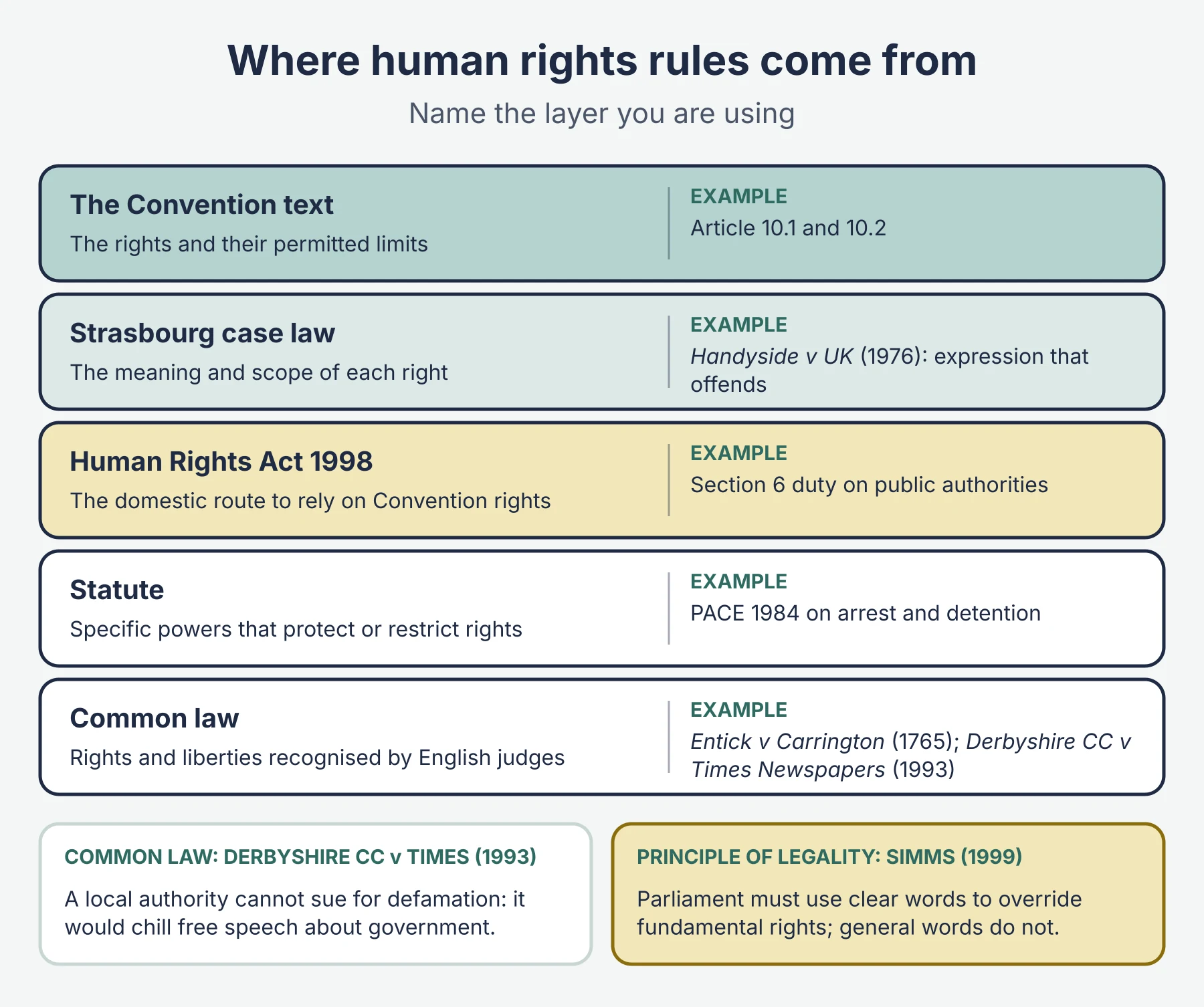
Human rights rules in the United Kingdom come from several layers, and a good answer shows which layer it is using.
| Source | What it supplies | Example |
|---|---|---|
| The Convention text | The rights and their permitted limits | Article 10.1 and 10.2 |
| Strasbourg case law | The meaning and scope of each right | Handyside v UK (1976) on expression that offends |
| Human Rights Act 1998 | The domestic route to rely on Convention rights | Section 6 duty on public authorities |
| Statute | Specific powers that protect or restrict rights | Police and Criminal Evidence Act 1984 on arrest and detention |
| Common law | Rights and liberties recognised by English judges | Entick v Carrington (1765); Derbyshire CC v Times Newspapers (1993) |
The common law layer still matters. In Derbyshire County Council v Times Newspapers (1993) the House of Lords held that a local authority cannot sue for defamation, because that would chill free speech about government. In R v Secretary of State for the Home Department, ex parte Simms (1999) Lord Hoffmann described the principle of legality: Parliament can legislate against fundamental rights, but must do so with clear words, so general words in a statute are read as not overriding them.
The five rights at a glance
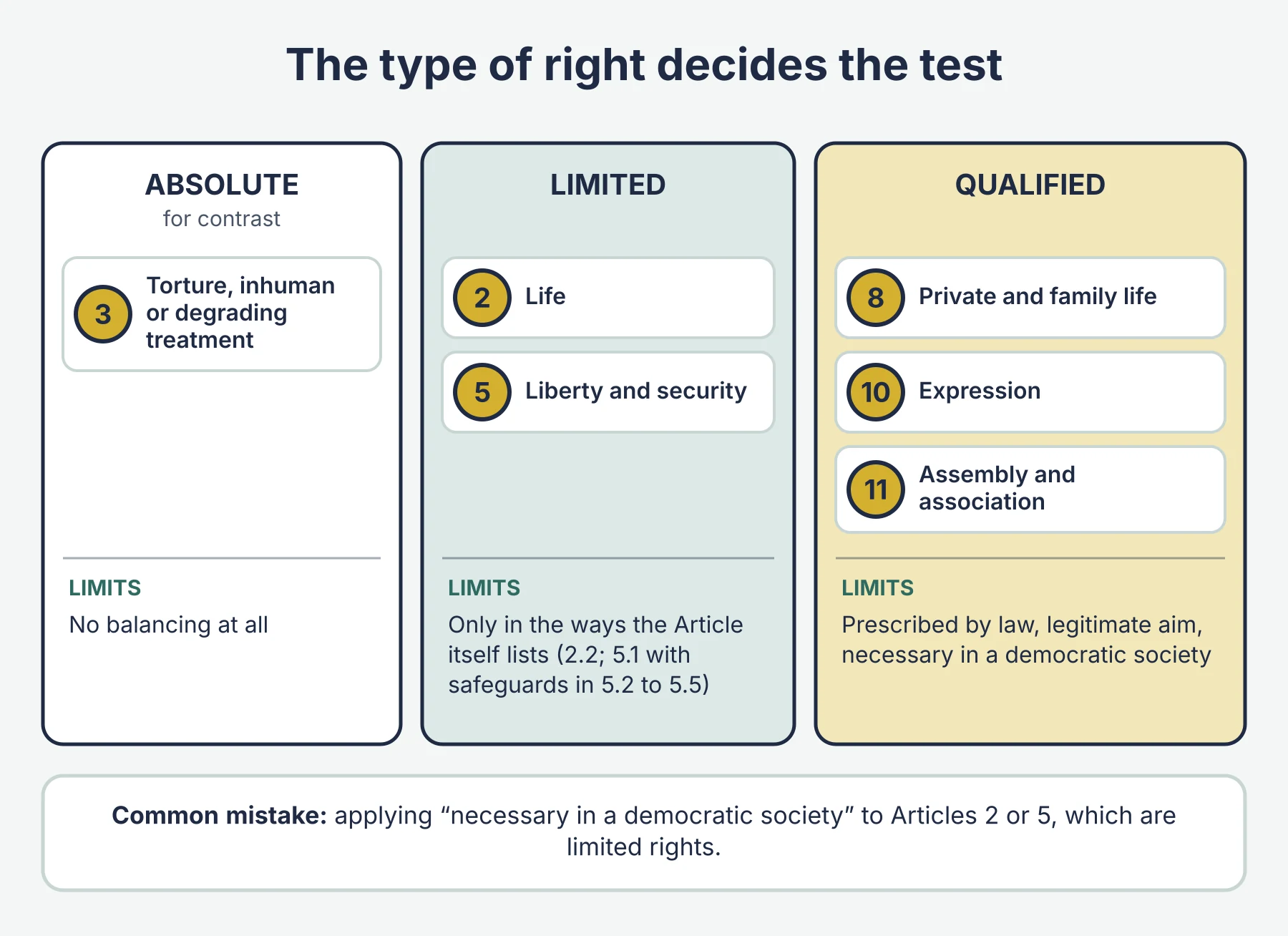
| Right | Article | Type | How it can be limited |
|---|---|---|---|
| Life | 2 | Limited | Only in the situations listed in Article 2.2, using force “no more than absolutely necessary” |
| Liberty and security | 5 | Limited | Only on the grounds listed in Article 5.1, with the safeguards in 5.2 to 5.5 |
| Private and family life | 8 | Qualified | Under Article 8.2 |
| Expression | 10 | Qualified | Under Article 10.2 |
| Assembly and association | 11 | Qualified | Under Article 11.2 |
The type decides the test. Limited rights can be restricted only in the ways the Article itself lists. Qualified rights can be restricted where the interference is prescribed by law (or “in accordance with the law” in Article 8), pursues a legitimate aim listed in the second paragraph, and is necessary in a democratic society, meaning proportionate to a pressing social need. The detailed tests are in the Restrictions study guide. For contrast, absolute rights such as Article 3 (torture, inhuman or degrading treatment) allow no balancing at all.
Principles that apply to every right
Negative and positive obligations
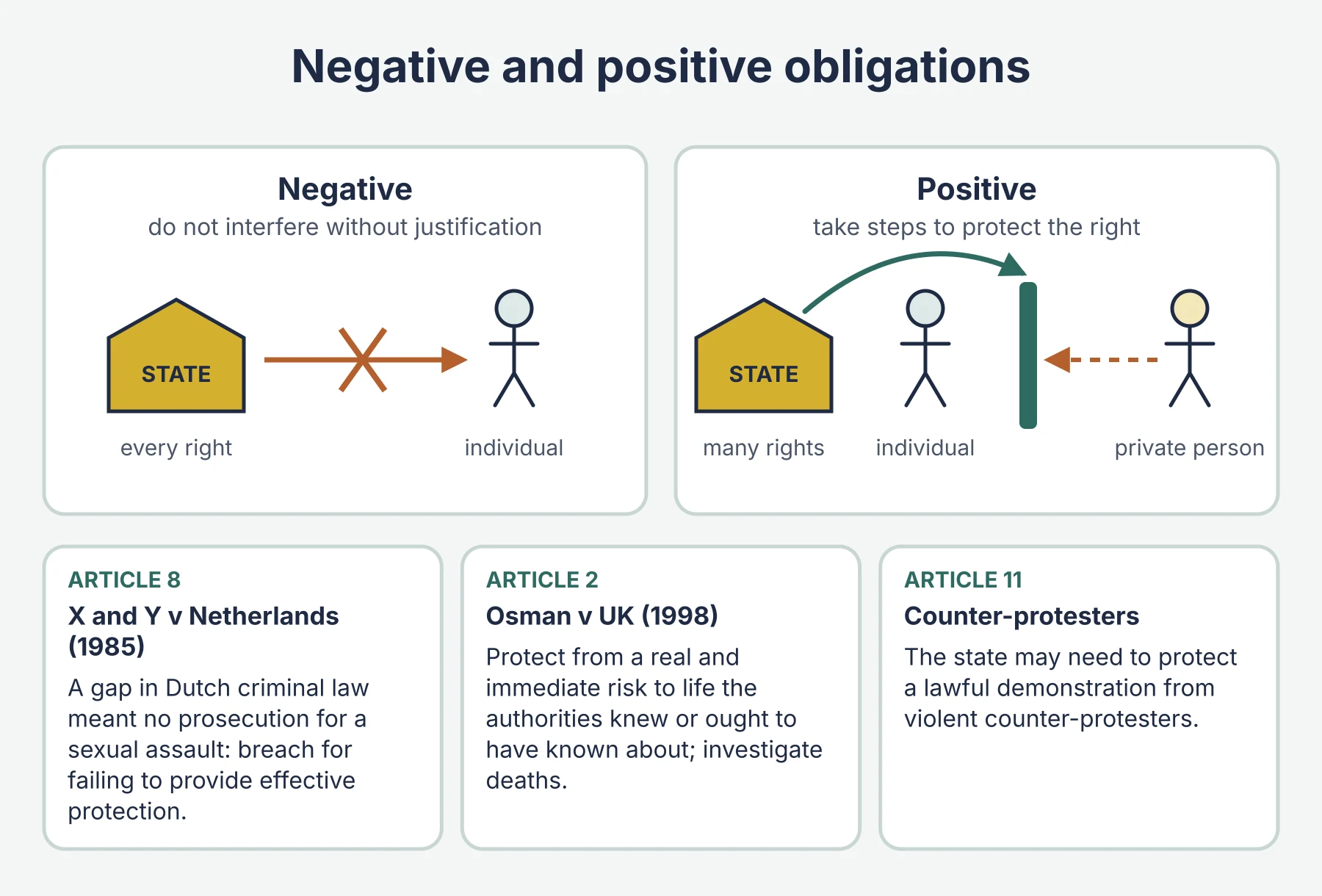
Every Convention right imposes a negative obligation: the state must not interfere without justification. Many also impose positive obligations: the state must take steps to protect the right, including against private individuals.
- In X and Y v Netherlands (1985) a gap in Dutch criminal law meant no prosecution could be brought for a sexual assault on a young woman with a learning disability. The state breached Article 8 by failing to provide effective criminal law protection.
- Under Article 2, the state must protect a person from a real and immediate risk to life that the authorities knew or ought to have known about (Osman v UK, 1998), and must investigate deaths.
- Under Article 11, the state may need to protect a lawful demonstration from violent counter-protesters.
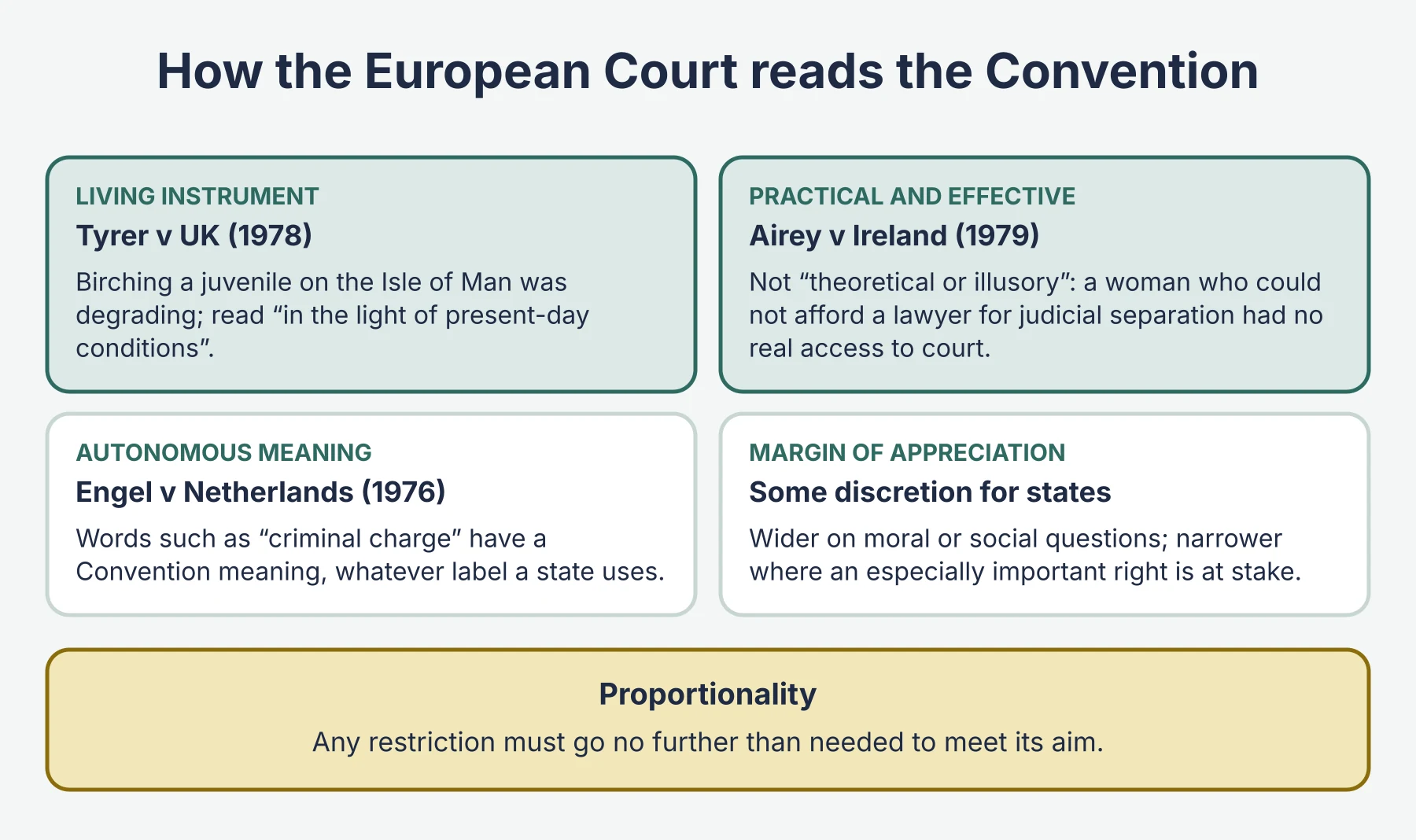
Interpretation principles used by the European Court
- Living instrument. In Tyrer v UK (1978) the Court held that birching of a juvenile on the Isle of Man was degrading treatment, and said the Convention must be interpreted “in the light of present-day conditions”.
- Practical and effective. In Airey v Ireland (1979) the Court said the Convention protects rights that are “practical and effective”, not “theoretical or illusory”; a woman who could not afford a lawyer to seek a judicial separation had no real access to court.
- Autonomous meaning. Key words, such as “criminal charge”, have a Convention meaning that does not depend on how a state labels them (Engel v Netherlands, 1976).
- Margin of appreciation. States have some discretion in deciding what is necessary, wider on moral or social questions and narrower where an especially important right is at stake.
- Proportionality. Any restriction must go no further than needed to meet its aim.
Vertical and horizontal effect
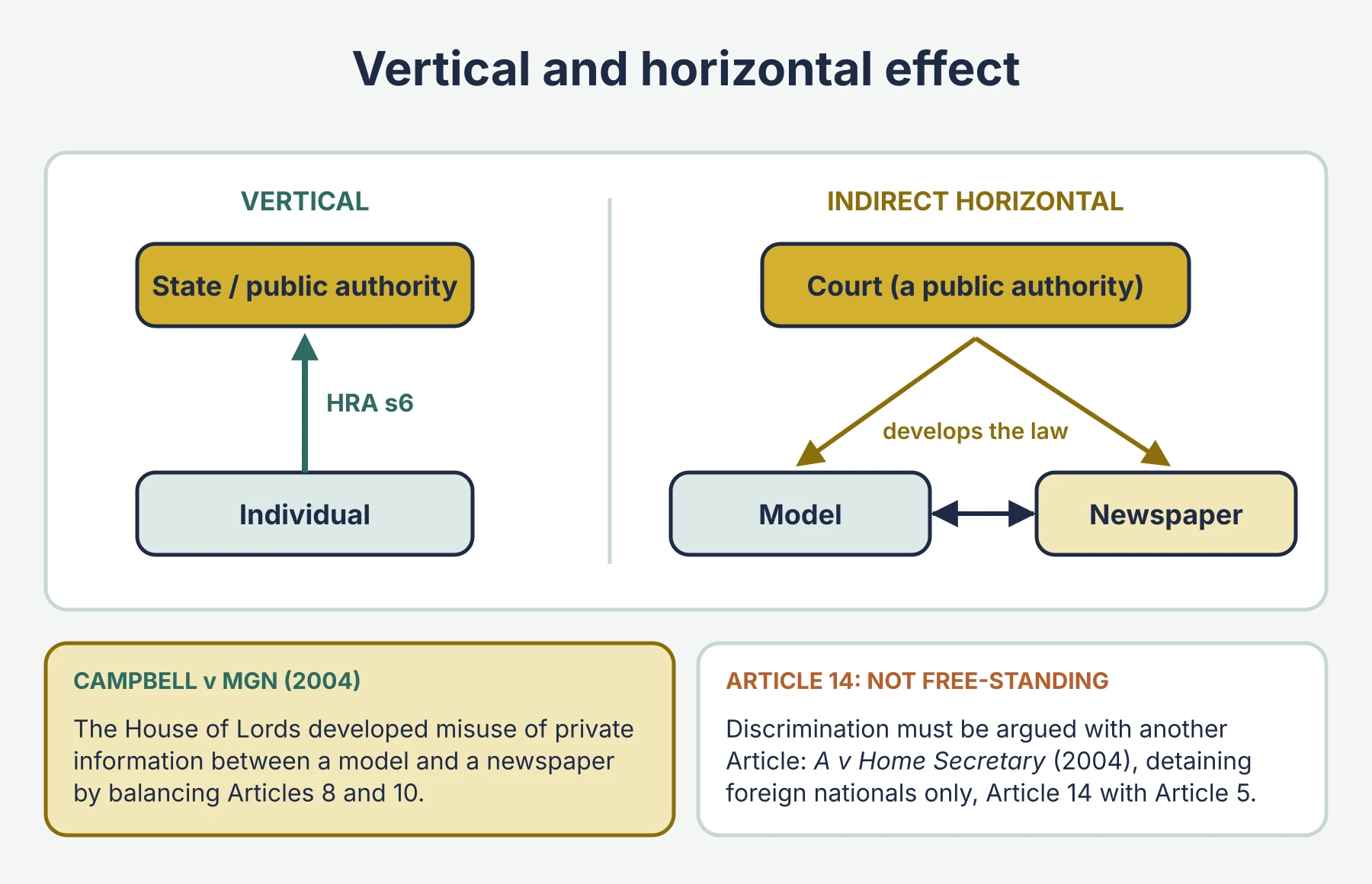
Convention rights are primarily vertical: they bind the state and public authorities (Human Rights Act 1998, section 6). They have an indirect horizontal effect because courts are themselves public authorities and must develop the law compatibly with Convention rights. In Campbell v MGN (2004) the House of Lords developed the tort of misuse of private information between a model and a newspaper by balancing Articles 8 and 10.
Discrimination
Article 14 prohibits discrimination in the enjoyment of the Convention rights. It is not free-standing: it must be argued alongside another Article. In A v Secretary of State for the Home Department (2004) detention of foreign nationals only was discriminatory under Article 14 taken with Article 5.
A method for any human rights problem
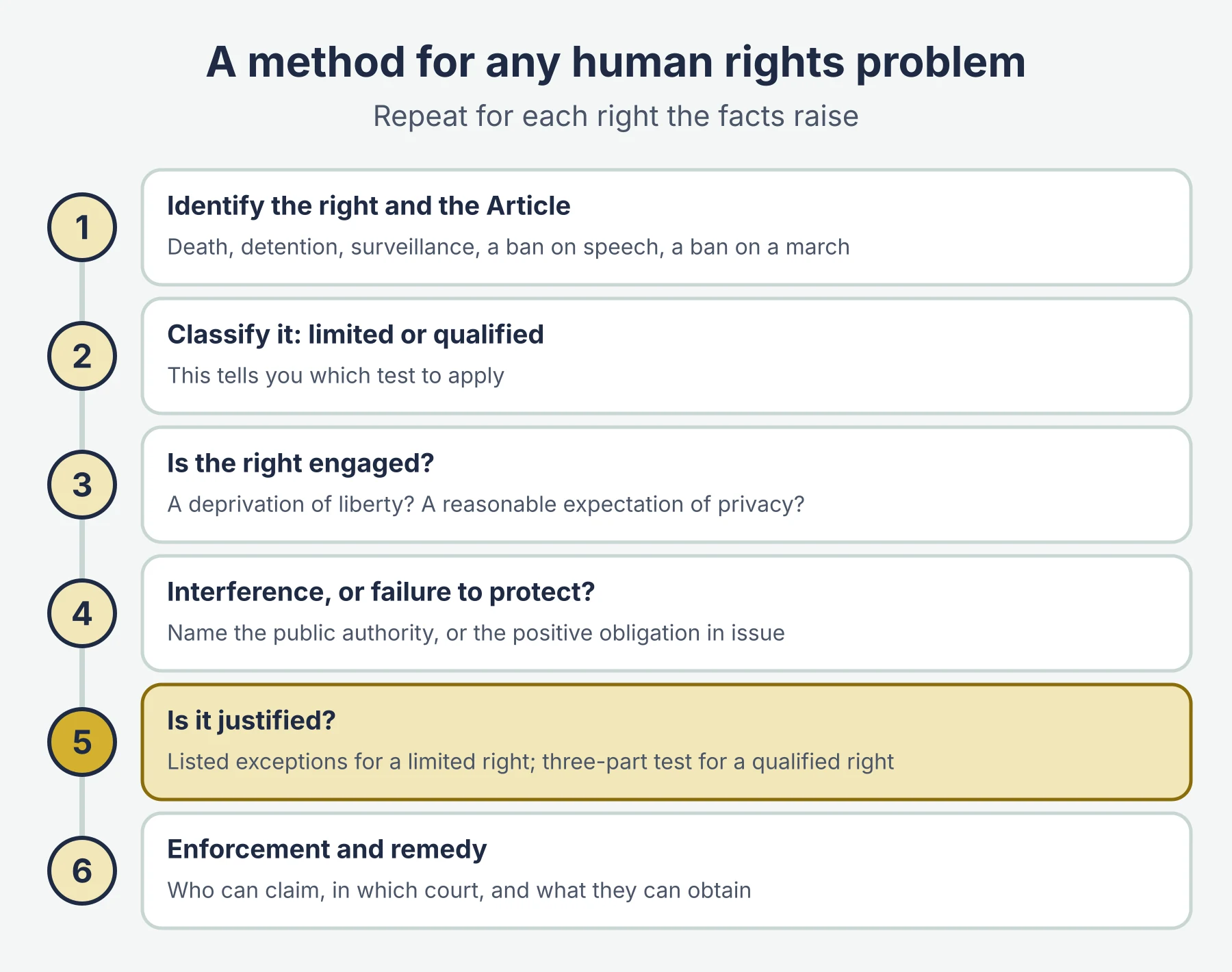
Paper 3 scenarios often raise several rights at once. The same sequence works for each.
- Identify the right and the Article, using the facts (death, detention, surveillance, a ban on speech, a ban on a march).
- Classify it: limited or qualified. This tells you which test to apply.
- Is the right engaged? For example, is there a deprivation of liberty, or a reasonable expectation of privacy?
- Is there an interference, or a failure to protect? Name the public authority responsible, or the positive obligation in issue.
- Is it justified? Apply the listed exceptions for a limited right, or the three-part test for a qualified right.
- Enforcement and remedy: who can claim, in which court, and what they can obtain.
Worked example
Facts: After a series of violent protests, police in a city intercept the phone calls of Sam, an organiser of a peaceful anti-war group, under a general power in a local by-law. They then ban his group’s planned march and arrest him when he speaks at a rally, holding him for 40 hours before he sees a judge.
Rights:        Art 8 (correspondence – phone calls), Art 11 (assembly),
               Art 10 (expression), Art 5 (liberty).
Types:         Arts 8, 10, 11 qualified; Art 5 limited.
Art 8:         Interception is an interference. A vague local power may not
               be "in accordance with the law", which requires accessible
               and foreseeable rules; if not, the analysis stops there.
Arts 10/11:    Legitimate aim – preventing disorder. Necessity – a total ban
               on a peaceful group needs strong evidence; conditions on
               route or time are less restrictive (proportionality).
Art 5:         Arrest needs a 5.1(c) ground (reasonable suspicion) and
               prompt appearance before a judge (5.3).
Remedy:        Police are a public authority (HRA s6); Sam is a victim (s7);
               damages or a declaration (s8).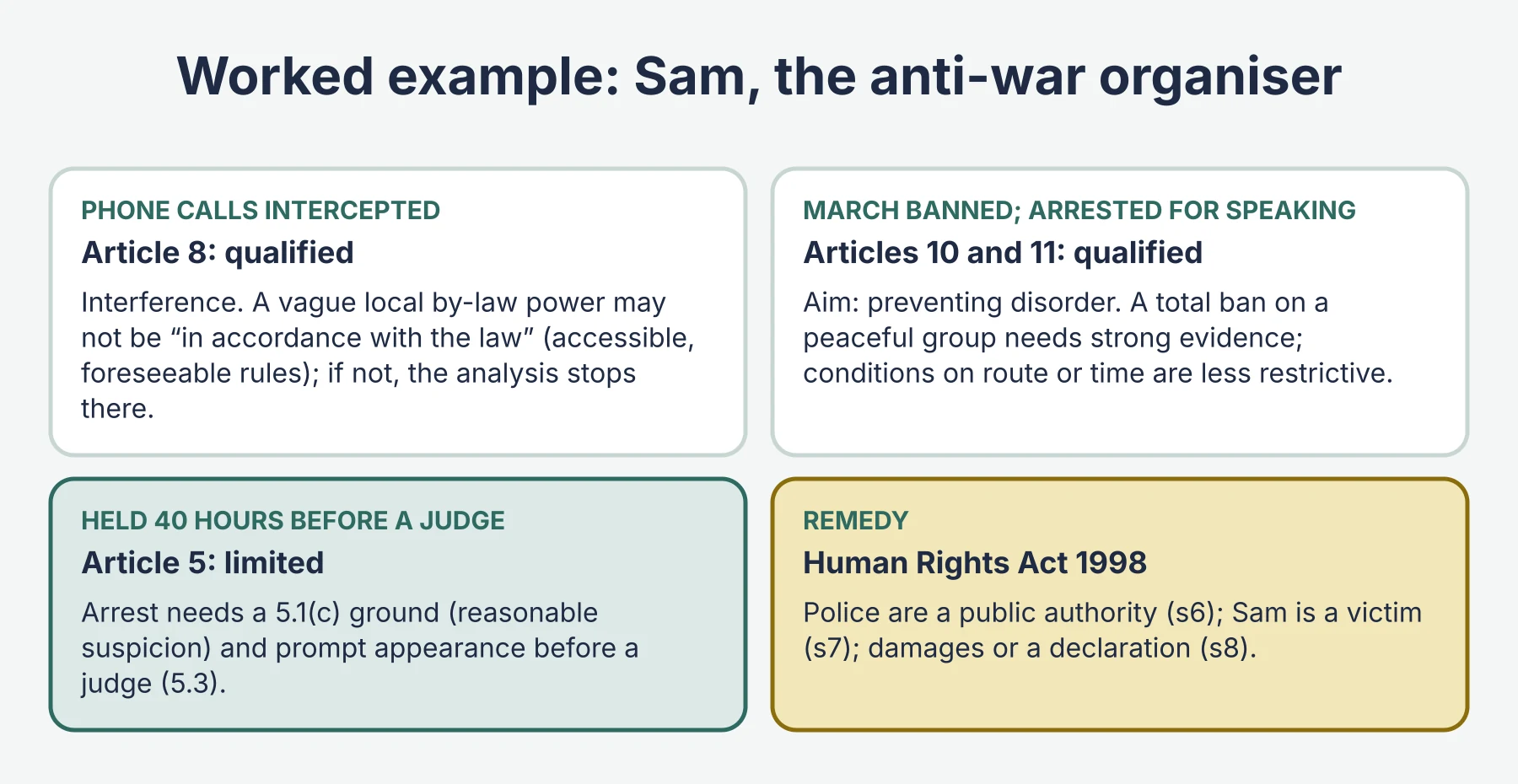
Common mistakes
- Applying “necessary in a democratic society” to Articles 2 or 5, which are limited rights.
- Ignoring positive obligations when the harm is caused by a private person.
- Treating Article 14 as a free-standing right.
- Forgetting common law rights, which may give a domestic answer without the Convention.
- Stopping once a right is engaged, without testing justification.
Exam technique
- Explain questions: describe one principle, such as positive obligations or the living instrument approach, with a case.
- Suggest and Advise questions: use the six-step method for each right in turn and conclude.
- Consider questions: argue whether a right is engaged or an interference justified, both ways.
- Discuss questions: evaluate how well the rules protect rights, for example whether the margin of appreciation gives states too much room.
More resources on this topic
Rules in Human Rights law revision notes | Rules in Human Rights law practice questions | Theory in Human Rights study guide
Related resources
-
Practice questions
AQA A Level Law (7162): Rules in Human Rights law – Practice Questions
Original practice on the general rules of human rights law for AQA A Level Law 7162, with mark-scheme answers on types of right and positive duties.
Law · AQA · A Level
Try questions -
Revision notes
AQA A Level Law (7162): Rules in Human Rights law – Revision Notes
Condensed recall on the general rules of human rights law for AQA A Level Law 7162: sources, types of right, positive duties, interpretation, horizontal effect.
Law · AQA · A Level
Revise topic -
Study guides
AQA A Level Law (7162): The European Convention on Human Rights 1953
The ECHR as a treaty for AQA A Level Law 7162: its structure, Article 1 jurisdiction, types of right, Articles 14, 15, 17 and 18, the protocols and the Court.
Law · AQA · A Level
Read guide
Get free revision emails (optional)
Occasional emails with practice questions, worked explanations and links to free resources for the qualification and subjects you choose. No spam, and you can unsubscribe from any email. The free tools on this site never need an email.