
Study Guides
AQA A Level Law (7162): The European Convention on Human Rights 1953
The ECHR as a treaty for AQA A Level Law 7162: its structure, Article 1 jurisdiction, types of right, Articles 14, 15, 17 and 18, the protocols and the Court.
- Subject
- Law
- Level
- A LEVELS
- Topic
- Topic 5: Human Rights
- Author
- Marlbridge Academic Team
- Updated
- Reviewed by
- Aizaz Raoof Ali (what this means)
Aligned to AQA A Level Law (7162), For teaching from September 2017 onwards, A-level exams 2019 onwards. Official specification .
Syllabus page (what it covers and how it is assessed): AQA A Level Law.
Syllabus points this page covers
7162
- The European Convention on Human Rights 1953
Found an error? Report a correction.
Need help with this topic? Request a free trial class for A Level Law (7162).
This guide covers The European Convention on Human Rights 1953 in section 3.5 Human Rights of AQA A-level Law (7162). In the specification this heading introduces the rows on Articles 2, 5, 8, 10 and 11. This page explains the Convention as a whole: how it is organised, whom it binds, how its rights are classified, the general Articles that apply to every right, the protocols and the Court. For the whole option in outline, start with the Human Rights study guide.
The Convention as a treaty
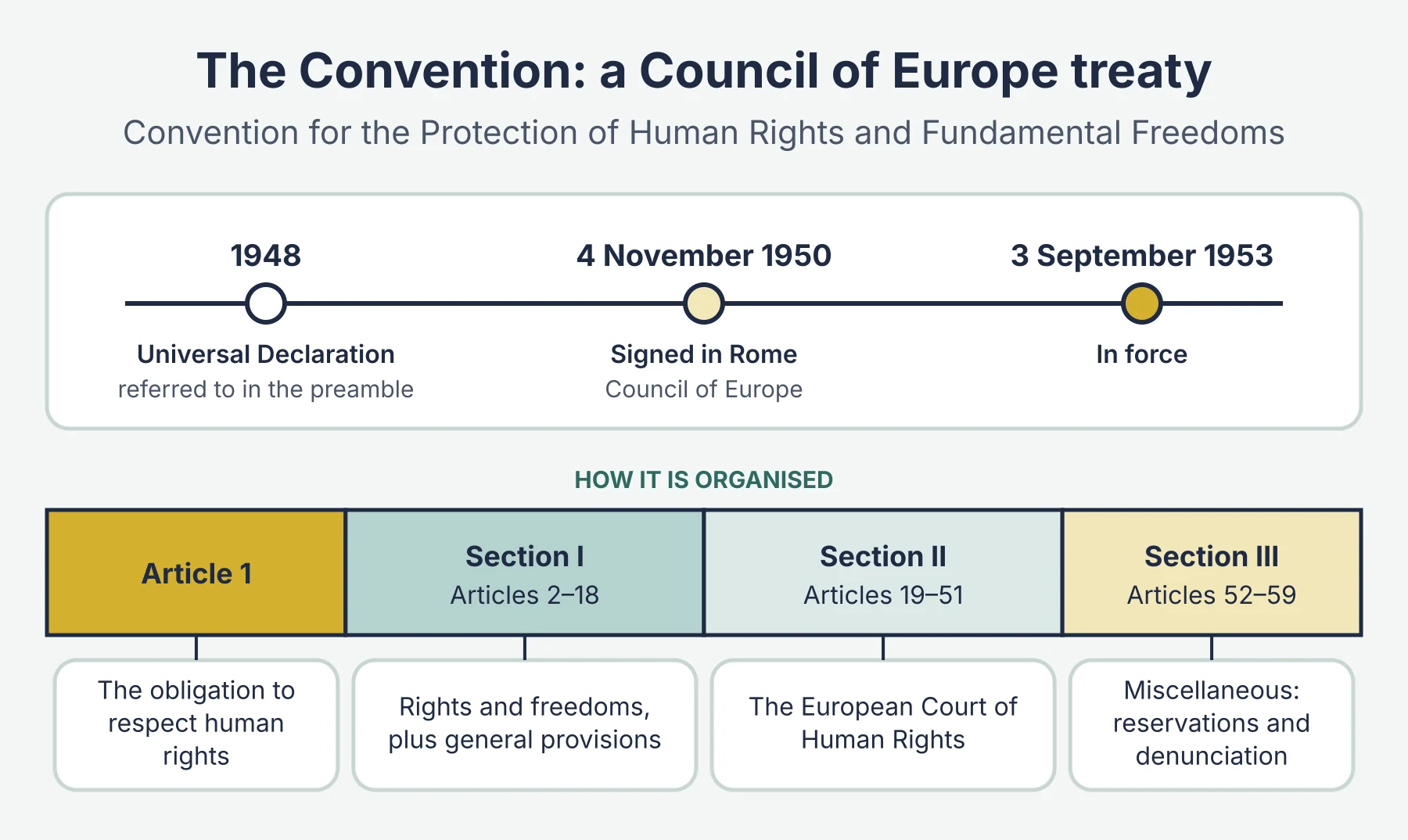
The Convention is a treaty of the Council of Europe, signed in Rome on 4 November 1950 and in force from 3 September 1953. Its formal title is the Convention for the Protection of Human Rights and Fundamental Freedoms. The preamble refers to the Universal Declaration of Human Rights 1948 and to the “common heritage of political traditions, ideals, freedom and the rule of law” of European states.
It is organised in three sections.
| Part | Articles | Content |
|---|---|---|
| Article 1 | 1 | The obligation to respect human rights |
| Section I | 2 to 18 | Rights and freedoms, plus general provisions on discrimination, derogation and abuse |
| Section II | 19 to 51 | The European Court of Human Rights: composition, procedure and judgments |
| Section III | 52 to 59 | Miscellaneous provisions, including reservations and denunciation |
Article 1: whom does the Convention protect?
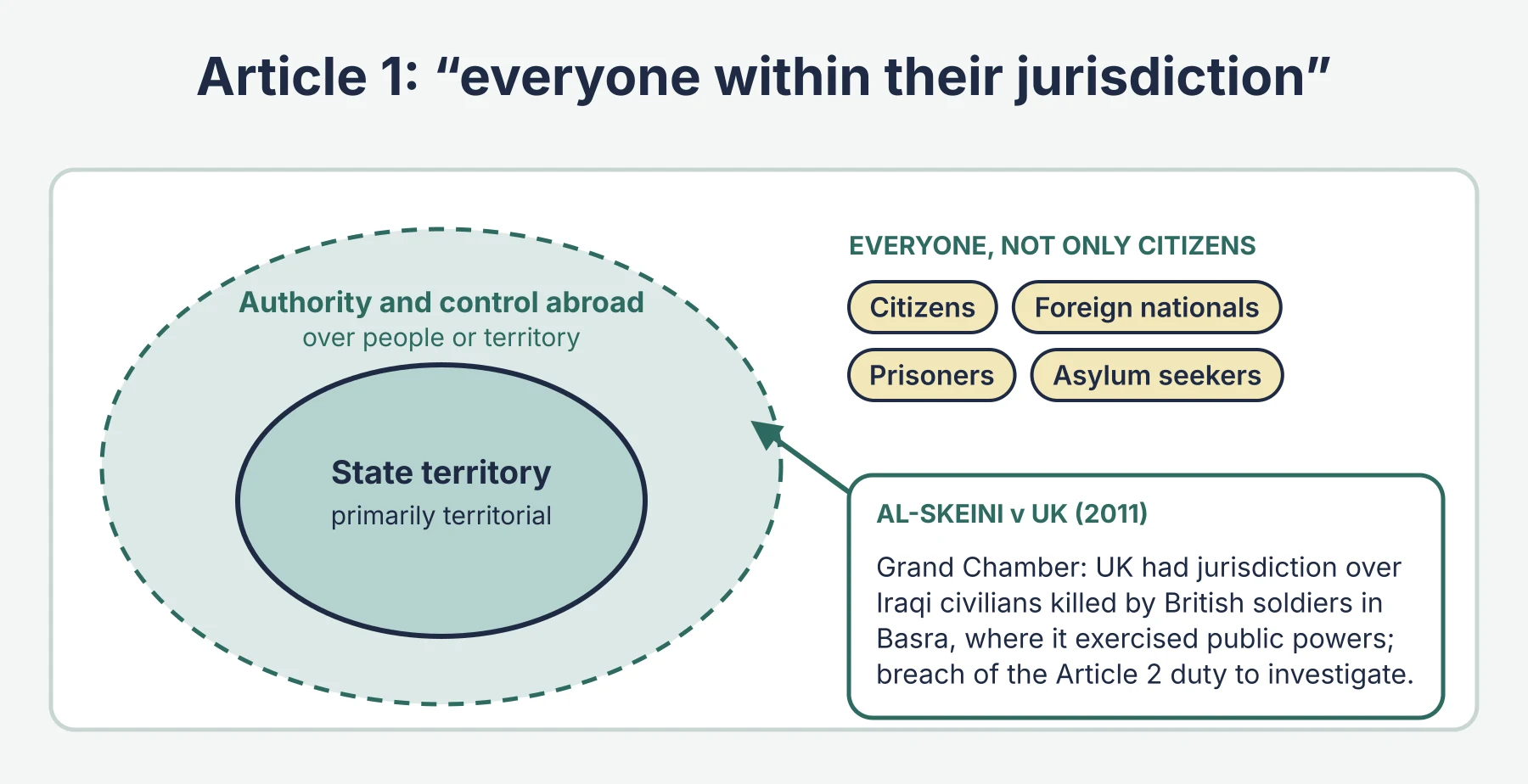
Under Article 1, states “shall secure to everyone within their jurisdiction” the rights in Section I.
- Everyone: not only citizens. Foreign nationals, prisoners and asylum seekers are protected.
- Within their jurisdiction: jurisdiction is primarily territorial, but it can extend abroad where a state exercises authority and control over people or territory. In Al-Skeini v UK (2011) the Grand Chamber held that the UK had jurisdiction over Iraqi civilians killed in security operations by British soldiers in Basra, where the UK exercised public powers, and found a breach of the duty under Article 2 to investigate the deaths.
The rights in Section I
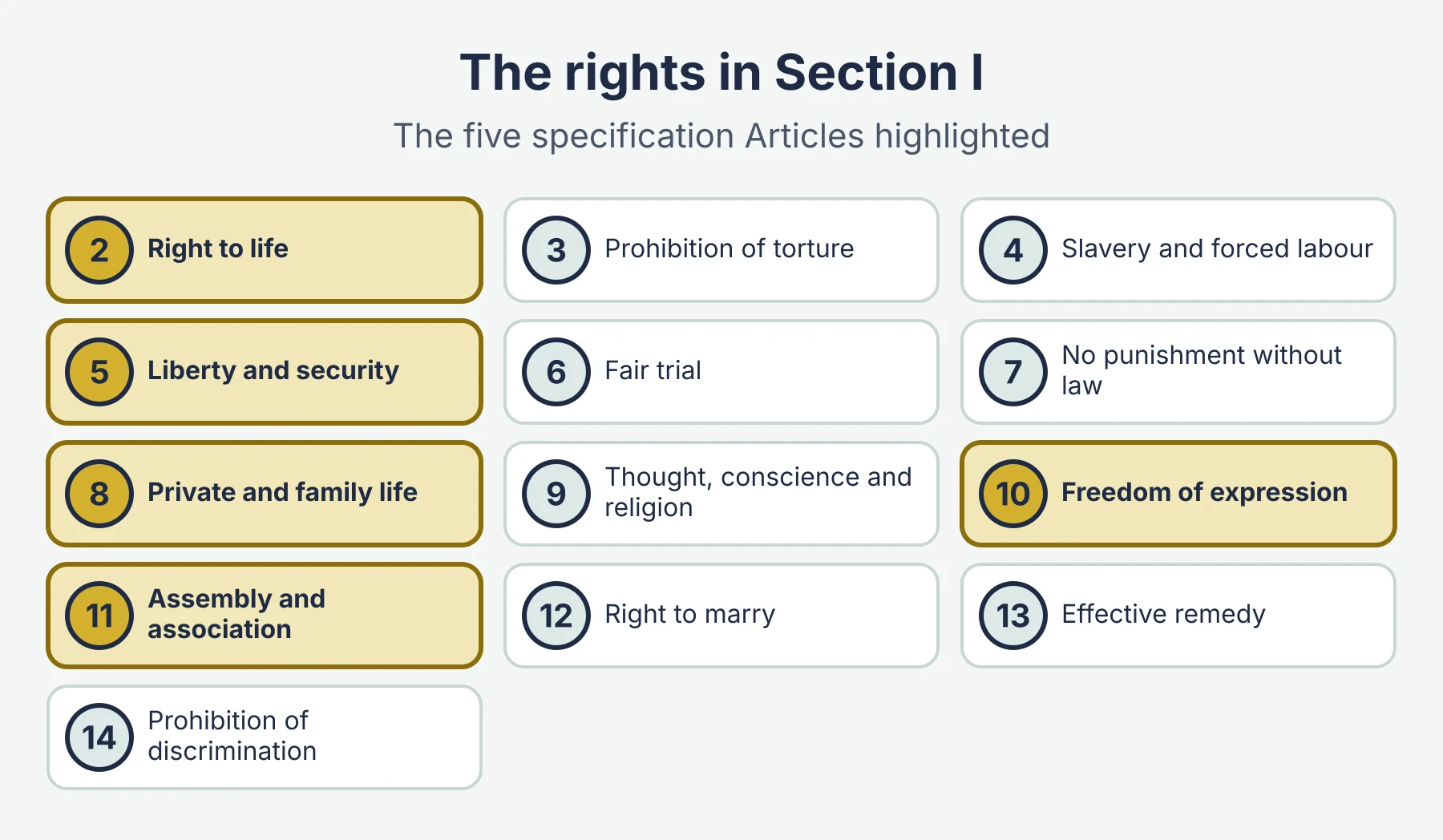
| Article | Right |
|---|---|
| 2 | Right to life |
| 3 | Prohibition of torture and inhuman or degrading treatment or punishment |
| 4 | Prohibition of slavery and forced labour |
| 5 | Right to liberty and security |
| 6 | Right to a fair trial |
| 7 | No punishment without law |
| 8 | Right to respect for private and family life, home and correspondence |
| 9 | Freedom of thought, conscience and religion |
| 10 | Freedom of expression |
| 11 | Freedom of assembly and association |
| 12 | Right to marry |
| 13 | Right to an effective remedy |
| 14 | Prohibition of discrimination |
The specification focuses on Articles 2, 5, 8, 10 and 11. Knowing where they sit among the others helps with classification and with evaluation.
Classification of rights
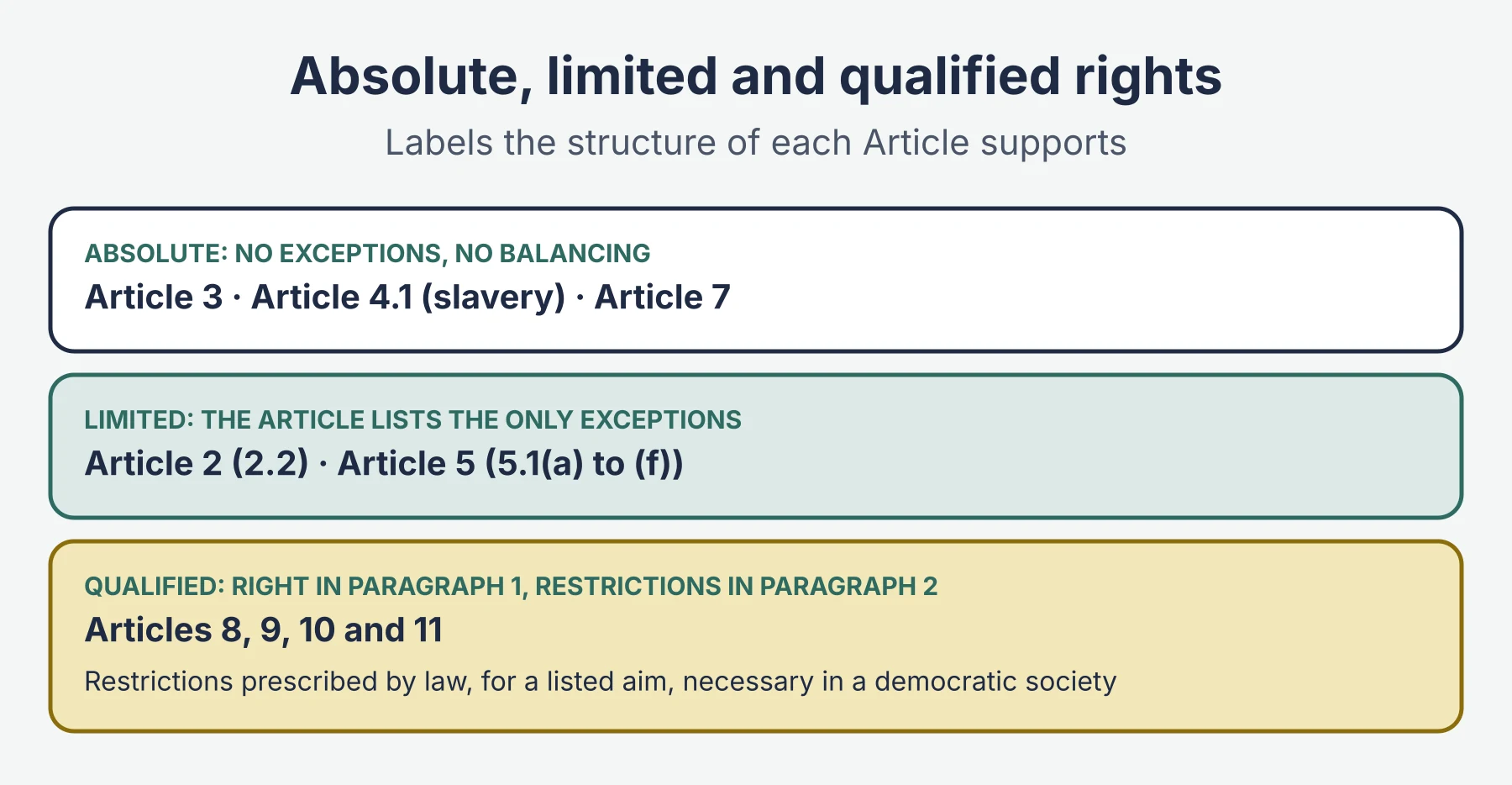
The Convention does not use the labels “absolute”, “limited” and “qualified”, but the structure of each Article supports them.
- Absolute: no exceptions and no balancing. Article 3, Article 4.1 (slavery) and Article 7.
- Limited: the Article itself lists the only exceptions. Article 2 (2.2) and Article 5 (5.1(a) to (f)) are the specification examples.
- Qualified: a first paragraph sets out the right and a second paragraph allows restrictions that are prescribed by law, pursue a listed aim and are necessary in a democratic society. Articles 8, 9, 10 and 11 follow this pattern.
General provisions that affect every right
| Article | Effect |
|---|---|
| 13 | Everyone whose rights are violated must have an effective remedy before a national authority |
| 14 | No discrimination in the enjoyment of the Convention rights on grounds such as sex, race, religion or “other status”; it is not free-standing |
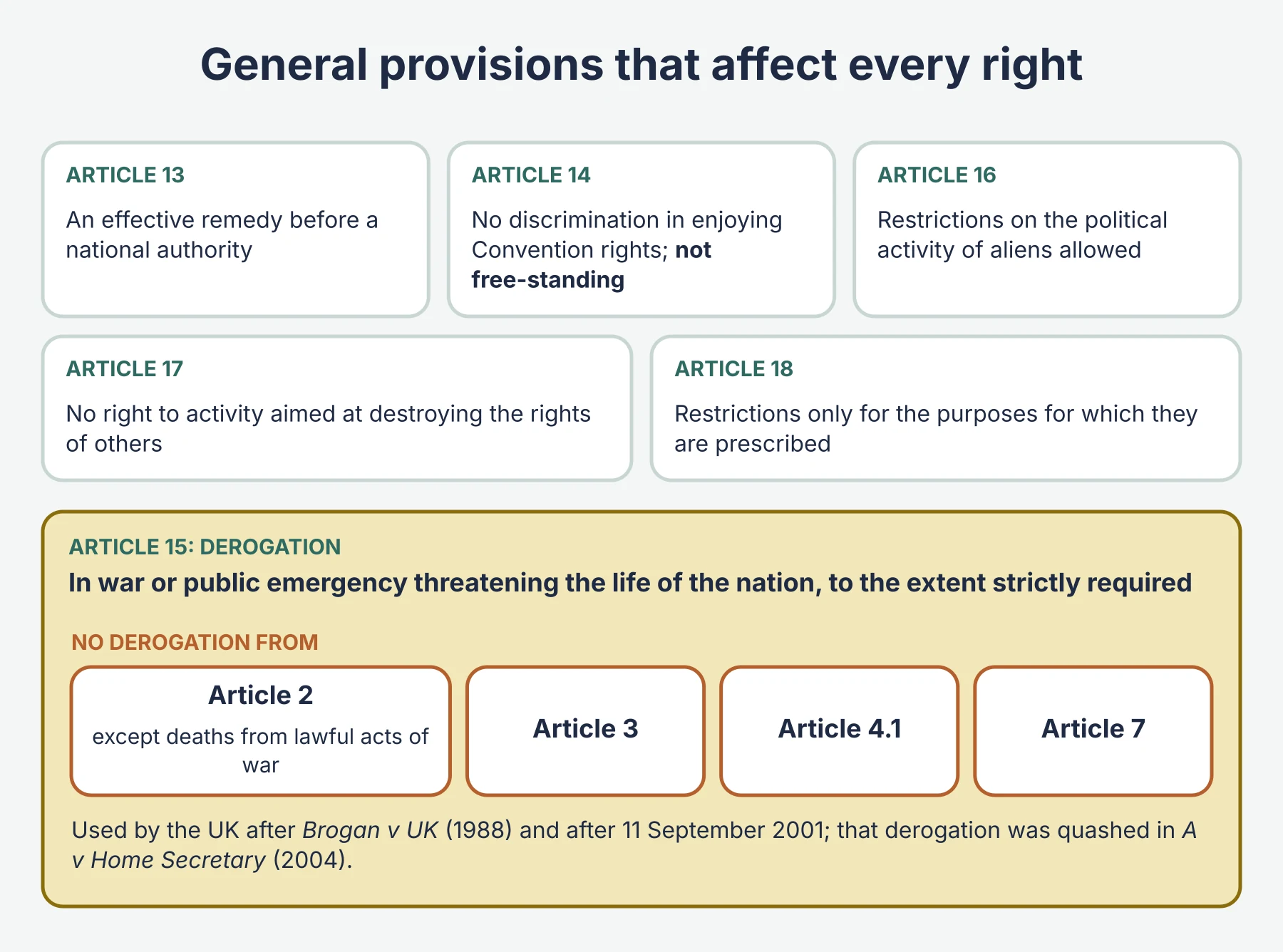
| 15 | In time of war or public emergency threatening the life of the nation, a state may derogate to the extent strictly required. There can be no derogation from Article 2 (except deaths from lawful acts of war), Article 3, Article 4.1 or Article 7 |
| 16 | Restrictions on the political activity of aliens are allowed |
| 17 | Nothing in the Convention gives a right to engage in activity aimed at destroying the rights of others |
| 18 | Restrictions may be applied only for the purposes for which they are prescribed |
Article 17 prevents the Convention being used against itself: for example, a group cannot rely on Article 10 to spread propaganda aimed at destroying the rights of others. Article 15 was relied on by the UK after Brogan v UK (1988) and after the attacks of 11 September 2001, the derogation that the House of Lords quashed in A v Secretary of State for the Home Department (2004).
The protocols
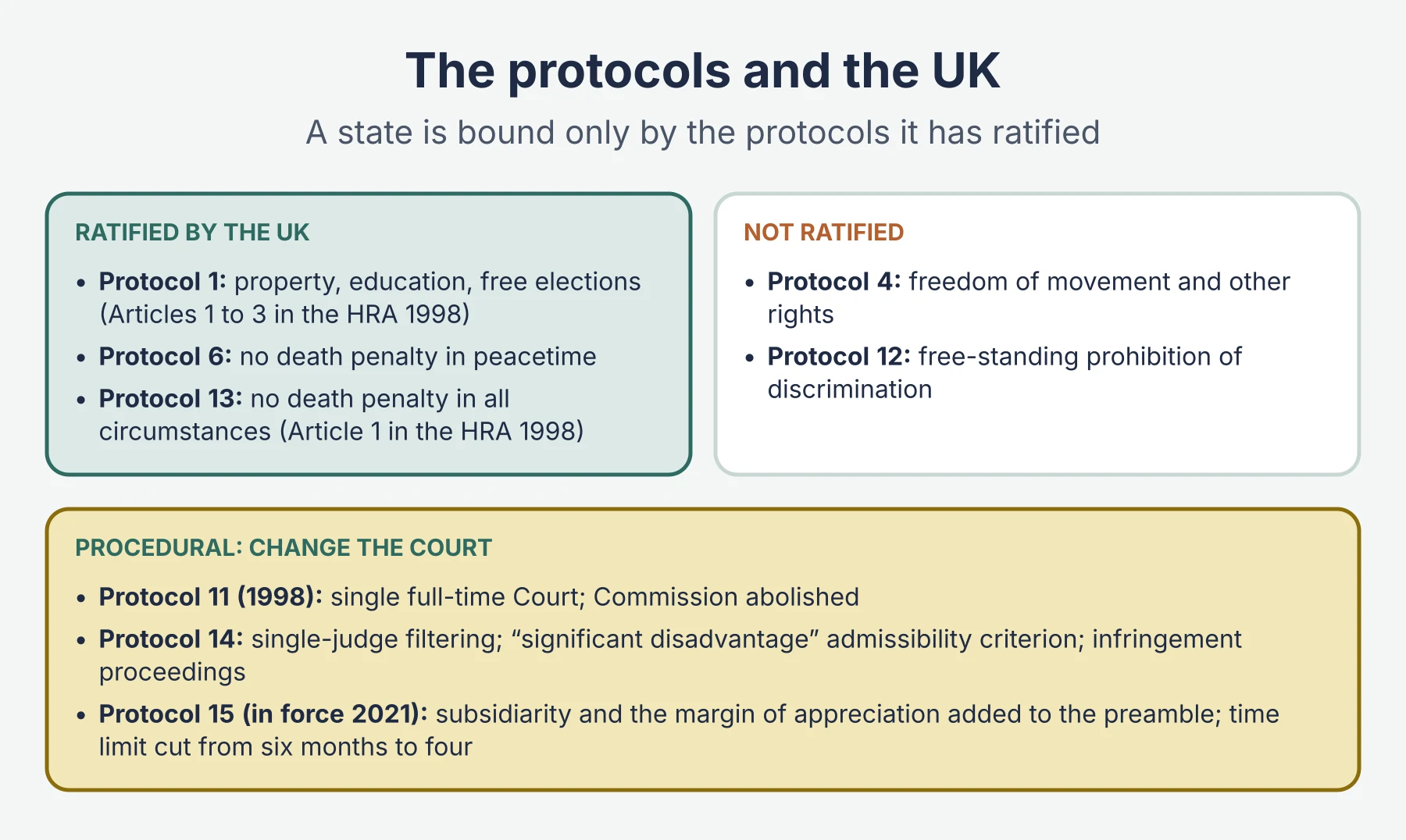
Protocols are additional treaties. Some add rights; others change the Court’s procedure. A state is bound only by the protocols it has ratified.
| Protocol | Content | UK position |
|---|---|---|
| Protocol 1 | Property, education, free elections | Ratified; Articles 1 to 3 in the Human Rights Act 1998 |
| Protocol 4 | Freedom of movement and other rights | Not ratified |
| Protocol 6 | Abolition of the death penalty in peacetime | Ratified |
| Protocol 11 (1998) | Single full-time Court; Commission abolished | Procedural; applies to all states |
| Protocol 12 | Free-standing prohibition of discrimination | Not ratified |
| Protocol 13 | Abolition of the death penalty in all circumstances | Ratified; Article 1 in the Human Rights Act 1998 |
| Protocol 14 | Single-judge filtering, a “significant disadvantage” admissibility criterion, infringement proceedings | Procedural |
| Protocol 15 (in force 2021) | Adds subsidiarity and the margin of appreciation to the preamble; time limit for applications cut from six months to four | Procedural |
The Court
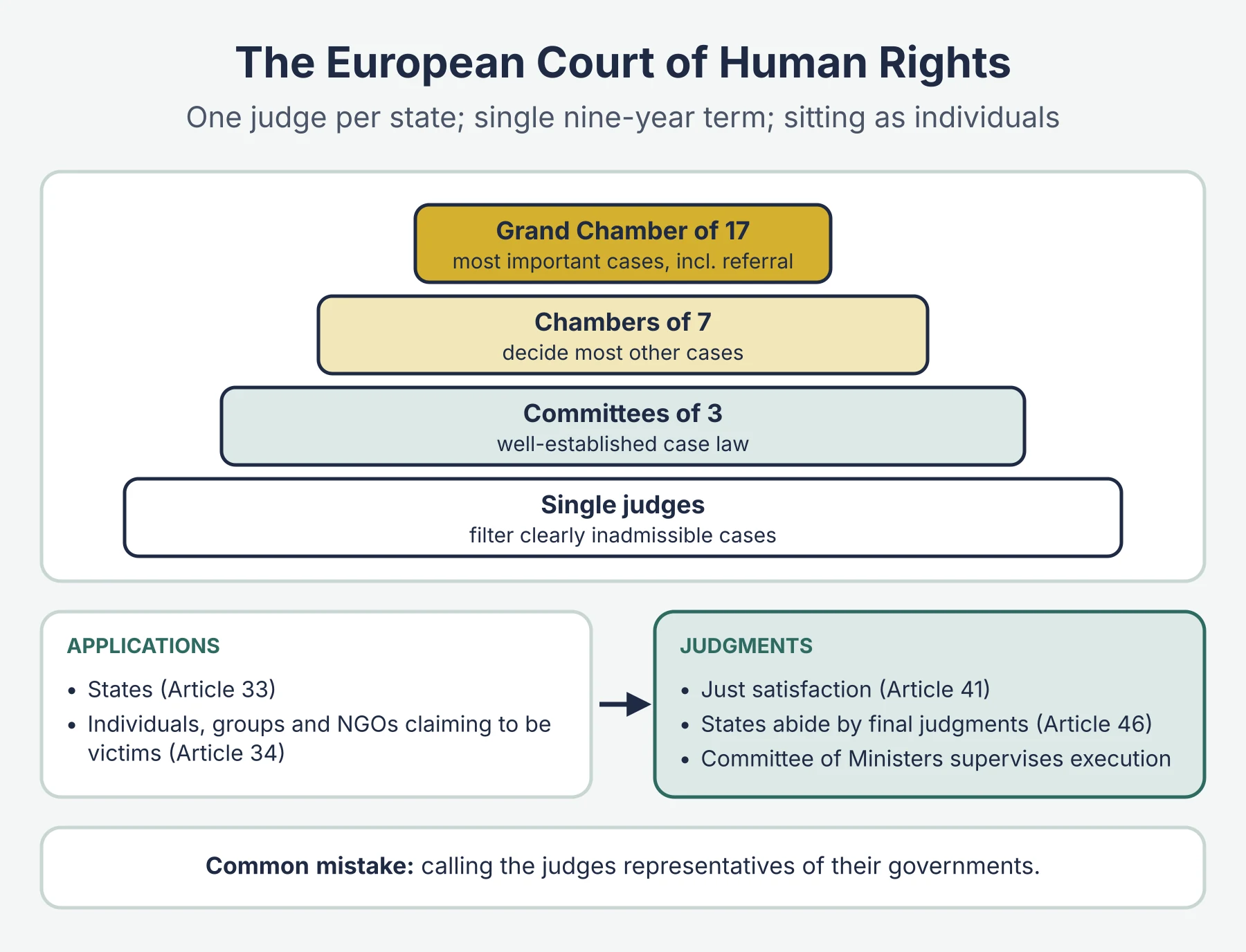
- Judges: one judge for each state party, elected by the Parliamentary Assembly of the Council of Europe for a single nine-year term. Judges sit as individuals, not as representatives of their state.
- Formations: single judges filter clearly inadmissible cases; committees of three decide cases covered by well-established case law; chambers of seven decide most others; a Grand Chamber of 17 hears the most important cases, including on referral from a chamber.
- Applications: from states (Article 33) or from individuals, groups and non-governmental organisations claiming to be victims (Article 34).
- Judgments: the Court may award just satisfaction (Article 41). States undertake to abide by final judgments (Article 46), and the Committee of Ministers supervises execution. Detailed rules on admissibility and execution are in the Enforcement study guide.
How the Convention is interpreted
The Court treats the Convention as a living instrument read in the light of present-day conditions, and requires rights to be practical and effective. It allows states a margin of appreciation, now referred to in the preamble since Protocol 15. These principles are explained in the Rules in Human Rights law study guide.
Annotated plan: “Explain the different types of right protected by the European Convention on Human Rights.”
Point 1   Absolute rights – Article 3: no exceptions, no derogation under
          Article 15; balancing is never allowed.
Point 2   Limited rights – Articles 2 and 5: exceptions listed in the
          Article (2.2; 5.1(a)–(f)), applied strictly ("absolutely
          necessary" for force under Article 2).
Point 3   Qualified rights – Articles 8, 10, 11: second paragraph allows
          restrictions prescribed by law, for a listed aim, necessary in a
          democratic society.
Point 4   General provisions – Article 15 derogation (not for Article 3),
          Article 17 abuse of rights, Article 18 improper purposes.
Common mistakes
- Confusing the Convention with the European Union or its Charter of Fundamental Rights.
- Saying every protocol binds the UK; Protocols 4 and 12 have not been ratified.
- Treating Article 14 as a free-standing right.
- Saying a state can derogate from Article 3 in an emergency.
- Calling the judges representatives of their governments.
Exam technique
- Explain questions: describe the structure, a classification or a general Article, with an example.
- Discuss questions: use the Convention’s design, such as qualified rights and the margin of appreciation, to evaluate how well it balances individual rights and state interests.
- In problem answers, start by naming the Article and its type, then use the right test.
More resources on this topic
European Convention on Human Rights revision notes | European Convention on Human Rights practice questions | Article 2 study guide
Related resources
-
Practice questions
AQA A Level Law (7162): The European Convention on Human Rights 1953 – Practice Questions
Original practice on the ECHR for AQA A Level Law 7162 with mark-scheme answers on structure, types of right, jurisdiction, derogation, protocols and the Court.
Law · AQA · A Level
Try questions -
Revision notes
AQA A Level Law (7162): The European Convention on Human Rights 1953 – Revision Notes
Condensed recall on the ECHR for AQA A Level Law 7162: structure, Article 1, absolute, limited and qualified rights, Articles 13 to 18, protocols and the Court.
Law · AQA · A Level
Revise topic -
Study guides
AQA A Level Law (7162): Theory in Human Rights
Theory in Human Rights for AQA A Level Law 7162: natural and positivist theories, will and interest theories, Hohfeld, liberties and fundamental rights.
Law · AQA · A Level
Read guide
Get free revision emails (optional)
Occasional emails with practice questions, worked explanations and links to free resources for the qualification and subjects you choose. No spam, and you can unsubscribe from any email. The free tools on this site never need an email.