
Revision Notes
AQA A Level Law (7162): The European Convention on Human Rights 1953 – Revision Notes
Condensed recall on the ECHR for AQA A Level Law 7162: structure, Article 1, absolute, limited and qualified rights, Articles 13 to 18, protocols and the Court.
- Subject
- Law
- Level
- A LEVELS
- Topic
- Topic 5: Human Rights
- Author
- Marlbridge Academic Team
- Updated
- Reviewed by
- Aizaz Raoof Ali (what this means)
Aligned to AQA A Level Law (7162), For teaching from September 2017 onwards, A-level exams 2019 onwards. Official specification .
Syllabus page (what it covers and how it is assessed): AQA A Level Law.
Syllabus points this page covers
7162
- The European Convention on Human Rights 1953
Found an error? Report a correction.
Need help with this topic? Request a free trial class for A Level Law (7162).
Condensed notes on the Convention as a treaty. For full explanation and an annotated plan, use the European Convention on Human Rights study guide.
The essentials in one line
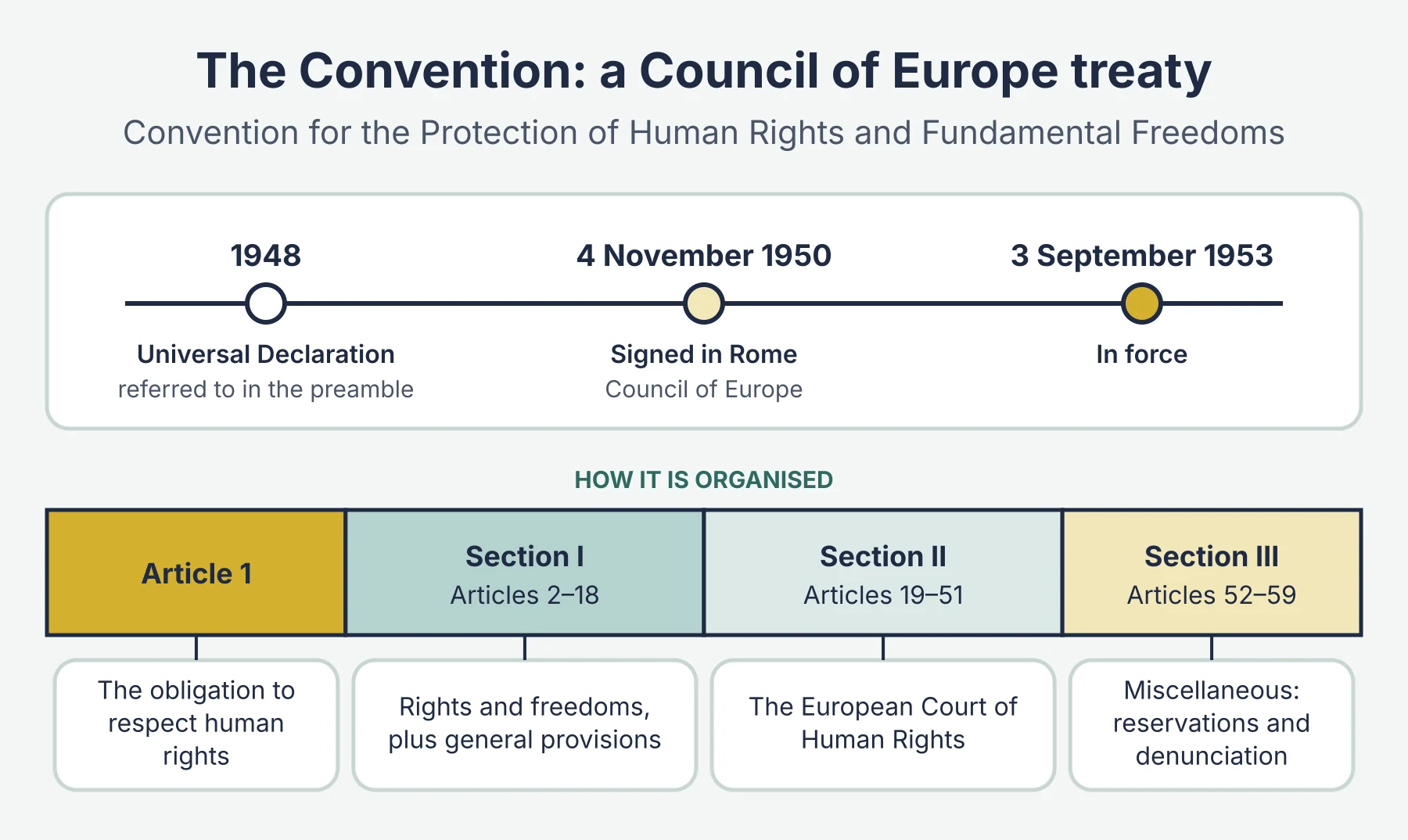
Council of Europe treaty (signed 1950, in force 1953) → Article 1 (everyone within the jurisdiction) → Section I rights (2 to 18) → Section II Court (19 to 51) → protocols add rights and change procedure.
Structure
| Part | Articles | Content |
|---|---|---|
| Article 1 | 1 | Obligation to secure rights |
| Section I | 2 to 18 | Rights and general provisions |
| Section II | 19 to 51 | The Court |
| Section III | 52 to 59 | Miscellaneous, including reservations and denunciation |
Article 1: jurisdiction
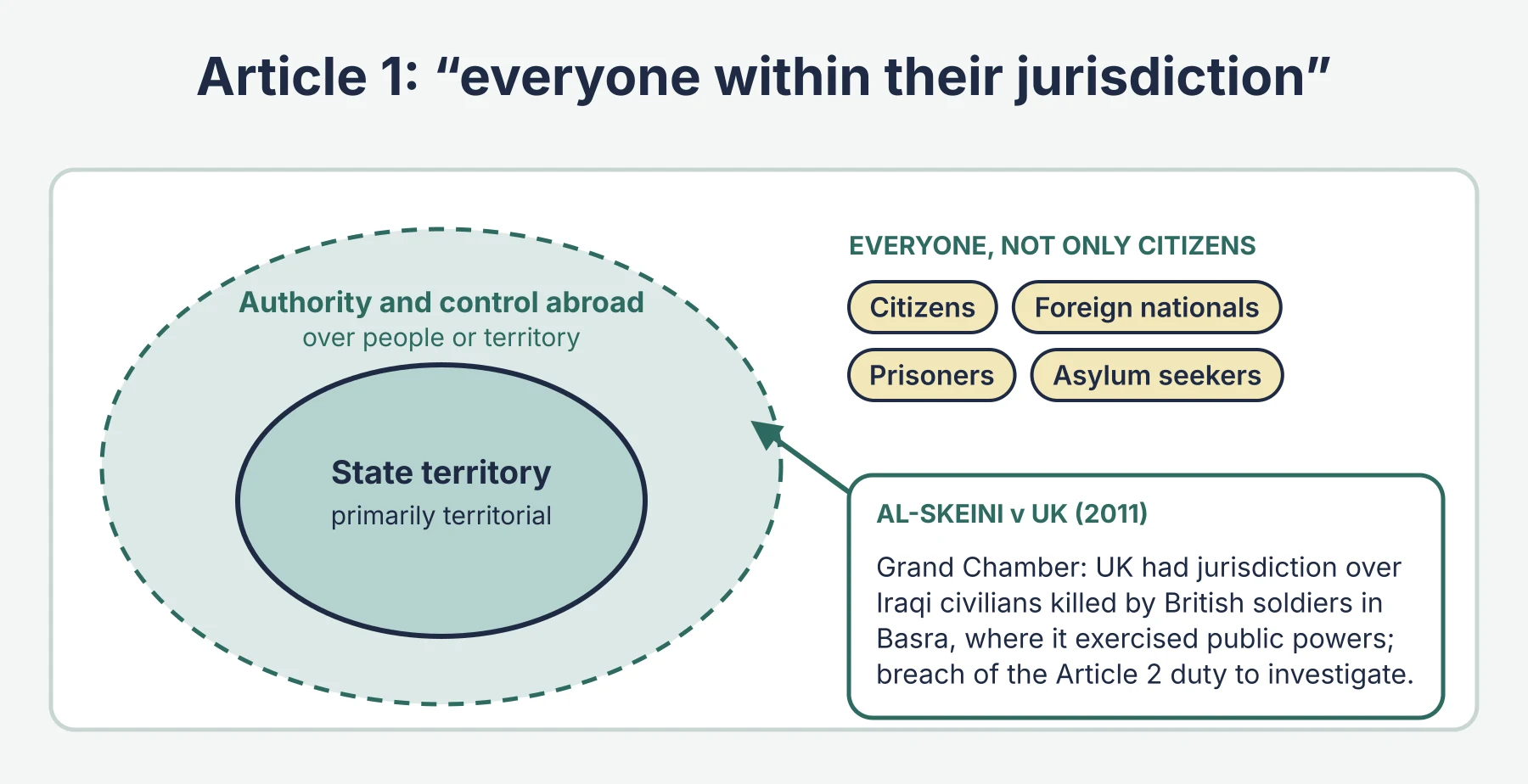
- “Everyone within their jurisdiction”: not limited to citizens.
- Mainly territorial, but extends abroad where the state exercises authority and control.
- Al-Skeini v UK (2011): UK jurisdiction over civilians killed by British soldiers in Basra; breach of the Article 2 duty to investigate.
Section I rights
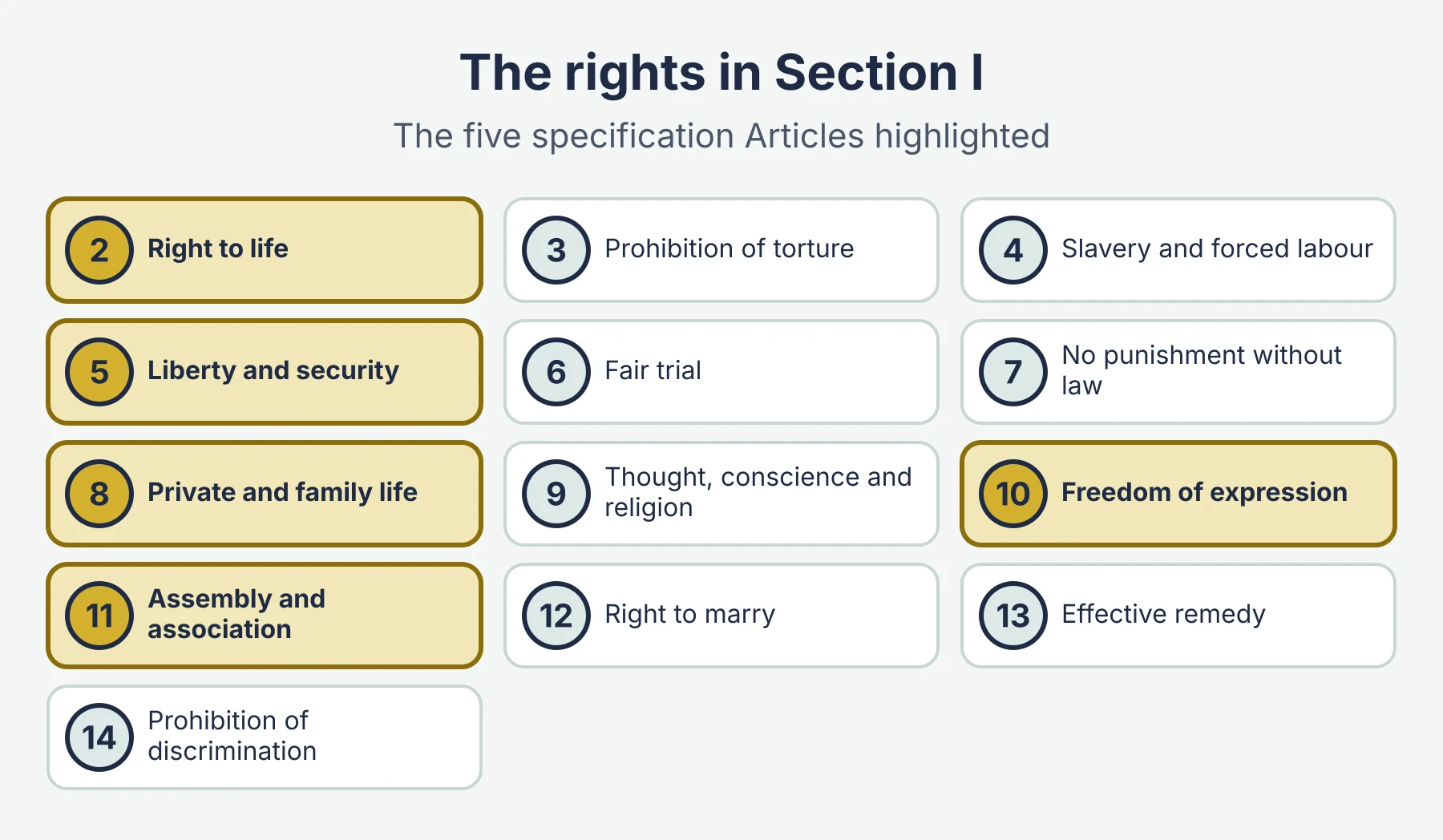
2 life · 3 torture and inhuman or degrading treatment · 4 slavery and forced labour · 5 liberty · 6 fair trial · 7 no punishment without law · 8 private and family life · 9 thought, conscience, religion · 10 expression · 11 assembly and association · 12 marry · 13 effective remedy · 14 discrimination.
Types of right
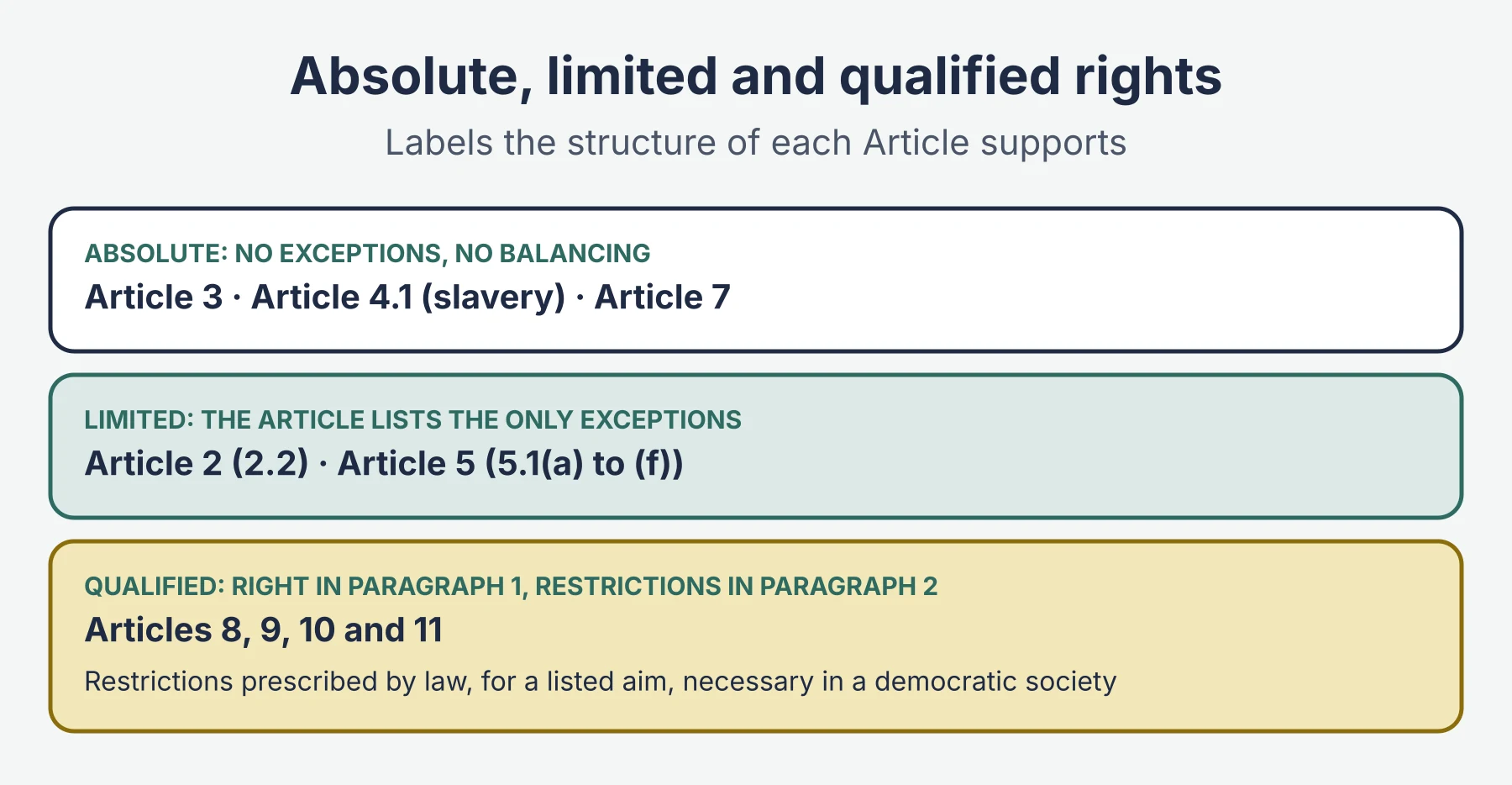
| Type | Meaning | Examples |
|---|---|---|
| Absolute | No exceptions or balancing | Article 3; Article 4.1; Article 7 |
| Limited | Only the exceptions listed in the Article | Article 2 (2.2); Article 5 (5.1(a) to (f)) |
| Qualified | Second paragraph allows restrictions: prescribed by law, listed aim, necessary in a democratic society | Articles 8, 9, 10, 11 |
General provisions
| Article | Rule |
|---|---|
| 13 | Effective national remedy |
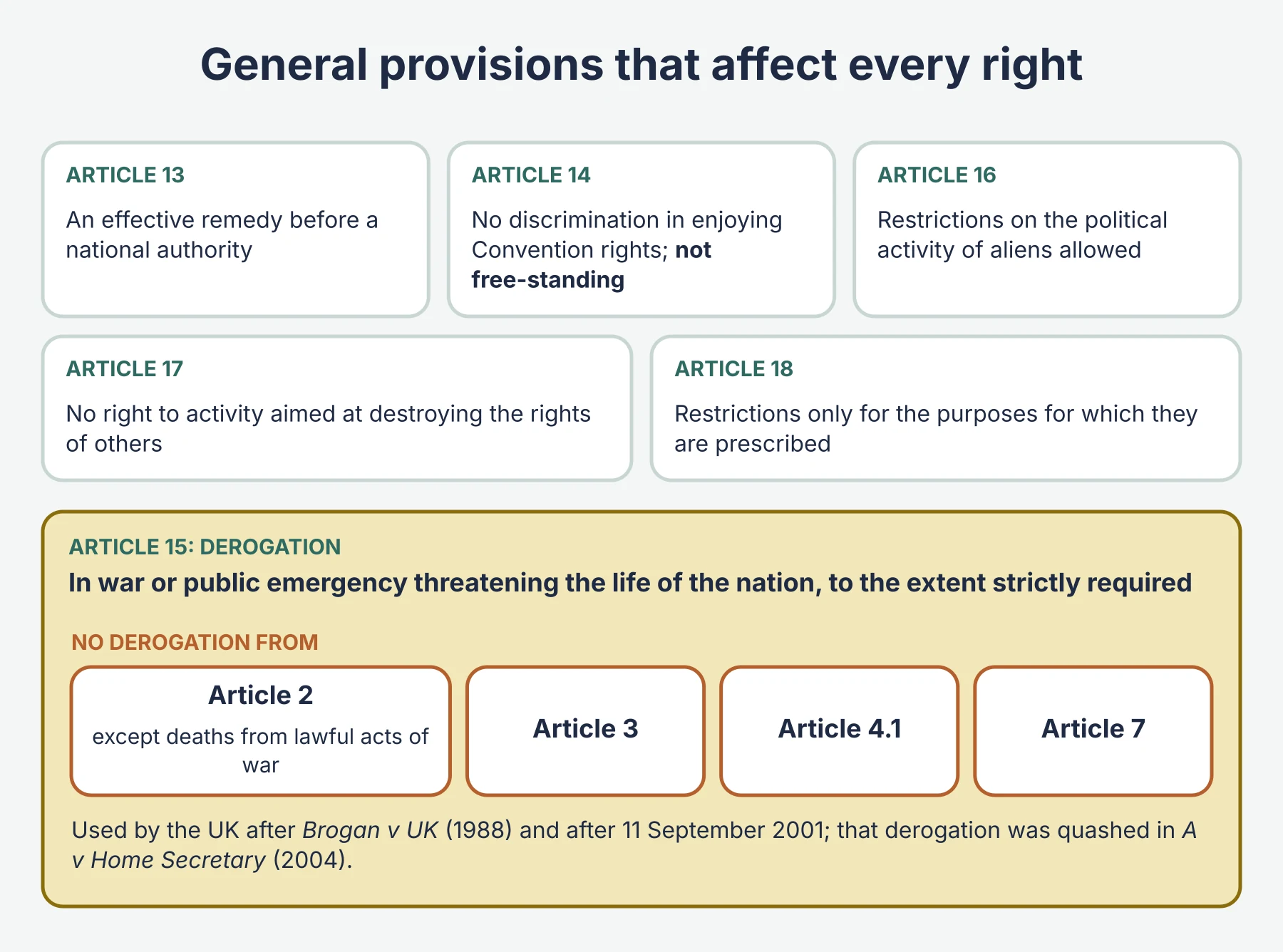
| 14 | No discrimination in enjoying Convention rights; not free-standing |
| 15 | Derogation in war or public emergency threatening the life of the nation, only as strictly required; none from Article 2 (except lawful acts of war), 3, 4.1 or 7 |
| 16 | Restrictions on political activity of aliens |
| 17 | No right to act to destroy others’ rights (abuse of rights) |
| 18 | Restrictions only for their prescribed purposes |
UK derogations: after Brogan v UK (1988); after 11 September 2001, quashed in A v SSHD (2004).
Protocols
| Protocol | Content | UK |
|---|---|---|
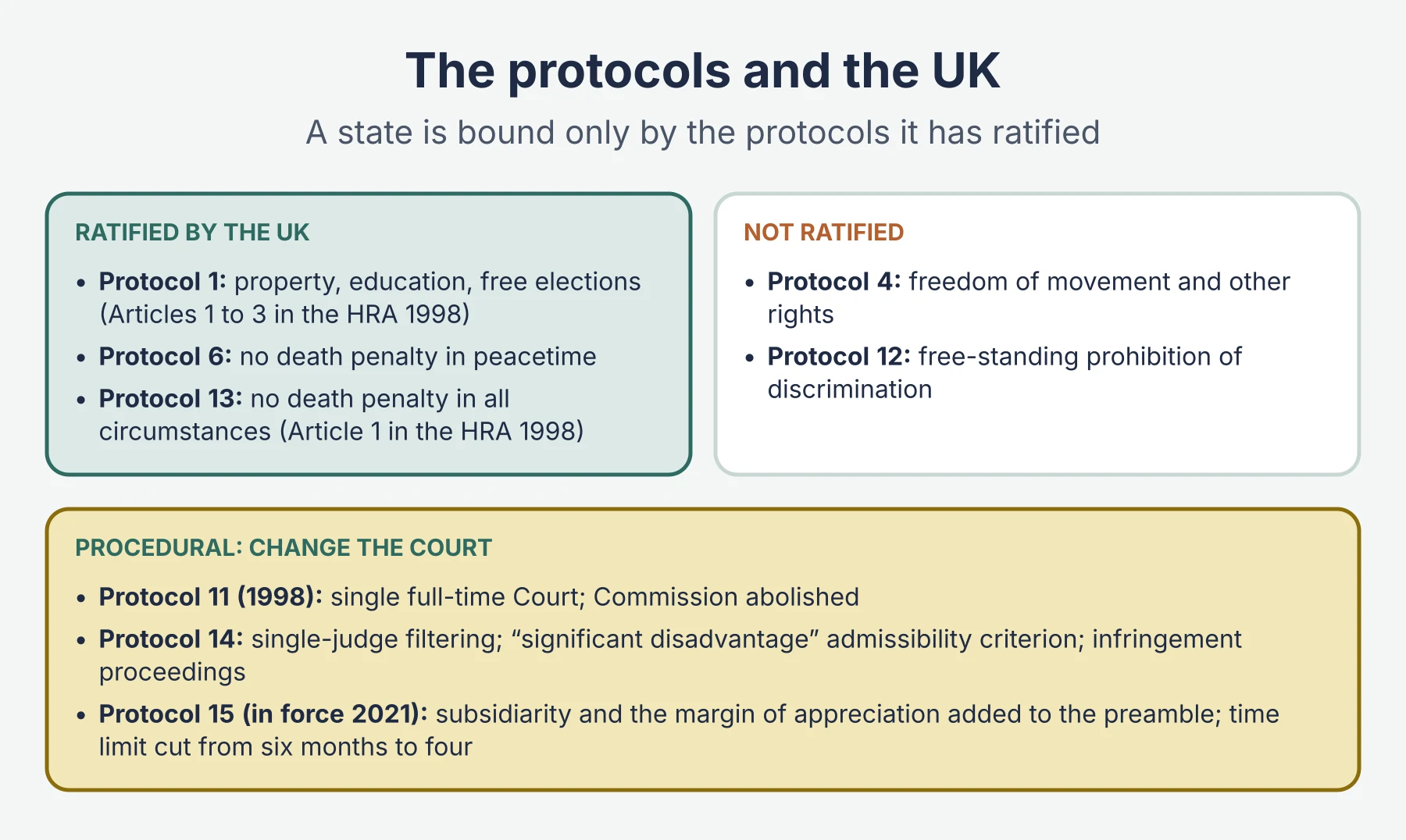
| 1 | Property, education, free elections | Ratified; in HRA Schedule 1 |
| 4 | Freedom of movement | Not ratified |
| 6 | Death penalty abolished in peacetime | Ratified |
| 11 (1998) | Full-time Court; Commission abolished | Procedural |
| 12 | Free-standing non-discrimination | Not ratified |
| 13 | Death penalty abolished in all circumstances | Ratified; in HRA Schedule 1 |
| 14 | Single-judge filtering; significant disadvantage test; infringement proceedings | Procedural |
| 15 (2021) | Subsidiarity and margin of appreciation in the preamble; four-month time limit | Procedural |
The Court
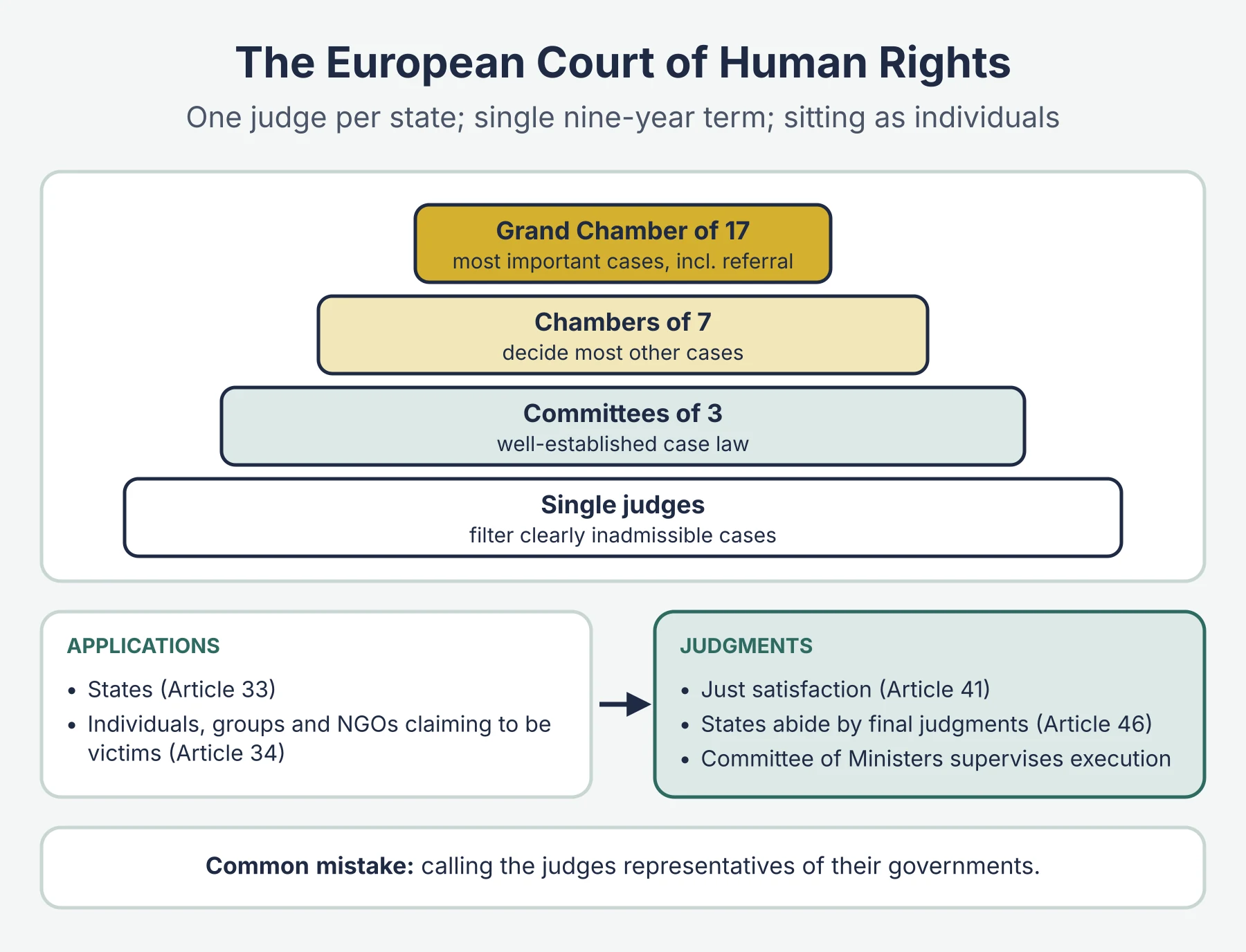
- One judge per state; elected by the Parliamentary Assembly; single nine-year term; independent.
- Single judge (filter) → committee of three → chamber of seven → Grand Chamber of 17.
- Applications by states (Article 33) or victims (Article 34).
- Article 41: just satisfaction. Article 46: states abide by final judgments; Committee of Ministers supervises.
Key terms
| Term | Meaning |
|---|---|
| Jurisdiction (Article 1) | The area or people over whom a state must secure Convention rights |
| Derogation | Temporary suspension of some obligations under Article 15 |
| Reservation | A statement on ratification limiting acceptance of a particular provision |
| Protocol | Additional treaty adding rights or changing procedure |
| Abuse of rights | Using Convention rights to destroy others’ rights (Article 17) |
| Just satisfaction | Compensation awarded by the Court (Article 41) |
| Grand Chamber | 17-judge formation for the most important cases |
Exam traps
- Confusing the Convention with the EU Charter of Fundamental Rights.
- Saying Article 3 can be derogated from.
- Assuming the UK is bound by every protocol.
- Using Article 14 on its own.
- Saying the Convention protects only citizens of the state.
- Forgetting that Article 13 was not included in the Human Rights Act 1998.
Self-test
- When was the Convention signed and when did it come into force?
- What does Article 1 require?
- What did Al-Skeini v UK decide?
- Name one absolute, one limited and one qualified right.
- What is the structure of a qualified right?
- From which Articles can a state never derogate?
- What is the purpose of Article 17?
- Why is Article 14 not free-standing, and which protocol addresses this?
- Which protocols abolish the death penalty, and has the UK ratified them?
- What did Protocol 15 add?
- How many judges sit in the Grand Chamber?
- Which Articles deal with just satisfaction and the binding force of judgments?
Answers: 1. Signed 4 November 1950; in force 3 September 1953. 2. States must secure the rights to everyone within their jurisdiction. 3. The UK had jurisdiction over civilians killed by British soldiers in Basra, and breached the Article 2 duty to investigate. 4. For example Article 3; Article 2 or 5; Article 8, 10 or 11. 5. A first paragraph stating the right and a second allowing restrictions prescribed by law, for a listed aim and necessary in a democratic society. 6. Article 2 (except deaths from lawful acts of war), Article 3, Article 4.1 and Article 7. 7. To stop anyone using Convention rights to destroy the rights of others. 8. It applies only to enjoyment of other Convention rights; Protocol 12, which the UK has not ratified. 9. Protocols 6 and 13; yes, both. 10. References to subsidiarity and the margin of appreciation in the preamble, and a four-month time limit. 11. 17. 12. Article 41 and Article 46.
More resources on this topic
European Convention on Human Rights study guide | European Convention on Human Rights practice questions | Human Rights revision notes
Related resources
-
Study guides
AQA A Level Law (7162): Theory in Human Rights
Theory in Human Rights for AQA A Level Law 7162: natural and positivist theories, will and interest theories, Hohfeld, liberties and fundamental rights.
Law · AQA · A Level
Read guide -
Practice questions
AQA A Level Law (7162): Theory in Human Rights – Practice Questions
Original practice on human rights theory for AQA A Level Law 7162 with mark-scheme answers on theories of rights, rights and liberties, and fundamental rights.
Law · AQA · A Level
Try questions -
Revision notes
AQA A Level Law (7162): Theory in Human Rights – Revision Notes
Condensed recall on human rights theory for AQA A Level Law 7162: natural rights, positivism, Dworkin, will and interest theories, Hohfeld and scope.
Law · AQA · A Level
Revise topic
Get free revision emails (optional)
Occasional emails with practice questions, worked explanations and links to free resources for the qualification and subjects you choose. No spam, and you can unsubscribe from any email. The free tools on this site never need an email.