
Study Guides
AQA A Level Law (7162): Theory in Human Rights
Theory in Human Rights for AQA A Level Law 7162: natural and positivist theories, will and interest theories, Hohfeld, liberties and fundamental rights.
- Subject
- Law
- Level
- A LEVELS
- Topic
- Topic 5: Human Rights
- Author
- Marlbridge Academic Team
- Updated
- Reviewed by
- Aizaz Raoof Ali (what this means)
Aligned to AQA A Level Law (7162), For teaching from September 2017 onwards, A-level exams 2019 onwards. Official specification .
Syllabus page (what it covers and how it is assessed): AQA A Level Law.
Syllabus points this page covers
7162
- Theory in Human Rights
Found an error? Report a correction.
Need help with this topic? Request a free trial class for A Level Law (7162).
This guide covers Theory in Human Rights in section 3.5 Human Rights of AQA A-level Law (7162). The specification lists three things: “Theories of rights”, “Rights contrasted with liberties” and “The scope of ‘fundamental human’ rights”. Theory questions are usually essays, but theory also earns marks in problem answers when you explain why a right is absolute or qualified. For the whole option in outline, start with the Human Rights study guide.
Theories of rights: where do rights come from?
Natural rights
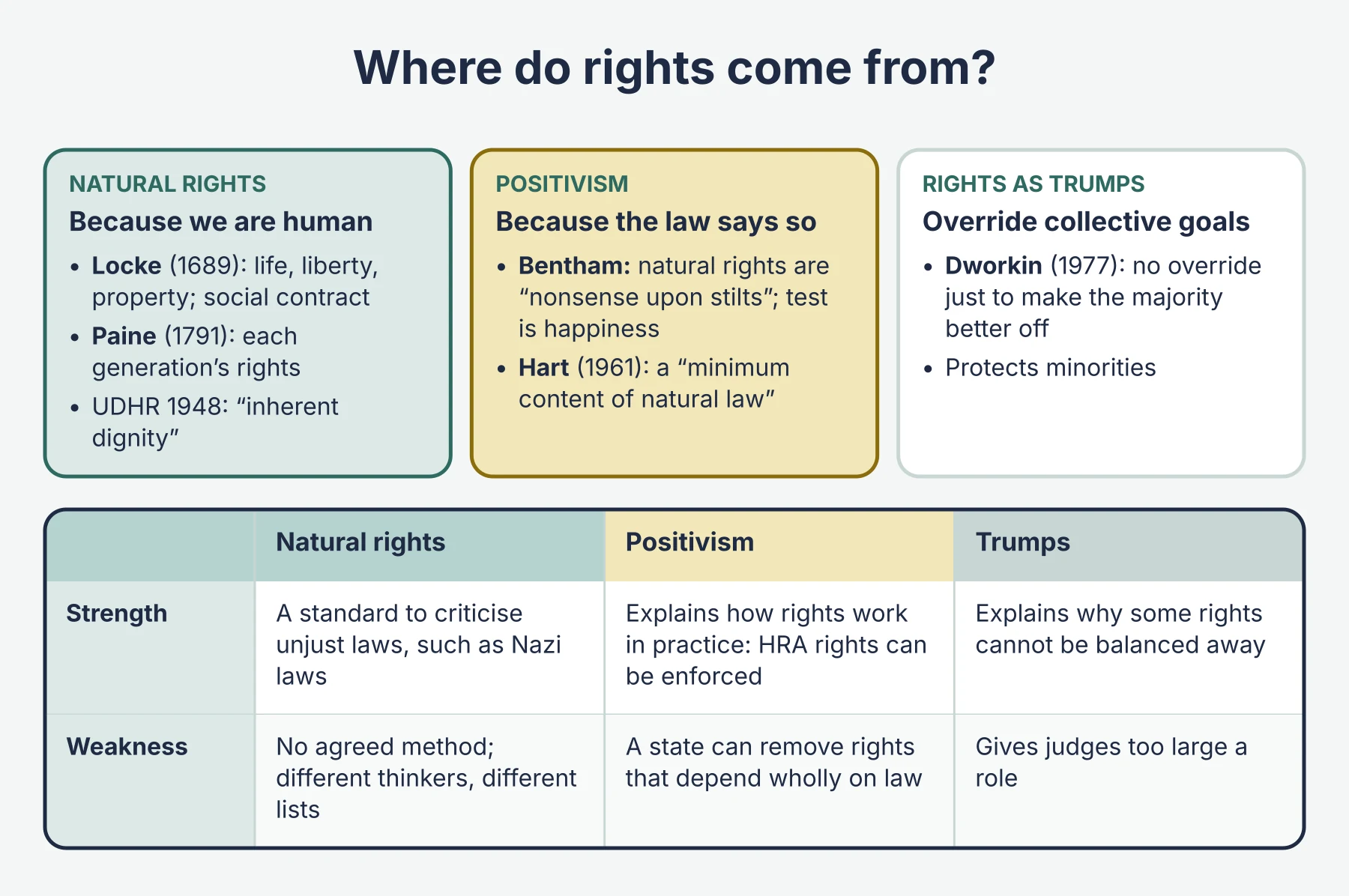
Natural rights theory holds that people have rights simply because they are human, whatever any government says.
- John Locke, in his Two Treatises of Government (1689), argued that people in a state of nature have rights to life, liberty and property. They form a government by social contract to protect those rights, and a government that violates them loses its legitimacy.
- Thomas Paine, in Rights of Man (1791), defended the French Revolution’s Declaration of the Rights of Man and of the Citizen and argued that rights belong to each generation and cannot be signed away by earlier ones.
Strengths: natural rights give a standard against which unjust laws can be criticised, which became important after the Second World War, when the legality of Nazi laws did not make them just. The Universal Declaration of Human Rights 1948 opens by recognising the “inherent dignity” of all people, language that echoes this tradition.
Weaknesses: there is no agreed method for discovering which rights are natural, and different thinkers produce different lists.
Legal positivism and utilitarian criticism
Positivists separate the existence of a law from its moral merit. On this view a right exists only when a legal system creates and enforces it.
- Jeremy Bentham, a utilitarian, attacked natural rights in Anarchical Fallacies, calling “natural and imprescriptible rights” “nonsense upon stilts”. For Bentham, real rights come from real laws, and the test of a law is whether it maximises happiness.
- H. L. A. Hart, a later positivist, accepted that law and morality are separate, but argued in The Concept of Law (1961) that every legal system needs a “minimum content of natural law” because of human vulnerability and limited resources.
Strength: positivism explains how rights operate in practice: a right in the Human Rights Act 1998 can be enforced; an abstract moral right cannot. Weakness: if rights depend wholly on law, a state can remove them, which is the danger human rights law was designed to prevent.
Rights as trumps
Ronald Dworkin, in Taking Rights Seriously (1977), described rights as trumps over collective goals. A government may not override an individual right simply because doing so would make the majority better off. This captures why some rights, such as freedom from torture, cannot be balanced away, and why judges protect minorities against majorities. Critics argue that it gives judges too large a role in deciding which interests are rights.
Will theory and interest theory
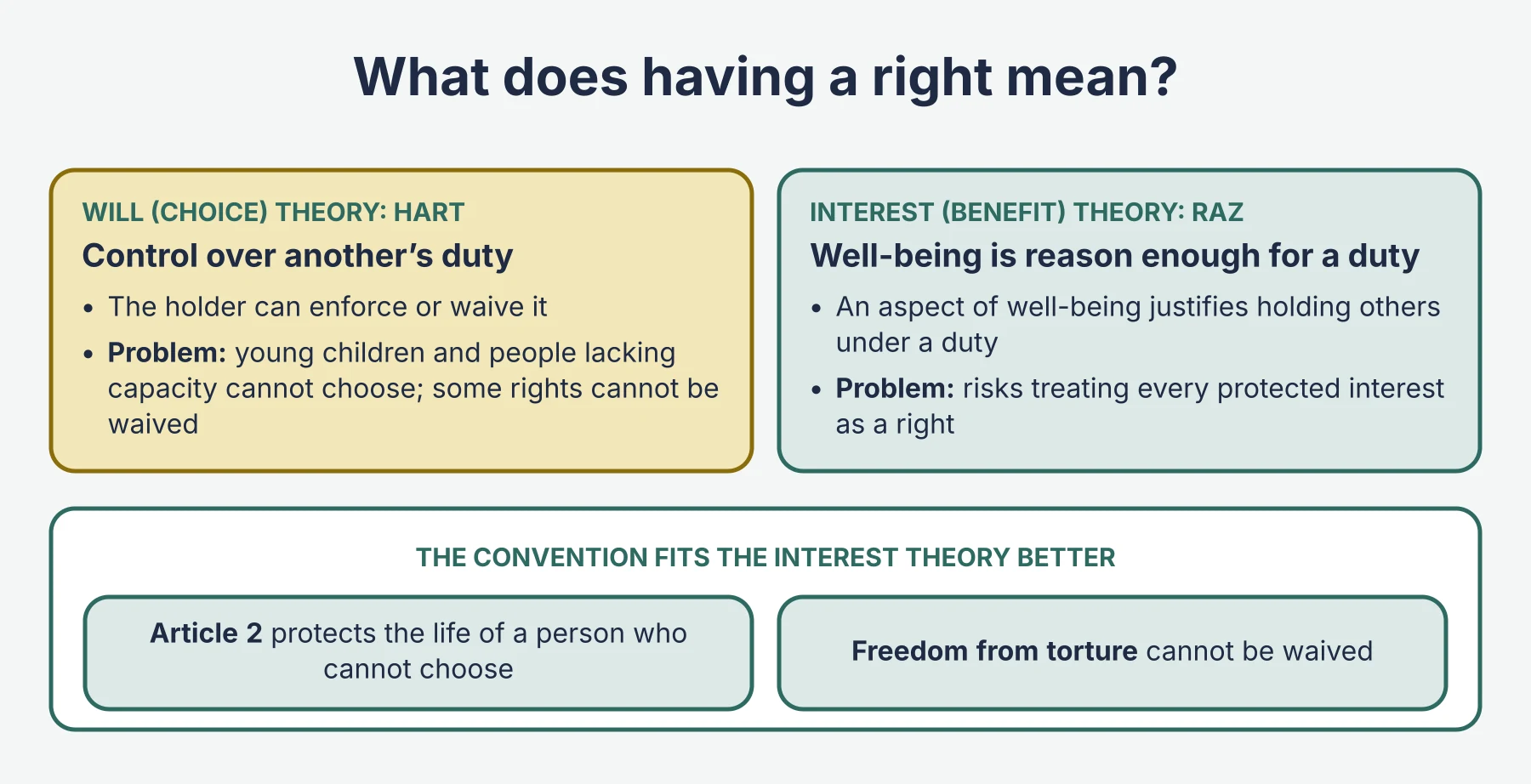
These theories ask what having a right means.
| Theory | Key idea | Associated writer | Problem |
|---|---|---|---|
| Will (choice) theory | A right gives the holder control over another’s duty: they can enforce or waive it | H. L. A. Hart | Struggles to explain rights of young children or people lacking capacity, who cannot exercise choice, and rights that cannot be waived |
| Interest (benefit) theory | A person has a right when an aspect of their well-being is a sufficient reason to hold others under a duty | Joseph Raz | Risks treating every protected interest as a right |
The Convention fits the interest theory better: Article 2 protects the life of a person who cannot choose, and some rights, such as freedom from torture, cannot be waived.
Rights contrasted with liberties
Hohfeld’s analysis
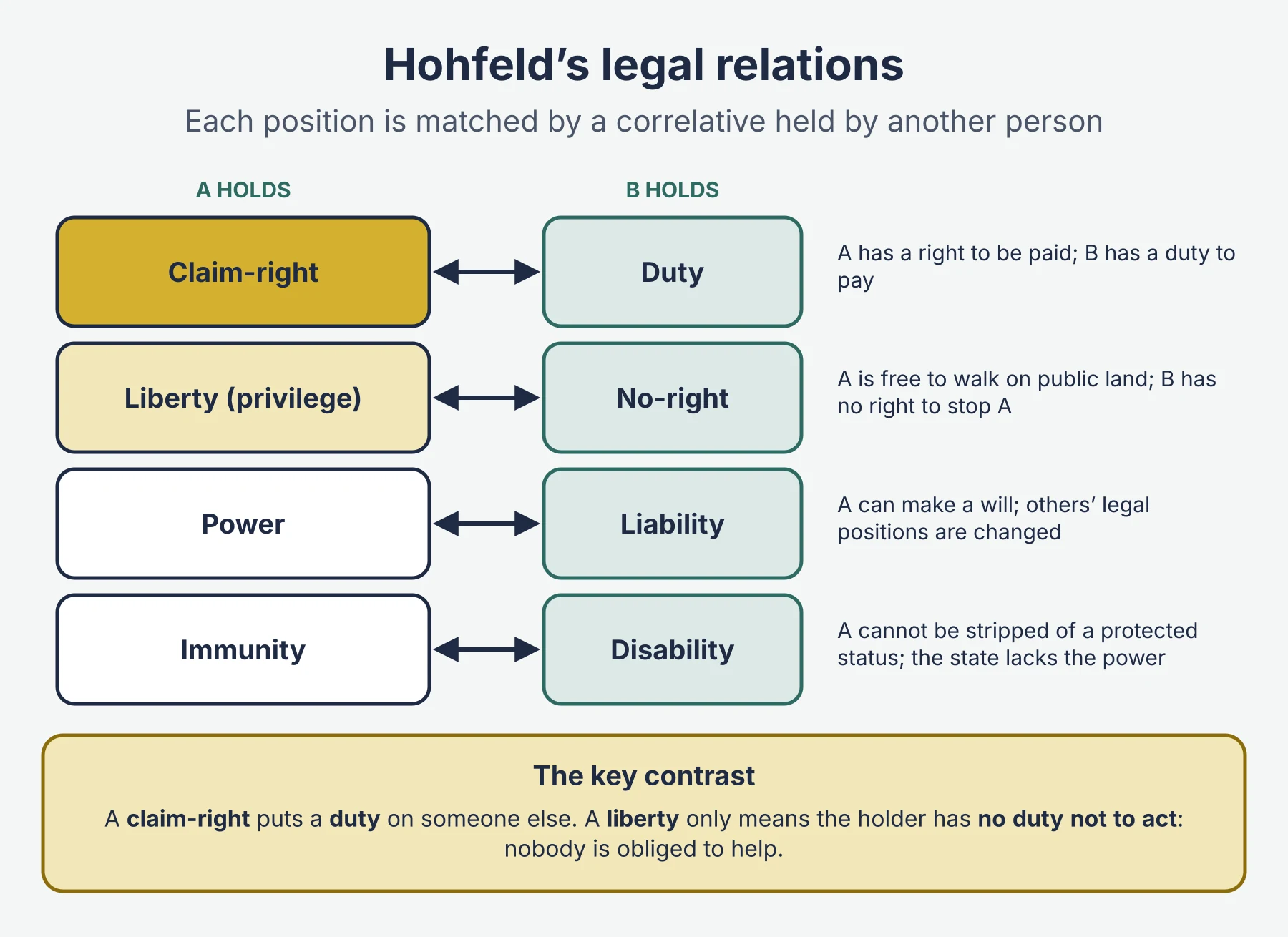
Wesley Newcomb Hohfeld analysed legal relations into pairs of correlatives.
| Position | Correlative held by another | Example |
|---|---|---|
| Claim-right | Duty | A has a right to be paid; B has a duty to pay |
| Liberty (privilege) | No-right | A is free to walk on public land; B has no right to stop A |
| Power | Liability | A can make a will; others’ legal positions are changed |
| Immunity | Disability | A cannot be stripped of a protected status; the state lacks the power to do so |
The key contrast is that a claim-right imposes a duty on someone else, whereas a liberty only means the holder has no duty not to act. A liberty does not oblige anyone to help, or even to refrain from obstructing, unless some other rule says so.
Liberties in the traditional United Kingdom model
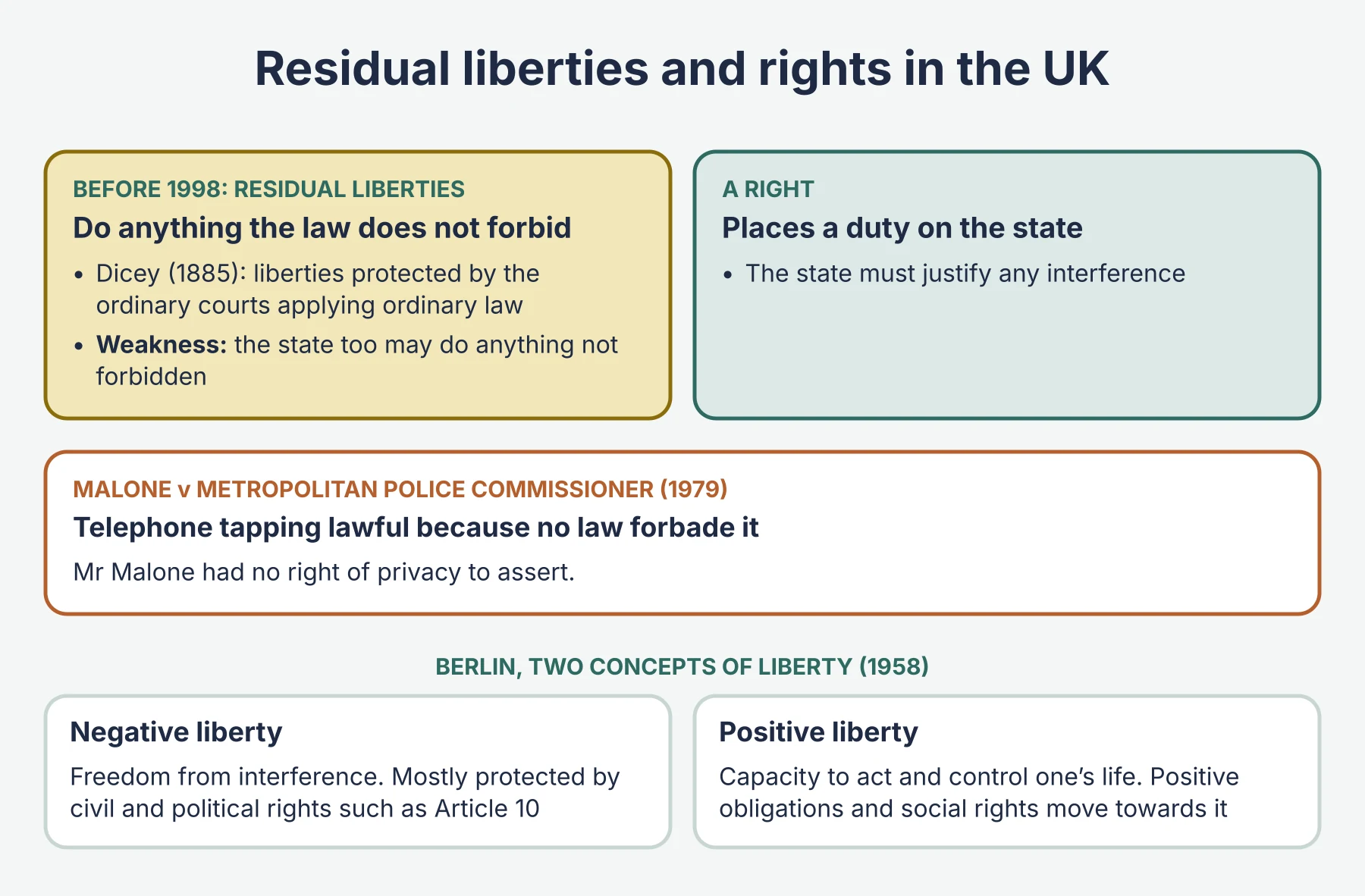
Before 1998 the United Kingdom protected residual liberties: a person could do anything that the law did not forbid. A. V. Dicey, in his Introduction to the Study of the Law of the Constitution (1885), argued that liberties were better protected by the ordinary courts applying ordinary law than by a written declaration of rights.
The weakness is shown by Malone v Metropolitan Police Commissioner (1979): telephone tapping was lawful because no law forbade it, so Mr Malone had no right of privacy to assert. The same logic applies to the state: if the state may do anything not forbidden, a liberty offers no protection against it. A right, by contrast, places a duty on the state, which must then justify any interference.
Negative and positive liberty
Isaiah Berlin, in Two Concepts of Liberty (1958), contrasted negative liberty (freedom from interference) with positive liberty (the capacity to act and control one’s life). Civil and political rights such as Article 10 mostly protect negative liberty, while positive obligations and social rights move towards positive liberty.
The scope of “fundamental human” rights
The specification’s phrase invites the question: which rights are fundamental, who has them, and against whom?
Universality and the generations of rights
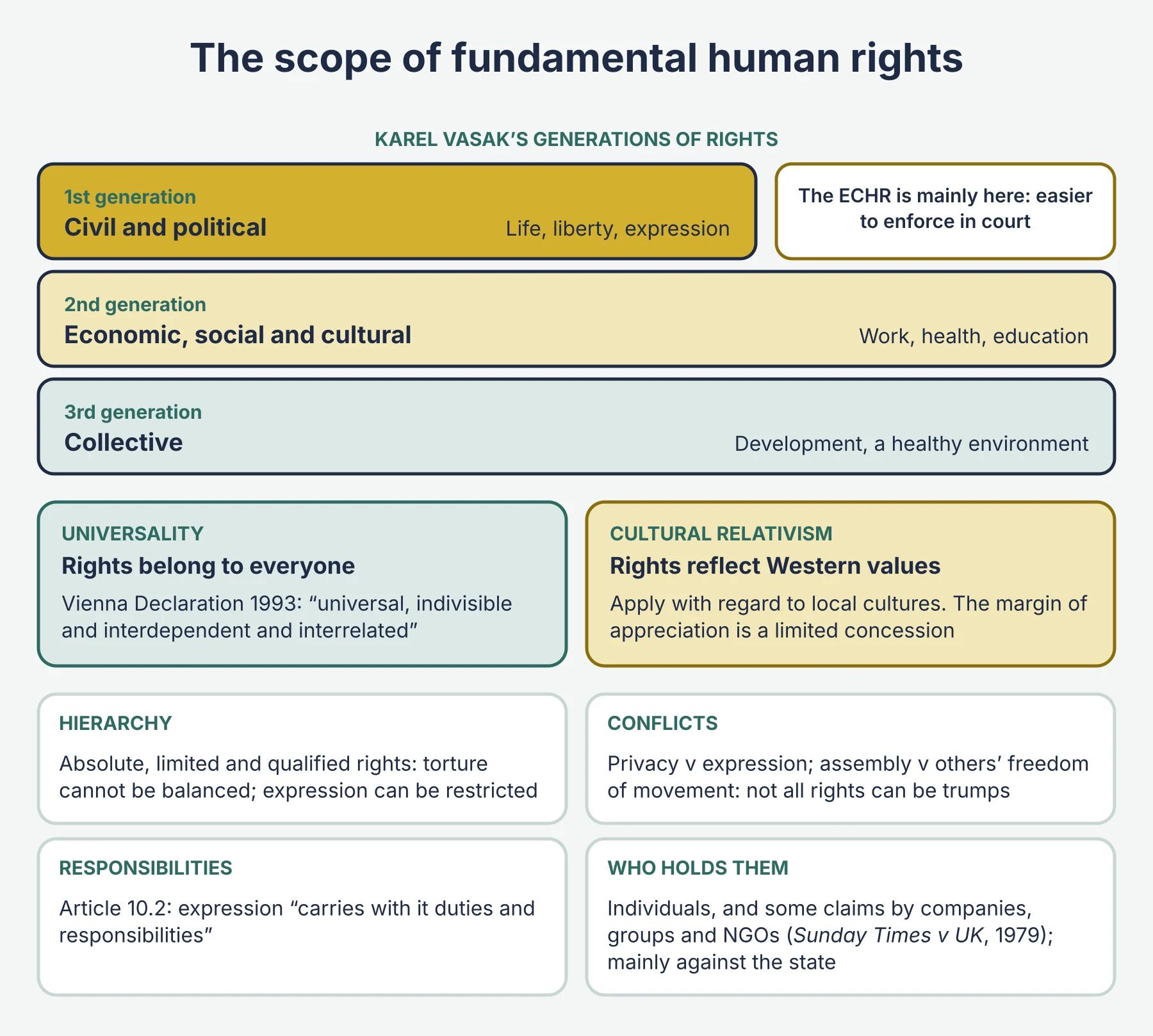
- Universality: human rights belong to everyone. The Vienna Declaration of 1993 described them as “universal, indivisible and interdependent and interrelated”. Cultural relativists argue that rights reflect Western values and should be applied with regard to local cultures. The margin of appreciation is a limited concession to this argument.
- Generations: Karel Vasak classified rights into first-generation civil and political rights (life, liberty, expression), second-generation economic, social and cultural rights (work, health, education) and third-generation collective rights (development, a healthy environment). The ECHR is mainly first-generation, which is why it is easier to enforce in court.
Hierarchy and limits
- Absolute, limited and qualified rights reflect a hierarchy of importance: freedom from torture cannot be balanced, while expression can be restricted to protect others.
- Conflicts between rights: privacy and expression, or assembly and others’ freedom of movement, show that rights cannot all be trumps at once.
- Rights and responsibilities: Article 10.2 states that expression “carries with it duties and responsibilities”.
Who holds rights?
Rights belong to individuals, but the Convention lets companies, groups and non-governmental organisations bring some claims; Sunday Times v UK (1979) was brought by a newspaper publisher. Rights are held mainly against the state.
Annotated plan: “Discuss the view that human rights are no more than liberties granted by law.”
Introduction  Define a right (claim and correlative duty, Hohfeld) and a
              liberty (no duty not to act).
Point 1       Positivist support: Bentham – rights come only from law; HRA
              1998 rights exist because Parliament enacted them.
Point 2       Against: natural rights (Locke) and the UDHR's "inherent
              dignity" – some rights exist whatever the law says.
Point 3       UK experience: residual liberties under Dicey's model failed in
              Malone (1979); a right imposes a duty that a liberty does not.
Point 4       Dworkin – rights as trumps resist majority override, unlike
              liberties, which statute can remove.
Point 5       Scope: absolute rights such as Article 3 cannot be reduced to
              liberties; qualified rights look closer to liberties.
Conclusion    Reasoned judgement, e.g. legal recognition is needed to enforce
              rights, but their justification is moral, not legal.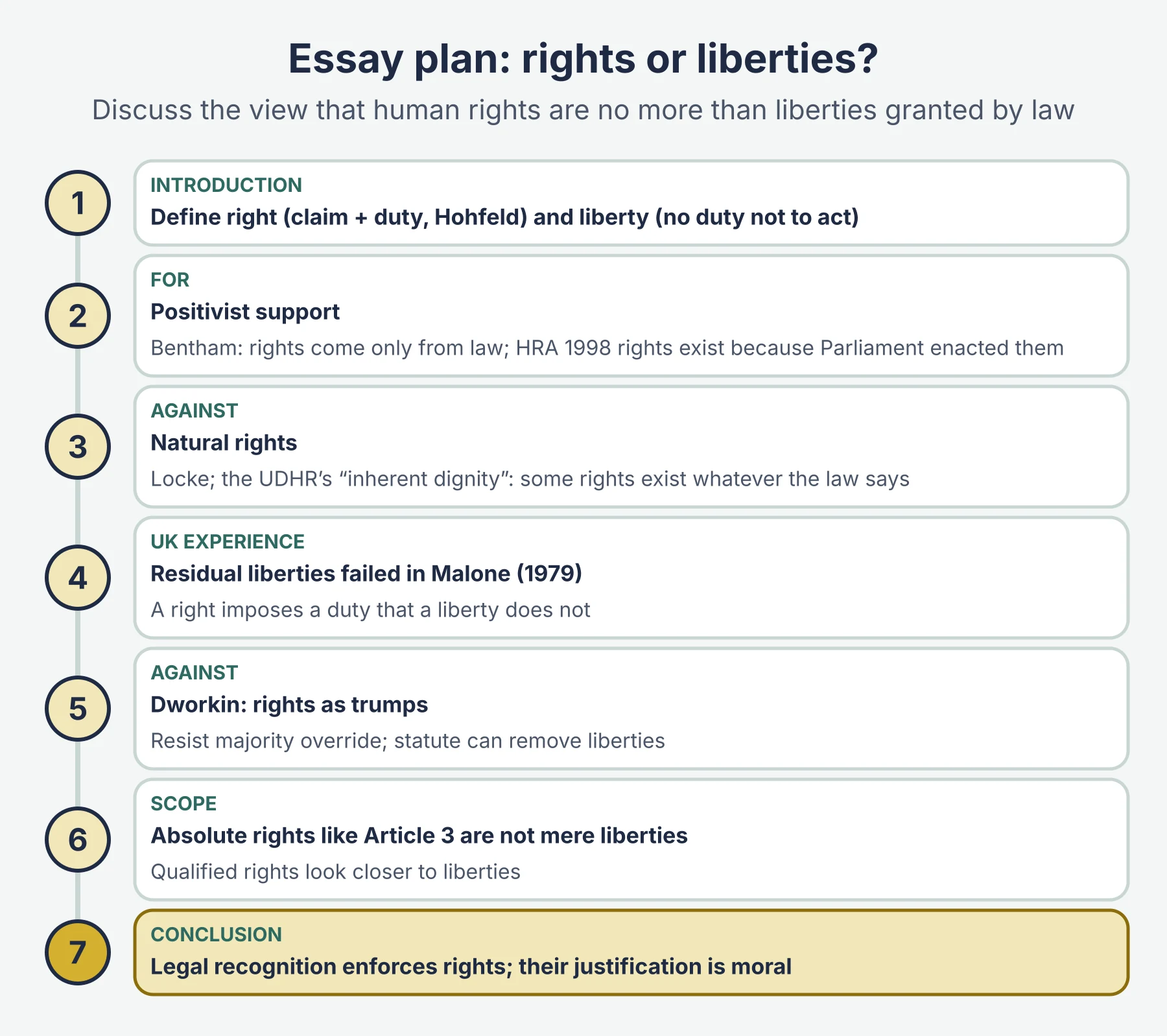
Common mistakes
- Using “right” and “liberty” interchangeably.
- Naming theorists without explaining their argument or linking it to the law.
- Saying positivists think rights do not matter; they say rights depend on law.
- Treating the ECHR as covering economic and social rights.
- Writing theory with no reference to cases or Articles.
Exam technique
- Explain questions: define the theory or distinction and illustrate it with one example.
- Discuss questions: set out competing theories, apply them to the Convention or the Human Rights Act 1998, and reach a conclusion.
- In problem answers, use theory briefly, for example to explain why Article 3 is absolute.
More resources on this topic
Theory in Human Rights revision notes | Theory in Human Rights practice questions | Rules in Human Rights law study guide
Related resources
-
Practice questions
AQA A Level Law (7162): Theory in Human Rights – Practice Questions
Original practice on human rights theory for AQA A Level Law 7162 with mark-scheme answers on theories of rights, rights and liberties, and fundamental rights.
Law · AQA · A Level
Try questions -
Revision notes
AQA A Level Law (7162): Theory in Human Rights – Revision Notes
Condensed recall on human rights theory for AQA A Level Law 7162: natural rights, positivism, Dworkin, will and interest theories, Hohfeld and scope.
Law · AQA · A Level
Revise topic -
Practice questions
AQA A-Level Law: Human Rights — Practice Questions
AQA A-level Law 7162 human rights practice with worked answers: HRA 1998 ss2-4, Articles 2, 5, 8, 10 and 11, proportionality, judicial review and reform.
Law · AQA · A Level
Try questions
Get free revision emails (optional)
Occasional emails with practice questions, worked explanations and links to free resources for the qualification and subjects you choose. No spam, and you can unsubscribe from any email. The free tools on this site never need an email.