
Revision Notes
AQA A Level Law (7162): Theory in Human Rights – Revision Notes
Condensed recall on human rights theory for AQA A Level Law 7162: natural rights, positivism, Dworkin, will and interest theories, Hohfeld and scope.
- Subject
- Law
- Level
- A LEVELS
- Topic
- Topic 5: Human Rights
- Author
- Marlbridge Academic Team
- Updated
- Reviewed by
- Aizaz Raoof Ali (what this means)
Aligned to AQA A Level Law (7162), For teaching from September 2017 onwards, A-level exams 2019 onwards. Official specification .
Syllabus page (what it covers and how it is assessed): AQA A Level Law.
Syllabus points this page covers
7162
- Theory in Human Rights
Found an error? Report a correction.
Need help with this topic? Request a free trial class for A Level Law (7162).
Condensed notes on the three theory headings in the specification: theories of rights, rights contrasted with liberties, and the scope of “fundamental human” rights. For full explanation and an annotated essay plan, use the Theory in Human Rights study guide.
Theories of rights
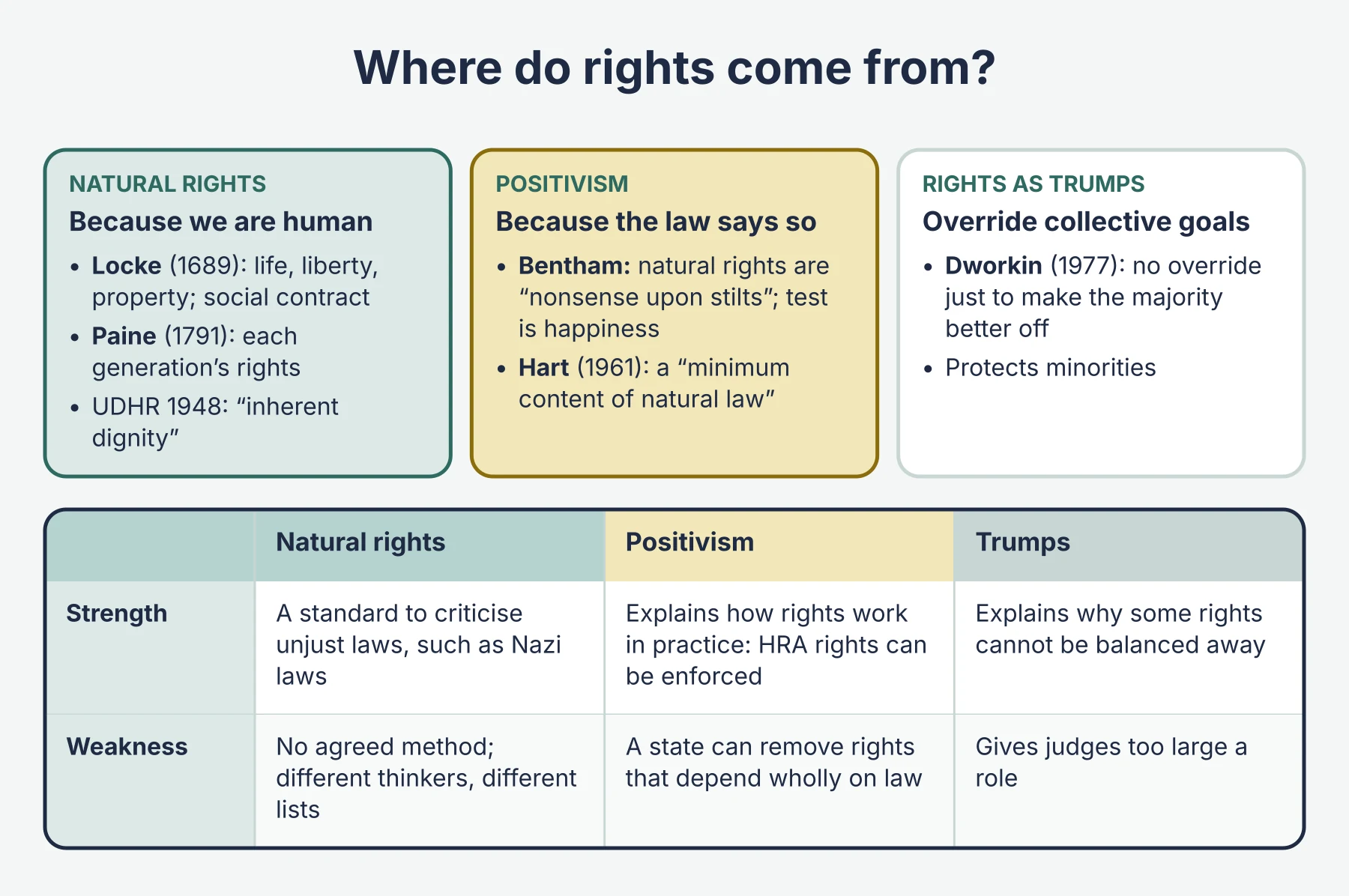
| Theory | Writer and work | Core claim | Evaluation |
|---|---|---|---|
| Natural rights | John Locke, Two Treatises of Government (1689) | Life, liberty and property exist before the state; government is a social contract to protect them | Gives a standard to judge unjust law; no agreed list or method |
| Natural rights | Thomas Paine, Rights of Man (1791) | Rights belong to each generation and cannot be signed away | Influential in revolutionary declarations |
| Utilitarian positivism | Jeremy Bentham, Anarchical Fallacies | Natural rights are “nonsense upon stilts”; real rights come from real laws | Explains enforceable rights; leaves rights at the mercy of the state |
| Positivism | H. L. A. Hart, The Concept of Law (1961) | Law and morality are separate, but systems need a “minimum content of natural law” | Bridges the two traditions |
| Rights as trumps | Ronald Dworkin, Taking Rights Seriously (1977) | Rights override collective goals and majority preferences | Protects minorities; gives judges a large role |
What it means to have a right
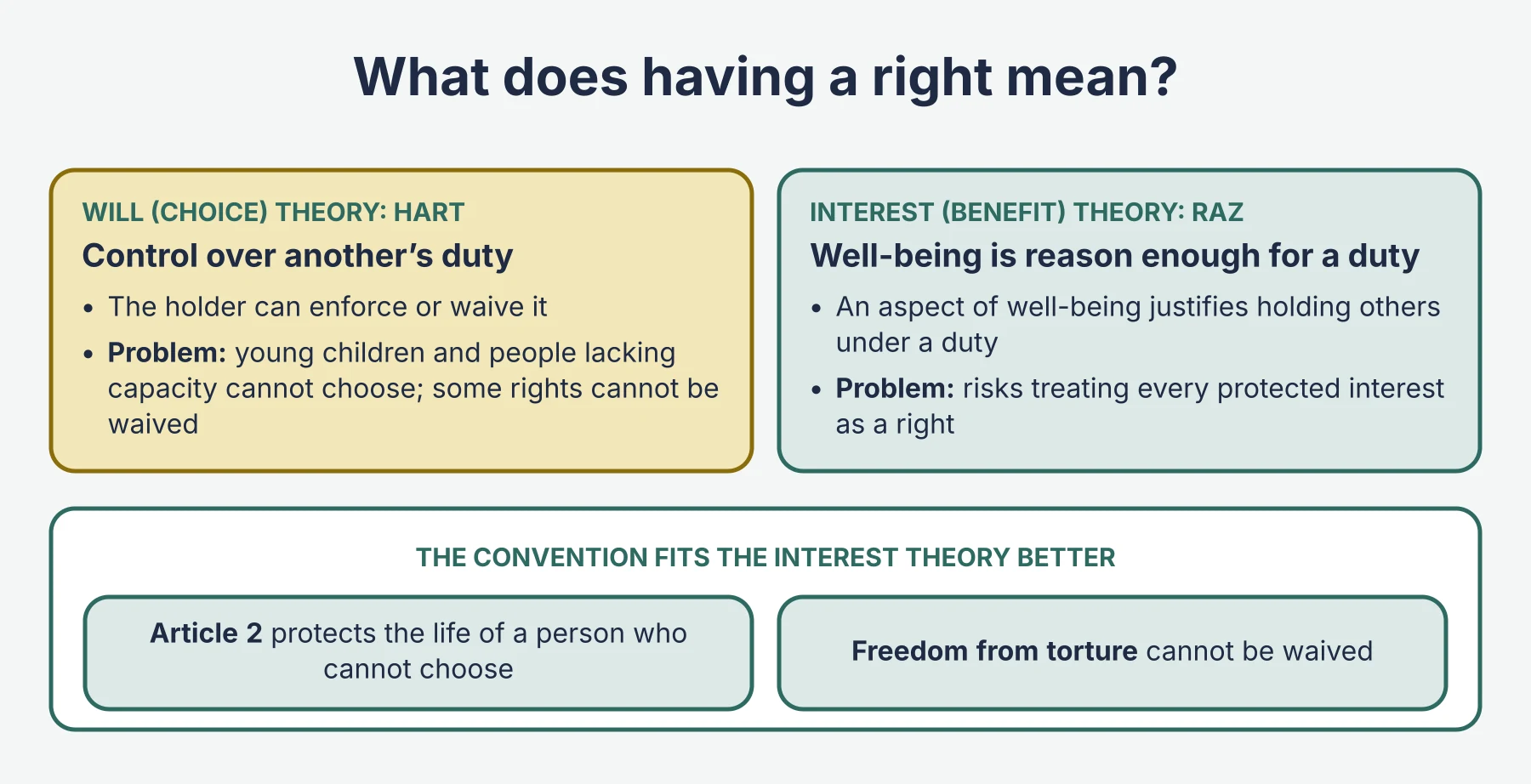
| Theory | Idea | Writer | Weakness |
|---|---|---|---|
| Will (choice) | Right gives control over another’s duty: enforce or waive | H. L. A. Hart | Children and people lacking capacity; unwaivable rights |
| Interest (benefit) | An interest is sufficient reason to impose a duty on others | Joseph Raz | Could turn every interest into a right |
The Convention fits interest theory: Article 2 protects people who cannot choose; Article 3 cannot be waived.
Rights contrasted with liberties
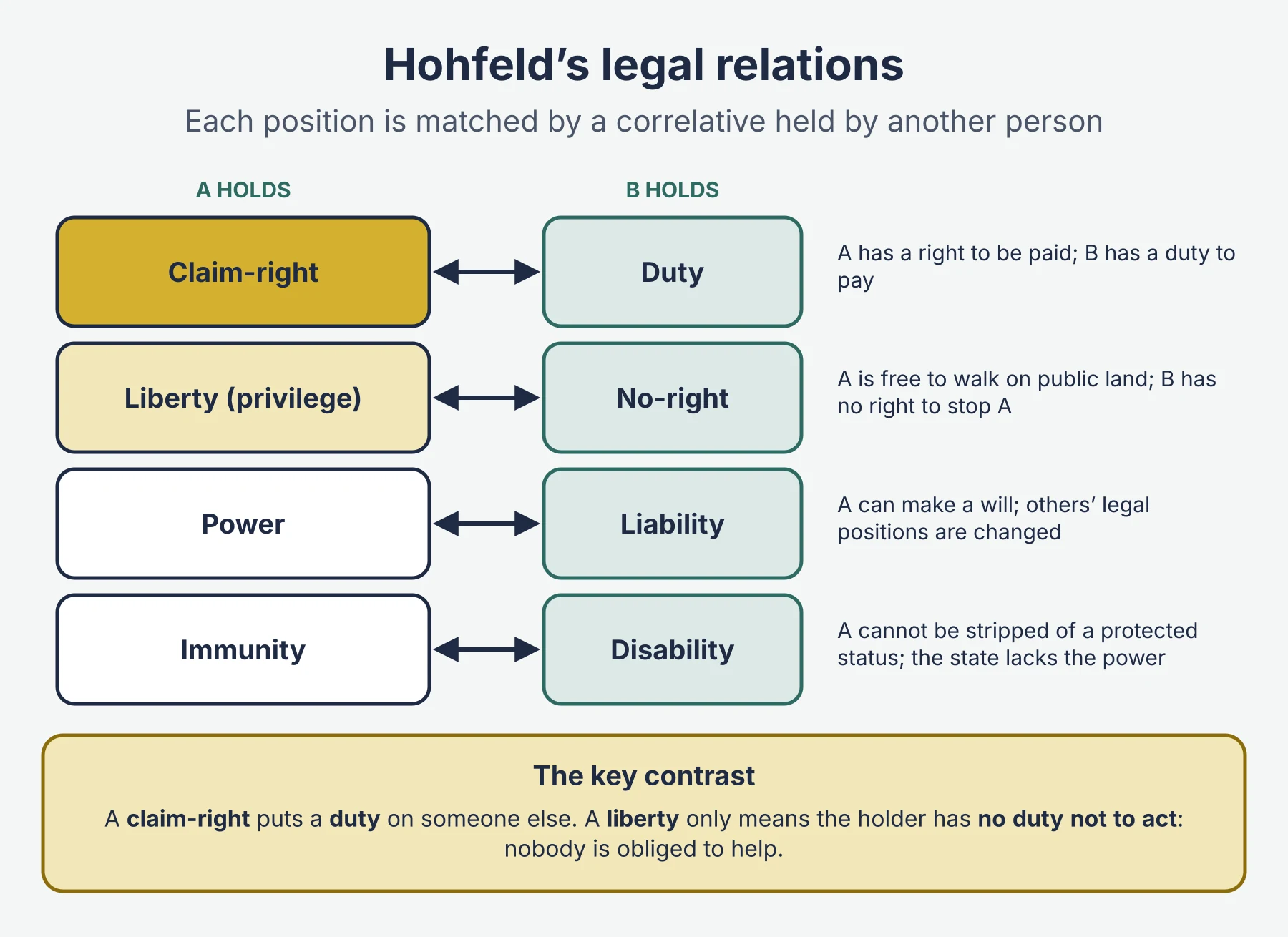
Hohfeld’s correlatives
| Holder has | Other person has |
|---|---|
| Claim-right | Duty |
| Liberty (privilege) | No-right |
| Power | Liability |
| Immunity | Disability |
- Right: someone else owes a duty.
- Liberty: the holder has no duty not to act; no one has to help.
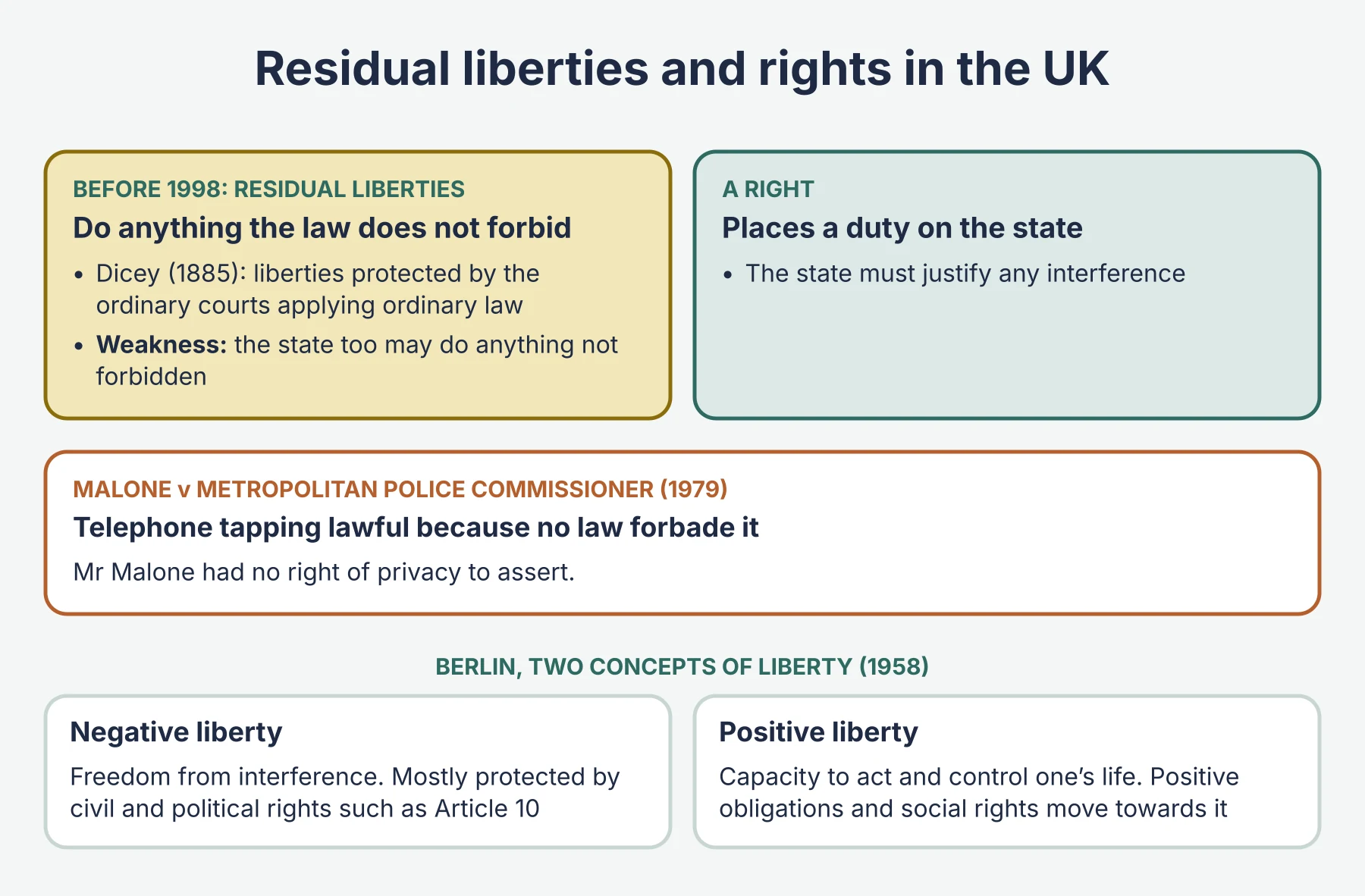
- Residual liberty (UK before 1998): free to do anything the law does not forbid. A. V. Dicey (1885) trusted ordinary courts and ordinary law rather than a bill of rights.
- Weakness: Malone v Metropolitan Police Commissioner (1979): phone tapping lawful because nothing forbade it; no right to assert.
- Isaiah Berlin, Two Concepts of Liberty (1958): negative liberty (freedom from interference) and positive liberty (capacity to act). ECHR civil rights mostly protect negative liberty; positive obligations move towards positive liberty.
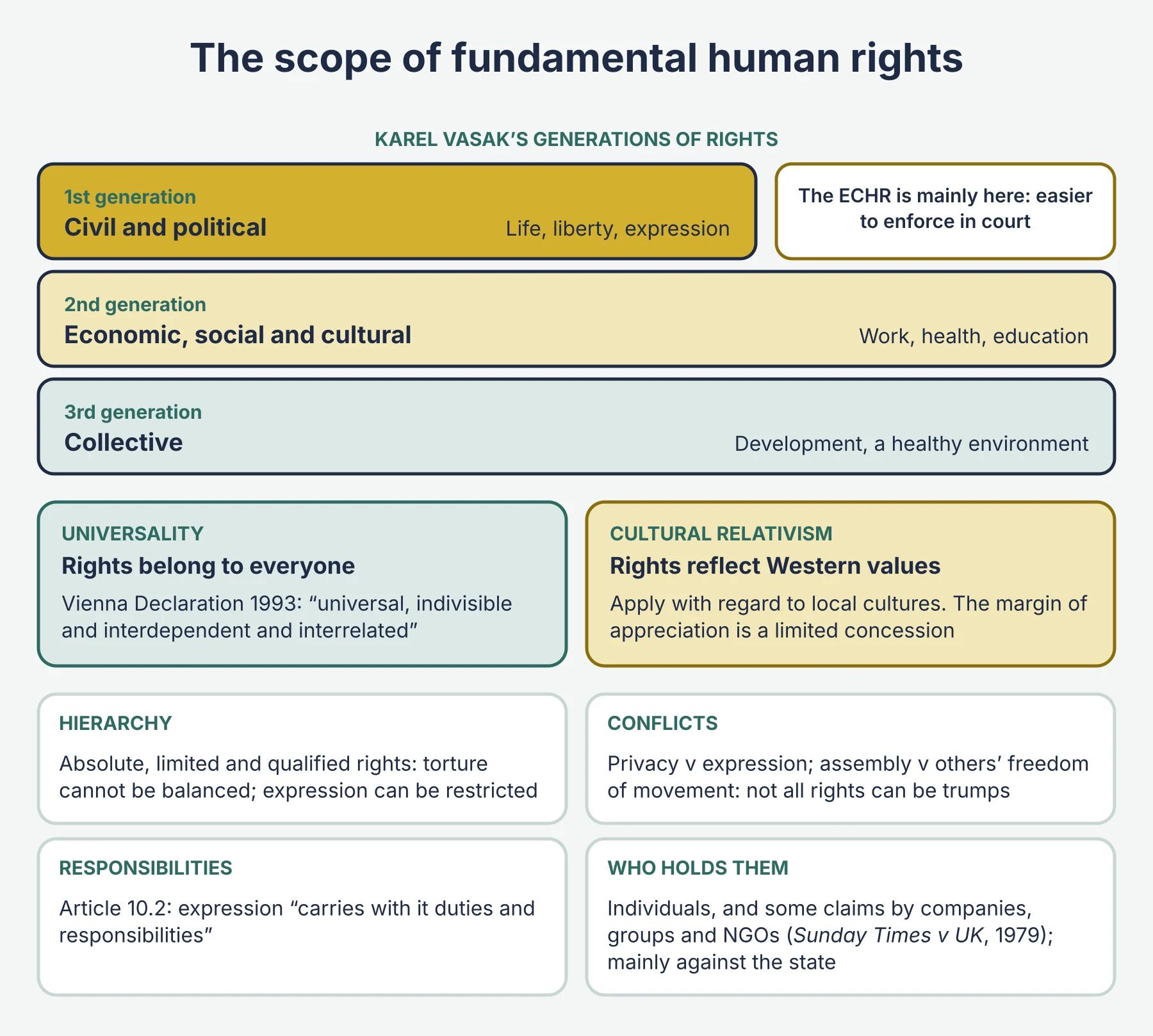
Scope of “fundamental human” rights
- Universal: belong to everyone. Vienna Declaration 1993: “universal, indivisible and interdependent and interrelated”.
- Cultural relativism: rights reflect particular cultures; the margin of appreciation is a limited concession.
- Karel Vasak’s generations: first (civil and political), second (economic, social, cultural), third (collective, such as development and environment). ECHR is mainly first-generation.
- Hierarchy: absolute (Article 3), limited (Articles 2 and 5), qualified (Articles 8, 10 and 11).
- Conflicts: privacy against expression; assembly against others’ movement.
- Responsibilities: Article 10.2, expression “carries with it duties and responsibilities”.
- Holders: individuals, and in some cases companies and groups (Sunday Times v UK, 1979, brought by a publisher). Held mainly against the state.
Key terms
| Term | Meaning |
|---|---|
| Natural right | A right held because one is human, independent of law |
| Legal positivism | The view that law’s existence is separate from its moral merit |
| Rights as trumps | Rights override majority preferences and collective goals |
| Claim-right | A right with a correlative duty on another |
| Liberty | Freedom to act with no duty not to; no correlative duty on others |
| Residual liberty | Freedom to do whatever the law does not prohibit |
| Negative liberty | Freedom from interference |
| Positive liberty | Real capacity to act and direct one’s own life |
| Cultural relativism | The view that rights depend on cultural context |
Exam traps
- Confusing a right with a liberty in an essay about the pre-1998 position.
- Attributing “nonsense upon stilts” to anyone other than Bentham.
- Saying Hart rejected all natural law ideas; he accepted a minimum content.
- Calling the ECHR a charter of social rights.
- Listing theories without applying them to an Article or a case.
- Ignoring the scope heading, which needs universality, generations, hierarchy and conflicts.
Self-test
- What rights did Locke say exist in the state of nature?
- What did Bentham call natural rights?
- What is Hart’s “minimum content of natural law”?
- What did Dworkin mean by rights as trumps?
- State the difference between the will theory and the interest theory.
- Which theory better fits Article 2, and why?
- What is the correlative of a claim-right in Hohfeld’s scheme? Of a liberty?
- What is a residual liberty?
- Why does Malone v Metropolitan Police Commissioner show the weakness of liberties?
- Distinguish negative and positive liberty.
- Name Vasak’s three generations of rights.
- Give one argument for and one against the universality of human rights.
Answers: 1. Life, liberty and property. 2. “Nonsense upon stilts”. 3. Every legal system needs some basic protections, given human vulnerability and limited resources. 4. Rights override collective goals and majority preferences. 5. Will theory: a right gives control over another’s duty; interest theory: an interest is sufficient reason to impose a duty. 6. Interest theory, because Article 2 protects people who cannot exercise choice. 7. A duty; a no-right. 8. Freedom to do anything the law does not forbid. 9. Phone tapping was lawful because no law forbade it, so Malone had no right to assert. 10. Negative liberty is freedom from interference; positive liberty is the capacity to act and control one’s life. 11. Civil and political; economic, social and cultural; collective. 12. For: they rest on shared human dignity, as the UDHR states. Against: cultural relativists argue rights reflect Western values.
More resources on this topic
Theory in Human Rights study guide | Theory in Human Rights practice questions | Human Rights revision notes
Related resources
-
Practice questions
AQA A-Level Law: Human Rights — Practice Questions
AQA A-level Law 7162 human rights practice with worked answers: HRA 1998 ss2-4, Articles 2, 5, 8, 10 and 11, proportionality, judicial review and reform.
Law · AQA · A Level
Try questions -
Revision notes
AQA A-Level Law: Human Rights — Revision Notes
AQA A-level Law 7162 human rights revision notes: rights theory, ECHR Articles 2, 5, 8, 10 and 11, HRA 1998 sections, restrictions, judicial review and reform.
Law · AQA · A Level
Revise topic -
Study guides
AQA A Level Law (7162): Human Rights – Study Guide
Convention rights, the Human Rights Act 1998, Articles 2, 5, 8, 10 and 11, restrictions, enforcement and reform for AQA A Level Law human rights.
Law · AQA · A Level
Read guide
Get free revision emails (optional)
Occasional emails with practice questions, worked explanations and links to free resources for the qualification and subjects you choose. No spam, and you can unsubscribe from any email. The free tools on this site never need an email.