
Study Guides
AQA A Level Law (7162): Article 2 of the European Convention on Human Rights 1953
Article 2 ECHR for AQA A Level Law 7162: the right to life, the 2.2 exceptions, absolutely necessary force and the state's positive and procedural duties.
- Subject
- Law
- Level
- A LEVELS
- Topic
- Topic 5: Human Rights
- Author
- Marlbridge Academic Team
- Updated
- Reviewed by
- Aizaz Raoof Ali (what this means)
Aligned to AQA A Level Law (7162), For teaching from September 2017 onwards, A-level exams 2019 onwards. Official specification .
Syllabus page (what it covers and how it is assessed): AQA A Level Law.
Syllabus points this page covers
7162
- Article 2 of the European Convention on Human Rights 1953
Found an error? Report a correction.
Need help with this topic? Request a free trial class for A Level Law (7162).
This guide covers Article 2 of the European Convention on Human Rights 1953, part of section 3.5 Human Rights in AQA A-level Law (7162). The specification lists two things: “Article 2.1: right to life” and “Article 2.2: justified exceptions”. How English law gives effect to the right, through homicide law, policing and inquests, is covered in the Human Rights and English law study guide. For the whole option in outline, start with the Human Rights study guide.
Where Article 2 fits
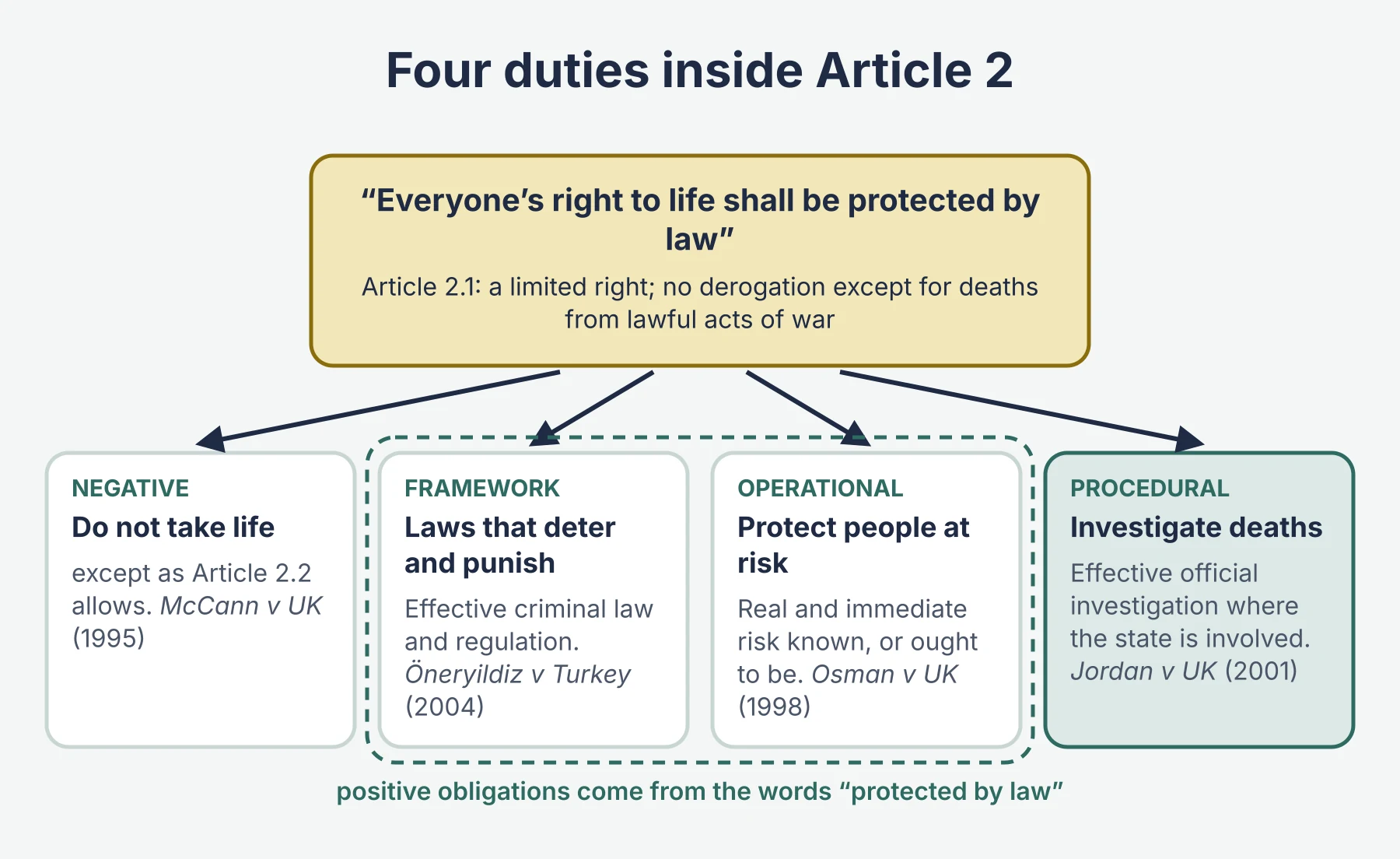
Article 2 is a limited right: the only exceptions are the ones written into Article 2.2, and there is no general balancing test. It is among the most fundamental rights in the Convention. Under Article 15, no derogation is permitted from it, except for deaths resulting from lawful acts of war.
Article 2.1: the right to life
Article 2.1 begins: “Everyone’s right to life shall be protected by law.” It then provides that no one shall be deprived of life intentionally save in execution of a court’s sentence following conviction of a crime for which the death penalty is provided by law.
- The death penalty exception is now of historical interest for the UK. Protocol 6 abolished the death penalty in peacetime and Protocol 13 in all circumstances; the UK has ratified both, and Article 1 of Protocol 13 is a Convention right under the Human Rights Act 1998.
- “Protected by law” is the source of the state’s positive obligations: it must not only refrain from killing but must also take steps to protect life.
Three kinds of obligation
| Obligation | Content | Leading case |
|---|---|---|
| Negative | State agents must not take life except as Article 2.2 allows | McCann v UK (1995) |
| Positive: framework | An effective system of criminal law and regulation to deter and punish threats to life | Öneryildiz v Turkey (2004): failure to regulate a dangerous rubbish tip where a methane explosion killed nearby residents |
| Positive: operational | Reasonable steps to protect a person from a real and immediate risk to life that the authorities knew or ought to have known about | Osman v UK (1998) |
| Procedural | An effective official investigation into deaths involving the state | Jordan v UK (2001) |
The operational duty in more detail
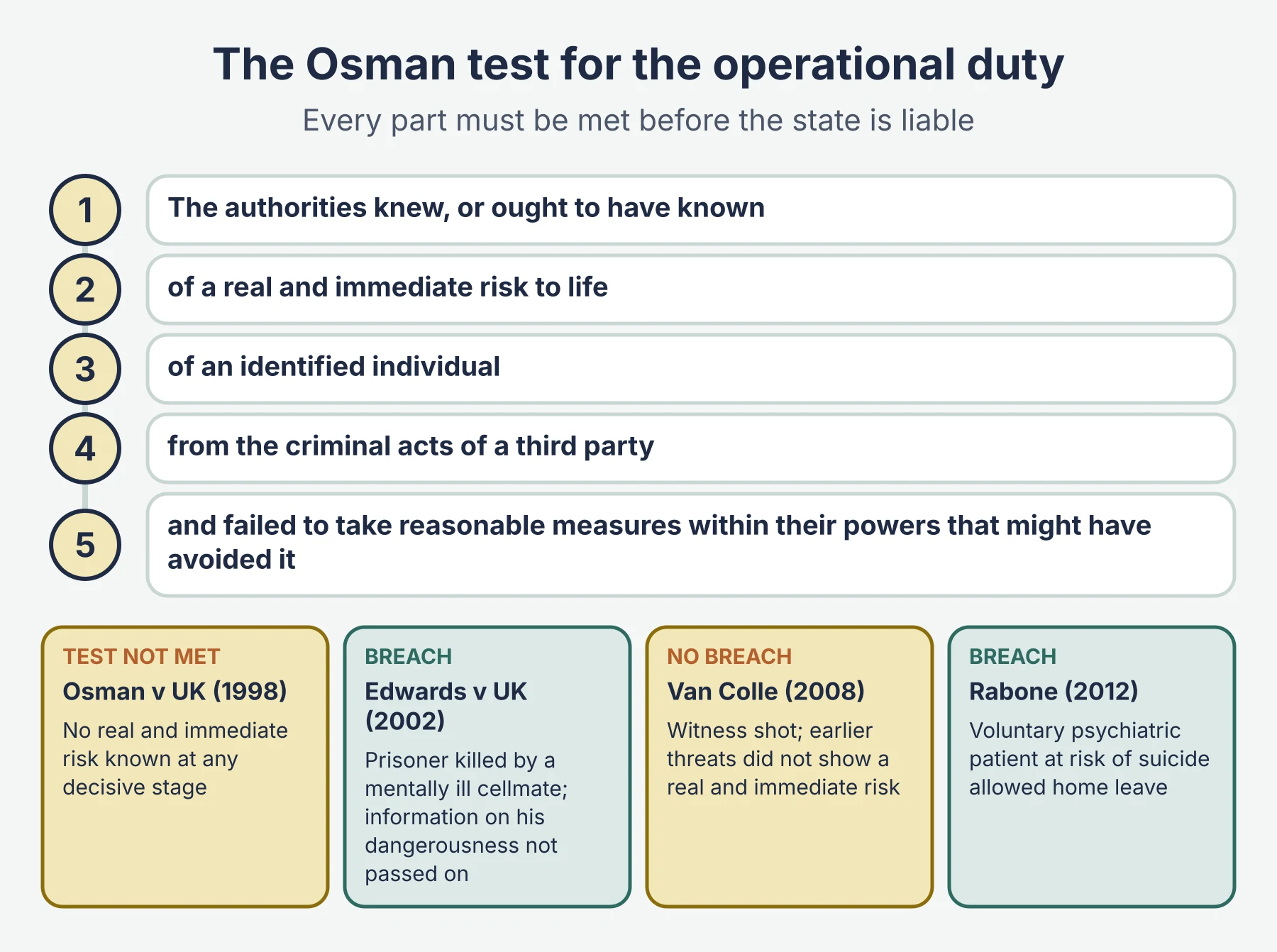
The Osman test is demanding. The authorities must have known, or ought to have known, of a real and immediate risk to the life of an identified individual from the criminal acts of a third party, and failed to take measures within their powers which, judged reasonably, might have been expected to avoid that risk.
- In Osman v UK (1998) the test was not met: the police could not be said to have known of a real and immediate risk at any decisive stage.
- In Edwards v UK (2002) a prisoner was killed by a mentally ill cellmate. The authorities had information about the cellmate’s dangerousness that was not passed on, and Article 2 was breached.
- In Van Colle v Chief Constable of Hertfordshire (2008) the House of Lords applied Osman strictly: a witness was shot by the defendant in a criminal case, but the earlier threats did not show a real and immediate risk to life, so there was no breach.
- In Rabone v Pennine Care NHS Foundation Trust (2012) the Supreme Court held that a hospital owed the operational duty to a voluntary psychiatric patient at real and immediate risk of suicide, and breached it by allowing her home leave.
Scope: when life begins and ends
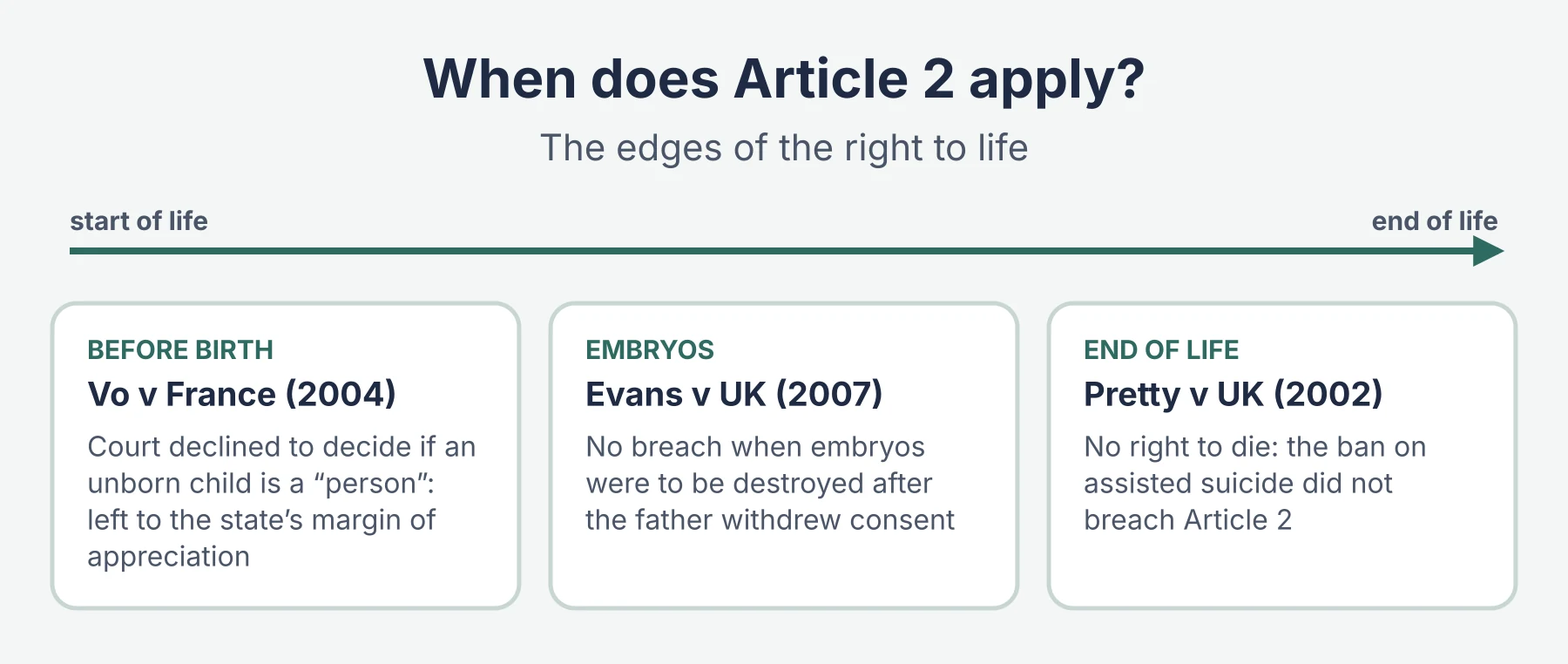
- Unborn children: in Vo v France (2004) the Court declined to decide whether an unborn child is a “person” under Article 2, leaving the question within the state’s margin of appreciation. In Evans v UK (2007) there was no breach of Article 2 when embryos were to be destroyed after the father withdrew consent.
- A right to die: in Pretty v UK (2002) the Court held that Article 2 cannot be interpreted as conferring the opposite right, a right to die, so the ban on assisted suicide did not breach it.
Article 2.2: justified exceptions
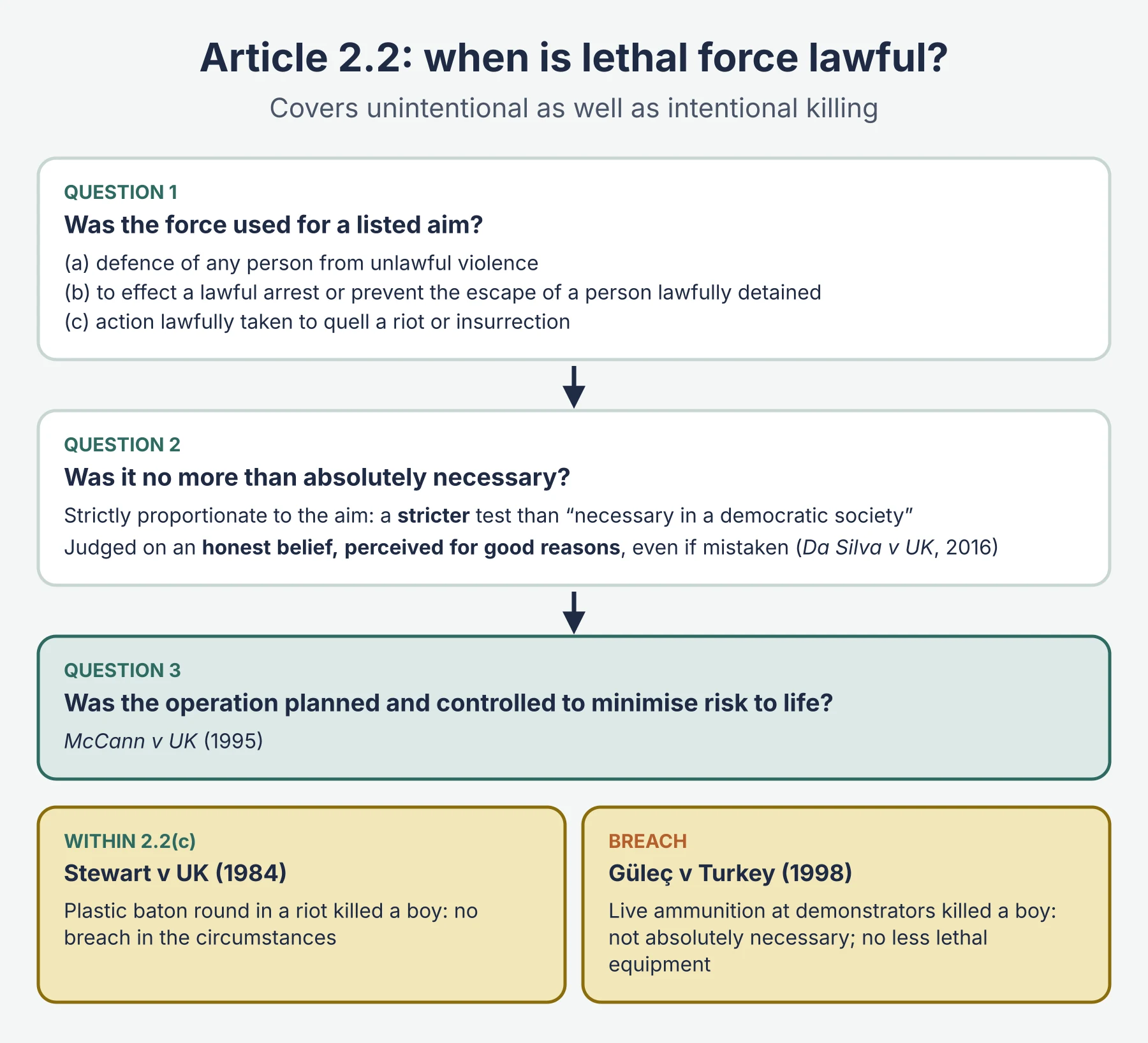
Article 2.2 provides that deprivation of life is not a breach when it results from the use of force which is no more than absolutely necessary:
- (a) in defence of any person from unlawful violence;
- (b) in order to effect a lawful arrest or to prevent the escape of a person lawfully detained;
- (c) in action lawfully taken for the purpose of quelling a riot or insurrection.
“Absolutely necessary”
The words “absolutely necessary” set a stricter test than “necessary in a democratic society” in the qualified rights. The force must be strictly proportionate to achieving one of the listed aims.
Article 2.2 covers unintentional as well as intentional killing: it applies whenever lethal force is used, even if death was not the aim.
McCann v UK (1995)
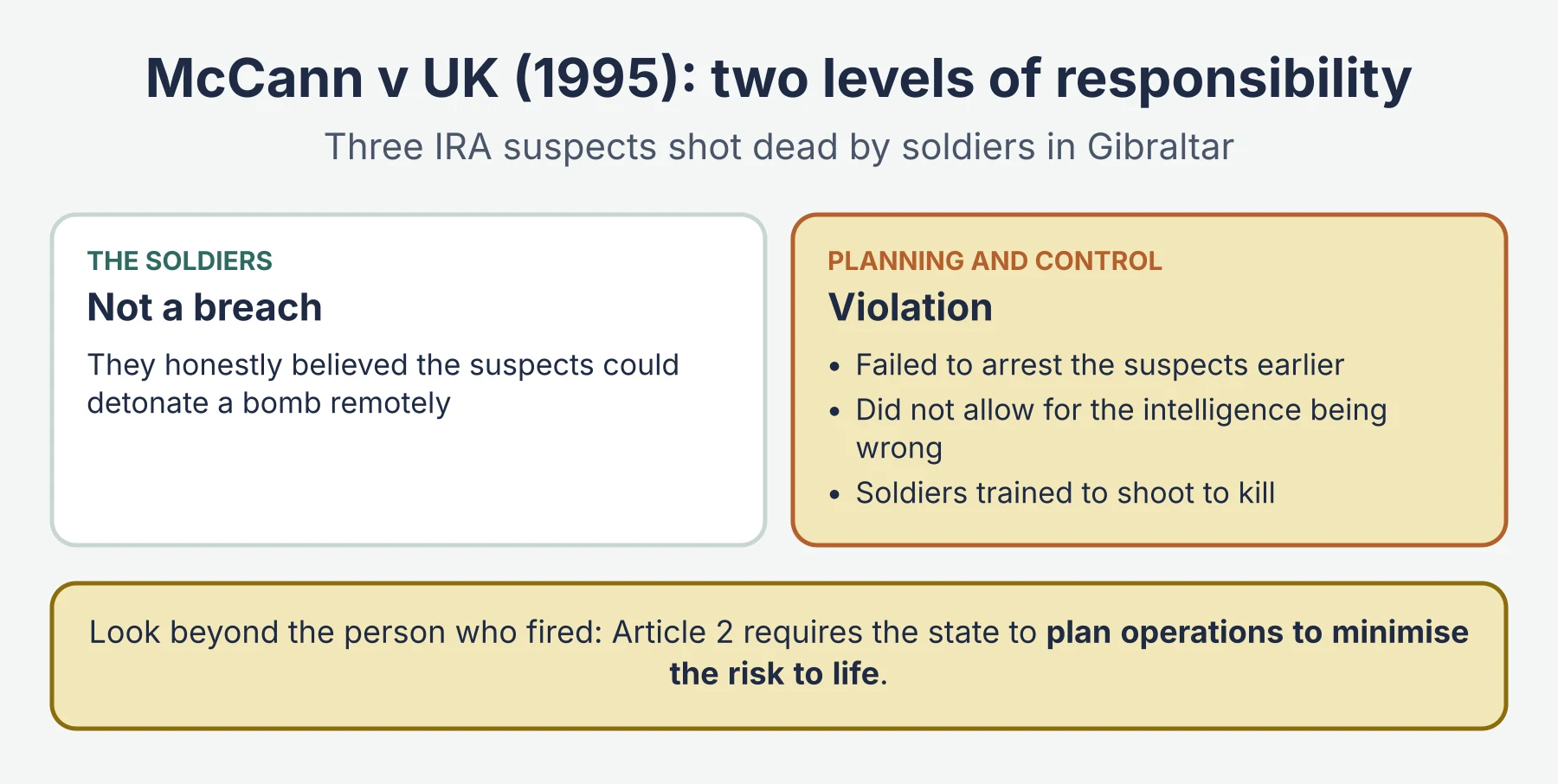
Three IRA suspects believed to be planning a car bomb attack in Gibraltar were shot dead by soldiers. The soldiers honestly believed that the suspects could detonate a bomb remotely, so their own actions were not a breach. But the Court found a violation because of the planning and control of the operation: the authorities failed to arrest the suspects earlier, did not allow for the possibility that their intelligence was wrong, and the soldiers were trained to shoot to kill. Article 2 therefore requires the state to plan operations to minimise the risk to life.
Honest belief
In Da Silva v UK (2016) the Grand Chamber held that force is assessed on the basis of an honest belief, perceived for good reasons, to be valid at the time, even if it turns out to be mistaken. The test is subjective, but the belief must be genuinely held and the reasons for it are examined.
Riots and demonstrations
- In Stewart v UK (1984) the European Commission found no breach where a soldier fired a plastic baton round during a riot in Northern Ireland and killed a boy; the force was within 2.2(c) in the circumstances.
- In Güleç v Turkey (1998) security forces used live ammunition against demonstrators and killed a boy. The Court found a breach: the force was not absolutely necessary, and the forces lacked less lethal equipment.
The procedural duty
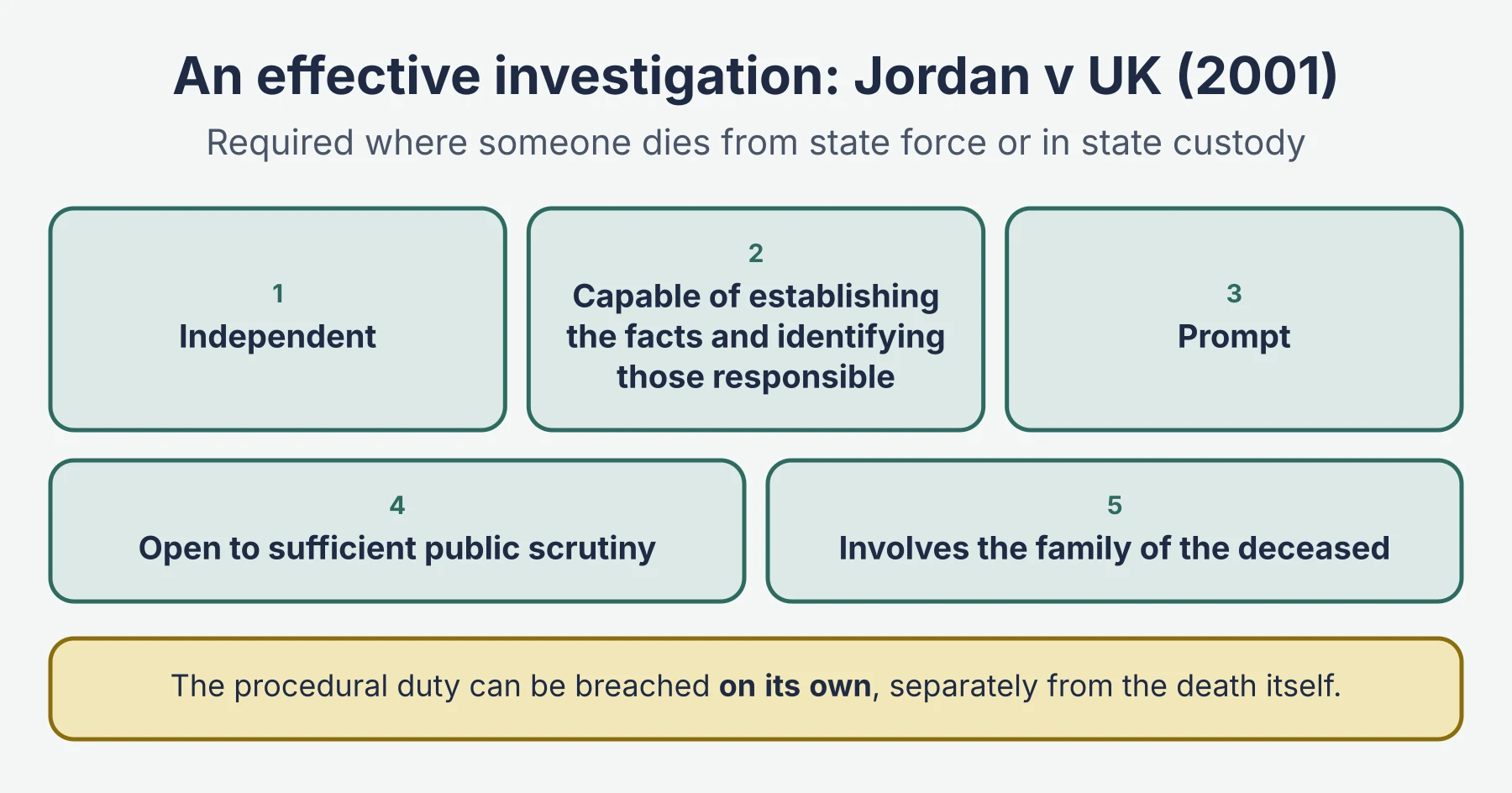
Wherever a person dies as a result of the use of force by the state, or in state custody, there must be an effective official investigation. Jordan v UK (2001) sets out its features: it must be independent, capable of establishing the facts and identifying those responsible, prompt, open to sufficient public scrutiny, and must involve the family of the deceased.
Worked example
Facts: Police receive a tip-off that Marek has a gun and plans to rob a bank. They let him enter the bank so they can catch him “in the act” rather than arrest him at home. An officer shoots him dead when he raises an object later found to be a phone. Marek’s family were told nothing for two weeks, and an investigation was carried out by officers from the same force.
Article 2.2:    Was the shooting for an aim in (a) or (b)? Defence of others
                from unlawful violence, or effecting a lawful arrest.
Absolutely      The officer's honest belief, for good reasons, that Marek
necessary:      was raising a gun may justify the shot itself (Da Silva).
Planning:       Choosing to let an armed suspect enter a bank instead of
                arresting him earlier may breach Article 2 through poor
                planning and control (McCann).
Procedural:     Investigation by the same force is not independent, and
                the family was not involved (Jordan): a separate breach.
Conclusion:     Likely violation of Article 2 on planning and on the
                investigation, even if the officer is not personally at fault.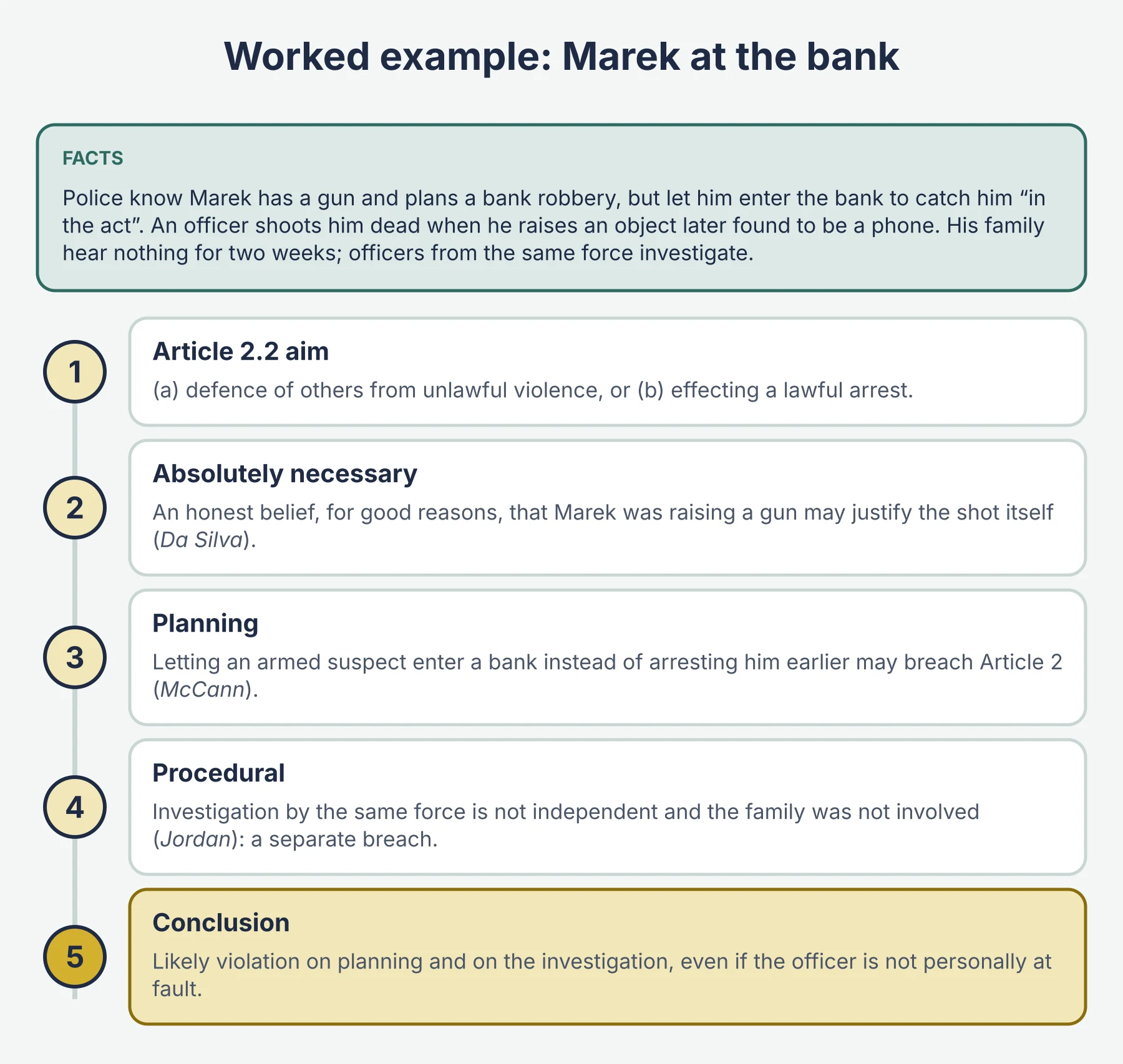
Common mistakes
- Applying a proportionality balancing test as if Article 2 were qualified.
- Treating “absolutely necessary” as the same as “necessary in a democratic society”.
- Looking only at the person who used force and ignoring planning and control (McCann).
- Forgetting the procedural duty to investigate, which can be breached on its own.
- Saying Article 2 protects a right to die; Pretty v UK held it does not.
- Treating Osman as a case where the state was liable; the test was not met.
Exam technique
- Explain questions: set out 2.1, the obligations and 2.2, each with one case.
- Suggest and Advise questions: identify the obligation in play (negative, operational or procedural), apply the relevant test and conclude on breach.
- Consider questions: develop both sides, for example whether a risk was “real and immediate” or whether force was absolutely necessary.
- Discuss questions: evaluate how well Article 2 protects life, for example whether the Osman test is too demanding or whether McCann places too heavy a burden on security forces.
More resources on this topic
Article 2 revision notes | Article 2 practice questions | Article 5 study guide
Related resources
-
Practice questions
AQA A Level Law (7162): Article 2 of the European Convention on Human Rights 1953 – Practice Questions
Original Article 2 ECHR practice for AQA A Level Law 7162 with mark-scheme answers on positive duties, the Osman test, Article 2.2, McCann and investigations.
Law · AQA · A Level
Try questions -
Revision notes
AQA A Level Law (7162): Article 2 of the European Convention on Human Rights 1953 – Revision Notes
Condensed recall on Article 2 ECHR for AQA A Level Law 7162: positive and procedural duties, the Osman test, the 2.2 exceptions and absolutely necessary force.
Law · AQA · A Level
Revise topic -
Study guides
AQA A Level Law (7162): Article 5 of the European Convention on Human Rights 1953
Article 5 ECHR for AQA A Level Law 7162: what counts as a deprivation of liberty, the 5.1(a) to (c) grounds and the safeguards in Articles 5.2 to 5.5.
Law · AQA · A Level
Read guide
Get free revision emails (optional)
Occasional emails with practice questions, worked explanations and links to free resources for the qualification and subjects you choose. No spam, and you can unsubscribe from any email. The free tools on this site never need an email.