
Revision Notes
AQA A Level Law (7162): Article 2 of the European Convention on Human Rights 1953 – Revision Notes
Condensed recall on Article 2 ECHR for AQA A Level Law 7162: positive and procedural duties, the Osman test, the 2.2 exceptions and absolutely necessary force.
- Subject
- Law
- Level
- A LEVELS
- Topic
- Topic 5: Human Rights
- Author
- Marlbridge Academic Team
- Updated
- Reviewed by
- Aizaz Raoof Ali (what this means)
Aligned to AQA A Level Law (7162), For teaching from September 2017 onwards, A-level exams 2019 onwards. Official specification .
Syllabus page (what it covers and how it is assessed): AQA A Level Law.
Syllabus points this page covers
7162
- Article 2 of the European Convention on Human Rights 1953
Found an error? Report a correction.
Need help with this topic? Request a free trial class for A Level Law (7162).
Condensed notes on Article 2, the right to life. For full explanation and a worked scenario, use the Article 2 study guide.
The structure in one line
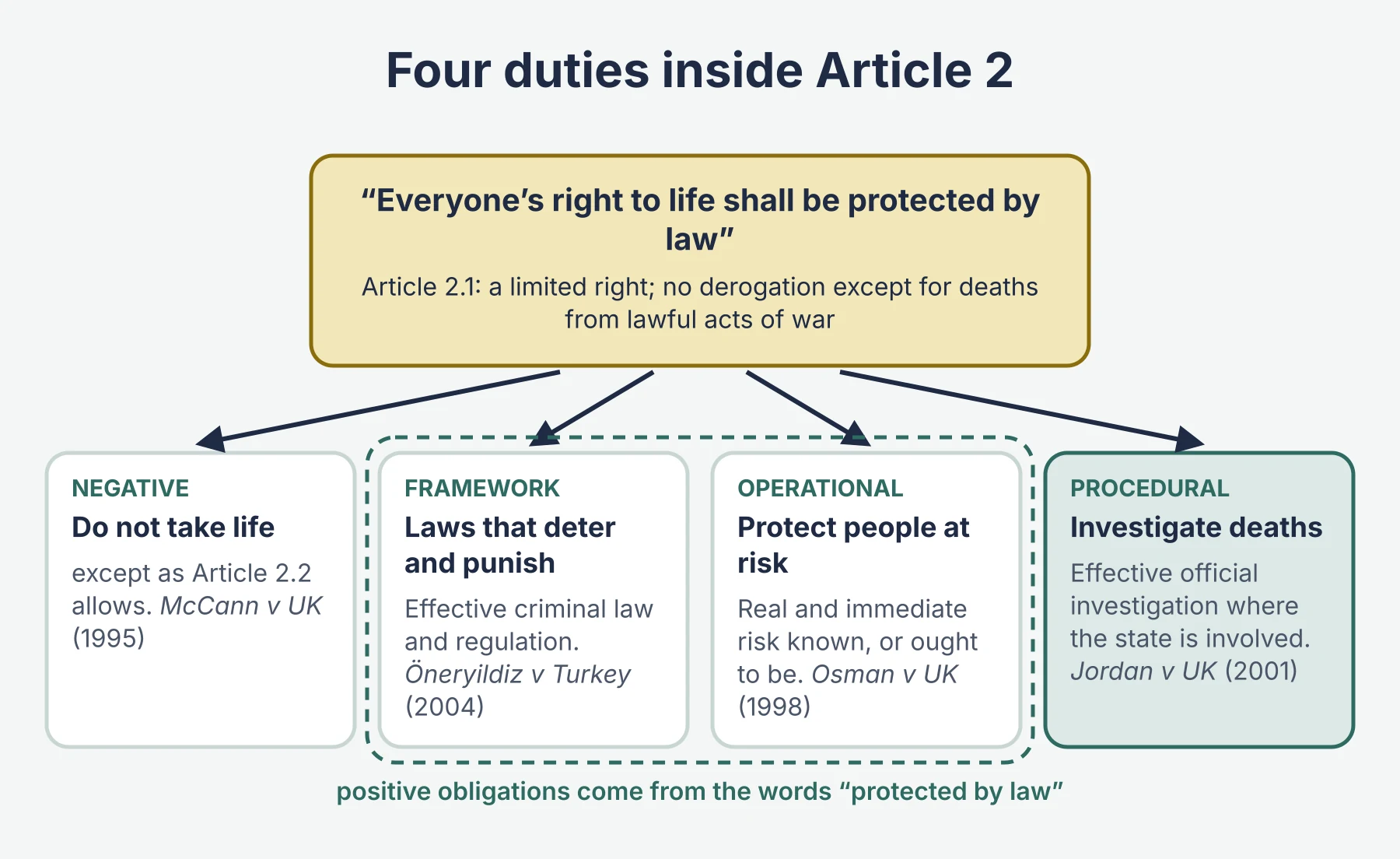
2.1 right to life “protected by law” → which obligation? (negative, framework, operational, procedural) → if the state used force: 2.2(a), (b) or (c) and “no more than absolutely necessary” → planning and control → investigation → remedy.
Article 2 is limited: the exceptions in 2.2 are exhaustive. No derogation under Article 15, except deaths from lawful acts of war.
Article 2.1
- Death penalty exception superseded by Protocols 6 and 13 (both ratified by the UK).
- “Protected by law” grounds the positive obligations.
| Obligation | Test | Case |
|---|---|---|
| Negative | No intentional or unintended killing by state agents outside 2.2 | McCann v UK (1995) |
| Framework | Effective criminal law and regulation of dangerous activities | Öneryildiz v Turkey (2004): methane explosion at a rubbish tip |
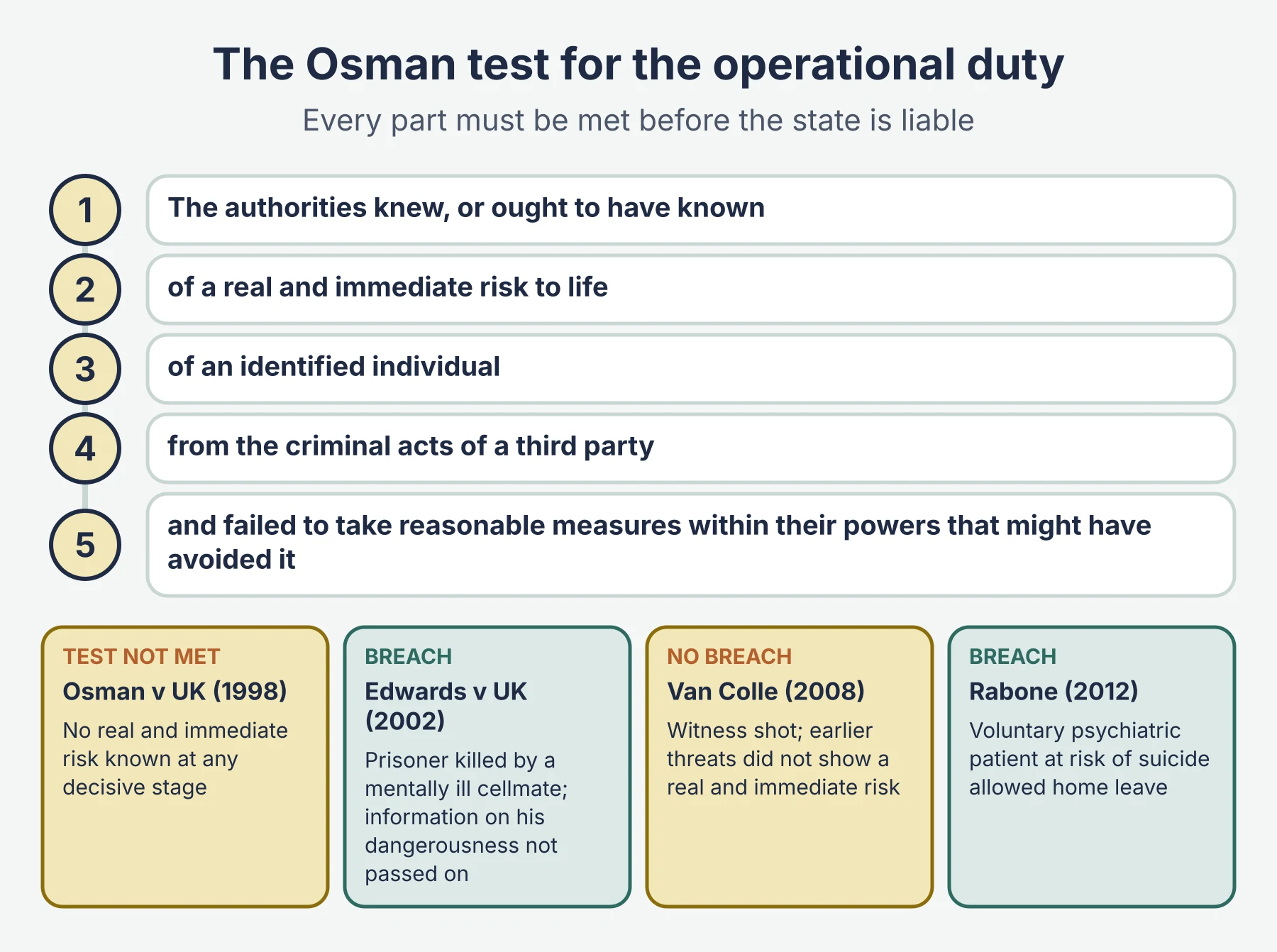
| Operational | Knew or ought to have known of a real and immediate risk to an identified individual; failed to take reasonable measures | Osman v UK (1998) |
| Procedural | Effective official investigation of deaths involving the state | Jordan v UK (2001) |
Operational duty cases
| Case | Outcome |
|---|---|
| Osman v UK (1998) | No breach: no decisive point at which police knew of a real and immediate risk |
| Edwards v UK (2002) | Breach: prisoner killed by a mentally ill cellmate; information not passed on |
| Van Colle v CC Hertfordshire (2008) | No breach: threats to a witness did not show a real and immediate risk |
| Rabone v Pennine Care (2012) | Breach: duty owed to a voluntary psychiatric patient at real and immediate risk of suicide |
Scope
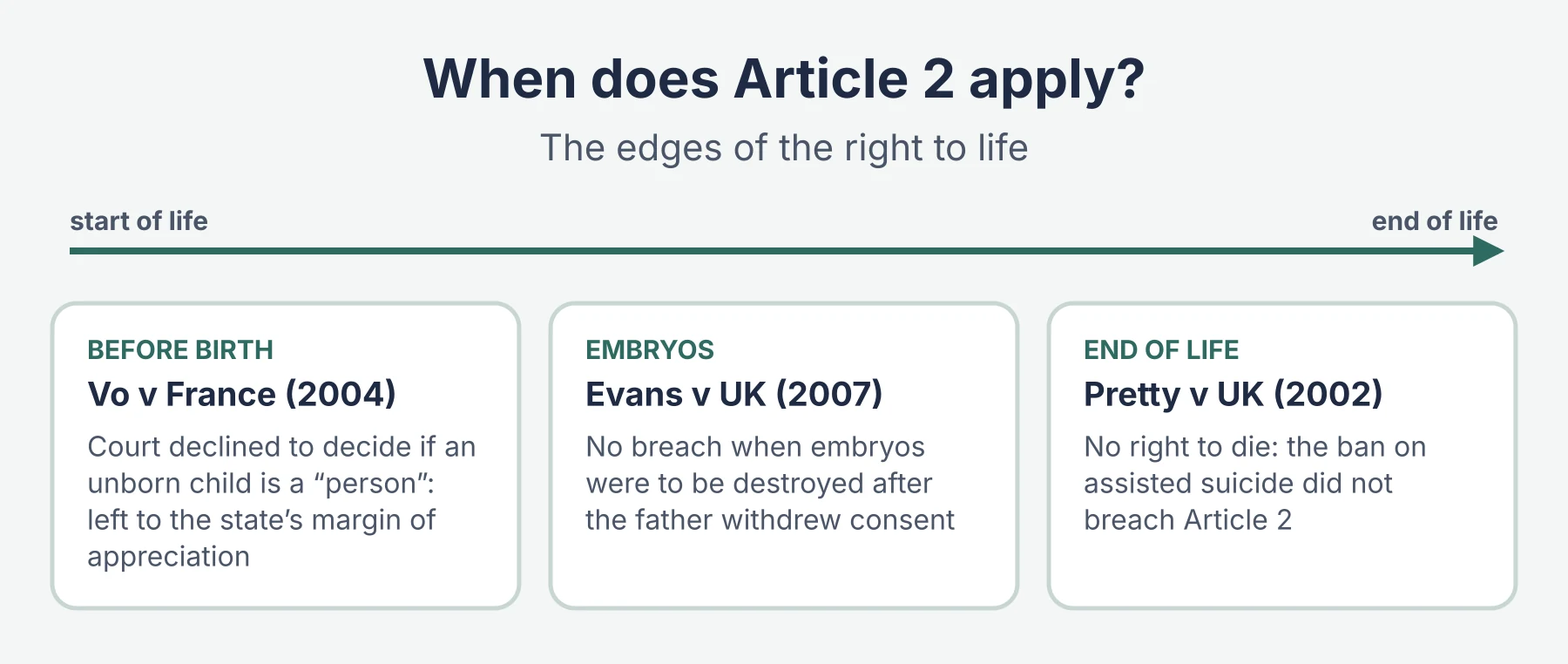
- Vo v France (2004): status of the unborn left within the margin of appreciation.
- Evans v UK (2007): destroying embryos after consent withdrawn did not breach Article 2.
- Pretty v UK (2002): no right to die.
Article 2.2
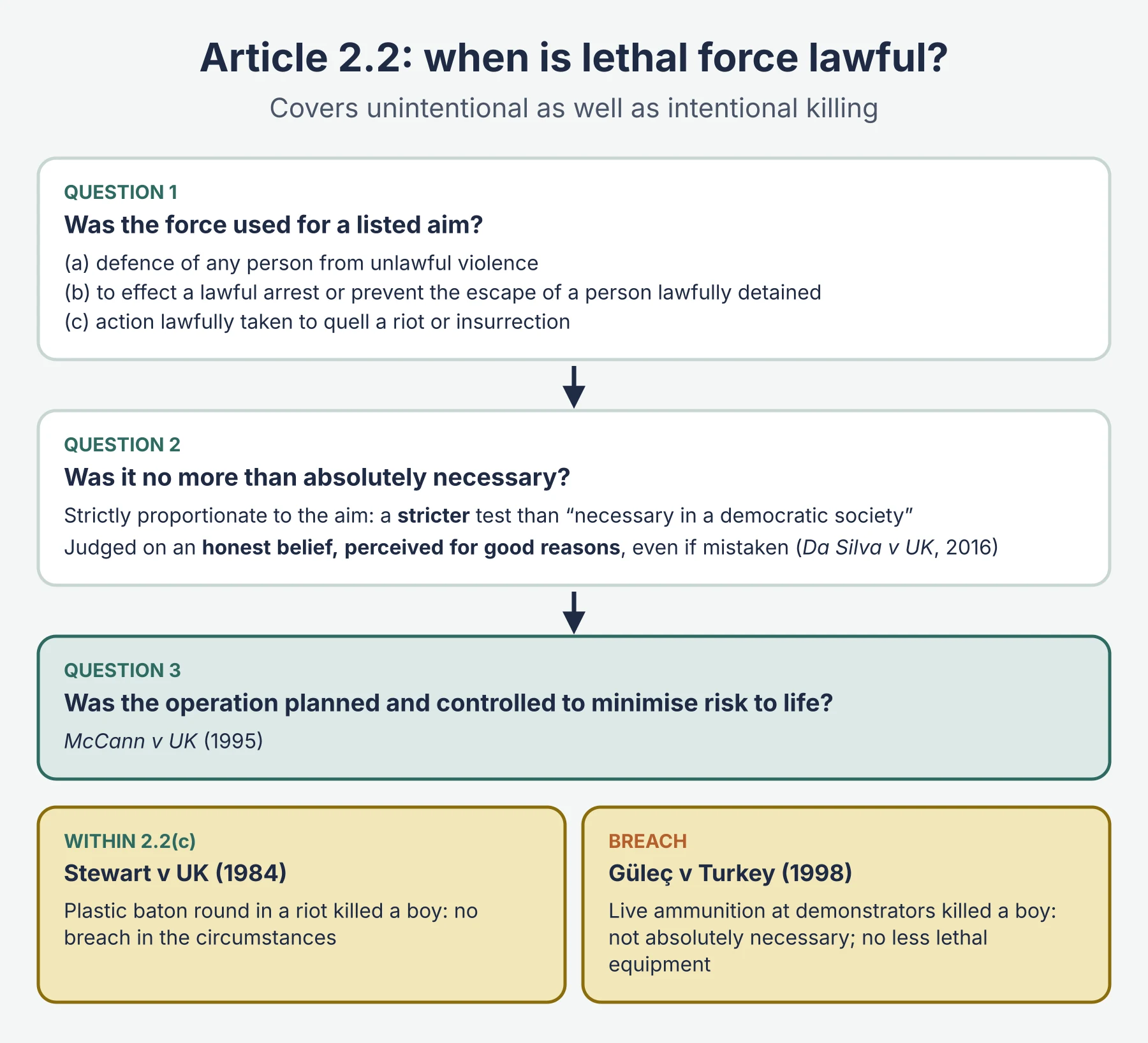
Force no more than absolutely necessary:
-
(a) defence of any person from unlawful violence;
-
(b) effecting a lawful arrest or preventing the escape of a person lawfully detained;
-
(c) action lawfully taken to quell a riot or insurrection.
-
“Absolutely necessary” is stricter than “necessary in a democratic society”: force must be strictly proportionate.
-
Covers unintended deaths from the use of force.
| Case | Point |
|---|---|
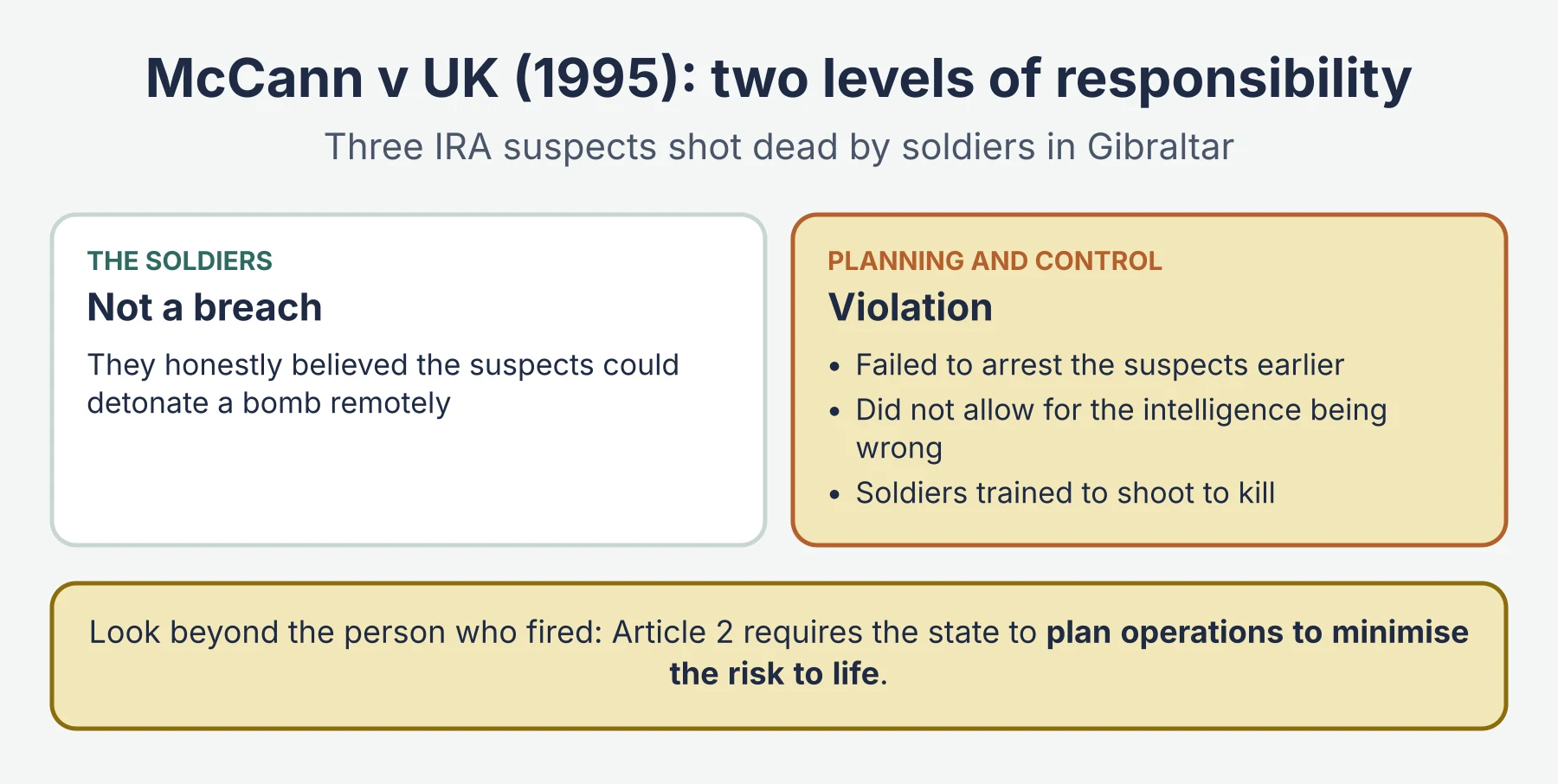
| McCann v UK (1995) | Soldiers’ honest belief excused them, but planning and control of the operation breached Article 2 |
| Da Silva v UK (2016) | Honest belief, perceived for good reasons, valid at the time, even if mistaken |
| Stewart v UK (1984) | Commission: plastic baton round in a riot within 2.2(c); no breach |
| Güleç v Turkey (1998) | Live fire on demonstrators not absolutely necessary; no less lethal equipment; breach |
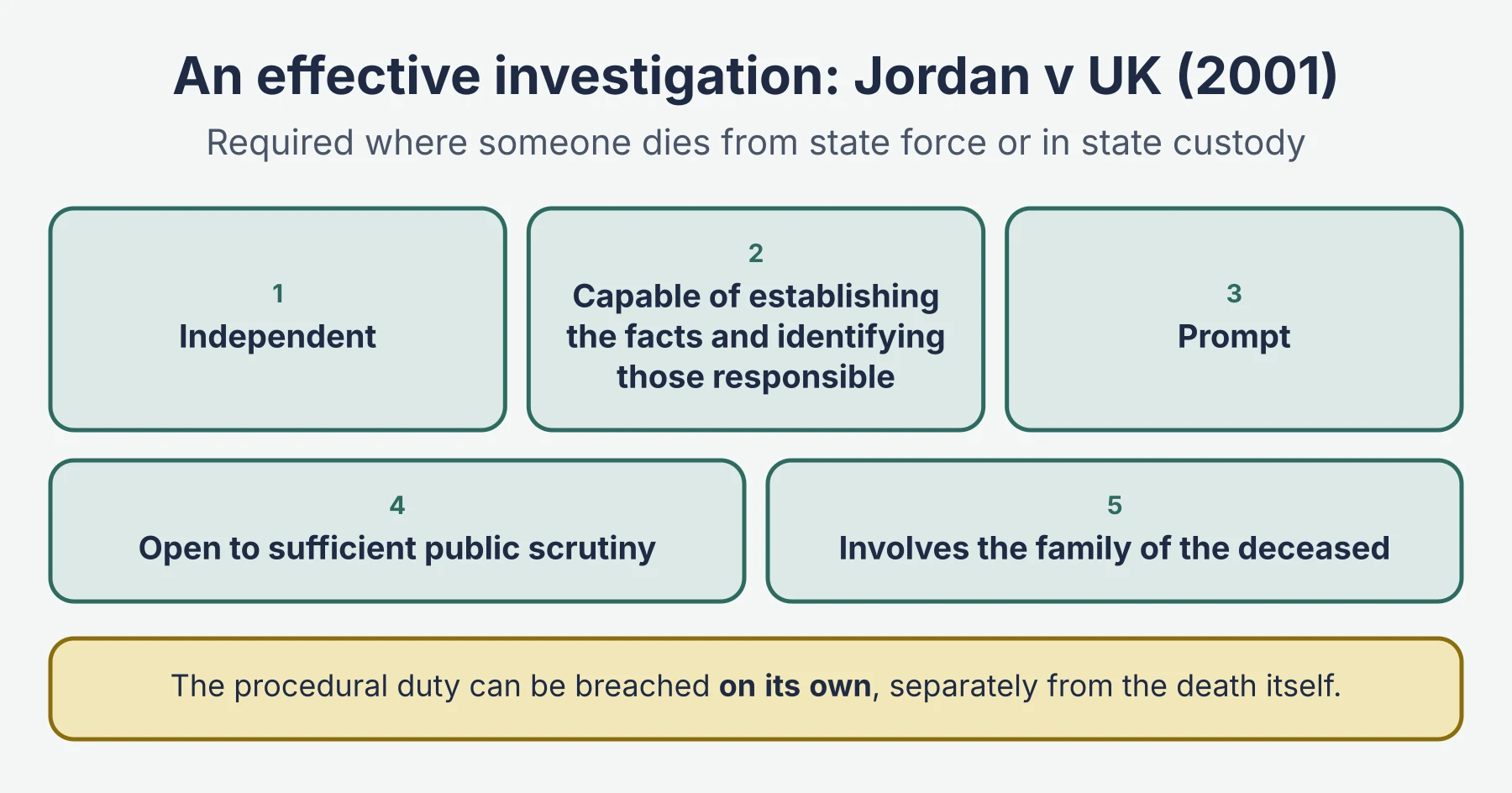
Procedural duty (Jordan v UK, 2001)
Investigation must be: independent · effective (able to establish facts and identify those responsible) · prompt · open to public scrutiny · involve the family.
Key terms
| Term | Meaning |
|---|---|
| Limited right | Exceptions only as listed in the Article |
| Positive obligation | Duty to take steps to protect life |
| Operational duty | Duty to act on a known real and immediate risk to an identified person |
| Real and immediate risk | Objectively verified and present and continuing, not remote |
| Absolutely necessary | Force strictly proportionate to a 2.2 aim |
| Planning and control | The state’s responsibility for how an operation is organised |
| Procedural obligation | Duty to investigate deaths effectively |
Exam traps
- Applying the qualified-rights test to Article 2.
- Missing the planning and control point after finding the officer’s belief honest.
- Treating Osman as a breach; it was not.
- Forgetting that unintended killings by force are within 2.2.
- Omitting the investigation duty, which can be breached on its own.
- Claiming Article 2 includes a right to die.
Self-test
- Why is Article 2 described as a limited right?
- Can a state derogate from Article 2?
- What is the effect of Protocols 6 and 13?
- State the Osman test for the operational duty.
- Why was there a breach in Edwards v UK?
- Why was there no breach in Van Colle?
- What did Rabone v Pennine Care decide?
- List the three aims in Article 2.2.
- How does “absolutely necessary” differ from “necessary in a democratic society”?
- Why did the Court find a breach in McCann v UK?
- What test did the Grand Chamber apply in Da Silva v UK?
- What are the requirements of an effective investigation under Jordan v UK?
Answers: 1. Its only exceptions are those listed in Article 2.2. 2. No, except for deaths resulting from lawful acts of war. 3. They abolish the death penalty, in peacetime and in all circumstances. 4. The authorities knew or ought to have known of a real and immediate risk to the life of an identified individual from a third party’s criminal acts, and failed to take reasonable measures within their powers to avoid it. 5. Information about the cellmate’s dangerousness was not passed on, and a prisoner was killed. 6. The earlier threats did not show a real and immediate risk to life. 7. A hospital owed the operational duty to a voluntary psychiatric patient at real and immediate risk of suicide and breached it. 8. Defence of any person from unlawful violence; effecting a lawful arrest or preventing escape; quelling a riot or insurrection. 9. It is stricter: force must be strictly proportionate to the aim. 10. The planning and control of the operation did not minimise the risk to life. 11. An honest belief, perceived for good reasons to be valid at the time, even if mistaken. 12. Independent, effective, prompt, open to public scrutiny and involving the family.
More resources on this topic
Article 2 study guide | Article 2 practice questions | Human Rights revision notes
Related resources
-
Study guides
AQA A Level Law (7162): Article 5 of the European Convention on Human Rights 1953
Article 5 ECHR for AQA A Level Law 7162: what counts as a deprivation of liberty, the 5.1(a) to (c) grounds and the safeguards in Articles 5.2 to 5.5.
Law · AQA · A Level
Read guide -
Practice questions
AQA A Level Law (7162): Article 5 of the European Convention on Human Rights 1953 – Practice Questions
Original Article 5 ECHR practice for AQA A Level Law 7162 with mark-scheme answers on deprivation of liberty, reasonable suspicion, Brogan and derogation.
Law · AQA · A Level
Try questions -
Revision notes
AQA A Level Law (7162): Article 5 of the European Convention on Human Rights 1953 – Revision Notes
Condensed recall on Article 5 ECHR for AQA A Level Law 7162: deprivation of liberty, grounds 5.1(a) to (c), reasonable suspicion and the 5.2 to 5.5 safeguards.
Law · AQA · A Level
Revise topic
Get free revision emails (optional)
Occasional emails with practice questions, worked explanations and links to free resources for the qualification and subjects you choose. No spam, and you can unsubscribe from any email. The free tools on this site never need an email.