
Revision Notes
AQA A Level Law (7162): Article 5 of the European Convention on Human Rights 1953 – Revision Notes
Condensed recall on Article 5 ECHR for AQA A Level Law 7162: deprivation of liberty, grounds 5.1(a) to (c), reasonable suspicion and the 5.2 to 5.5 safeguards.
- Subject
- Law
- Level
- A LEVELS
- Topic
- Topic 5: Human Rights
- Author
- Marlbridge Academic Team
- Updated
- Reviewed by
- Aizaz Raoof Ali (what this means)
Aligned to AQA A Level Law (7162), For teaching from September 2017 onwards, A-level exams 2019 onwards. Official specification .
Syllabus page (what it covers and how it is assessed): AQA A Level Law.
Syllabus points this page covers
7162
- Article 5 of the European Convention on Human Rights 1953
Found an error? Report a correction.
Need help with this topic? Request a free trial class for A Level Law (7162).
Condensed notes on Article 5, the right to liberty and security of person. For full explanation and a worked scenario, use the Article 5 study guide.
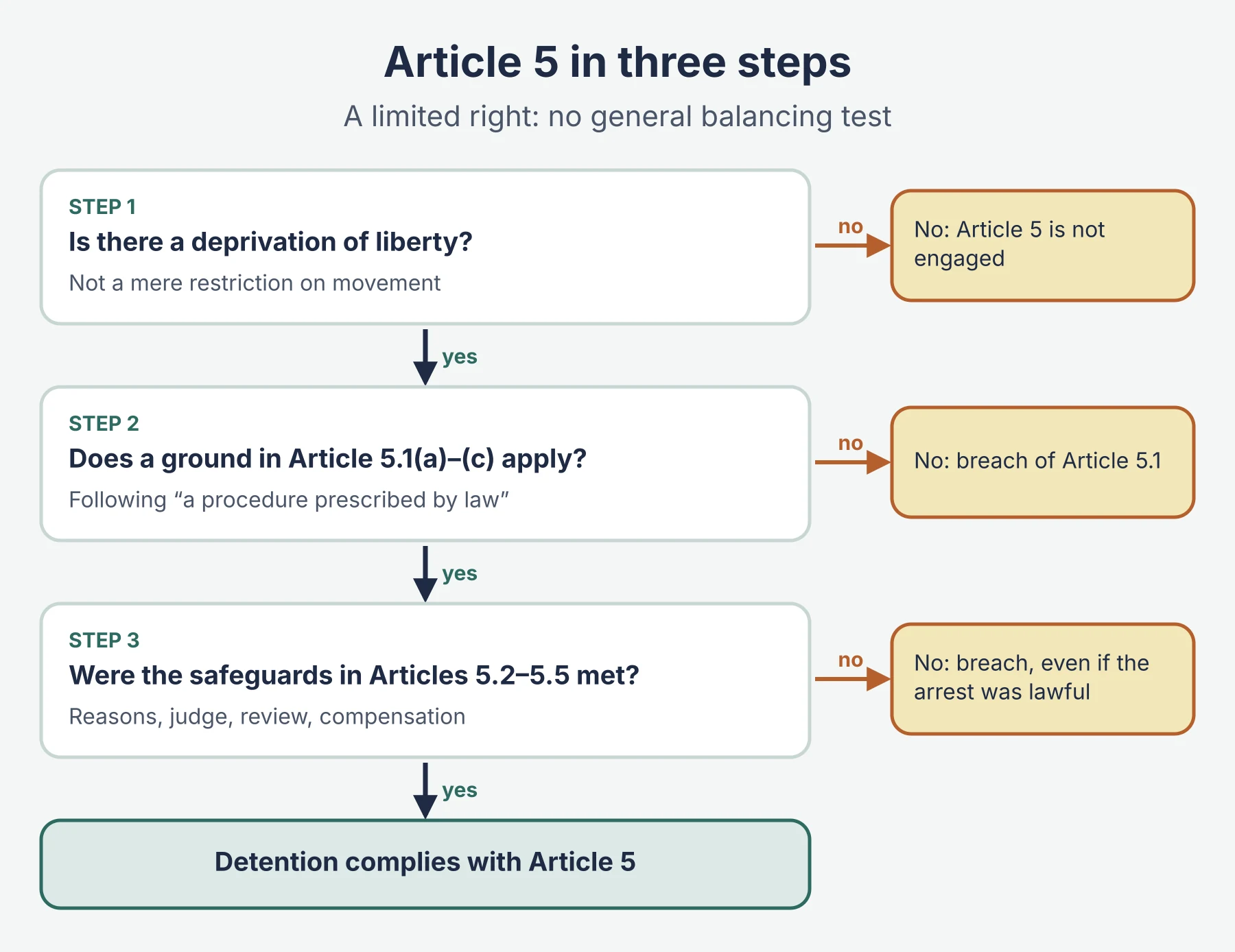
The structure in one line
Right (5.1) → is there a deprivation? → listed ground (5.1(a) to (f); the specification names (a) to (c)) → procedure prescribed by law → safeguards (5.2 to 5.5) → remedy.
Article 5 is a limited right: the exceptions are written into the Article and the list is exhaustive. There is no general balancing test as there is for Articles 8, 10 and 11.
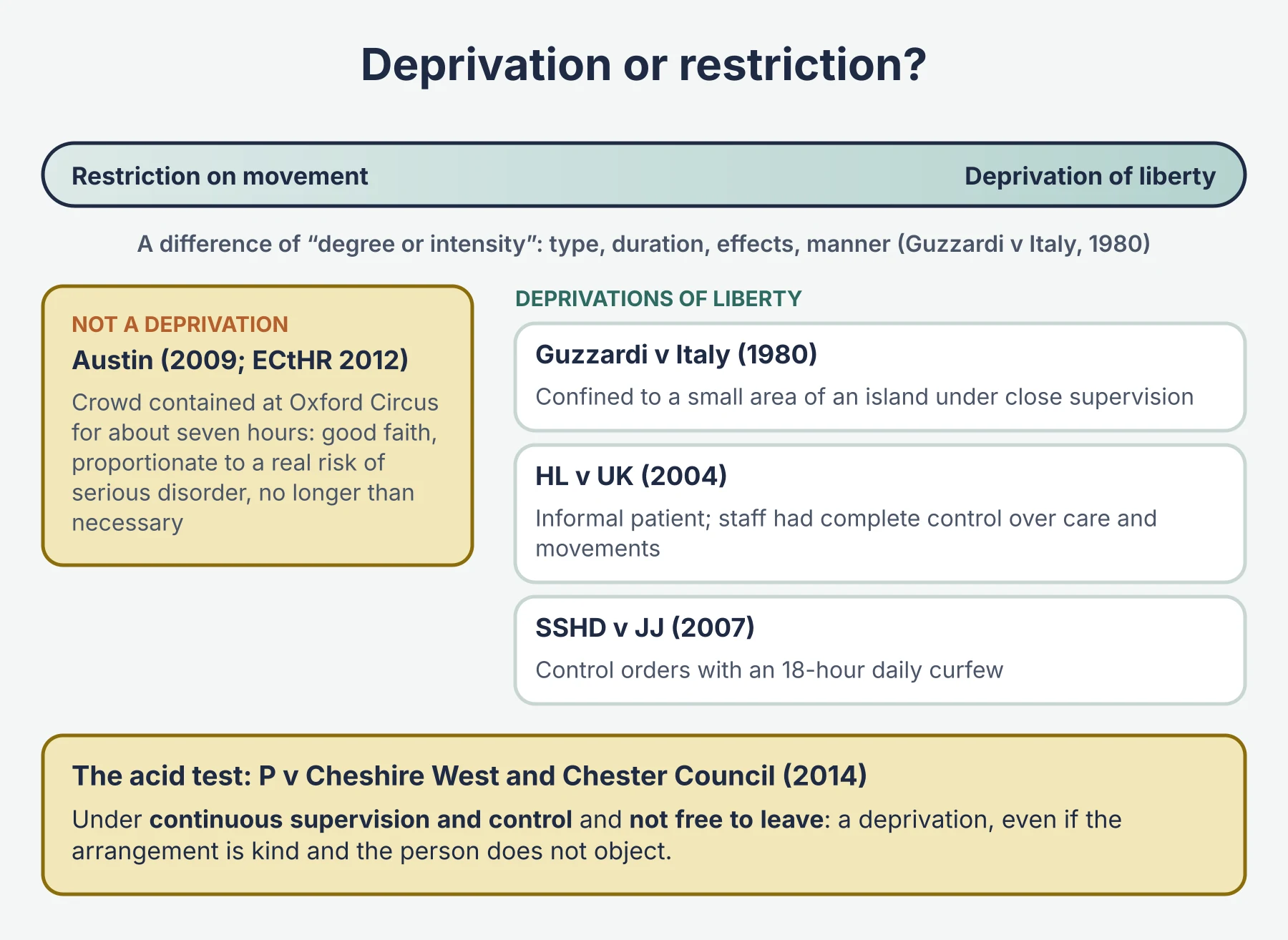
Deprivation or restriction?
| Case | Facts in brief | Outcome |
|---|---|---|
| Guzzardi v Italy (1980) | Suspect confined to a small part of an island under supervision | Deprivation: the difference is “one of degree or intensity” |
| HL v UK (2004) | Informal patient lacking capacity, kept in hospital under full staff control | Deprivation; no legal procedure or review, so 5.1 and 5.4 breached |
| Cheshire West (2014) | Adults lacking capacity in care settings | “Acid test”: continuous supervision and control and not free to leave |
| SSHD v JJ (2007) | Control orders with an 18-hour curfew | Deprivation of liberty |
| Austin v MPC (2009); Austin v UK (2012) | Crowd contained at Oxford Circus for about seven hours | No deprivation: good faith, proportionate, no longer than necessary, crowd-control context |
The three named grounds
- 5.1(a): detention after conviction by a competent court. Needs a causal link to the conviction.
- 5.1(b): arrest or detention for breach of a lawful court order, or to secure a specific obligation prescribed by law.
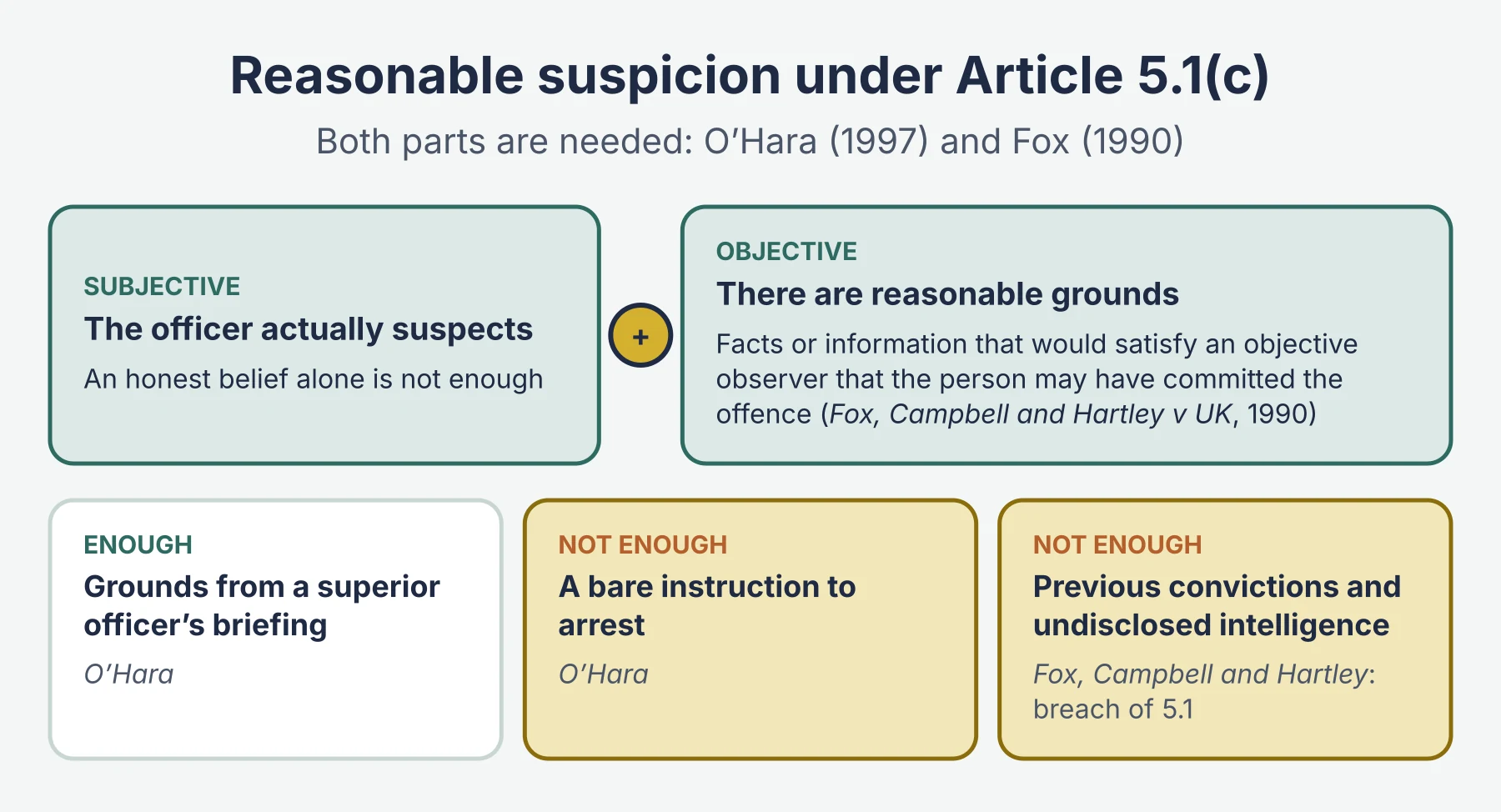
- 5.1(c): arrest or detention to bring a person before the competent legal authority on reasonable suspicion of an offence, or when reasonably necessary to prevent an offence or flight.
Reasonable suspicion: facts or information that would satisfy an objective observer that the person may have committed the offence (Fox, Campbell and Hartley v UK, 1990). Honest belief alone is not enough. English law: the officer must actually suspect and have reasonable grounds; grounds may come from a briefing, but a bare order to arrest is not enough (O’Hara v Chief Constable of the RUC, 1997).
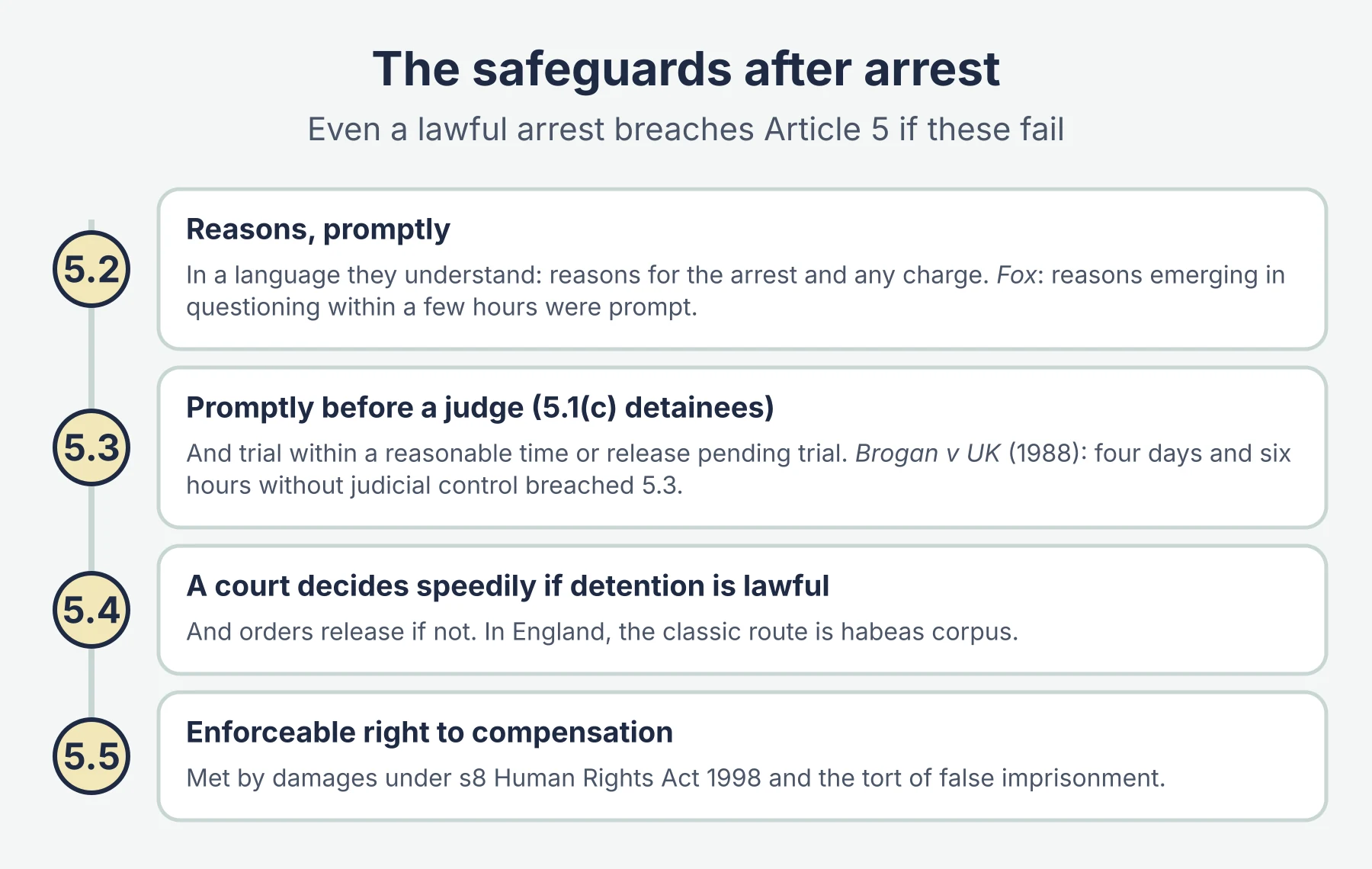
The safeguards
| Paragraph | Requirement | Authority |
|---|---|---|
| 5.2 | Told promptly, in a language understood, the reasons for arrest and any charge | Fox, Campbell and Hartley: reasons given in interview within a few hours were prompt |
| 5.3 | Brought promptly before a judge; trial within a reasonable time or release pending trial | Brogan v UK (1988): four days six hours was too long |
| 5.4 | Speedy court decision on the lawfulness of detention, release if unlawful | Habeas corpus; HL v UK |
| 5.5 | Enforceable right to compensation for unlawful detention | HRA 1998 s8 damages; false imprisonment |
Derogation
- Article 15 allows derogation from Article 5 in war or a public emergency threatening the life of the nation, only to the extent strictly required.
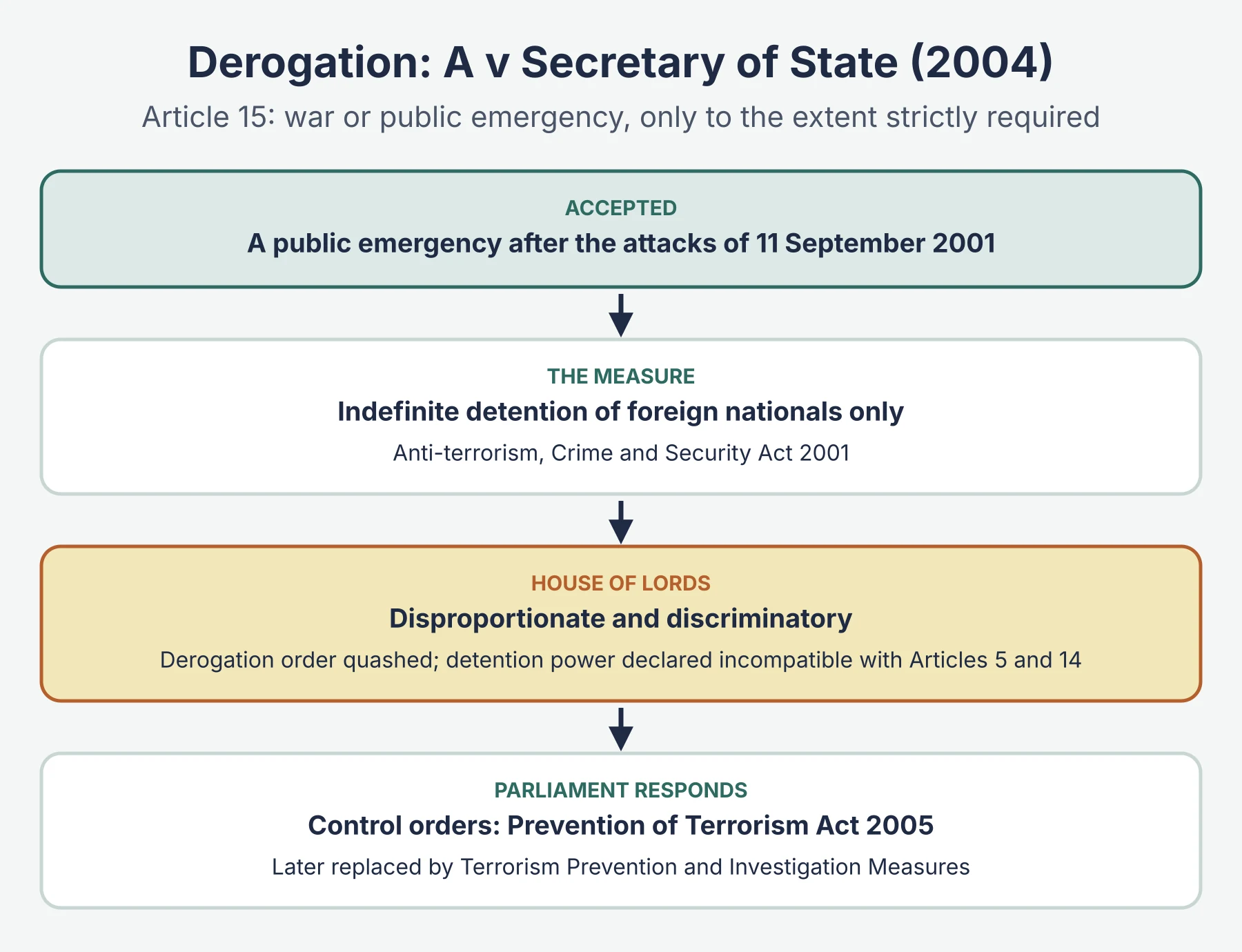
- A v SSHD (2004): emergency accepted, but indefinite detention of foreign nationals only was disproportionate and discriminatory; derogation order quashed; declaration of incompatibility with Articles 5 and 14. Parliament responded with control orders (Prevention of Terrorism Act 2005).
Key terms
| Term | Meaning |
|---|---|
| Limited right | A right subject only to the exceptions written into the Article itself |
| Deprivation of liberty | Confinement of sufficient degree or intensity, judged on type, duration, effects and manner |
| Procedure prescribed by law | The detention must have a basis in domestic law that is accessible and foreseeable and followed correctly |
| Reasonable suspicion | Facts or information that would satisfy an objective observer |
| Promptly (5.3) | Without undue delay; strictly construed after Brogan |
| Habeas corpus | Ancient writ requiring a detainer to justify the detention before a court |
| Derogation | Formal suspension of some Convention obligations under Article 15 |
Exam traps
- Applying “necessary in a democratic society” to Article 5. That test belongs to 8.2, 10.2 and 11.2.
- Missing the deprivation step: a short stop, or a short containment justified as in Austin, may not engage Article 5 at all.
- Mixing up 5.3 (after arrest, before a judge promptly) and 5.4 (any detainee can challenge lawfulness speedily).
- Saying Brogan set a fixed number of hours. It held that four days six hours was too long.
- Treating a lawful ground as the end of the analysis. A failure to give reasons (5.2) is a separate breach.
- Forgetting the remedy. Article 5.5 is the only paragraph in the Article that expressly requires compensation.
Self-test
- What kind of right is Article 5: absolute, limited or qualified?
- Which case states that deprivation differs from restriction in “degree or intensity”?
- State the “acid test” from Cheshire West.
- Why was there no deprivation of liberty in Austin?
- Which paragraph permits arrest on reasonable suspicion of an offence?
- What did Fox, Campbell and Hartley v UK decide about reasonable suspicion?
- In O’Hara, what two elements must be present for a lawful arrest on suspicion?
- Which paragraph requires reasons to be given, and how quickly?
- What did Brogan v UK decide?
- What is the difference between 5.3 and 5.4?
- What did the House of Lords decide in A v SSHD (2004)?
- How does English law satisfy Article 5.5?
Answers: 1. Limited. 2. Guzzardi v Italy (1980). 3. A person is deprived of liberty if under continuous supervision and control and not free to leave. 4. The containment was in good faith, proportionate to a real risk of serious disorder and no longer than necessary, in a crowd-control context. 5. Article 5.1(c). 6. It requires facts or information that would satisfy an objective observer; honest belief and past convictions alone were not enough. 7. The officer must actually suspect and there must be reasonable grounds for the suspicion. 8. Article 5.2: promptly, in a language the person understands. 9. Holding suspects for four days and six hours without bringing them before a judge breached Article 5.3. 10. Article 5.3 requires a person arrested on suspicion to be brought promptly before a judge; Article 5.4 gives any detained person the right to a speedy court decision on whether the detention is lawful. 11. Indefinite detention of foreign nationals only was disproportionate and discriminatory; the derogation order was quashed and a declaration of incompatibility made. 12. Damages under section 8 of the Human Rights Act 1998 and the tort of false imprisonment.
More resources on this topic
Article 5 study guide | Article 5 practice questions | Human Rights revision notes
Related resources
-
Study guides
AQA A Level Law (7162): Article 8 of the European Convention on Human Rights 1953
Article 8.1 ECHR for AQA A Level Law 7162: scope of private and family life, home and correspondence, positive obligations and privacy claims against the press.
Law · AQA · A Level
Read guide -
Practice questions
AQA A Level Law (7162): Article 8 of the European Convention on Human Rights 1953 – Practice Questions
Original Article 8 ECHR practice for AQA A Level Law 7162 with mark-scheme answers on private and family life, home, correspondence and private information.
Law · AQA · A Level
Try questions -
Revision notes
AQA A Level Law (7162): Article 8 of the European Convention on Human Rights 1953 – Revision Notes
Condensed recall on Article 8.1 ECHR for AQA A Level Law 7162: private life, family life, home, correspondence, positive duties and private information.
Law · AQA · A Level
Revise topic
Get free revision emails (optional)
Occasional emails with practice questions, worked explanations and links to free resources for the qualification and subjects you choose. No spam, and you can unsubscribe from any email. The free tools on this site never need an email.