
Study Guides
AQA A Level Law (7162): Article 8 of the European Convention on Human Rights 1953
Article 8.1 ECHR for AQA A Level Law 7162: scope of private and family life, home and correspondence, positive obligations and privacy claims against the press.
- Subject
- Law
- Level
- A LEVELS
- Topic
- Topic 5: Human Rights
- Author
- Marlbridge Academic Team
- Updated
- Reviewed by
- Aizaz Raoof Ali (what this means)
Aligned to AQA A Level Law (7162), For teaching from September 2017 onwards, A-level exams 2019 onwards. Official specification .
Syllabus page (what it covers and how it is assessed): AQA A Level Law.
Syllabus points this page covers
7162
- Article 8 of the European Convention on Human Rights 1953
Found an error? Report a correction.
Need help with this topic? Request a free trial class for A Level Law (7162).
This guide covers Article 8 of the European Convention on Human Rights 1953 in section 3.5 Human Rights of AQA A-level Law (7162). The specification states the content as “Article 8.1: right to respect for private and family life, his home and for his correspondence”. The permitted restrictions in Article 8.2 are a separate specification row, covered in the Restrictions study guide. For the option as a whole, see the Human Rights study guide.
Why Article 8 needs careful handling
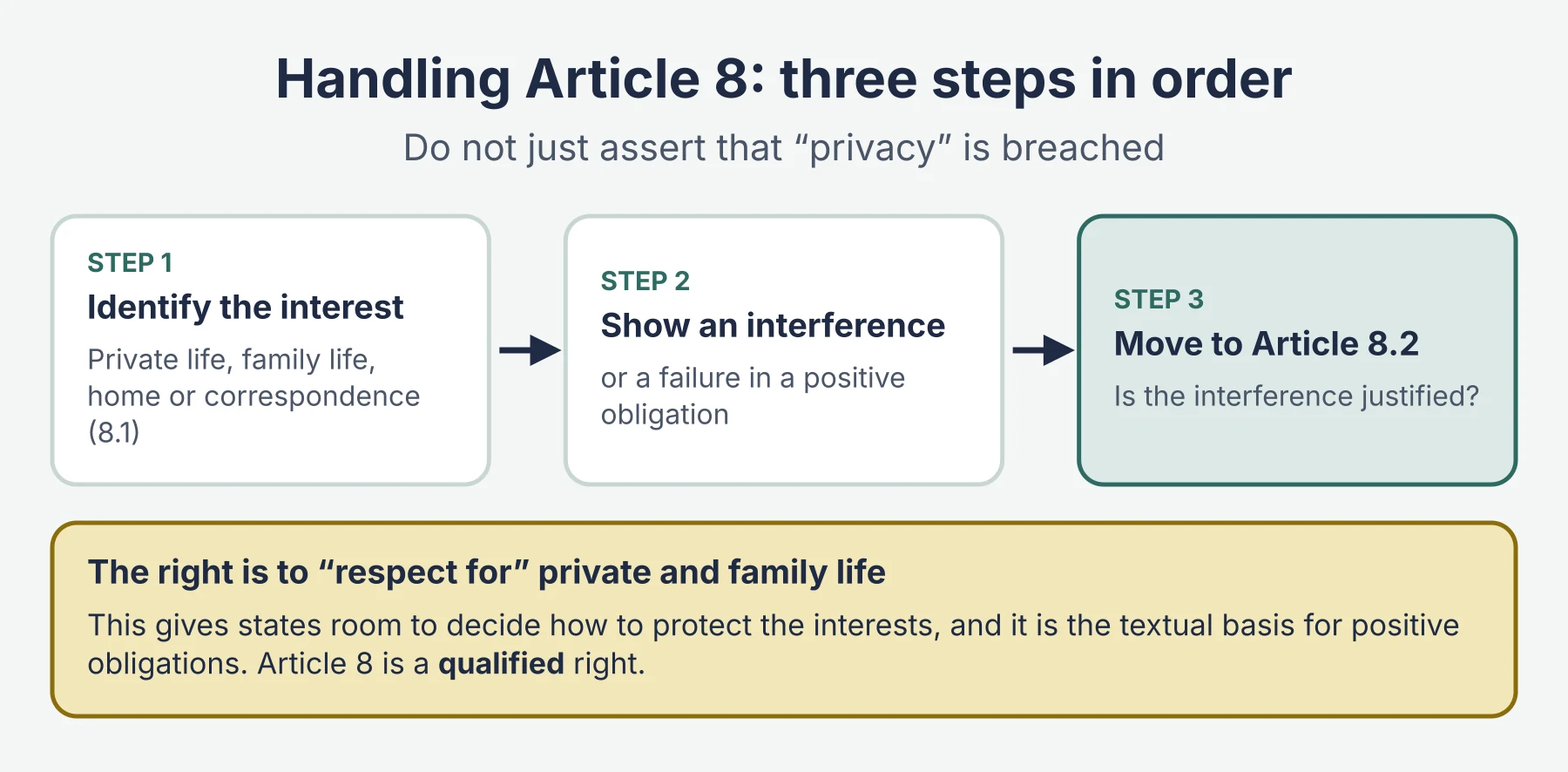
Article 8 is a qualified right, and the European Court has read its four interests broadly. That makes it the Article most likely to be engaged in a Paper 3 scenario, but it also means students often assert that “privacy” is breached without showing which interest is affected. A strong answer does three things in order: identifies the interest under 8.1, shows that there has been an interference (or a failure in a positive obligation), and then moves to 8.2.
Note the wording: the right is to respect for private and family life. This gives states room to decide how to protect the interests, and it is the textual basis for positive obligations.
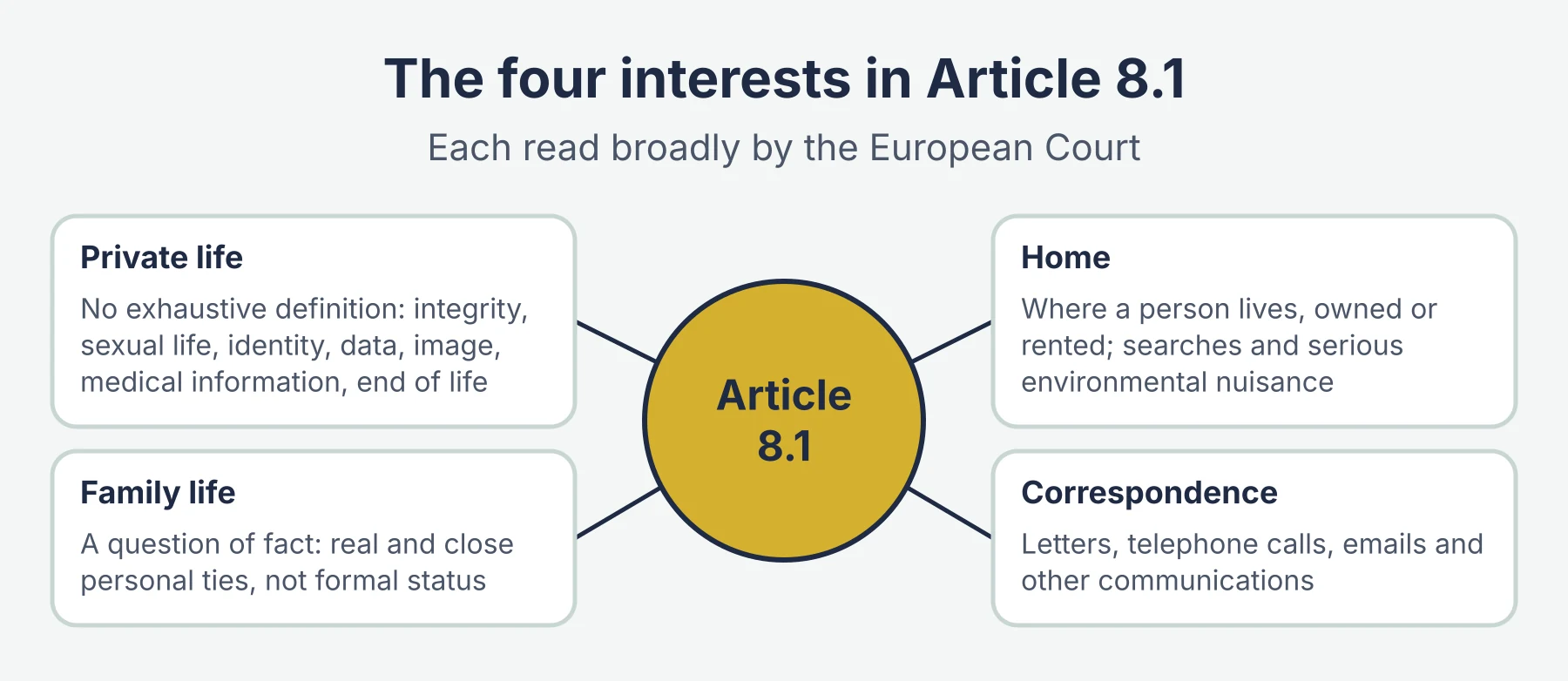
The four interests in Article 8.1
Private life
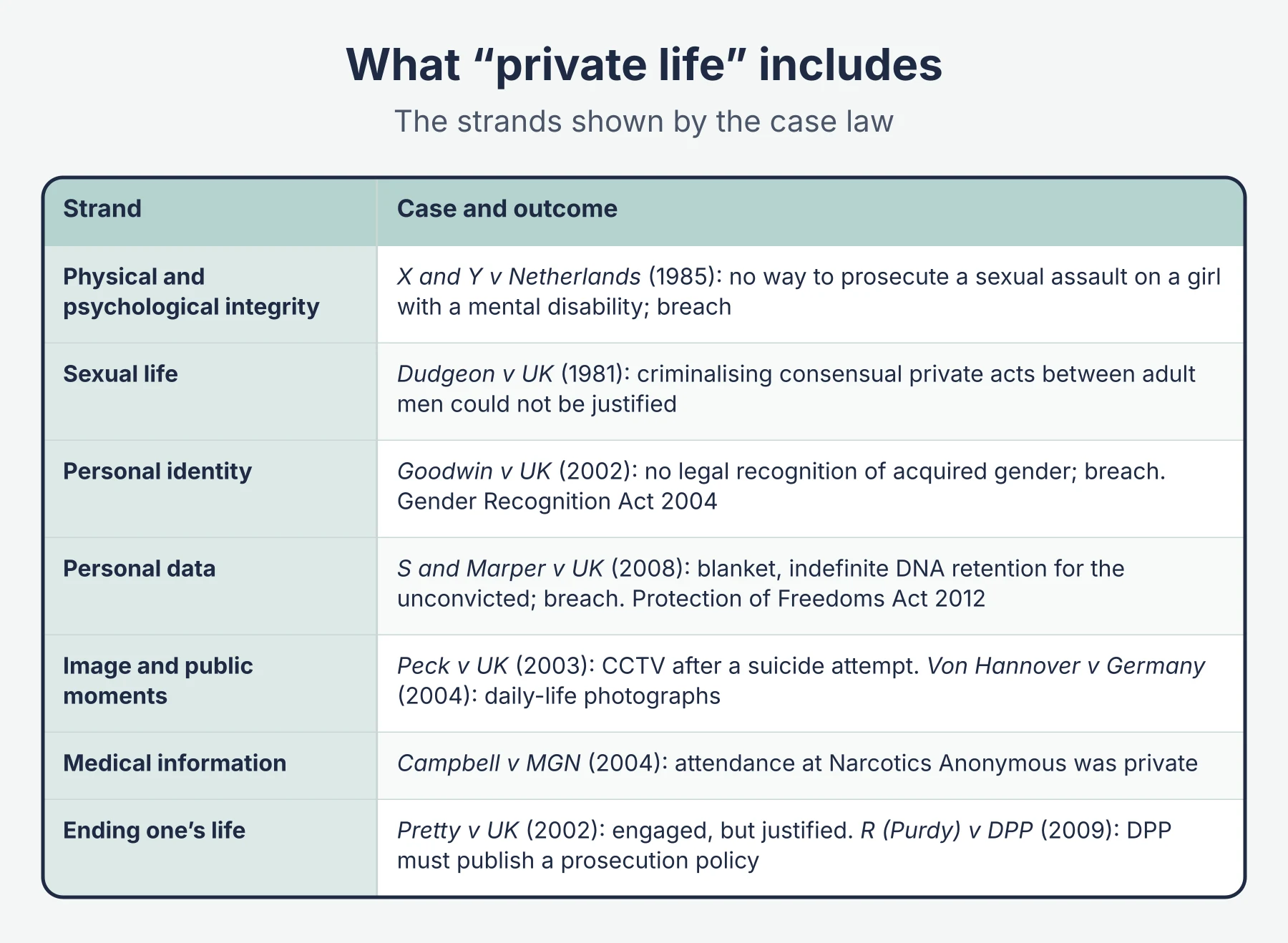
Private life has no exhaustive definition. The case law shows it includes:
- Physical and psychological integrity. In X and Y v Netherlands (1985) Dutch law left no way to bring a criminal prosecution for a sexual assault on a 16-year-old girl with a mental disability, because she could not make the complaint herself and her father could not make it for her. The Court found a breach: effective protection required criminal law provisions.
- Sexual life. Dudgeon v United Kingdom (1981): criminalising consensual private sexual acts between adult men in Northern Ireland interfered with private life and could not be justified.
- Personal identity. Goodwin v United Kingdom (2002): the failure to give legal recognition to a transsexual woman’s acquired gender breached Article 8. Parliament responded with the Gender Recognition Act 2004.
- Personal data. S and Marper v United Kingdom (2008): the blanket and indefinite retention of the DNA profiles, samples and fingerprints of people who had not been convicted breached Article 8. The rules were changed by the Protection of Freedoms Act 2012.
- Image and public moments. Peck v United Kingdom (2003): a council released CCTV footage of a man in a street shortly after a suicide attempt, and it was broadcast without his face being properly masked. Being filmed in a public place did not remove his private life. Von Hannover v Germany (2004): photographs of Princess Caroline of Monaco going about daily life engaged Article 8, as they contributed nothing to a debate of general interest.
- Medical information. Campbell v MGN Ltd (2004): details and photographs of a model’s attendance at Narcotics Anonymous were private information.
- Decisions about how to end one’s life. In Pretty v United Kingdom (2002) the Court accepted that Article 8 was engaged by the ban on assisted suicide, although the interference was justified. In R (Purdy) v DPP (2009) the House of Lords held that Article 8 required the Director of Public Prosecutions to publish a policy on when assisting a suicide would be prosecuted.
Family life
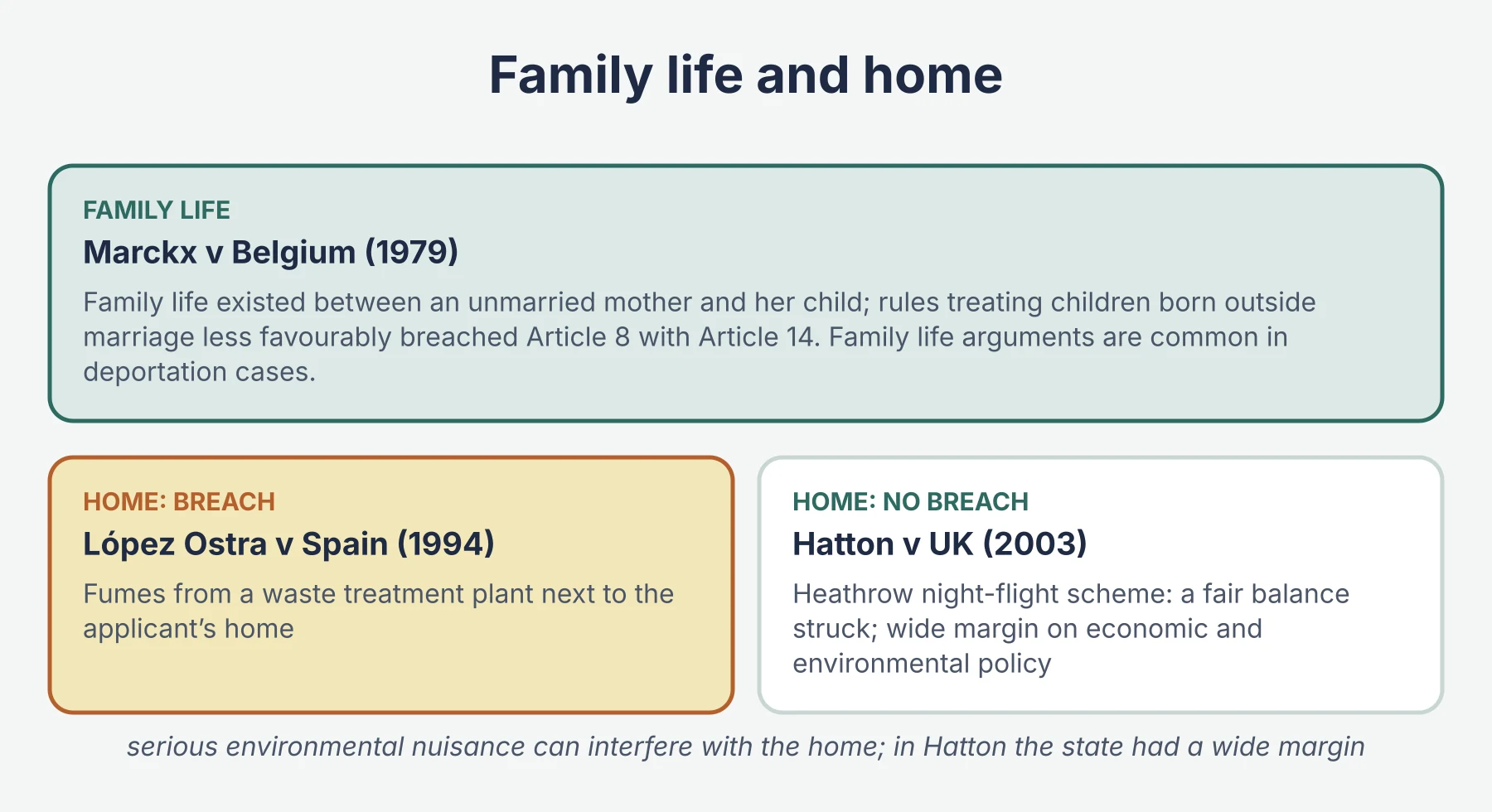
Family life is a question of fact: the Court looks for real and close personal ties rather than formal status. In Marckx v Belgium (1979) family life existed between an unmarried mother and her child, and Belgian rules that treated children born outside marriage less favourably breached Article 8 with Article 14. Family life arguments are common in deportation cases, where removing a person would separate them from a partner or children.
Home
“Home” means the place where a person lives, whether owned or rented. Interference includes searches and also serious environmental nuisance. In López Ostra v Spain (1994) fumes from a waste treatment plant next to the applicant’s home breached Article 8. By contrast, in Hatton v United Kingdom (2003) the Grand Chamber held that the night-flight scheme at Heathrow did not breach Article 8, because the state had struck a fair balance and enjoyed a wide margin of appreciation on economic and environmental policy.
Correspondence
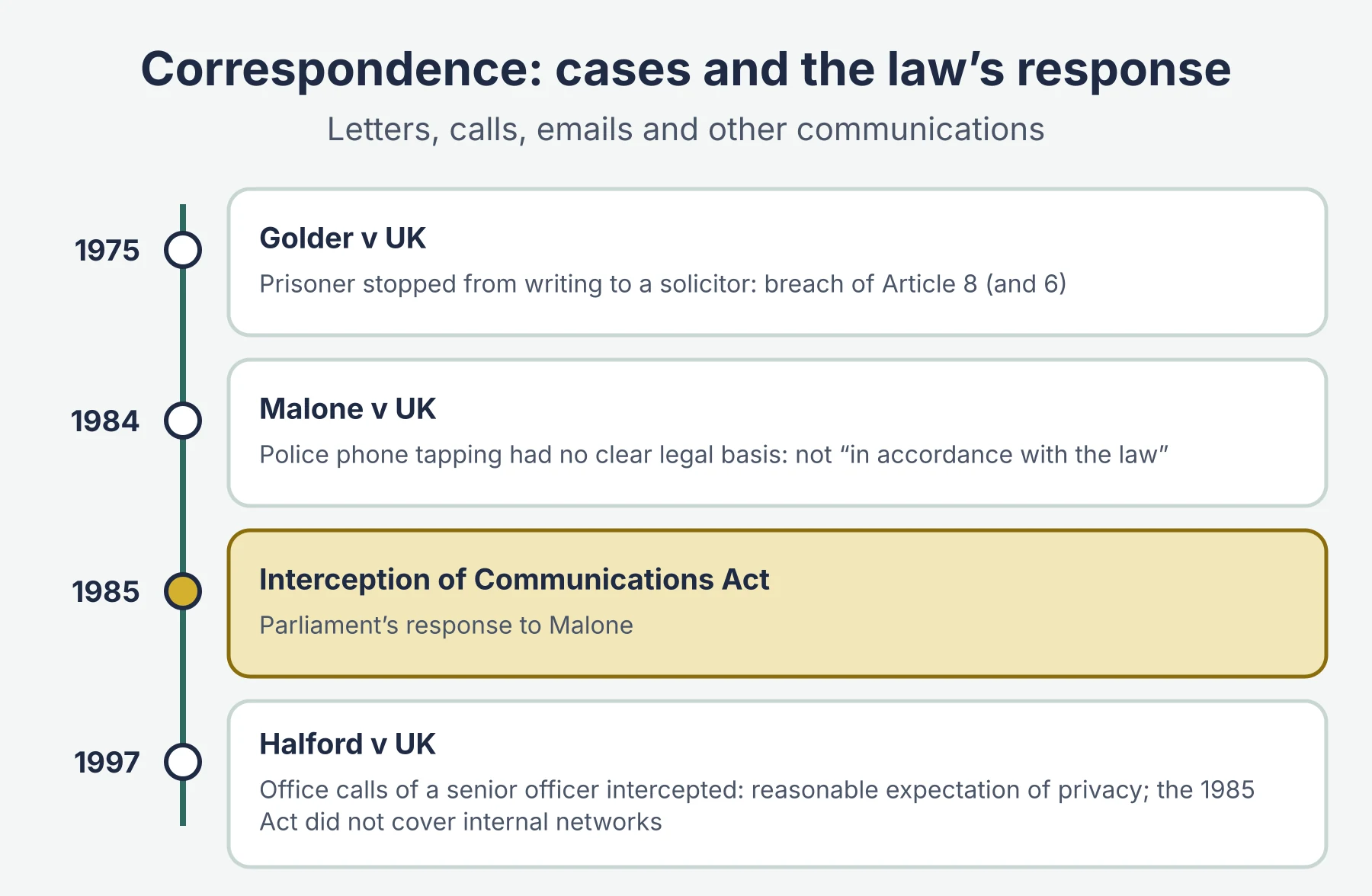
Correspondence covers letters, telephone calls, emails and other communications.
- Golder v United Kingdom (1975): stopping a prisoner from writing to a solicitor breached Article 8 (and Article 6).
- Malone v United Kingdom (1984): police telephone tapping had no clear legal basis, so it was not “in accordance with the law”. This led to the Interception of Communications Act 1985.
- Halford v United Kingdom (1997): interception of a senior police officer’s calls from her office telephone breached Article 8. She had a reasonable expectation of privacy, and the 1985 Act did not regulate internal networks.
Positive obligations and the press
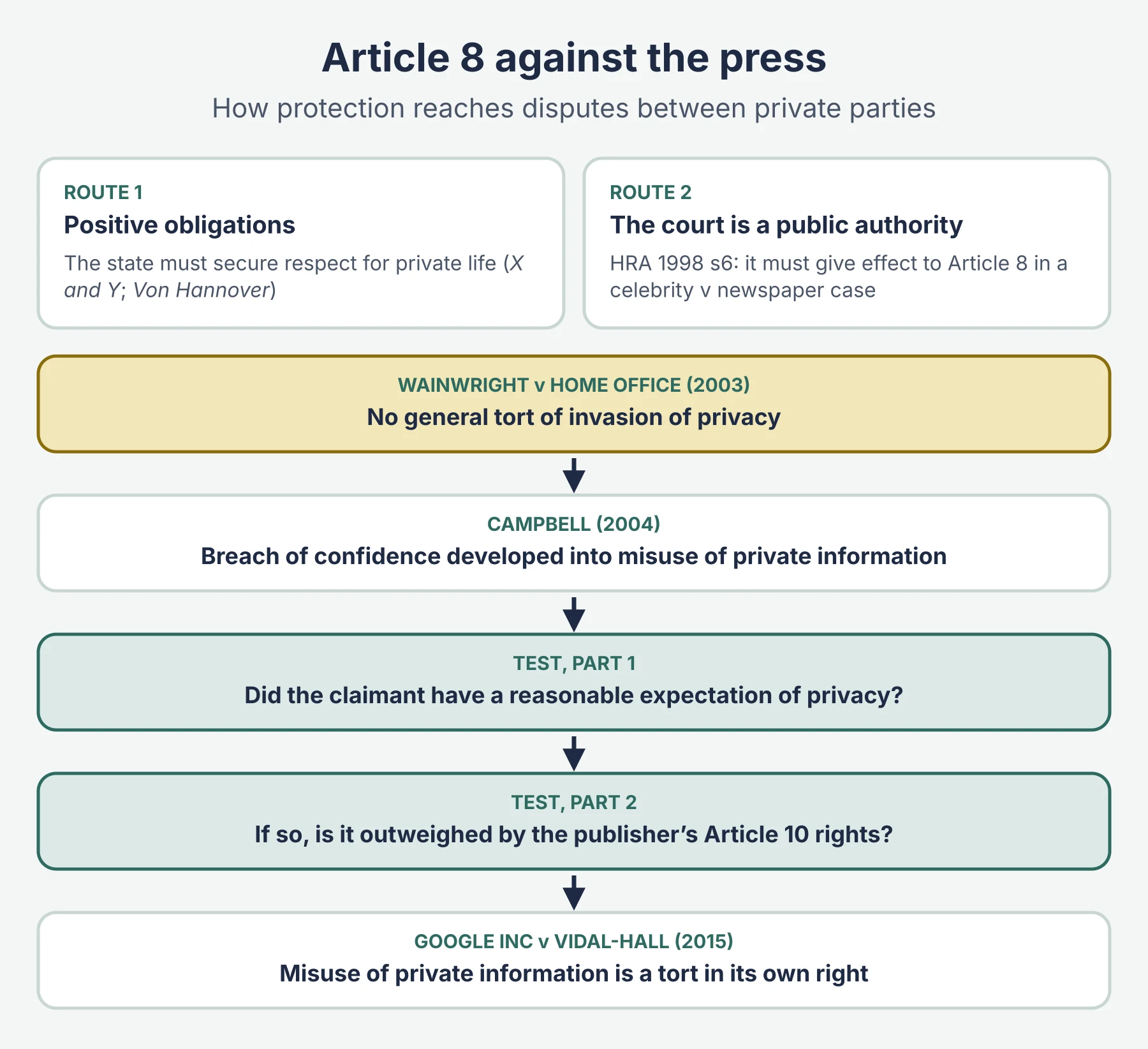
Article 8 binds the state, but its protection reaches disputes between private parties in two ways. First, the state has positive obligations to secure respect for private life, as X and Y v Netherlands and Von Hannover show. Second, under section 6 of the Human Rights Act 1998 a court is itself a public authority, so it must give effect to Article 8 when deciding a case between a celebrity and a newspaper.
English law had no general tort of invasion of privacy: Wainwright v Home Office (2003). Instead the courts developed breach of confidence into misuse of private information (Campbell). The test asks whether the claimant had a reasonable expectation of privacy and, if so, whether that is outweighed by the publisher’s Article 10 rights. In Google Inc v Vidal-Hall (2015) the Court of Appeal confirmed that misuse of private information is a tort in its own right.
Worked example
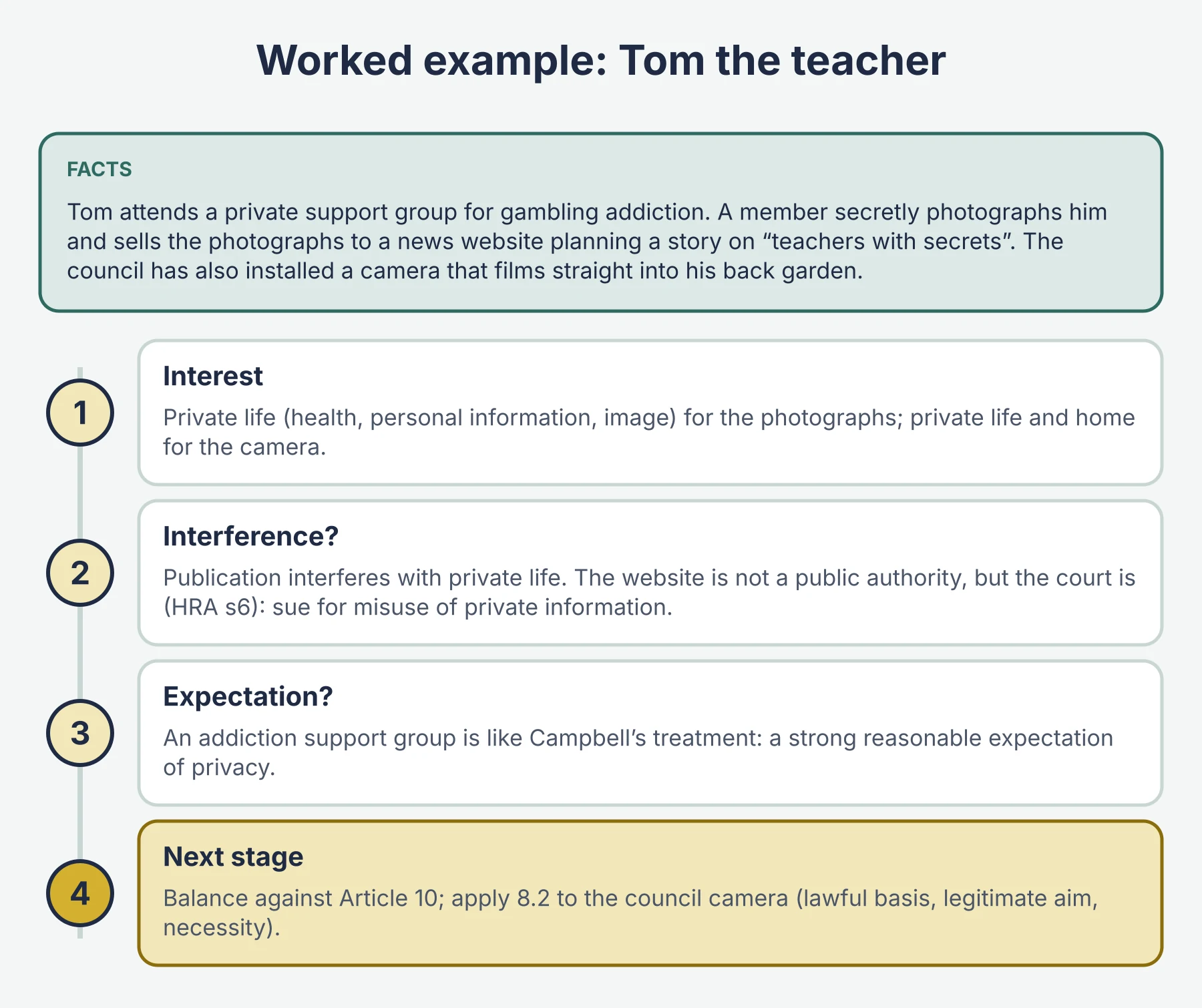
Facts: Tom, a school teacher, attends a private support group for gambling addiction. A member secretly photographs him and sells the photographs to a local news website, which plans to publish them with a story about “teachers with secrets”. Tom also learns that the local council installed a camera that films straight into his back garden.
Interest:        Private life (health and personal information, image) for the
                 photographs; private life and home for the camera.
Interference?    Publication would interfere with Tom's private life. The
                 website is not a public authority, but the court is (HRA s6),
                 so Tom sues for misuse of private information.
Expectation?     A support group for addiction is like Campbell's treatment:
                 a strong reasonable expectation of privacy.
Next stage:      Balance against Article 10 and apply 8.2 to the council
                 camera (lawful basis, legitimate aim, necessity).
The 8.2 and Article 10 stages are developed in the Restrictions and Article 10 guides. The point here is that the first stage is fully argued with authority before moving on.
Common mistakes
- Writing “privacy” without naming which of the four interests is engaged.
- Assuming that anything done in public is outside private life; Peck and Von Hannover show otherwise.
- Claiming English law has a general privacy tort. Wainwright says it does not; the protection comes from misuse of private information.
- Forgetting positive obligations, which explain why the state can be responsible for what private parties do.
- Misstating Hatton: the Grand Chamber found no breach of Article 8.
Exam technique
- Explain: define each interest and support it with a case.
- Suggest and Advise: identify the interest, show the interference, consider whether the defendant is a public authority or whether the court must act, then apply 8.2 and conclude.
- Consider: argue both sides on whether the facts engage Article 8 at all, for example whether a photograph in a street can be private.
- Discuss: evaluate how well English law protects privacy without a statutory privacy tort, using Wainwright, Campbell and Vidal-Hall.
More resources on this topic
Article 8 revision notes | Article 8 practice questions | Article 10 study guide
Related resources
-
Practice questions
AQA A Level Law (7162): Article 8 of the European Convention on Human Rights 1953 – Practice Questions
Original Article 8 ECHR practice for AQA A Level Law 7162 with mark-scheme answers on private and family life, home, correspondence and private information.
Law · AQA · A Level
Try questions -
Revision notes
AQA A Level Law (7162): Article 8 of the European Convention on Human Rights 1953 – Revision Notes
Condensed recall on Article 8.1 ECHR for AQA A Level Law 7162: private life, family life, home, correspondence, positive duties and private information.
Law · AQA · A Level
Revise topic -
Study guides
AQA A Level Law (7162): Enforcement
Enforcing Convention rights for AQA A Level Law 7162: Strasbourg claims and admissibility, domestic courts, the effect of judgments and judicial review.
Law · AQA · A Level
Read guide
Get free revision emails (optional)
Occasional emails with practice questions, worked explanations and links to free resources for the qualification and subjects you choose. No spam, and you can unsubscribe from any email. The free tools on this site never need an email.