
Study Guides
AQA A Level Law (7162): Article 10 of the European Convention on Human Rights 1953
Article 10.1 ECHR for AQA A Level Law 7162: the right to receive and communicate information and ideas, press freedom, political speech and section 12 HRA 1998.
- Subject
- Law
- Level
- A LEVELS
- Topic
- Topic 5: Human Rights
- Author
- Marlbridge Academic Team
- Updated
- Reviewed by
- Aizaz Raoof Ali (what this means)
Aligned to AQA A Level Law (7162), For teaching from September 2017 onwards, A-level exams 2019 onwards. Official specification .
Syllabus page (what it covers and how it is assessed): AQA A Level Law.
Syllabus points this page covers
7162
- Article 10 of the European Convention on Human Rights 1953
Found an error? Report a correction.
Need help with this topic? Request a free trial class for A Level Law (7162).
This guide covers Article 10 of the European Convention on Human Rights 1953 in section 3.5 Human Rights of AQA A-level Law (7162). The specification names “Article 10.1: right to freedom of expression” and two elements within it: to “receive information and ideas” and to “communicate information and ideas”. How the right may be limited under Article 10.2 is a separate row, covered in the Restrictions study guide. For the whole option, see the Human Rights study guide.
What Article 10.1 says
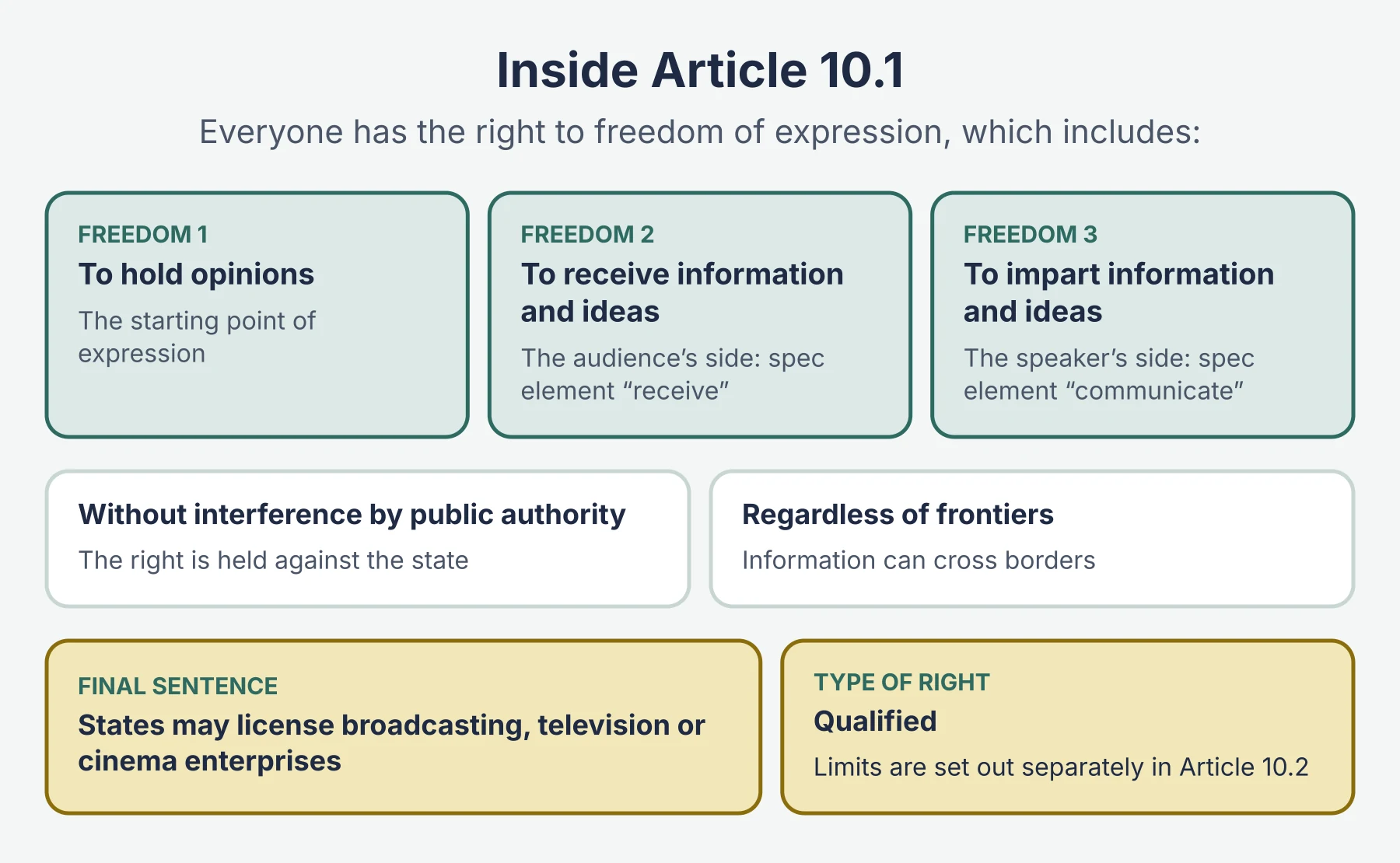
Article 10.1 gives everyone the right to freedom of expression, which includes the freedom to hold opinions and to receive and impart information and ideas without interference by public authority and regardless of frontiers. Its final sentence allows states to require the licensing of broadcasting, television or cinema enterprises. Article 10 is a qualified right.
What counts as “expression”
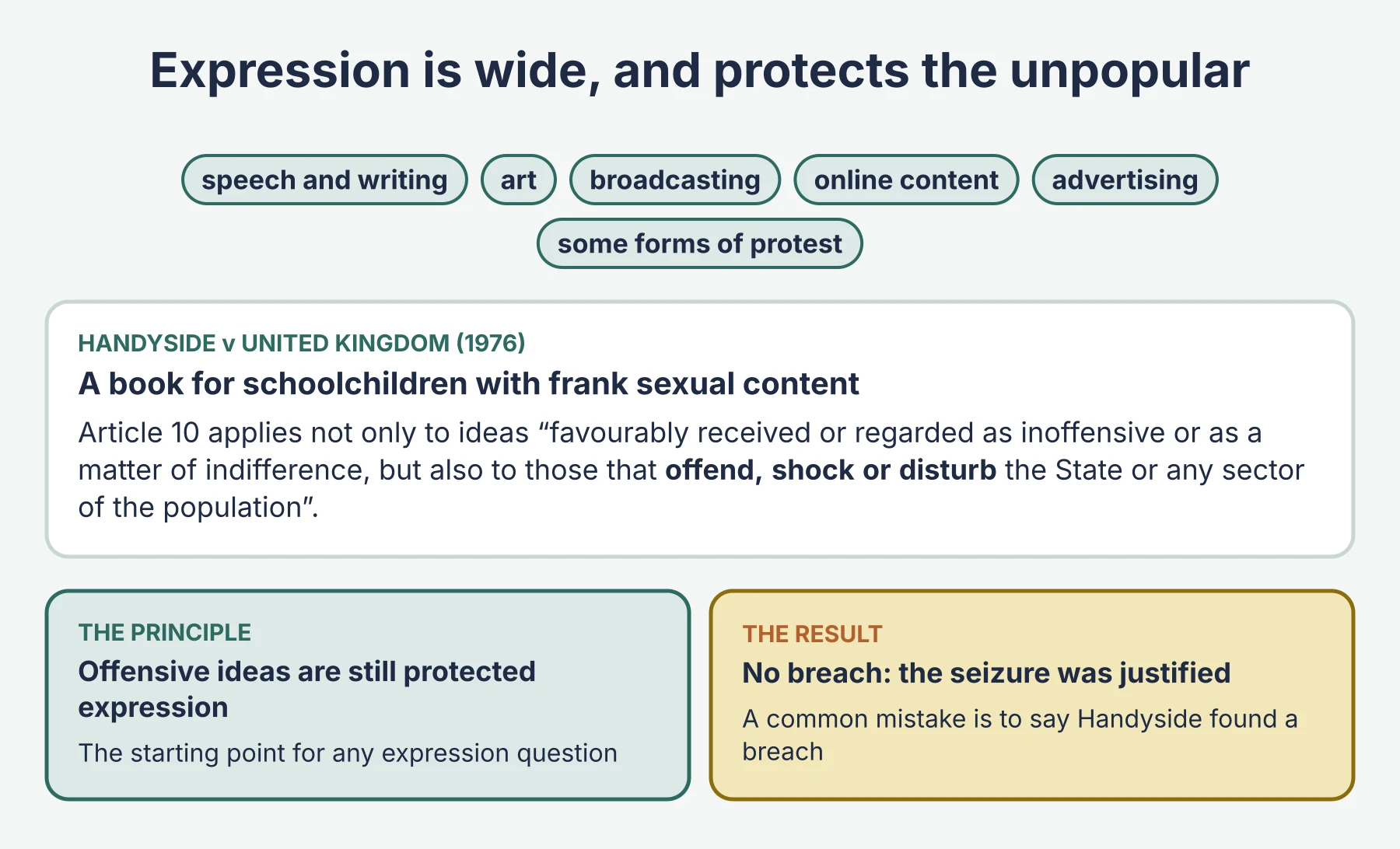
The Court gives “expression” a wide meaning. It covers speech and writing, art, broadcasting, online content and advertising, and it can cover conduct used to express a view, such as some forms of protest. Crucially, it protects ideas that are unpopular. In Handyside v United Kingdom (1976), about a book for schoolchildren with frank sexual content, the Court said Article 10 applies “not only to ‘information’ or ‘ideas’ that are favourably received or regarded as inoffensive or as a matter of indifference, but also to those that offend, shock or disturb the State or any sector of the population”. The UK’s seizure of the book was still found justified, but the principle is the starting point for any expression question.
Not all speech is treated equally
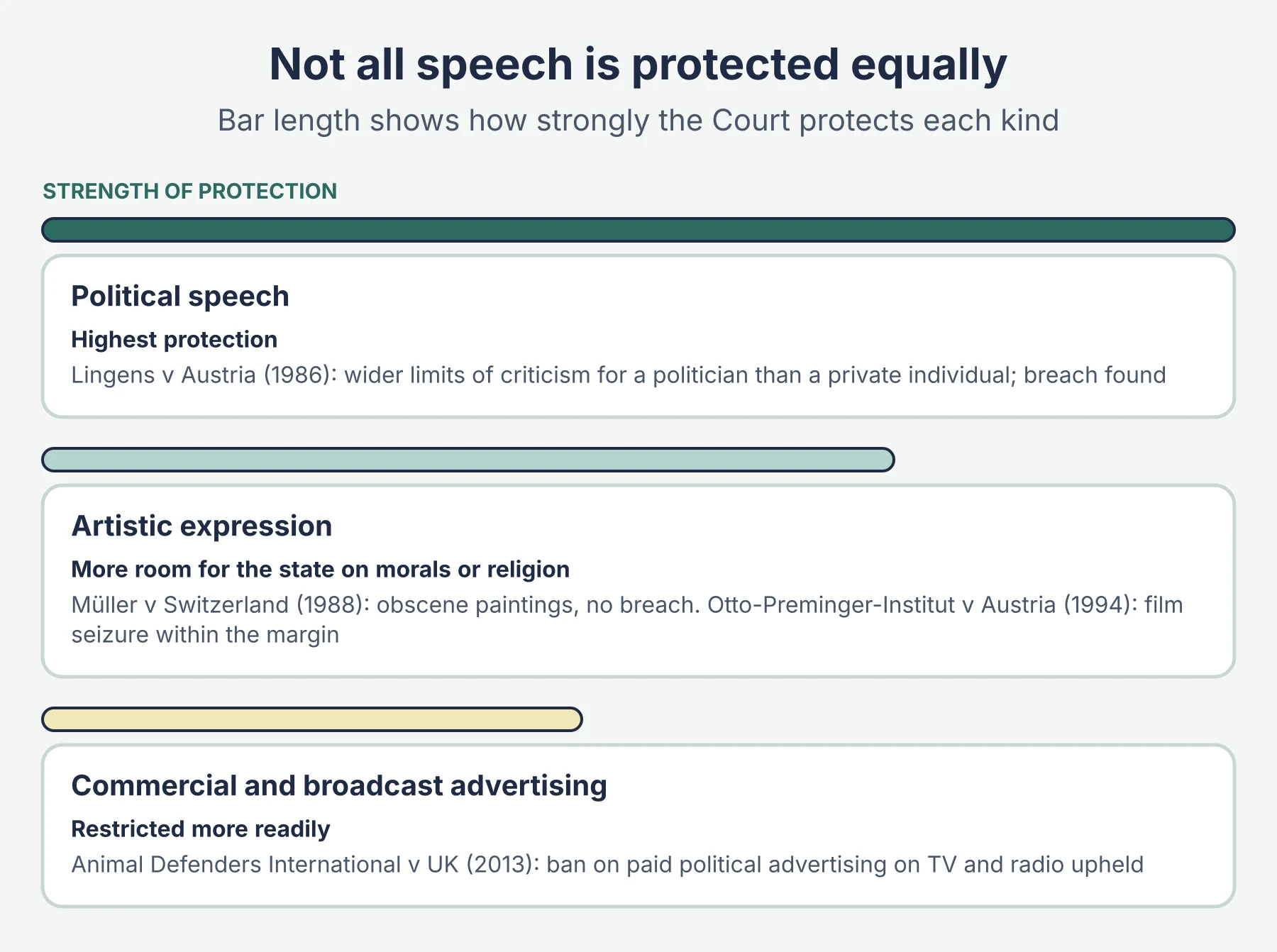
The Court applies stronger protection to some kinds of expression than others.
- Political speech gets the highest protection. In Lingens v Austria (1986) a journalist was convicted of defamation for criticising a politician. The Court held that the limits of acceptable criticism are wider for a politician than for a private individual, and found a breach.
- Artistic expression is protected, but states have more room where morals or religious feelings are involved. In Müller v Switzerland (1988) a conviction for exhibiting obscene paintings was not a breach, and in Otto-Preminger-Institut v Austria (1994) seizure of a film likely to offend religious feelings was within the state’s margin of appreciation.
- Commercial and broadcast advertising can be restricted more readily. In Animal Defenders International v United Kingdom (2013) the Grand Chamber upheld the UK ban on paid political advertising on television and radio.
Communicating information and ideas
The press as “public watchdog”
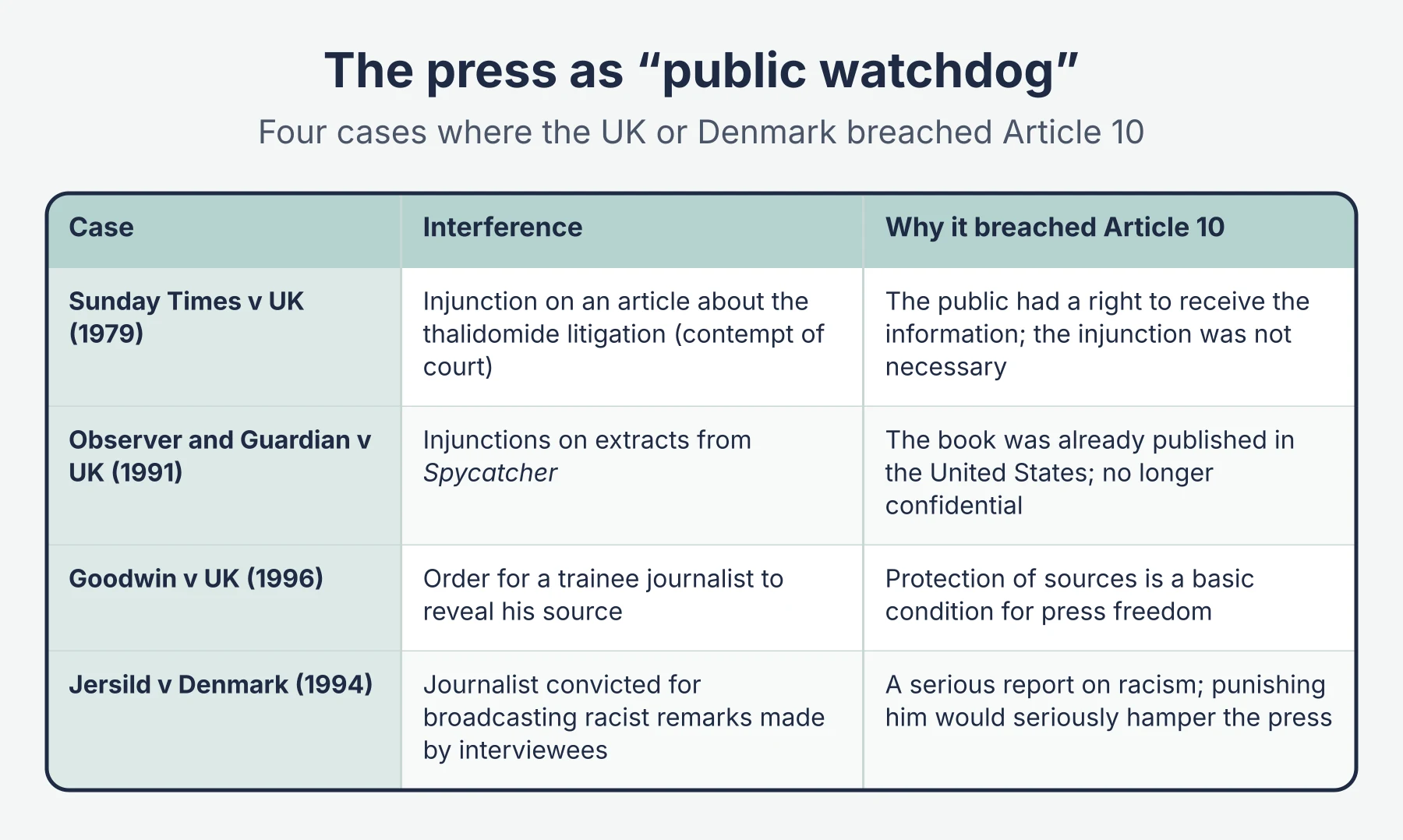
The Court treats the press as performing a vital role in a democracy. Three cases are useful.
- Sunday Times v United Kingdom (1979): an injunction stopped the newspaper publishing an article about the thalidomide litigation on grounds of contempt of court. The Court held that the public had a right to receive the information and the injunction was not necessary.
- Observer and Guardian v United Kingdom (1991): injunctions against publishing extracts from the memoir Spycatcher could not be justified once the book had been published in the United States and its contents were no longer confidential.
- Goodwin v United Kingdom (1996): an order requiring a trainee journalist to reveal his source breached Article 10. The Court described protection of sources as one of the basic conditions for press freedom.
The press is also responsible for how it handles others’ views. In Jersild v Denmark (1994) a journalist was convicted for broadcasting an interview in which young men made racist remarks. The Court found a breach: the programme was a serious report on racism, and punishing a journalist for helping to spread others’ statements would seriously hamper the press.
Receiving information and ideas
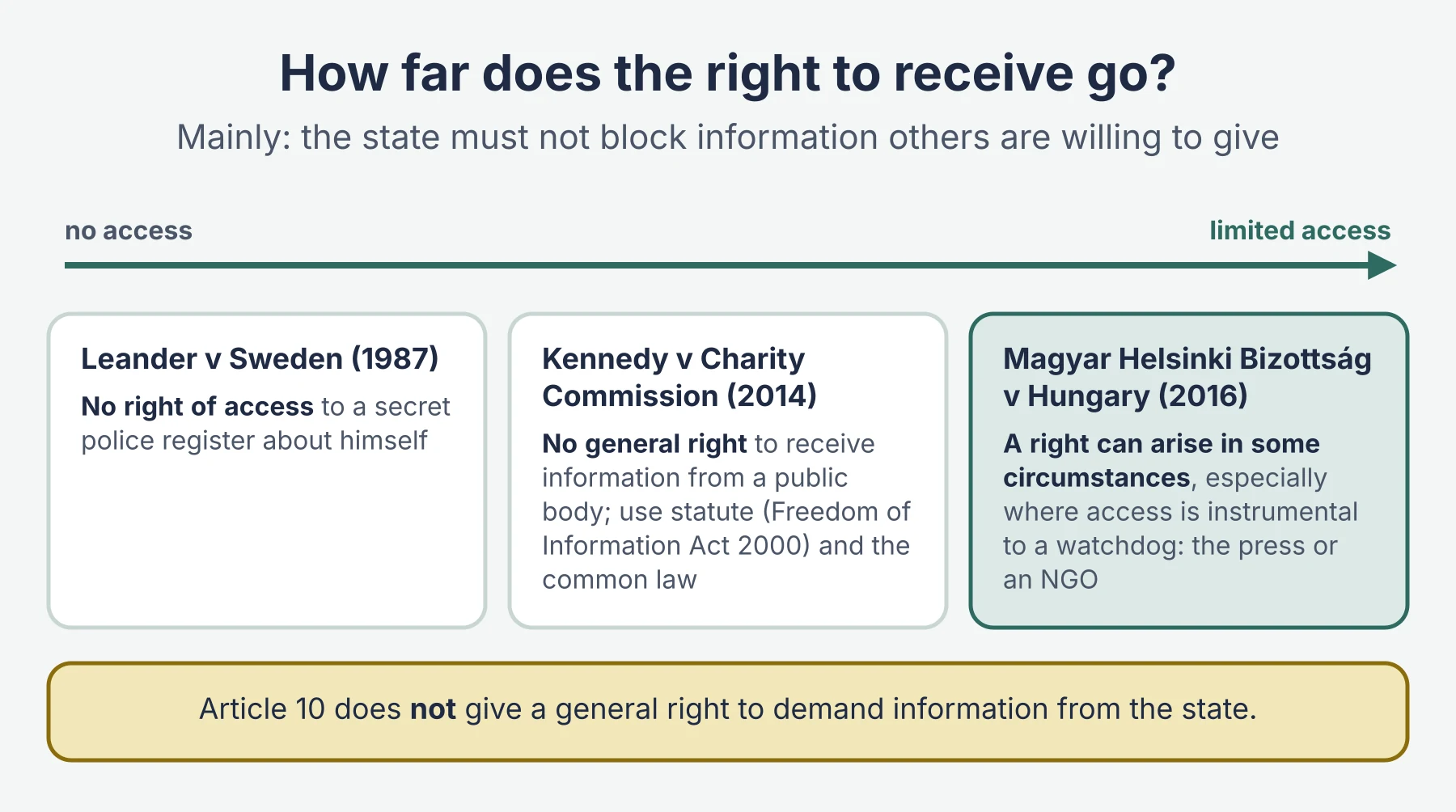
The right to receive information mainly stops the state from blocking information that others are willing to give. In Leander v Sweden (1987) the Court held that Article 10 did not give a person a right of access to a secret police register about himself. Later, in Magyar Helsinki Bizottság v Hungary (2016), the Grand Chamber accepted that a right of access to information held by the state can arise in some circumstances, especially where access is instrumental to the work of the press or a non-governmental organisation acting as a watchdog. In Kennedy v Charity Commission (2014) the Supreme Court held that Article 10 did not give a journalist a general right to receive information from a public body; the claim had to be approached through statute, including the Freedom of Information Act 2000, and the common law.
How English law gives effect to Article 10
English common law already valued expression before 1998.
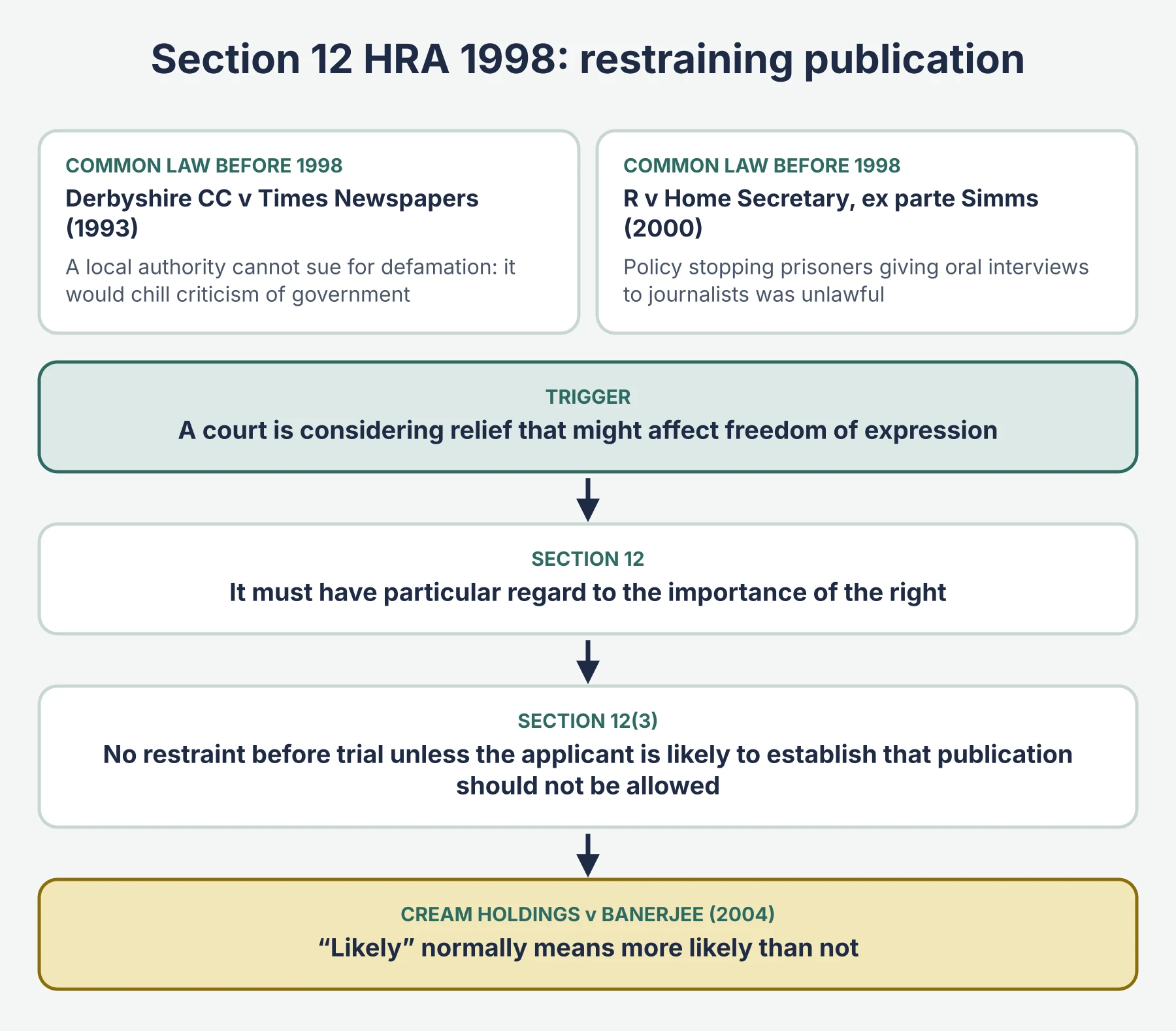
- Derbyshire County Council v Times Newspapers (1993): a local authority cannot sue for defamation, because the threat of such claims would chill criticism of government.
- R v Secretary of State for the Home Department, ex parte Simms (2000): a policy stopping prisoners from giving oral interviews to journalists who were investigating claims of wrongful conviction was unlawful.
The Human Rights Act 1998 adds a specific provision. Section 12 applies whenever a court is considering relief that might affect freedom of expression. The court must have particular regard to the importance of the right, and under section 12(3) it must not restrain publication before trial unless the applicant is likely to establish that publication should not be allowed. In Cream Holdings v Banerjee (2004) the House of Lords held that “likely” normally means more likely than not. The criminal and civil provisions that restrict expression are covered in the Human Rights and English law study guide.
Worked example
Facts: Ruth runs a blog about her council. She posts a leaked council report showing that a children’s playground was built on contaminated land. The council obtains an interim injunction requiring the post to be removed, and asks the court to order Ruth to name the council officer who leaked the report.
Right engaged:   Article 10.1, communicating information. The public also
                 has a right to receive it (Sunday Times).
Type of speech:  Public-interest speech about local government: strong
                 protection (Lingens; Derbyshire).
Interim order:   HRA s12 applies. Under s12(3) and Cream Holdings, the council
                 must show it is more likely than not to win at trial.
Source order:    Goodwin v UK: compelling disclosure of a source needs an
                 overriding requirement in the public interest.
Next stage:      Apply Article 10.2 to see whether either order is justified.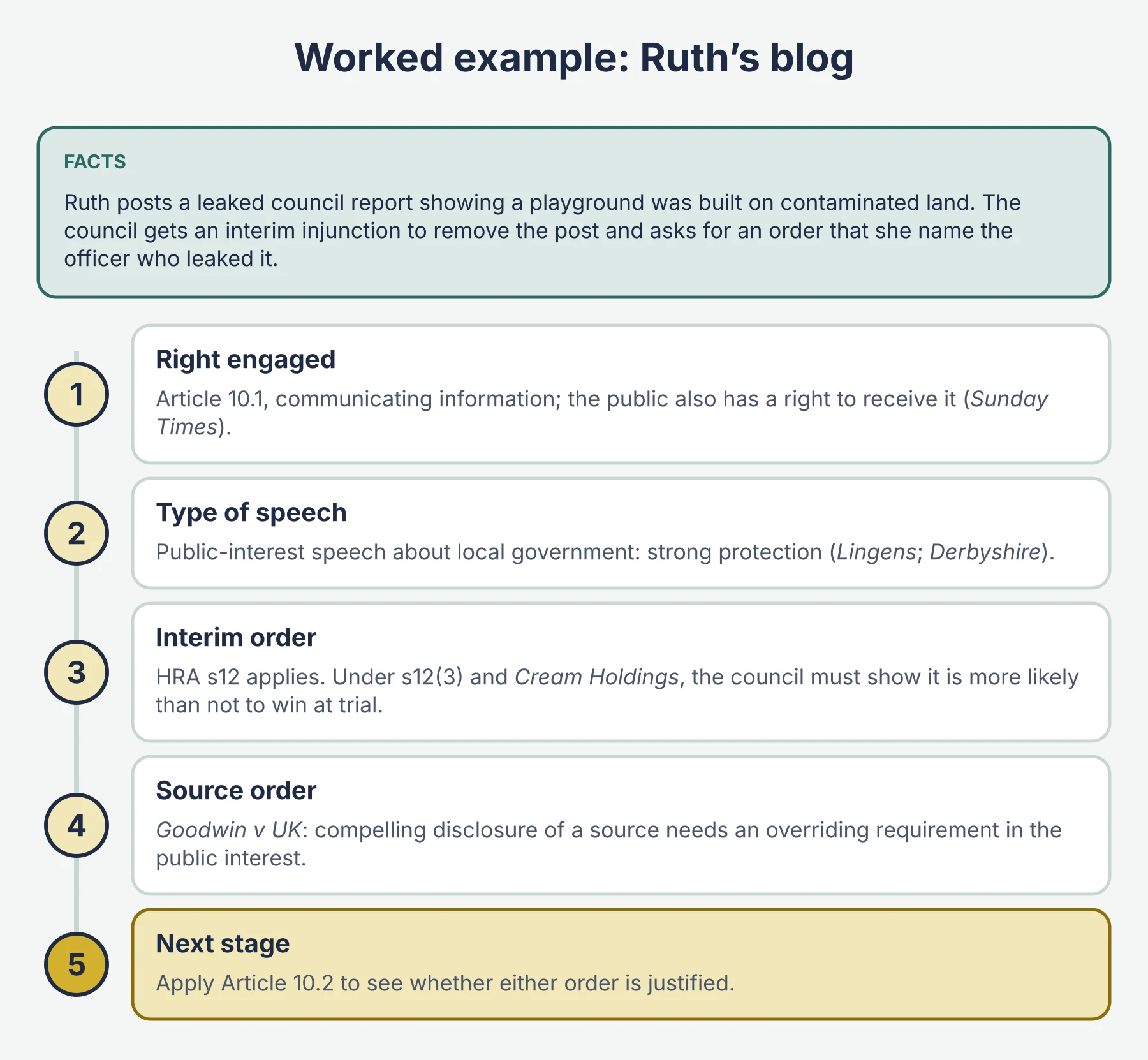
Common mistakes
- Saying Handyside found a breach. It did not; it set the “offend, shock or disturb” principle but upheld the restriction.
- Treating all speech alike. Political speech is protected most strongly; artistic and commercial speech attract a wider margin.
- Ignoring the receiving element. The audience’s right to receive information is part of 10.1.
- Forgetting section 12 HRA 1998 in any question about an injunction against publication.
- Claiming Article 10 gives a general right to demand information from the state. Leander and Kennedy say it does not, and Magyar Helsinki allows only a limited right in some circumstances.
Exam technique
- Explain: define 10.1, separate the receiving and communicating elements, support each with a case.
- Suggest and Advise: identify the type of expression, show the interference, apply section 12 where publication is restrained, then move to 10.2.
- Consider: develop arguments on both sides about the value of the speech in question.
- Discuss: evaluate whether English law protects expression adequately, using common law cases and section 12.
More resources on this topic
Article 10 revision notes | Article 10 practice questions | Article 8 study guide
Related resources
-
Practice questions
AQA A Level Law (7162): Article 10 of the European Convention on Human Rights 1953 – Practice Questions
Original Article 10 ECHR practice for AQA A Level Law 7162 with mark-scheme answers on receiving and imparting information, press freedom and section 12 HRA.
Law · AQA · A Level
Try questions -
Revision notes
AQA A Level Law (7162): Article 10 of the European Convention on Human Rights 1953 – Revision Notes
Condensed recall on Article 10.1 ECHR for AQA A Level Law 7162: receiving and communicating information, the press, types of speech and section 12 HRA 1998.
Law · AQA · A Level
Revise topic -
Study guides
AQA A Level Law (7162): Article 11 of the European Convention on Human Rights 1953
Article 11.1 ECHR for AQA A Level Law 7162: peaceful assembly, protest on the highway, positive obligations, trade unions and the freedom not to associate.
Law · AQA · A Level
Read guide
Get free revision emails (optional)
Occasional emails with practice questions, worked explanations and links to free resources for the qualification and subjects you choose. No spam, and you can unsubscribe from any email. The free tools on this site never need an email.