
Revision Notes
AQA A Level Law (7162): Article 10 of the European Convention on Human Rights 1953 – Revision Notes
Condensed recall on Article 10.1 ECHR for AQA A Level Law 7162: receiving and communicating information, the press, types of speech and section 12 HRA 1998.
- Subject
- Law
- Level
- A LEVELS
- Topic
- Topic 5: Human Rights
- Author
- Marlbridge Academic Team
- Updated
- Reviewed by
- Aizaz Raoof Ali (what this means)
Aligned to AQA A Level Law (7162), For teaching from September 2017 onwards, A-level exams 2019 onwards. Official specification .
Syllabus page (what it covers and how it is assessed): AQA A Level Law.
Syllabus points this page covers
7162
- Article 10 of the European Convention on Human Rights 1953
Found an error? Report a correction.
Need help with this topic? Request a free trial class for A Level Law (7162).
Condensed notes on Article 10.1. For full explanation and a worked scenario, use the Article 10 study guide.
The text in summary
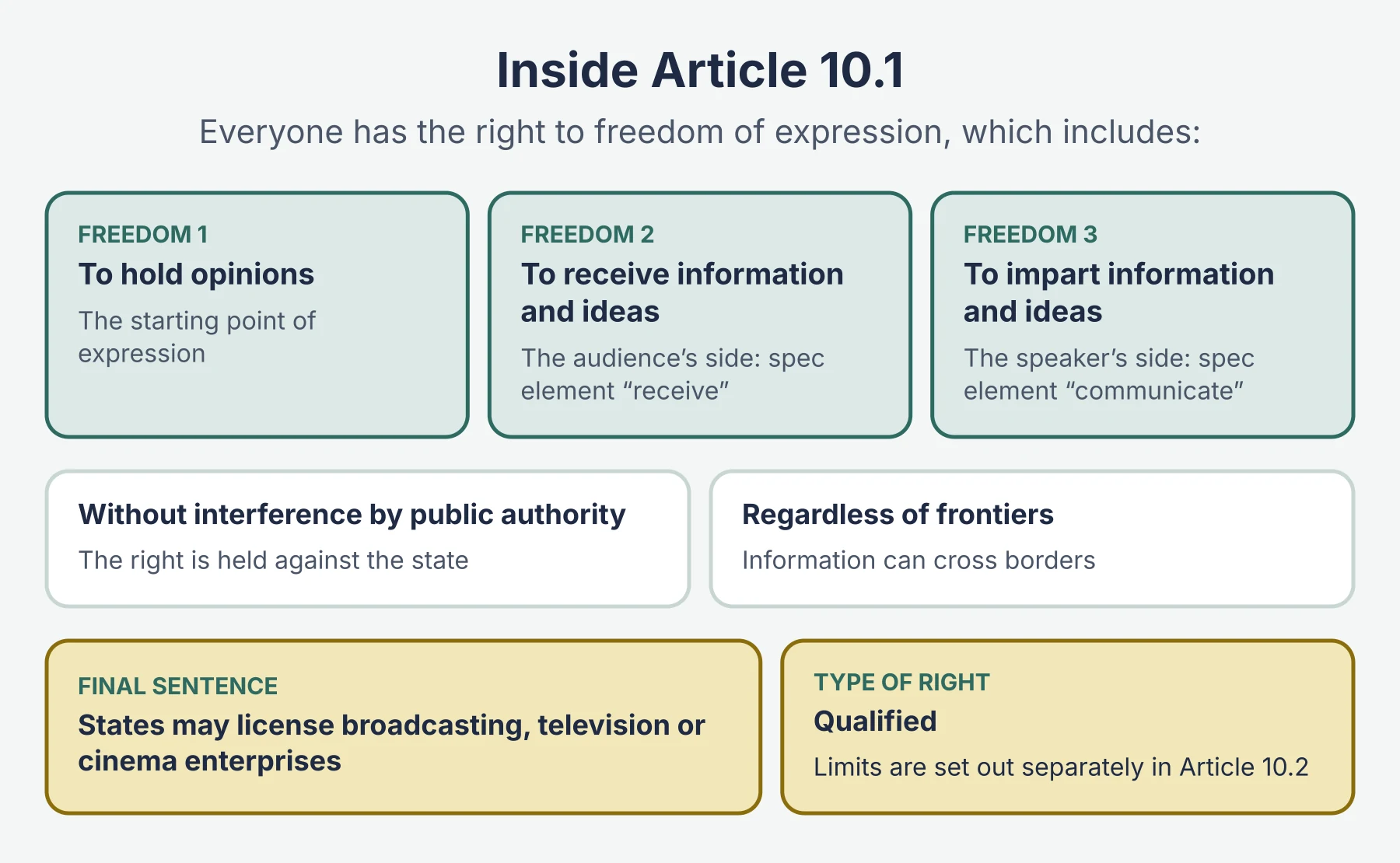
Everyone has the right to freedom of expression: to hold opinions and to receive and impart information and ideas, without interference by public authority and regardless of frontiers. States may license broadcasting, television and cinema. The right is qualified (restrictions in 10.2).
The specification splits 10.1 into two elements: receive information and ideas, and communicate information and ideas.
Scope: the Handyside principle
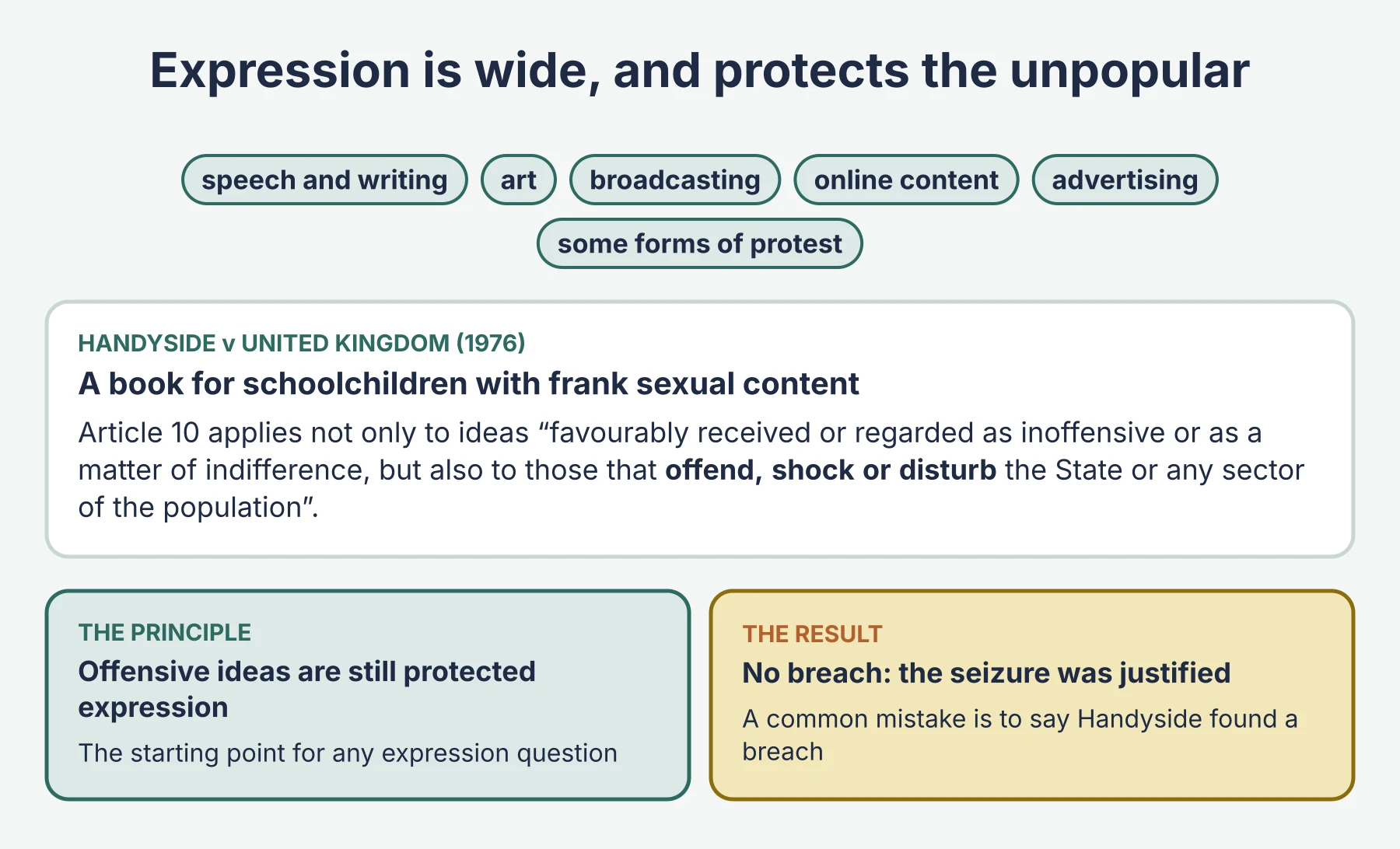
Article 10 protects ideas that “offend, shock or disturb the State or any sector of the population” (Handyside v UK, 1976). Handyside itself found no breach: seizure of the book was justified to protect morals.
A rough hierarchy of protection
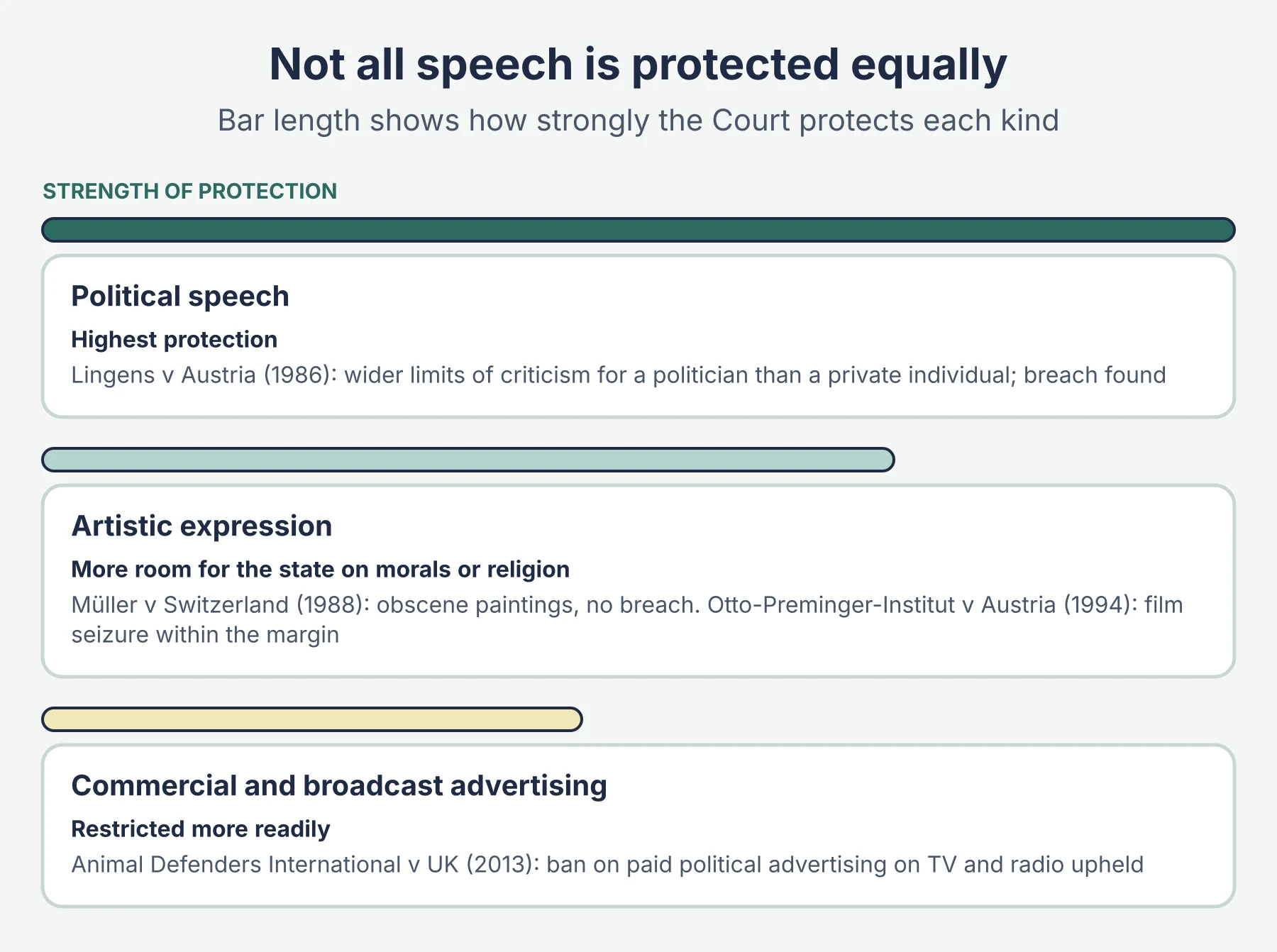
| Type of expression | Protection | Case |
|---|---|---|
| Political speech, criticism of politicians | Strongest; politicians must tolerate wider criticism | Lingens v Austria (1986): breach |
| Press reporting on public affairs | Strong; press is “public watchdog” | Sunday Times v UK (1979); Observer and Guardian v UK (1991) |
| Journalistic sources | Protection of sources is a basic condition of press freedom | Goodwin v UK (1996): breach |
| Reporting others’ offensive views | Protected where part of serious reporting | Jersild v Denmark (1994): breach |
| Artistic expression touching morals or religion | Wider margin | Müller v Switzerland (1988); Otto-Preminger-Institut v Austria (1994): no breach |
| Paid political advertising on broadcast media | Restriction can be justified | Animal Defenders International v UK (2013): no breach |
Communicating
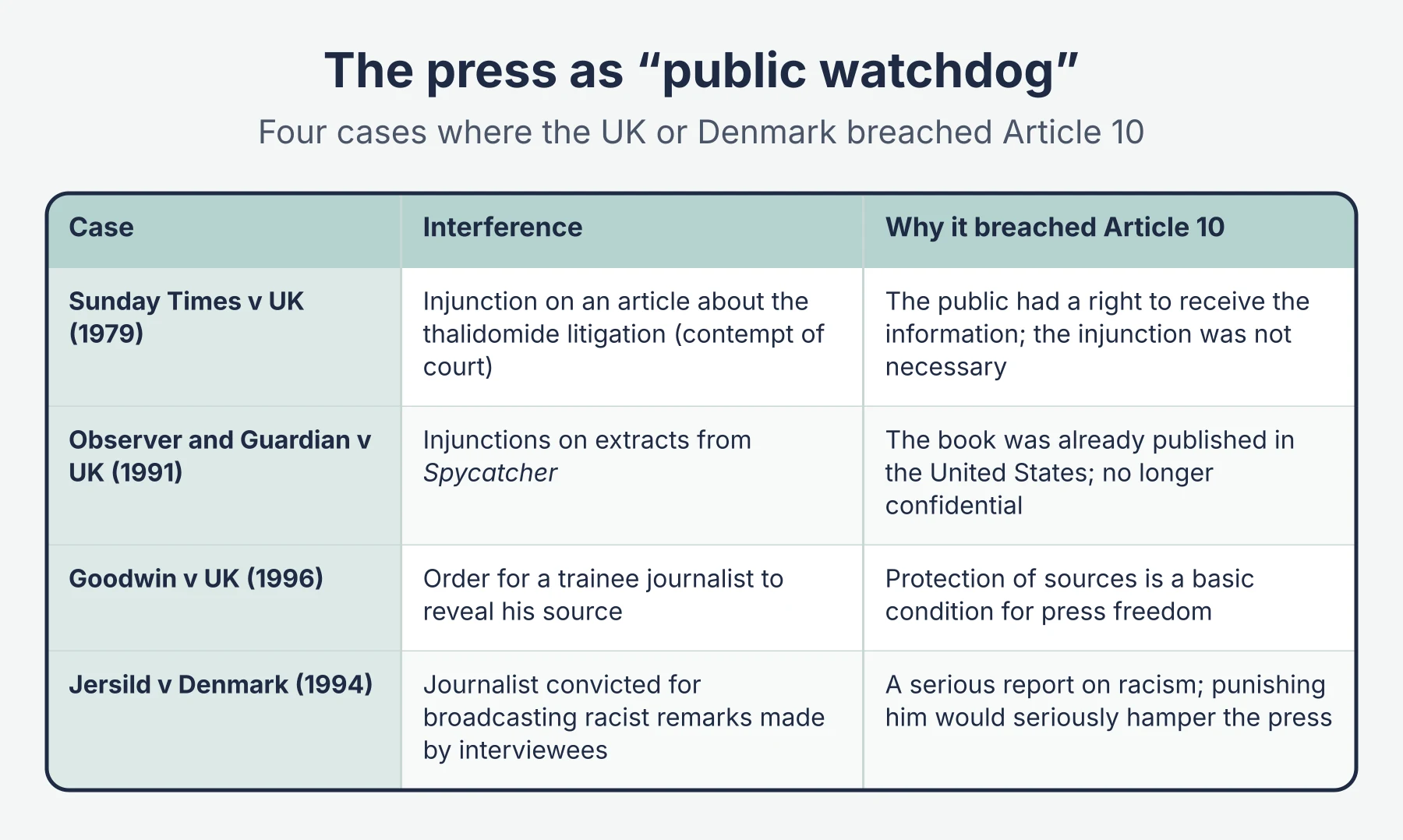
- Sunday Times v UK (1979): contempt injunction stopping a thalidomide article was not necessary; the public was entitled to the information.
- Observer and Guardian v UK (1991): Spycatcher injunctions unjustified after the book was published in the United States.
- Goodwin v UK (1996): order for a journalist to reveal his source breached Article 10.
Receiving
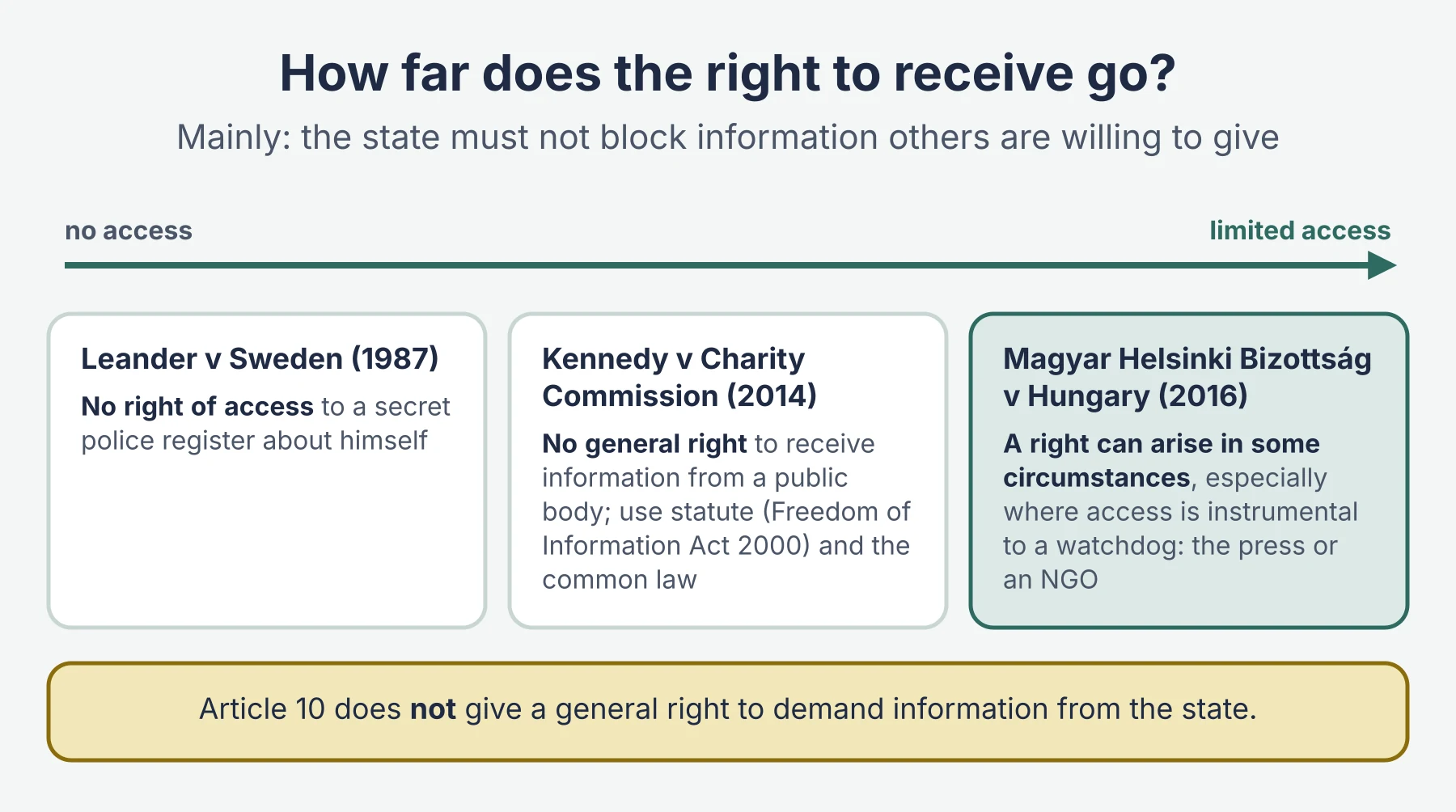
- Mainly a right not to be prevented from receiving information others are willing to give.
- Leander v Sweden (1987): no right of access to a secret police register.
- Magyar Helsinki Bizottság v Hungary (2016): a right of access to state-held information can arise in some circumstances, especially for watchdogs such as the press and NGOs.
- Kennedy v Charity Commission (2014): no general Article 10 right to information from a public body; use statute, including the Freedom of Information Act 2000, and the common law.
English law
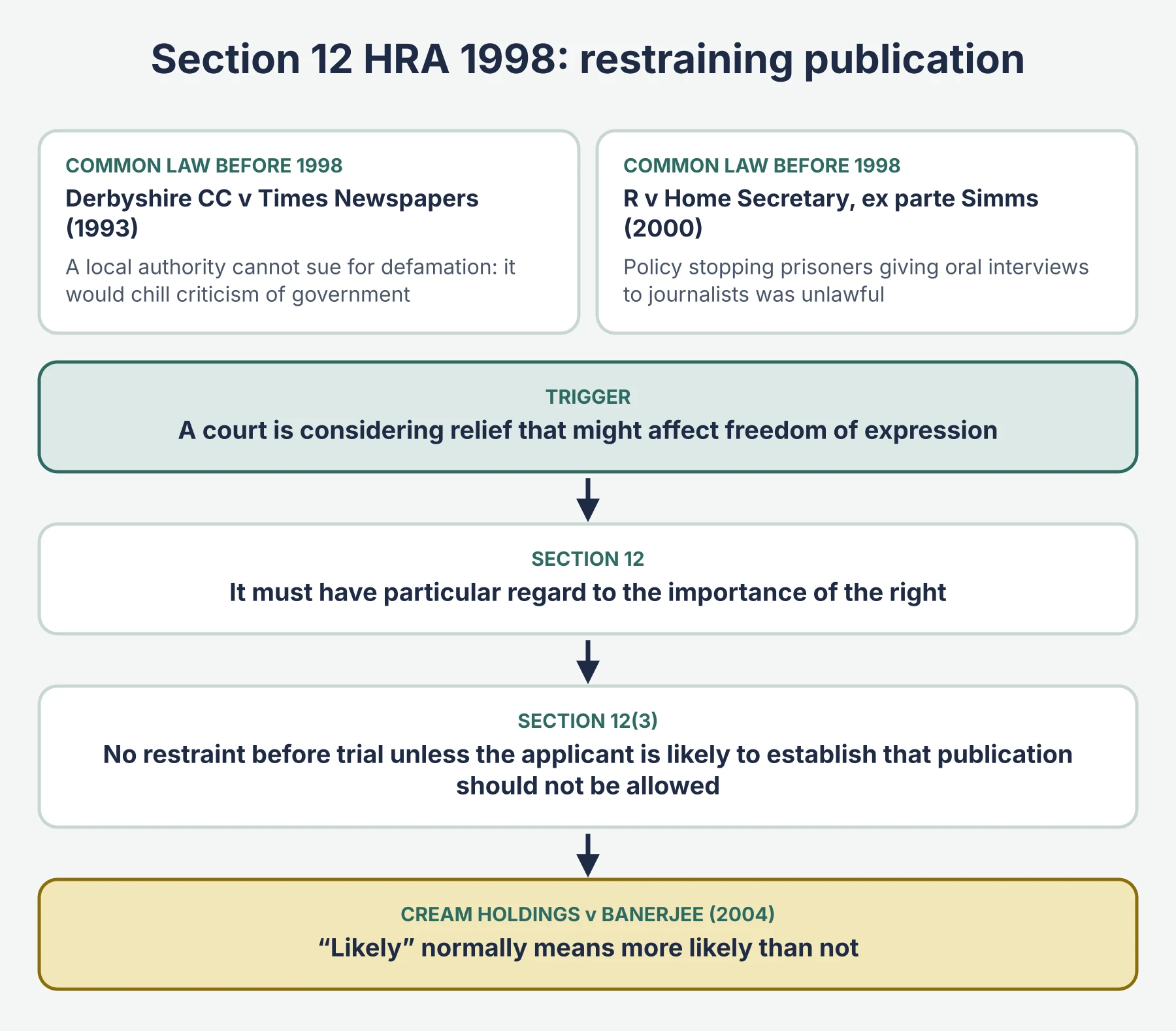
- Derbyshire CC v Times Newspapers (1993): a local authority cannot sue in defamation.
- R v SSHD ex p Simms (2000): policy stopping prisoners giving oral interviews to journalists investigating possible wrongful convictions was unlawful.
- HRA 1998 s12: where relief might affect expression, the court must have particular regard to the importance of the right; s12(3) no pre-trial restraint unless the applicant is likely to succeed.
- Cream Holdings v Banerjee (2004): “likely” normally means more likely than not.
Key terms
| Term | Meaning |
|---|---|
| Freedom of expression | The right to hold opinions and to receive and impart information and ideas |
| Impart | To communicate or pass on information and ideas |
| Prior restraint | Stopping publication before it happens, usually by interim injunction |
| Public watchdog | The Court’s description of the press’s democratic role |
| Chilling effect | The deterrent effect of sanctions on lawful expression |
| Margin of appreciation | Latitude given to states, wider on morals and religion than on political speech |
| Licensing | The power in 10.1 for states to license broadcasting, television and cinema |
Exam traps
- Handyside: principle protecting offensive ideas, but no breach on the facts.
- Do not treat all speech the same; say where on the hierarchy the facts sit.
- The audience’s right to receive is part of 10.1; Sunday Times relied on it.
- In any injunction question, cite s12 HRA and Cream Holdings.
- Article 10 is not a general freedom of information right (Leander; Kennedy).
- Remember 10.1 is engaged before 10.2 is considered; do not start with justification.
Self-test
- What three freedoms does Article 10.1 expressly include?
- What power does the final sentence of Article 10.1 give to states?
- State the Handyside principle and the outcome of the case.
- Why did the Court find a breach in Lingens v Austria?
- What did Goodwin v UK decide?
- Why was there a breach in Jersild v Denmark?
- Give a case where a restriction on artistic expression was upheld.
- What did Leander v Sweden decide about the right to receive information?
- How did Magyar Helsinki Bizottság v Hungary develop the right to receive information?
- What did Derbyshire CC v Times Newspapers decide?
- What does section 12(3) HRA 1998 require?
- What does “likely” mean in section 12(3), according to Cream Holdings?
Answers: 1. To hold opinions, to receive information and ideas, and to impart information and ideas. 2. To require the licensing of broadcasting, television or cinema enterprises. 3. Article 10 protects ideas that offend, shock or disturb; the seizure of the book was nevertheless justified. 4. A politician must tolerate wider criticism than a private individual, so the defamation conviction of a journalist was not necessary. 5. Ordering a journalist to disclose his source breached Article 10; protection of sources is a basic condition of press freedom. 6. The programme was a serious report on racism, and punishing the journalist for spreading the interviewees’ views would seriously hamper the press. 7. Müller v Switzerland (1988) or Otto-Preminger-Institut v Austria (1994). 8. It does not give a right of access to a secret police register; it mainly stops the state blocking information others will give. 9. It accepted that a right of access to state-held information can arise in some circumstances, especially for watchdogs. 10. A local authority cannot sue for defamation. 11. No relief restraining publication before trial unless the applicant is likely to establish that publication should not be allowed. 12. Normally more likely than not.
More resources on this topic
Article 10 study guide | Article 10 practice questions | Restrictions revision notes
Related resources
-
Study guides
AQA A Level Law (7162): Article 11 of the European Convention on Human Rights 1953
Article 11.1 ECHR for AQA A Level Law 7162: peaceful assembly, protest on the highway, positive obligations, trade unions and the freedom not to associate.
Law · AQA · A Level
Read guide -
Practice questions
AQA A Level Law (7162): Article 11 of the European Convention on Human Rights 1953 – Practice Questions
Original Article 11 ECHR practice for AQA A Level Law 7162 with mark-scheme answers on peaceful assembly, protest policing, unions and political association.
Law · AQA · A Level
Try questions -
Revision notes
AQA A Level Law (7162): Article 11 of the European Convention on Human Rights 1953 – Revision Notes
Condensed recall on Article 11.1 ECHR for AQA A Level Law 7162: peaceful assembly, positive duties, protest on the highway, unions and political association.
Law · AQA · A Level
Revise topic
Get free revision emails (optional)
Occasional emails with practice questions, worked explanations and links to free resources for the qualification and subjects you choose. No spam, and you can unsubscribe from any email. The free tools on this site never need an email.