
Revision Notes
AQA A Level Law (7162): Article 11 of the European Convention on Human Rights 1953 – Revision Notes
Condensed recall on Article 11.1 ECHR for AQA A Level Law 7162: peaceful assembly, positive duties, protest on the highway, unions and political association.
- Subject
- Law
- Level
- A LEVELS
- Topic
- Topic 5: Human Rights
- Author
- Marlbridge Academic Team
- Updated
- Reviewed by
- Aizaz Raoof Ali (what this means)
Aligned to AQA A Level Law (7162), For teaching from September 2017 onwards, A-level exams 2019 onwards. Official specification .
Syllabus page (what it covers and how it is assessed): AQA A Level Law.
Syllabus points this page covers
7162
- Article 11 of the European Convention on Human Rights 1953
Found an error? Report a correction.
Need help with this topic? Request a free trial class for A Level Law (7162).
Condensed notes on Article 11.1. For full explanation and a worked scenario, use the Article 11 study guide.
The text in summary
Everyone has the right to freedom of peaceful assembly and to freedom of association with others, including the right to form and join trade unions for the protection of their interests. Qualified right: restrictions in 11.2. Closely linked with Article 10, since protest is usually expression.
Answer order: which freedom (assembly or association) → is it peaceful / is it an association → interference or failure of positive duty → 11.2 → conclusion.
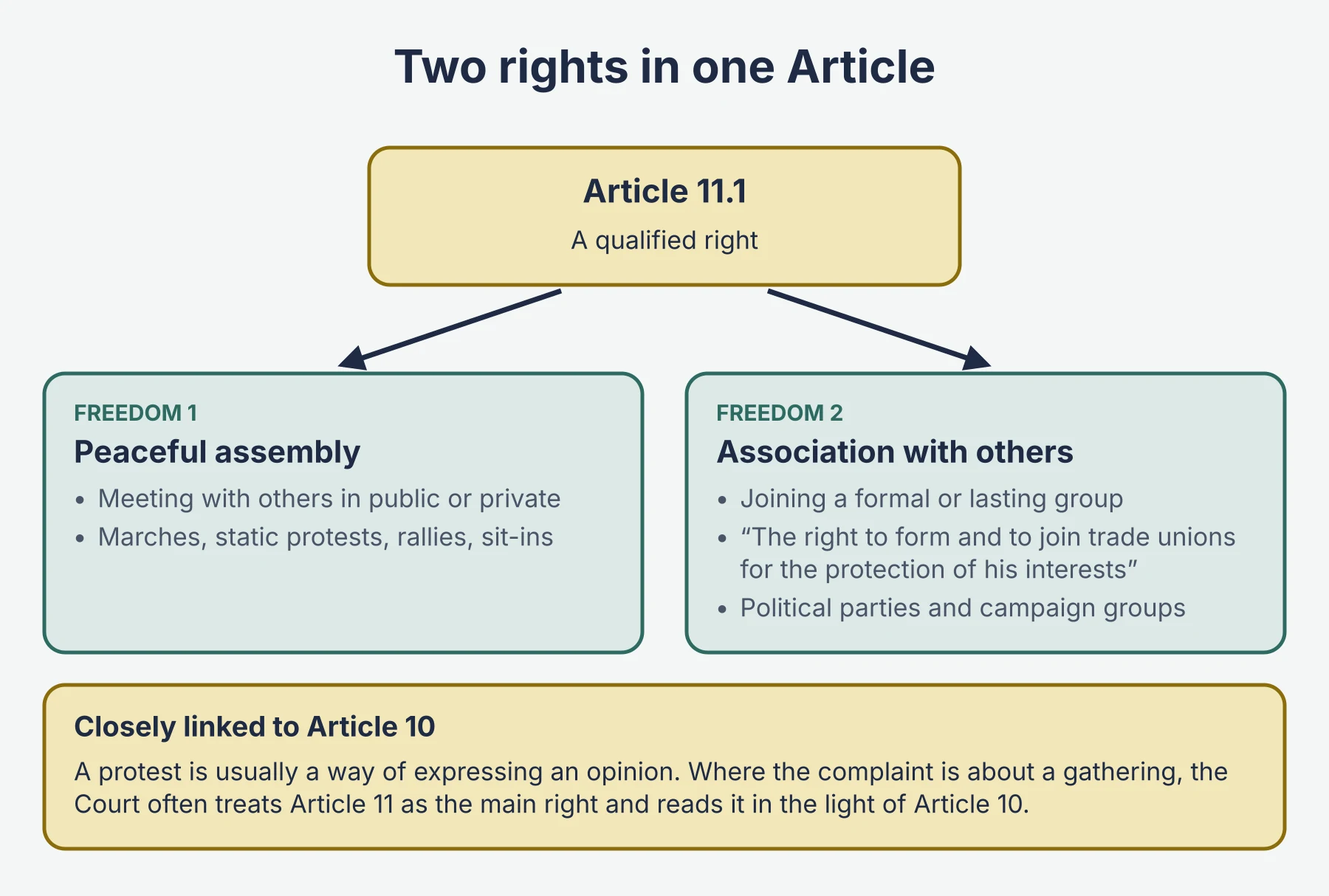
Peaceful assembly: core rules
| Rule | Authority |
|---|---|
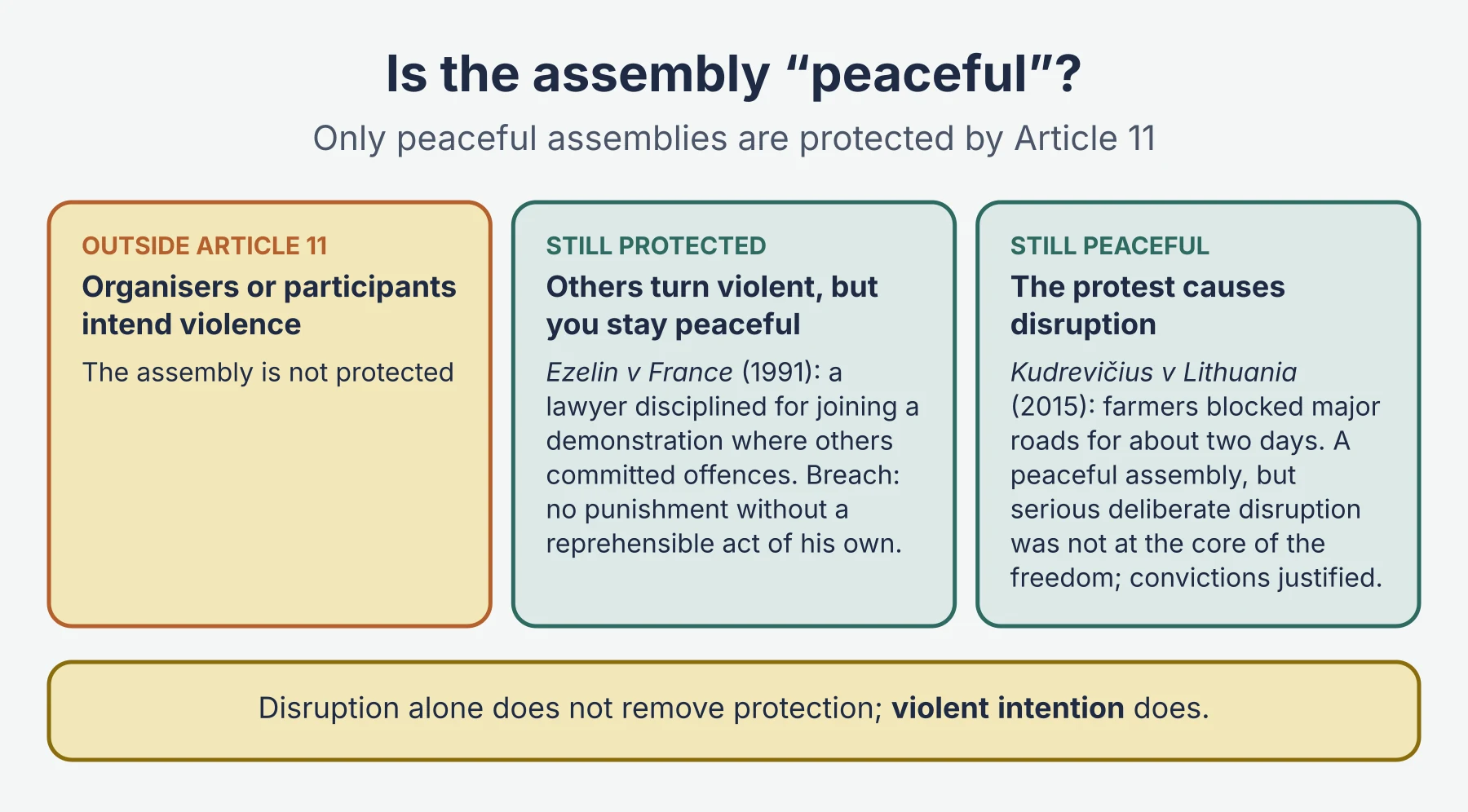
| Only peaceful assemblies are protected; violent intention removes protection | Kudrevičius v Lithuania (2015) |
| A peaceful individual keeps protection despite violence by others | Ezelin v France (1991): lawyer disciplined for attending; breach |
| Disruption alone does not make an assembly non-peaceful, but deliberate serious disruption is not at the core | Kudrevičius: road blockades by farmers; convictions justified |
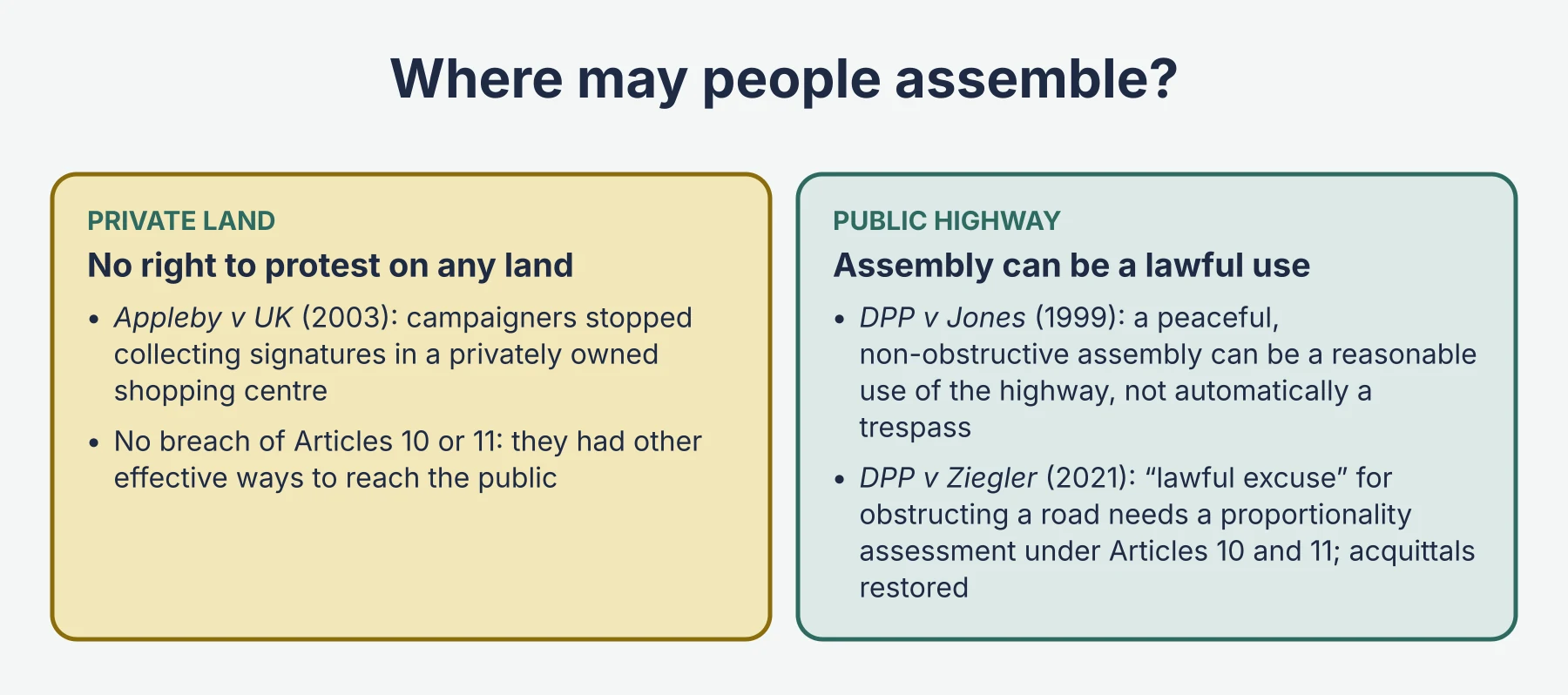
| No general right to protest on private land where alternatives exist | Appleby v UK (2003): shopping centre; no breach |
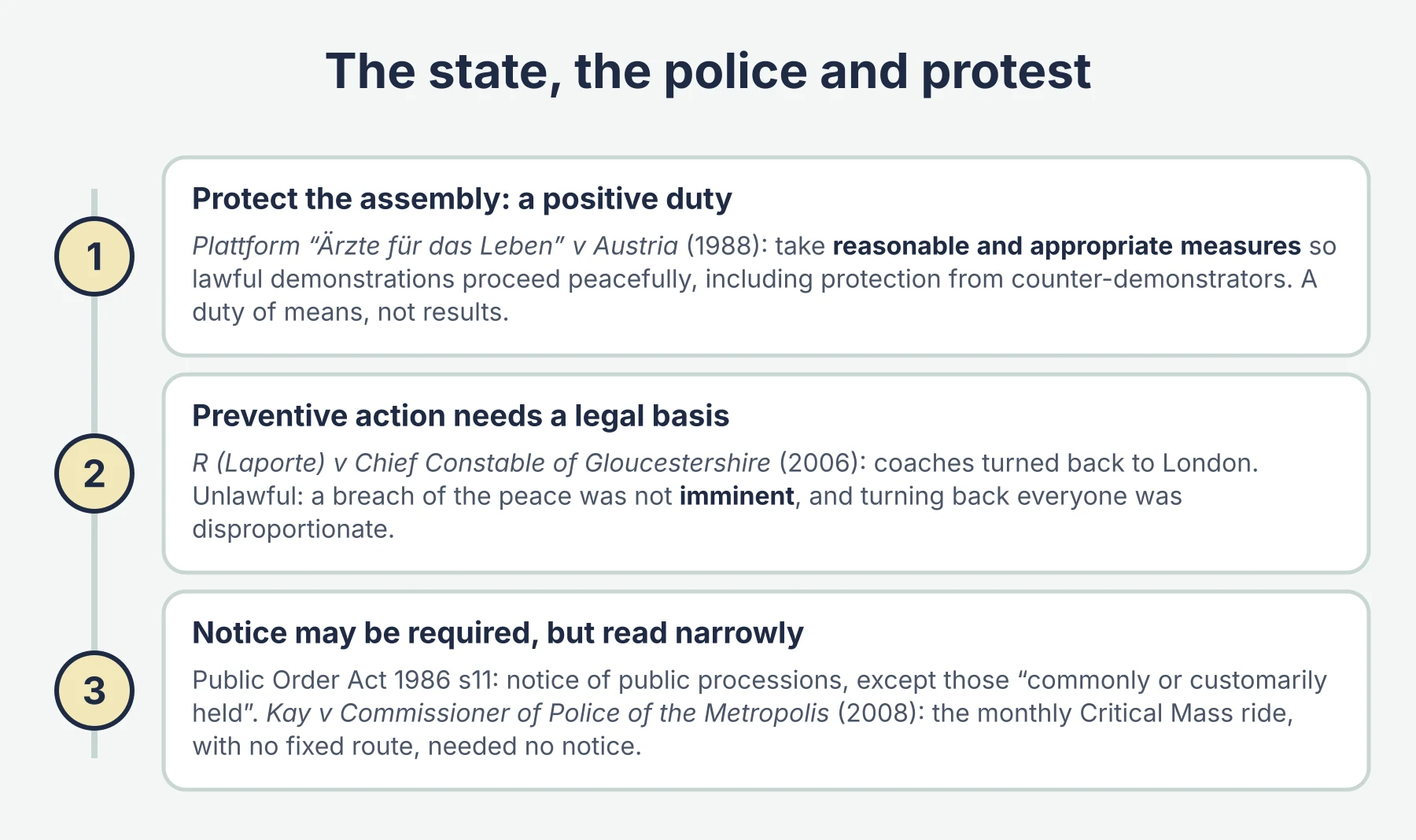
| States must take reasonable and appropriate measures to protect lawful demonstrations | Plattform “Ärzte für das Leben” v Austria (1988) |
English cases on protest
-
DPP v Jones (1999): peaceful, non-obstructive assembly on the highway can be a reasonable use, not automatically trespass.
-
R (Laporte) v Chief Constable of Gloucestershire (2006): turning back coaches of protesters unlawful; breach of the peace not imminent; disproportionate.
-
DPP v Ziegler (2021): “lawful excuse” for obstructing the highway requires a proportionality assessment under Articles 10 and 11; acquittals restored.
-
Kay v MPC (2008): Critical Mass cycle ride with no fixed route was “commonly or customarily held”, so no advance notice was needed under the Public Order Act 1986 s11.
Linking Article 11 with Article 10
A protest is both an assembly and a form of expression. The Court usually treats Article 11 as the main right where the complaint concerns a gathering, reading it in the light of Article 10. In an answer, name both, then analyse under Article 11 with Article 10 support. Where the complaint is about leaflets, banners or speeches rather than the gathering itself, Article 10 may be the better lead right.
Freedom of association
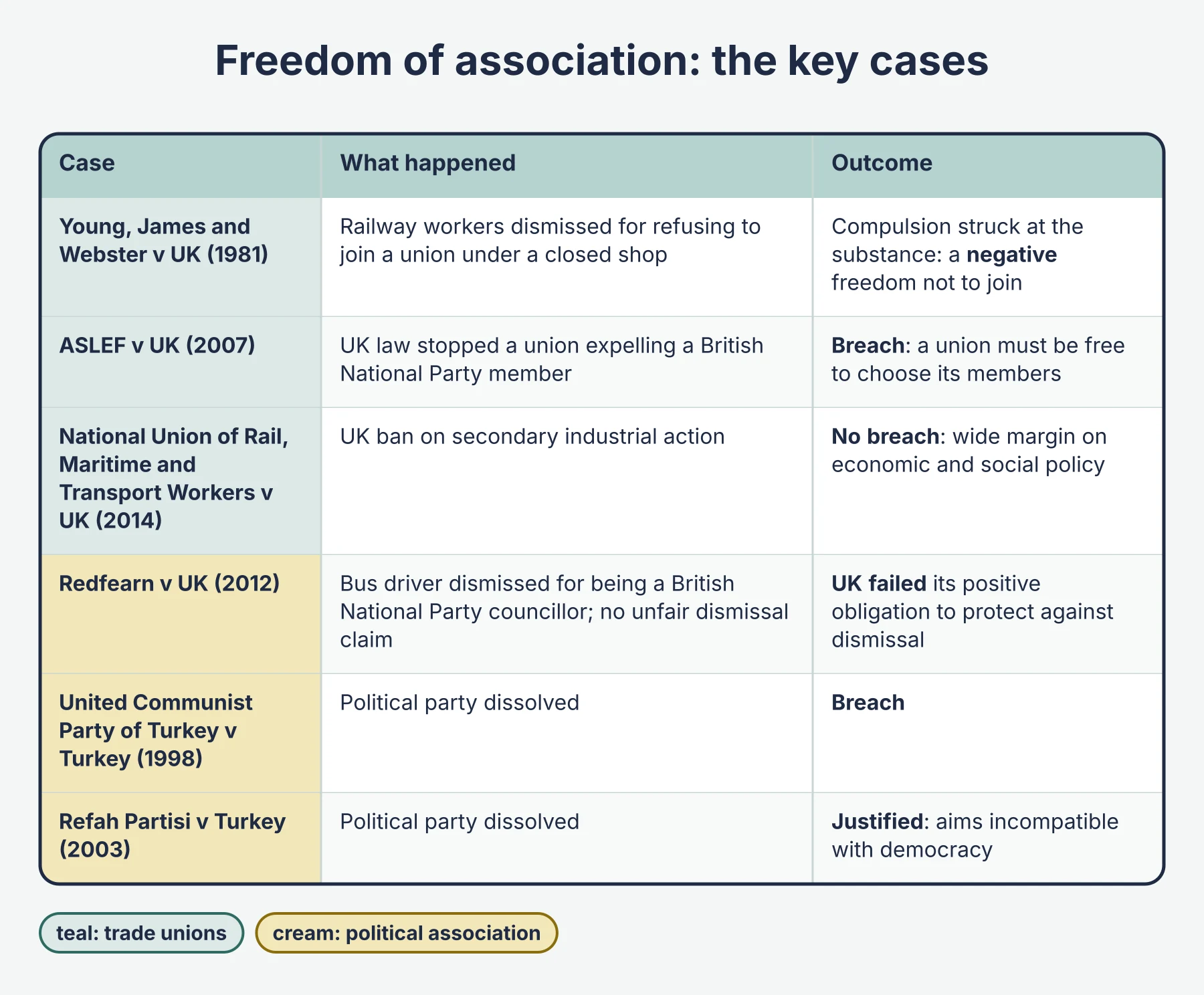
| Case | Point |
|---|---|
| Young, James and Webster v UK (1981) | Dismissal for refusing to join a union under a closed shop: breach; negative freedom |
| ASLEF v UK (2007) | Union entitled to expel a BNP member; UK law preventing this: breach |
| RMT v UK (2014) | Ban on secondary industrial action: no breach; wide margin |
| Redfearn v UK (2012) | Dismissal for BNP membership with no unfair dismissal remedy: breach of positive obligation |
| United Communist Party of Turkey v Turkey (1998) | Dissolution of a party: breach |
| Refah Partisi v Turkey (2003) | Dissolution justified; aims incompatible with democracy |
Key terms
| Term | Meaning |
|---|---|
| Peaceful assembly | A gathering of people whose organisers and participants do not intend violence |
| Association | A voluntary grouping for a common goal, such as a union, party or campaign group |
| Negative freedom of association | Freedom not to be compelled to join an association |
| Positive obligation | Duty on the state to take reasonable steps to protect the exercise of the right |
| Closed shop | Agreement requiring employees to be members of a particular union |
| Secondary action | Industrial action against an employer that is not party to the dispute |
| Imminence | The requirement that a breach of the peace be about to happen before preventive powers are used (Laporte) |
Exam traps
- Disruptive does not mean non-peaceful.
- Violence by others does not remove a peaceful protester’s protection.
- Article 11 is not a right to protest anywhere; Appleby.
- Remember positive obligations: the police may need to protect, not just tolerate, a lawful protest.
- ASLEF protects the union’s choice of members; Redfearn protects the individual’s association.
- Do not forget that the association half carries marks too.
Self-test
- What two freedoms are protected by Article 11.1?
- Which group does Article 11.1 expressly mention as an association a person may form and join?
- What makes an assembly fall outside Article 11?
- What was decided in Ezelin v France?
- What did the Grand Chamber decide in Kudrevičius v Lithuania?
- Why was there no breach in Appleby v UK?
- What positive obligation did Plattform “Ärzte für das Leben” v Austria recognise?
- What did DPP v Jones decide about assemblies on the highway?
- Why was the police action in Laporte unlawful?
- What principle did Young, James and Webster v UK establish?
- Contrast ASLEF v UK with Redfearn v UK.
- What did DPP v Ziegler require courts to do?
Answers: 1. Peaceful assembly and association with others. 2. Trade unions. 3. Violent intentions on the part of the organisers or participants. 4. A peaceful participant cannot be punished for taking part in a demonstration where others commit offences, if they commit no reprehensible act themselves. 5. Road blockades were a peaceful assembly, though deliberate serious disruption is not at the core of the right; the convictions were justified. 6. The campaigners had other effective ways to reach the public, so being excluded from a private shopping centre did not breach Articles 10 or 11. 7. States must take reasonable and appropriate measures to enable lawful demonstrations to proceed peacefully. 8. A peaceful, non-obstructive assembly can be a reasonable use of the highway and is not automatically a trespass. 9. A breach of the peace was not imminent and turning back everyone was disproportionate. 10. Article 11 includes a negative freedom not to be compelled to join a union. 11. ASLEF upheld a union’s right to expel a member for his politics; Redfearn upheld an individual’s right to protection from dismissal for political membership. 12. Assess proportionality under Articles 10 and 11 when deciding whether protesters had a lawful excuse for obstructing the highway.
More resources on this topic
Article 11 study guide | Article 11 practice questions | Restrictions revision notes
Related resources
-
Study guides
AQA A Level Law (7162): Article 2 of the European Convention on Human Rights 1953
Article 2 ECHR for AQA A Level Law 7162: the right to life, the 2.2 exceptions, absolutely necessary force and the state's positive and procedural duties.
Law · AQA · A Level
Read guide -
Practice questions
AQA A Level Law (7162): Article 2 of the European Convention on Human Rights 1953 – Practice Questions
Original Article 2 ECHR practice for AQA A Level Law 7162 with mark-scheme answers on positive duties, the Osman test, Article 2.2, McCann and investigations.
Law · AQA · A Level
Try questions -
Revision notes
AQA A Level Law (7162): Article 2 of the European Convention on Human Rights 1953 – Revision Notes
Condensed recall on Article 2 ECHR for AQA A Level Law 7162: positive and procedural duties, the Osman test, the 2.2 exceptions and absolutely necessary force.
Law · AQA · A Level
Revise topic
Get free revision emails (optional)
Occasional emails with practice questions, worked explanations and links to free resources for the qualification and subjects you choose. No spam, and you can unsubscribe from any email. The free tools on this site never need an email.