
Study Guides
AQA A Level Law (7162): Article 11 of the European Convention on Human Rights 1953
Article 11.1 ECHR for AQA A Level Law 7162: peaceful assembly, protest on the highway, positive obligations, trade unions and the freedom not to associate.
- Subject
- Law
- Level
- A LEVELS
- Topic
- Topic 5: Human Rights
- Author
- Marlbridge Academic Team
- Updated
- Reviewed by
- Aizaz Raoof Ali (what this means)
Aligned to AQA A Level Law (7162), For teaching from September 2017 onwards, A-level exams 2019 onwards. Official specification .
Syllabus page (what it covers and how it is assessed): AQA A Level Law.
Syllabus points this page covers
7162
- Article 11 of the European Convention on Human Rights 1953
Found an error? Report a correction.
Need help with this topic? Request a free trial class for A Level Law (7162).
This guide covers Article 11 of the European Convention on Human Rights 1953 in section 3.5 Human Rights of AQA A-level Law (7162). The specification states it as “Article 11.1: right to freedom of peaceful assembly and to freedom of association with others”. The justified limits in Article 11.2 are a separate row, covered in the Restrictions study guide. For the option as a whole, see the Human Rights study guide.
Two rights in one Article
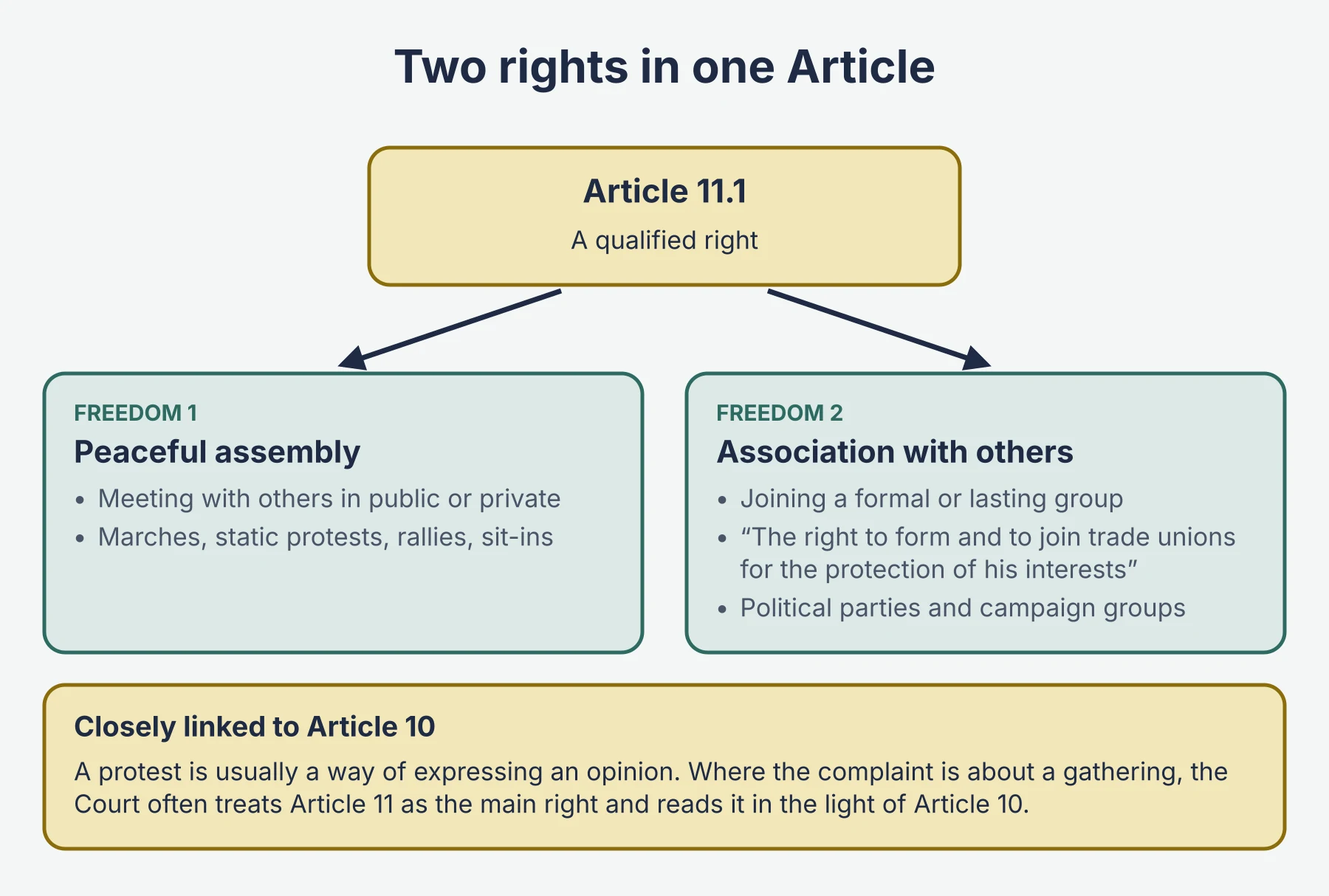
Article 11.1 contains two linked freedoms:
- Peaceful assembly: meeting with others in public or private, including marches, static protests, rallies and sit-ins.
- Association with others: joining together in a formal or lasting group, expressly including “the right to form and to join trade unions for the protection of his interests”. Political parties and campaign groups are also associations.
Article 11 is a qualified right and is closely linked to Article 10: a protest is usually a way of expressing an opinion. The Court often treats Article 11 as the main right where the complaint is about a gathering, and reads it in the light of Article 10.
Peaceful assembly
The word “peaceful”
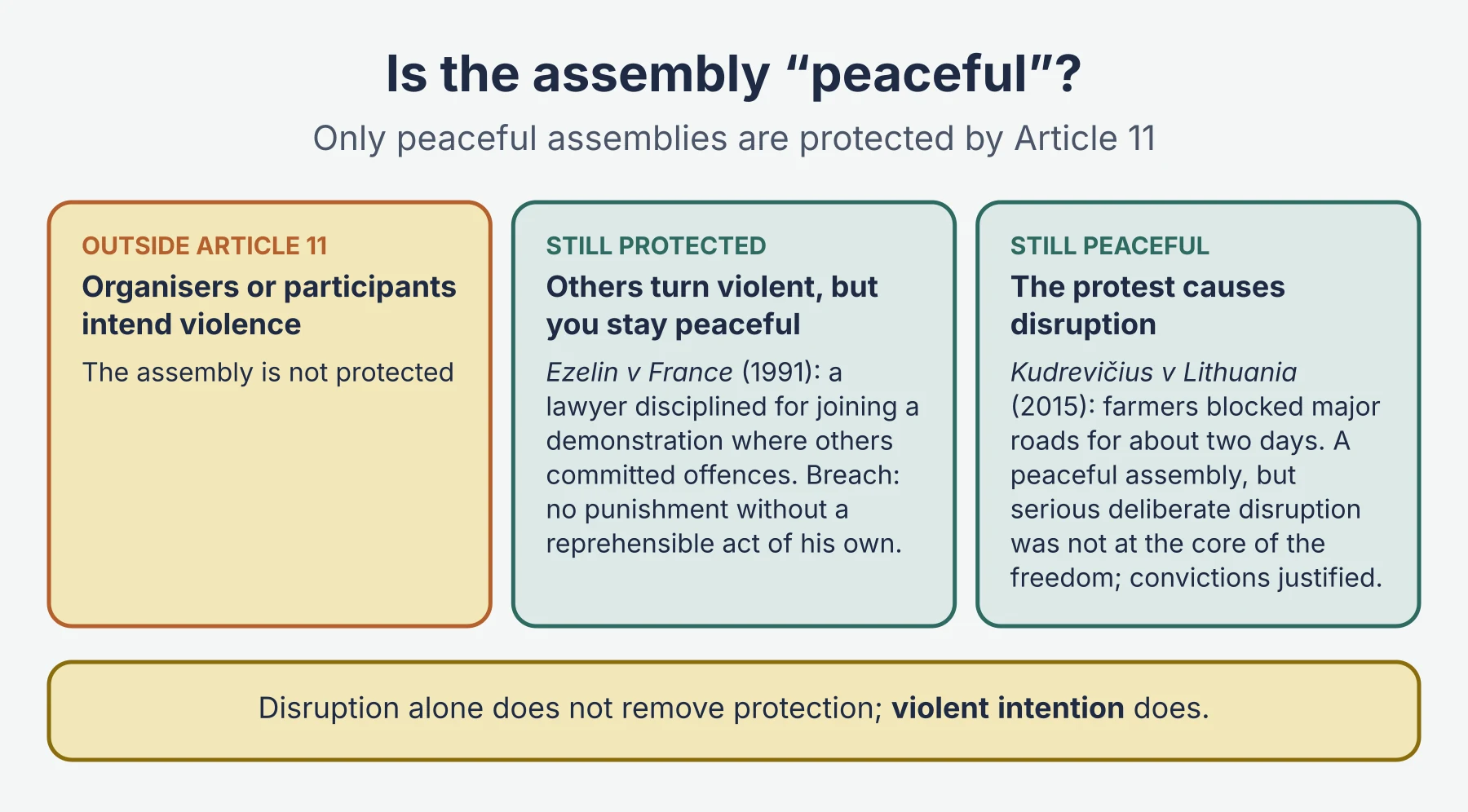
Only peaceful assemblies are protected. An assembly whose organisers or participants intend violence falls outside Article 11. But a person who stays peaceful does not lose protection because others at the same event are violent. In Ezelin v France (1991) a lawyer was disciplined for taking part in a demonstration during which others committed offences; he had done nothing wrong himself. The Court found a breach: a person cannot be punished for joining a peaceful demonstration as long as they do not commit any reprehensible act.
Disruption does not make an assembly non-peaceful. In Kudrevičius v Lithuania (2015) farmers blocked major roads for about two days. The Grand Chamber accepted that this was a peaceful assembly within Article 11, though deliberately causing serious disruption was not at the core of the freedom, and the farmers’ convictions were found to be justified.
Where people may assemble
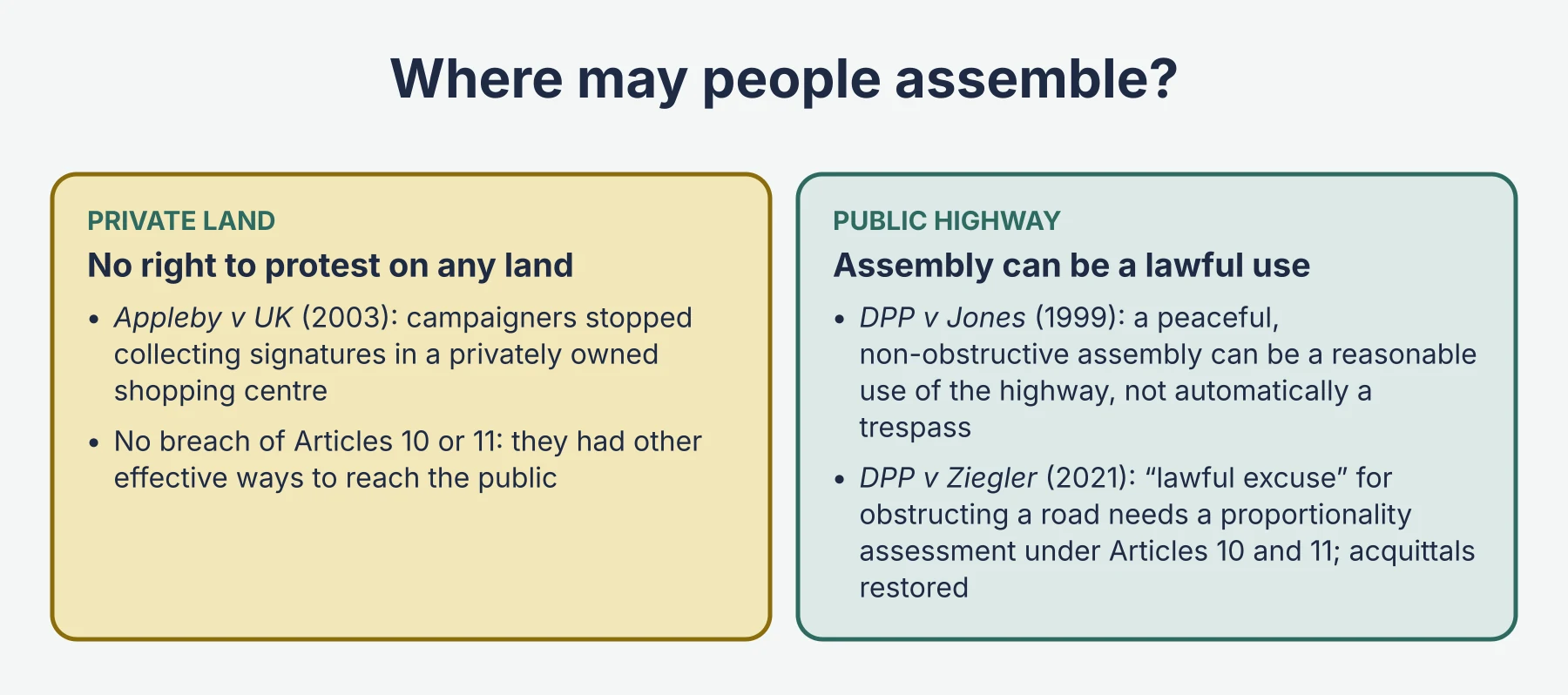
Article 11 does not give a right to protest on any land. In Appleby v United Kingdom (2003) campaigners were stopped from collecting signatures in a privately owned shopping centre. There was no breach of Articles 10 or 11, because they had other effective ways to reach the public.
On public land, English law has moved towards recognising assembly as a lawful use. In DPP v Jones (1999) the House of Lords held that a peaceful, non-obstructive assembly on the highway can be a reasonable use of it and so is not automatically a trespass. In DPP v Ziegler (2021) protesters blocked a road to an arms fair. The Supreme Court held that whether they had a “lawful excuse” for obstructing the highway required a proportionality assessment under Articles 10 and 11, and their acquittals were restored.
Positive obligations to protect assemblies
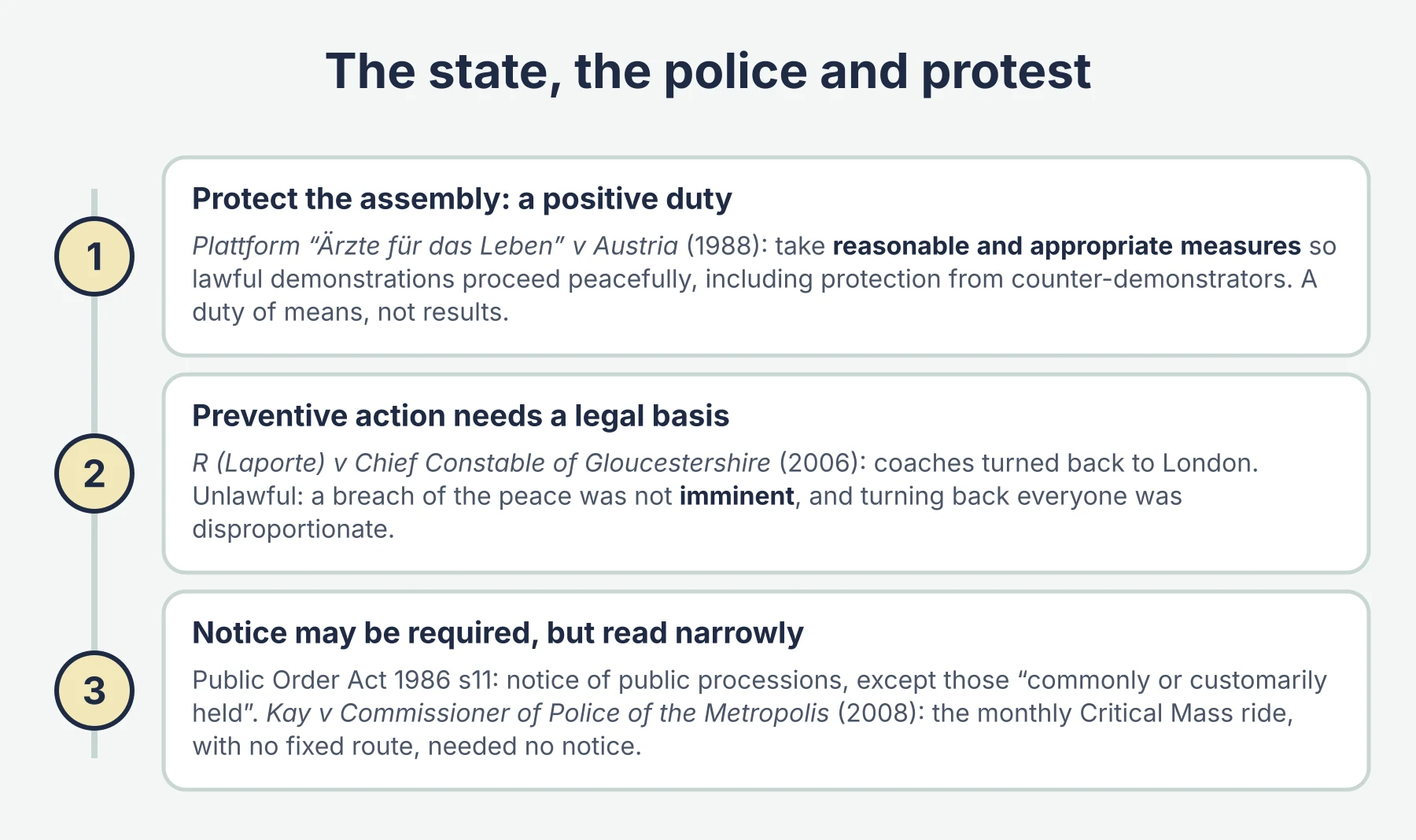
Article 11 requires more than non-interference. In Plattform “Ärzte für das Leben” v Austria (1988) the Court held that states must take reasonable and appropriate measures to enable lawful demonstrations to proceed peacefully, including protection from counter-demonstrators. The duty is one of means, not results: the police are not guarantors of every event.
Preventive policing of protest
In R (Laporte) v Chief Constable of Gloucestershire (2006) police stopped coaches taking protesters to an RAF base and escorted them back to London. The House of Lords held this was unlawful: a breach of the peace was not imminent, so there was no power to act, and turning back everyone on the coaches was disproportionate. The case shows that preventive action against people who have done nothing wrong needs a clear legal basis and close scrutiny.
Notice and regularity
Article 11 does not forbid states from requiring advance notice of marches, provided the requirement is not used to block peaceful protest. In English law, section 11 of the Public Order Act 1986 requires notice of public processions but exempts those “commonly or customarily held”. In Kay v Commissioner of Police of the Metropolis (2008) the House of Lords held that the monthly Critical Mass cycle ride, which had no fixed route, was commonly or customarily held and so needed no notice. Reading such conditions narrowly keeps them compatible with Article 11.
Freedom of association
Trade unions
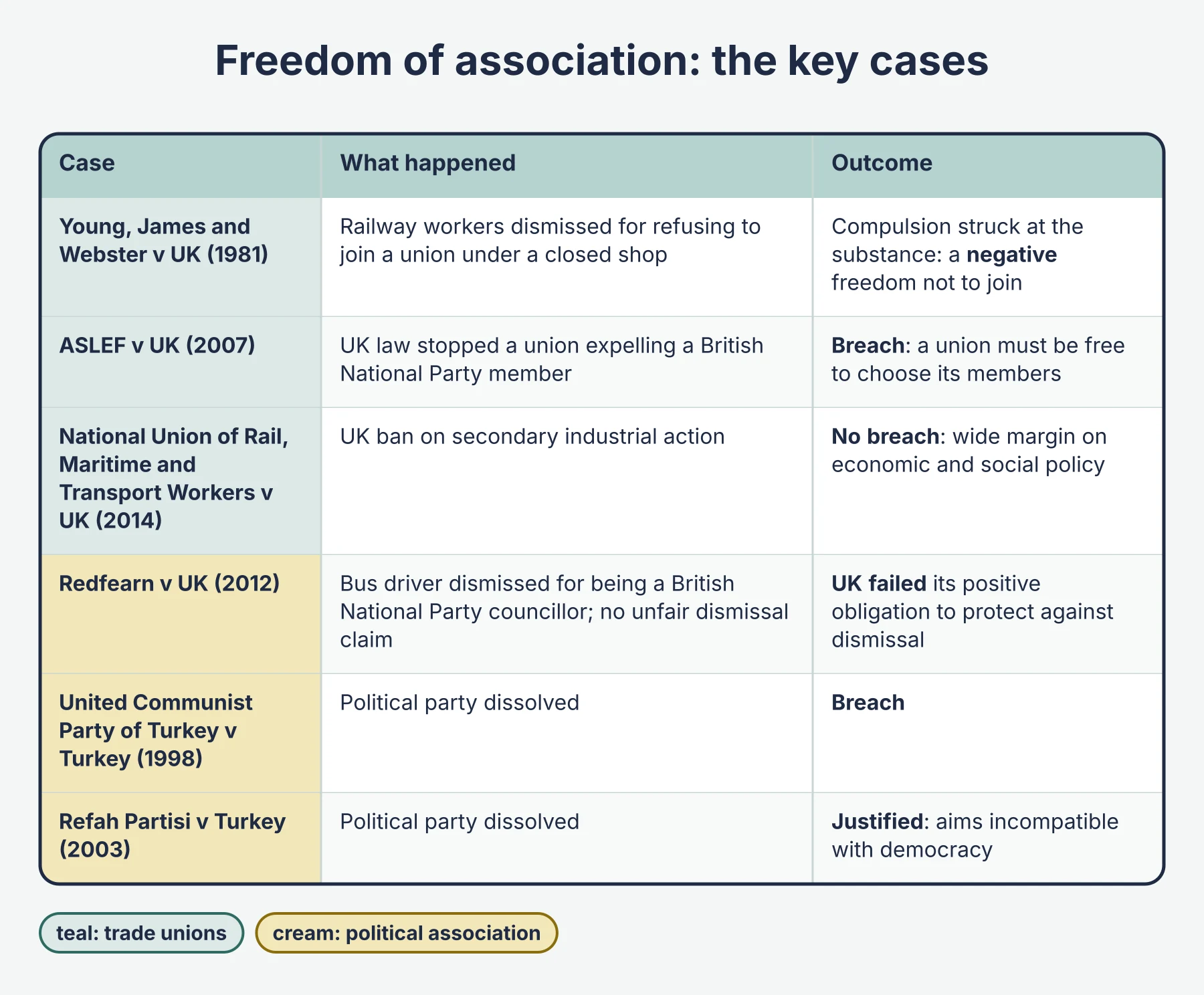
- Young, James and Webster v United Kingdom (1981): railway workers were dismissed for refusing to join a union under a “closed shop” agreement. The Court held that compulsion of this kind struck at the substance of the freedom, recognising a negative aspect: freedom not to be forced to join.
- ASLEF v United Kingdom (2007): a union was prevented by UK law from expelling a member because of his membership of the British National Party. The Court held that a union must be free to choose its members, and found a breach.
- National Union of Rail, Maritime and Transport Workers v United Kingdom (2014): the UK ban on secondary industrial action did not breach Article 11; the state had a wide margin of appreciation on economic and social policy.
Political association
- Redfearn v United Kingdom (2012): a bus driver was dismissed because he was a local councillor for the British National Party. He could not bring an unfair dismissal claim because he lacked the qualifying period of employment. The Court held the UK had failed in its positive obligation to provide protection against dismissal based on political association.
- Dissolving a political party is the most serious interference. In United Communist Party of Turkey v Turkey (1998) dissolution breached Article 11, whereas in Refah Partisi v Turkey (2003) the Grand Chamber held dissolution justified because the party’s aims were incompatible with democracy.
Worked example
Facts: A group of nurses plan a silent vigil outside a hospital about staff shortages. On the morning, a separate group arrives and starts throwing objects at them. Police tell the nurses to leave because “there might be trouble”, and arrest Kim when she stays standing silently on the pavement.
Right:          Article 11.1, peaceful assembly, read with Article 10.
Peaceful?       The nurses are peaceful; violence by others does not remove
                their protection (Ezelin).
Location:       A pavement is public highway; peaceful use can be lawful
                (DPP v Jones).
Positive duty:  Police should take reasonable steps to protect the vigil from
                the counter-group (Plattform Ärzte für das Leben).
Kim's arrest:   Action against the peaceful group rather than the aggressors
                needs justification; compare Laporte on imminence and
                proportionality. Article 11.2 decides whether it is justified.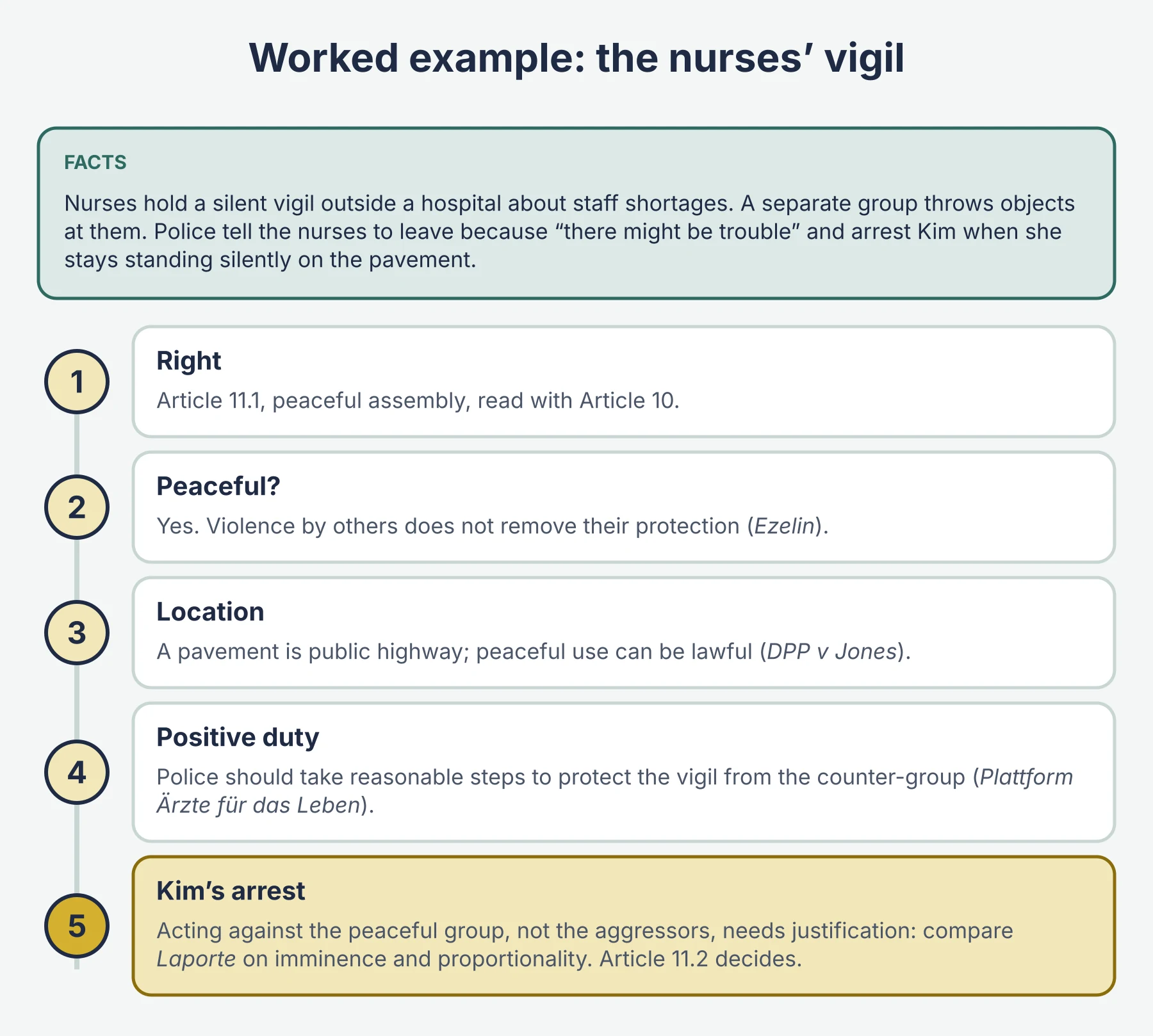
Common mistakes
- Treating any disruptive protest as non-peaceful. Kudrevičius shows disruption alone does not remove the protection; violent intention does.
- Forgetting the positive obligation to protect lawful protests from others.
- Claiming Article 11 gives a right to protest on private land; Appleby says otherwise where alternatives exist.
- Ignoring the association half of Article 11, especially trade unions and the negative freedom in Young, James and Webster.
- Misstating ASLEF: it was the union’s freedom to exclude members that was protected.
Exam technique
- Explain: separate assembly and association and give a case for each.
- Suggest and Advise: decide whether the assembly is peaceful, consider location, positive duties and the legal basis of police action, then apply 11.2.
- Consider: develop arguments on whether disruption or the conduct of others removes protection.
- Discuss: evaluate how far English law, through DPP v Jones, Laporte and Ziegler, protects protest.
More resources on this topic
Article 11 revision notes | Article 11 practice questions | Human Rights and English law study guide
Related resources
-
Practice questions
AQA A Level Law (7162): Article 11 of the European Convention on Human Rights 1953 – Practice Questions
Original Article 11 ECHR practice for AQA A Level Law 7162 with mark-scheme answers on peaceful assembly, protest policing, unions and political association.
Law · AQA · A Level
Try questions -
Revision notes
AQA A Level Law (7162): Article 11 of the European Convention on Human Rights 1953 – Revision Notes
Condensed recall on Article 11.1 ECHR for AQA A Level Law 7162: peaceful assembly, positive duties, protest on the highway, unions and political association.
Law · AQA · A Level
Revise topic -
Study guides
AQA A Level Law (7162): Article 2 of the European Convention on Human Rights 1953
Article 2 ECHR for AQA A Level Law 7162: the right to life, the 2.2 exceptions, absolutely necessary force and the state's positive and procedural duties.
Law · AQA · A Level
Read guide
Get free revision emails (optional)
Occasional emails with practice questions, worked explanations and links to free resources for the qualification and subjects you choose. No spam, and you can unsubscribe from any email. The free tools on this site never need an email.