
Study Guides
AQA A Level Law (7162): Human Rights and English law
How English law protects and restricts Convention rights for AQA A Level Law 7162: the right to life, liberty, privacy, expression, assembly and association.
- Subject
- Law
- Level
- A LEVELS
- Topic
- Topic 5: Human Rights
- Author
- Marlbridge Academic Team
- Updated
- Reviewed by
- Aizaz Raoof Ali (what this means)
Aligned to AQA A Level Law (7162), For teaching from September 2017 onwards, A-level exams 2019 onwards. Official specification .
Syllabus page (what it covers and how it is assessed): AQA A Level Law.
Syllabus points this page covers
7162
- Human Rights and English law
Found an error? Report a correction.
Need help with this topic? Request a free trial class for A Level Law (7162).
This guide covers Human Rights and English law in section 3.5 Human Rights of AQA A-level Law (7162). The specification asks for “an outline of criminal and civil law provisions and investigatory procedures” for the right to life, then deprivation of liberty, “privacy and communication: criminal and civil law provisions which protect or restrict the rights” and expression, assembly and association. It is where the Convention Articles meet the domestic rules that a scenario will test. For the option as a whole, see the Human Rights study guide.
The right to life in English law
The specification lists five strands. Each matches an obligation that Article 2 places on the state.
Homicide and associated offences
The criminal law protects life through murder (unlawful killing with intention to kill or to cause grievous bodily harm), voluntary manslaughter (murder reduced by loss of control or diminished responsibility under the Coroners and Justice Act 2009 and Homicide Act 1957), and involuntary manslaughter (unlawful act manslaughter and gross negligence manslaughter, as in R v Adomako, 1995). Organisations can be liable under the Corporate Manslaughter and Corporate Homicide Act 2007, which can apply to public bodies including police forces, though some operational policing activities are excluded. Assisting suicide remains an offence under section 2 of the Suicide Act 1961.
Self-defence and prevention of crime
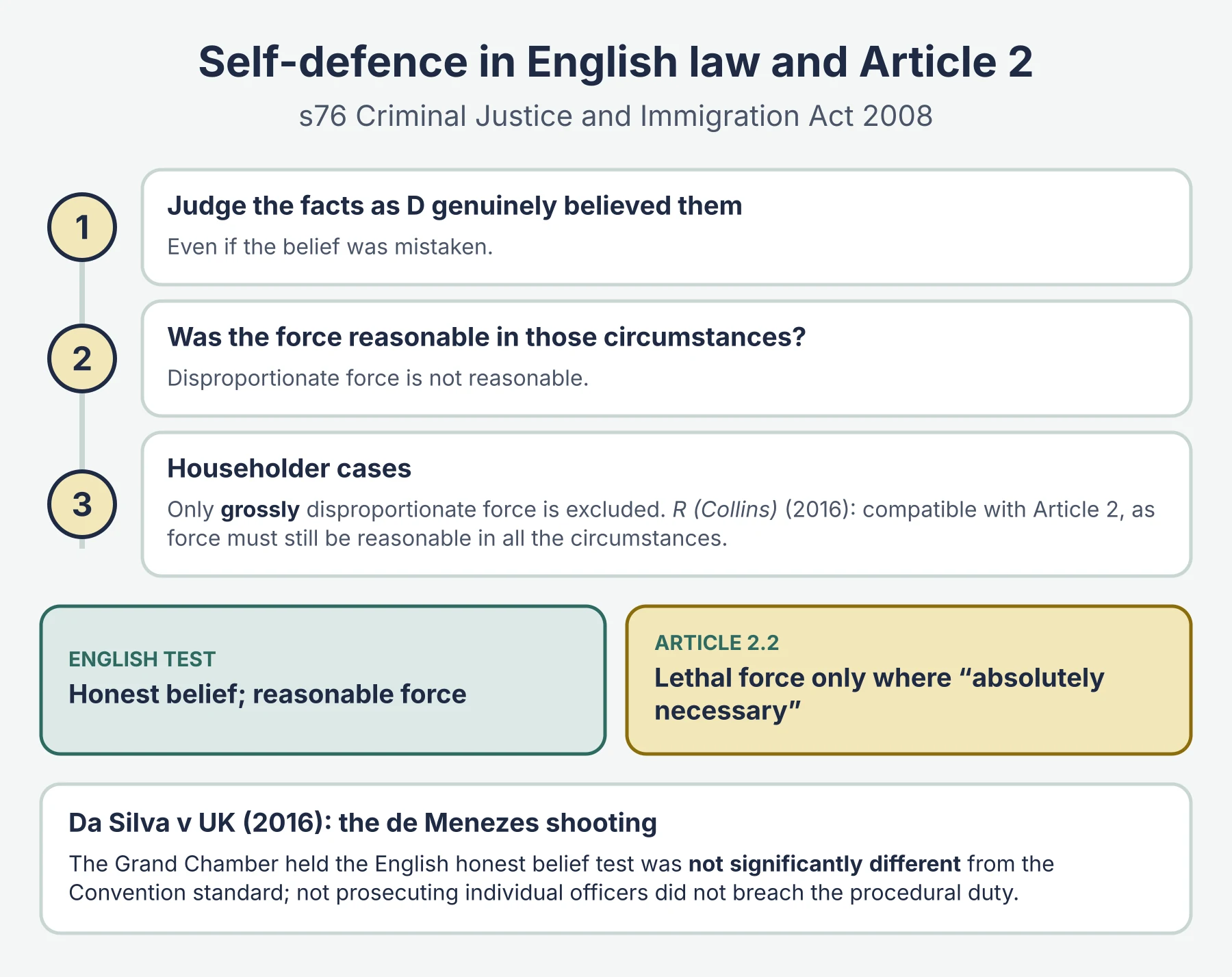
A person may use reasonable force in self-defence at common law and, in the prevention of crime, under section 3 of the Criminal Law Act 1967. Section 76 of the Criminal Justice and Immigration Act 2008 sets the test: the defendant is judged on the facts as they genuinely believed them to be, even if the belief was mistaken, and the force must be reasonable in those circumstances; disproportionate force is not reasonable, except that in householder cases only grossly disproportionate force is excluded. In R (Collins) v Secretary of State for Justice (2016) the householder rule was held compatible with Article 2, because the force must still be reasonable in all the circumstances.
There is a tension with Article 2.2, which permits lethal force only where “absolutely necessary”. In Da Silva v United Kingdom (2016), brought by the family of Jean Charles de Menezes, who was shot by police who wrongly believed he was a suicide bomber, the Grand Chamber held that the English test of honest belief was not significantly different from the Convention standard, and that the decision not to prosecute individual officers did not breach the procedural duty under Article 2.
Planning dangerous operations
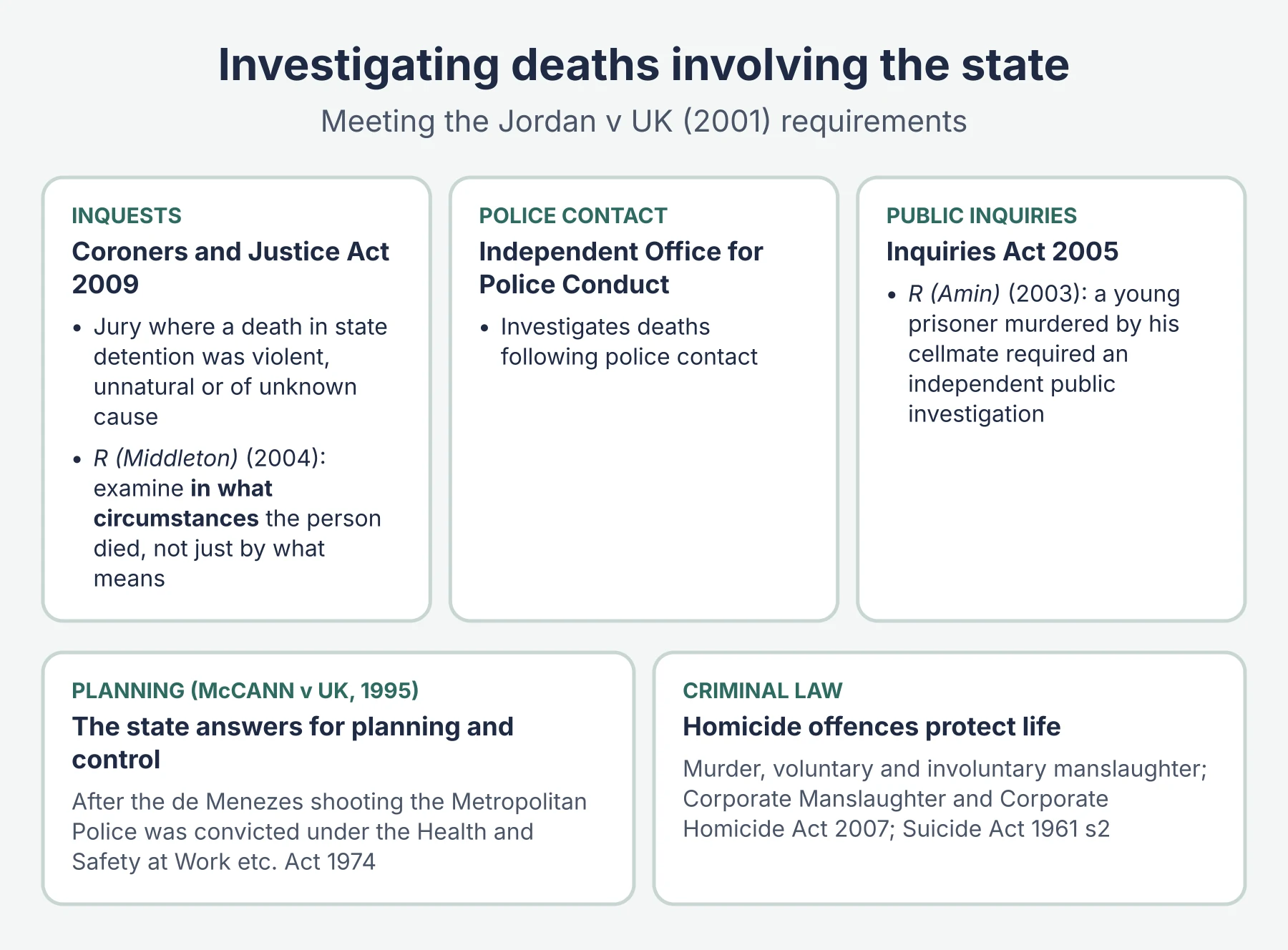
McCann v United Kingdom (1995) made the state responsible for the planning and control of operations that may involve lethal force, not just the actions of the officer who fires. Domestically, operational failures can lead to prosecution of the organisation: after the de Menezes shooting the Metropolitan Police was convicted of an offence under the Health and Safety at Work etc. Act 1974.
Protective policing
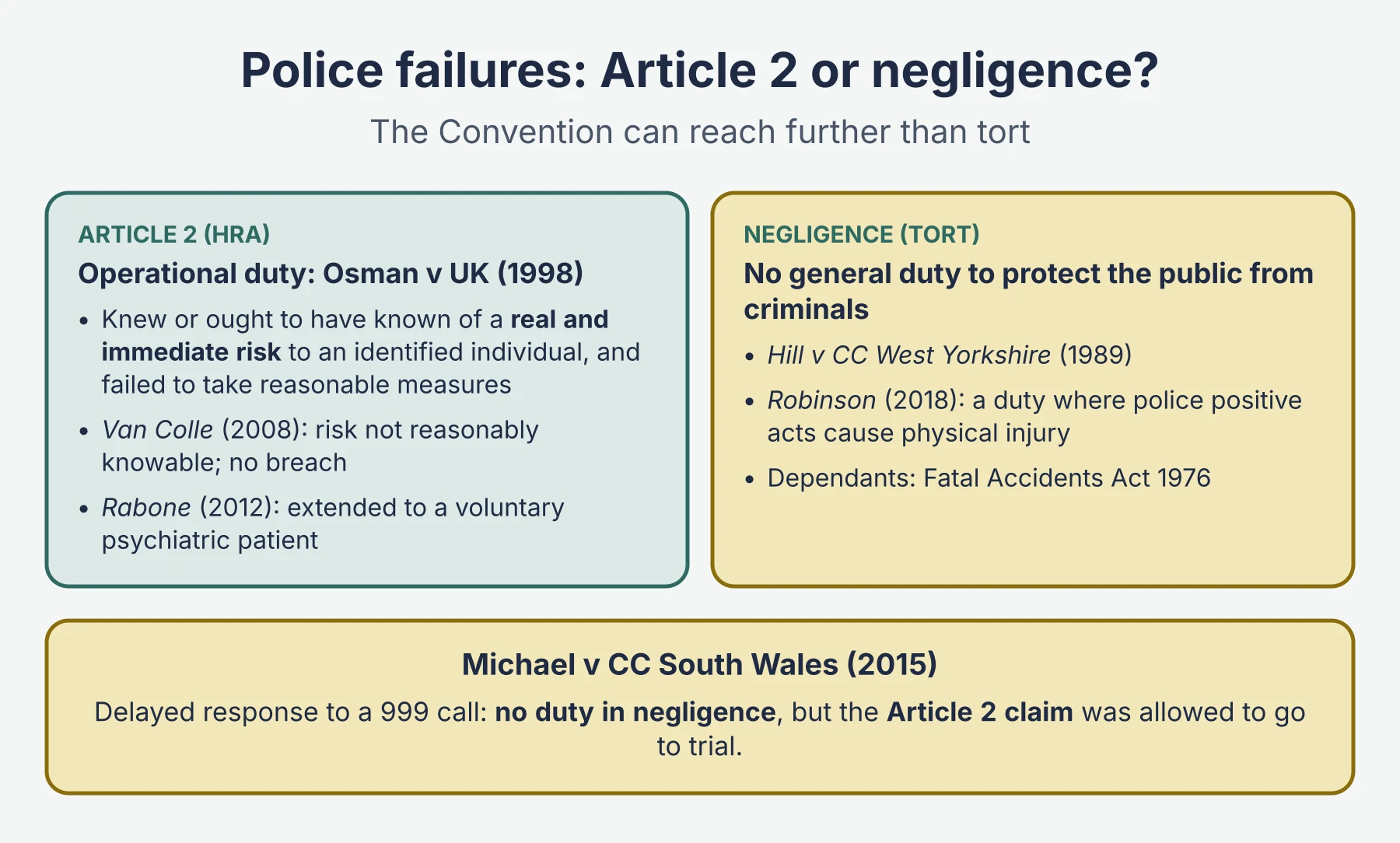
Under Osman v United Kingdom (1998) the police breach Article 2 if they knew or ought to have known of a real and immediate risk to the life of an identified individual from the criminal acts of another and failed to take reasonable measures within their powers to avoid it. The test is demanding. In Van Colle v Chief Constable of Hertfordshire (2008) a prosecution witness was murdered, but the House of Lords held the police could not reasonably have known of a real and immediate risk. In Rabone v Pennine Care NHS Trust (2012) the operational duty was extended to a voluntary psychiatric patient at risk of suicide.
Civil law negligence
Negligence gives a separate, narrower route. Since Hill v Chief Constable of West Yorkshire (1989) the police owe no general duty of care to protect members of the public from criminals. Michael v Chief Constable of South Wales (2015) confirmed there was no duty in negligence for a delayed response to a 999 call, but allowed the Article 2 claim to go to trial, showing that the Convention can reach further than tort. Robinson v Chief Constable of West Yorkshire (2018) clarified that police do owe a duty where their own positive acts cause physical injury. Dependants may claim under the Fatal Accidents Act 1976.
Independent investigation of deaths
Article 2 requires an effective official investigation where someone dies at the hands of the state or in custody. Jordan v United Kingdom (2001) set out its features: independence, effectiveness, promptness, public scrutiny and involvement of the family. In England the main mechanisms are:
- Inquests under the Coroners and Justice Act 2009, with a jury where a death in state detention was violent, unnatural or of unknown cause. After R (Middleton) v West Somerset Coroner (2004) an Article 2 inquest must examine in what circumstances the person died, not just by what means.
- The Independent Office for Police Conduct, which investigates deaths following police contact.
- Public inquiries under the Inquiries Act 2005. In R (Amin) v Secretary of State for the Home Department (2003) the murder of a young prisoner by his cellmate required an independent public investigation.
Deprivation of liberty
| Provision | Rule |
|---|---|
| PACE 1984 s1 and Code A | Stop and search requires reasonable grounds for suspecting stolen or prohibited articles |
| Criminal Justice and Public Order Act 1994 s60 | Authorised stop and search without suspicion where serious violence is anticipated |
| PACE s24 | Arrest without warrant on reasonable grounds for suspicion, and only if necessary for a listed reason |
| PACE s28 | Person told of the fact of and grounds for arrest |
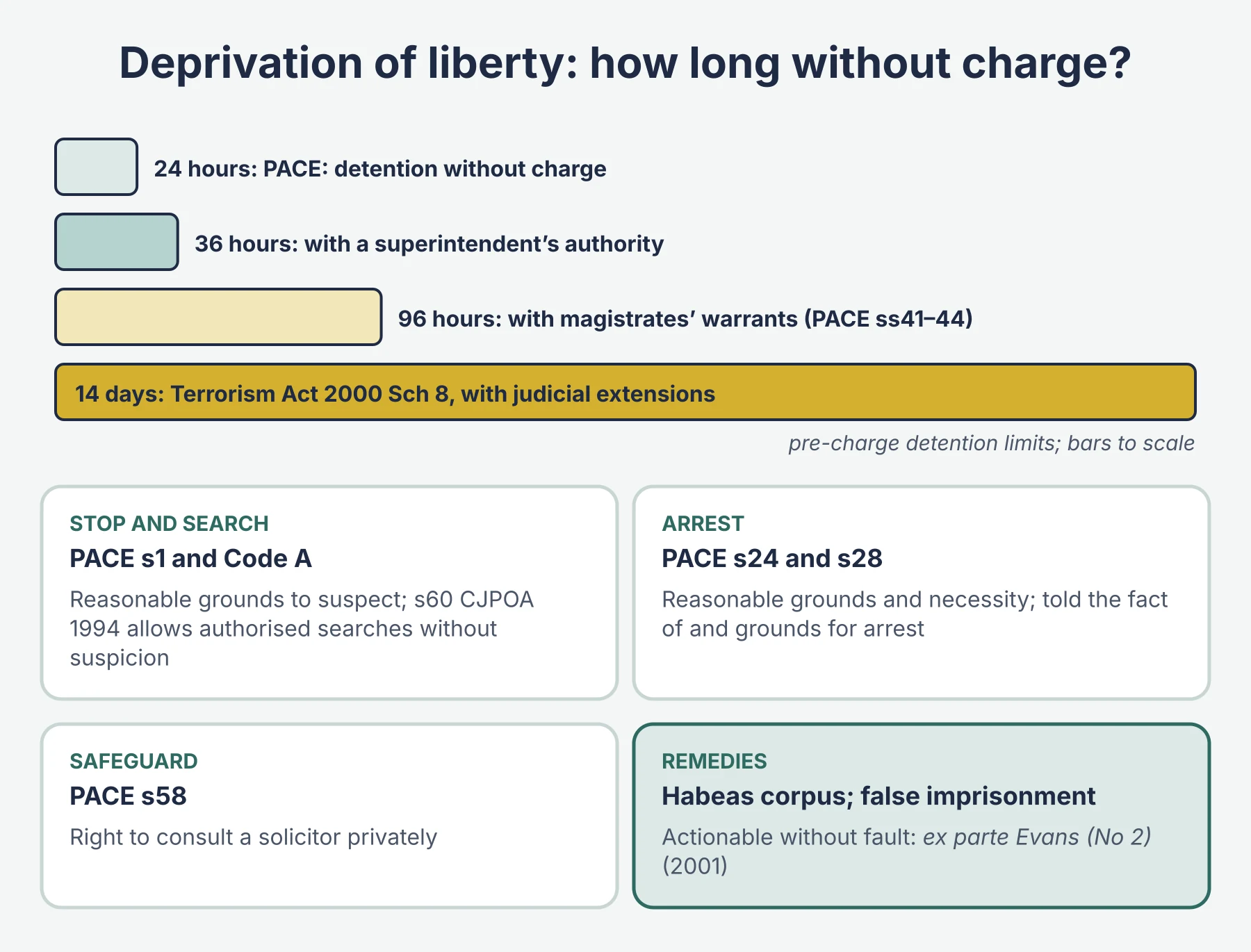
| PACE ss41 to 44 | Detention without charge: 24 hours, up to 36 with a superintendent’s authority, up to 96 with magistrates’ warrants |
| PACE s58 | Right to consult a solicitor privately |
| Terrorism Act 2000 Sch 8 | Pre-charge detention up to 14 days with judicial extensions |
| Common law breach of the peace | Arrest or action to prevent an imminent breach (Laporte, 2006) |
| Mental Health Act 1983 ss2 and 3 | Detention for assessment (up to 28 days) or treatment, reviewable by a tribunal |
Remedies: habeas corpus, and the tort of false imprisonment, which is actionable without proof of fault. In R v Governor of Brockhill Prison, ex parte Evans (No 2) (2001) a prisoner held beyond her correct release date recovered damages, even though the governor had followed the law as then understood.
Privacy and communication
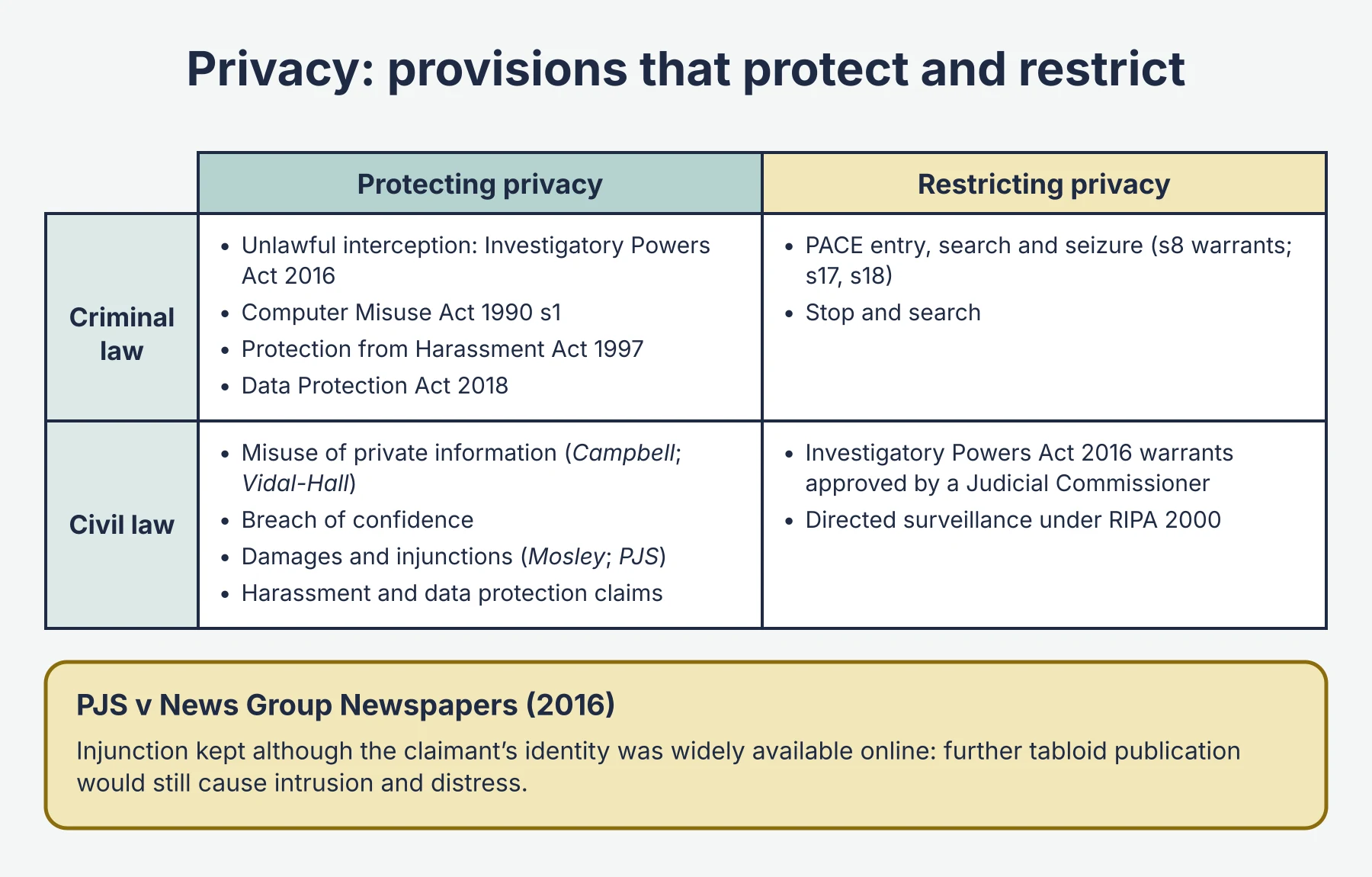
| Protecting privacy | Restricting privacy | |
|---|---|---|
| Criminal law | Unlawful interception offence under the Investigatory Powers Act 2016; Computer Misuse Act 1990 s1; harassment and stalking under the Protection from Harassment Act 1997; unlawfully obtaining personal data under the Data Protection Act 2018 | Police powers of entry, search and seizure under PACE (warrants under s8, entry under s17 and s18); stop and search |
| Civil law | Misuse of private information (Campbell v MGN, 2004; Vidal-Hall, 2015); breach of confidence; damages and injunctions (Mosley v News Group Newspapers, 2008; PJS v News Group Newspapers, 2016); civil claims under the Protection from Harassment Act 1997 and data protection law | Interception and equipment interference warrants under the Investigatory Powers Act 2016, needing approval by a Judicial Commissioner; directed surveillance under the Regulation of Investigatory Powers Act 2000 |
PJS is a useful evaluation point: the Supreme Court kept an injunction in place although the claimant’s identity was widely available online, because further tabloid publication would still cause intrusion and distress.
Expression, assembly and association
The specification adds these on top of the privacy provisions above, which already shape the balance between privacy and expression.
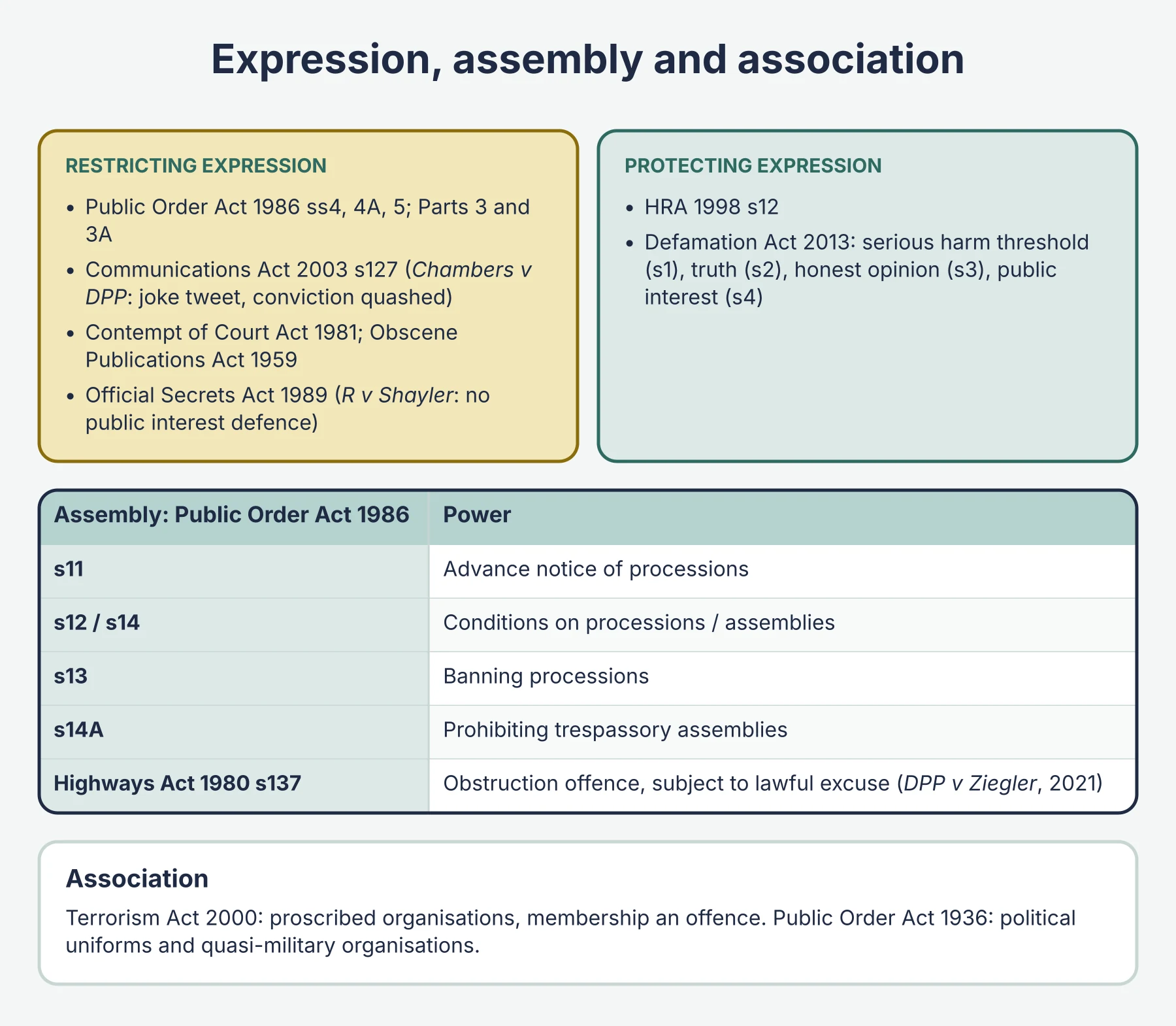
Expression. Restrictions include the Public Order Act 1986 sections 4, 4A and 5 (threatening or abusive words or behaviour) and Parts 3 and 3A (stirring up racial and religious hatred); section 127 of the Communications Act 2003 (grossly offensive or menacing messages, where Chambers v DPP (2012) quashed a conviction for a joke tweet); the Contempt of Court Act 1981; the Official Secrets Act 1989 (R v Shayler, 2002, no public interest defence); and the Obscene Publications Act 1959. Protections include section 12 of the Human Rights Act 1998 and the defences in the Defamation Act 2013: the serious harm threshold (s1), truth (s2), honest opinion (s3) and publication on a matter of public interest (s4).
Assembly. The Public Order Act 1986 requires notice of processions (s11), allows conditions on processions (s12) and assemblies (s14), banning of processions (s13) and prohibition of trespassory assemblies (s14A). Obstruction of the highway is an offence under section 137 of the Highways Act 1980, subject to lawful excuse (DPP v Ziegler, 2021). Parliament has widened police powers in the Police, Crime, Sentencing and Courts Act 2022 and the Public Order Act 2023.
Association. The Terrorism Act 2000 allows organisations to be proscribed, making membership an offence. The Public Order Act 1936 prohibits political uniforms and quasi-military organisations.
Worked example: choosing the right domestic route
Facts: Police receive repeated warnings that Carl has threatened to kill his former partner, Lena. They take no action. Carl attacks and kills her.
Criminal law:   Carl: murder (intention to kill or cause GBH).
Article 2:      Osman test: did police know or ought to have known of a real
                and immediate risk to an identified person? Repeated
                specific threats point towards yes.
Negligence:     Hill and Michael: no general duty of care; the tort claim is
                weak, but the Article 2 claim under s7 HRA may proceed.
Investigation:  Inquest examining in what circumstances she died
                (Middleton); IOPC investigation of police contact.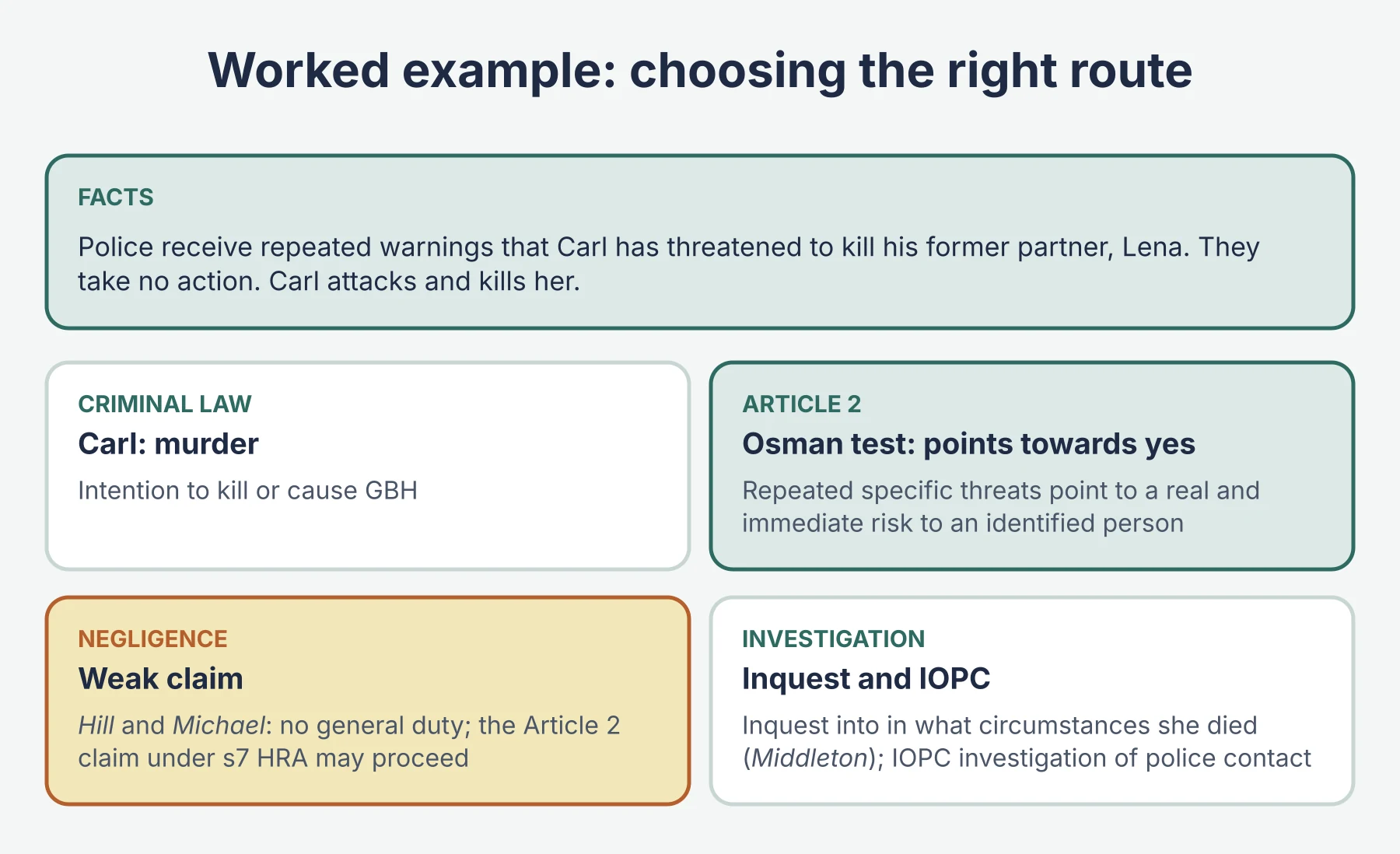
Common mistakes
- Treating the Osman test as easy to meet; Van Colle shows how demanding it is.
- Assuming a negligence claim against the police will succeed where an Article 2 claim might.
- Listing statutes without saying whether each protects or restricts the right.
- Forgetting that false imprisonment needs no proof of fault.
Exam technique
- Explain: give an outline of the provisions for one right, saying for each whether it protects or restricts the right.
- Advise and Consider: identify the Convention right, then the domestic offence, power or tort, apply both to the facts and conclude on liability and remedy.
- Discuss: evaluate the gap between Convention duties and domestic law, for example Osman against Hill, or the honest belief test against “absolutely necessary”.
More resources on this topic
Human Rights and English law revision notes | Human Rights and English law practice questions | Article 5 study guide
Related resources
-
Practice questions
AQA A Level Law (7162): Human Rights and English law – Practice Questions
Original practice for AQA A Level Law 7162 on English law and Convention rights, with answers on self-defence, Osman duties, inquests, liberty and privacy.
Law · AQA · A Level
Try questions -
Revision notes
AQA A Level Law (7162): Human Rights and English law – Revision Notes
Condensed recall for AQA A Level Law 7162 on English law and Convention rights: homicide, self-defence, policing duties, inquests, liberty, privacy and protest.
Law · AQA · A Level
Revise topic -
Study guides
AQA A Level Law (7162): Human Rights in international law
Human rights in international law for AQA A Level Law 7162: the Second World War, the UN and the 1948 Declaration, the Council of Europe and the ECHR.
Law · AQA · A Level
Read guide
Get free revision emails (optional)
Occasional emails with practice questions, worked explanations and links to free resources for the qualification and subjects you choose. No spam, and you can unsubscribe from any email. The free tools on this site never need an email.