
Revision Notes
AQA A Level Law (7162): Enforcement – Revision Notes
Condensed recall on enforcing human rights for AQA A Level Law 7162: Strasbourg admissibility and judgments, HRA sections 6 to 8 and judicial review.
- Subject
- Law
- Level
- A LEVELS
- Topic
- Topic 5: Human Rights
- Author
- Marlbridge Academic Team
- Updated
- Reviewed by
- Aizaz Raoof Ali (what this means)
Aligned to AQA A Level Law (7162), For teaching from September 2017 onwards, A-level exams 2019 onwards. Official specification .
Syllabus page (what it covers and how it is assessed): AQA A Level Law.
Syllabus points this page covers
7162
- Enforcement
Found an error? Report a correction.
Need help with this topic? Request a free trial class for A Level Law (7162).
Condensed notes on how Convention rights are enforced. For full explanation and a worked scenario, use the Enforcement study guide.
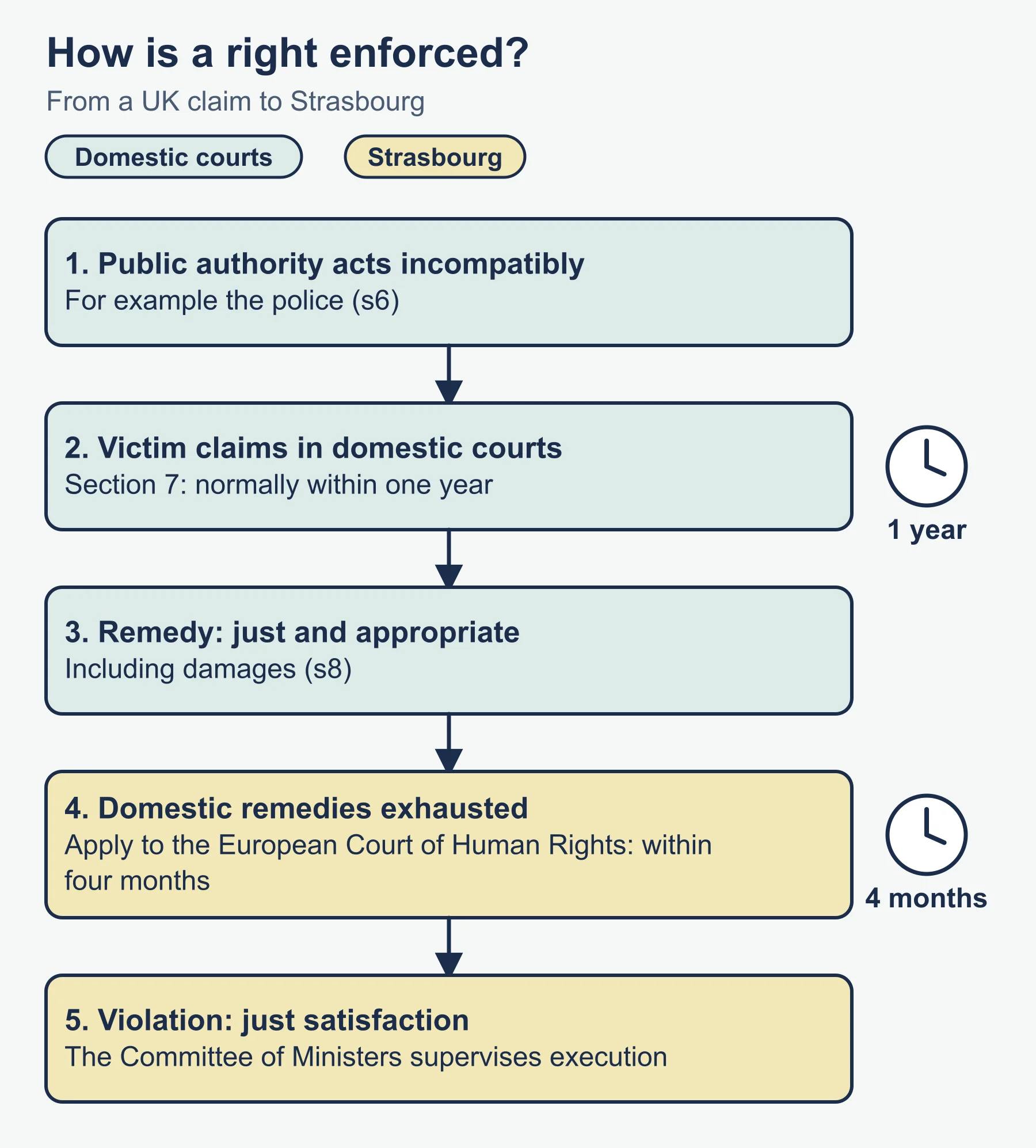
The route in one line
Public authority acts → victim claims in domestic court (HRA s7, one year; or judicial review, three months) → appeals → exhausted → Strasbourg application within four months → judgment → Committee of Ministers supervises execution.
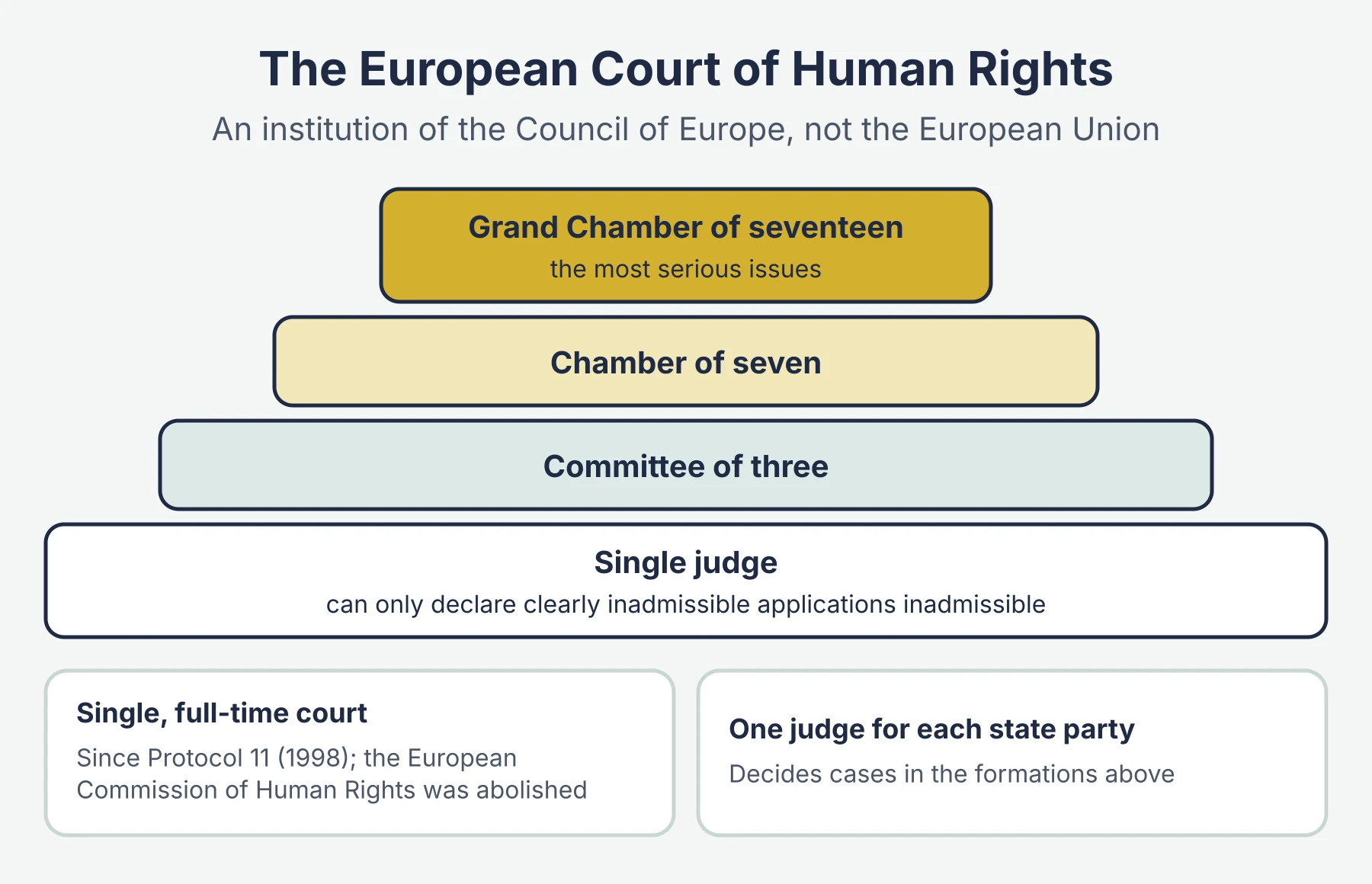
The European Court of Human Rights
| Feature | Detail |
|---|---|
| Parent body | Council of Europe (not the EU) |
| Structure | Full-time single court since Protocol 11 (1998); Commission abolished |
| Formations | Single judge (clearly inadmissible), committee of three, Chamber of seven, Grand Chamber of seventeen |
| Individual applications | Article 34: person, NGO or group claiming to be a victim |
| Inter-state cases | Article 33: e.g. Ireland v UK (1978) |
| Interim measures | Rule 39, e.g. halting a removal while a case is pending |
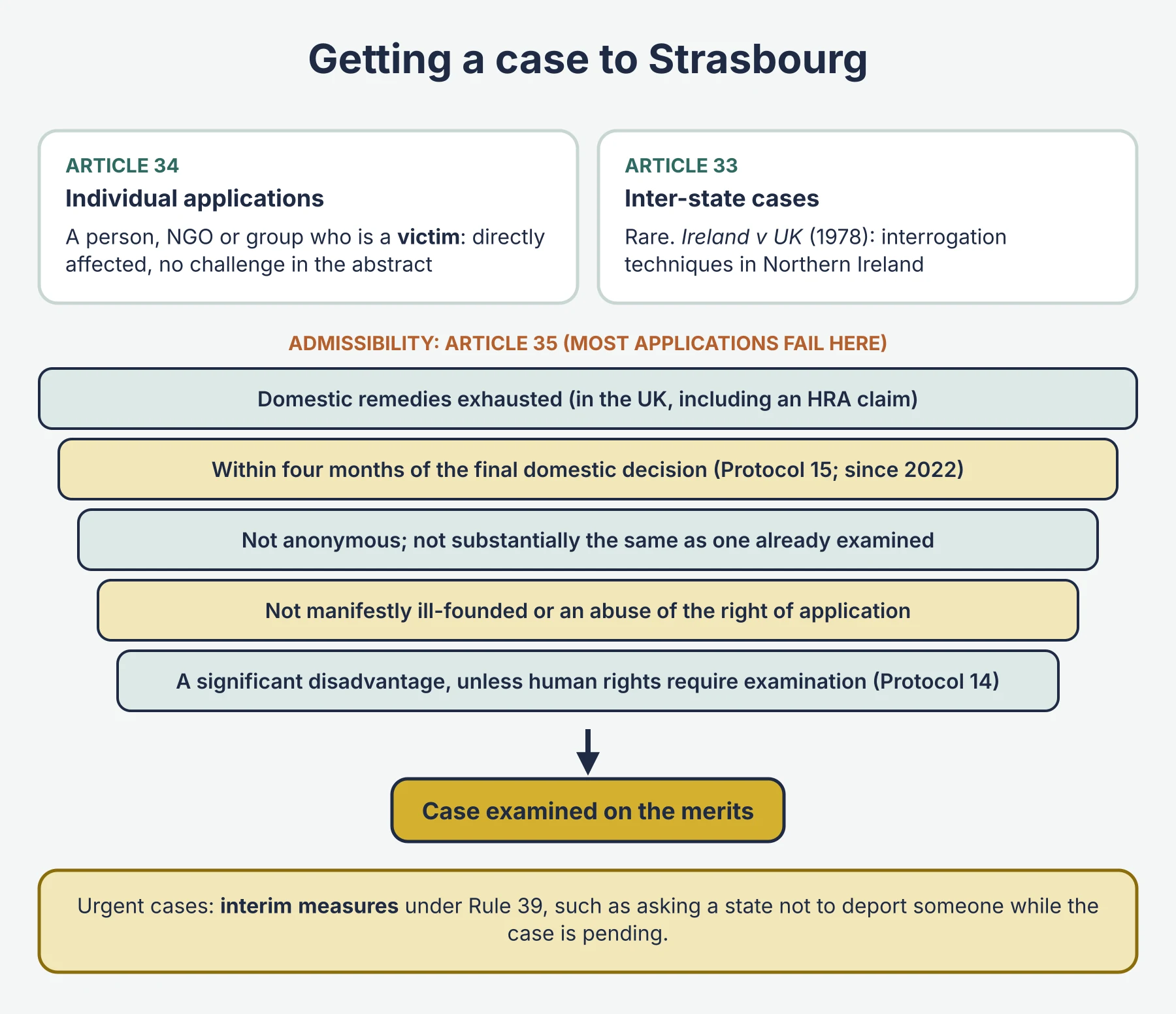
Admissibility (Article 35)
- Exhaust domestic remedies.
- Apply within four months of the final decision (Protocol 15; formerly six).
- Not anonymous; not substantially the same as an earlier application.
- Not manifestly ill-founded or an abuse.
- Significant disadvantage (Protocol 14), unless respect for human rights requires examination.
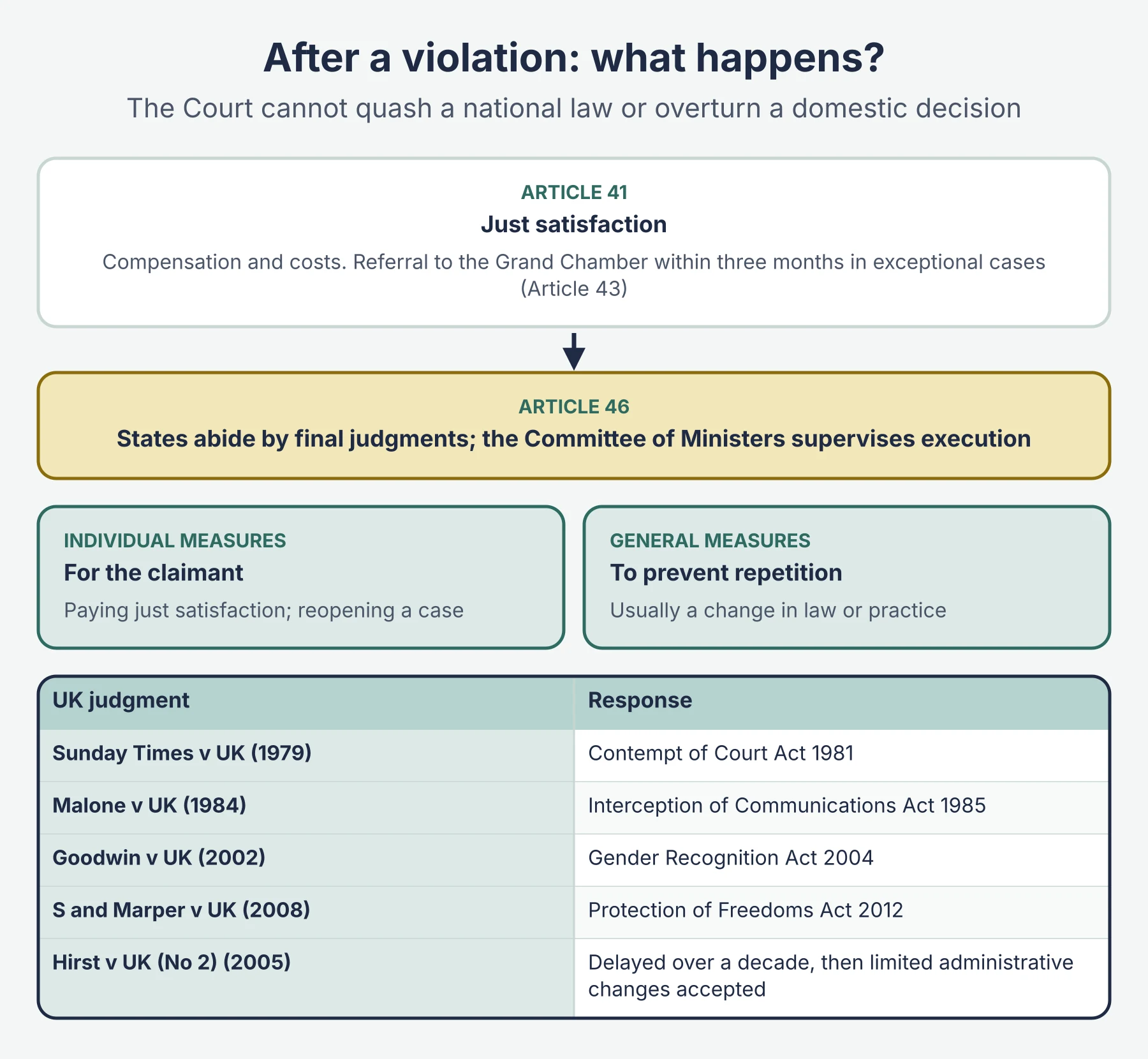
Judgments and their effect
- Article 41: just satisfaction (compensation, costs).
- Article 43: referral to the Grand Chamber within three months, exceptionally.
- Article 46: states must abide by final judgments; Committee of Ministers supervises; infringement proceedings possible since Protocol 14.
- Court cannot quash national law or domestic decisions.
- Individual measures (for the claimant) and general measures (change law to prevent repeats).
| Judgment | UK response |
|---|---|
| Sunday Times v UK (1979) | Contempt of Court Act 1981 |
| Malone v UK (1984) | Interception of Communications Act 1985 |
| Goodwin v UK (2002) | Gender Recognition Act 2004 |
| S and Marper v UK (2008) | Protection of Freedoms Act 2012 |
| Hirst v UK (No 2) (2005) | Over a decade of delay; limited administrative changes eventually accepted |
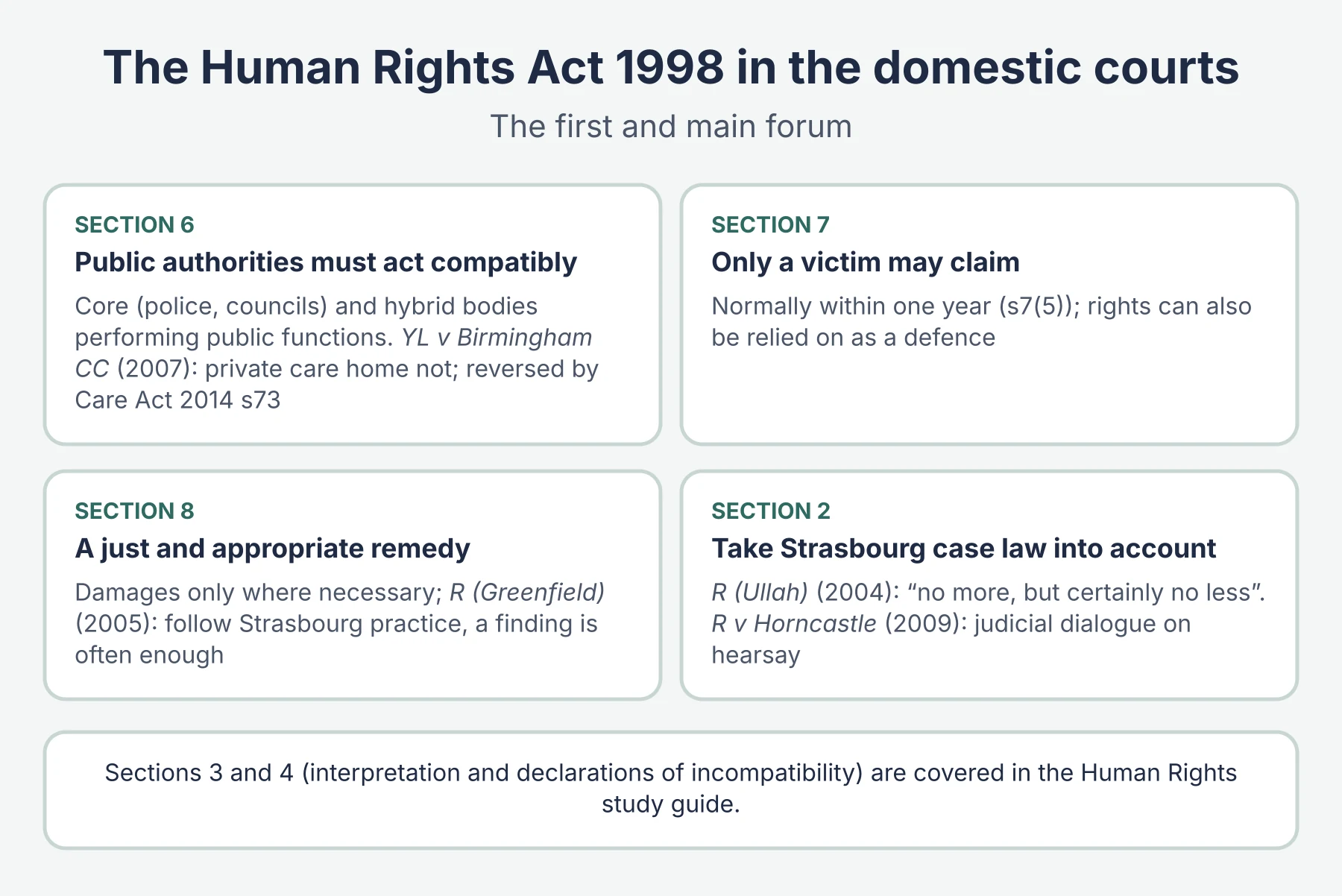
Domestic courts under the HRA 1998
| Section | Rule | Authority |
|---|---|---|
| s2 | Take into account Strasbourg case law | Ullah (2004): “no more, but certainly no less”; Horncastle (2009): dialogue |
| s6 | Public authorities must act compatibly; core and hybrid bodies | YL v Birmingham CC (2007); reversed by Care Act 2014 s73 |
| s7 | Only a victim may sue; one year (s7(5)); may also rely on rights in other proceedings | |
| s8 | Just and appropriate remedy; damages only if necessary for just satisfaction | R (Greenfield) v SSHD (2005) |
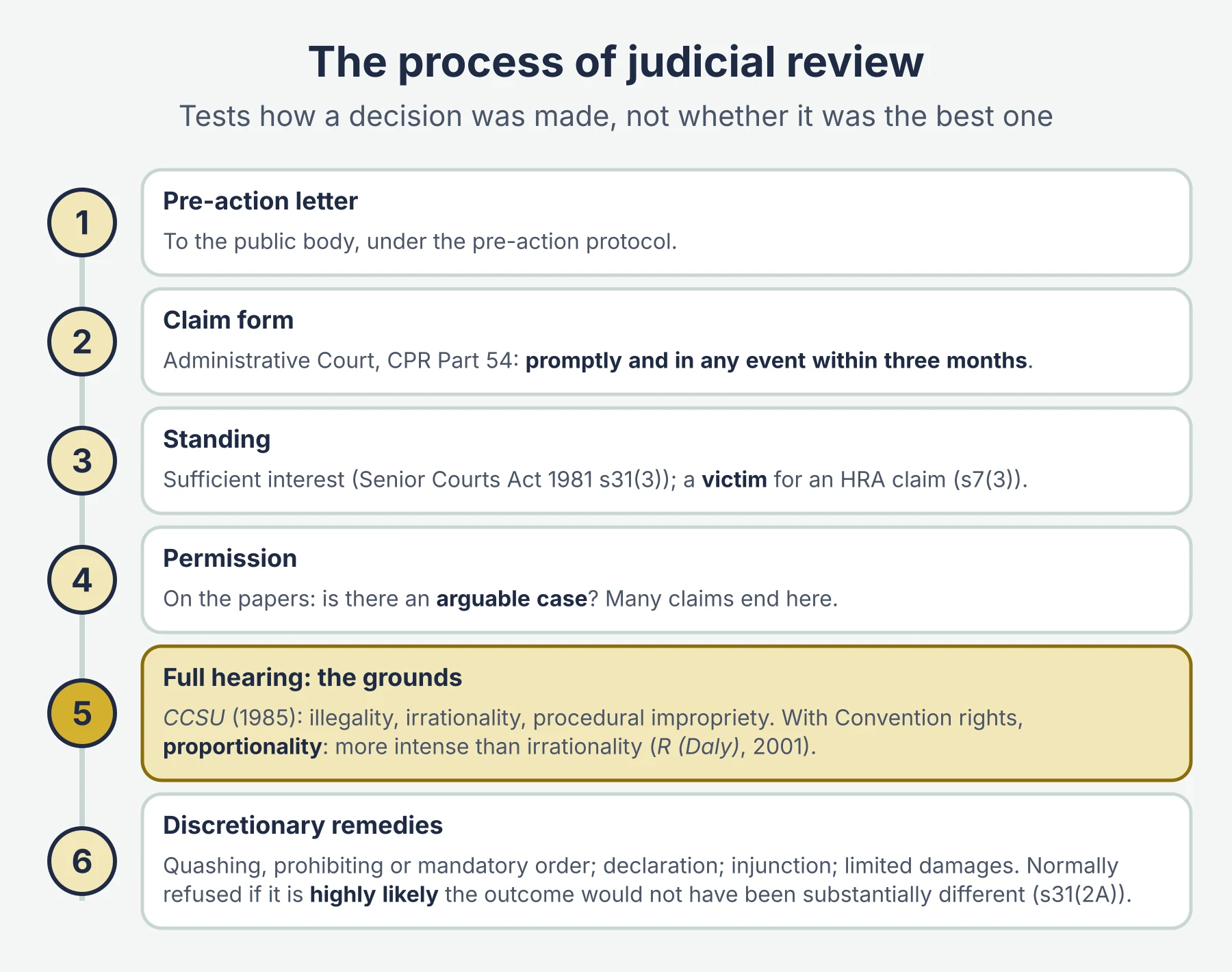
Judicial review: the process
- Pre-action protocol letter.
- Claim form, Administrative Court, CPR Part 54, promptly and within three months.
- Sufficient interest (Senior Courts Act 1981 s31(3)); victim for HRA grounds (s7(3)).
- Permission: arguable case.
- Hearing. Grounds (GCHQ, 1985): illegality, irrationality, procedural impropriety; plus proportionality for Convention rights (Daly, 2001).
- Discretionary remedies: quashing, prohibiting, mandatory orders; declaration; injunction; limited damages. Relief refused if outcome highly likely not substantially different (s31(2A)).
Key terms
| Term | Meaning |
|---|---|
| Subsidiarity | States secure rights first; Strasbourg supervises |
| Victim | A person directly affected by the act or measure complained of |
| Exhaustion of domestic remedies | Using every effective national remedy before applying to Strasbourg |
| Just satisfaction | Compensation awarded under Article 41 |
| Hybrid public authority | A body performing some functions of a public nature |
| Permission stage | The filter in judicial review requiring an arguable case |
| Quashing order | A judicial review remedy that sets aside an unlawful decision |
Exam traps
- Strasbourg is last, not first.
- Four months, not six.
- Strasbourg cannot strike down an Act; nor can UK courts (s4 only declares).
- HRA one year versus judicial review three months: know both.
- Judicial review is about lawfulness, not merits.
- Section 2 means “take into account”, not “be bound by”.
Self-test
- Which body does the European Court of Human Rights belong to?
- What did Protocol 11 change?
- Under which Article are individual applications made, and who may apply?
- State three admissibility criteria under Article 35.
- What is the time limit for applying to Strasbourg?
- What can the Court award under Article 41?
- Who supervises the execution of judgments?
- Give two examples of UK legislation passed after a Strasbourg judgment.
- What did YL v Birmingham City Council decide?
- What principle did Ullah state about section 2?
- What are the three classic grounds of judicial review, and which case set them out?
- What did R (Daly) add for human rights cases?
Answers: 1. The Council of Europe. 2. It created a single full-time Court and abolished the Commission. 3. Article 34: any person, NGO or group of individuals claiming to be a victim. 4. Any three: exhaustion of domestic remedies; four-month limit; not anonymous; not substantially the same; not manifestly ill-founded or an abuse; significant disadvantage. 5. Four months from the final domestic decision. 6. Just satisfaction, including compensation and costs. 7. The Committee of Ministers. 8. Any two: Contempt of Court Act 1981; Interception of Communications Act 1985; Gender Recognition Act 2004; Protection of Freedoms Act 2012. 9. A private care home was not performing a public function under section 6; reversed by section 73 of the Care Act 2014. 10. Domestic courts should keep pace with Strasbourg, “no more, but certainly no less”. 11. Illegality, irrationality and procedural impropriety, from Council of Civil Service Unions v Minister for the Civil Service (1985). 12. Proportionality, a more intense standard of review than irrationality, applies where Convention rights are engaged.
More resources on this topic
Enforcement study guide | Enforcement practice questions | Human Rights revision notes
Related resources
-
Study guides
AQA A Level Law (7162): Human Rights and English law
How English law protects and restricts Convention rights for AQA A Level Law 7162: the right to life, liberty, privacy, expression, assembly and association.
Law · AQA · A Level
Read guide -
Practice questions
AQA A Level Law (7162): Human Rights and English law – Practice Questions
Original practice for AQA A Level Law 7162 on English law and Convention rights, with answers on self-defence, Osman duties, inquests, liberty and privacy.
Law · AQA · A Level
Try questions -
Revision notes
AQA A Level Law (7162): Human Rights and English law – Revision Notes
Condensed recall for AQA A Level Law 7162 on English law and Convention rights: homicide, self-defence, policing duties, inquests, liberty, privacy and protest.
Law · AQA · A Level
Revise topic
Get free revision emails (optional)
Occasional emails with practice questions, worked explanations and links to free resources for the qualification and subjects you choose. No spam, and you can unsubscribe from any email. The free tools on this site never need an email.