
Revision Notes
AQA A Level Law (7162): Human Rights and English law – Revision Notes
Condensed recall for AQA A Level Law 7162 on English law and Convention rights: homicide, self-defence, policing duties, inquests, liberty, privacy and protest.
- Subject
- Law
- Level
- A LEVELS
- Topic
- Topic 5: Human Rights
- Author
- Marlbridge Academic Team
- Updated
- Reviewed by
- Aizaz Raoof Ali (what this means)
Aligned to AQA A Level Law (7162), For teaching from September 2017 onwards, A-level exams 2019 onwards. Official specification .
Syllabus page (what it covers and how it is assessed): AQA A Level Law.
Syllabus points this page covers
7162
- Human Rights and English law
Found an error? Report a correction.
Need help with this topic? Request a free trial class for A Level Law (7162).
Condensed notes on the domestic provisions that protect or restrict Convention rights. For full explanation and a worked scenario, use the Human Rights and English law study guide.
Right to life: the five strands
| Strand | Key law |
|---|---|
| Homicide offences | Murder; voluntary manslaughter (loss of control, diminished responsibility); involuntary manslaughter (unlawful act; gross negligence, Adomako 1995); Corporate Manslaughter and Corporate Homicide Act 2007; Suicide Act 1961 s2 |
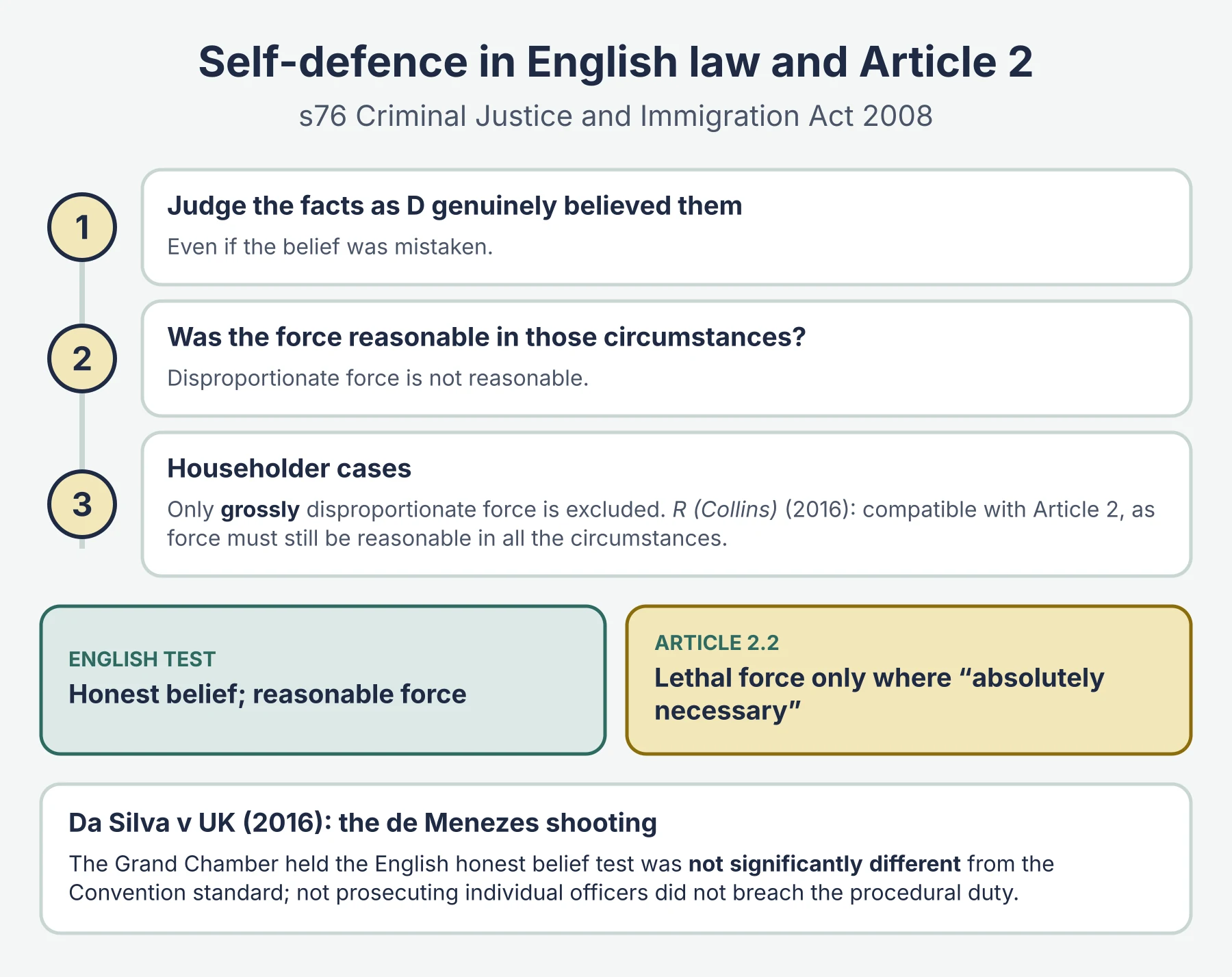
| Self-defence / prevention of crime | Common law; Criminal Law Act 1967 s3; Criminal Justice and Immigration Act 2008 s76: genuine belief, reasonable force; householder: not grossly disproportionate (Collins 2016, compatible with Article 2) |
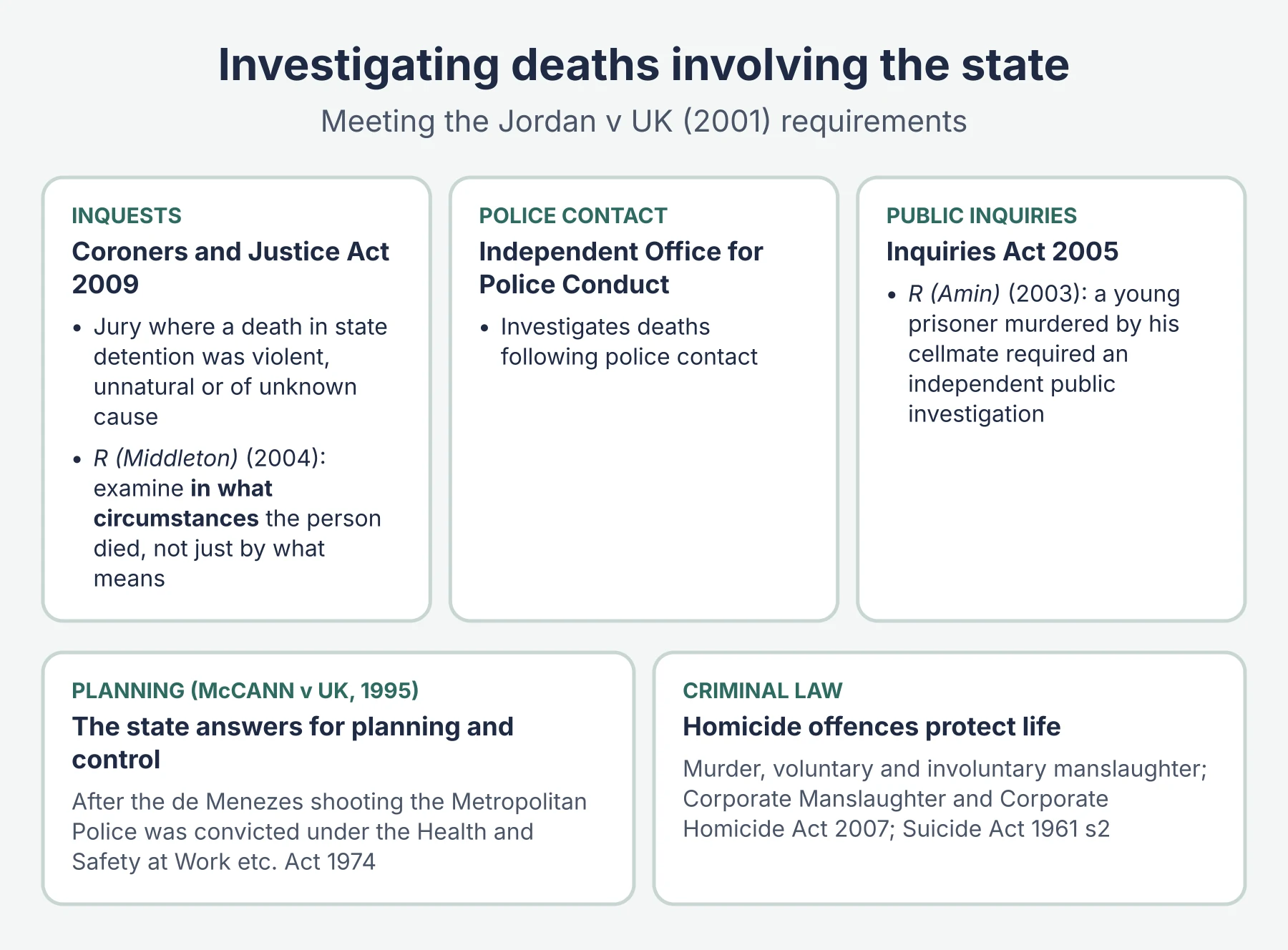
| Planning operations | McCann v UK (1995); Metropolitan Police convicted under health and safety law after the de Menezes shooting; Da Silva v UK (2016): honest belief test compatible |
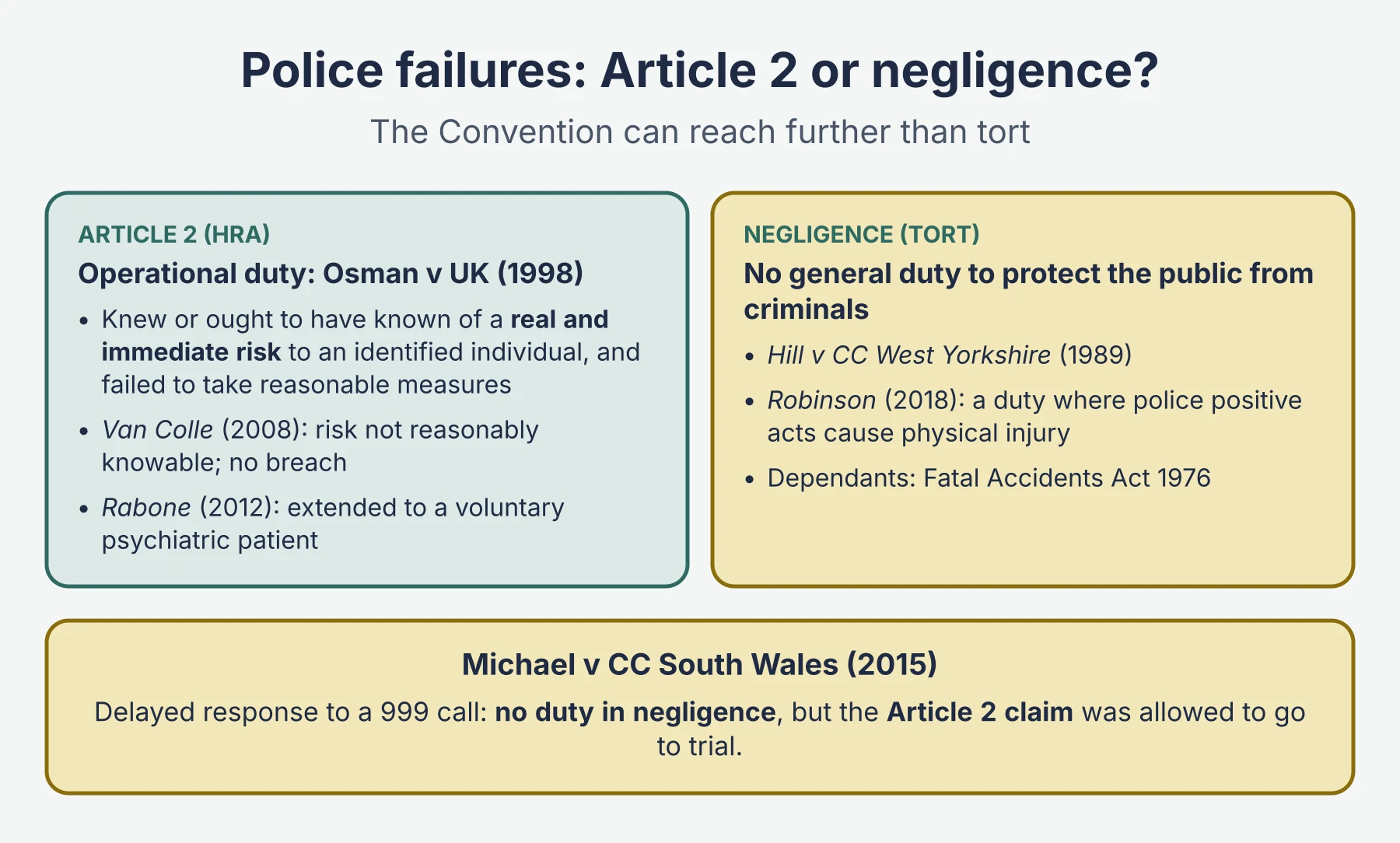
| Protective policing | Osman v UK (1998): real and immediate risk to an identified person; Van Colle (2008): not met; Rabone (2012): voluntary psychiatric patient |
| Civil negligence | Hill (1989): no general duty to protect public from criminals; Michael (2015): no duty for 999 delay, but Article 2 claim to trial; Robinson (2018): duty for positive acts; Fatal Accidents Act 1976 |
| Independent investigation | Jordan v UK (2001) features; inquests under the Coroners and Justice Act 2009; Middleton (2004): “in what circumstances”; Independent Office for Police Conduct; Inquiries Act 2005; Amin (2003) |
Osman test in full: authorities knew or ought to have known at the time of a real and immediate risk to the life of an identified individual from the criminal acts of a third party, and failed to take measures within their powers which, judged reasonably, might have been expected to avoid that risk.
Jordan features: independent; effective (capable of identifying and punishing those responsible); prompt; open to public scrutiny; family involved.
Deprivation of liberty
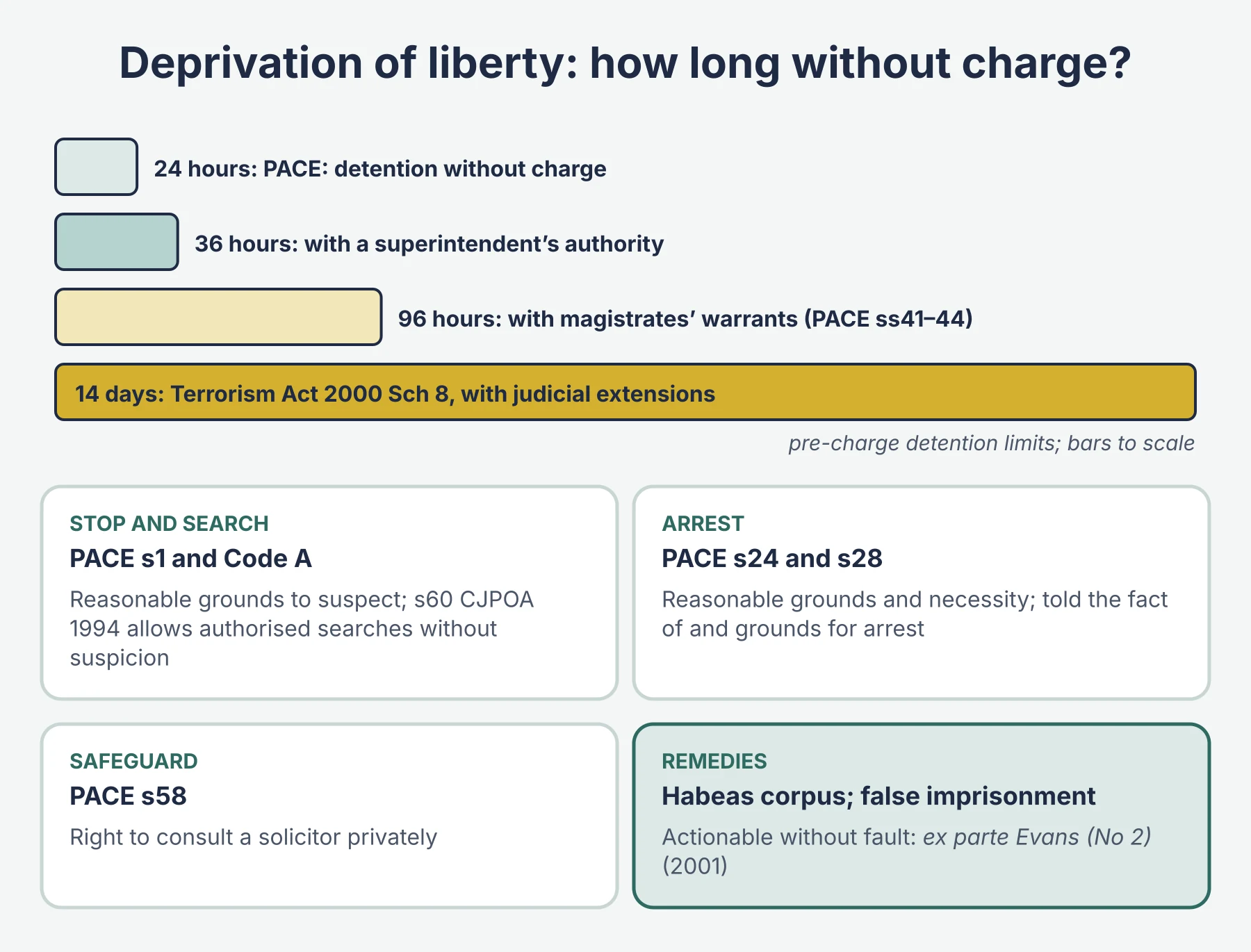
- PACE s1 and Code A: stop and search on reasonable grounds.
- CJPOA 1994 s60: authorised, suspicionless stop and search where serious violence anticipated.
- PACE s24: arrest on reasonable grounds and necessity; s28: told fact and grounds of arrest.
- PACE ss41 to 44: 24 hours; 36 with superintendent; 96 maximum with magistrates.
- PACE s58: right to legal advice.
- Terrorism Act 2000 Sch 8: up to 14 days pre-charge.
- Breach of the peace: must be imminent (Laporte, 2006).
- Mental Health Act 1983: s2 (assessment, up to 28 days); s3 (treatment).
- Remedies: habeas corpus; false imprisonment, no fault needed (Evans (No 2), 2001).
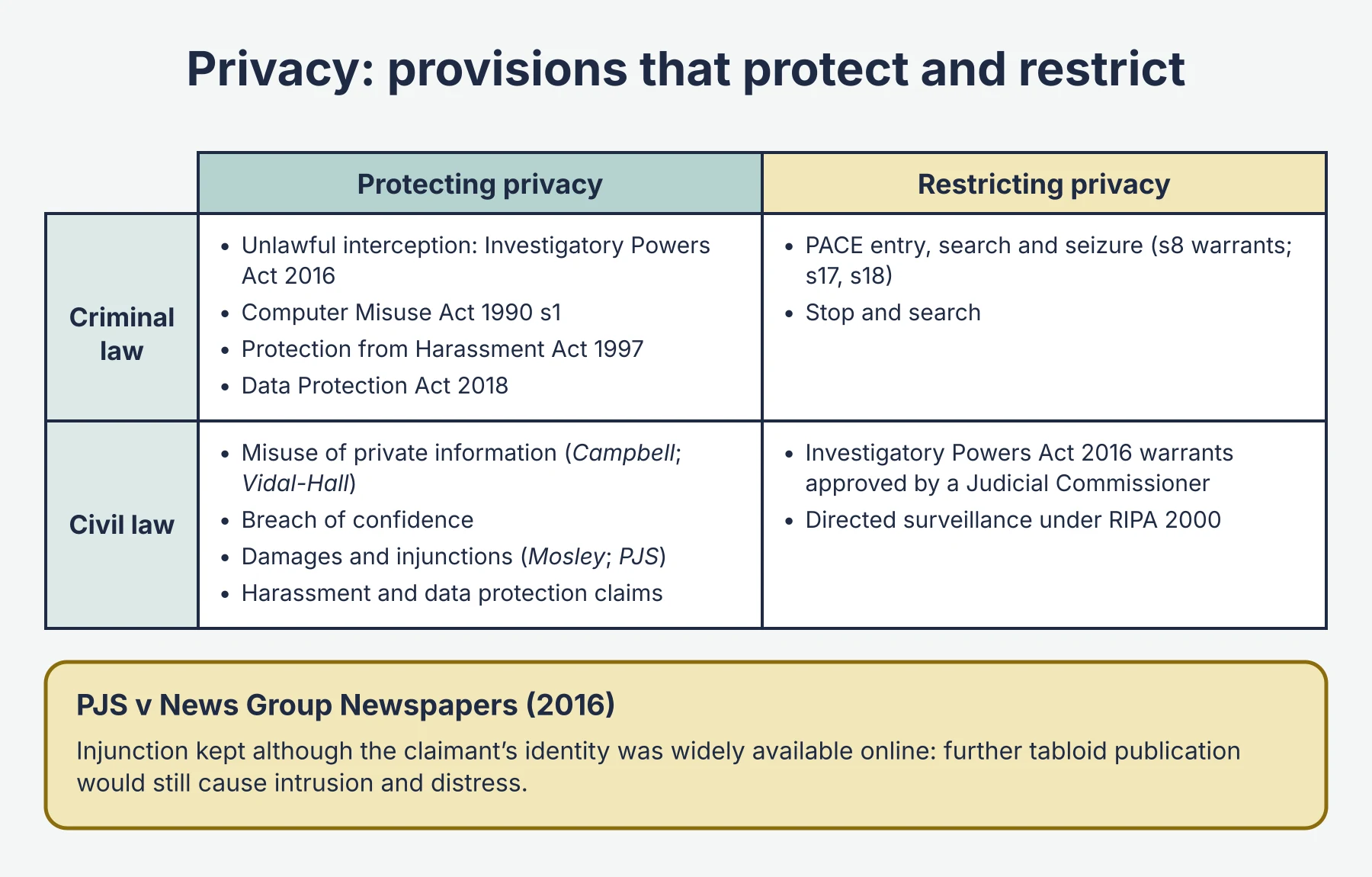
Privacy and communication
| Protect | Restrict | |
|---|---|---|
| Criminal | Investigatory Powers Act 2016 (unlawful interception); Computer Misuse Act 1990 s1; Protection from Harassment Act 1997; Data Protection Act 2018 (unlawfully obtaining personal data) | PACE entry, search and seizure (s8 warrants, s17, s18); stop and search |
| Civil | Misuse of private information (Campbell; Vidal-Hall); breach of confidence; injunctions (PJS, 2016); damages (Mosley, 2008); harassment and data protection claims | Investigatory Powers Act 2016 warrants with Judicial Commissioner approval; RIPA 2000 surveillance |
Expression, assembly and association
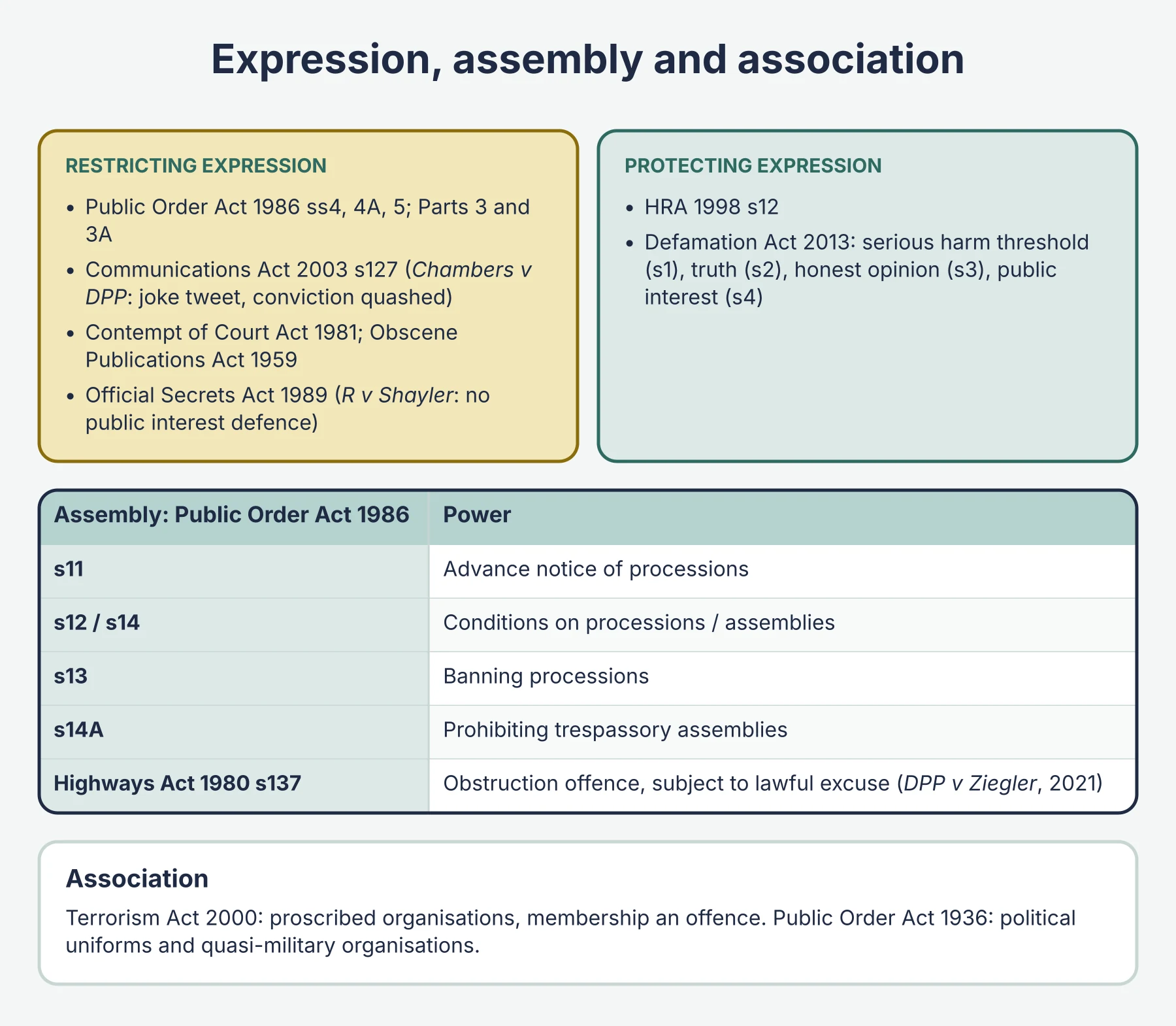
Expression: restricted by Public Order Act 1986 ss4, 4A, 5 and Parts 3 and 3A; Communications Act 2003 s127 (Chambers v DPP, 2012, conviction quashed); Contempt of Court Act 1981; Official Secrets Act 1989 (Shayler, 2002); Obscene Publications Act 1959. Protected by HRA s12 and Defamation Act 2013 (s1 serious harm; s2 truth; s3 honest opinion; s4 public interest).
Assembly: Public Order Act 1986 s11 notice, s12 conditions on processions, s13 bans, s14 conditions on assemblies, s14A trespassory assemblies; Highways Act 1980 s137 (Ziegler, 2021: lawful excuse needs proportionality); Police, Crime, Sentencing and Courts Act 2022; Public Order Act 2023.
Association: Terrorism Act 2000 proscription and membership offences; Public Order Act 1936 (political uniforms, quasi-military organisations).
Key terms
| Term | Meaning |
|---|---|
| Operational duty | The Osman duty to take reasonable protective steps against a known real and immediate risk |
| Procedural duty | The Article 2 duty to investigate deaths effectively |
| Article 2 inquest | An inquest examining by what means and in what circumstances the deceased died |
| False imprisonment | Unlawful total restraint of a person’s liberty; no proof of fault needed |
| Misuse of private information | Tort protecting private information against unjustified disclosure |
| Lawful excuse | A defence to obstruction of the highway, assessed with proportionality |
| Proscription | A ministerial order banning an organisation under terrorism law |
Exam traps
- Say whether each provision protects or restricts the right.
- The Osman test is hard to satisfy; do not assume a breach because a death occurred.
- Negligence (Hill, Michael) is narrower than Article 2; consider both routes.
- Self-defence turns on the defendant’s genuine belief; compare Article 2.2’s “absolutely necessary”.
- False imprisonment needs no fault (Evans).
Self-test
- Which statute sets out the test for reasonable force in self-defence?
- What is the householder rule, and was it held compatible with Article 2?
- State the Osman test.
- Why did the claim fail in Van Colle?
- What did Michael v Chief Constable of South Wales decide?
- What did Robinson v Chief Constable of West Yorkshire clarify?
- List the Jordan features of an effective investigation.
- What did Middleton add to inquests?
- What are the PACE detention time limits before charge?
- Why did the prisoner win in Evans (No 2)?
- Give one criminal and one civil provision that protect privacy.
- What did Chambers v DPP decide?
Answers: 1. Criminal Justice and Immigration Act 2008 s76. 2. In householder cases only grossly disproportionate force is unreasonable; yes, compatible (Collins, 2016). 3. Authorities knew or ought to have known of a real and immediate risk to an identified person’s life from a third party’s criminal acts and failed to take reasonable measures within their powers. 4. The police could not reasonably have known of a real and immediate risk to the witness. 5. No duty of care in negligence for a delayed 999 response, but the Article 2 claim could go to trial. 6. Police owe a duty of care where their own positive acts cause physical injury. 7. Independence, effectiveness, promptness, public scrutiny and family involvement. 8. An Article 2 inquest must examine in what circumstances the person died. 9. 24 hours; up to 36 with a superintendent’s authority; up to 96 with magistrates’ warrants. 10. False imprisonment is strict: she was held beyond her correct release date even though the governor followed the law as then understood. 11. For example, the unlawful interception offence under the Investigatory Powers Act 2016; misuse of private information. 12. A conviction under the Communications Act 2003 s127 for a joke tweet was quashed because the message was not menacing.
More resources on this topic
Human Rights and English law study guide | Human Rights and English law practice questions | Human Rights revision notes
Related resources
-
Study guides
AQA A Level Law (7162): Human Rights in international law
Human rights in international law for AQA A Level Law 7162: the Second World War, the UN and the 1948 Declaration, the Council of Europe and the ECHR.
Law · AQA · A Level
Read guide -
Practice questions
AQA A Level Law (7162): Human Rights in international law – Practice Questions
Original practice on international human rights law for AQA A Level Law 7162 with mark-scheme answers on post-war origins, the UDHR and the Council of Europe.
Law · AQA · A Level
Try questions -
Revision notes
AQA A Level Law (7162): Human Rights in international law – Revision Notes
Condensed recall on international human rights law for AQA A Level Law 7162: post-war origins, the UN and UDHR, the Council of Europe and the ECHR timeline.
Law · AQA · A Level
Revise topic
Get free revision emails (optional)
Occasional emails with practice questions, worked explanations and links to free resources for the qualification and subjects you choose. No spam, and you can unsubscribe from any email. The free tools on this site never need an email.