
Study Guides
AQA A Level Law (7162): Reform
Reform of human rights protection in the UK for AQA A Level Law 7162: criticisms of the HRA, Bill of Rights proposals, devolution limits and Strasbourg reform.
- Subject
- Law
- Level
- A LEVELS
- Topic
- Topic 5: Human Rights
- Author
- Marlbridge Academic Team
- Updated
- Reviewed by
- Aizaz Raoof Ali (what this means)
Aligned to AQA A Level Law (7162), For teaching from September 2017 onwards, A-level exams 2019 onwards. Official specification .
Syllabus page (what it covers and how it is assessed): AQA A Level Law.
Syllabus points this page covers
7162
- Reform
Found an error? Report a correction.
Need help with this topic? Request a free trial class for A Level Law (7162).
This guide covers Reform in section 3.5 Human Rights of AQA A-level Law (7162). The specification states the content as “Reform of the protection of Human Rights in the UK”. Questions on reform are usually evaluative, so this guide sets out the criticisms that drive reform, the main options, what has actually been proposed, and the constraints on change. For the option as a whole, see the Human Rights study guide.
Reform is a moving area. Political positions change between elections, so check the current position before an exam and present proposals as proposals, not as law.
Why reform is debated
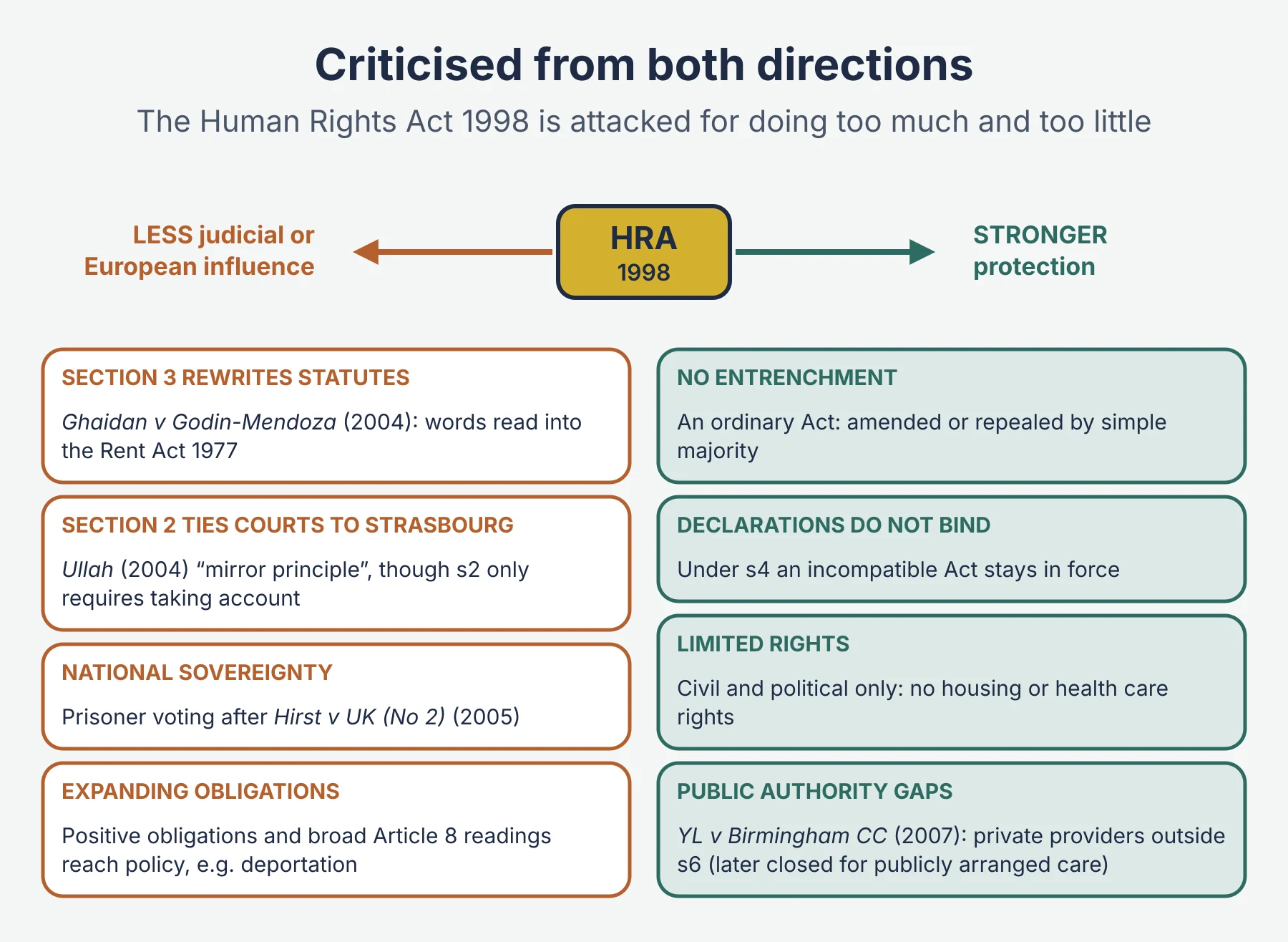
Criticisms from those who want less judicial or European influence
- Section 3 lets judges rewrite statutes. In Ghaidan v Godin-Mendoza (2004) the House of Lords read words into the Rent Act 1977. Critics say this blurs the line between interpreting and legislating.
- Section 2 ties UK courts too closely to Strasbourg. The Ullah “mirror principle” (2004) encouraged courts to follow Strasbourg closely, even though section 2 only requires them to take its case law into account.
- National sovereignty. The prisoner voting dispute after Hirst v United Kingdom (No 2) (2005) is the standard example of a Strasbourg ruling that Parliament resisted.
- Expanding obligations. Critics argue that positive obligations and broad readings of Article 8 have extended rights into areas of policy, such as deportation, that should be decided by elected politicians.
Criticisms from those who want stronger protection
- No entrenchment. The Human Rights Act 1998 is an ordinary Act that Parliament can amend or repeal by simple majority.
- Declarations of incompatibility do not bind. Under section 4 an incompatible Act stays in force.
- Limited rights. The Act covers civil and political rights only; there is no domestic protection of economic and social rights such as housing or health care.
- Public authority gaps. YL v Birmingham City Council (2007) showed that private providers of public services may fall outside section 6, though Parliament later closed that particular gap for publicly arranged care.
The main reform options
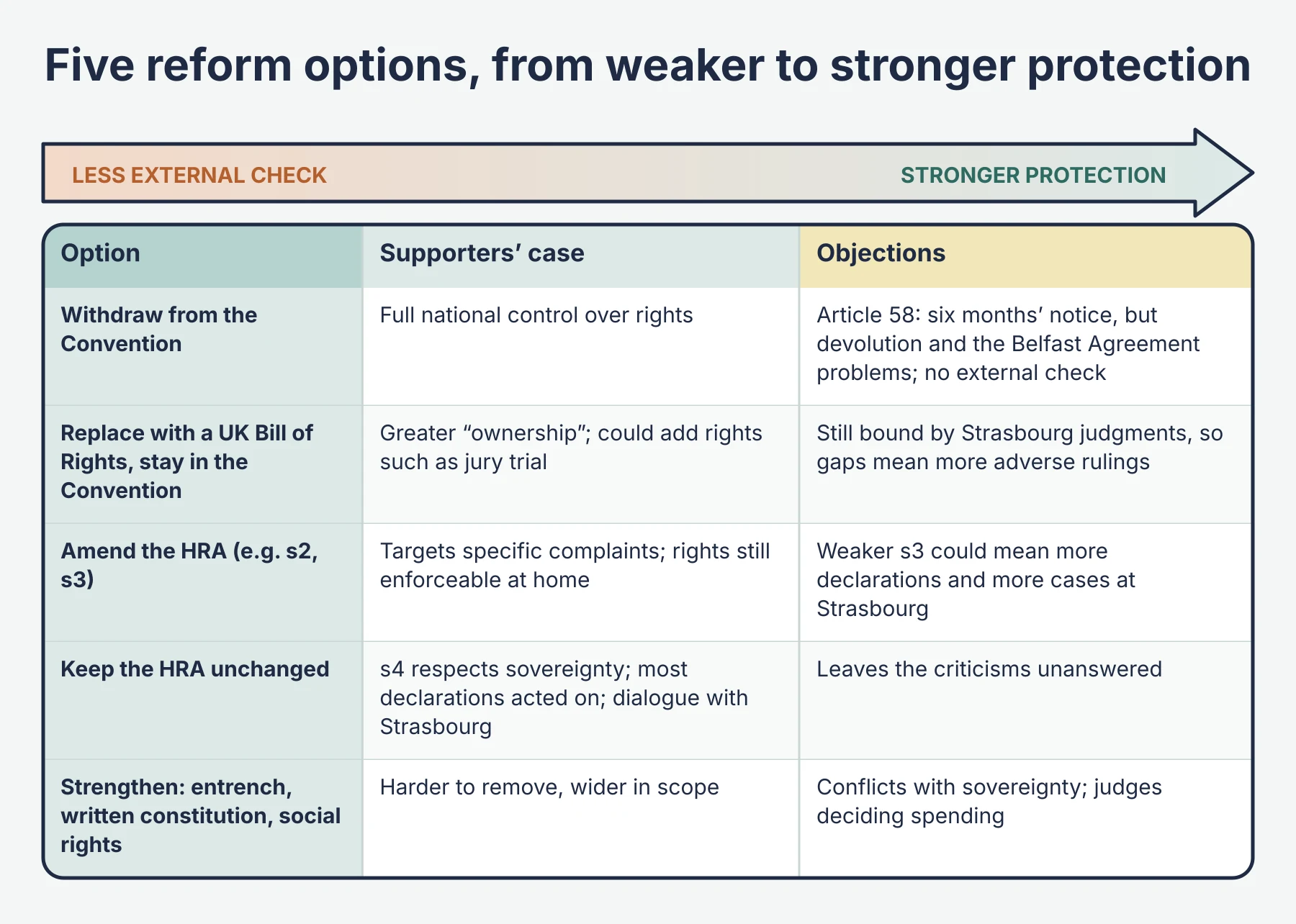
| Option | Supporters’ case | Objections |
|---|---|---|
| Keep the HRA unchanged | It respects sovereignty through the section 4 model; most declarations have been acted on; it lets UK judges shape Strasbourg through dialogue | Leaves the criticisms above unanswered |
| Amend the HRA, for example sections 2 and 3 | Targets the specific complaints while keeping rights enforceable at home | Weakening section 3 could mean more declarations and more cases going to Strasbourg |
| Replace it with a UK Bill of Rights, staying in the Convention | Greater “ownership” of rights; could add rights such as jury trial | The UK would still be bound in international law by Strasbourg judgments, so gaps would lead to more adverse rulings |
| Withdraw from the Convention | Full national control over rights | Article 58 allows denunciation on six months’ notice, but withdrawal would raise serious problems for devolution and the Belfast (Good Friday) Agreement, and would remove an external check |
| Strengthen protection: entrenchment, a written constitution or social rights | Rights would be harder to remove and wider in scope | Entrenchment conflicts with parliamentary sovereignty; social rights raise questions about judges deciding spending |
What has actually been proposed
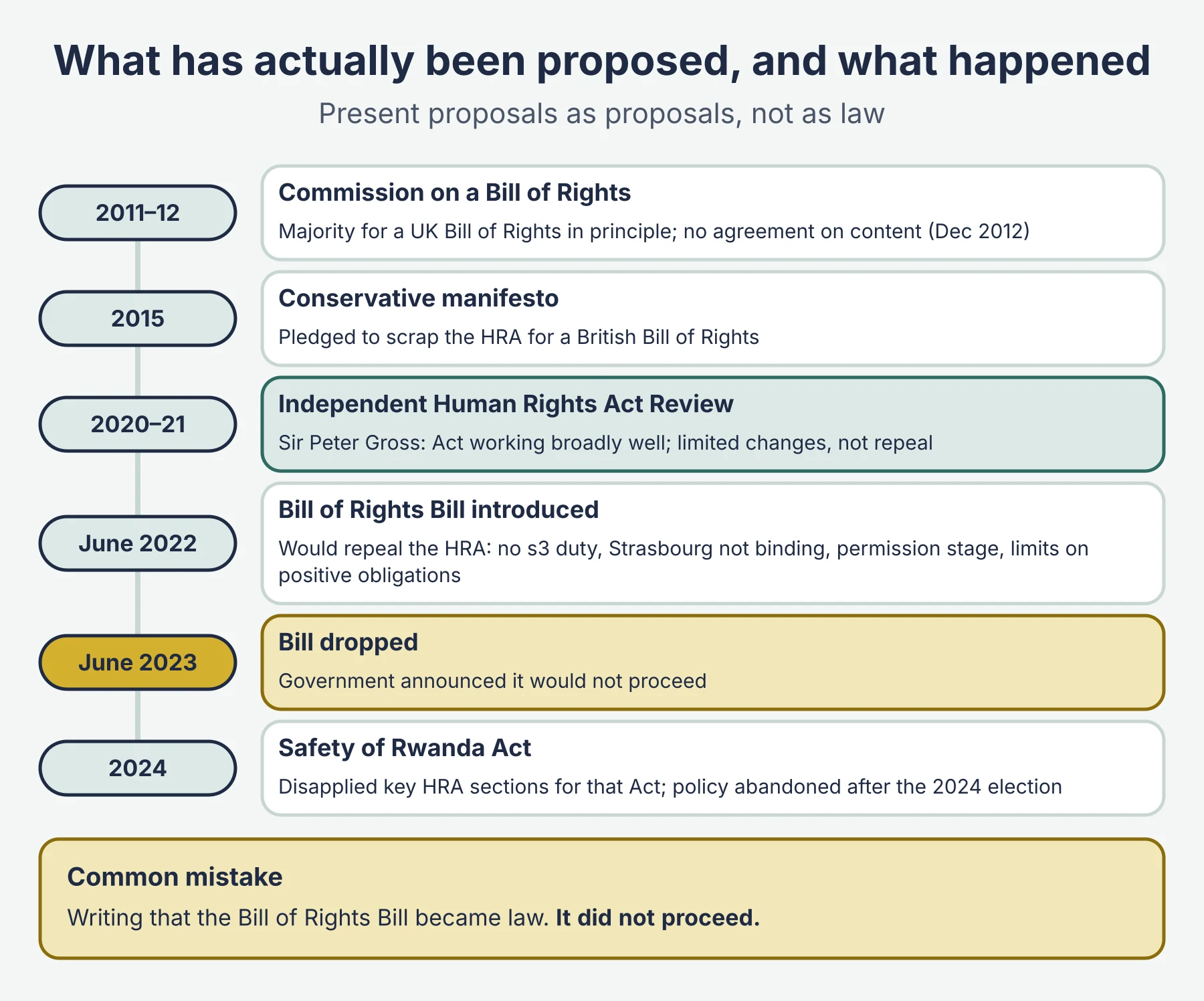
- Commission on a Bill of Rights (2011 to 2012). Set up by the coalition government. Its December 2012 report showed a majority in favour of a UK Bill of Rights in principle, but no agreement on what it should contain.
- 2015 Conservative manifesto. Pledged to scrap the HRA and introduce a British Bill of Rights.
- Independent Human Rights Act Review (2020 to 2021). Chaired by Sir Peter Gross. It reported in December 2021 that the Act was working broadly well and recommended only limited changes, rather than repeal.
- Bill of Rights Bill (2022). Introduced in June 2022. It would have repealed the HRA and replaced it. Among its proposals were removing the section 3 interpretive duty, stating that UK courts need not follow Strasbourg case law, telling courts to disregard Strasbourg interim measures, adding a permission stage requiring a claimant to show significant disadvantage, limiting positive obligations, and requiring great weight to be given to freedom of speech. The government announced in June 2023 that the Bill would not proceed.
- Targeted disapplication. Parliament has also chosen to exclude parts of the HRA in specific Acts. The Safety of Rwanda (Asylum and Immigration) Act 2024 disapplied key sections of the HRA in relation to that Act. The Rwanda policy was abandoned after the 2024 general election.
Constraints on reform
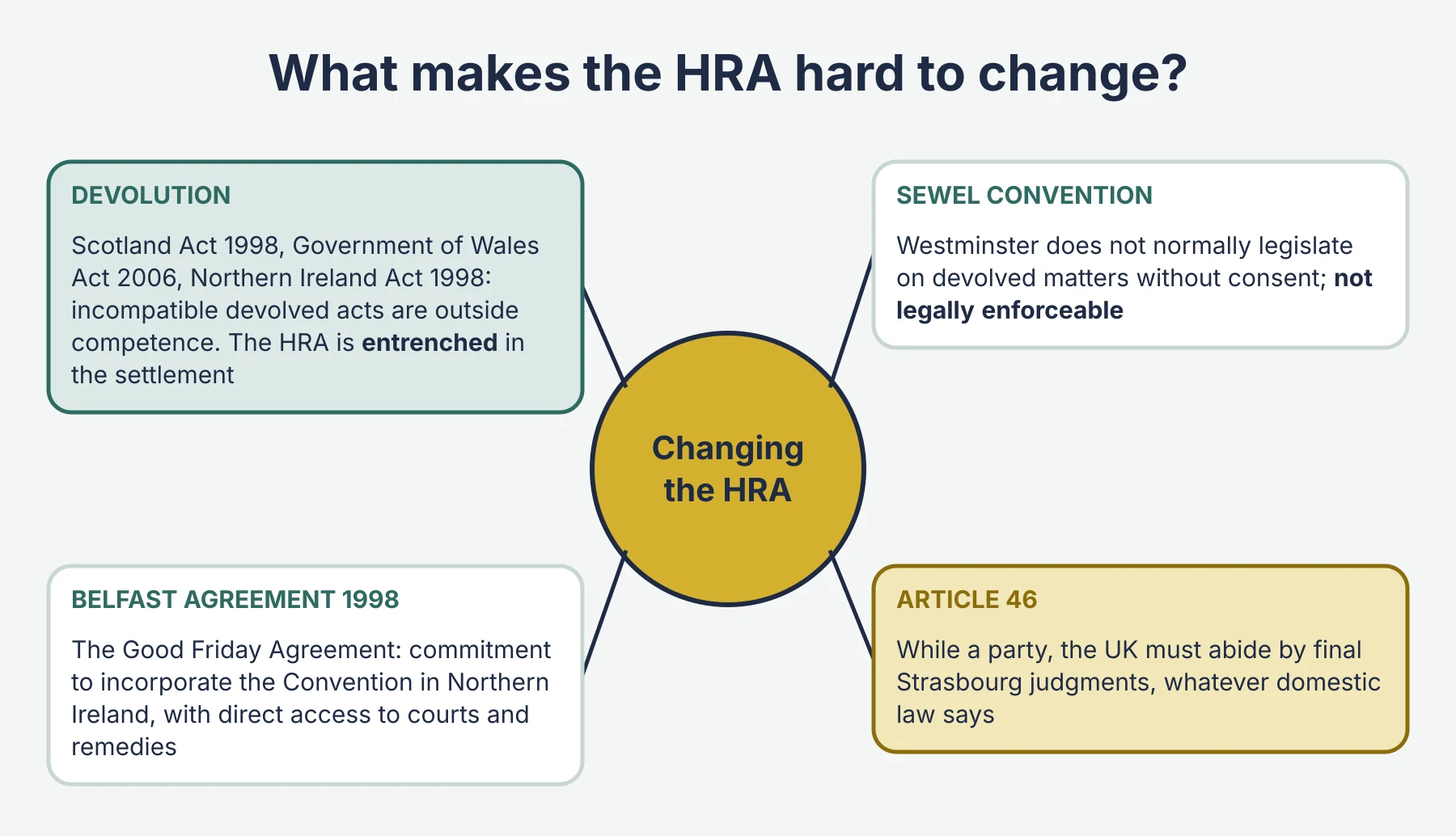
- Devolution. The Scotland Act 1998, the Government of Wales Act 2006 and the Northern Ireland Act 1998 make acts of the devolved legislatures that are incompatible with Convention rights outside their competence. This is why the specification describes the HRA as entrenched in the devolutionary settlement. Changing it would engage the Sewel convention, under which Westminster does not normally legislate on devolved matters without consent, though the convention is not legally enforceable.
- Northern Ireland. The Belfast (Good Friday) Agreement 1998 includes a commitment to incorporate the Convention into Northern Ireland law, with direct access to the courts and remedies for breach.
- International obligations. As long as the UK remains a party, Article 46 obliges it to abide by final judgments against it, whatever domestic law says.
Reform at Strasbourg
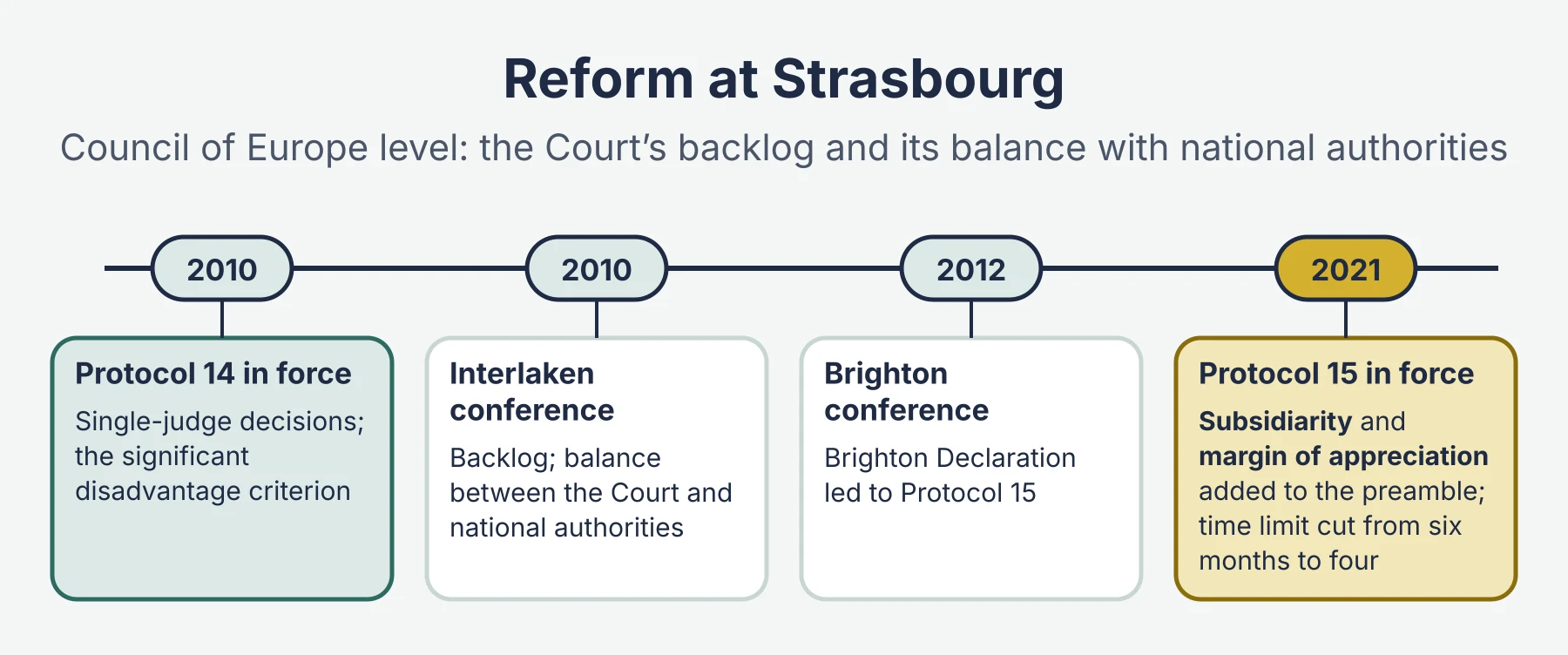
Reform also happens at Council of Europe level. Conferences at Interlaken (2010) and Brighton (2012) addressed the Court’s backlog and the balance between the Court and national authorities. The Brighton Declaration led to Protocol 15, in force from 2021, which added references to subsidiarity and the margin of appreciation to the Convention’s preamble and cut the time limit for applications from six months to four. Earlier, Protocol 14 (in force 2010) introduced single-judge decisions and the significant disadvantage criterion.
Annotated plan: “Discuss whether the Human Rights Act 1998 should be replaced by a UK Bill of Rights.”
Intro:      State the HRA model (s3, s4, s6) and the reform option. Signal a
            line of argument.
Point 1:    Case for replacement: s3 overreach (Ghaidan), Strasbourg influence
            (Ullah, Hirst). Evaluate: Horncastle shows UK courts can push
            back without new legislation.
Point 2:    Case against: the UK stays bound by Article 46, so a weaker Bill
            means more Strasbourg defeats; IHRAR found the Act working well.
Point 3:    Devolution and the Belfast Agreement complicate replacement.
Point 4:    Alternative reforms: targeted amendment, or strengthening rights.
Conclusion: Reach a judgement, e.g. that targeted amendment answers the
            criticisms with fewer risks than replacement.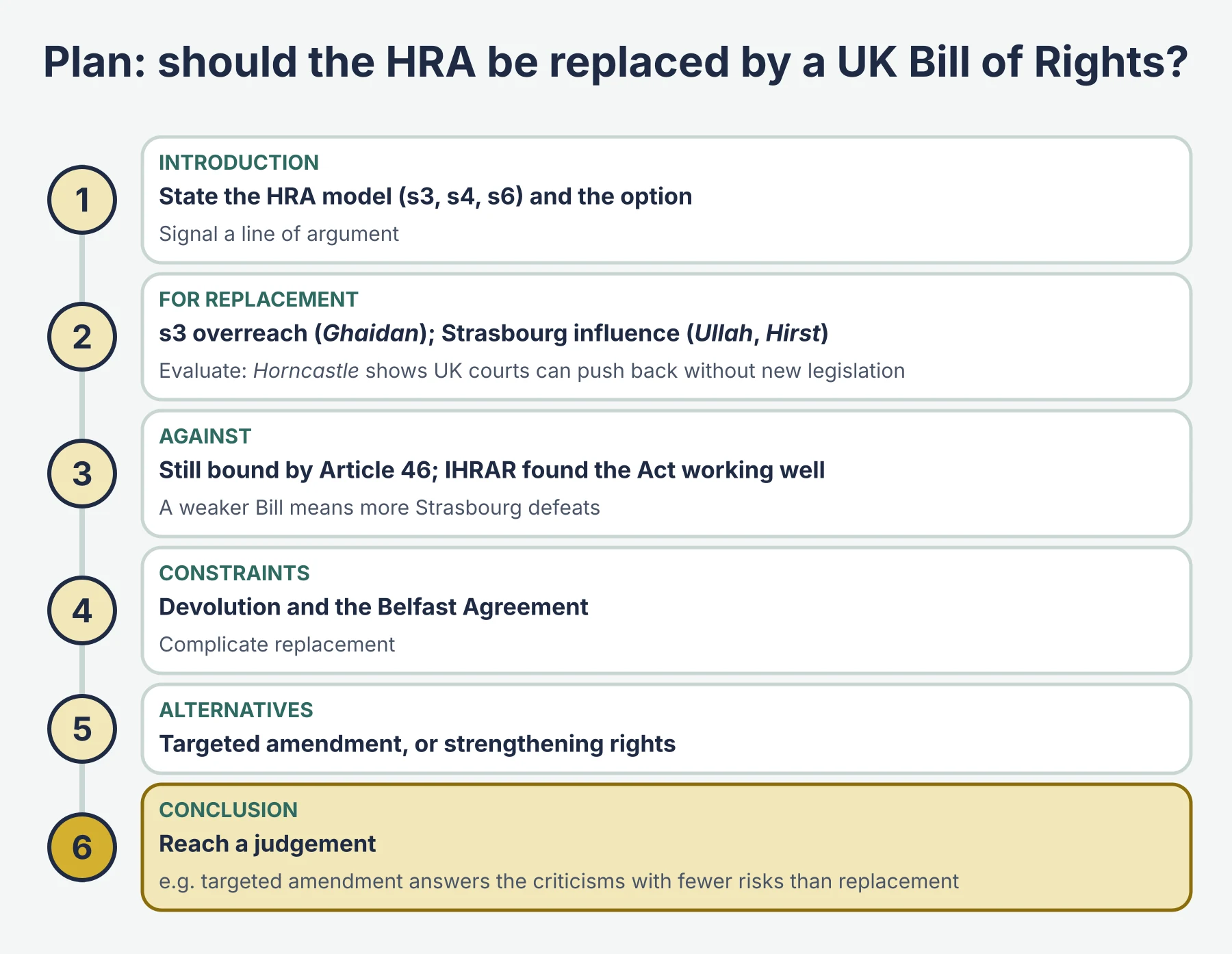
Common mistakes
- Writing that the Bill of Rights Bill became law. It did not proceed.
- Treating replacing the HRA as the same as leaving the Convention. They are different options.
- Describing reform proposals without evaluating them.
- Ignoring devolution and Northern Ireland, which the specification links to entrenchment.
Exam technique
- Discuss questions on reform need a sustained line of argument and a conclusion. Weigh at least two options against the criticisms they are meant to fix.
- Use cases as evidence for criticisms (Ghaidan, Hirst, YL) rather than retelling their facts.
- Present political proposals with dates and say whether they were enacted.
More resources on this topic
Reform revision notes | Reform practice questions | Enforcement study guide
Related resources
-
Practice questions
AQA A Level Law (7162): Reform – Practice Questions
Original practice on reform of UK human rights protection for AQA A Level Law 7162, with mark-scheme answers on Bill of Rights proposals and constraints.
Law · AQA · A Level
Try questions -
Revision notes
AQA A Level Law (7162): Reform – Revision Notes
Condensed recall on reform of human rights protection in the UK for AQA A Level Law 7162: criticisms, reform options, Bill of Rights proposals and constraints.
Law · AQA · A Level
Revise topic -
Study guides
AQA A Level Law (7162): Restrictions
Restrictions under Articles 8.2, 10.2 and 11.2 ECHR for AQA A Level Law 7162: prescribed by law, legitimate aims, necessity, proportionality and conflicts.
Law · AQA · A Level
Read guide
Get free revision emails (optional)
Occasional emails with practice questions, worked explanations and links to free resources for the qualification and subjects you choose. No spam, and you can unsubscribe from any email. The free tools on this site never need an email.