
Revision Notes
AQA A Level Law (7162): Reform – Revision Notes
Condensed recall on reform of human rights protection in the UK for AQA A Level Law 7162: criticisms, reform options, Bill of Rights proposals and constraints.
- Subject
- Law
- Level
- A LEVELS
- Topic
- Topic 5: Human Rights
- Author
- Marlbridge Academic Team
- Updated
- Reviewed by
- Aizaz Raoof Ali (what this means)
Aligned to AQA A Level Law (7162), For teaching from September 2017 onwards, A-level exams 2019 onwards. Official specification .
Syllabus page (what it covers and how it is assessed): AQA A Level Law.
Syllabus points this page covers
7162
- Reform
Found an error? Report a correction.
Need help with this topic? Request a free trial class for A Level Law (7162).
Condensed notes on reform of human rights protection in the UK. For full explanation and an annotated essay plan, use the Reform study guide. Political positions change, so check the current position before the exam.
Criticisms that drive reform
“Too much” protection or influence
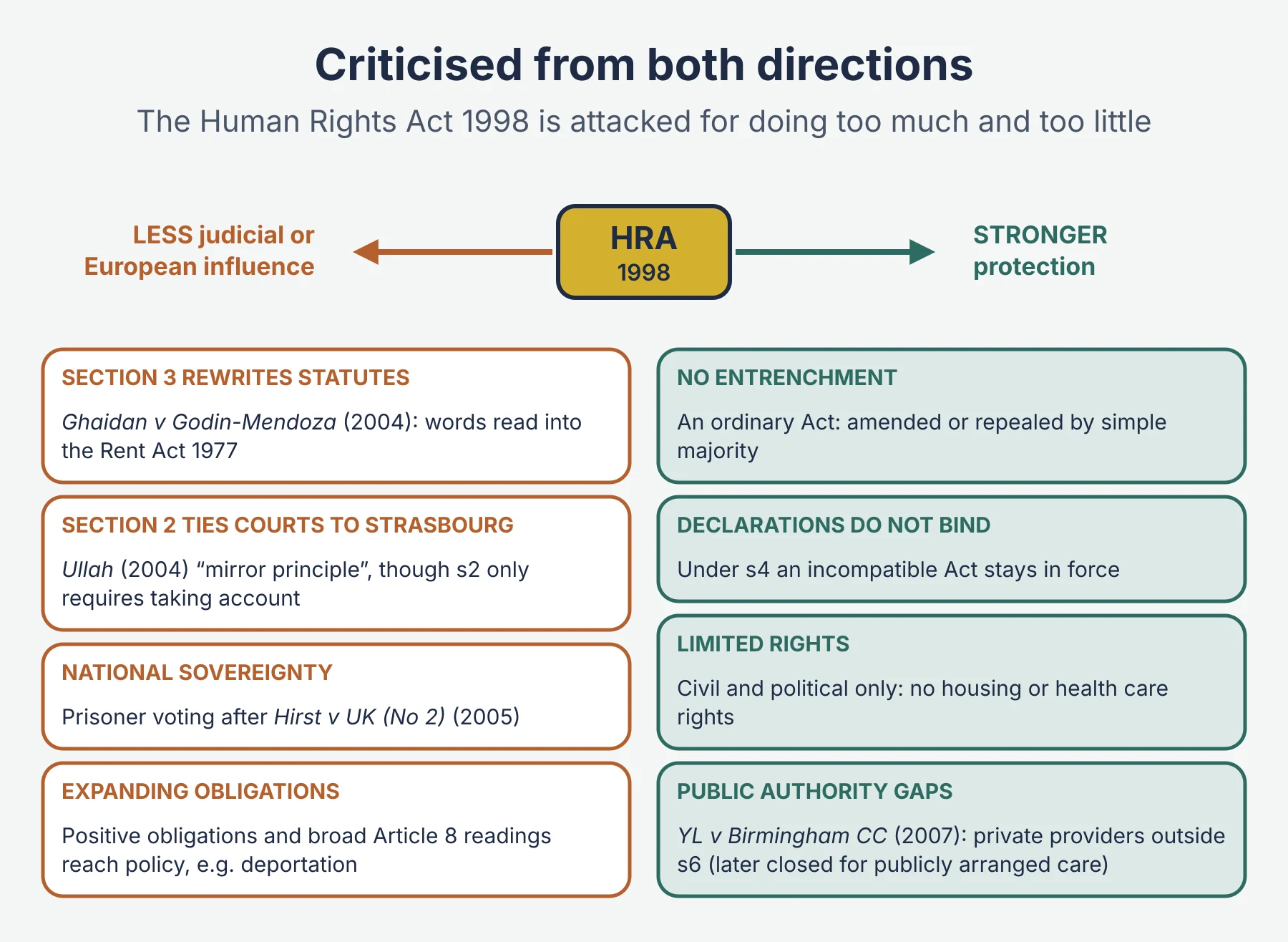
| Criticism | Evidence |
|---|---|
| Section 3 lets judges rewrite statutes | Ghaidan v Godin-Mendoza (2004) |
| Section 2 ties courts to Strasbourg | Ullah (2004) mirror principle |
| Strasbourg overrides Parliament | Hirst v UK (No 2) (2005), prisoner voting |
| Rights stretched into policy | Broad Article 8 and positive obligations in deportation cases |
“Too little” protection
| Criticism | Evidence |
|---|---|
| Not entrenched | HRA is an ordinary Act, repealable by simple majority |
| Declarations do not bind | Section 4: Act stays valid |
| Civil and political rights only | No domestic economic or social rights |
| Public authority gaps | YL v Birmingham CC (2007); later reversed by Care Act 2014 s73 |
Five options
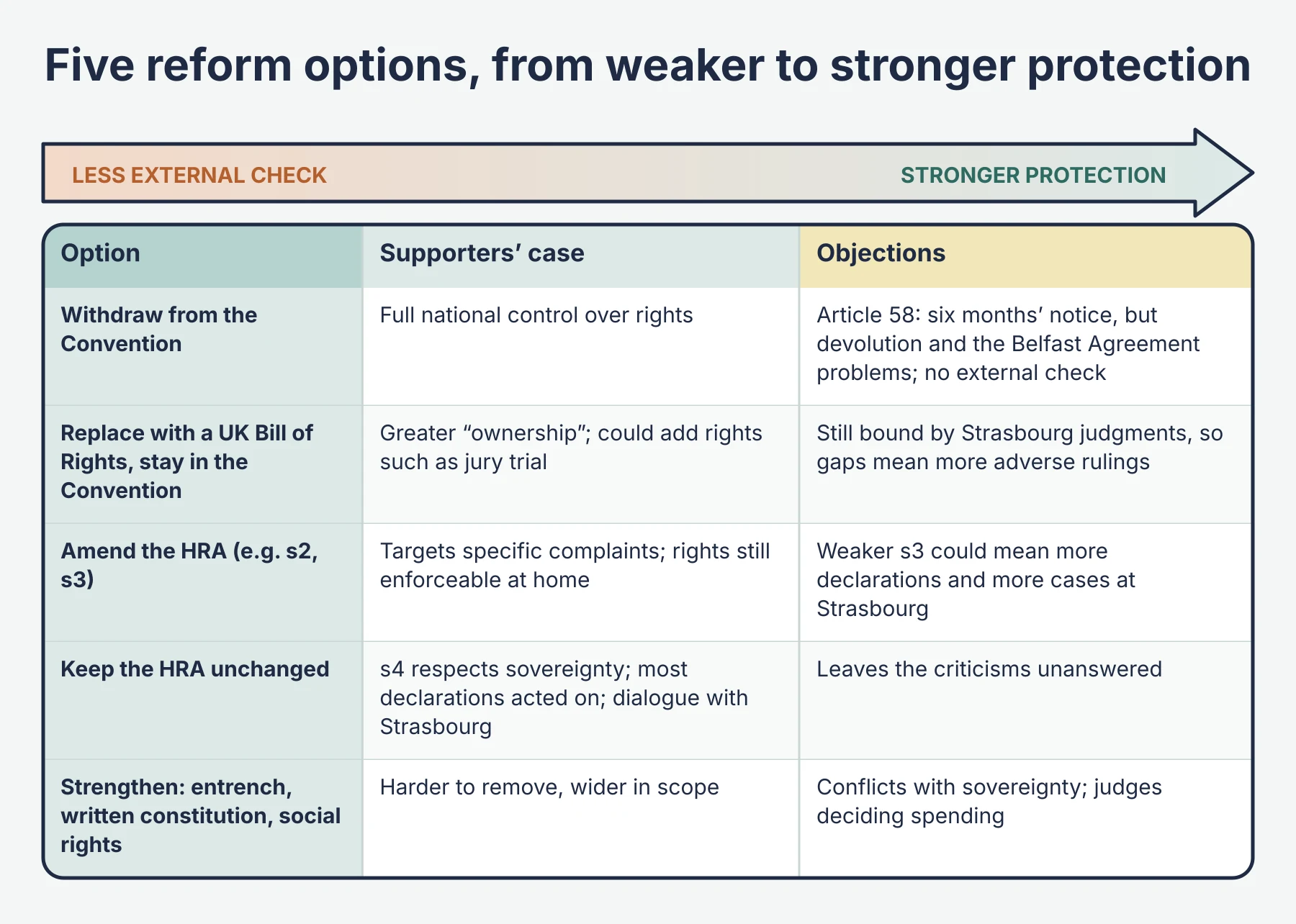
- Keep the HRA: section 4 model respects sovereignty; dialogue (Horncastle).
- Amend the HRA (e.g. ss2 and 3): targeted, but risks more declarations and Strasbourg cases.
- UK Bill of Rights, stay in the Convention: “ownership”, but Article 46 still binds the UK.
- Withdraw from the Convention: Article 58, six months’ notice; devolution and Belfast Agreement problems; no external check.
- Strengthen: entrenchment, written constitution, social rights; conflicts with parliamentary sovereignty and raises spending questions.
Timeline of proposals
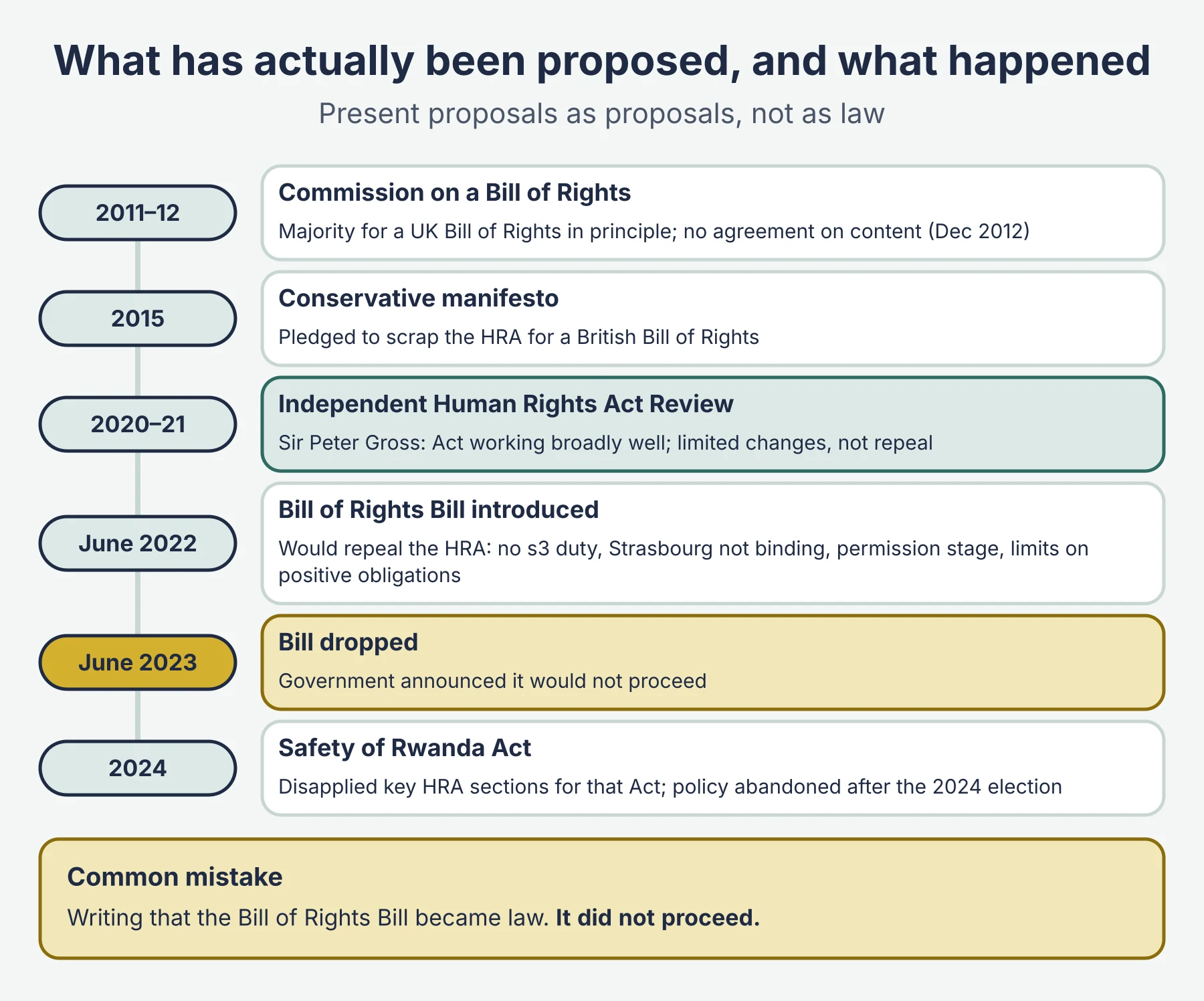
| Date | Event | Outcome |
|---|---|---|
| 2011 to 2012 | Commission on a Bill of Rights | Majority for a UK Bill of Rights in principle; no agreement on content |
| 2015 | Conservative manifesto pledge to scrap the HRA | Not carried out |
| 2020 to 2021 | Independent Human Rights Act Review (Sir Peter Gross) | Act working broadly well; limited changes only |
| June 2022 | Bill of Rights Bill introduced | Withdrawn; government announced in June 2023 it would not proceed |
| 2024 | Safety of Rwanda (Asylum and Immigration) Act 2024 disapplied key HRA sections for that Act | Rwanda policy abandoned after the 2024 general election |
Bill of Rights Bill 2022, main proposals: repeal the HRA; remove the s3 interpretive duty; UK courts need not follow Strasbourg; disregard Strasbourg interim measures; permission stage with significant disadvantage; limit positive obligations; great weight to freedom of speech.
Constraints
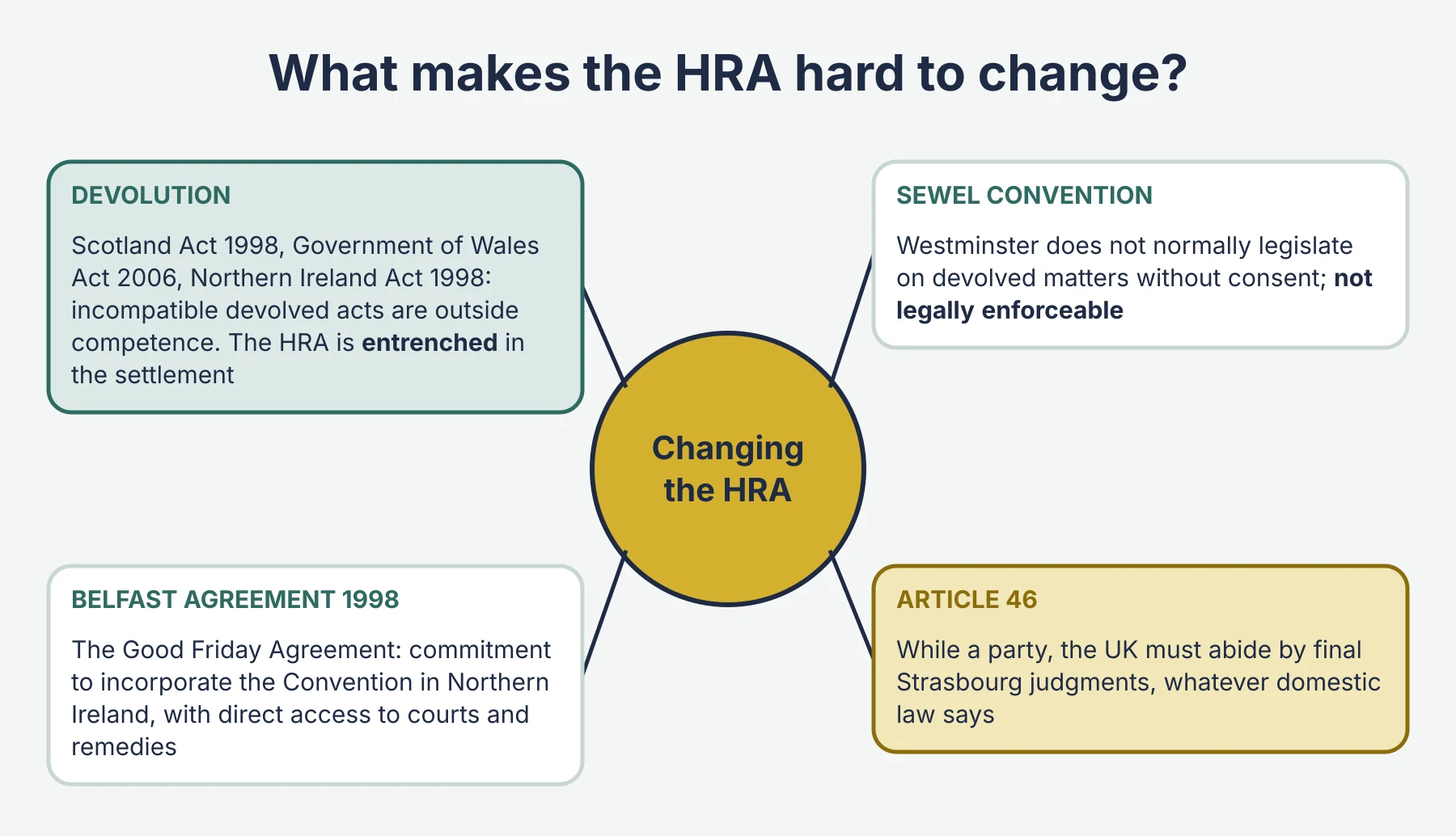
- Devolution: Scotland Act 1998, Government of Wales Act 2006 and Northern Ireland Act 1998 make incompatible devolved legislation outside competence: the HRA is “entrenched” in the settlement.
- Sewel convention: Westminster does not normally legislate on devolved matters without consent; not legally enforceable.
- Belfast (Good Friday) Agreement 1998: commitment to incorporate the Convention in Northern Ireland law.
- Article 46: while a party, the UK must abide by final judgments.
Strasbourg-level reform
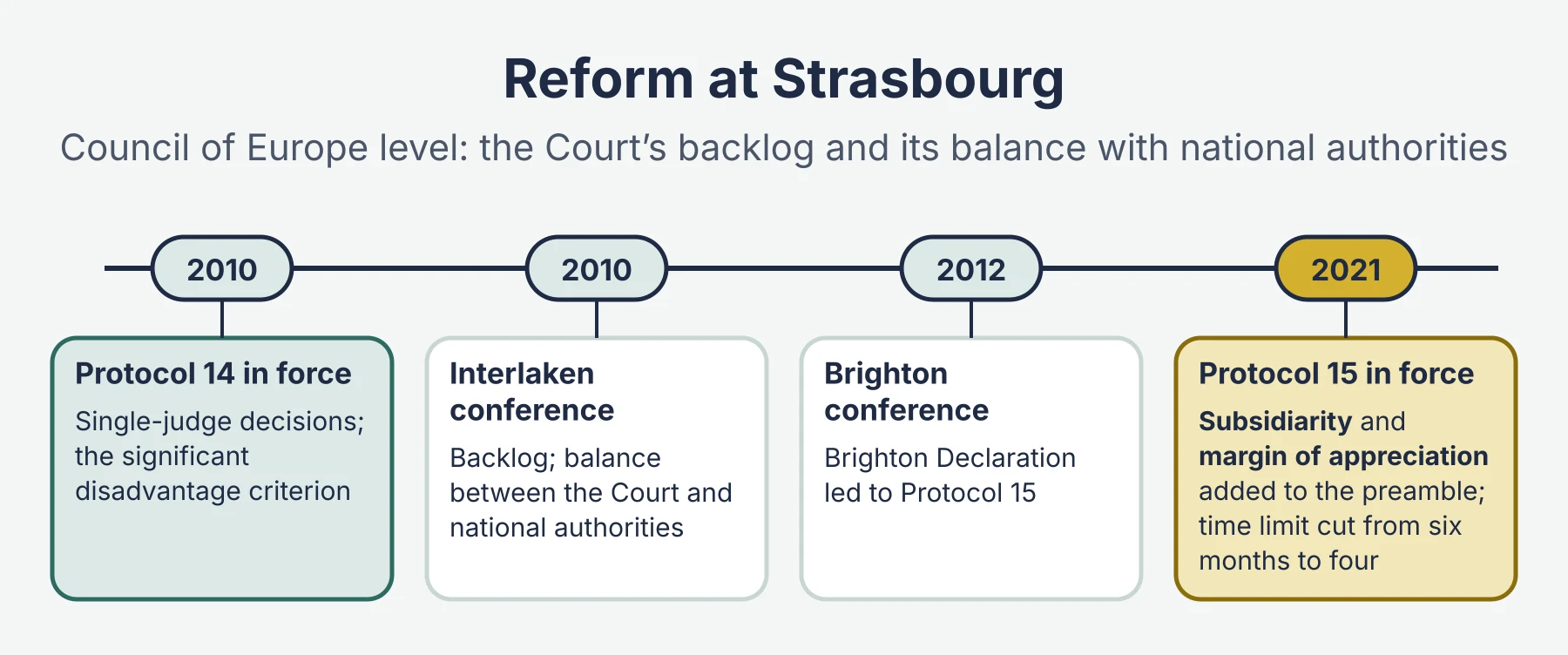
- Interlaken (2010) and Brighton (2012) conferences: backlog, subsidiarity.
- Protocol 14 (2010): single-judge formation; significant disadvantage criterion; infringement proceedings.
- Protocol 15 (2021): subsidiarity and margin of appreciation in the preamble; four-month time limit.
Key terms
| Term | Meaning |
|---|---|
| Entrenchment | Protection of a law against ordinary amendment or repeal |
| Bill of Rights | A single statement of rights; here, a proposed replacement for the HRA |
| Denunciation | Formal withdrawal from a treaty; for the Convention, under Article 58 |
| Subsidiarity | States secure rights first; the Court supervises |
| Sewel convention | Westminster does not normally legislate on devolved matters without consent |
| Mirror principle | The Ullah approach of keeping pace with Strasbourg, no more and no less |
| Dialogue | Exchange between UK courts and Strasbourg, as in Horncastle |
Exam traps
- The Bill of Rights Bill did not become law.
- Replacing the HRA is not the same as leaving the Convention.
- Do not describe proposals without evaluating them against the criticisms.
- Remember devolution and Northern Ireland when assessing replacement or withdrawal.
- Give dates, and say whether a proposal was enacted.
Self-test
- Give two criticisms of the HRA from those who think it gives too much power to judges or Strasbourg.
- Give two criticisms from those who think it gives too little protection.
- What did the Commission on a Bill of Rights conclude?
- What did the Independent Human Rights Act Review conclude?
- When was the Bill of Rights Bill introduced, and what happened to it?
- Give three proposals in the Bill of Rights Bill.
- Which Article of the Convention allows a state to withdraw, and on what notice?
- Why would replacing the HRA still leave the UK bound by Strasbourg judgments?
- How does devolution constrain reform of the HRA?
- What commitment in the Belfast (Good Friday) Agreement is relevant?
- What did Protocol 15 change?
- What is the Sewel convention, and is it legally enforceable?
Answers: 1. Any two: section 3 lets judges rewrite statutes (Ghaidan); section 2 ties courts to Strasbourg (Ullah); Strasbourg overrides Parliament (Hirst); rights stretched into policy. 2. Any two: not entrenched; declarations do not bind; no social rights; public authority gaps (YL). 3. A majority favoured a UK Bill of Rights in principle, but there was no agreement on content. 4. The Act was working broadly well; only limited changes were recommended. 5. June 2022; the government announced in June 2023 that it would not proceed. 6. Any three: repeal the HRA; remove s3; courts need not follow Strasbourg; disregard interim measures; significant disadvantage permission stage; limit positive obligations; great weight to freedom of speech. 7. Article 58; six months’ notice. 8. Article 46 obliges a state party to abide by final judgments against it. 9. The devolution statutes make incompatible devolved legislation outside competence, so changing the HRA affects the settlement and engages the Sewel convention. 10. Incorporation of the Convention into Northern Ireland law with access to courts and remedies. 11. It added subsidiarity and the margin of appreciation to the preamble and cut the time limit to four months. 12. Westminster does not normally legislate on devolved matters without the devolved legislature’s consent; it is not legally enforceable.
More resources on this topic
Reform study guide | Reform practice questions | Human Rights revision notes
Related resources
-
Study guides
AQA A Level Law (7162): Restrictions
Restrictions under Articles 8.2, 10.2 and 11.2 ECHR for AQA A Level Law 7162: prescribed by law, legitimate aims, necessity, proportionality and conflicts.
Law · AQA · A Level
Read guide -
Practice questions
AQA A Level Law (7162): Restrictions – Practice Questions
Original practice on restrictions under Articles 8.2, 10.2 and 11.2 for AQA A Level Law 7162, with mark-scheme answers on legality, aims and proportionality.
Law · AQA · A Level
Try questions -
Revision notes
AQA A Level Law (7162): Restrictions – Revision Notes
Condensed recall on Articles 8.2, 10.2 and 11.2 ECHR for AQA A Level Law 7162: the three-part test, Bank Mellat proportionality and the margin of appreciation.
Law · AQA · A Level
Revise topic
Get free revision emails (optional)
Occasional emails with practice questions, worked explanations and links to free resources for the qualification and subjects you choose. No spam, and you can unsubscribe from any email. The free tools on this site never need an email.