
Revision Notes
AQA A Level Law (7162): Human Rights in international law – Revision Notes
Condensed recall on international human rights law for AQA A Level Law 7162: post-war origins, the UN and UDHR, the Council of Europe and the ECHR timeline.
- Subject
- Law
- Level
- A LEVELS
- Topic
- Topic 5: Human Rights
- Author
- Marlbridge Academic Team
- Updated
- Reviewed by
- Aizaz Raoof Ali (what this means)
Aligned to AQA A Level Law (7162), For teaching from September 2017 onwards, A-level exams 2019 onwards. Official specification .
Syllabus page (what it covers and how it is assessed): AQA A Level Law.
Syllabus points this page covers
7162
- Human Rights in international law
Found an error? Report a correction.
Need help with this topic? Request a free trial class for A Level Law (7162).
Condensed notes on the development of international human rights law. For full explanation and an annotated plan, use the Human Rights in international law study guide.
The story in one line
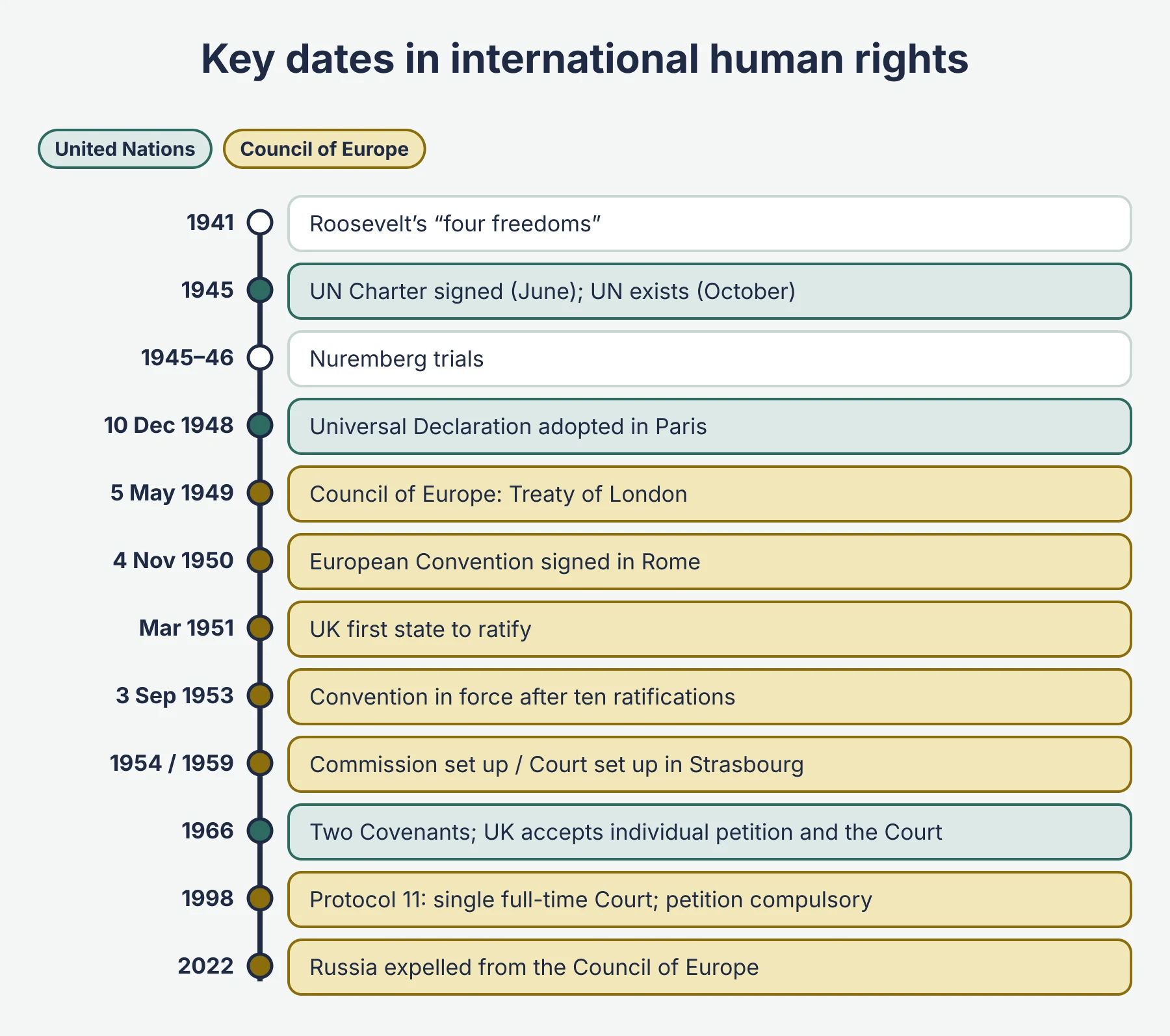
War and atrocity → Nuremberg → UN Charter 1945 → UDHR 1948 (standards, not binding) → Council of Europe 1949 → ECHR signed 1950, in force 1953 (binding, with a court) → Covenants 1966 → Protocol 11, 1998 (single full-time Court).
The Second World War and its aftermath
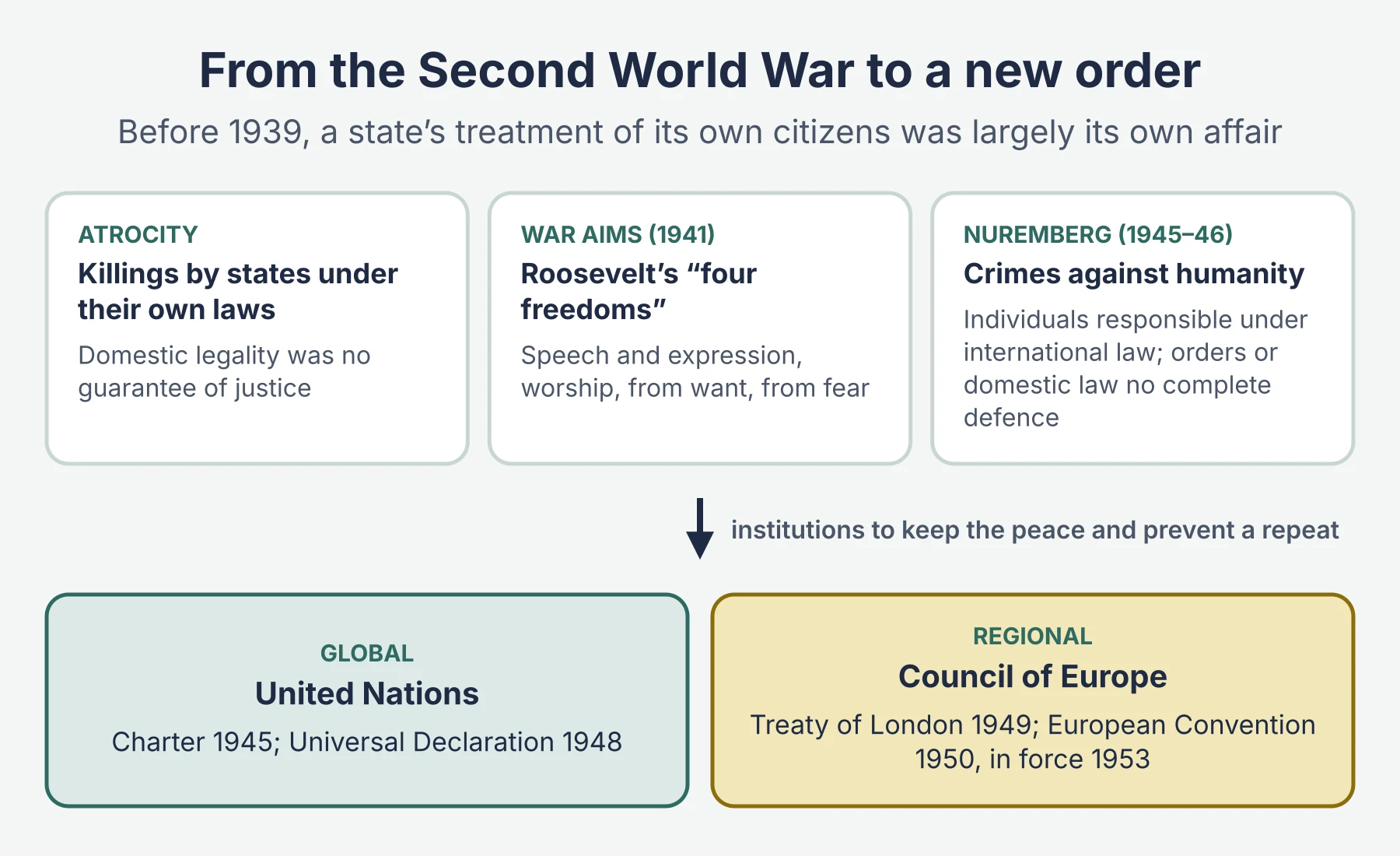
- Atrocities carried out by states under their own laws: domestic legality did not ensure justice.
- Four freedoms (Roosevelt, 1941): speech and expression, worship, from want, from fear.
- Nuremberg trials (1945 to 1946): International Military Tribunal; crimes against humanity; individuals responsible under international law; obeying orders not a complete defence.
- Aim: international institutions to keep peace and protect rights above the state.
The United Nations and the UDHR
| Point | Detail |
|---|---|
| UN Charter | Signed San Francisco, June 1945; UN in existence October 1945; purposes include promoting respect for human rights without distinction as to race, sex, language or religion |
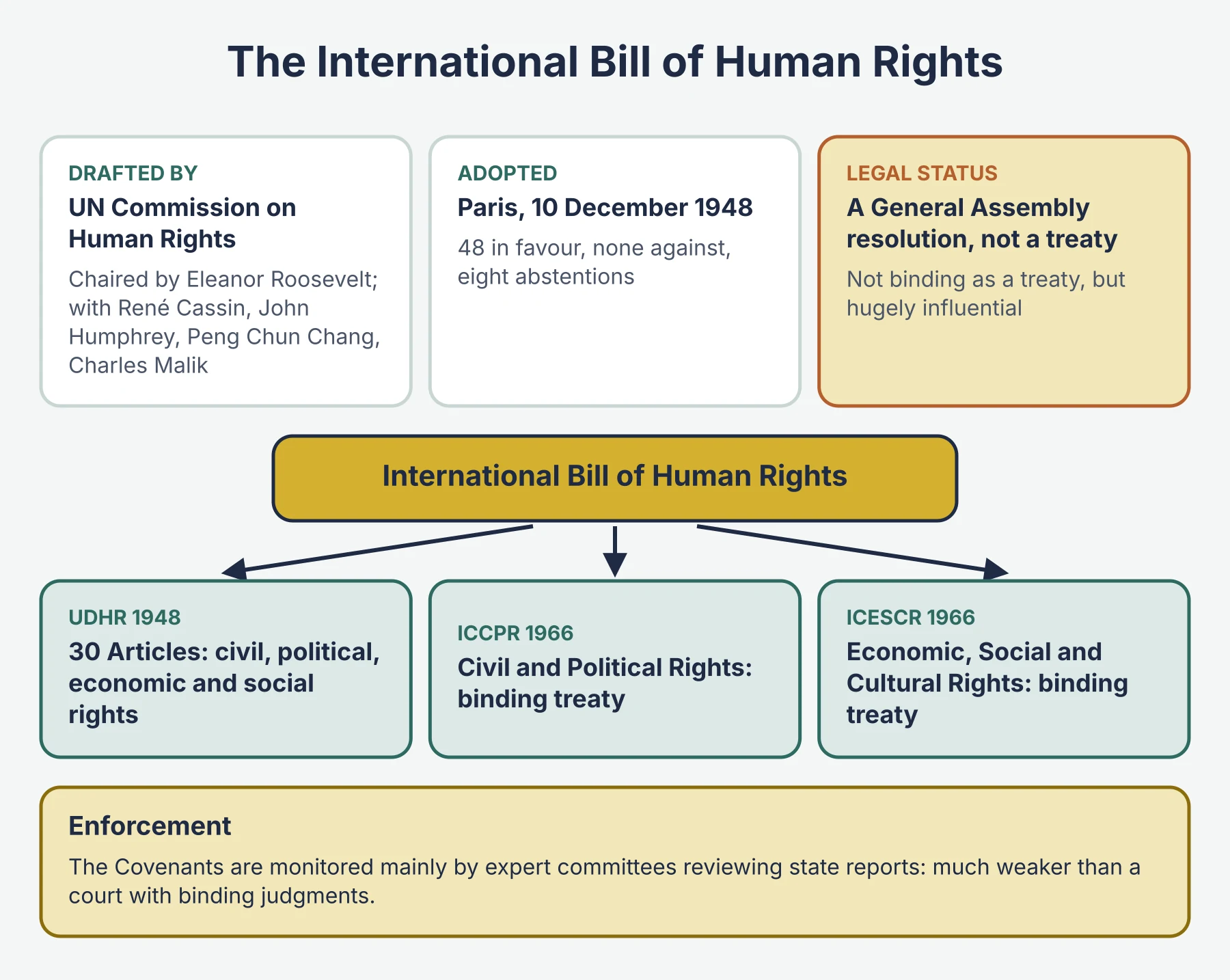
| Drafting body | UN Commission on Human Rights, chaired by Eleanor Roosevelt; contributors included René Cassin, John Humphrey, Peng Chun Chang and Charles Malik |
| Adoption | General Assembly, Paris, 10 December 1948: 48 for, none against, eight abstentions |
| Content | 30 Articles; civil and political plus economic and social rights; preamble on “inherent dignity” |
| Status | General Assembly resolution, not a treaty; influential, parts argued to be customary law |
| Follow-up | ICCPR and ICESCR, 1966; with the UDHR, the “International Bill of Human Rights”; monitored by expert committees, no binding court |
The Council of Europe and the ECHR
| Date | Event |
|---|---|
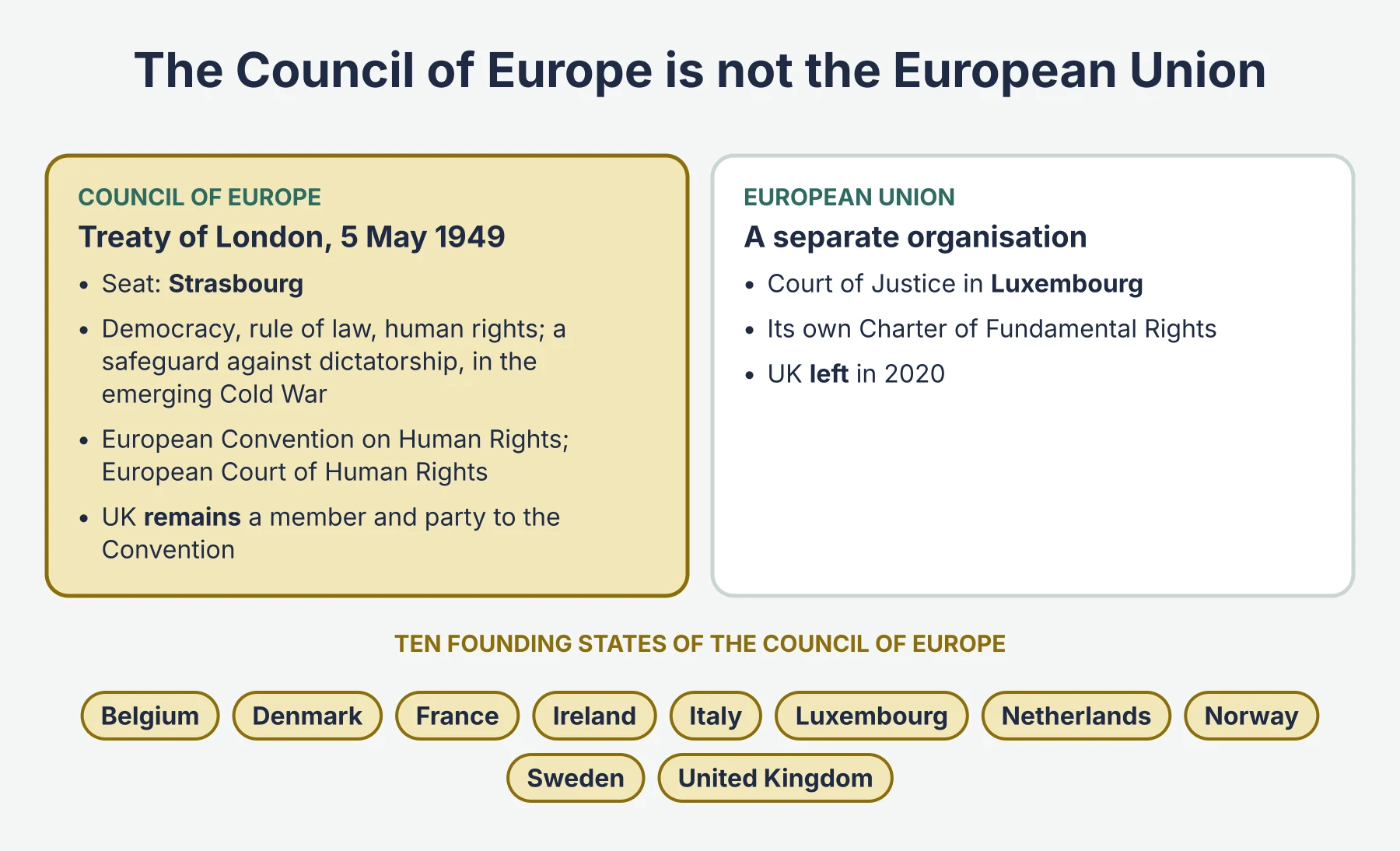
| 5 May 1949 | Treaty of London creates the Council of Europe; ten founding states including the UK; seat in Strasbourg |
| 4 November 1950 | ECHR signed in Rome; Sir David Maxwell Fyfe prominent in drafting |
| March 1951 | UK is the first state to ratify |
| 3 September 1953 | ECHR in force after ten ratifications |
| 1954 | European Commission of Human Rights set up |
| 1959 | European Court of Human Rights set up |
| 1966 | UK accepts individual petition and the Court’s jurisdiction |
| 1998 | Protocol 11: Commission abolished; single full-time Court; individual petition compulsory |
| 2022 | Russia expelled from the Council of Europe |
- Committee of Ministers supervises execution of judgments.
- Not the EU: the EU has the Court of Justice in Luxembourg and its own Charter of Fundamental Rights. The UK left the EU in 2020 but remains in the Council of Europe and the Convention.
Comparison
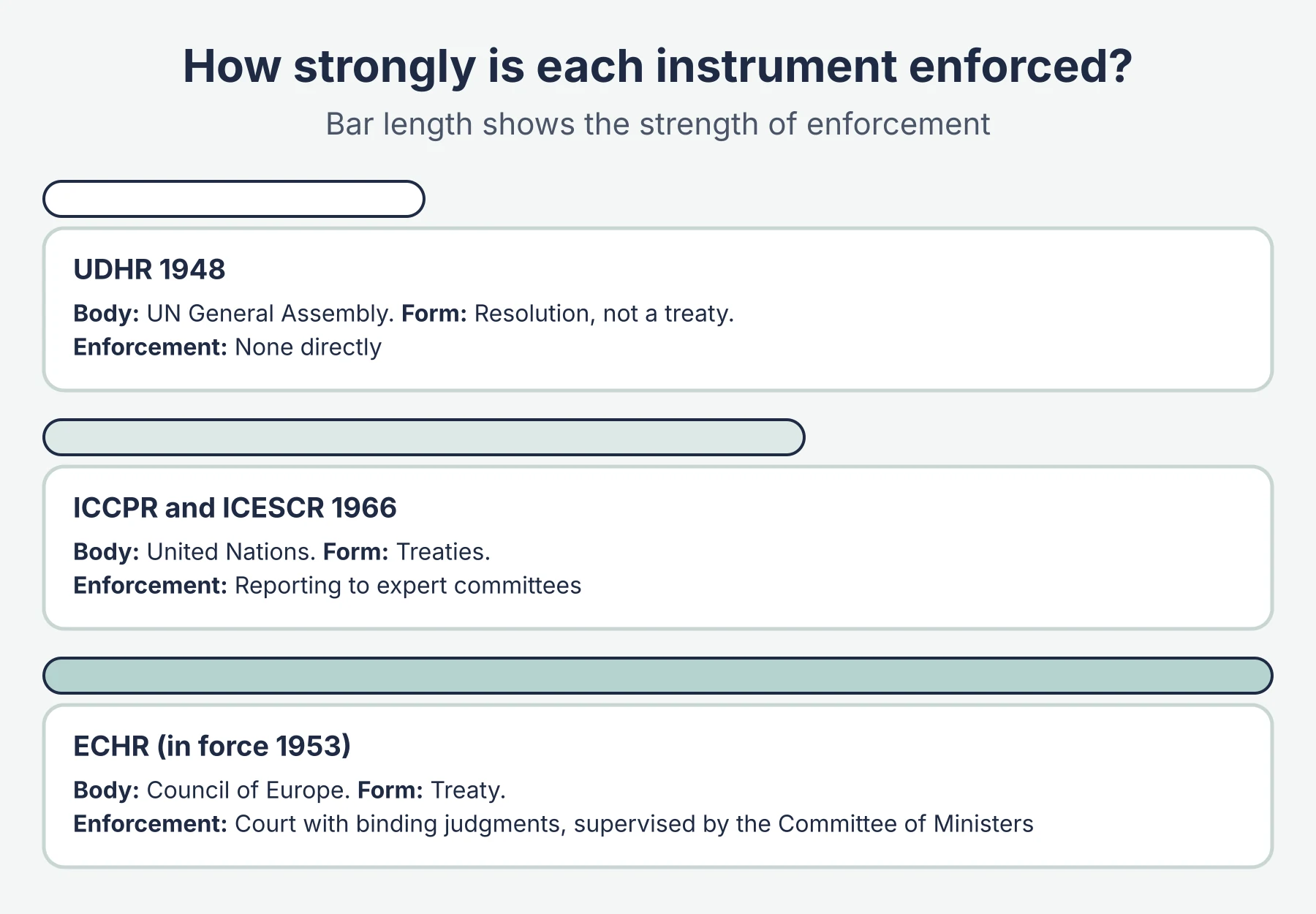
| UDHR | Covenants | ECHR | |
|---|---|---|---|
| Binding? | No | Yes | Yes |
| Enforcement | None directly | Reports to expert committees | Court with binding judgments |
| Scope | All categories | Civil and political; economic, social and cultural | Civil and political |
Key terms
| Term | Meaning |
|---|---|
| Crimes against humanity | Serious crimes against civilians, prosecuted at Nuremberg under international law |
| General Assembly resolution | A statement adopted by UN members; not binding like a treaty |
| Treaty | A binding agreement between states |
| Ratification | A state’s formal consent to be bound by a treaty |
| Individual petition | The right of a person to bring a complaint to the Strasbourg institutions |
| Protocol | An additional treaty adding rights or changing procedures under the Convention |
| Committee of Ministers | Council of Europe body supervising execution of judgments |
Exam traps
- Confusing the Council of Europe with the EU, or Strasbourg with Luxembourg.
- Calling the UDHR a treaty.
- Mixing up 1950 (signed) and 1953 (in force).
- Saying UK citizens could petition Strasbourg from 1953; the UK accepted individual petition in 1966.
- Forgetting that the Convention covers civil and political rights, while the UDHR also covers economic and social rights.
- Saying Brexit took the UK out of the Convention.
Self-test
- Why did the Second World War change attitudes to how states treat their own citizens?
- What principle of responsibility did the Nuremberg trials establish?
- When was the UN Charter signed, and what does it say about human rights?
- Who chaired the UN Commission on Human Rights during the drafting of the UDHR?
- When and where was the UDHR adopted, and what was the vote?
- Is the UDHR binding? Explain.
- Name the two UN Covenants of 1966.
- When and by which treaty was the Council of Europe created?
- When was the ECHR signed and when did it come into force?
- When did the UK accept the right of individual petition?
- What did Protocol 11 change?
- Give two differences between the Council of Europe and the European Union.
Answers: 1. States had committed atrocities under their own laws, showing domestic law could not be relied on to protect rights. 2. Individuals can be criminally responsible under international law, including for crimes against humanity. 3. June 1945; it lists promoting respect for human rights and fundamental freedoms for all among the UN’s purposes. 4. Eleanor Roosevelt. 5. 10 December 1948 in Paris; 48 for, none against, eight abstentions. 6. No; it is a General Assembly resolution, though influential and partly argued to reflect customary law. 7. The International Covenant on Civil and Political Rights and the International Covenant on Economic, Social and Cultural Rights. 8. 5 May 1949, by the Treaty of London. 9. Signed 4 November 1950 in Rome; in force 3 September 1953. 10. 1966. 11. It abolished the Commission, created a single full-time Court and made individual petition compulsory. 12. Any two of: different organisations with different membership; different courts (Strasbourg and Luxembourg); the UK has left the EU but remains in the Council of Europe; the EU has its own Charter of Fundamental Rights.
More resources on this topic
Human Rights in international law study guide | Human Rights in international law practice questions | Human Rights revision notes
Related resources
-
Study guides
AQA A Level Law (7162): Human Rights in the United Kingdom after the enactment of the Human Rights Act 1998
The HRA 1998 for AQA A Level Law 7162: how the ECHR was incorporated, ss3 and 4 in practice, constitutional impact, devolution entrenchment and criticisms.
Law · AQA · A Level
Read guide -
Practice questions
AQA A Level Law (7162): Human Rights in the United Kingdom after the enactment of the Human Rights Act 1998 – Practice Questions
Original practice on the HRA 1998 for AQA A Level Law 7162 with mark-scheme answers on incorporation, ss3 and 4, devolution entrenchment and criticisms.
Law · AQA · A Level
Try questions -
Revision notes
AQA A Level Law (7162): Human Rights in the United Kingdom after the enactment of the Human Rights Act 1998 – Revision Notes
Condensed recall on the HRA 1998 for AQA A Level Law 7162: Schedule 1 rights, ss2 to 4, 6, 10 and 19, constitutional impact, devolution and criticisms.
Law · AQA · A Level
Revise topic
Get free revision emails (optional)
Occasional emails with practice questions, worked explanations and links to free resources for the qualification and subjects you choose. No spam, and you can unsubscribe from any email. The free tools on this site never need an email.