
Study Guides
AQA A Level Law (7162): Human Rights in the United Kingdom after the enactment of the Human Rights Act 1998
The HRA 1998 for AQA A Level Law 7162: how the ECHR was incorporated, ss3 and 4 in practice, constitutional impact, devolution entrenchment and criticisms.
- Subject
- Law
- Level
- A LEVELS
- Topic
- Topic 5: Human Rights
- Author
- Marlbridge Academic Team
- Updated
- Reviewed by
- Aizaz Raoof Ali (what this means)
Aligned to AQA A Level Law (7162), For teaching from September 2017 onwards, A-level exams 2019 onwards. Official specification .
Syllabus page (what it covers and how it is assessed): AQA A Level Law.
Syllabus points this page covers
7162
- Human Rights in the United Kingdom after the enactment of the Human Rights Act 1998
Found an error? Report a correction.
Need help with this topic? Request a free trial class for A Level Law (7162).
This guide covers Human Rights in the United Kingdom after the enactment of the Human Rights Act 1998 in section 3.5 Human Rights of AQA A-level Law (7162). The specification lists the “extent and method of incorporation and interpretation of the provisions of the European Convention on Human Rights”, the “impact on constitutional arrangements and on law in the United Kingdom including entrenched nature of the Human Rights Act 1998 in the devolutionary settlement of Scotland and Northern Ireland”, and “criticisms of Human Rights”. For the whole option in outline, start with the Human Rights study guide.
Extent of incorporation
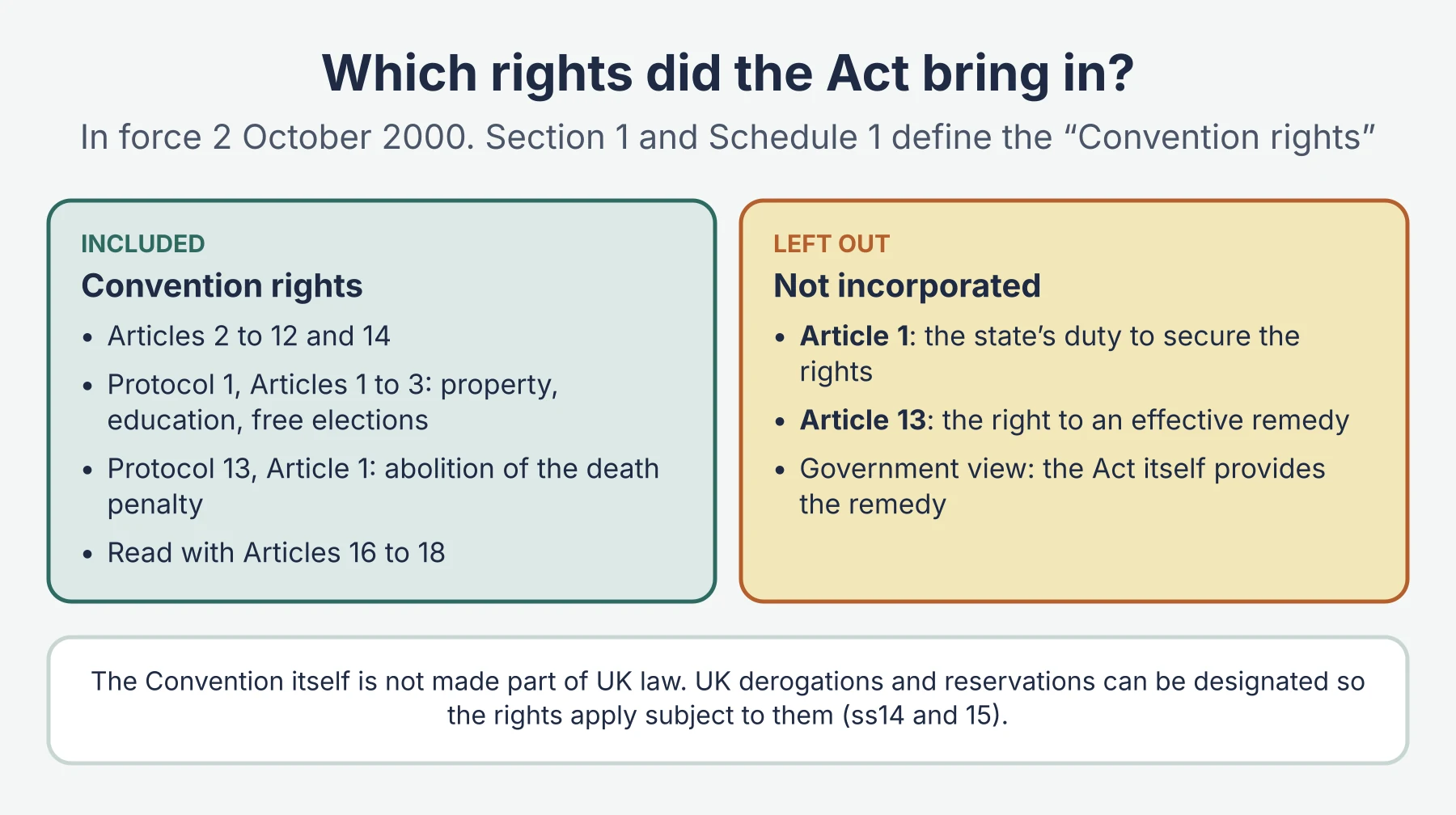
The Act came into force on 2 October 2000. It does not make the Convention itself part of UK law. Instead, section 1 and Schedule 1 define the “Convention rights” that UK courts give effect to.
- Included: Articles 2 to 12 and 14, Articles 1 to 3 of Protocol 1 (property, education and free elections) and Article 1 of Protocol 13 (abolition of the death penalty), read with Articles 16 to 18.
- Left out: Article 1, the state’s duty to secure the rights, and Article 13, the right to an effective remedy. The government’s view was that the Act itself provides the remedy, so incorporating Article 13 was unnecessary.
- Derogations and reservations made by the UK can be designated so that the rights apply subject to them (sections 14 and 15).
Method of incorporation: the “dialogue” model
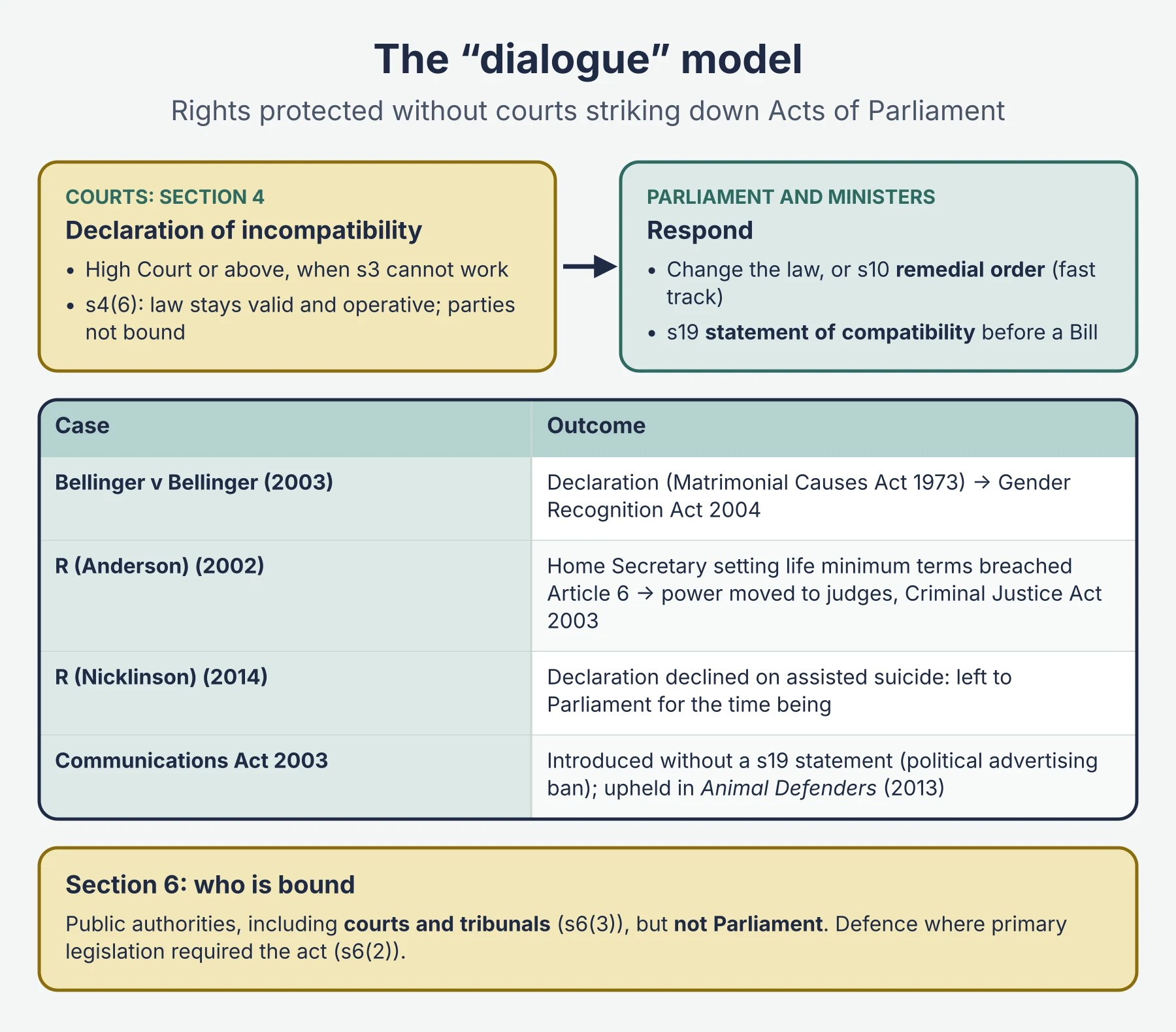
The Act was designed to protect rights without giving courts power to strike down Acts of Parliament. It does this through four mechanisms.
Section 2: taking account of Strasbourg
Courts must take into account Strasbourg case law but are not bound by it. The approach has moved from close adherence, the “mirror principle” in R (Ullah) v Special Adjudicator (2004), towards greater willingness to differ where there are good reasons, as in R v Horncastle (2009).
Section 3: interpretation
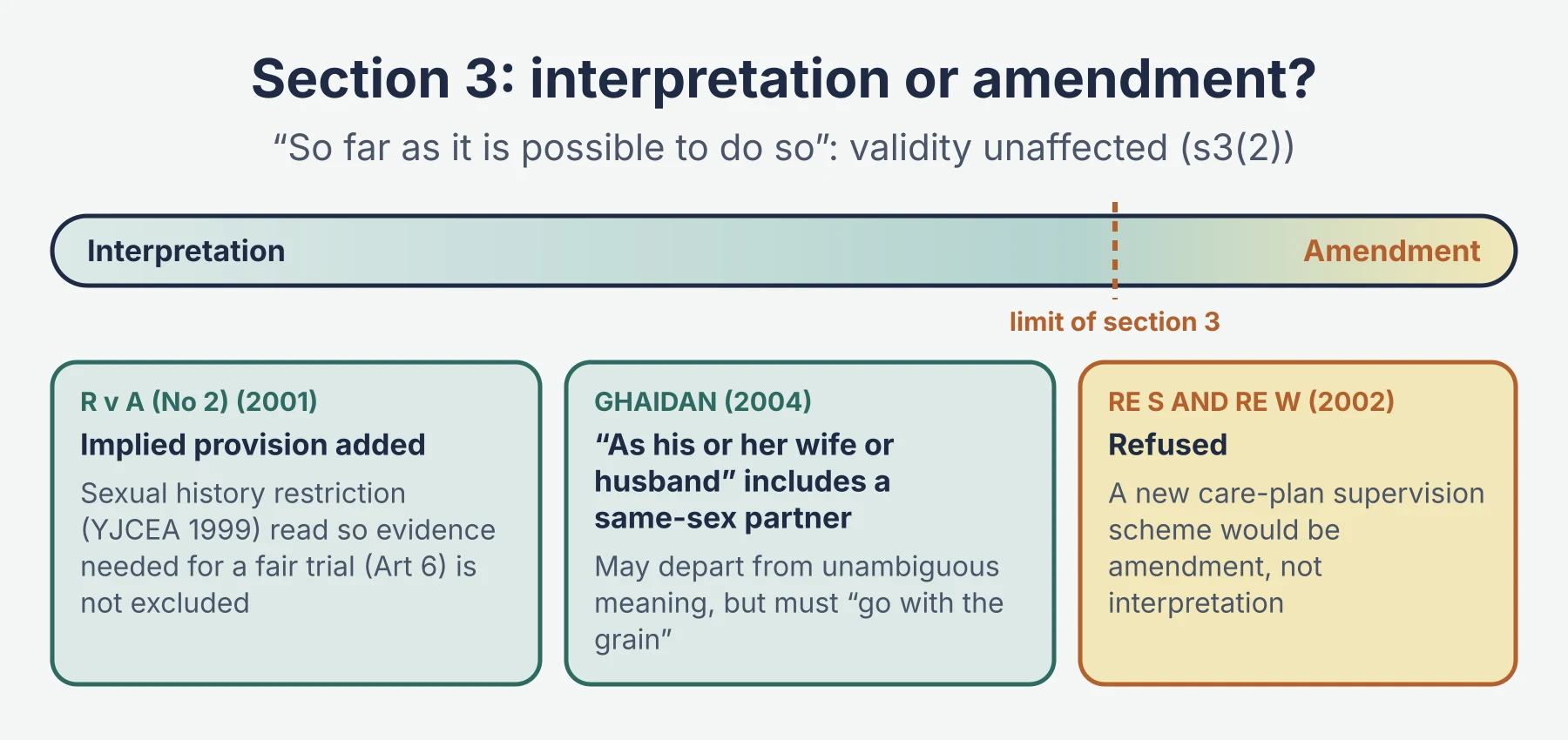
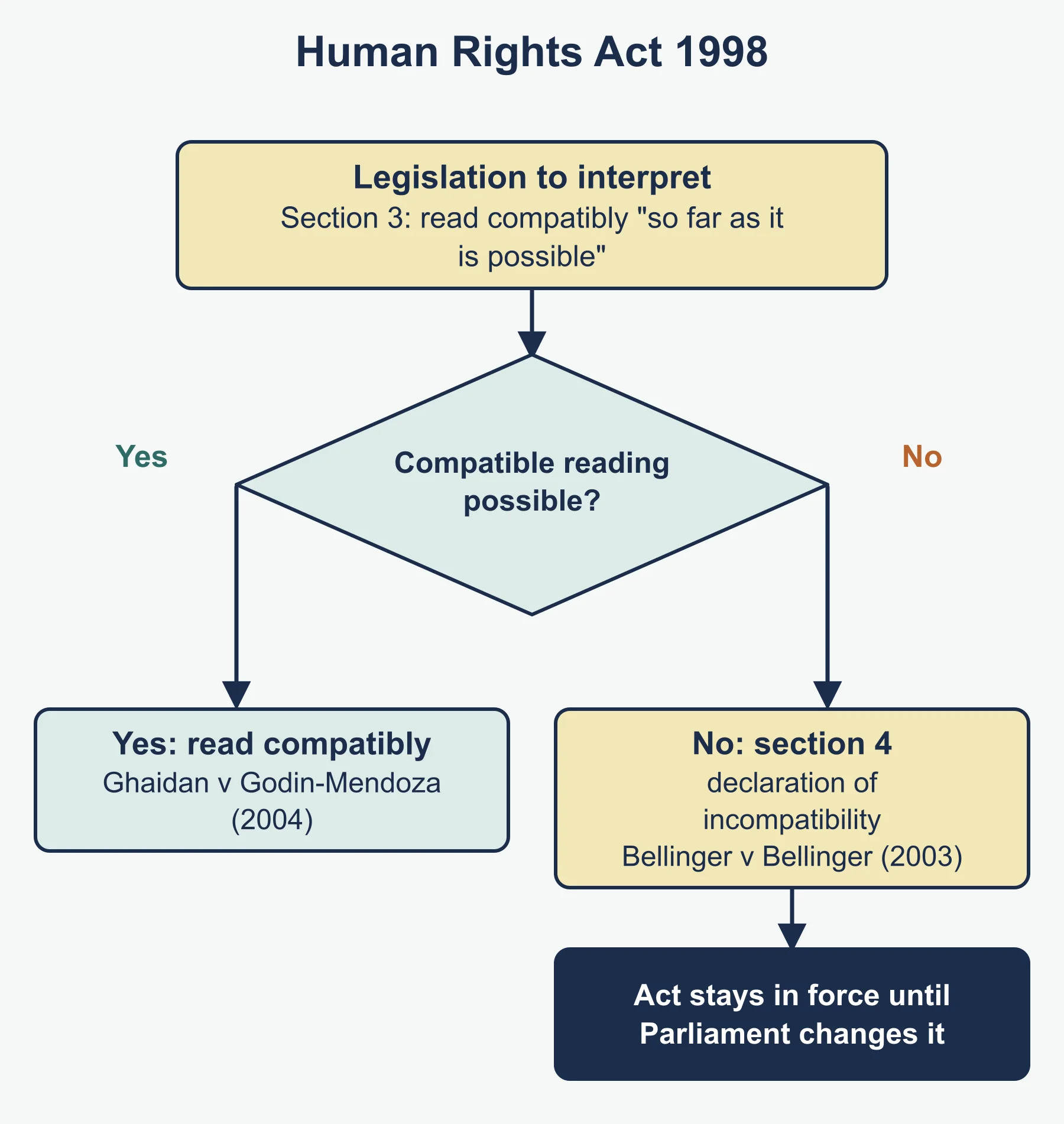
“So far as it is possible to do so, primary legislation and subordinate legislation must be read and given effect in a way which is compatible with the Convention rights.” This applies to legislation passed before and after 1998 and does not affect the validity of an incompatible Act (section 3(2)).
| Case | Use of section 3 |
|---|---|
| R v A (No 2) (2001) | A restriction on evidence of a complainant’s sexual history in rape trials, in the Youth Justice and Criminal Evidence Act 1999, was read subject to an implied provision that evidence needed for a fair trial under Article 6 should not be excluded |
| Ghaidan v Godin-Mendoza (2004) | Words in the Rent Act 1977 about a person living with the tenant “as his or her wife or husband” were read to include a same-sex partner. Lord Nicholls said section 3 may require courts to depart from the unambiguous meaning, but the interpretation must “go with the grain” of the legislation |
| Re S and Re W (Care Orders) (2002) | The House of Lords refused to read into the Children Act 1989 a new scheme of court supervision of care plans, because that would depart from a fundamental feature of the Act: this was amendment, not interpretation |
Section 4: declarations of incompatibility
If a compatible reading is impossible, the High Court or a higher court may declare the provision incompatible. Under section 4(6) the declaration does not affect the validity, continuing operation or enforcement of the provision, and does not bind the parties.
- Bellinger v Bellinger (2003): the Matrimonial Causes Act 1973 could not be read to recognise a marriage by a transgender woman; a declaration was made, and Parliament passed the Gender Recognition Act 2004.
- R (Anderson) v Secretary of State for the Home Department (2002): the Home Secretary’s power to set the minimum term for mandatory life prisoners was incompatible with Article 6; Parliament transferred the power to judges in the Criminal Justice Act 2003.
- R (Nicklinson) v Ministry of Justice (2014): the Supreme Court declined to make a declaration on the ban on assisted suicide, leaving the matter to Parliament for the time being.
Sections 10 and 19: the political branches
- Section 10 lets a minister amend incompatible legislation by remedial order, a fast-track procedure.
- Section 19 requires the minister in charge of a Bill to make a statement of compatibility, or state that one cannot be made but the government wishes to proceed. The Communications Act 2003 was introduced without one because of its ban on political advertising, which was later upheld in Animal Defenders International v UK (2013).
Section 6: who is bound
It is unlawful for a public authority to act incompatibly with Convention rights. Courts and tribunals are public authorities (section 6(3)), but Parliament is not. A public authority has a defence if primary legislation required it to act as it did (section 6(2)).
Impact on constitutional arrangements
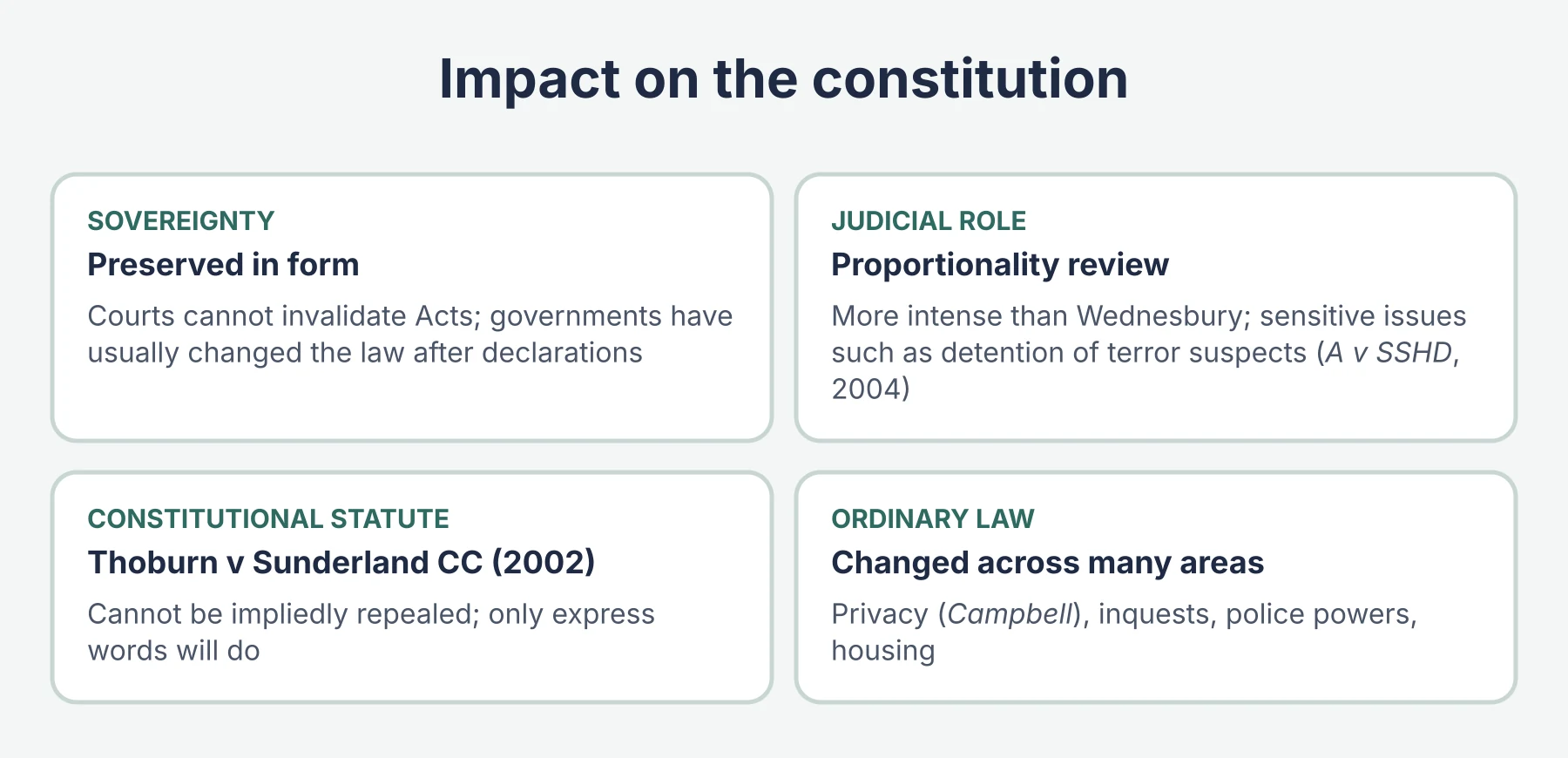
- Parliamentary sovereignty preserved in form. Courts cannot invalidate Acts of Parliament. In practice, governments have usually responded to declarations of incompatibility by changing the law, so the final word rests with Parliament, but with strong pressure to comply.
- A new judicial role. Courts now assess proportionality of executive action, a more intense review than Wednesbury irrationality, and decide politically sensitive questions such as detention of terror suspects (A v Secretary of State for the Home Department, 2004).
- A constitutional statute. In Thoburn v Sunderland City Council (2002) Laws LJ listed the Human Rights Act 1998 among “constitutional statutes” that cannot be impliedly repealed by later Acts; only express words will do.
- Change across ordinary law. The Act has shaped privacy law (Campbell v MGN, 2004), the law on inquests into deaths involving the state, police powers and housing law.
Entrenchment in the devolution settlements
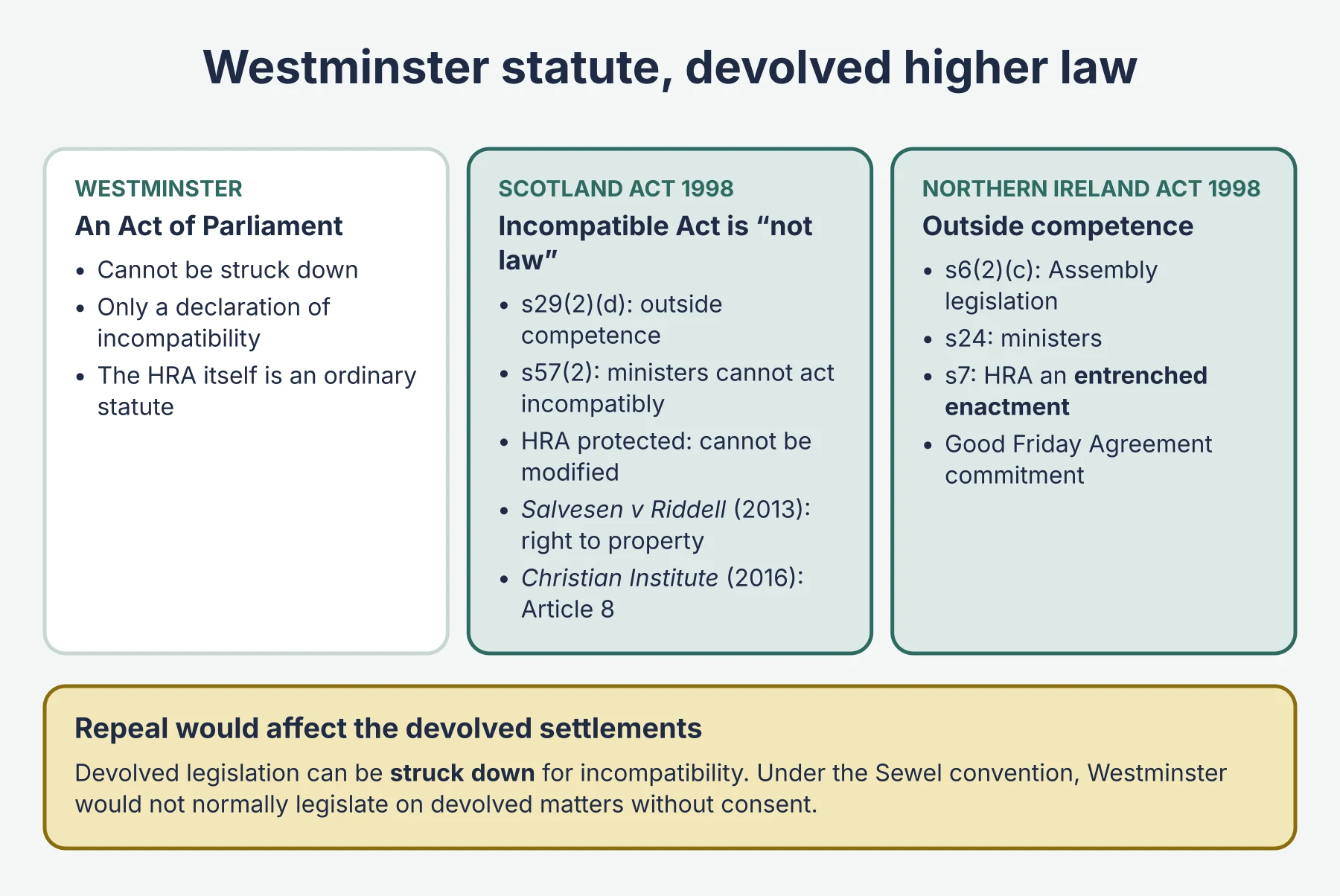
At Westminster the Act is an ordinary statute. In the devolved systems it operates as a higher law.
- Scotland: under the Scotland Act 1998, an Act of the Scottish Parliament is “not law” so far as it is incompatible with Convention rights (section 29(2)(d)), and Scottish ministers have no power to act incompatibly (section 57(2)). The Human Rights Act is a protected enactment the Scottish Parliament cannot modify.
- Northern Ireland: under the Northern Ireland Act 1998, Assembly legislation incompatible with Convention rights is outside competence (section 6(2)(c)), ministers cannot act incompatibly (section 24), and the Human Rights Act is an entrenched enactment the Assembly cannot modify (section 7). The Belfast (Good Friday) Agreement 1998 included a commitment to incorporate the Convention.
So devolved legislation can be struck down for incompatibility, unlike an Act of Parliament.
- Salvesen v Riddell (2013): a provision of the Agricultural Holdings (Scotland) Act 2003 was outside competence because it breached the right to property in Article 1 of Protocol 1.
- Christian Institute v Lord Advocate (2016): information-sharing provisions of the “named person” scheme in the Children and Young People (Scotland) Act 2014 were outside competence because they were incompatible with Article 8.
Repealing or weakening the Act would therefore affect the devolved settlements and, under the Sewel convention, Westminster would not normally legislate on devolved matters without consent.
Criticisms of Human Rights
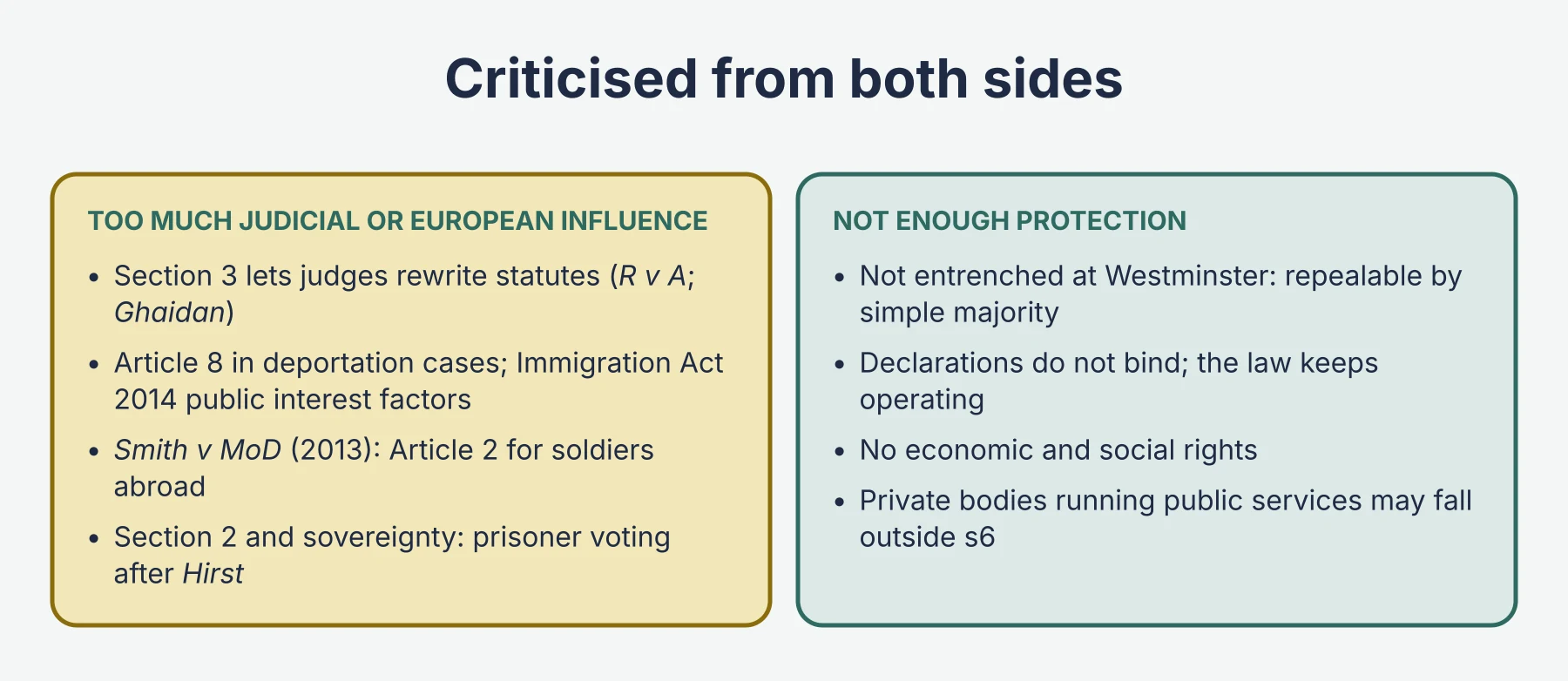
| From those who want less judicial or European influence | From those who want stronger protection |
|---|---|
| Section 3 lets judges rewrite statutes (R v A; Ghaidan) | The Act is not entrenched at Westminster and can be repealed by simple majority |
| Article 8 claims in deportation cases were said to frustrate immigration control; Parliament responded with statutory public interest factors in the Immigration Act 2014 | Declarations of incompatibility do not bind; the incompatible law continues to operate |
| Extension of Article 2 to soldiers abroad in Smith v Ministry of Defence (2013) was criticised as judicialising military decisions | No protection of economic and social rights |
| Strasbourg influence through section 2 conflicts with national sovereignty (prisoner voting after Hirst v UK (No 2), 2005) | Private bodies performing public services may fall outside section 6 |
These criticisms drive the debate covered in the Reform study guide.
Common mistakes
- Saying the Act “incorporated the whole Convention”; Articles 1 and 13 were left out.
- Saying a declaration of incompatibility strikes down an Act; section 4(6) says it does not.
- Treating section 3 as unlimited; Re S and Re W shows it cannot be used to amend a fundamental feature.
- Forgetting that devolved legislation, unlike Westminster legislation, can be struck down.
- Writing criticisms from one side only.
Exam technique
- Explain questions: describe a mechanism, such as section 3 or section 4, with a case and its effect.
- Discuss questions: evaluate whether the Act balances rights protection with parliamentary sovereignty, using the constitutional impact and both sets of criticisms.
- In problem answers, use section 6 (public authority), section 7 (victim) and section 8 (remedy) to frame the claim.
More resources on this topic
Human Rights after the HRA 1998 revision notes | Human Rights after the HRA 1998 practice questions | Human Rights before the HRA 1998 study guide
Related resources
-
Practice questions
AQA A Level Law (7162): Human Rights in the United Kingdom after the enactment of the Human Rights Act 1998 – Practice Questions
Original practice on the HRA 1998 for AQA A Level Law 7162 with mark-scheme answers on incorporation, ss3 and 4, devolution entrenchment and criticisms.
Law · AQA · A Level
Try questions -
Revision notes
AQA A Level Law (7162): Human Rights in the United Kingdom after the enactment of the Human Rights Act 1998 – Revision Notes
Condensed recall on the HRA 1998 for AQA A Level Law 7162: Schedule 1 rights, ss2 to 4, 6, 10 and 19, constitutional impact, devolution and criticisms.
Law · AQA · A Level
Revise topic -
Study guides
AQA A Level Law (7162): Human Rights in the United Kingdom prior to the Human Rights Act 1998
Human rights in the UK before 1998 for AQA A Level Law 7162: the ECHR as an unincorporated treaty, its limited use in courts and Strasbourg's impact.
Law · AQA · A Level
Read guide
Get free revision emails (optional)
Occasional emails with practice questions, worked explanations and links to free resources for the qualification and subjects you choose. No spam, and you can unsubscribe from any email. The free tools on this site never need an email.