
Revision Notes
AQA A Level Law (7162): Human Rights in the United Kingdom after the enactment of the Human Rights Act 1998 – Revision Notes
Condensed recall on the HRA 1998 for AQA A Level Law 7162: Schedule 1 rights, ss2 to 4, 6, 10 and 19, constitutional impact, devolution and criticisms.
- Subject
- Law
- Level
- A LEVELS
- Topic
- Topic 5: Human Rights
- Author
- Marlbridge Academic Team
- Updated
- Reviewed by
- Aizaz Raoof Ali (what this means)
Aligned to AQA A Level Law (7162), For teaching from September 2017 onwards, A-level exams 2019 onwards. Official specification .
Syllabus page (what it covers and how it is assessed): AQA A Level Law.
Syllabus points this page covers
7162
- Human Rights in the United Kingdom after the enactment of the Human Rights Act 1998
Found an error? Report a correction.
Need help with this topic? Request a free trial class for A Level Law (7162).
Condensed notes on how the Human Rights Act 1998 incorporated the Convention and what it changed. For full explanation, use the Human Rights after the HRA 1998 study guide.
The design in one line
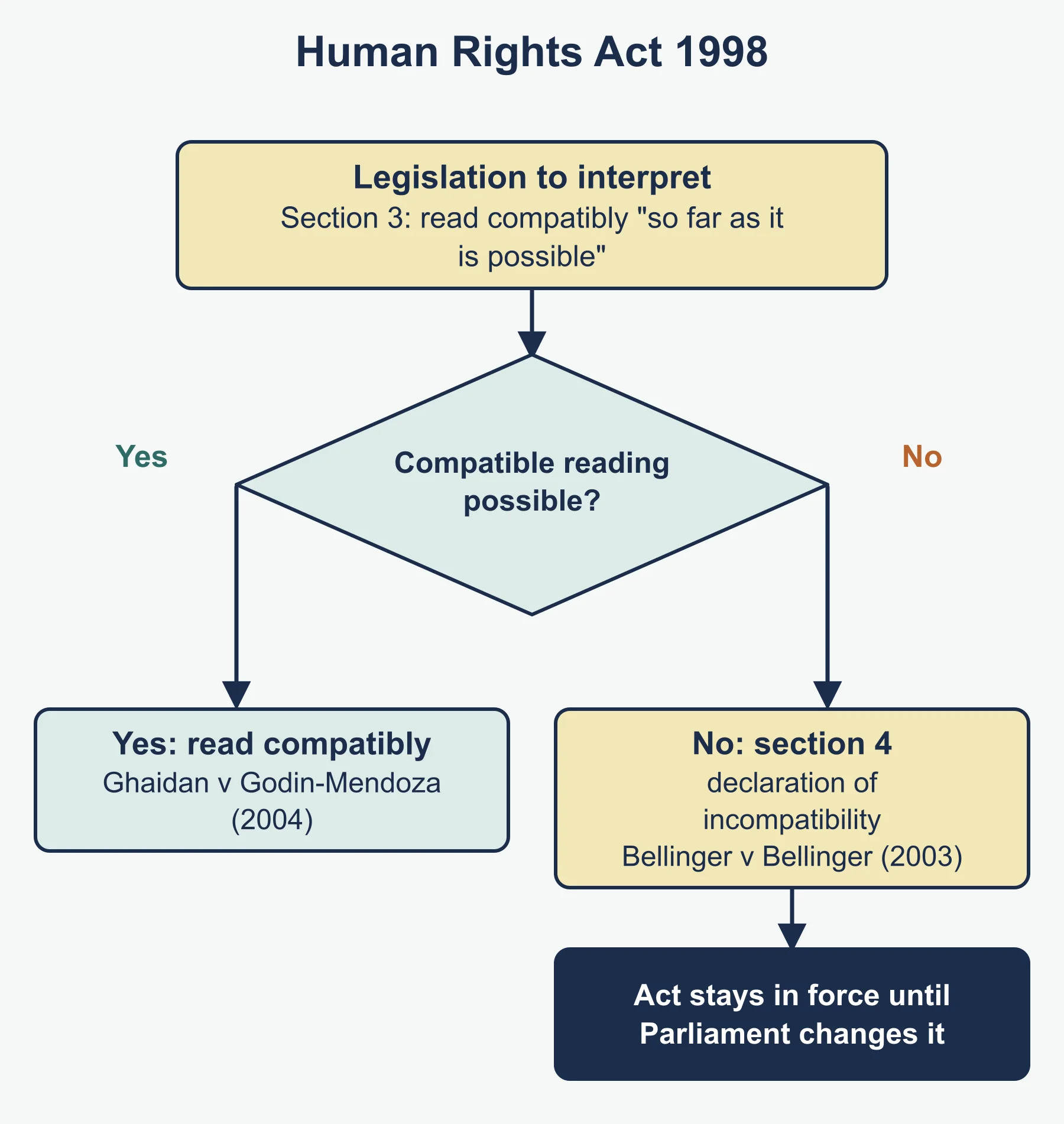
Convention rights defined (s1, Sch 1) → read legislation compatibly (s3) → if impossible, declaration (s4) → Parliament decides (s10 remedial order or new Act) → public authorities bound (s6) → victims claim (s7) → remedies (s8).
Extent
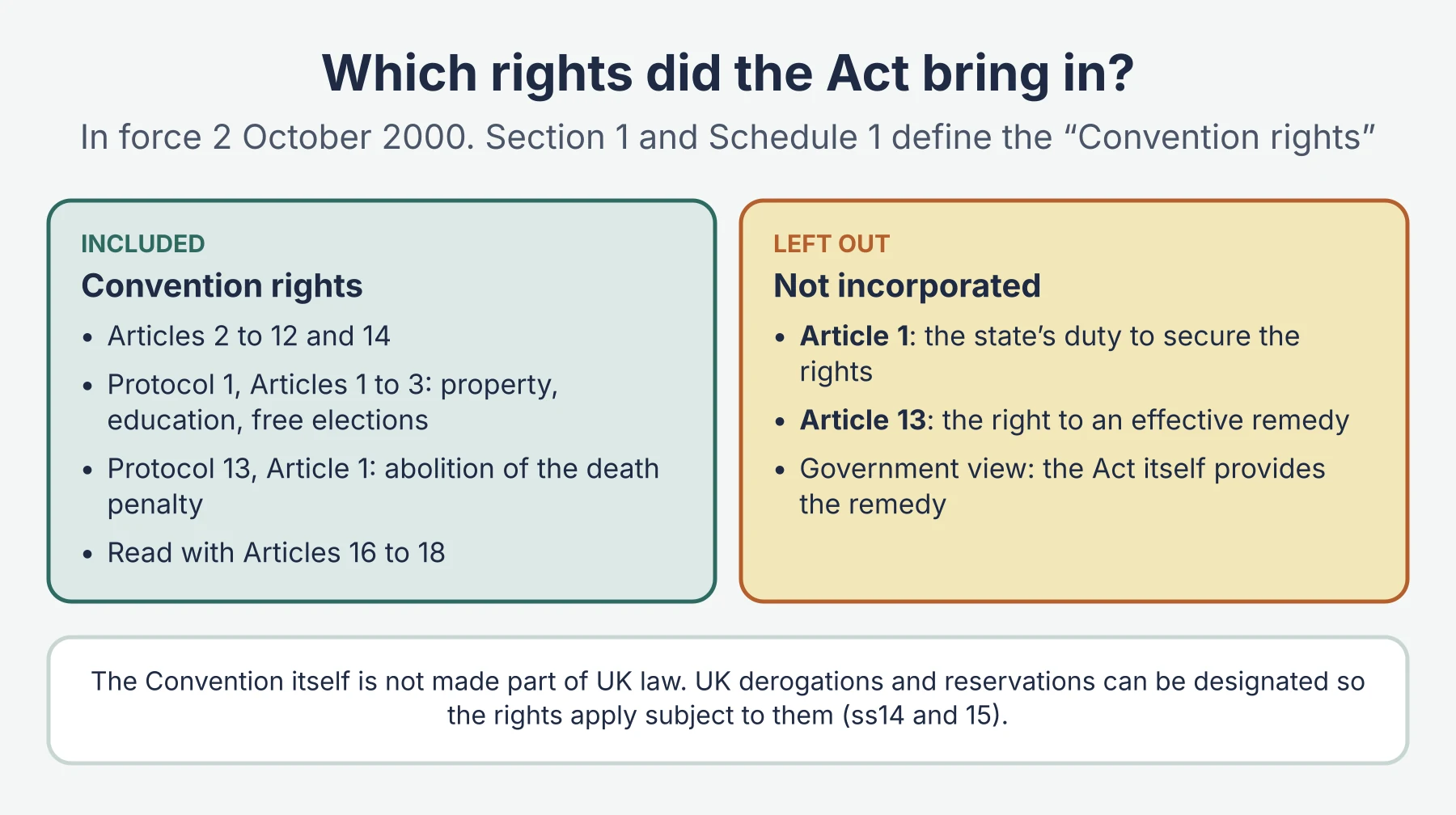
- In force 2 October 2000.
- Schedule 1: Articles 2 to 12 and 14; Protocol 1, Articles 1 to 3; Protocol 13, Article 1; read with Articles 16 to 18.
- Omitted: Article 1 (duty to secure rights) and Article 13 (effective remedy), because the Act itself provides the remedy.
- Designated derogations and reservations apply (ss14 and 15).
Method: the key sections
| Section | Rule | Key cases |
|---|---|---|
| s2 | Take into account Strasbourg case law; not bound | Ullah (2004) “mirror”; Horncastle (2009) declined to follow |
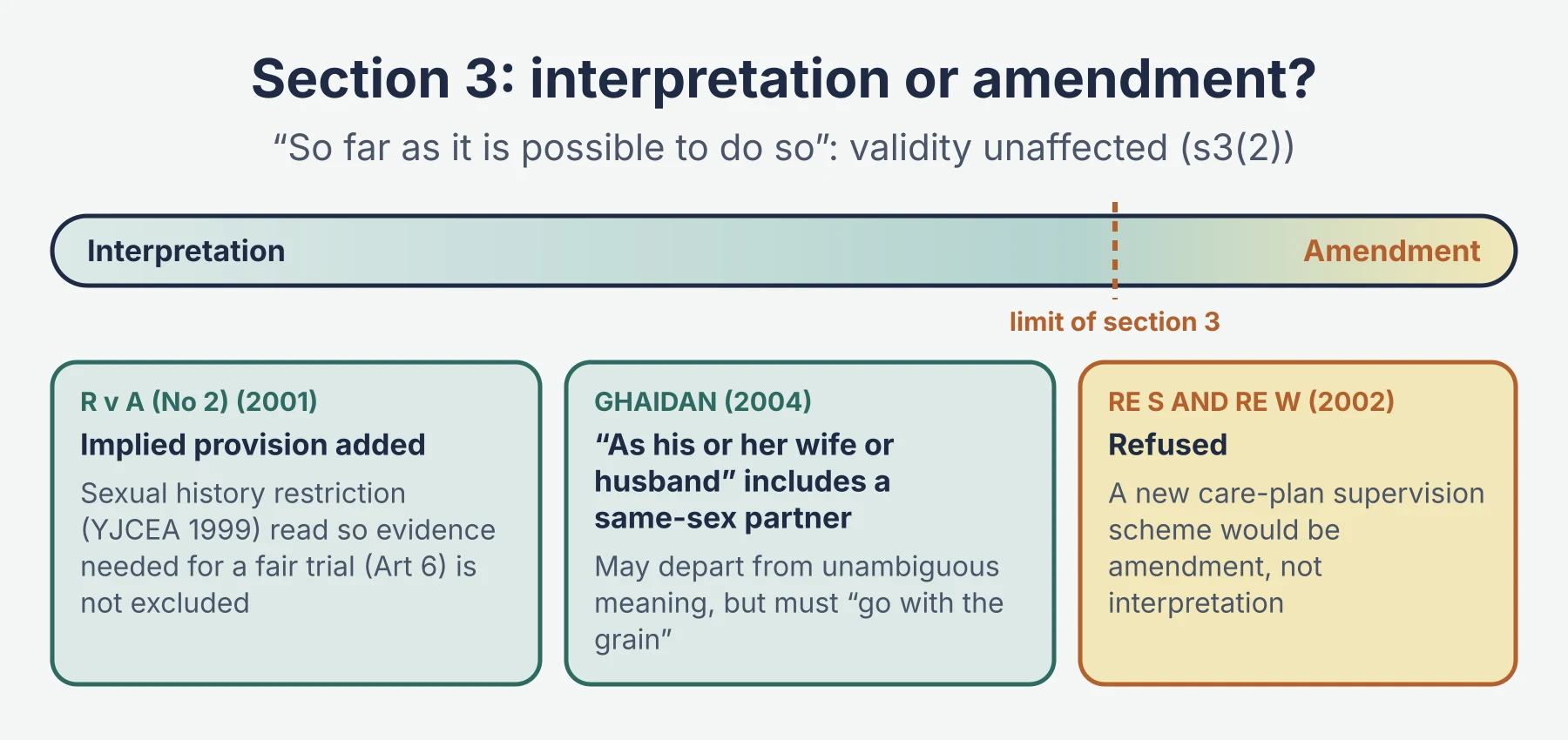
| s3 | Read legislation compatibly “so far as it is possible”; validity unaffected | R v A (No 2) (2001); Ghaidan (2004) “go with the grain”; Re S and Re W (2002) limit |
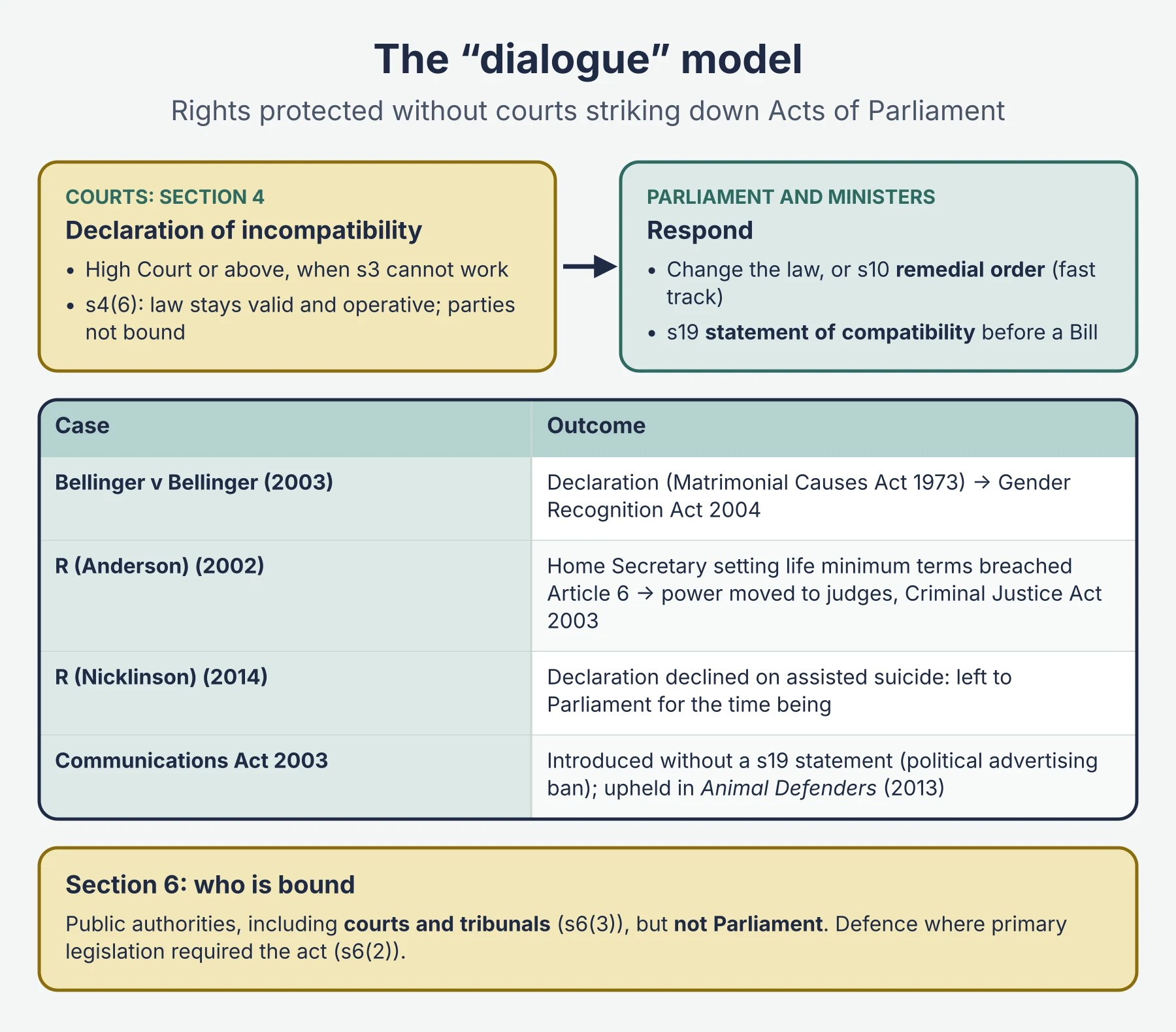
| s4 | Declaration of incompatibility by the High Court or above; s4(6): validity and operation unaffected, parties not bound | Bellinger (2003) → Gender Recognition Act 2004; Anderson (2002) → Criminal Justice Act 2003; Nicklinson (2014) declined |
| s6 | Unlawful for public authorities to act incompatibly; courts included, Parliament excluded; s6(2) defence where statute requires the act | |
| s10 | Remedial orders to amend incompatible legislation | |
| s19 | Statement of compatibility, or statement that the government proceeds anyway | Communications Act 2003; Animal Defenders International v UK (2013) |
R v A (No 2): rape shield provision read subject to Article 6 fair trial. Ghaidan: “as his or her wife or husband” read to include same-sex partners. Re S and Re W: new supervisory scheme for care plans would be amendment, not interpretation.
Constitutional impact
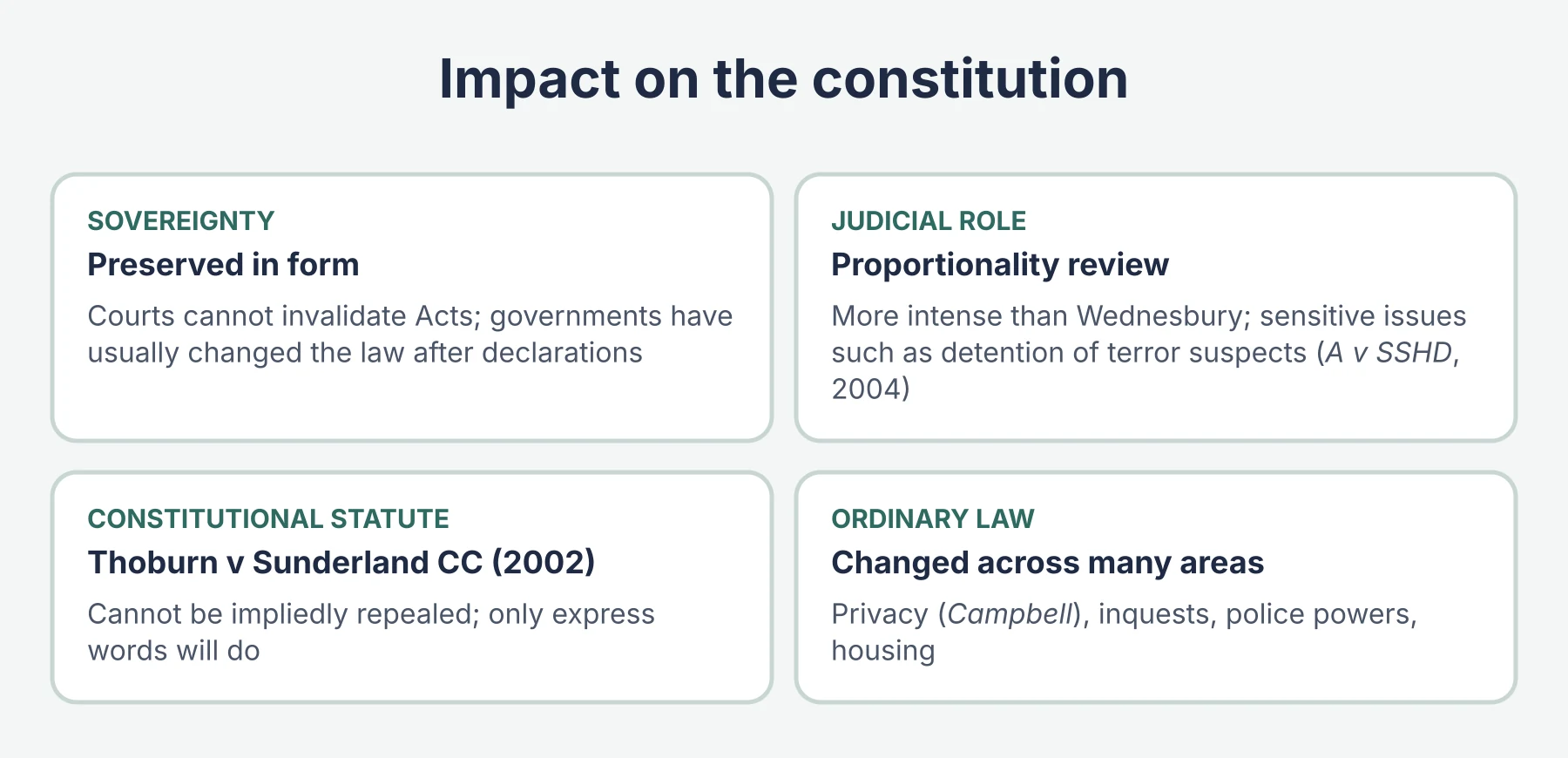
- Sovereignty preserved in form: no strike-down of Acts; Parliament decides after a declaration.
- Dialogue: courts flag incompatibility; Parliament usually responds.
- New judicial role: proportionality review; sensitive cases such as A v SSHD (2004).
- Constitutional statute: Thoburn v Sunderland CC (2002); cannot be impliedly repealed.
- Ordinary law reshaped: privacy (Campbell v MGN, 2004), inquests, policing, housing.
Devolution: entrenchment
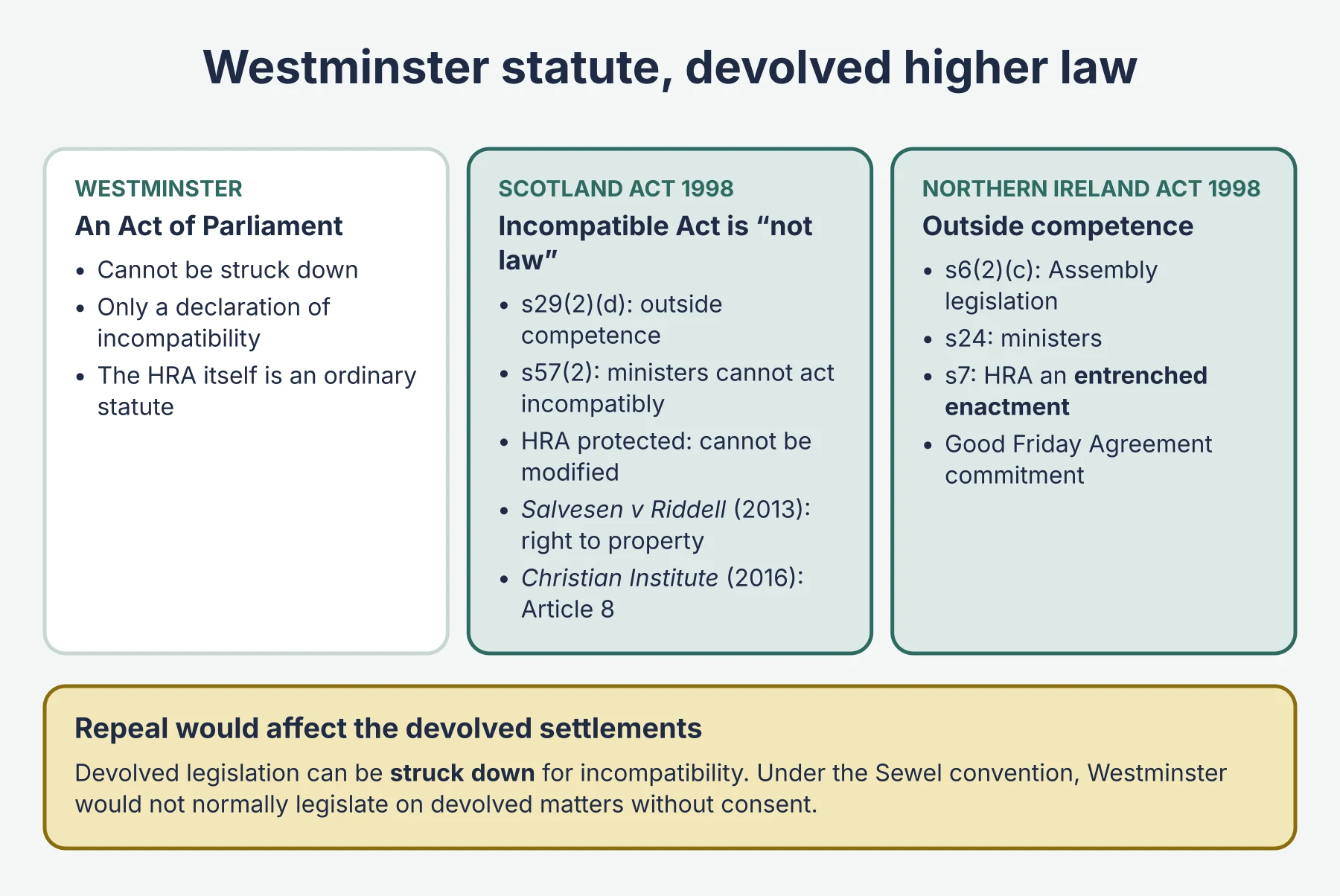
| Scotland Act 1998 | Northern Ireland Act 1998 |
|---|---|
| s29(2)(d): Act of the Scottish Parliament incompatible with Convention rights is outside competence and “not law” | s6(2)(c): Assembly Act incompatible with Convention rights outside competence |
| s57(2): ministers have no power to act incompatibly | s24: ministers cannot act incompatibly |
| HRA is protected from modification | s7: HRA is an entrenched enactment |
- Salvesen v Riddell (2013): Scottish agricultural tenancy provision outside competence (Protocol 1, Article 1).
- Christian Institute v Lord Advocate (2016): “named person” information-sharing outside competence (Article 8).
- Belfast (Good Friday) Agreement 1998: commitment to incorporate the Convention.
- Sewel convention: Westminster does not normally legislate on devolved matters without consent.
Criticisms
| Too strong | Too weak |
|---|---|
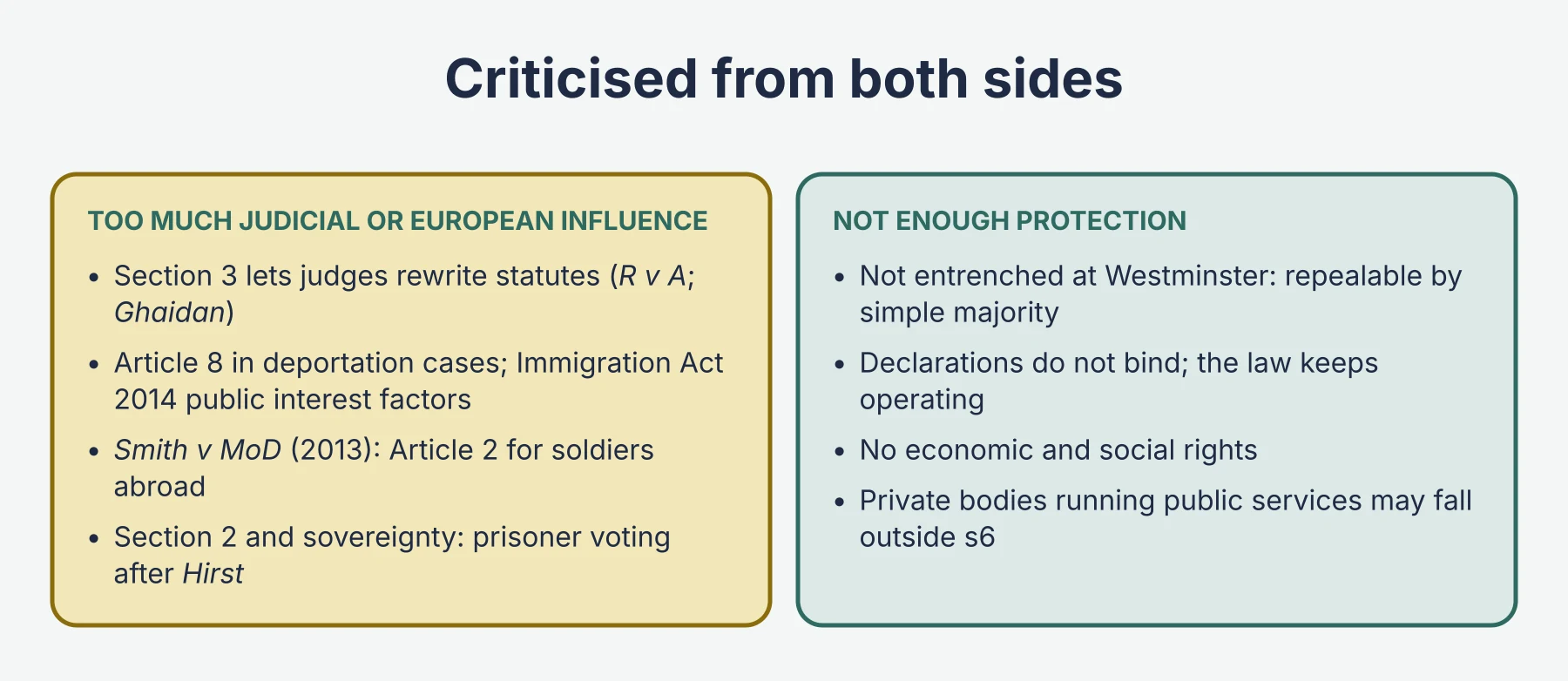
| s3 lets judges rewrite statutes | Not entrenched at Westminster |
| Article 8 and deportation; Immigration Act 2014 response | s4 declarations not binding |
| Smith v MoD (2013): Article 2 and soldiers abroad | No economic and social rights |
| Strasbourg influence; prisoner voting after Hirst (2005) | Gaps in s6 for private providers |
Key terms
| Term | Meaning |
|---|---|
| Convention rights | The rights listed in Schedule 1 that UK courts give effect to |
| Interpretive obligation | The s3 duty to read legislation compatibly where possible |
| Declaration of incompatibility | A s4 statement that legislation cannot be read compatibly; no effect on validity |
| Remedial order | Ministerial order under s10 amending incompatible legislation |
| Statement of compatibility | s19 ministerial statement on a Bill |
| Constitutional statute | A statute that can be repealed only expressly (Thoburn) |
| Outside competence | Beyond the devolved legislature’s power, so not law |
Exam traps
- Saying all Convention Articles were incorporated.
- Saying a declaration of incompatibility invalidates an Act.
- Ignoring the limits on s3 shown by Re S and Re W.
- Forgetting that Parliament is not a public authority under s6.
- Missing the contrast that devolved Acts can be struck down.
- Giving criticisms from only one side.
Self-test
- When did the Human Rights Act 1998 come into force?
- Which two Articles of the Convention were omitted from Schedule 1, and why was Article 13 left out?
- What does section 3 require?
- How did the House of Lords use section 3 in Ghaidan v Godin-Mendoza?
- Why did the House of Lords refuse to use section 3 in Re S and Re W?
- What is the effect of a declaration under section 4?
- What followed the declaration in Bellinger v Bellinger?
- What does section 19 require?
- Is Parliament a public authority under section 6?
- What did Thoburn v Sunderland City Council say about the HRA?
- What happens to an Act of the Scottish Parliament that is incompatible with Convention rights?
- Give one criticism that the Act is too strong and one that it is too weak.
Answers: 1. 2 October 2000. 2. Articles 1 and 13; the Act itself provides the remedy. 3. Legislation must be read and given effect compatibly with Convention rights so far as it is possible to do so. 4. It read “as his or her wife or husband” to include same-sex partners. 5. A supervisory scheme for care plans would depart from a fundamental feature of the Children Act 1989: amendment, not interpretation. 6. It does not affect the validity, continuing operation or enforcement of the provision and does not bind the parties. 7. The Gender Recognition Act 2004. 8. The minister in charge of a Bill must state that it is compatible, or that the government wishes to proceed anyway. 9. No. 10. It is a constitutional statute that cannot be impliedly repealed. 11. It is outside competence and not law (Scotland Act 1998 s29(2)(d)). 12. Too strong: s3 lets judges rewrite statutes (or any other listed). Too weak: it is not entrenched at Westminster (or any other listed).
More resources on this topic
Human Rights after the HRA 1998 study guide | Human Rights after the HRA 1998 practice questions | Reform study guide
Related resources
-
Study guides
AQA A Level Law (7162): Human Rights in the United Kingdom prior to the Human Rights Act 1998
Human rights in the UK before 1998 for AQA A Level Law 7162: the ECHR as an unincorporated treaty, its limited use in courts and Strasbourg's impact.
Law · AQA · A Level
Read guide -
Practice questions
AQA A Level Law (7162): Human Rights in the United Kingdom prior to the Human Rights Act 1998 – Practice Questions
Original practice on UK human rights before 1998 for AQA A Level Law 7162 with mark-scheme answers on dualism, ex parte Brind and Strasbourg rulings.
Law · AQA · A Level
Try questions -
Revision notes
AQA A Level Law (7162): Human Rights in the United Kingdom prior to the Human Rights Act 1998 – Revision Notes
Condensed recall on UK rights before 1998 for AQA A Level Law 7162: dualism, the unincorporated ECHR, ex parte Brind, review gaps and Strasbourg's impact.
Law · AQA · A Level
Revise topic
Get free revision emails (optional)
Occasional emails with practice questions, worked explanations and links to free resources for the qualification and subjects you choose. No spam, and you can unsubscribe from any email. The free tools on this site never need an email.