
Study Guides
AQA A Level Law (7162): Human Rights in the United Kingdom prior to the Human Rights Act 1998
Human rights in the UK before 1998 for AQA A Level Law 7162: the ECHR as an unincorporated treaty, its limited use in courts and Strasbourg's impact.
- Subject
- Law
- Level
- A LEVELS
- Topic
- Topic 5: Human Rights
- Author
- Marlbridge Academic Team
- Updated
- Reviewed by
- Aizaz Raoof Ali (what this means)
Aligned to AQA A Level Law (7162), For teaching from September 2017 onwards, A-level exams 2019 onwards. Official specification .
Syllabus page (what it covers and how it is assessed): AQA A Level Law.
Syllabus points this page covers
7162
- Human Rights in the United Kingdom prior to the Human Rights Act 1998
Found an error? Report a correction.
Need help with this topic? Request a free trial class for A Level Law (7162).
This guide covers Human Rights in the United Kingdom prior to the Human Rights Act 1998 in section 3.5 Human Rights of AQA A-level Law (7162). The specification names “The status of the European Convention on Human Rights in the United Kingdom, and the impact of decisions of the European Court of Human Rights”. The topic explains why the Human Rights Act 1998 was passed and gives evidence for essays on how well rights are protected. For the whole option in outline, start with the Human Rights study guide.
The status of the Convention in the United Kingdom
A ratified but unincorporated treaty
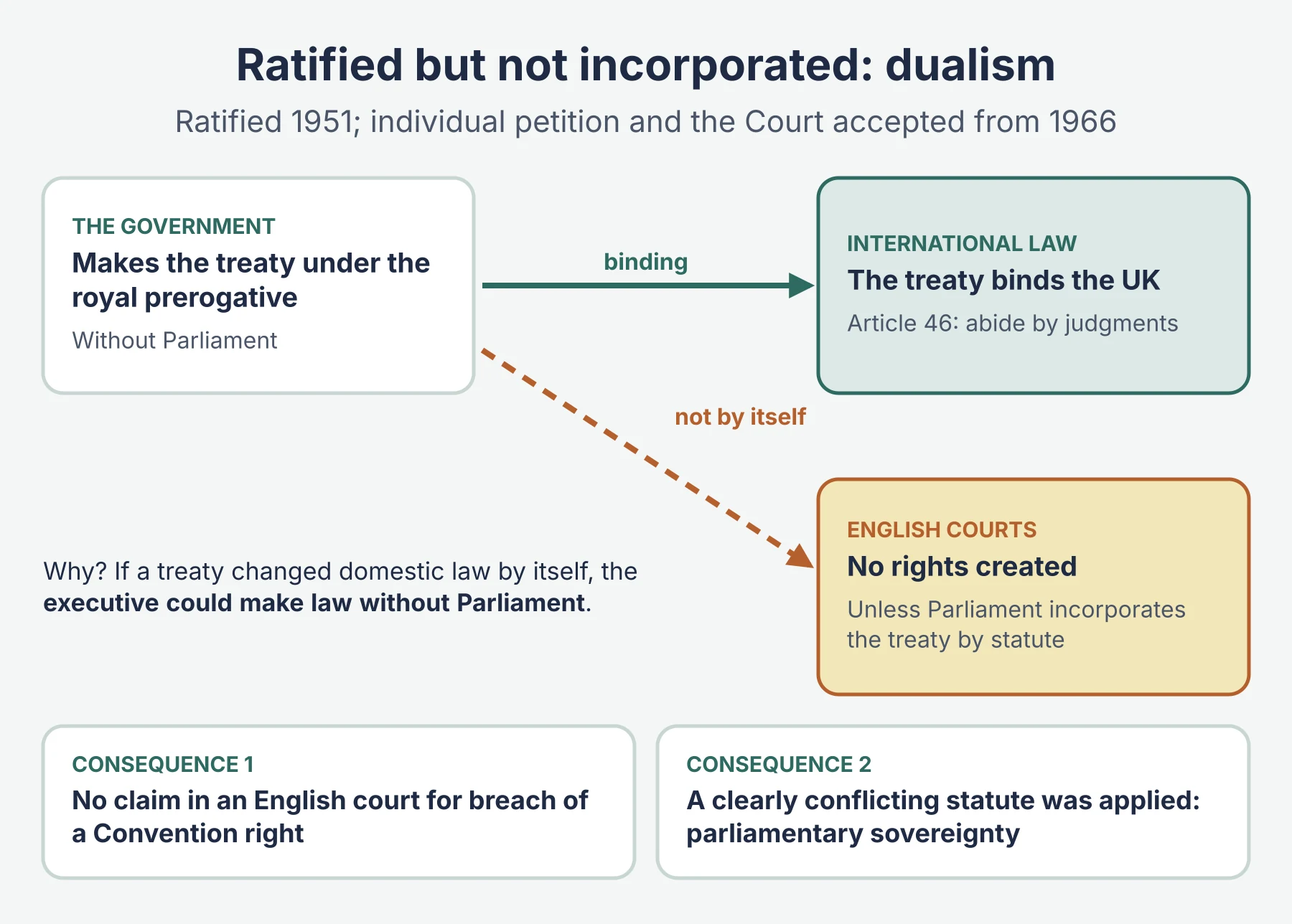
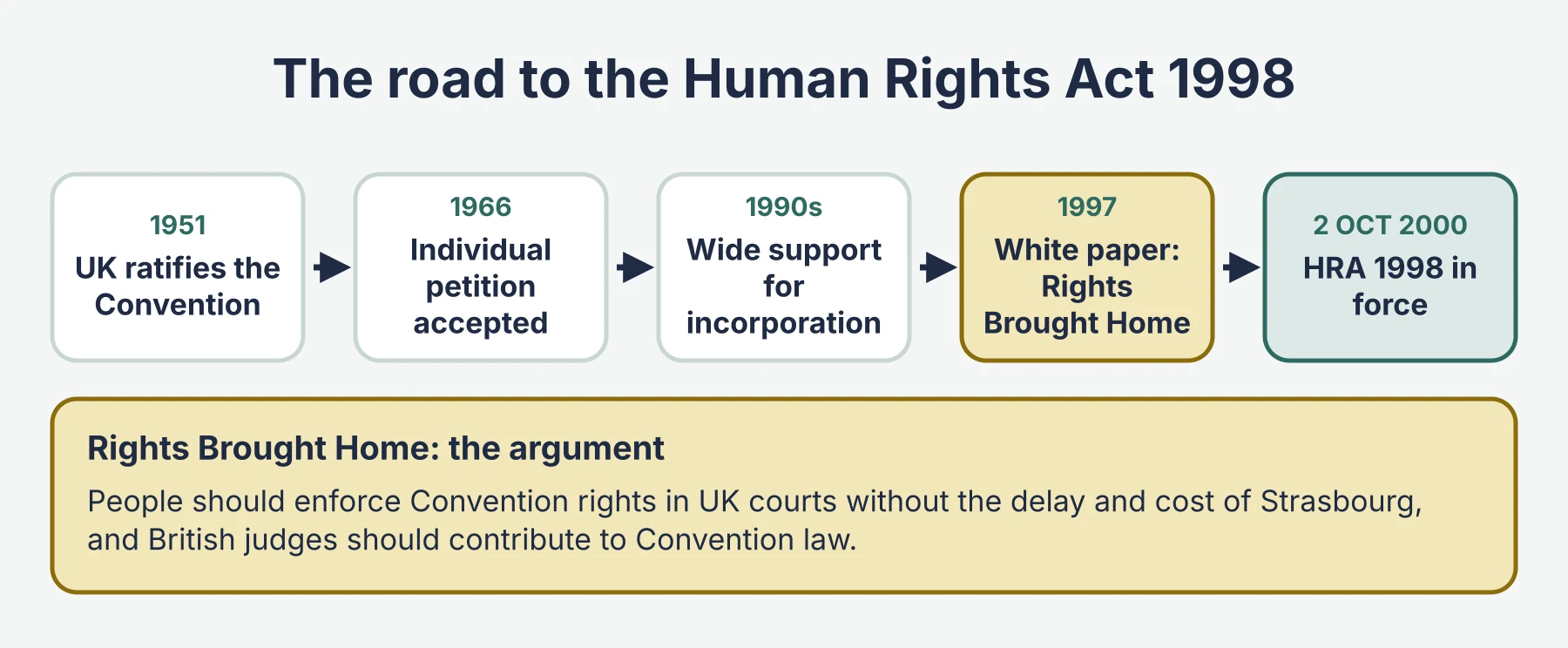
The United Kingdom ratified the Convention in 1951, and from 1966 accepted the right of individual petition and the jurisdiction of the European Court of Human Rights. But the Convention was not part of domestic law until the Human Rights Act 1998 came into force in October 2000.
This follows from the UK’s dualist approach to international law. Treaties are made by the government under the royal prerogative, without Parliament. If a treaty could change domestic law by itself, the executive could make law without Parliament. So a treaty binds the UK in international law, but creates no rights in English courts unless Parliament incorporates it by statute.
Two consequences followed:
- A person could not bring a claim in an English court for breach of a Convention right.
- If a statute clearly conflicted with the Convention, the court had to apply the statute, because of parliamentary sovereignty.
Limited indirect use by the courts
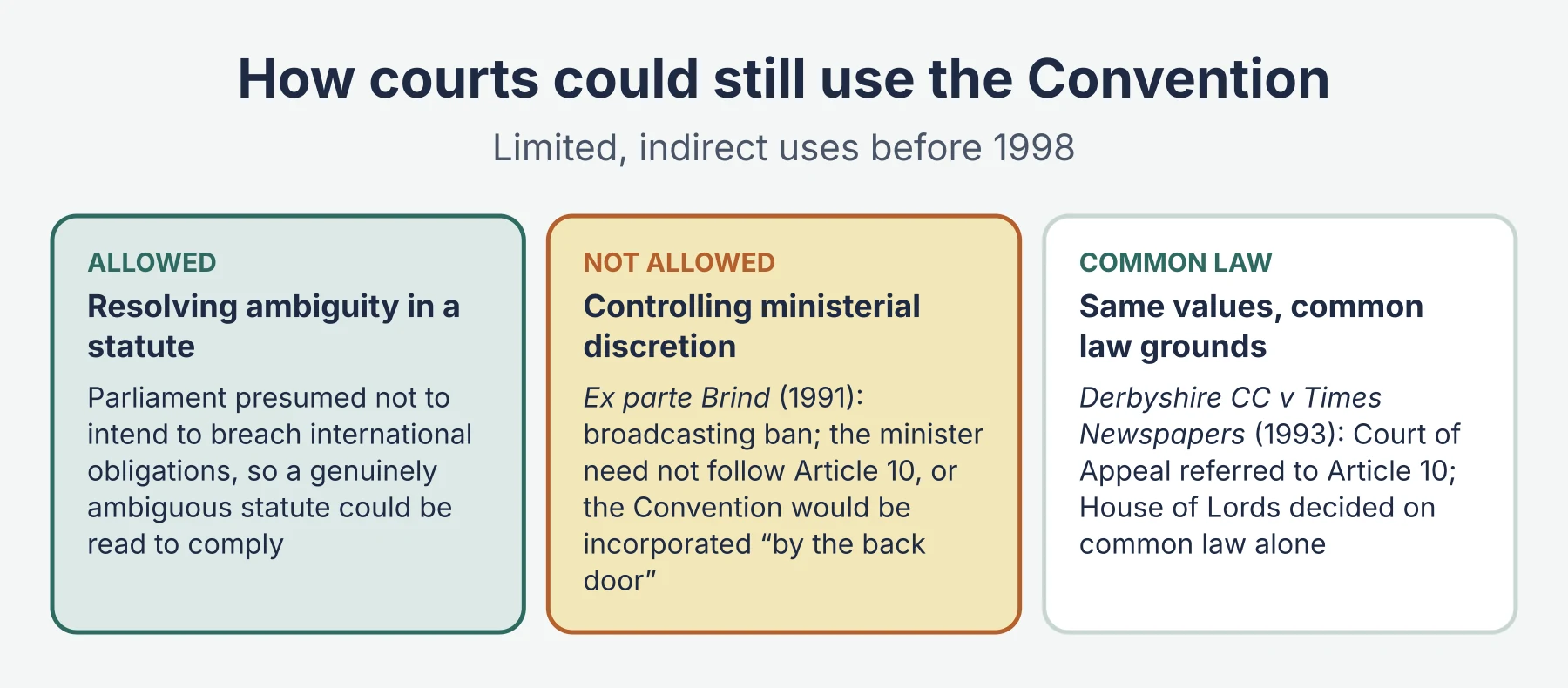
Courts could still refer to the Convention in some ways.
- Resolving ambiguity in legislation. Courts presumed that Parliament did not intend to legislate in breach of the UK’s international obligations, so where a statute was genuinely ambiguous, they could choose the meaning that complied with the Convention.
- Not controlling discretion. In R v Secretary of State for the Home Department, ex parte Brind (1991) journalists challenged the Home Secretary’s directive banning the broadcasting of the direct speech of representatives of certain Northern Ireland organisations. The House of Lords held that, where a statute gave a broad discretion, the minister was not required to exercise it in line with Article 10; to require this would incorporate the Convention by the back door.
- Developing the common law. Judges sometimes said the common law already protected the same values. In Derbyshire County Council v Times Newspapers (1993) the Court of Appeal referred to Article 10, but the House of Lords reached its decision that a council cannot sue for defamation on common law grounds alone.
The weakness of judicial review
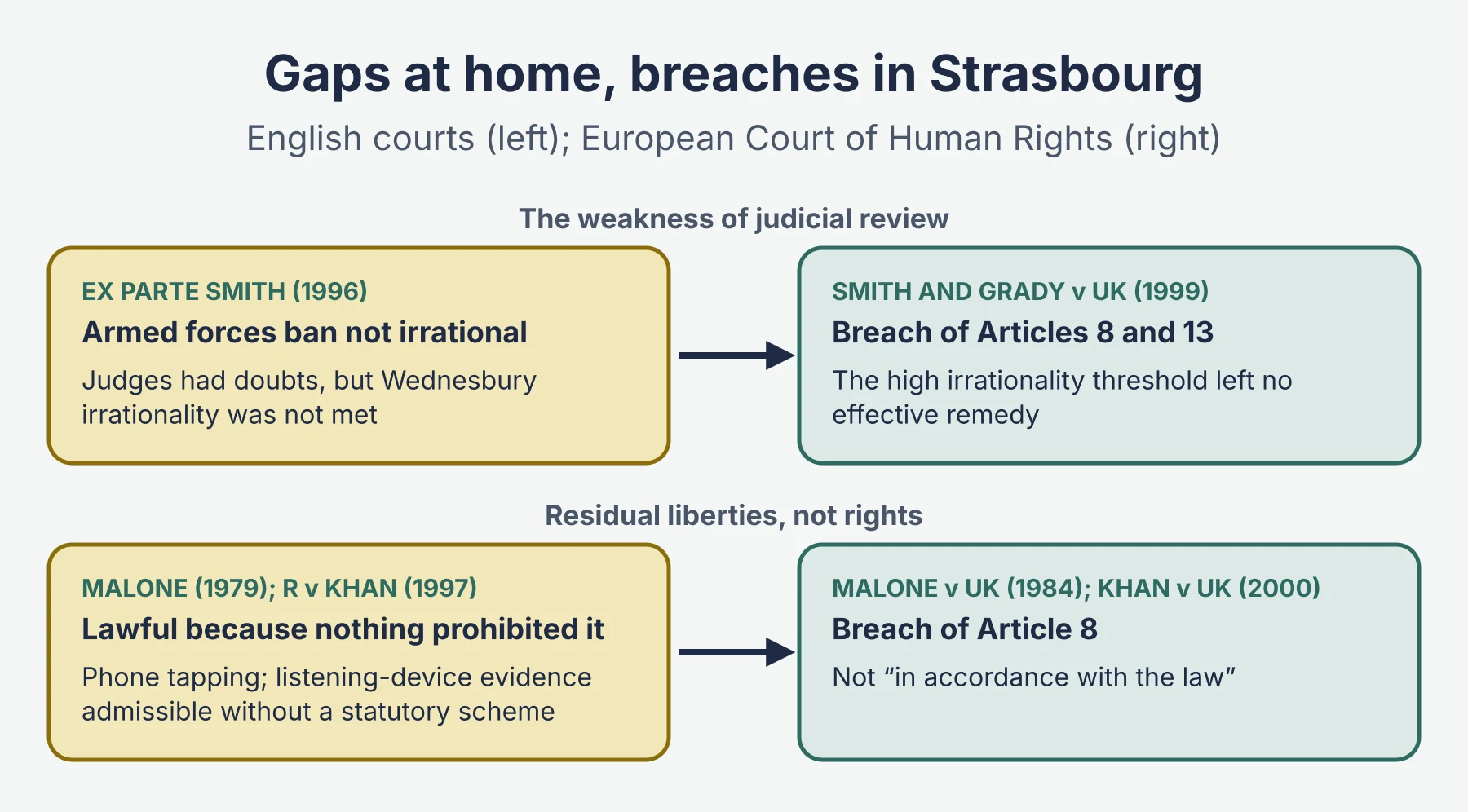
Without the Convention, a challenge to government action relied on ordinary judicial review, especially irrationality (the Wednesbury test, from Associated Provincial Picture Houses v Wednesbury Corporation, 1948), which asks whether a decision is so unreasonable that no reasonable authority could have made it.
In R v Ministry of Defence, ex parte Smith (1996) the Court of Appeal rejected a challenge to the ban on gay men and lesbians serving in the armed forces, even though judges expressed doubts about the policy, because it was not irrational. In Smith and Grady v UK (1999) the European Court held that the ban breached Article 8, and that the high irrationality threshold meant there was no effective remedy in domestic law, in breach of Article 13.
Gaps in protection: residual liberties
The common law protected liberties rather than rights. Malone v Metropolitan Police Commissioner (1979) held that phone tapping was lawful because nothing prohibited it. R v Khan (1997) held that evidence from a police listening device fixed to a house was admissible, even though there was no statutory scheme for such surveillance. In Khan v UK (2000) the European Court found a breach of Article 8 because the surveillance was not “in accordance with the law”.
The impact of decisions of the European Court of Human Rights
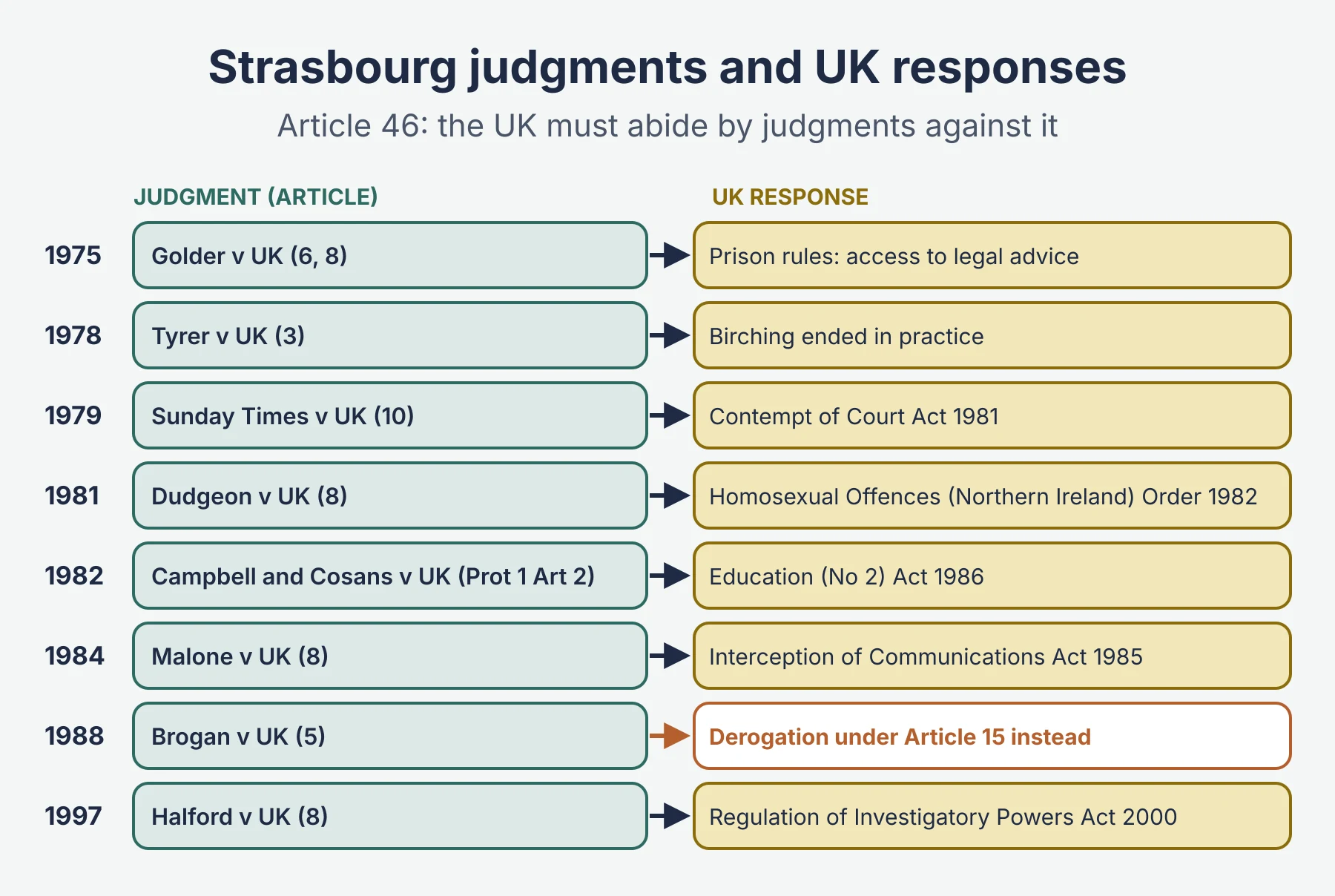
From 1966 individuals could take the UK to Strasbourg, and the UK lost a significant number of cases. Because Article 46 obliges a state to abide by judgments against it, adverse decisions often led Parliament or the government to change the law.
| Decision | Article | Finding | UK response |
|---|---|---|---|
| Golder v UK (1975) | 6 and 8 | A prisoner was refused permission to consult a solicitor about suing a prison officer | Prison rules changed to allow access to legal advice |
| Tyrer v UK (1978) | 3 | Judicial birching of a juvenile on the Isle of Man was degrading | Birching ended in practice |
| Sunday Times v UK (1979) | 10 | An injunction on articles about the thalidomide litigation was not necessary | Contempt of Court Act 1981 |
| Dudgeon v UK (1981) | 8 | Criminalising private consensual homosexual acts in Northern Ireland | Homosexual Offences (Northern Ireland) Order 1982 |
| Campbell and Cosans v UK (1982) | Protocol 1, Article 2 | Corporal punishment in Scottish schools against parents’ convictions | Education (No 2) Act 1986 abolished corporal punishment in state schools |
| Malone v UK (1984) | 8 | Phone tapping had no clear legal basis | Interception of Communications Act 1985 |
| Brogan v UK (1988) | 5 | Detention for over four days without a judge | UK derogated under Article 15 rather than change the law |
| Halford v UK (1997) | 8 | Interception of a senior police officer’s office calls not governed by law | Regulation of Investigatory Powers Act 2000 |
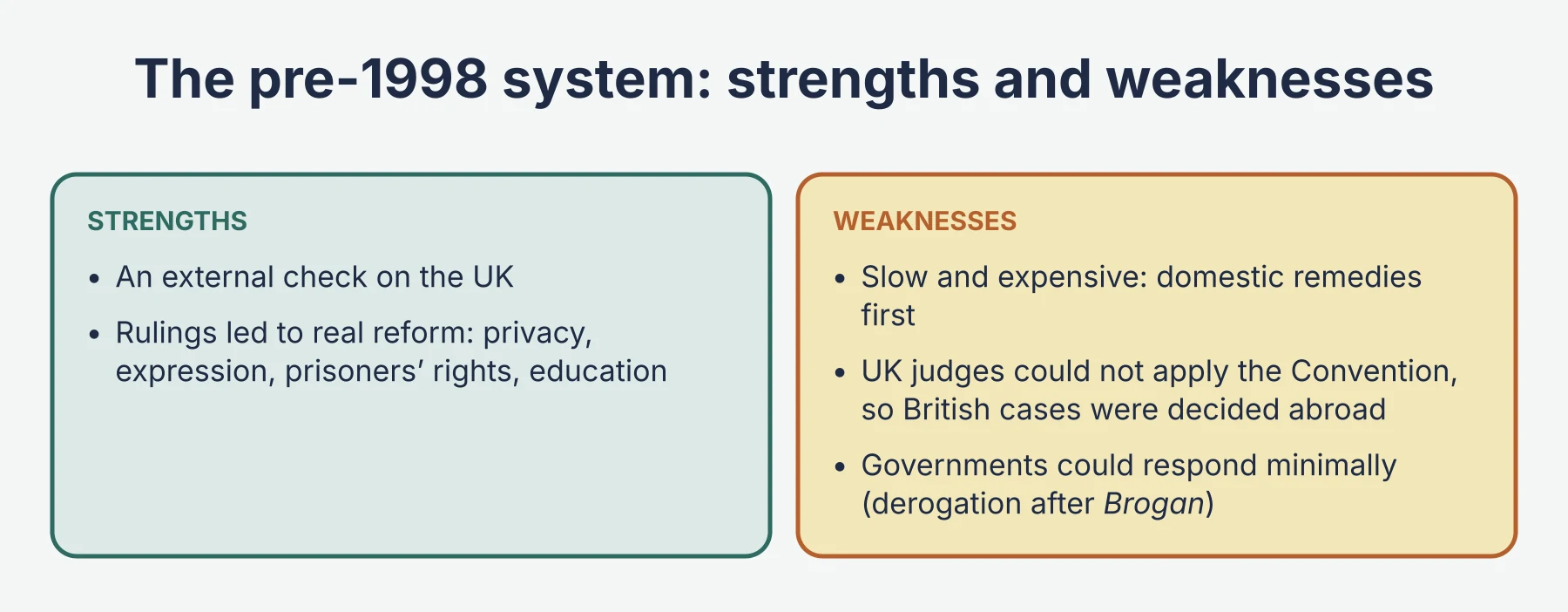
These cases show both strengths and weaknesses of the pre-1998 system.
- Strengths: Strasbourg provided an external check, and its rulings led to real reform in privacy, expression, prisoners’ rights and education.
- Weaknesses: claims were slow and expensive, because domestic remedies had to be exhausted first; UK judges could not apply the Convention, so British cases were decided abroad; and governments could respond minimally, as with the derogation after Brogan.
The road to the Human Rights Act 1998
By the 1990s there was wide support among judges and politicians for incorporation. The Labour government elected in 1997 published the white paper Rights Brought Home, arguing that people should be able to enforce their Convention rights in UK courts without the delay and cost of going to Strasbourg, and that British judges should contribute to the development of Convention law. The Human Rights Act 1998 followed, coming into force on 2 October 2000.
Annotated plan: “Explain the status of the European Convention on Human Rights in the United Kingdom before the Human Rights Act 1998.”
Point 1   Ratified 1951; individual petition accepted 1966; binding in
          international law (Article 46).
Point 2   Dualism: treaty made under the prerogative, so not domestic law
          without incorporation; sovereignty meant statute prevailed.
Point 3   Indirect use: resolving ambiguity; but not controlling discretion
          (ex parte Brind, 1991).
Point 4   Common law and judicial review gaps: Malone (1979); ex parte Smith
          (1996) and Smith and Grady v UK (1999).
Point 5   Impact via Strasbourg: Sunday Times, Malone, Dudgeon – legislative
          change, but slow, costly and dependent on government response.
Common mistakes
- Saying the UK only joined the Convention in 1998; it ratified in 1951.
- Claiming English courts could enforce the Convention before 2000.
- Treating ex parte Brind as a case where the Convention was applied; the House of Lords refused to require ministers to follow it.
- Listing Strasbourg cases without stating how the UK responded.
- Forgetting the dualist reason for non-incorporation.
Exam technique
- Explain questions: describe the legal status, the limited uses courts made of the Convention and the route to Strasbourg, each supported by a case.
- Discuss questions: evaluate the pre-1998 system using the strengths and weaknesses above, and compare it with protection under the Human Rights Act 1998.
More resources on this topic
Human Rights before the HRA 1998 revision notes | Human Rights before the HRA 1998 practice questions | Human Rights after the HRA 1998 study guide
Related resources
-
Practice questions
AQA A Level Law (7162): Human Rights in the United Kingdom prior to the Human Rights Act 1998 – Practice Questions
Original practice on UK human rights before 1998 for AQA A Level Law 7162 with mark-scheme answers on dualism, ex parte Brind and Strasbourg rulings.
Law · AQA · A Level
Try questions -
Revision notes
AQA A Level Law (7162): Human Rights in the United Kingdom prior to the Human Rights Act 1998 – Revision Notes
Condensed recall on UK rights before 1998 for AQA A Level Law 7162: dualism, the unincorporated ECHR, ex parte Brind, review gaps and Strasbourg's impact.
Law · AQA · A Level
Revise topic -
Study guides
AQA A Level Law (7162): Reform
Reform of human rights protection in the UK for AQA A Level Law 7162: criticisms of the HRA, Bill of Rights proposals, devolution limits and Strasbourg reform.
Law · AQA · A Level
Read guide
Get free revision emails (optional)
Occasional emails with practice questions, worked explanations and links to free resources for the qualification and subjects you choose. No spam, and you can unsubscribe from any email. The free tools on this site never need an email.