
Study Guides
AQA A Level Law (7162): Article 5 of the European Convention on Human Rights 1953
Article 5 ECHR for AQA A Level Law 7162: what counts as a deprivation of liberty, the 5.1(a) to (c) grounds and the safeguards in Articles 5.2 to 5.5.
- Subject
- Law
- Level
- A LEVELS
- Topic
- Topic 5: Human Rights
- Author
- Marlbridge Academic Team
- Updated
- Reviewed by
- Aizaz Raoof Ali (what this means)
Aligned to AQA A Level Law (7162), For teaching from September 2017 onwards, A-level exams 2019 onwards. Official specification .
Syllabus page (what it covers and how it is assessed): AQA A Level Law.
Syllabus points this page covers
7162
- Article 5 of the European Convention on Human Rights 1953
Found an error? Report a correction.
Need help with this topic? Request a free trial class for A Level Law (7162).
This guide covers Article 5 of the European Convention on Human Rights 1953, part of section 3.5 Human Rights in AQA A-level Law (7162). The specification lists three things to know: “Article 5.1: right to liberty and security of person”, “Article 5.1a–5.1c: justified deprivation of liberty – lawful arrest or detention” and “Article 5.2–5.5: additional requirements to justify deprivation of liberty in cases of lawful arrest or detention”. For the whole human rights option in outline, start with the Human Rights study guide.
Where Article 5 fits
Article 5 is a limited right. It is not qualified like Articles 8, 10 and 11, so there is no general “necessary in a democratic society” balancing test. Instead the Article itself lists the only grounds on which a person may be deprived of liberty, and every deprivation must also follow “a procedure prescribed by law”. In a Paper 3 scenario, Article 5 usually appears alongside police powers: an arrest, a period in custody, a containment of protesters or a detention under terrorism or mental health law.
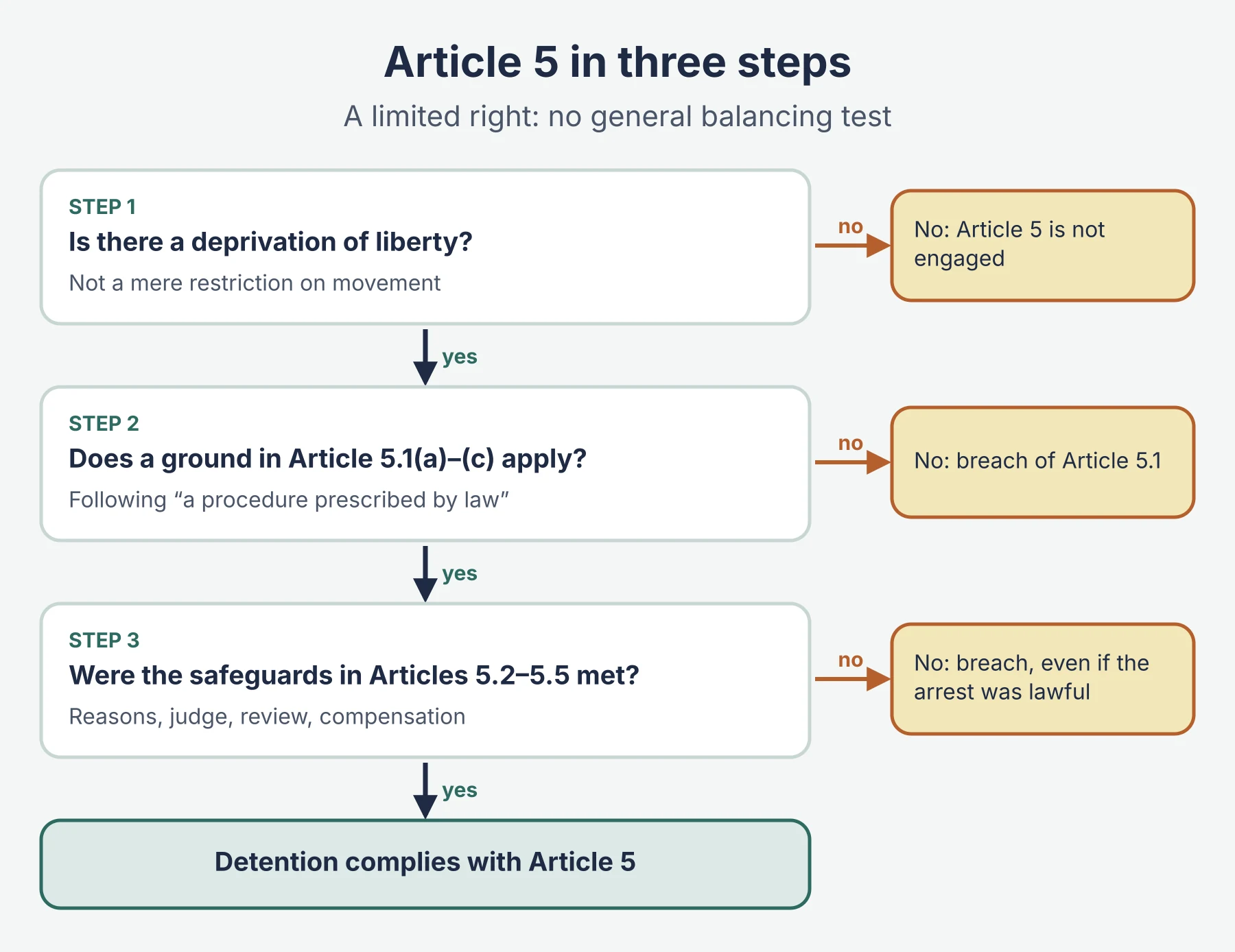
Step 1: is there a deprivation of liberty at all?
Article 5 protects physical liberty. It does not cover every restriction on movement; lesser restrictions fall under Article 2 of Protocol 4, which the United Kingdom has not ratified. So the first question is always whether the facts amount to a deprivation rather than a mere restriction.
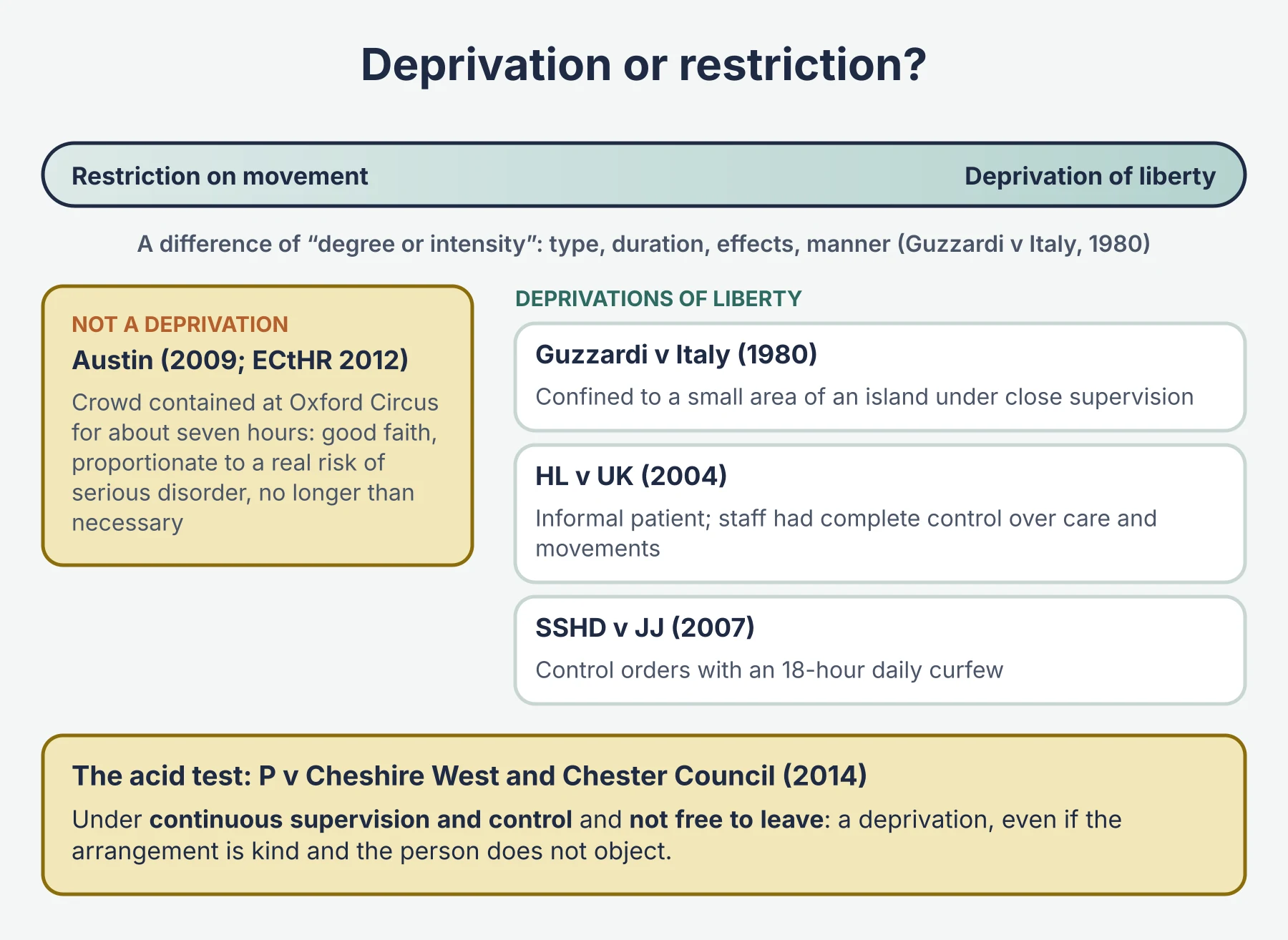
- Guzzardi v Italy (1980): the difference between deprivation and restriction is “one of degree or intensity, and not one of nature or substance”. The Court looks at the type, duration, effects and manner of implementation of the measure. Confining a suspect to a small area of an island, under close supervision, was a deprivation of liberty.
- HL v United Kingdom (2004): an autistic man who lacked capacity was kept in a psychiatric hospital as an informal patient. Staff had complete control over his care and movements, so he was deprived of liberty, and the lack of any legal procedure or review breached Article 5.1 and 5.4.
- P v Cheshire West and Chester Council (2014): the Supreme Court set the “acid test”: a person is deprived of liberty if under continuous supervision and control and not free to leave, even if the arrangement is kind and the person does not object.
- Secretary of State for the Home Department v JJ (2007): control orders imposing an 18-hour daily curfew were a deprivation of liberty.
- Austin v Commissioner of Police of the Metropolis (2009): the House of Lords held that containing a crowd at Oxford Circus for about seven hours was not a deprivation of liberty, because the measure was taken in good faith, was proportionate to a real risk of serious disorder and lasted no longer than necessary. The European Court reached the same result in Austin v United Kingdom (2012), stressing that the context of crowd control matters.
Step 2: does a ground in Article 5.1 apply?
The specification names Article 5.1(a) to (c). Each has its own conditions.
| Ground | What it allows | Key point |
|---|---|---|
| 5.1(a) | Lawful detention after conviction by a competent court | There must be a causal link between the conviction and the detention |
| 5.1(b) | Lawful arrest or detention for non-compliance with a lawful court order, or to secure fulfilment of an obligation prescribed by law | The obligation must be specific and concrete, not a general duty to obey the law |
| 5.1(c) | Lawful arrest or detention to bring a person before the competent legal authority on reasonable suspicion of an offence, or when reasonably considered necessary to prevent an offence or flight after one | The most common ground in police scenarios |
The other grounds, 5.1(d) to (f), cover minors, people of unsound mind or with infectious diseases, and immigration control. They are not named in the specification, so mention them only in passing.
Reasonable suspicion under 5.1(c)
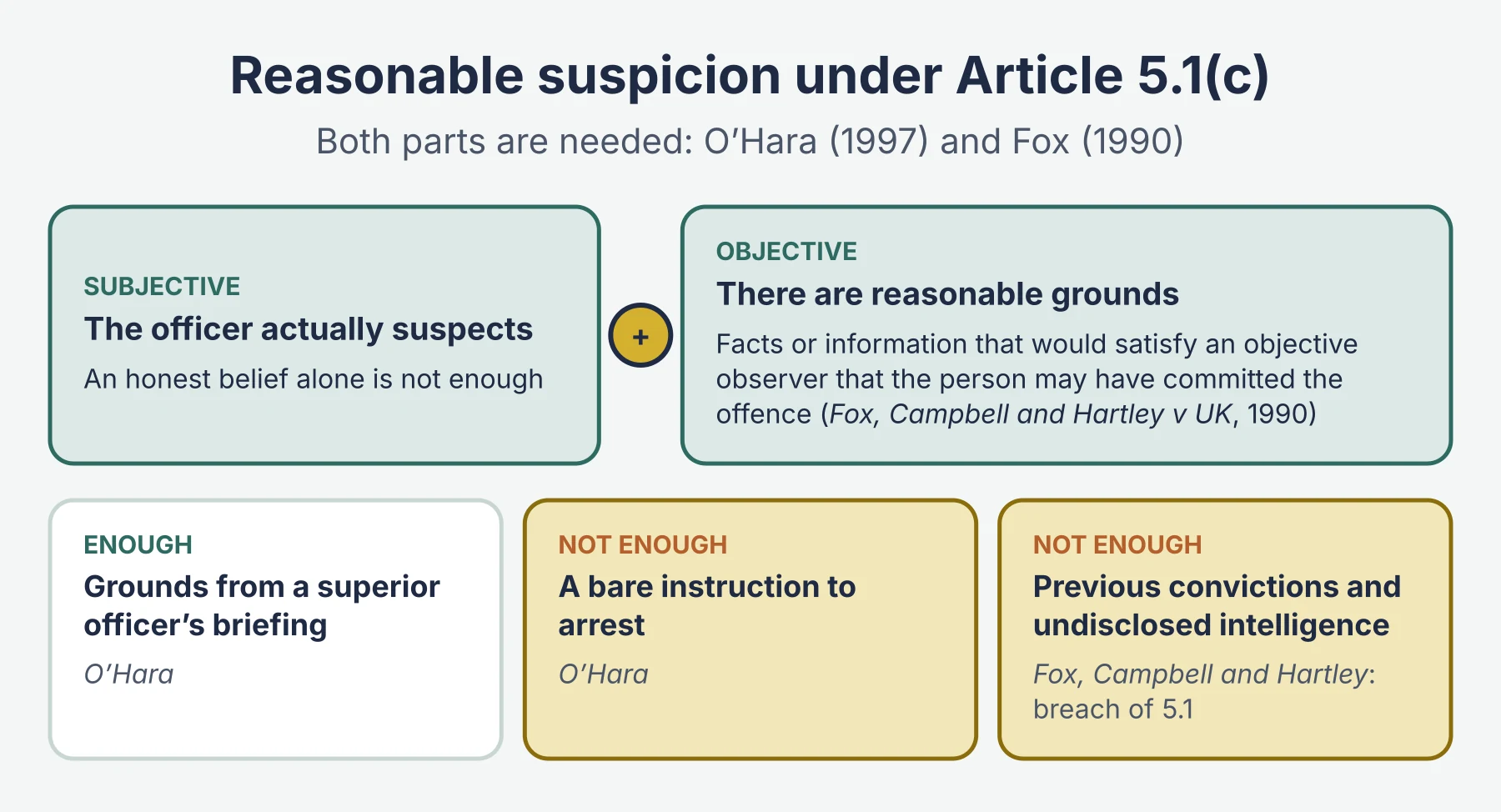
In Fox, Campbell and Hartley v United Kingdom (1990) the European Court held that reasonable suspicion “presupposes the existence of facts or information which would satisfy an objective observer that the person concerned may have committed the offence”. An honest belief alone is not enough. The government relied on the applicants’ previous terrorism convictions and undisclosed intelligence; this was not sufficient to show reasonable suspicion, and Article 5.1 was breached.
English law applies a similar two-part test. In O’Hara v Chief Constable of the Royal Ulster Constabulary (1997) the House of Lords held that the arresting officer must actually suspect (a subjective element) and that there must be reasonable grounds for that suspicion (an objective element). The grounds may come from a briefing by a superior officer, but a bare instruction to arrest is not enough.
Step 3: have the safeguards in Articles 5.2 to 5.5 been met?
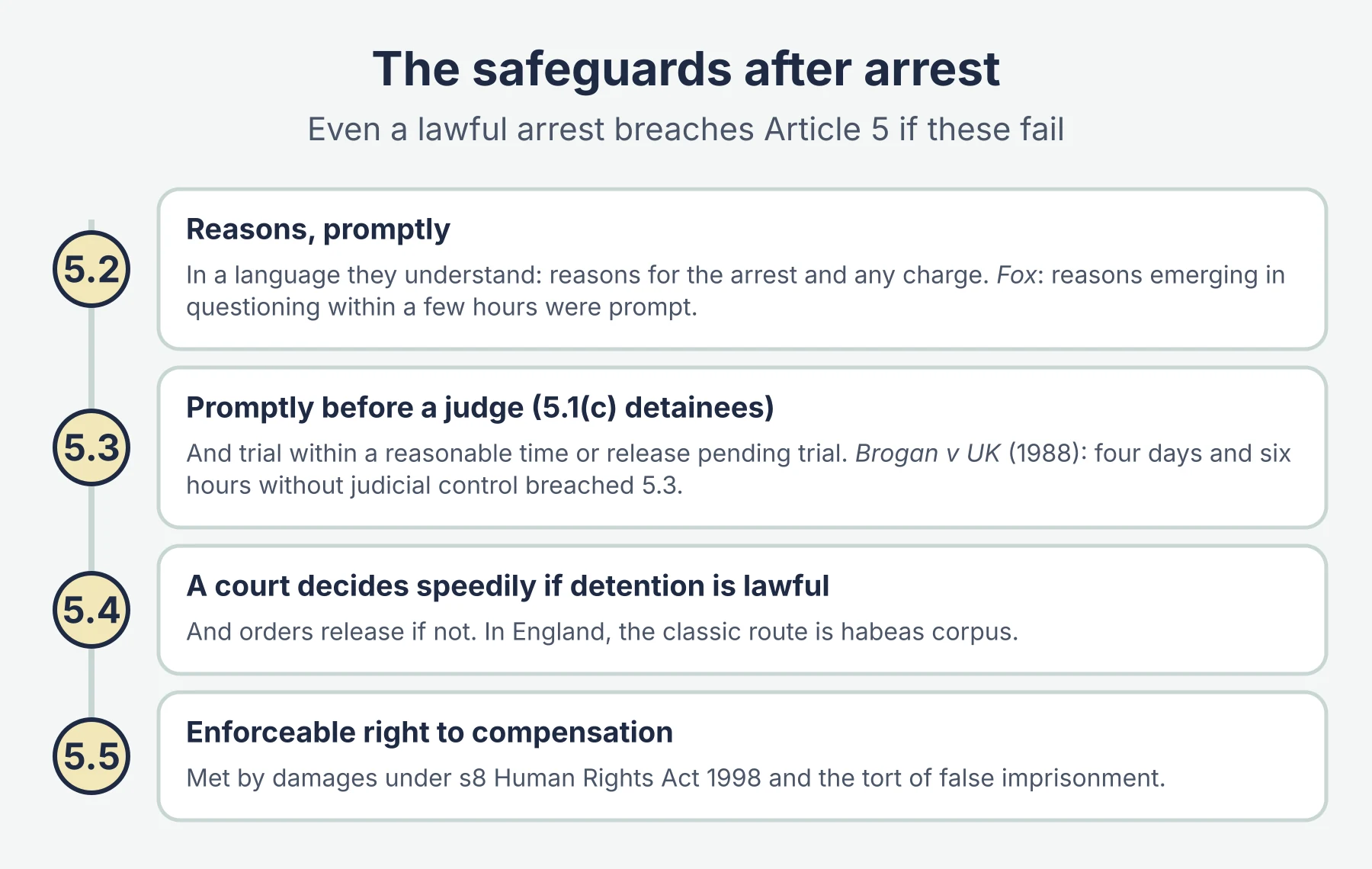
Even a lawful arrest breaches Article 5 if the procedural safeguards fail.
- Article 5.2: the person must be told promptly, in a language they understand, the reasons for the arrest and any charge. In Fox, Campbell and Hartley the reasons emerged during questioning within a few hours, which the Court accepted as prompt.
- Article 5.3: a person held under 5.1(c) must be brought promptly before a judge or other judicial officer and is entitled to trial within a reasonable time or release pending trial. In Brogan v United Kingdom (1988) detention under prevention of terrorism legislation for four days and six hours without judicial control breached 5.3, even allowing for the terrorist context.
- Article 5.4: anyone detained may take proceedings in which a court decides speedily whether the detention is lawful and orders release if it is not. In England the classic route is habeas corpus.
- Article 5.5: a victim of arrest or detention in breach of Article 5 has an enforceable right to compensation. Domestically this is met by damages under section 8 of the Human Rights Act 1998 and by the tort of false imprisonment.
Derogation and Article 5
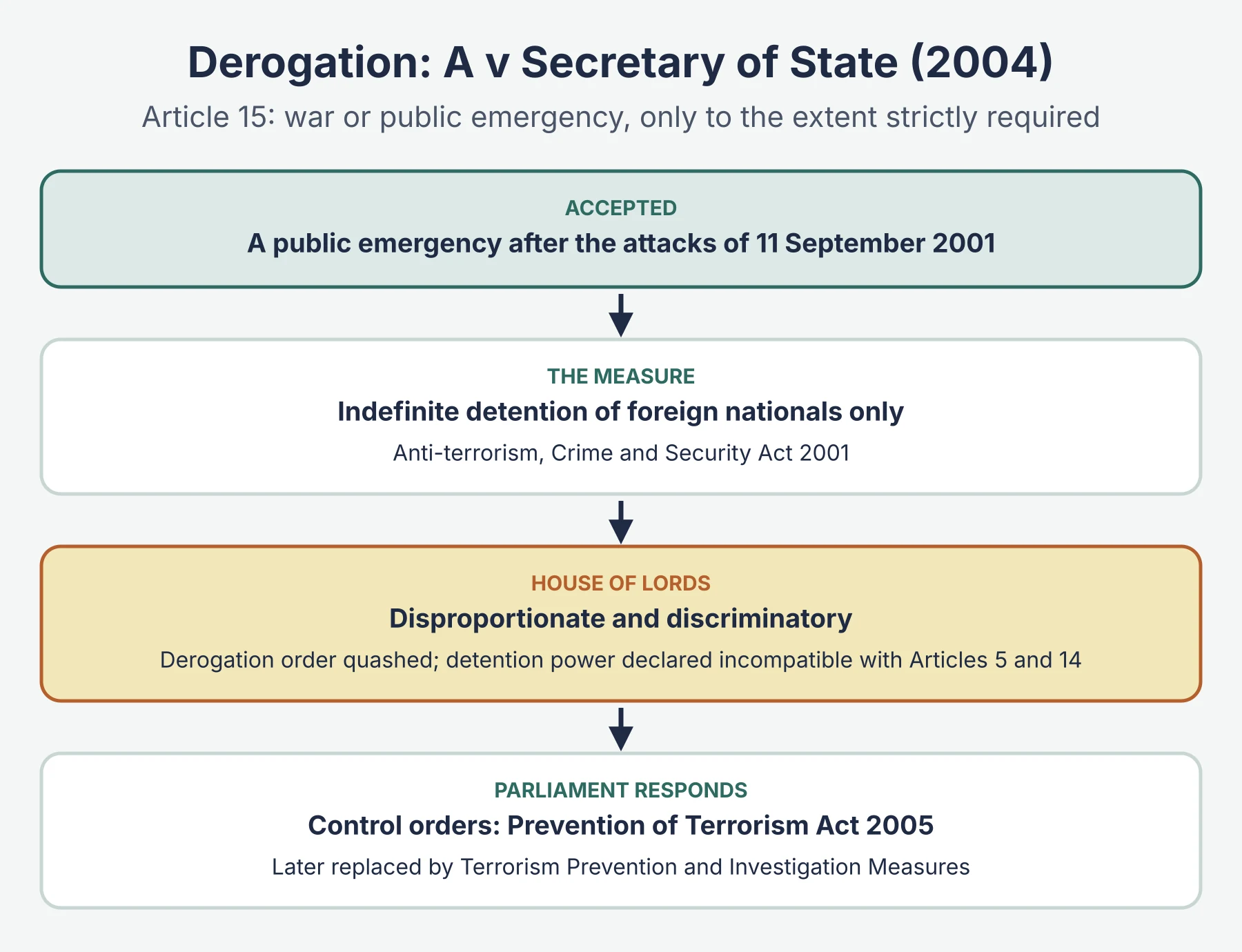
Because Article 5 is not absolute, a state may derogate from it under Article 15 in time of war or public emergency threatening the life of the nation, but only to the extent strictly required. In A v Secretary of State for the Home Department (2004) the House of Lords accepted that there was a public emergency after the attacks of 11 September 2001, but held that indefinite detention of foreign nationals only, under the Anti-terrorism, Crime and Security Act 2001, was disproportionate and discriminatory. It quashed the derogation order and declared the detention power incompatible with Articles 5 and 14. Parliament replaced it with control orders under the Prevention of Terrorism Act 2005, which were themselves later replaced by Terrorism Prevention and Investigation Measures.
Worked example
Facts: Priya is stopped outside a shop after a store detective says a woman “of her description” took a bracelet. PC Lane arrests her without saying why. She is told the reason three hours later at the police station and is released without charge after 20 hours.
Deprivation?   Arrest and custody are a clear deprivation of liberty (Article 5.1).
Ground?        5.1(c): reasonable suspicion of theft. A specific report from
               a store detective plus a matching description is information
               that could satisfy an objective observer (Fox; O'Hara).
Article 5.2?   Reasons must be given promptly. Three hours with no reason at
               all is hard to justify; English law requires reasons at the
               time of arrest or as soon as practicable.
Article 5.3?   Not reached: she was released without charge inside the
               normal time limits, so there was no need to bring her before
               a judge.
Remedy?        If the arrest was unlawful for lack of reasons, a claim for
               false imprisonment and section 8 damages (Article 5.5).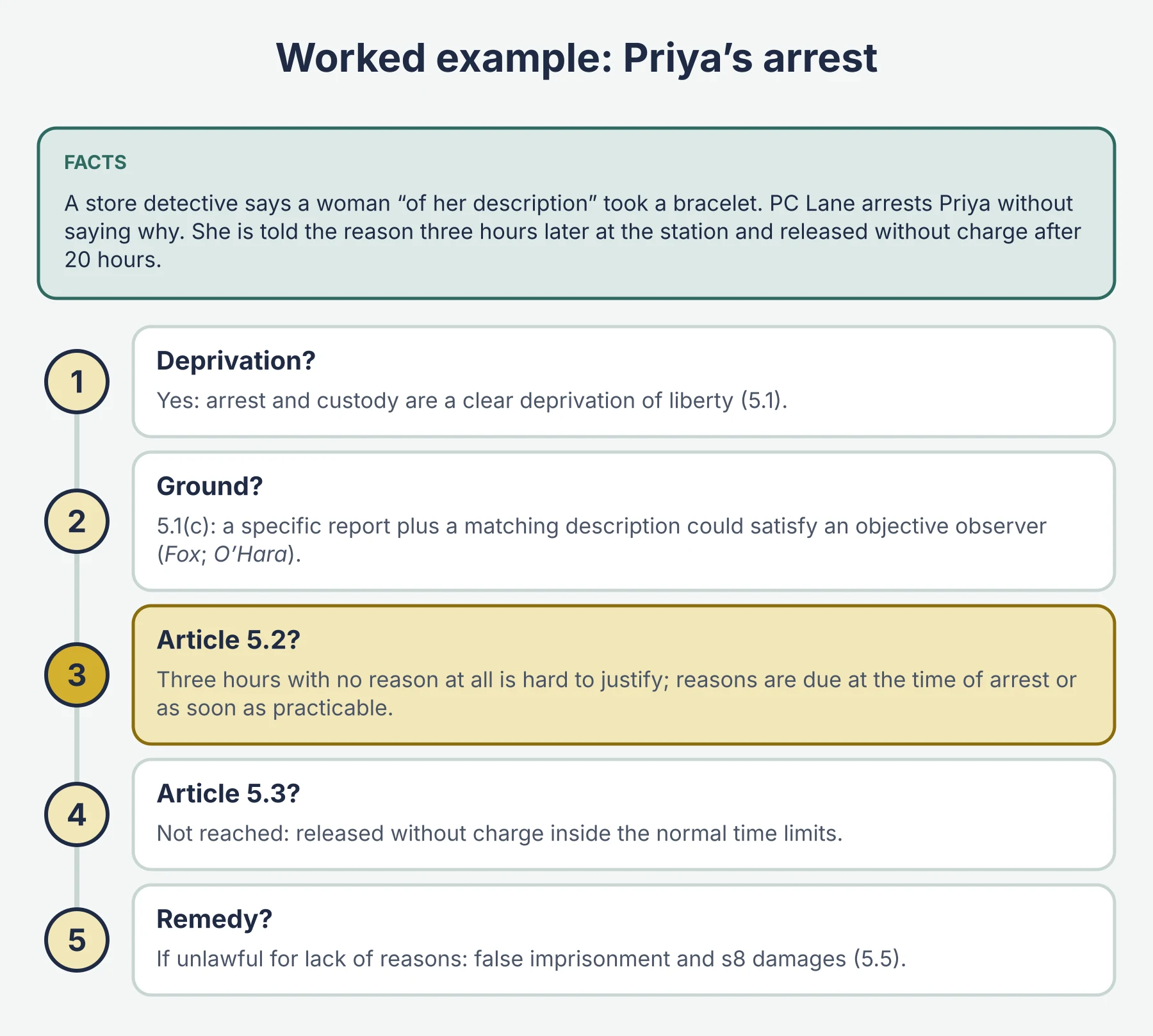
Common mistakes
- Treating Article 5 as a qualified right and applying a proportionality test to the grounds in 5.1. The list is exhaustive; proportionality is relevant to whether there is a deprivation (Austin) and to derogation (A v Secretary of State), not to whether a ground exists.
- Jumping to the grounds without first deciding whether there is a deprivation of liberty.
- Confusing Article 5.3 (prompt appearance before a judge after arrest) with Article 5.4 (speedy review of any detention by a court).
- Stating that Brogan fixed a precise time limit. The Court said four days and six hours was too long; it did not lay down an exact number of hours.
- Forgetting that a breach of 5.2 can occur even when the arrest itself is justified.
Exam technique
- Explain questions: set out the structure of Article 5 (right, grounds, safeguards) and support each part with one case.
- Suggest and Advise questions: work through the three steps above in order, apply each to the facts and give a conclusion on whether Article 5 has been breached and what remedy follows.
- Consider questions: develop the competing arguments, for example whether a containment is a deprivation under Austin or a short, necessary crowd-control measure, and reach a reasoned conclusion or range of conclusions.
- Discuss questions: evaluate how well Article 5 and English law protect liberty, for example the tension between the Brogan line and pre-charge detention in terrorism cases.
More resources on this topic
Article 5 revision notes | Article 5 practice questions | Human Rights and English law study guide
Related resources
-
Practice questions
AQA A Level Law (7162): Article 5 of the European Convention on Human Rights 1953 – Practice Questions
Original Article 5 ECHR practice for AQA A Level Law 7162 with mark-scheme answers on deprivation of liberty, reasonable suspicion, Brogan and derogation.
Law · AQA · A Level
Try questions -
Revision notes
AQA A Level Law (7162): Article 5 of the European Convention on Human Rights 1953 – Revision Notes
Condensed recall on Article 5 ECHR for AQA A Level Law 7162: deprivation of liberty, grounds 5.1(a) to (c), reasonable suspicion and the 5.2 to 5.5 safeguards.
Law · AQA · A Level
Revise topic -
Study guides
AQA A Level Law (7162): Article 8 of the European Convention on Human Rights 1953
Article 8.1 ECHR for AQA A Level Law 7162: scope of private and family life, home and correspondence, positive obligations and privacy claims against the press.
Law · AQA · A Level
Read guide
Get free revision emails (optional)
Occasional emails with practice questions, worked explanations and links to free resources for the qualification and subjects you choose. No spam, and you can unsubscribe from any email. The free tools on this site never need an email.