
Revision Notes
AQA A Level Law (7162): Article 8 of the European Convention on Human Rights 1953 – Revision Notes
Condensed recall on Article 8.1 ECHR for AQA A Level Law 7162: private life, family life, home, correspondence, positive duties and private information.
- Subject
- Law
- Level
- A LEVELS
- Topic
- Topic 5: Human Rights
- Author
- Marlbridge Academic Team
- Updated
- Reviewed by
- Aizaz Raoof Ali (what this means)
Aligned to AQA A Level Law (7162), For teaching from September 2017 onwards, A-level exams 2019 onwards. Official specification .
Syllabus page (what it covers and how it is assessed): AQA A Level Law.
Syllabus points this page covers
7162
- Article 8 of the European Convention on Human Rights 1953
Found an error? Report a correction.
Need help with this topic? Request a free trial class for A Level Law (7162).
Condensed notes on Article 8.1. For full explanation and a worked scenario, use the Article 8 study guide.
The wording and the type of right
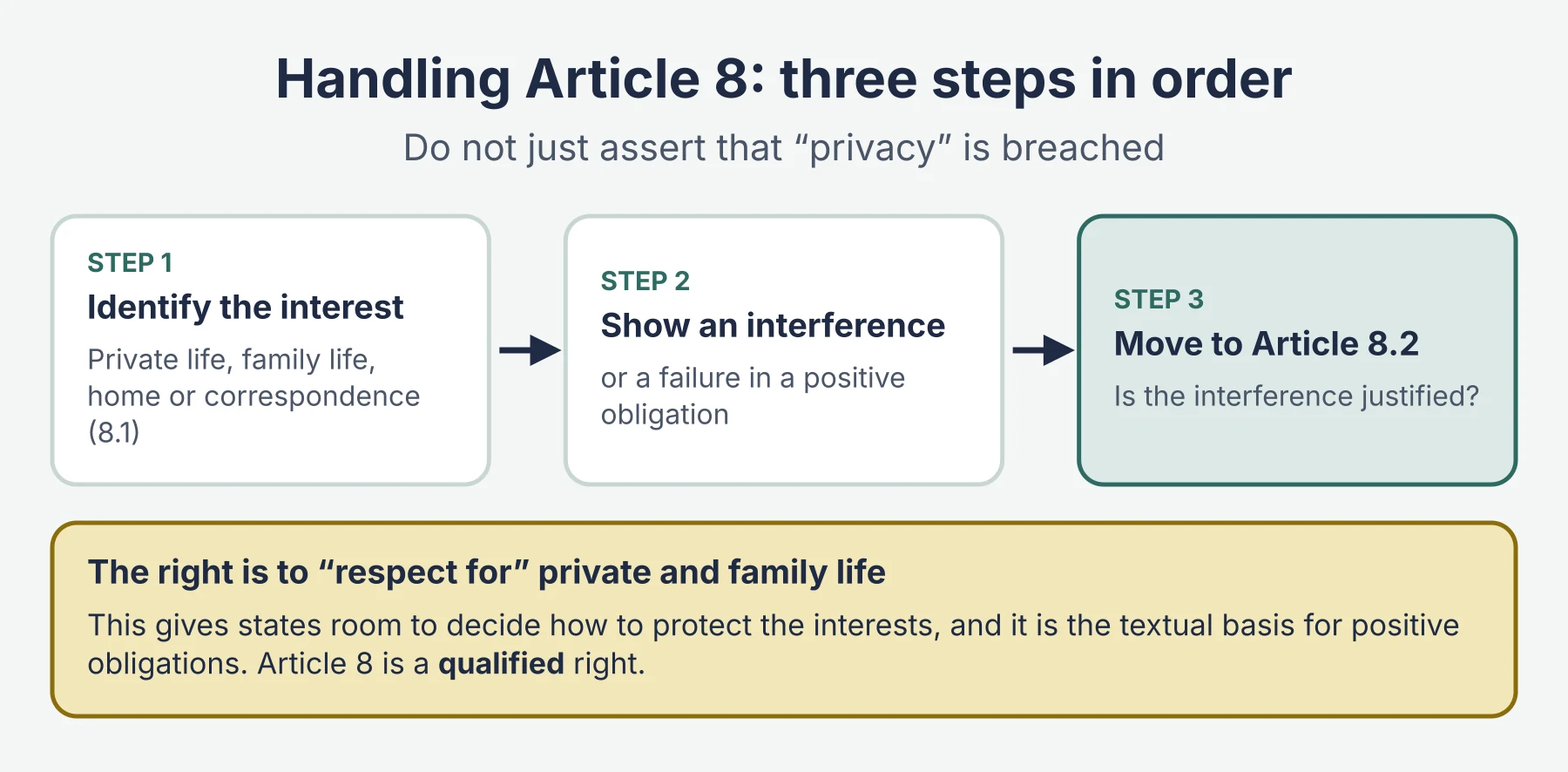
“Everyone has the right to respect for his private and family life, his home and his correspondence.” Article 8 is qualified: interference may be justified under 8.2. The words “respect for” leave states a choice of means and support positive obligations.
Answer order: interest engaged → interference or failure to protect → public authority or court as public authority → 8.2 justification → conclusion.
Interest by interest
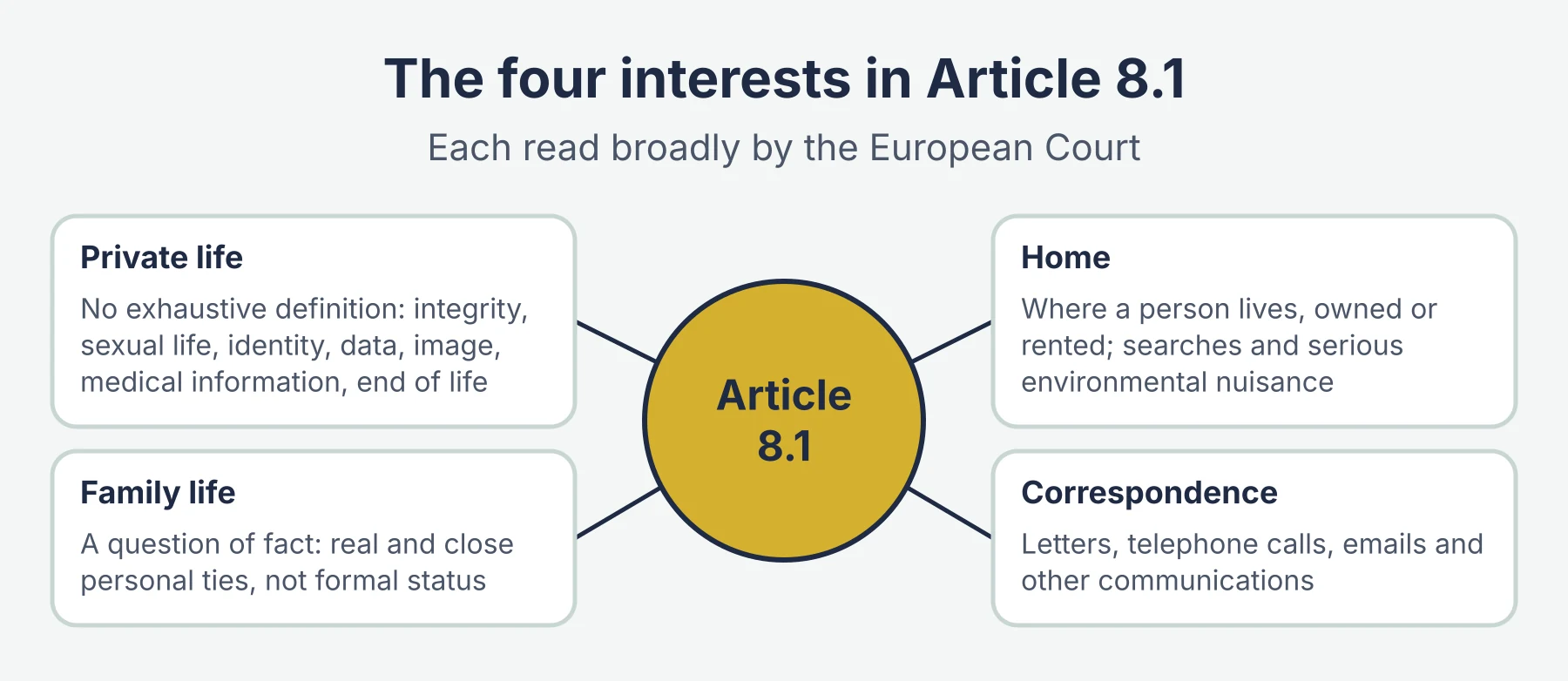
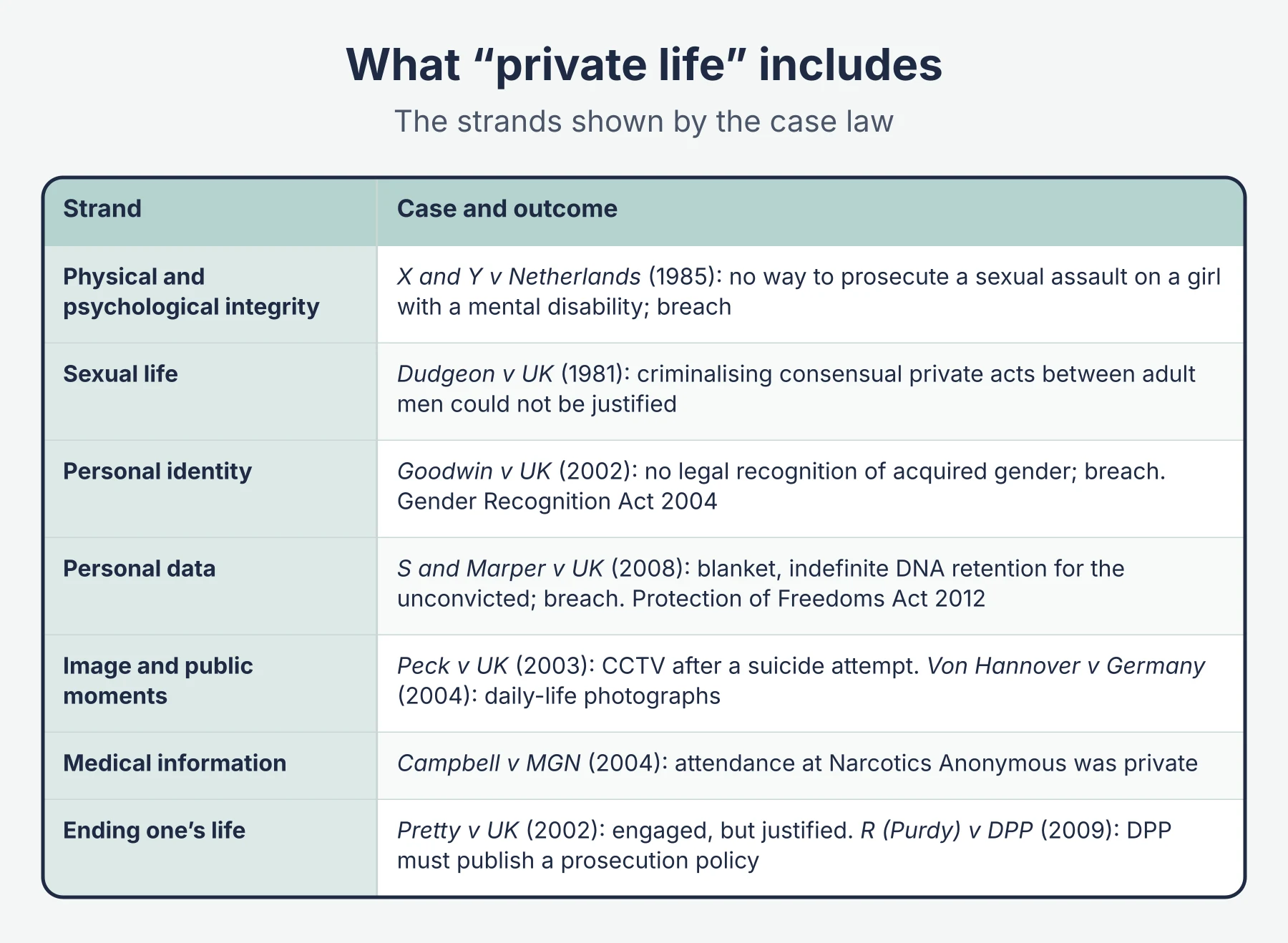
Private life (broad, no exhaustive definition)
| Aspect | Case | Point |
|---|---|---|
| Physical and psychological integrity | X and Y v Netherlands (1985) | No criminal route to prosecute an assault on a 16-year-old with a disability: breach; positive obligation |
| Sexual life | Dudgeon v UK (1981) | Criminalising private consensual acts between adult men: breach |
| Identity | Goodwin v UK (2002) | No legal recognition of acquired gender: breach; Gender Recognition Act 2004 |
| Personal data | S and Marper v UK (2008) | Indefinite retention of DNA and fingerprints of people not convicted: breach; Protection of Freedoms Act 2012 |
| Image in public | Peck v UK (2003) | CCTV of man after suicide attempt released to media: breach |
| Image and the press | Von Hannover v Germany (2004) | Photographs of daily life with no public-interest contribution: breach |
| Medical information | Campbell v MGN (2004) | Narcotics Anonymous details and photos were private |
| End of life | Pretty v UK (2002); R (Purdy) v DPP (2009) | Article 8 engaged; Purdy required a published prosecution policy |
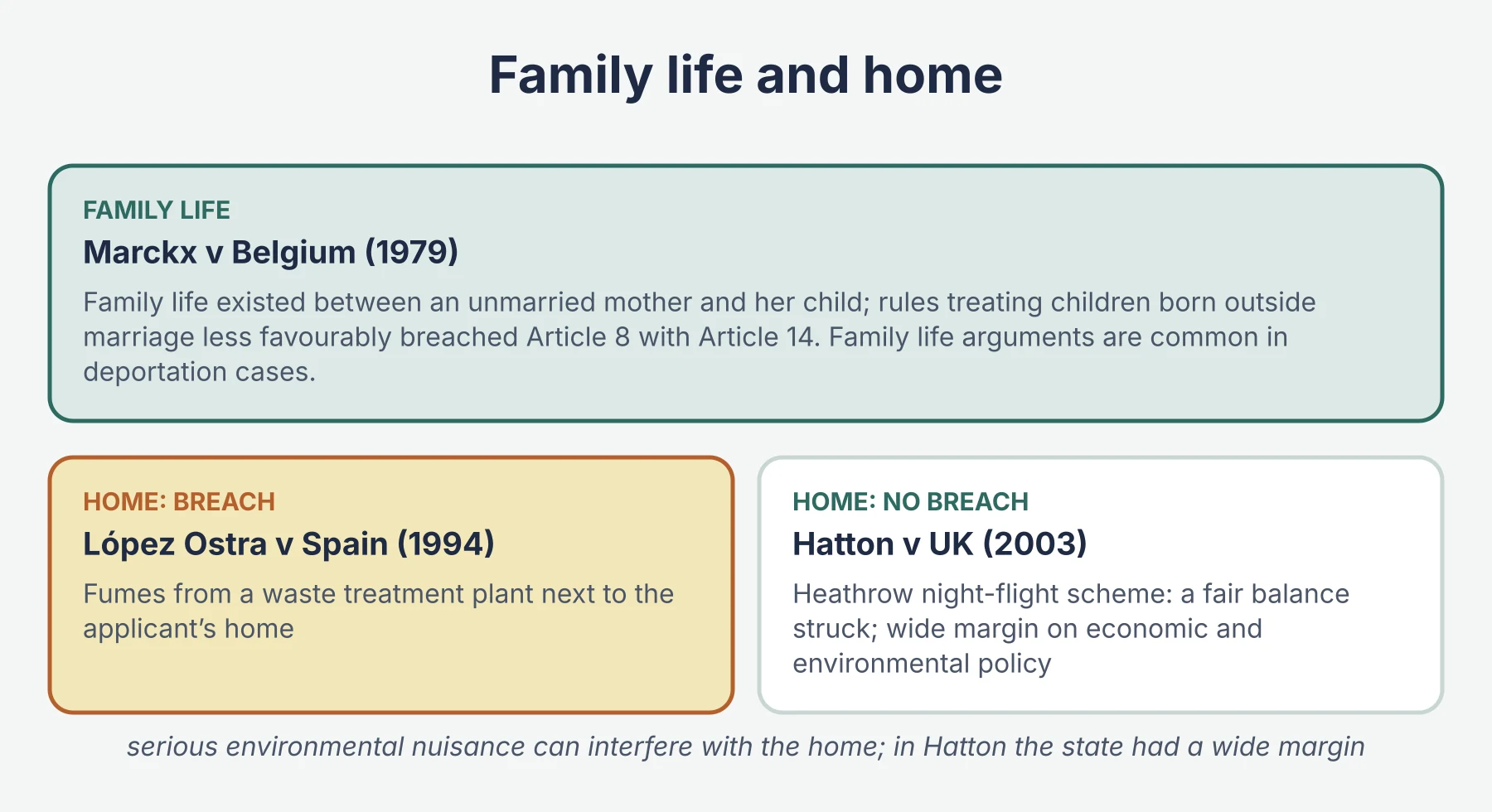
Family life: a question of fact, based on real and close personal ties. Marckx v Belgium (1979): unmarried mother and child had family life; discriminatory rules breached Article 8 with Article 14.
Home: where a person lives, owned or rented. López Ostra v Spain (1994): pollution from a waste plant breached Article 8. Hatton v UK (2003, Grand Chamber): Heathrow night flights did not breach Article 8; fair balance struck, wide margin.
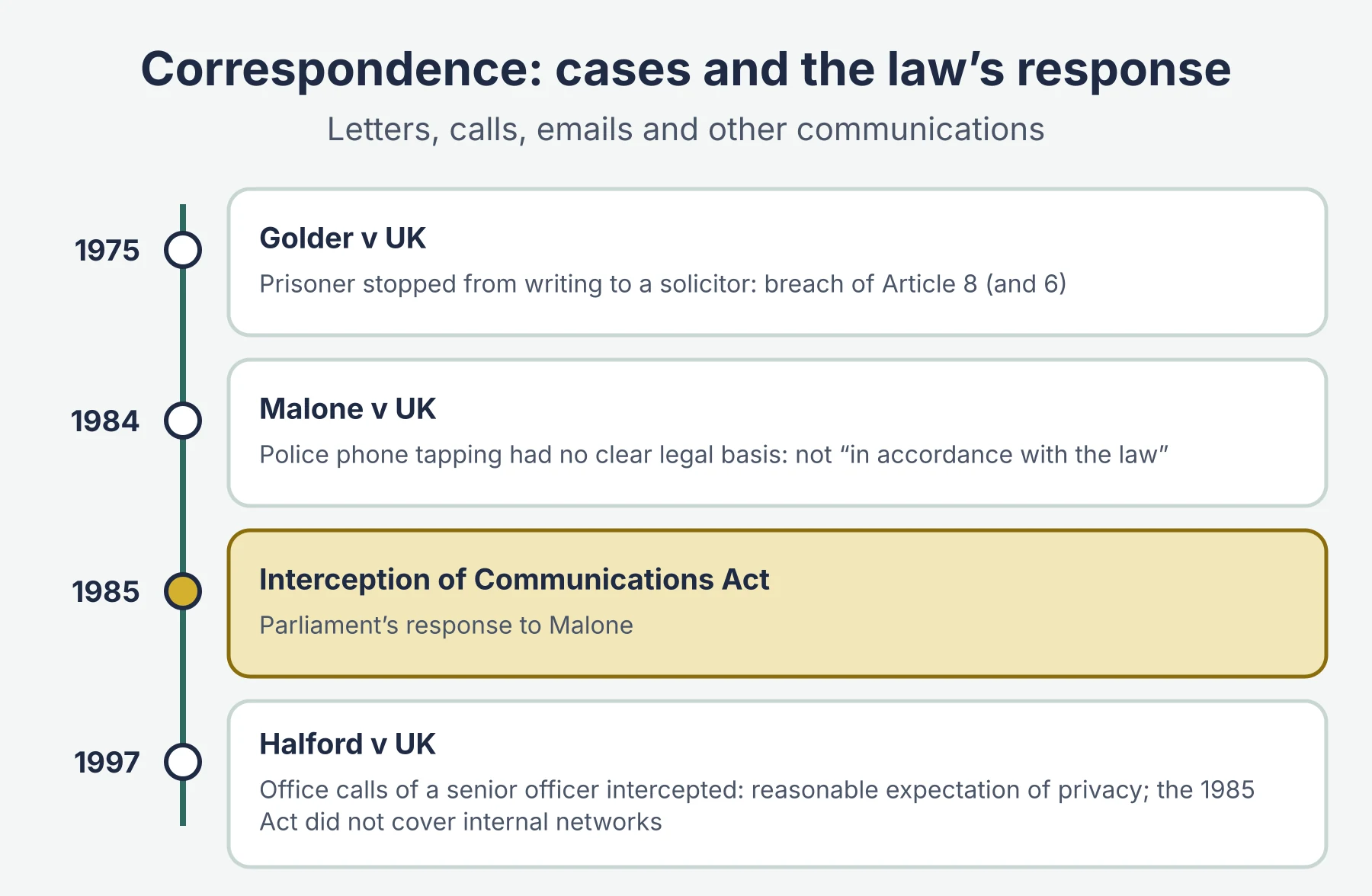
Correspondence: letters, calls, emails.
- Golder v UK (1975): prisoner prevented from writing to a solicitor.
- Malone v UK (1984): phone tapping not “in accordance with the law” → Interception of Communications Act 1985.
- Halford v UK (1997): office calls intercepted; reasonable expectation of privacy; 1985 Act did not cover internal networks.
Article 8 between private parties
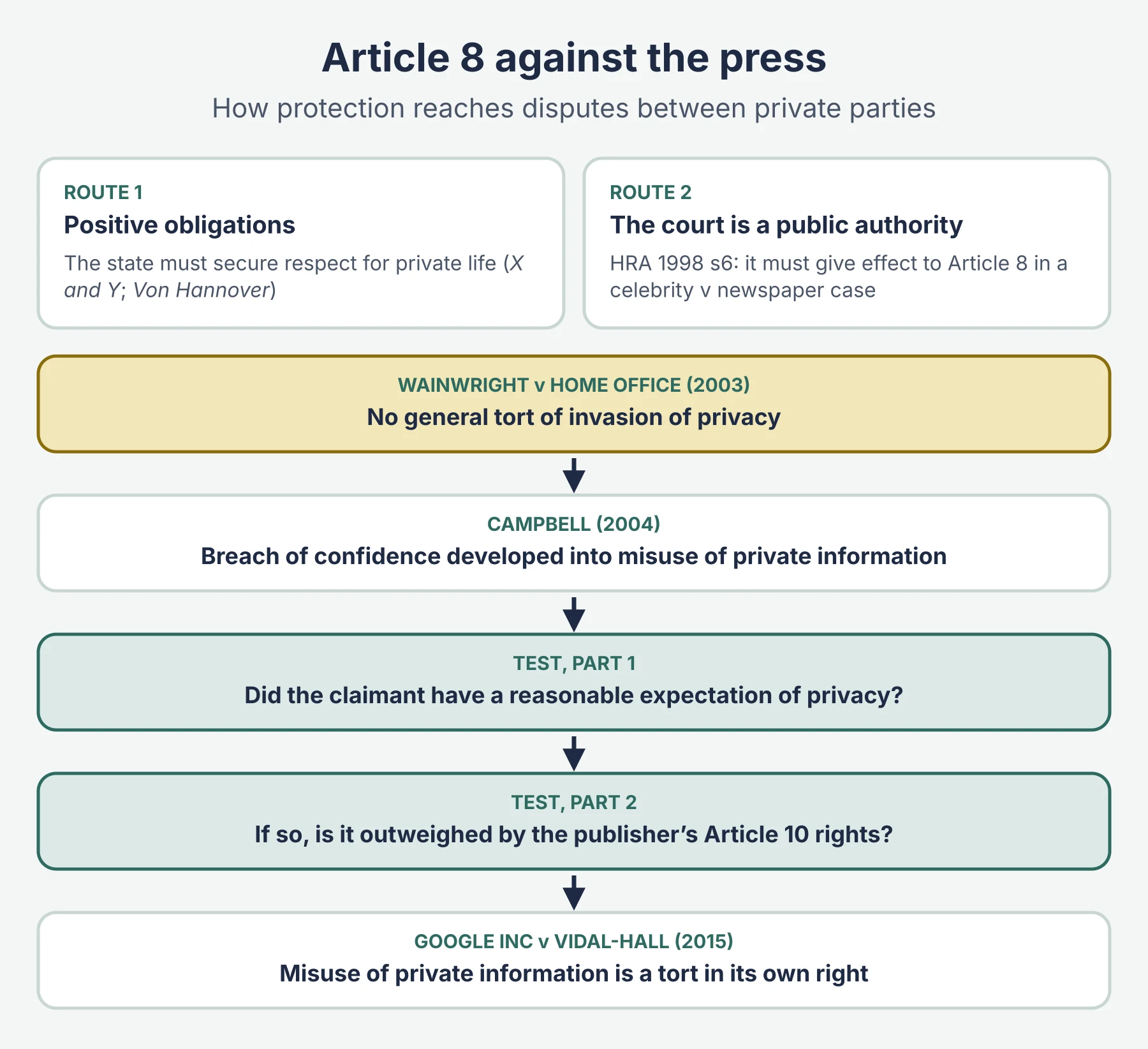
- Positive obligations: the state must secure respect for private life, including against private intrusion (X and Y; Von Hannover).
- HRA 1998 s6: courts are public authorities, so they must apply Article 8 in a claim against a newspaper.
- No general privacy tort: Wainwright v Home Office (2003).
- Misuse of private information: developed from breach of confidence in Campbell; confirmed as a tort in Google Inc v Vidal-Hall (2015).
- Two-stage test: reasonable expectation of privacy? If yes, is it outweighed by Article 10?
Key terms
| Term | Meaning |
|---|---|
| Qualified right | A right that may be restricted if the conditions in the second paragraph are met |
| Interference | State conduct that limits the exercise of the right |
| Positive obligation | A duty on the state to take steps to protect the right, not just to refrain from interfering |
| Reasonable expectation of privacy | The threshold question in misuse of private information |
| Misuse of private information | The English tort protecting private information, recognised in Vidal-Hall |
| Horizontal effect | Convention rights influencing disputes between private parties, mainly through the court’s duty under s6 |
| Margin of appreciation | The latitude a state has, wide in Hatton, narrow for intimate aspects of private life as in Dudgeon |
Exam traps
- “Privacy” is not an interest in the text. Name private life, family life, home or correspondence.
- Being in public does not end private life (Peck; Von Hannover).
- The newspaper is not a public authority; the court’s s6 duty is the route.
- Wainwright: no general tort of privacy. Do not invent one.
- Hatton: no breach. López Ostra: breach. Do not mix them up.
- The second paragraph is analysed separately; do not jump to “justified” before showing interference.
Self-test
- What do the words “respect for” in Article 8.1 add?
- Name the four interests protected by Article 8.1.
- Which case shows that a state may breach Article 8 by failing to provide a criminal law remedy?
- What did S and Marper v UK decide, and how did Parliament respond?
- Why did Peck v UK find a breach although the applicant was filmed in a street?
- What test decides whether family life exists?
- Contrast López Ostra v Spain with Hatton v UK.
- What was the defect found in Malone v UK?
- Why did Halford v UK find a breach of Article 8?
- What did Wainwright v Home Office decide?
- What are the two stages of a misuse of private information claim?
- How does Article 8 apply in a claim against a newspaper, which is not a public authority?
Answers: 1. They leave states a choice of means and are the basis of positive obligations. 2. Private life, family life, home and correspondence. 3. X and Y v Netherlands (1985). 4. Blanket indefinite retention of DNA and fingerprints of unconvicted people breached Article 8; the Protection of Freedoms Act 2012 changed the rules. 5. Release of the footage to the media, without proper masking, of a distressing private moment interfered with private life even though it happened in public. 6. Whether there are real and close personal ties, as a question of fact. 7. López Ostra: serious pollution next to a home breached Article 8; Hatton: night flights did not, because a fair balance was struck within a wide margin. 8. The tapping had no clear legal basis, so it was not in accordance with the law. 9. The officer had a reasonable expectation of privacy in calls from her office, and interception of internal networks was not regulated by law. 10. There is no general common law tort of invasion of privacy. 11. Did the claimant have a reasonable expectation of privacy; if so, is it outweighed by the publisher’s right to freedom of expression? 12. The court is a public authority under section 6 of the Human Rights Act 1998 and must give effect to Article 8 when deciding the claim.
More resources on this topic
Article 8 study guide | Article 8 practice questions | Restrictions revision notes
Related resources
-
Study guides
AQA A Level Law (7162): Enforcement
Enforcing Convention rights for AQA A Level Law 7162: Strasbourg claims and admissibility, domestic courts, the effect of judgments and judicial review.
Law · AQA · A Level
Read guide -
Practice questions
AQA A Level Law (7162): Enforcement – Practice Questions
Original practice on enforcing human rights for AQA A Level Law 7162, with mark-scheme answers on Strasbourg claims, HRA remedies and judicial review procedure.
Law · AQA · A Level
Try questions -
Revision notes
AQA A Level Law (7162): Enforcement – Revision Notes
Condensed recall on enforcing human rights for AQA A Level Law 7162: Strasbourg admissibility and judgments, HRA sections 6 to 8 and judicial review.
Law · AQA · A Level
Revise topic
Get free revision emails (optional)
Occasional emails with practice questions, worked explanations and links to free resources for the qualification and subjects you choose. No spam, and you can unsubscribe from any email. The free tools on this site never need an email.