
Revision Notes
AQA GCSE Biology 8461: Plant tissues; plant organ system – Revision Notes
Condensed AQA GCSE Biology 8461 notes on leaf tissues, root hair cells, xylem, phloem, stomata, transpiration, translocation and potometers, with a self-test.
- Subject
- Biology
- Level
- GCSE
- Topic
- Plant tissues; plant organ system
- Author
- Marlbridge Academic Team
- Updated
- Reviewed by
- Hina Mogul (what this means)
Aligned to AQA GCSE Biology (8461), For first teaching 2016. Official specification .
Syllabus page (what it covers and how it is assessed): AQA GCSE Biology.
Syllabus points this page covers
8461
- 4.2.3.1 Plant tissues
- 4.2.3.2 Plant organ system
This page covers 2 of the 10 subtopics recorded here in topic 2, Organisation.
Found an error? Report a correction.
Need help with this topic? Request a free trial class for GCSE Biology (8461).
These are condensed recall notes for 4.2.3.1 Plant tissues and 4.2.3.2 Plant organ system of the AQA GCSE Biology (8461) specification, Version 1.0, for teaching from September 2016 and exams from 2018 onwards. Both are assessed on Paper 1, set at Foundation and Higher Tier. Nothing in these two subtopics is marked (HT only) or (biology only), so every line applies to both tiers. Neither is one of the ten required practicals, but the specification suggests three practical activities you should be ready to describe and process data from: drawing a transverse section of a leaf, measuring the rate of transpiration by water uptake, and investigating the distribution of stomata.
Osmosis and active transport are in the Transport in cells revision notes. Photosynthesis in the leaf is in the Bioenergetics revision notes. Levels of organisation are in the Principles of organisation; the heart and blood vessels revision notes. The course hub is AQA GCSE Biology, and the printable checklist lists every point. To find your weak spots fast, try the free 10-minute diagnostics.
4.2.3.1 Plant tissues
The leaf is a plant organ: several tissues working together, mainly for photosynthesis. You need only the tissues below.
| Tissue | Where | Structure linked to function |
|---|---|---|
| Upper epidermis | Top surface | Single layer of transparent cells, covered by a waxy cuticle: lets light through and reduces water loss |
| Palisade mesophyll | Just below the upper epidermis | Tall, tightly packed cells with many chloroplasts: absorb the most light, so most photosynthesis happens here |
| Spongy mesophyll | Below the palisade layer | Loosely packed cells with air spaces: large surface area for gases to diffuse in and out of cells |
| Xylem | In the veins | Hollow tubes: carry water and mineral ions into the leaf |
| Phloem | In the veins, next to the xylem | Tubes of elongated cells: carry dissolved sugars out of the leaf |
| Lower epidermis with guard cells and stomata | Bottom surface | Stomata are pores; each is surrounded by two guard cells that open and close it |
| Meristem | Growing tips of shoots and roots (not the leaf) | Cells divide by mitosis and can differentiate into any type of plant cell, for growth |
Method in steps: drawing a transverse section of a leaf
1. Use a prepared slide of a leaf cut across (transverse section).
2. Find it on low power; move to higher power to see the cell layers.
3. Draw the layers in order from top to bottom, in pencil, with clear outlines and no shading.
4. Label upper epidermis, palisade mesophyll, spongy mesophyll, xylem, phloem, lower epidermis, guard cells and stomata.
5. Record the magnification.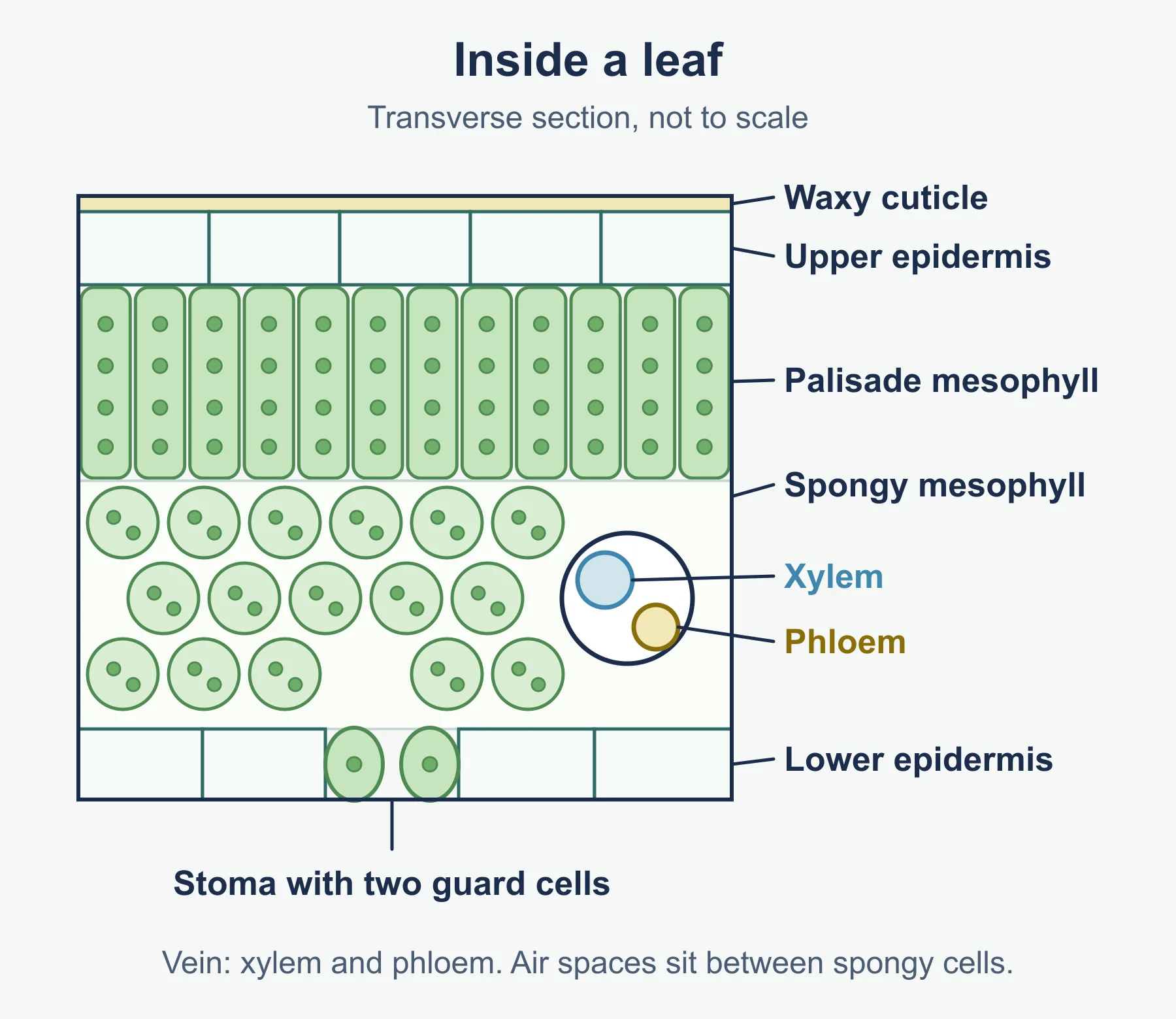
4.2.3.2 The plant organ system
The roots, stem and leaves form a plant organ system for transporting substances around the plant.
soil water -> root hair cells -> xylem in root -> xylem in stem -> leaf -> evaporates -> out through stomata
sugars made in leaf -> phloem -> growing tips, roots and storage organs
Root hair cells
| Feature | Effect |
|---|---|
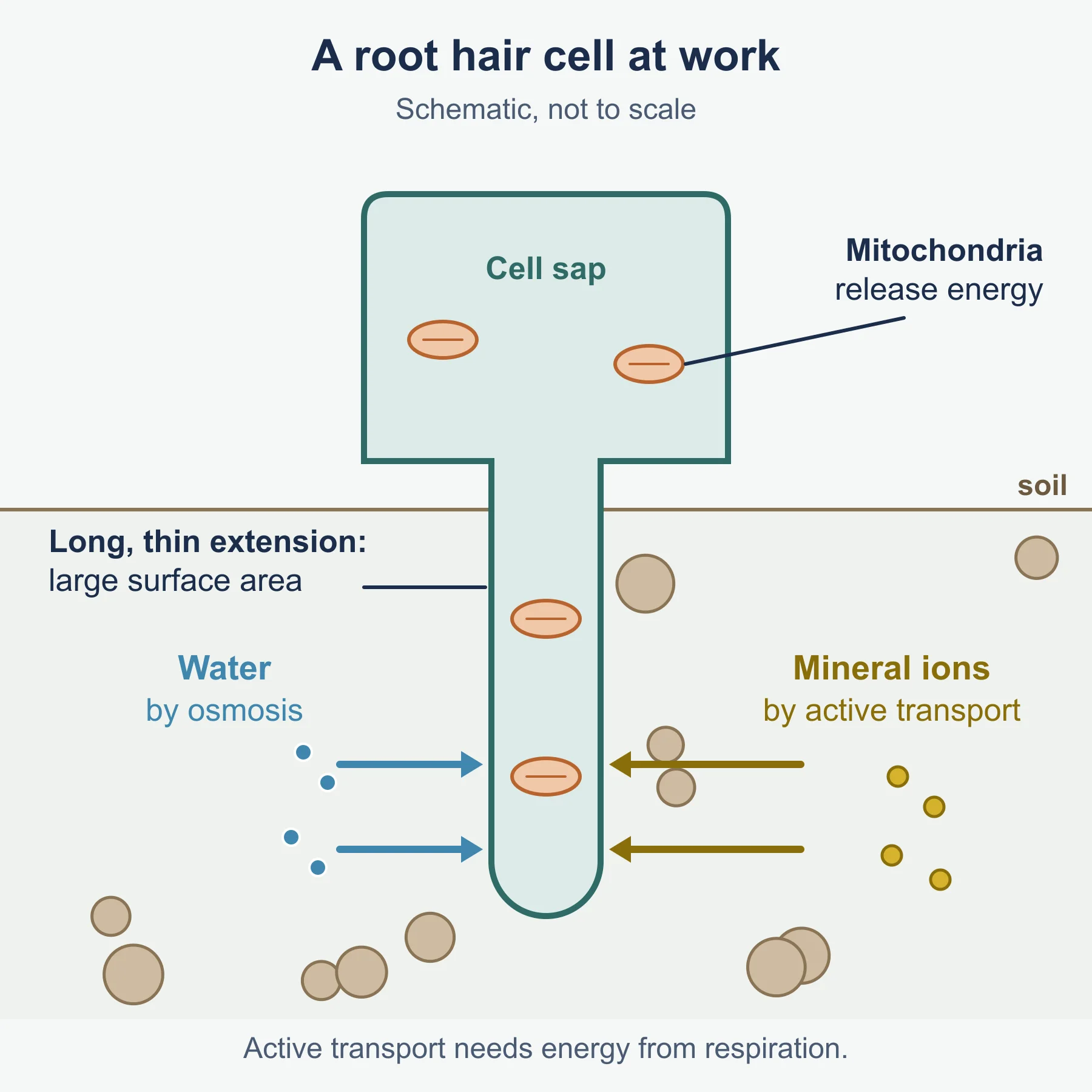
| Long, thin extension into the soil | Large surface area for uptake |
| Water enters by osmosis | Soil water is more dilute than the cell sap |
| Mineral ions enter by active transport | Ions are at a lower concentration in the soil than in the cell, so energy from respiration is used to take them up |
| Many mitochondria | Release energy from respiration for active transport |
Xylem vs phloem
| Xylem | Phloem | |
|---|---|---|
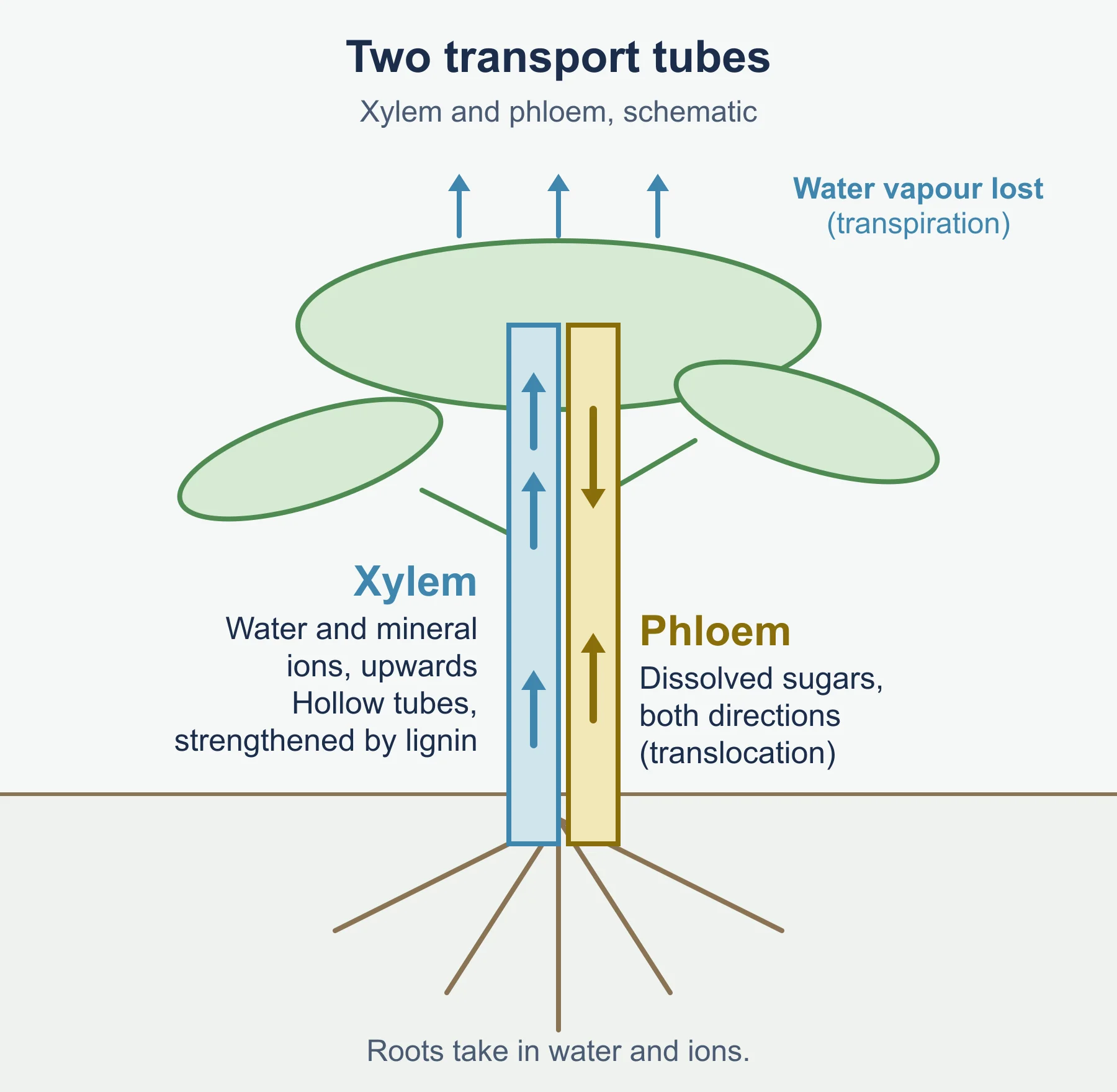
| Carries | Water and mineral ions | Dissolved sugars |
| Direction | Roots -> stems -> leaves (upwards only) | Leaves -> rest of the plant, for immediate use or storage (up and down) |
| Structure | Hollow tubes strengthened by lignin | Tubes of elongated cells; cell sap moves between cells through pores in the end walls |
| Process | Transpiration stream | Translocation |
The detailed structure of phloem and how translocation works are not required.
Transpiration
1. Water evaporates from cells inside the leaf into the air spaces.
2. Water vapour diffuses out of the leaf through the stomata.
3. More water is drawn out of the xylem in the leaf to replace it.
4. This pulls a continuous column of water up the xylem from the roots: the transpiration stream.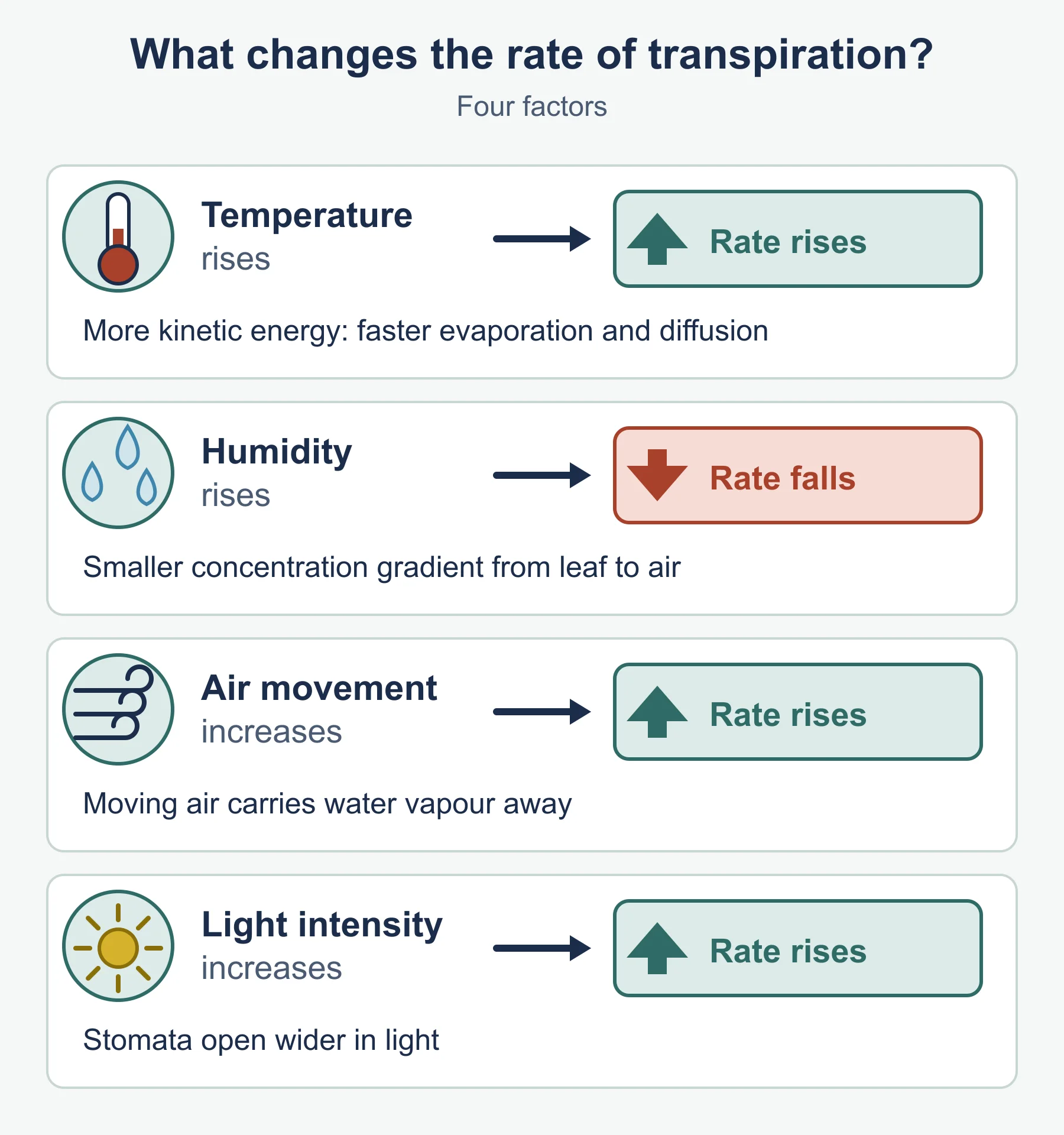
Stomata and guard cells
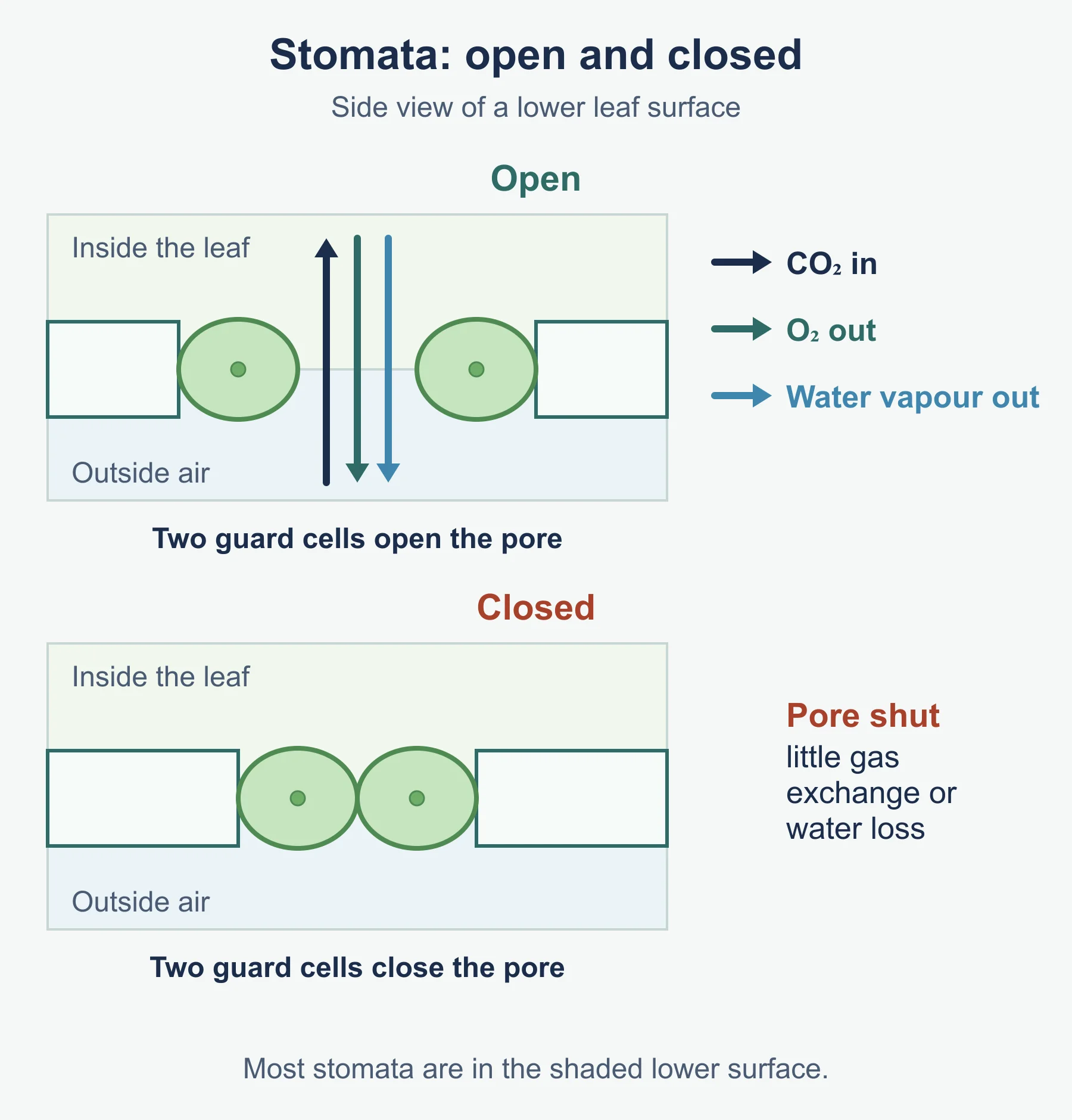
- Stomata and guard cells control gas exchange and water loss.
- Open stomata let carbon dioxide in for photosynthesis and oxygen out, but water vapour escapes too.
- Guard cells swell with water (turgid) to open the stoma and lose water (flaccid) to close it, for example when the plant is short of water.
- Most stomata are on the lower surface, which is cooler and shaded, so less water evaporates.
Factors affecting the rate of transpiration
| Factor change | Effect on rate | Why |
|---|---|---|
| Higher temperature | Increases | Water molecules have more kinetic energy, so evaporation and diffusion are faster |
| Higher humidity | Decreases | More water vapour in the air makes the concentration gradient smaller |
| More air movement | Increases | Moving air carries water vapour away, keeping the concentration gradient steep |
| Higher light intensity | Increases | More stomata open to let carbon dioxide in for photosynthesis |
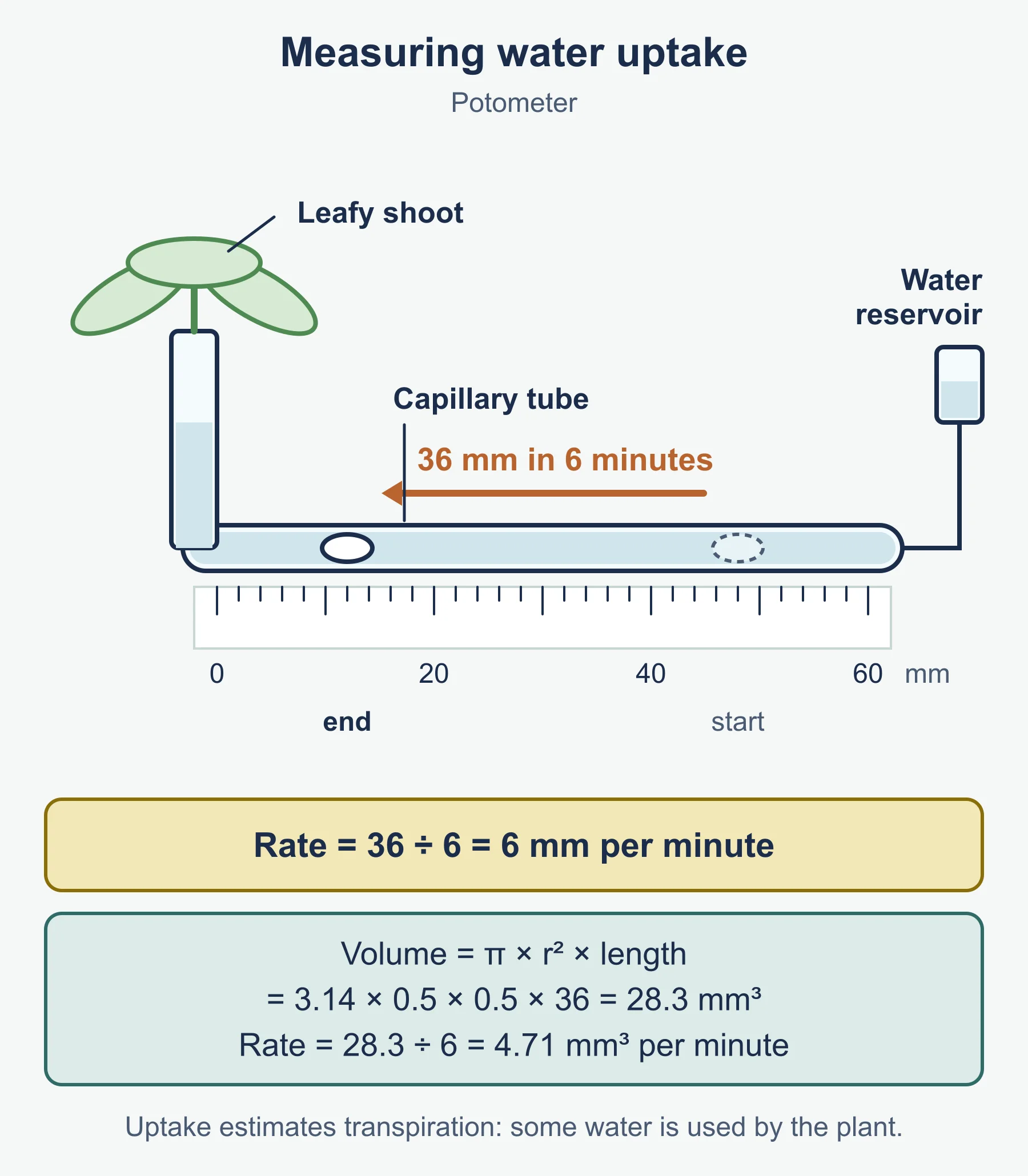
Method in steps: measuring transpiration by water uptake (potometer)
1. Cut a leafy shoot under water (so no air enters the xylem) and fit it into the potometer under water.
2. Seal the joints so they are airtight; dry the leaves.
3. Let an air bubble into the capillary tube.
4. Measure how far the bubble moves in a set time.
5. Reset the bubble with the reservoir and repeat; calculate a mean.
6. Change one factor (a fan, a lamp at a set distance, a plastic bag for humidity) and keep the others constant.
The potometer measures water uptake, which is used as an estimate of water loss: a little of the water taken up is used by the plant (for example in photosynthesis), so uptake is slightly more than loss.
Worked reminder: rate of water uptake
volume of water = pi x r^2 x distance moved by the bubble
rate = volume / time
A bubble moves 24 mm in 4 minutes in a tube of radius 0.5 mm. Volume = 3.14 x 0.5² x 24 = 3.14 x 0.25 x 24 = 18.8 mm³ (to 3 s.f.). Rate = 18.8 / 4 = 4.7 mm³ per minute. If only distance is needed: 24 / 4 = 6 mm per minute.
Method in steps: investigating the distribution of stomata
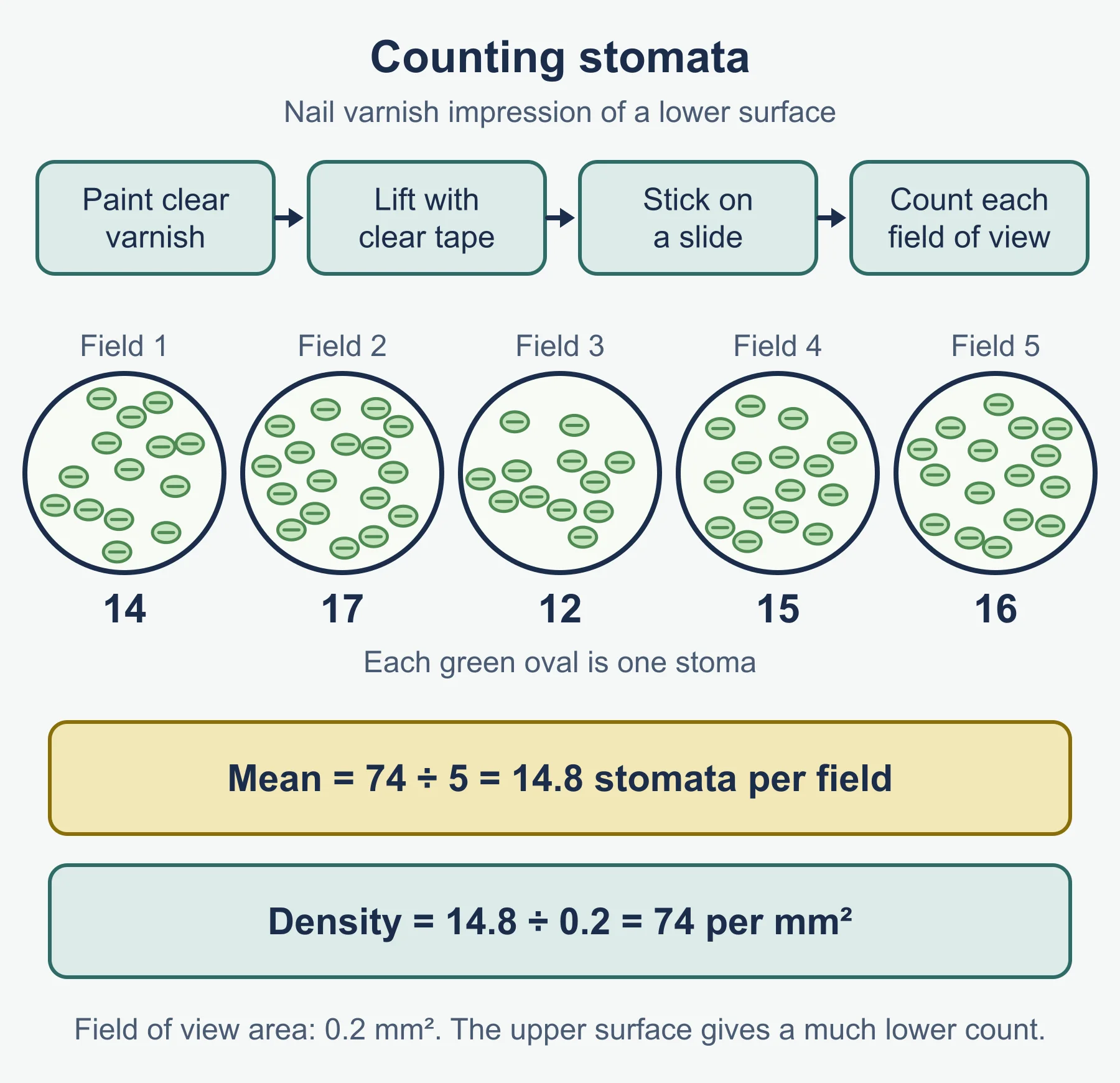
1. Paint a thin layer of clear nail varnish on the lower surface of a leaf; let it dry.
2. Peel it off with clear sticky tape and stick it on a slide.
3. Count the stomata in the field of view at a set magnification.
4. Repeat for several fields of view and several leaves (sampling), then find the mean.
5. Repeat for the upper surface and compare.
Worked reminder: mean and stomatal density
Counts in five fields of view: 14, 11, 13, 12, 15. Mean = 65 / 5 = 13 stomata.
The field of view is a circle 0.4 mm across, so radius = 0.2 mm. Area = 3.14 x 0.2² = 3.14 x 0.04 = 0.126 mm². Density = 13 / 0.126 = about 103 stomata per mm².
Graph skills
- Put the variable you changed (for example light intensity) on the x-axis and the rate on the y-axis.
- Choose scales so the points fill at least half the grid; label both axes with units.
- Plot with small crosses; draw a smooth curve or straight line of best fit.
- Quote values from the graph when you describe a trend (for example “the rate doubles from 2 to 4 mm³ per minute between 10 °C and 20 °C”).
Must-know distinctions
- Transpiration vs translocation: water moving up the xylem and out of the leaves vs sugars moving in the phloem.
- Xylem vs phloem: lignin-strengthened hollow tubes, upward only vs elongated cells with pores in the end walls, both directions.
- Osmosis vs active transport in roots: water (no energy needed) vs mineral ions (needs energy from respiration).
- Stoma vs guard cell: the pore vs one of the two cells that open and close it.
- Palisade vs spongy mesophyll: most photosynthesis vs air spaces for gas exchange.
- Water uptake vs water loss: a potometer measures uptake, used as an estimate of loss.
Quick self-test
- Why is a leaf an organ?
- How is the palisade mesophyll adapted for photosynthesis?
- Why does the spongy mesophyll have air spaces?
- Where is meristem tissue found and what does it do?
- Name the three organs in the plant transport system.
- How do root hair cells take up water, and how do they take up mineral ions?
- Give two differences between xylem and phloem.
- What is translocation?
- Describe the role of guard cells.
- Explain why transpiration is slower on a humid day.
- A potometer bubble moves 15 mm in 3 minutes in a tube of radius 0.5 mm. Calculate the rate of water uptake in mm³ per minute. (Use π = 3.14.)
- Why does a potometer not measure water loss exactly?
Answers
- It is made of several tissues (epidermis, palisade and spongy mesophyll, xylem and phloem) working together.
- Tall, tightly packed cells near the upper surface with many chloroplasts, so they absorb a lot of light.
- To give a large surface area for gases (carbon dioxide and oxygen) to diffuse in and out of cells.
- At the growing tips of shoots and roots. Its cells divide and can differentiate, for growth.
- Roots, stem and leaves.
- Water by osmosis; mineral ions by active transport.
- Any two: xylem carries water and mineral ions, phloem carries dissolved sugars; xylem is hollow tubes strengthened by lignin, phloem is elongated cells with pores in the end walls; xylem flow is upwards only, phloem goes both ways.
- The movement of dissolved sugars (food molecules) through the phloem.
- They open and close the stomata, controlling gas exchange and water loss.
- The air already holds a lot of water vapour, so the concentration gradient between the leaf and the air is smaller and water vapour diffuses out more slowly.
- Volume = 3.14 x 0.25 x 15 = 11.775 mm³. Rate = 11.775 / 3 = 3.9 mm³ per minute (3.925).
- Some of the water taken up is used by the plant (for example in photosynthesis), so uptake is not exactly equal to loss.
Where marks are usually lost
- Saying root hair cells take in minerals by osmosis or diffusion. It is active transport.
- Saying xylem carries sugars, or phloem carries water and minerals.
- Calling the movement of water “translocation”.
- Saying stomata “breathe” or are opened by the leaf, instead of by the guard cells.
- Explaining the humidity effect without the word concentration gradient.
- Forgetting to cut the shoot under water, or to keep the other factors constant, in a potometer method.
- Calculating a rate as time / distance, or leaving out the units.
- Counting stomata in one field of view only and calling it reliable.
Frequently asked questions
What is the difference between transpiration and translocation? Transpiration is the movement of water up the xylem and its loss from the leaves. Translocation is the movement of dissolved sugars through the phloem.
What does a potometer measure? A potometer measures water uptake by a leafy shoot, which is used as an estimate of the rate of transpiration.
How do root hair cells absorb mineral ions? Root hair cells absorb mineral ions by active transport, not by osmosis or diffusion. They take in water by osmosis.
Why are most stomata on the lower surface of a leaf? The lower surface is cooler and shaded, so less water is lost by evaporation through the stomata.
How do you investigate the distribution of stomata? Paint clear nail varnish on the leaf surface, peel it off with sticky tape, stick it on a slide and count stomata in several fields of view on several leaves.
Official syllabus
AQA GCSE Biology (8461) specification, Version 1.0, for teaching from September 2016 and exams from 2018 onwards (AQA), section 4.2 Organisation: 4.2.3.1 Plant tissues and 4.2.3.2 Plant organ system.
Get free revision emails (optional)
Occasional emails with practice questions, worked explanations and links to free resources for the qualification and subjects you choose. No spam, and you can unsubscribe from any email. The free tools on this site never need an email.
Related resources
-
Study guides
AQA GCSE Biology 8461: Plant tissues and the plant organ system – Study Guide
AQA GCSE Biology 8461 guide to leaf tissues, root hair cells, xylem, phloem, stomata, transpiration, translocation and potometer calculations, worked through.
Biology · AQA · GCSE
Read guide -
Practice questions
AQA GCSE Biology 8461: Plant tissues and the plant organ system – Practice Questions
Original AQA GCSE Biology 8461 questions on leaf tissues, root hair cells, xylem, phloem, stomata, transpiration and potometer rates, with marked answers.
Biology · AQA · GCSE
Try questions -
Study guides
AQA GCSE Biology 8461: Principles of organisation; the heart and blood vessels – Study Guide
AQA GCSE Biology 8461 study guide to levels of organisation, the heart, lungs, blood vessels, blood and coronary heart disease, with blood-flow rate examples.
Biology · AQA · GCSE
Read guide
Related articles
-
study skills
How to revise for a science examination
Most science revision fails because it rereads notes instead of retrieving them. A practical method for revising physics, chemistry and biology in the weeks before a paper.
14 July 2026
-
teaching
A Level tuition in Dubai: Cambridge or Pearson Edexcel International A Level?
Schools in Dubai and Abu Dhabi teach either Cambridge International AS & A Level or Pearson Edexcel International A Level. How the two are structured, why it matters for tuition, and how online classes from Lahore work.
9 October 2026
Studying this with a teacher
Working through Biology GCSE?
This page is free and stays free. If you would rather be taught it, Marlbridge runs Biology classes one-to-one and in small groups of up to 15, online in your own time zone. The first trial class is free. WhatsApp replies within an hour (8am–11pm Pakistan time, every day); email the same day.
AQA Biology teachers at Marlbridge


