
Revision Notes
AQA GCSE Business: Business operations (8132) – Revision Notes
Condensed revision notes on production, procurement, quality and customer service for AQA GCSE Business, with worked reminders and a self-test.
- Subject
- Business
- Level
- GCSE
- Topic
- Business operations
- Author
- Marlbridge Academic Team
- Updated
- Reviewed by
- Salman Ahmad (what this means)
Aligned to AQA GCSE Business (8132), First teaching September 2017. Official specification .
Syllabus page (what it covers and how it is assessed): AQA GCSE Business.
Syllabus points this page covers
8132
- 3.3.1 Production processes
- 3.3.2 The role of procurement
- 3.3.3 The concept of quality
- 3.3.4 Good customer services
Found an error? Report a correction.
Need help with this topic? Request a free trial class for GCSE Business (8132).
These notes condense topic 3.3 Business operations from the AQA GCSE Business (8132) specification, first teaching September 2017. For full explanations read the study guide; when you are ready to test yourself use the practice questions. The course hub is AQA GCSE Business, the printable list is the checklist, and the free diagnostics show which topics to prioritise. The specification places this topic in Paper 1, which is titled Influences of operations and HRM on business activity.
Map of the topic
| Section | Content points |
|---|---|
| Introduction to 3.3 | Operations, human resources, marketing and finance depend on each other; objectives split into functional plans |
| 3.3.1 Production processes | Job and flow production; lean production; just in time (JIT) |
| 3.3.2 The role of procurement | Managing stock (JIT and just in case, JIC); choice of supplier; procurement and logistics; supply chain management |
| 3.3.3 The concept of quality | Customer expectations; identifying and measuring quality problems; total quality management (TQM); costs and benefits of quality; outsourcing and franchising |
| 3.3.4 Good customer services | Methods of good service; benefits; dangers of poor service; ICT (websites, e-commerce, social media) |
Introduction: interdependence and functional plans
Business operations are what a business does to produce goods and provide services. Operations, human resources, marketing and finance are interdependent: a decision in one area changes what the others can do.
An objective is split into functional plans, each linked to the others. Take the objective “raise sales by 15% in a year” for a joinery firm:
- Operations: plan extra production capacity and secure timber supply.
- Human resources: recruit and train two more craftspeople.
- Marketing: promote the range to more customers.
- Finance: budget for the wages and materials, and forecast the cash needed.
If marketing wins orders that operations cannot make, customers are let down. That is the link to show in an answer.
3.3.1 Production processes
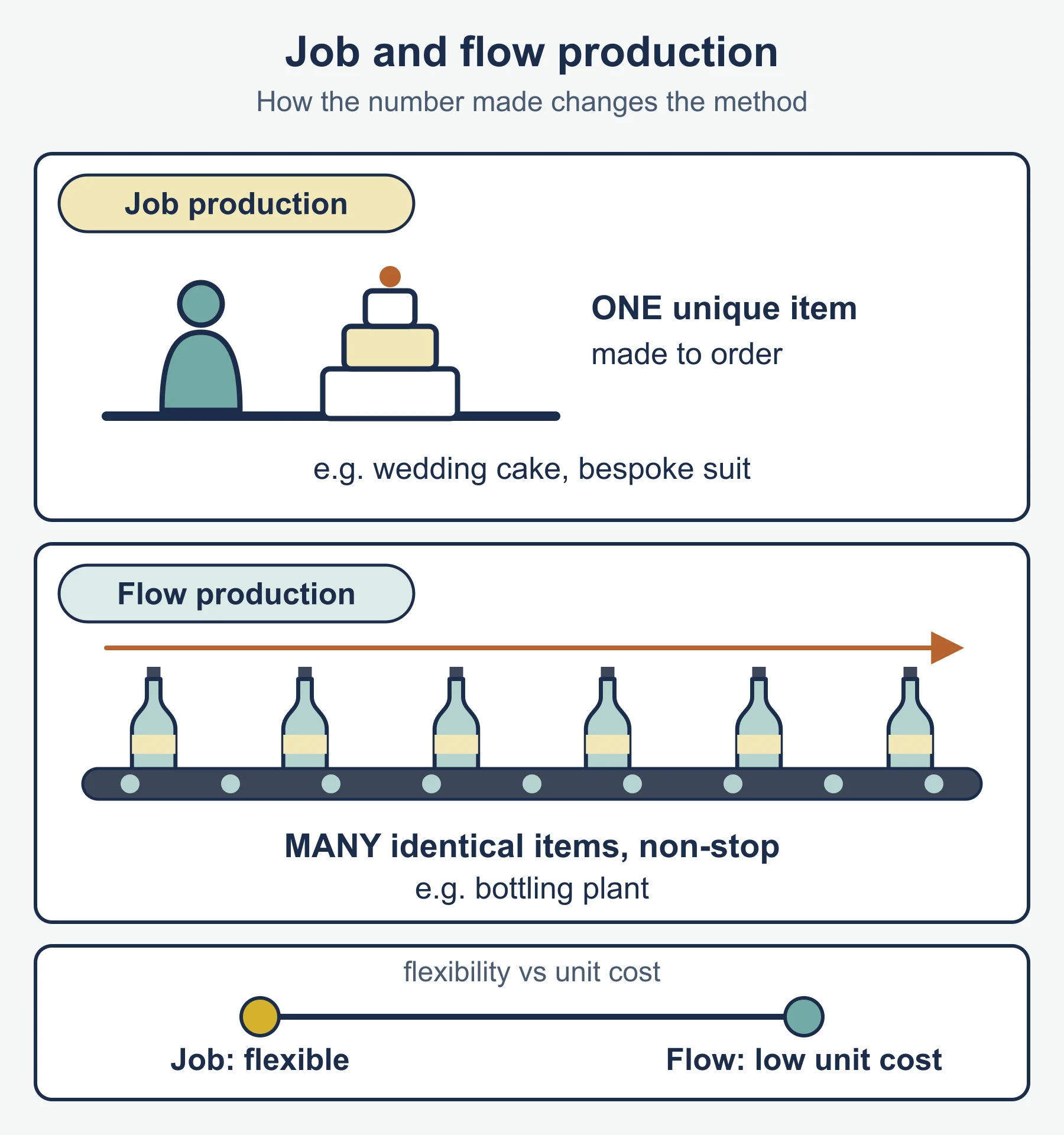
| Job production | Flow production | |
|---|---|---|
| Output | One item at a time, made to order | Large volumes of identical items, made continuously |
| Suits | Bespoke or one-off products (a made-to-measure staircase) | Standardised, high-demand products (tinned soup) |
| Strength | Flexible and personal | Low cost per unit at high output |
| Weakness | Slow, skilled labour, high unit cost | Costly machinery, inflexible, large demand needed |
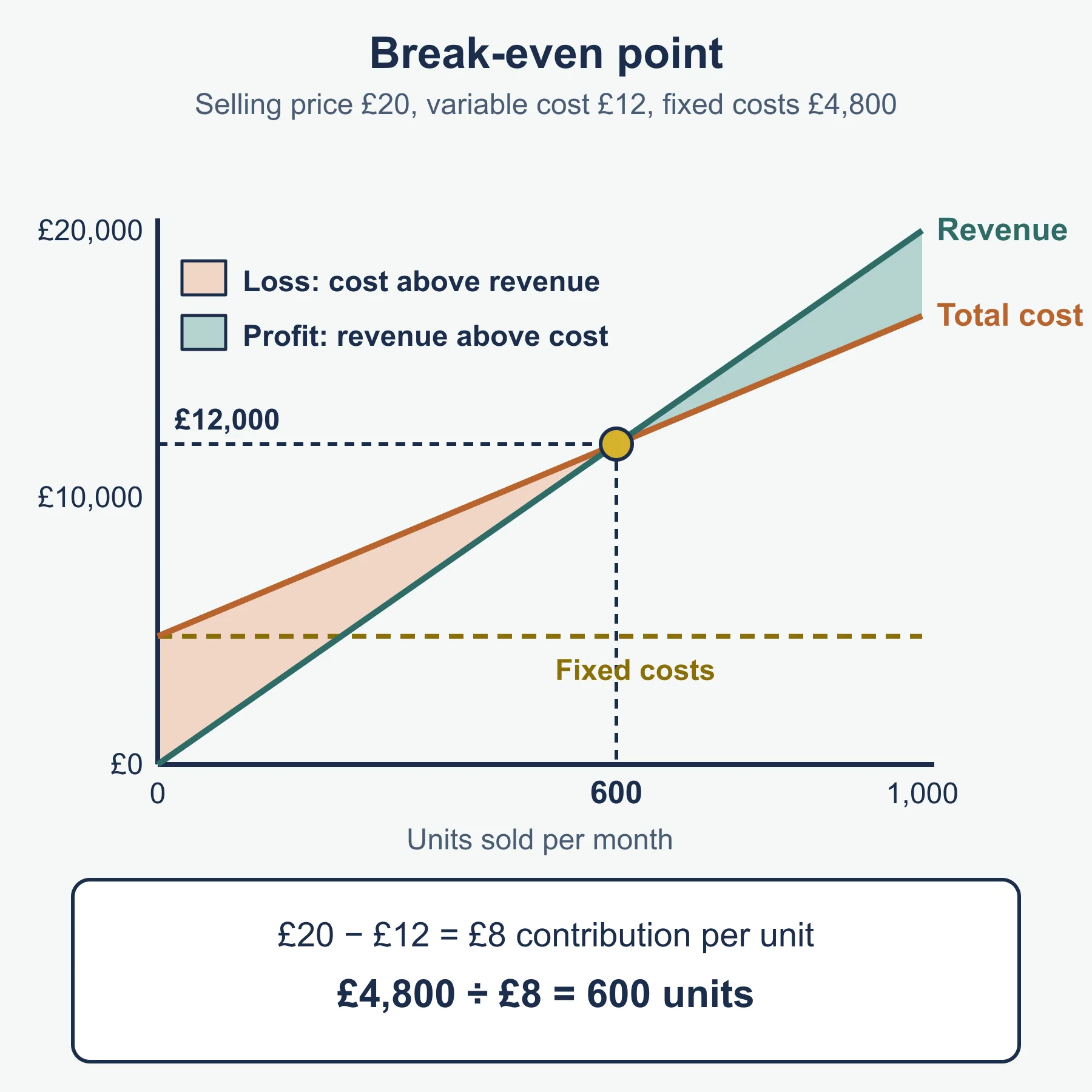
Worked reminder (unit cost). Sundrake Joinery has fixed costs of £18,000 a month and variable costs of £6 per unit. Unit cost = (fixed costs + variable costs) / output. At 3,000 units: (18,000 + 18,000) / 3,000 = £12. At 6,000 units: (18,000 + 36,000) / 6,000 = £9. Spreading fixed costs over more output is why flow production lowers unit cost.
Lean production means producing with as little waste as possible: waste of time, materials, space, effort and money. Techniques include removing unnecessary steps, keeping stock low, fixing faults at the point they occur, and involving workers in suggesting improvements.
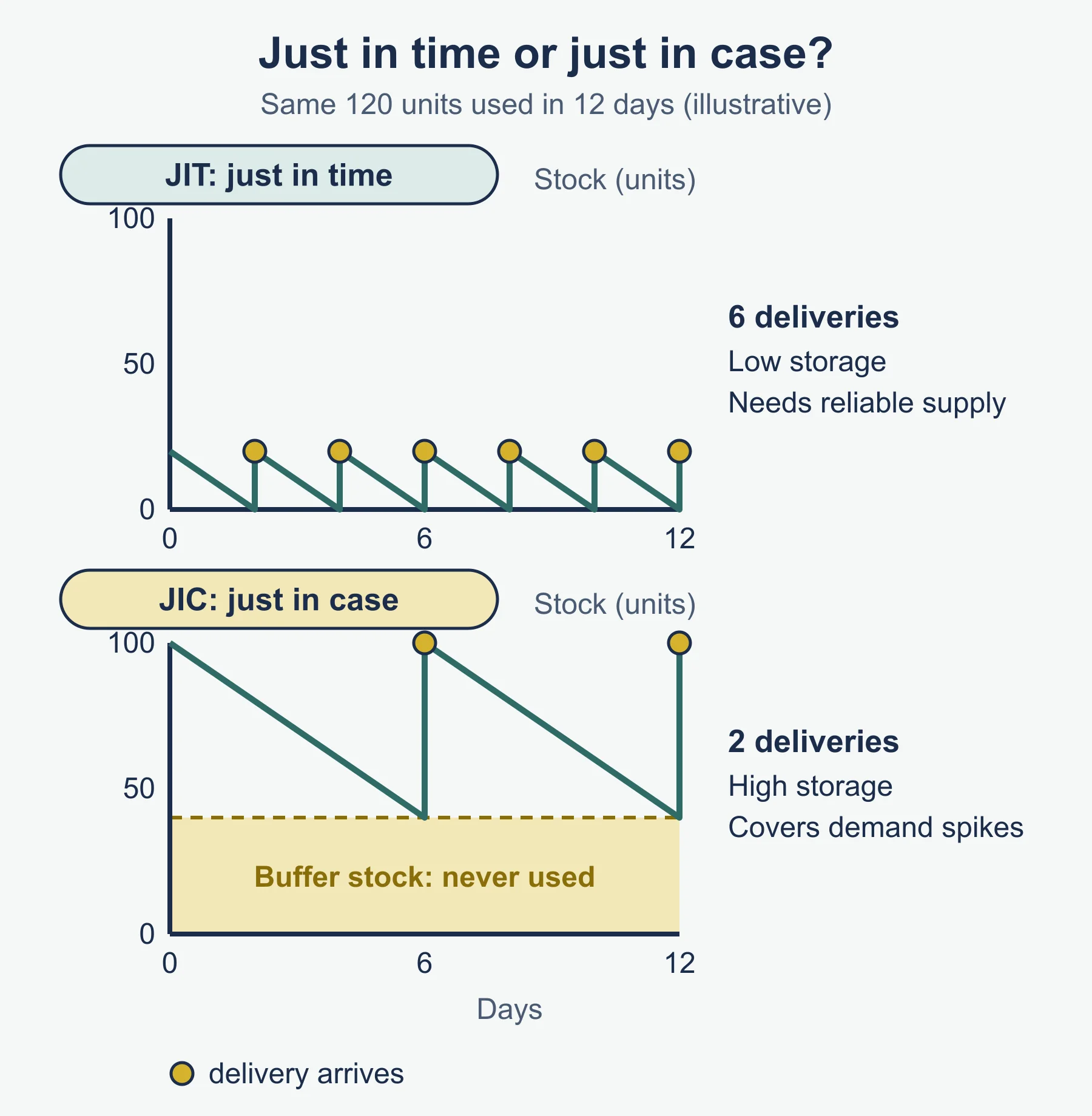
Just in time (JIT) is a lean technique: materials arrive just before they are needed and finished goods go out quickly, so little stock is held. It links to section 3.3.2 below.
3.3.2 The role of procurement
Procurement is obtaining the goods and services a business needs from suppliers. Logistics is moving and storing those goods (transport, warehousing, delivery). Both affect efficiency and lower unit costs, but cutting cost must be balanced against the quality of service.
Managing stock: JIT and JIC
| JIT | JIC | |
|---|---|---|
| Stock held | Minimal | Buffer stock kept |
| Benefit | Lower holding costs, less waste, less cash tied up | Spare stock meets sudden demand |
| Cost | More frequent deliveries; smaller orders lose purchasing economies of scale | Cost of holding buffer stock; risk of damage or going out of date |
| Risk | A late delivery stops production | Money tied up in unused stock |
Worked reminder. Trewin Bakery buys £6,000 of flour a month. JIC: one monthly order with a 5% discount costs £5,700, plus £250 to store it = £5,950. JIT: four weekly orders of £1,500 each at full price, plus £40 per delivery = £6,000 + £160 = £6,160. JIC is £210 cheaper here, though the answer changes if storage costs rise or demand becomes hard to predict. You are not asked to draw or interpret stock control charts.
To evaluate JIT for a given business, ask: is demand predictable, are suppliers reliable and close, does the product go off quickly? JIT suits a business with all three.
Choosing a supplier
Analyse three factors in the context of the business:
- Price: lower prices cut costs but may signal lower quality.
- Quality: poor materials cause faulty products, waste and complaints.
- Reliability: late or incomplete deliveries disrupt production, especially under JIT.
Worked reminder. Supplier A charges £2.40 a unit with 4% faulty; Supplier B charges £2.55 with 1% faulty. Cost per usable unit if faulty units are wasted: A = 2.40 / 0.96 = £2.50; B = 2.55 / 0.99 = £2.58 (to the nearest penny). A is still cheaper, but B may be chosen if a faulty unit would damage the brand.
Supply chain management
A supply chain is the series of businesses and activities that take a product from raw materials to the final customer. Effective management means:
- working with suppliers so key processes run efficiently and cost effectively;
- getting goods and services at the best price and value;
- cutting waste and unnecessary costs, giving a streamlined process and fast production times.
3.3.3 The concept of quality
Customers expect goods that work, last and match their description, and services that are reliable, friendly and on time. Quality means meeting those expectations.
Identifying and measuring quality problems: inspection and testing, customer complaints and returns, reviews and feedback, and measures such as the defect rate.
Defect rate = faulty items / items produced × 100. If 45 of 1,500 items are faulty: 45 / 1,500 × 100 = 3%.
Consequences of quality issues: returns and refunds, lost sales, damaged reputation, and product recalls.
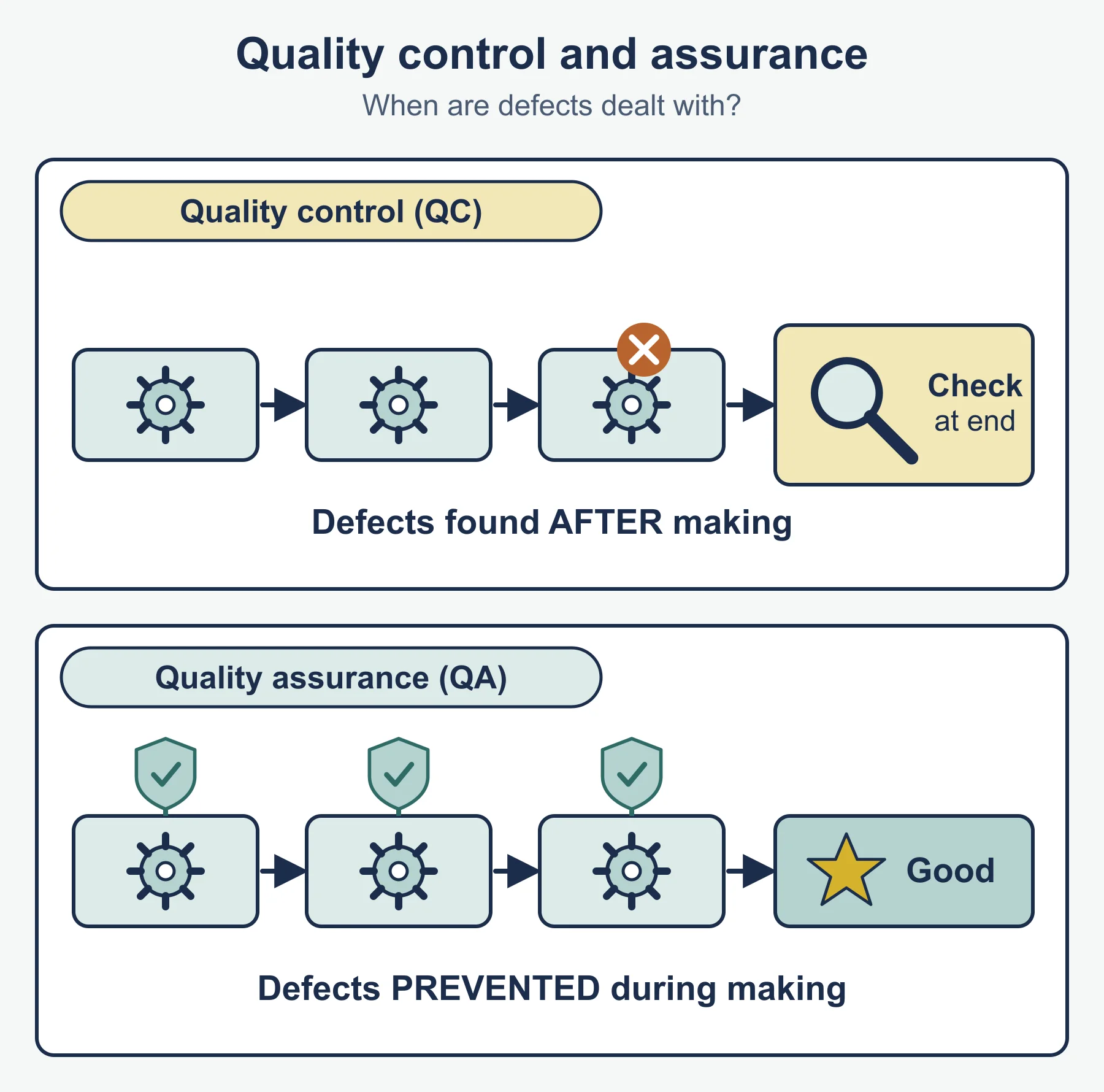
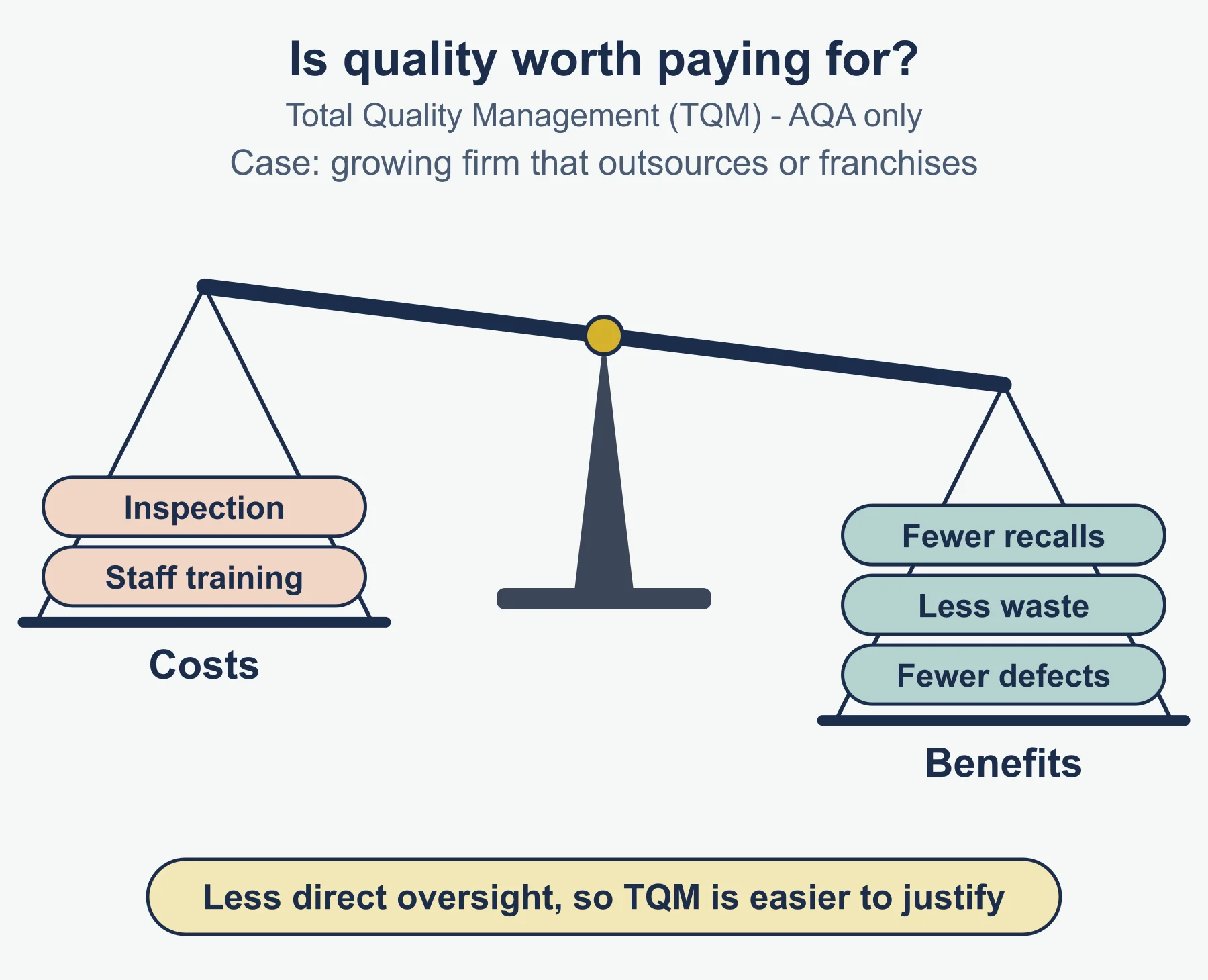
Total quality management (TQM) makes quality the responsibility of every employee in every department, aiming to get things right first time rather than checking at the end. Advantages: fewer defects and less waste, higher customer satisfaction, a better reputation.
| Costs of maintaining quality | Benefits of maintaining quality |
|---|---|
| Inspection costs | Additional sales |
| Staff training | Better image and reputation |
| Time and effort in the provision of services | Ability to charge a higher price |
| Fewer product recalls (a recall is costly) |
As a business grows by outsourcing (paying another business to carry out an activity) or franchising (a franchisee runs outlets under the brand), it has less direct control, so quality can become inconsistent. Standards, training and checks must be agreed with the other party.
3.3.4 Good customer services
Understand the sales process: the customer finds out about the product, is helped to choose, buys, and is supported afterwards.
| Method | Example |
|---|---|
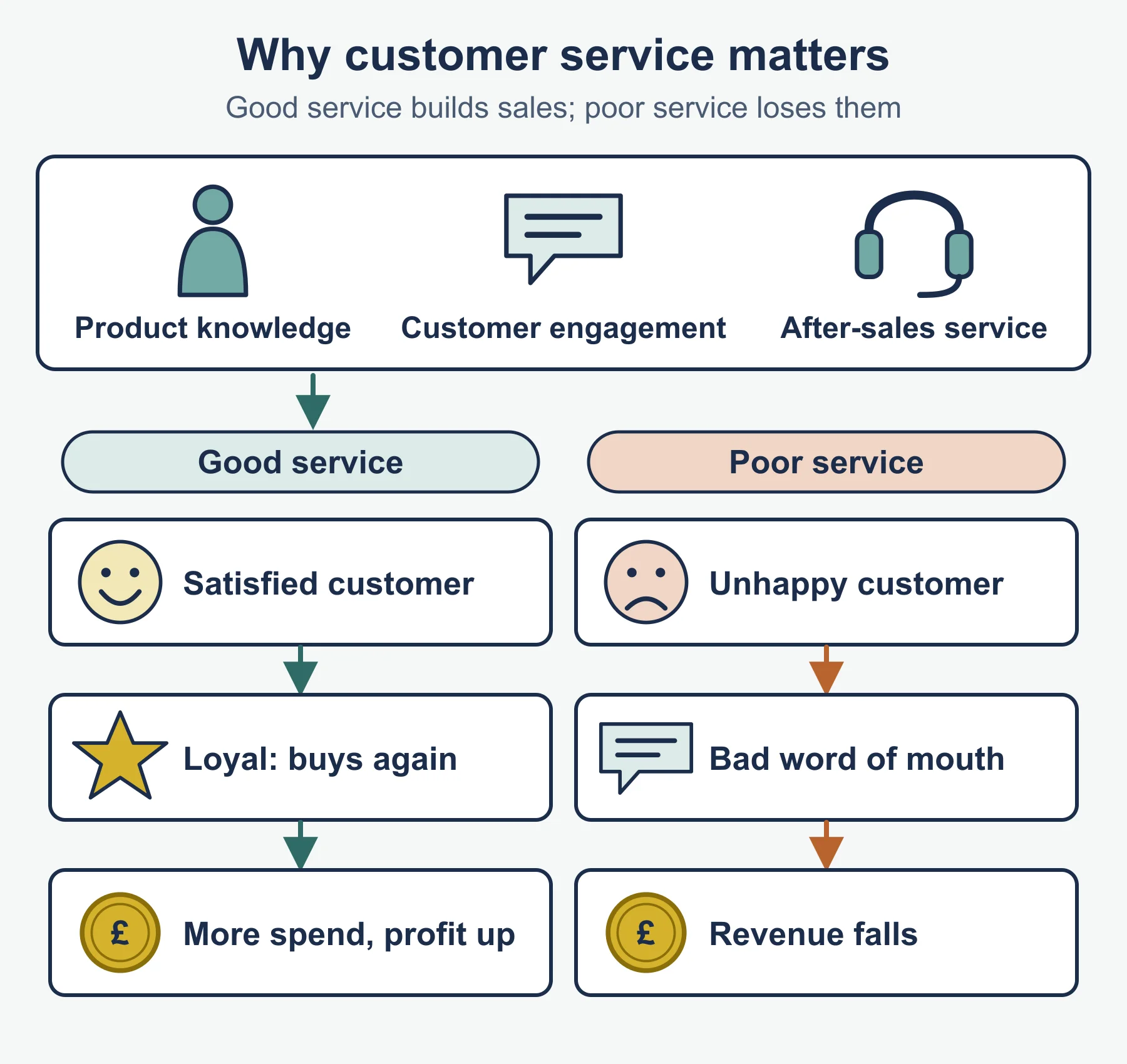
| Product knowledge | Staff can answer questions and advise on the best choice |
| Customer engagement | Greeting, listening, a positive experience |
| Post-sales services | User training, help lines, servicing |
Benefits: greater customer satisfaction, customer loyalty, increased spend, profitability.
Dangers of poor service: dissatisfied customers, a poor reputation through word of mouth, and a reduction in revenue.
Worked reminder. A café has 2,000 customers a month spending £9 each. Poor service loses 5%: 2,000 × 0.05 = 100 customers, so 100 × £9 = £900 lost a month, or £10,800 a year.
ICT has changed service: websites give information and support at any hour; e-commerce lets customers order online; social media allows quick two-way contact and public replies to complaints, which also means poor service becomes visible quickly.
Quick self-test
- Name the production method that makes one item to order.
- A firm has fixed costs of £20,000 and variable costs of £5 a unit. Calculate the unit cost at 4,000 units.
- State two features of lean production.
- Give one cost of JIT and one benefit of JIC.
- Name the three supplier factors in the specification.
- Define supply chain.
- Calculate the defect rate when 18 of 600 items are faulty.
- State one way TQM can reduce costs.
- Why might franchising put quality at risk?
- Give two post-sales services.
- State two dangers of poor customer service.
- Explain one way social media changes customer service.
Answers
- Job production.
- (20,000 + 5 × 4,000) / 4,000 = 40,000 / 4,000 = £10.
- Any two: little waste; low stock; fixing faults at source; removing unnecessary steps.
- JIT: more frequent deliveries and lost bulk-buying discounts. JIC: cost of holding buffer stock.
- Price, quality, reliability.
- The series of businesses and activities that take a product from raw materials to the customer.
- 18 / 600 × 100 = 3%.
- Fewer defects mean less waste and fewer costly recalls.
- The head office has less direct oversight of each outlet, so standards may vary.
- Any two: user training, help lines, servicing.
- Any two: dissatisfied customers, poor word-of-mouth reputation, reduced revenue.
- Customers can contact the business quickly and publicly, so a complaint can be answered fast, but a poor reply is seen by many people.
Where marks are usually lost
- Describing a technique without applying it to the business in the case study.
- Writing “JIT is cheaper” with no mention of delivery costs or the risk of late supplies.
- Mixing up production methods (job, flow) with stock methods (JIT, JIC).
- Giving unit cost as only the variable cost, forgetting fixed costs per unit.
- Naming a quality cost or benefit but not saying why it matters to that business.
- Treating the cheapest supplier as automatically best, ignoring quality and reliability.
- Saying “good customer service is polite” without a specific method such as product knowledge or post-sales support.
- Giving an evaluation with no judgement: weigh both sides, then decide and justify.
Frequently asked questions
What is the difference between job production and flow production? Job production makes one item at a time to order, which is flexible but slow with a high unit cost. Flow production makes large volumes of identical items continuously, giving a low unit cost but needing costly machinery and high demand.
What are the three factors in choosing a supplier for AQA GCSE Business (8132)? Price, quality and reliability. Analyse them together for the business in the case, because the cheapest supplier may deliver faulty goods or arrive late.
How do you calculate a defect rate? Divide the number of faulty items by the number of items produced and multiply by 100. For example, 45 faulty out of 1,500 gives a defect rate of 3%.
Are stock control charts in the AQA GCSE Business specification? No. Section 3.3.2 covers just in time and just in case stock management, but stock control charts are not required.
Official syllabus
AQA GCSE Business (8132) specification, first teaching September 2017, published by AQA: section 3.3 Business operations (3.3.1 to 3.3.4).
Get free revision emails (optional)
Occasional emails with practice questions, worked explanations and links to free resources for the qualification and subjects you choose. No spam, and you can unsubscribe from any email. The free tools on this site never need an email.
Related resources
-
Study guides
AQA GCSE Business: Business Operations (8132)
Production methods, procurement and stock management, quality, and customer service – the full content of Topic 3.3 for AQA GCSE Business (8132).
Business · AQA · GCSE
Read guide -
Practice questions
AQA GCSE Business: Business operations (8132) – Practice Questions
Original short-answer, calculation and case-study questions with worked answers on production, procurement, quality and service for AQA GCSE Business.
Business · AQA · GCSE
Try questions -
Study guides
AQA GCSE Business: Competitive environment (8132)
Study guide to AQA GCSE Business 8132 section 3.2.6: markets and competition, little or no competition, uncertainty and risk, and how entrepreneurs reduce risk.
Business · AQA · GCSE
Read guide
Related articles
-
teaching
A Level tuition in Dubai: Cambridge or Pearson Edexcel International A Level?
Schools in Dubai and Abu Dhabi teach either Cambridge International AS & A Level or Pearson Edexcel International A Level. How the two are structured, why it matters for tuition, and how online classes from Lahore work.
9 October 2026
-
curriculum guides
Choosing subjects at IGCSE and A Level
How subject choices at 14 and 16 affect university options later, and how to keep pathways open without overloading a timetable.
28 July 2026
Studying this with a teacher
Working through Business GCSE?
This page is free and stays free. If you would rather be taught it, Marlbridge runs Business classes one-to-one and in small groups of up to 15, online in your own time zone. The first trial class is free. WhatsApp replies within an hour (8am–11pm Pakistan time, every day); email the same day.
AQA Business teachers at Marlbridge
