
Study Guides
AQA GCSE Business: Ethical and environmental considerations and The economic climate on businesses (8132)
A full study guide to ethics, the environment, sustainability, interest rates, employment and consumer spending for AQA GCSE Business 8132.
- Subject
- Business
- Level
- GCSE
- Topic
- Influences on business
- Author
- Marlbridge Academic Team
- Updated
- Reviewed by
- Salman Ahmad (what this means)
Aligned to AQA GCSE Business (8132), For first teaching from September 2017. Official specification .
Syllabus page (what it covers and how it is assessed): AQA GCSE Business.
Syllabus points this page covers
8132
- 3.2.2 Ethical and environmental considerations
- 3.2.3 The economic climate on businesses
Found an error? Report a correction.
Need help with this topic? Request a free trial class for GCSE Business (8132).
This guide covers sections 3.2.2 (Ethical and environmental considerations) and 3.2.3 (The economic climate on businesses) of the AQA GCSE Business (8132) specification, for first teaching from September 2017. Influences on business is assessed in both written papers, so these ideas can turn up in either one. The specification asks you to think about the effect of each influence on the four functional areas: business operations, human resources, marketing and finance.
Related pages: course hub, printable checklist, revision notes for this unit, practice questions for this unit, technology and ethics guide and stakeholders in the real world. To find weak spots first, try the free diagnostics.
What the specification lists
| Section | Content you must cover | What you must be able to do |
|---|---|---|
| 3.2.2 | Ethical considerations | Identify and analyse a possible trade off between ethics and profit; know examples, benefits and drawbacks |
| 3.2.2 | Environmental considerations: traffic congestion, recycling, disposing of waste, noise and air pollution | Show how business and consumers accept greater environmental responsibility; know the costs and benefits |
| 3.2.2 | Sustainability: global warming, using scarce resources | Identify and analyse a possible trade-off between sustainability and profit |
| 3.2.3 | Interest rates, including overdrafts and loans, and consumer and business spending | Show how businesses might be affected by changes in the rate of interest |
| 3.2.3 | Level of employment | Identify how and why businesses might be affected by changes in levels of employment |
| 3.2.3 | Consumer spending | Discuss how demand may change as incomes fluctuate |
The specification says economic theory about how or why interest rates change is not required. You need the effects, not the causes.
Ethical considerations
The specification says ethical behaviour requires a business to act in ways that stakeholders consider to be both fair and honest. The test is what stakeholders think, so always ask which stakeholder group is judging: customers, employees, suppliers, owners, the local community.
Ways a business can behave ethically (you are expected to know relevant examples):
- Paying suppliers a price that lets them pay their own workers properly.
- Describing products honestly in advertising and on packaging.
- Paying employees fairly and giving them safe conditions.
- Treating customers fairly when something goes wrong, for example by refunding promptly.
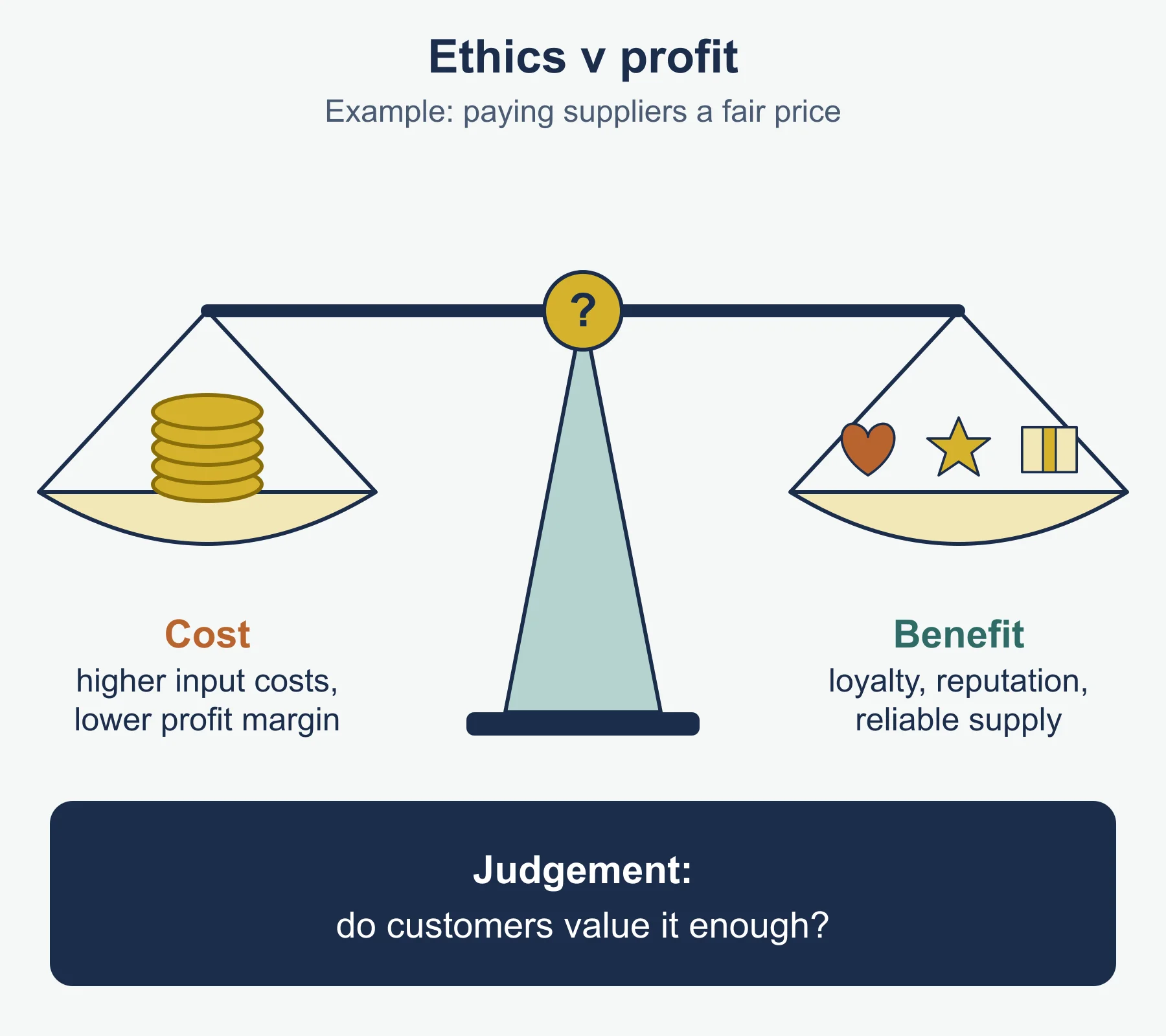
Benefits can include a better reputation, more loyal customers, staff who are easier to recruit and keep, and good relations with suppliers. Drawbacks can include higher costs, higher prices that may put customers off, and lower profit in the short run.
The trade off between ethics and profit
A trade off means gaining one thing costs you another. Ethical choices often cost money, so profit may fall, but the reputation gained may protect sales. Your job is to weigh the two for the business in the question.
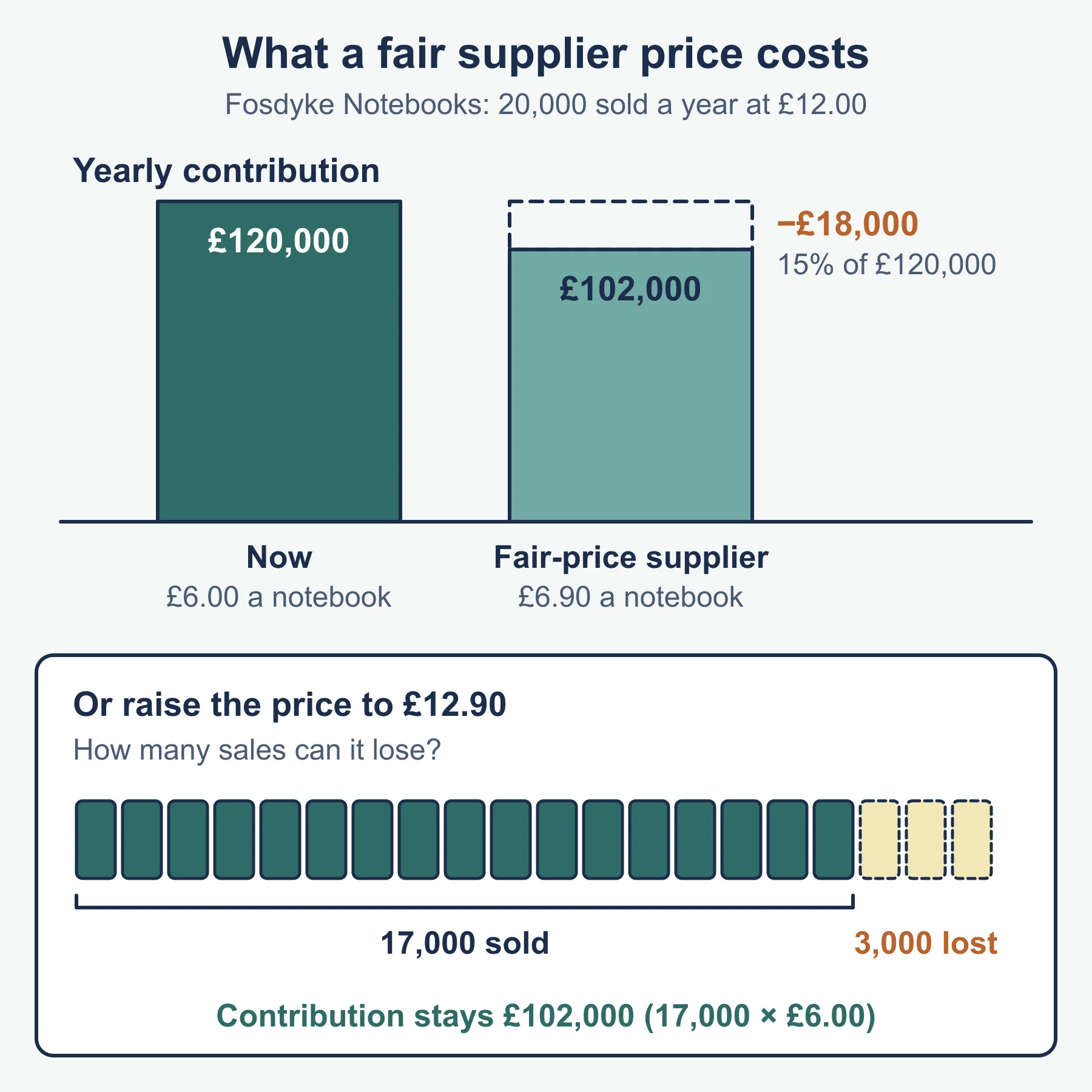
Worked example. Fosdyke Notebooks sells 20,000 hand-bound notebooks a year at £12.00. Each costs £6.00 to buy in. Its supplier asks for £6.90 a notebook so it can pay a fair wage to its binders.
- Contribution now: 20,000 × (£12.00 − £6.00) = £120,000.
- If Fosdyke accepts the new cost and keeps the price: 20,000 × (£12.00 − £6.90) = £102,000.
- Fall in contribution: £18,000, which is 15% of £120,000.
- Fosdyke could raise the price by £0.90 to £12.90 and keep £6.00 per notebook. Sales can then fall to 17,000 before it does worse than the £102,000 in step 2 (£102,000 ÷ £6.00 = 17,000). That is a 15% fall in sales.
Judgement: if loyal customers value fair treatment of workers, the price rise is likely to lose fewer than 15% of sales, so Fosdyke can behave ethically and protect most of its profit. If its buyers choose mainly on price, the risk is higher. Notice that the answer uses the figures, names the stakeholders (customers, the supplier’s workers) and ends with a judgement.
Environmental considerations
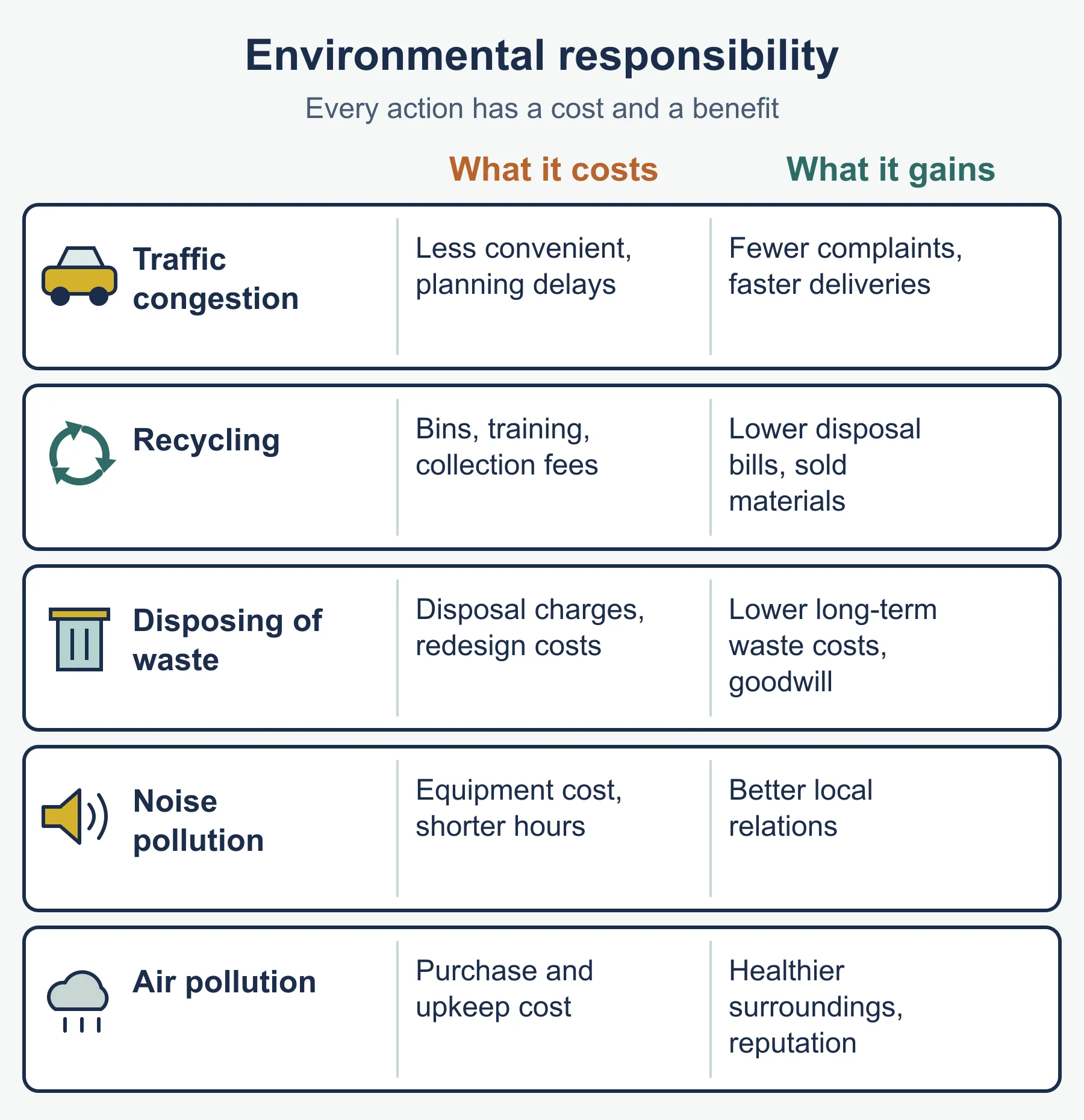
The specification lists five areas. For each, think about what the business does, what it costs and what it gains.
| Area | How the business affects it | Responsible action | Possible cost | Possible benefit |
|---|---|---|---|---|
| Traffic congestion | Deliveries, customers and staff add vehicles to local roads | Off-peak deliveries, car park management, staff travel schemes | Less convenient for customers, planning delays | Fewer complaints, faster deliveries |
| Recycling | Materials thrown away that could be reused | Sorting waste, using recycled materials | Bins, training, collection fees | Lower disposal bills, income from sold materials, image |
| Disposing of waste | Rubbish, packaging, chemicals must go somewhere | Cutting packaging, using approved disposal | Disposal charges, redesign costs | Lower long-term waste costs, community goodwill |
| Noise pollution | Machinery, late deliveries, events | Quieter machines, restricted hours | Equipment cost, shorter operating hours | Better local relations |
| Air pollution | Vehicle and factory emissions | Cleaner vehicles, filters | Purchase and maintenance cost | Healthier surroundings, reputation |
Business and consumers both take responsibility. Businesses change what they make, how they package it and how they deliver it. Consumers choose products with less packaging, refuse unnecessary bags, repair rather than replace, and share journeys. When enough consumers do this, businesses that ignore it lose sales, so responsibility spreads through the market.
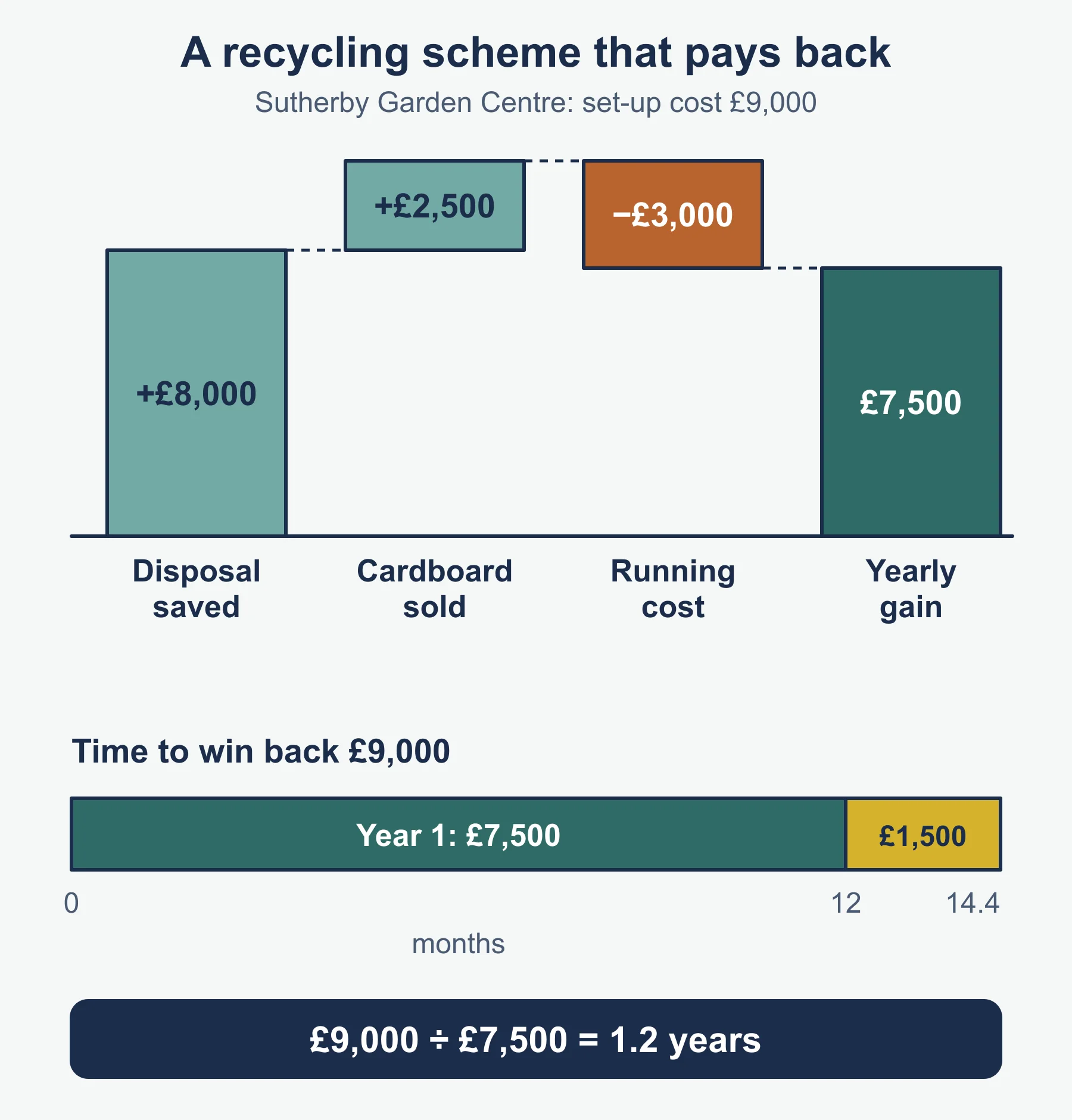
Worked example. Sutherby Garden Centre spends £14,000 a year on waste disposal. A recycling scheme costs £9,000 to set up and £3,000 a year to run. It cuts disposal costs by £8,000 a year and earns £2,500 a year from selling cardboard.
- Yearly gain: £8,000 + £2,500 − £3,000 = £7,500.
- Time to recover set-up cost: £9,000 ÷ £7,500 = 1.2 years, or 14.4 months.
- Benefits beyond cash: a better image with customers who care about the environment. Costs beyond cash: staff time to sort materials.
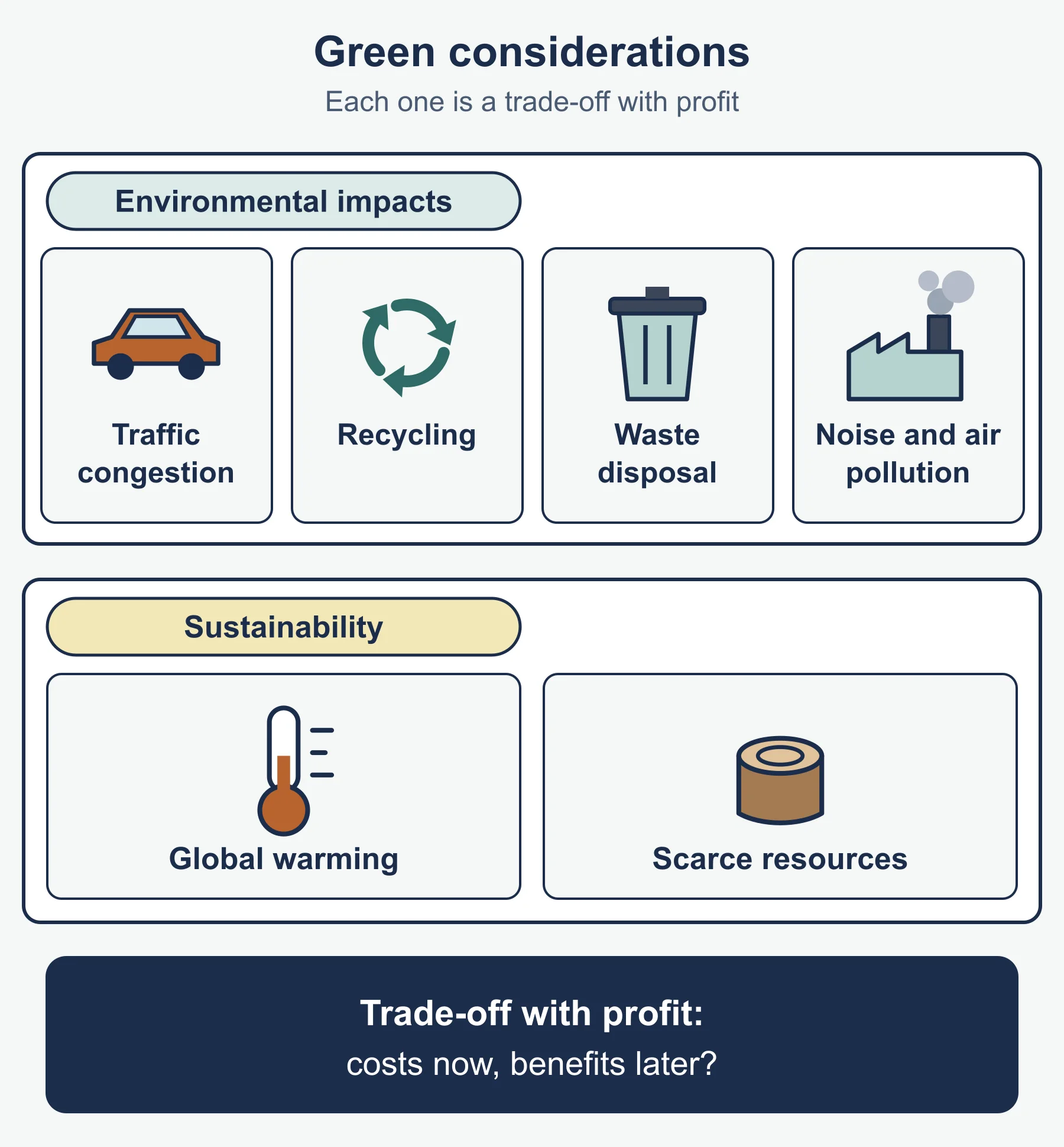
Here the environmental choice also saves money, so there is no real trade off. Not every case is like this. A new, larger site may bring in more customers but more traffic, noise and air pollution for neighbours. Always ask whether the benefits and costs fall on the same people.
Sustainability
The specification names two areas: global warming and using scarce resources. In general terms, sustainability means meeting today’s needs without damaging the ability of future generations to meet theirs. The specification does not give a formal definition, so use this plain meaning.
- Global warming: a business can cut the energy it burns, switch to cleaner energy or reduce emissions from transport. These steps may cost money now.
- Using scarce resources: a business can use less of a limited material, reuse it or switch to renewable inputs. The scarcer a resource becomes, the more expensive it tends to get, so using less of it can protect future costs.
The trade-off between sustainability and profit is usually short-term cost against long-term benefit. A sustainable choice may lower profit this year but may cut costs later and keep customers who care about the issue. Compare the length of time the owners are willing to wait, the cash available now and what rivals are doing.
Interest rates
The interest rate is the cost of borrowing and the reward for saving. You do not need to explain why it changes. You do need to explain what happens when it does.
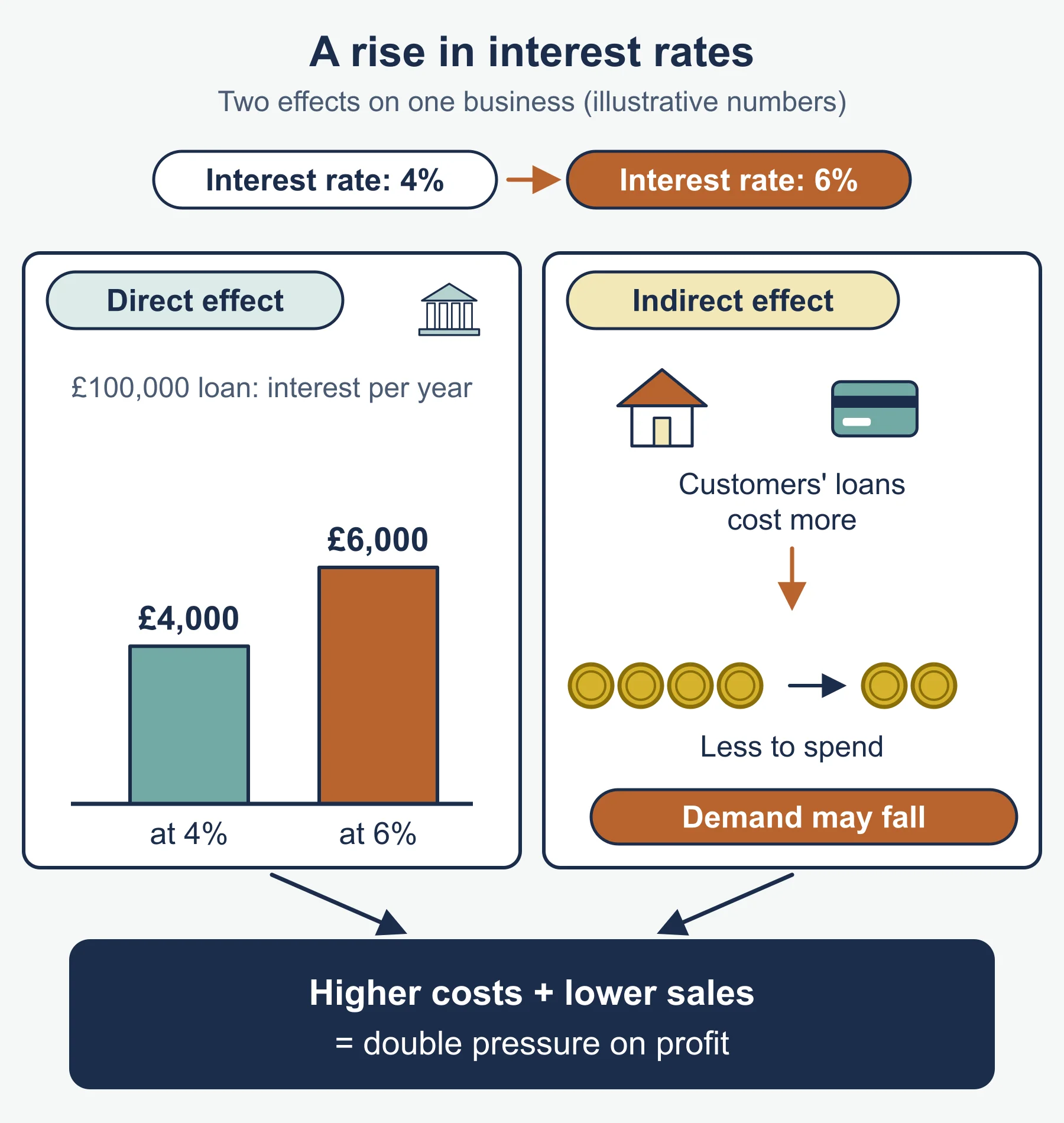
Businesses that rely on overdrafts and loans. A higher rate means higher interest payments, which cuts profit and cash flow (finance). A business may delay new equipment or hiring. A lower rate does the opposite: borrowing is cheaper, so investment is easier.
Consumer and business spending. When rates rise, borrowing for big purchases costs more and saving pays more, so some households spend less. Businesses also invest less. Demand for goods bought on credit, such as cars, furniture and holidays, tends to fall most. Businesses may then need to change marketing, cut prices or reduce output (operations).
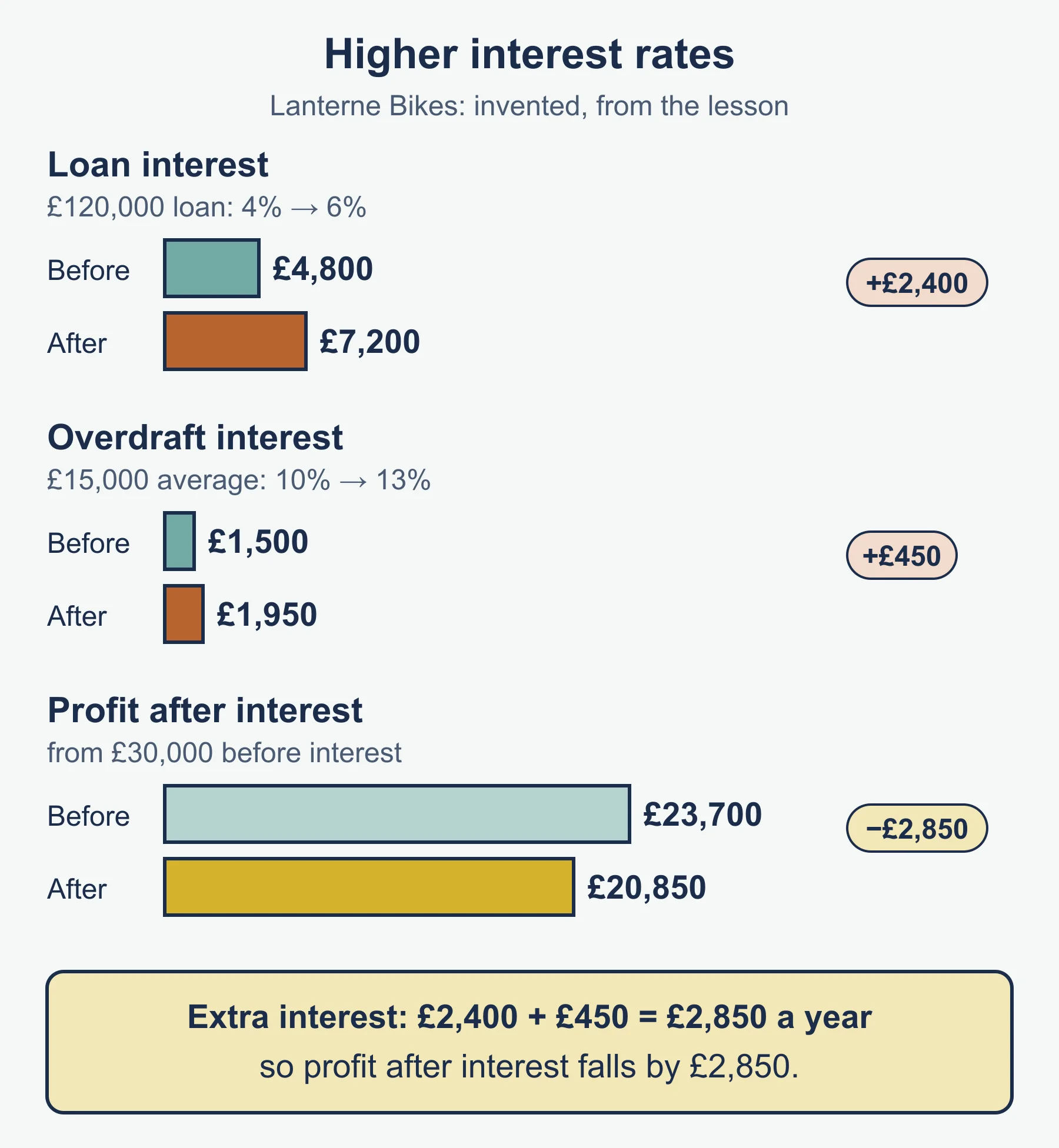
Worked example. Lanterne Bikes has a loan of £120,000 and an average overdraft of £15,000. Its profit before interest is £30,000. The loan rate rises from 4% to 6% and the overdraft rate from 10% to 13%.
- Loan interest: £4,800 rises to £7,200, an increase of £2,400 a year (£200 a month).
- Overdraft interest: £1,500 rises to £1,950, an increase of £450.
- Total extra interest: £2,850 a year.
- Profit after interest: £30,000 − £4,800 − £1,500 = £23,700 before; £30,000 − £7,200 − £1,950 = £20,850 after.
- Customers buying bikes on credit also face higher costs, so Lanterne may sell fewer bikes at the same time as its own costs rise.
Level of employment
The level of employment is how many people in the economy have jobs.
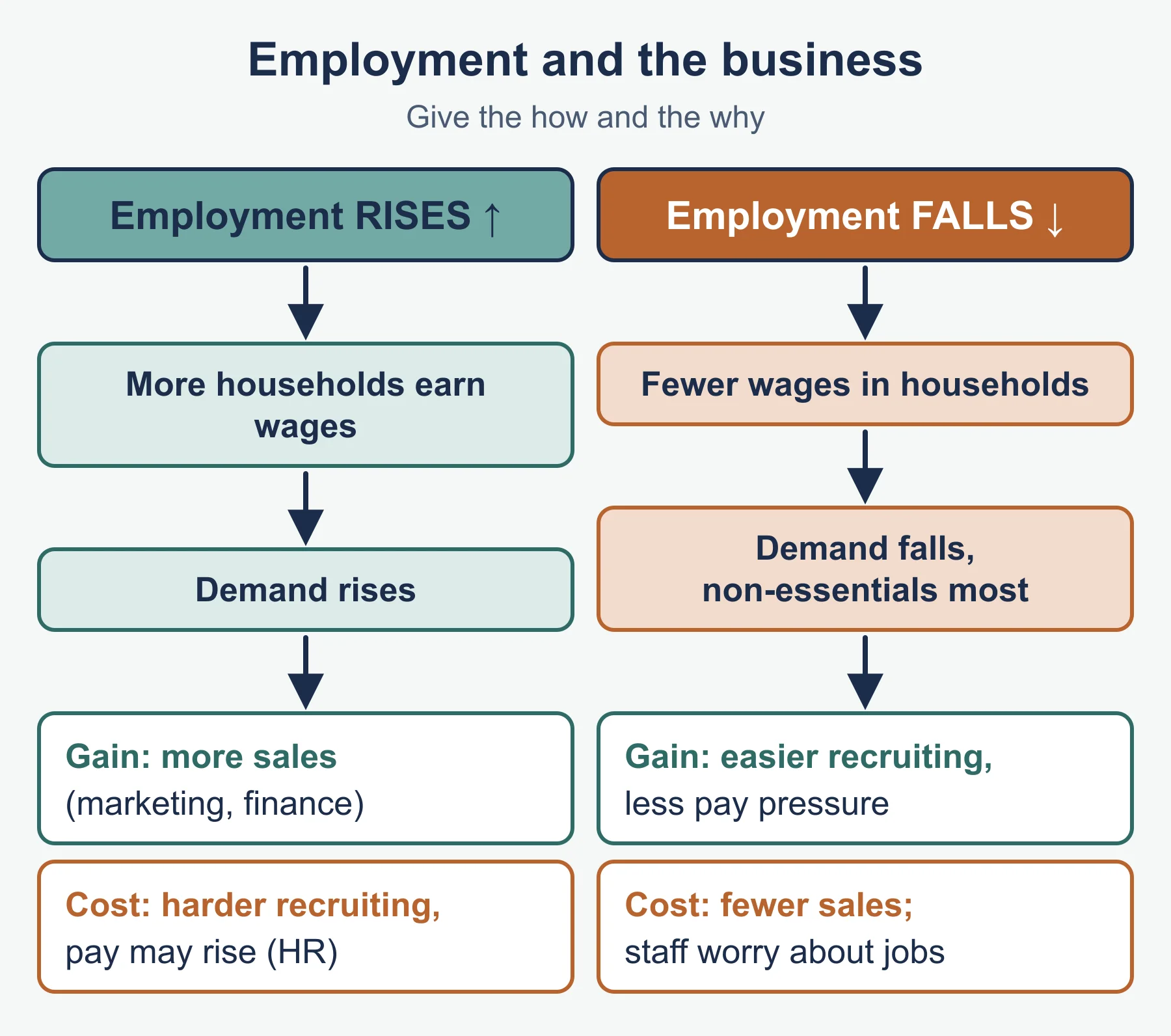
- When employment rises: more households have wages, so demand rises (marketing and finance gain). But recruiting is harder, and pay may need to rise to attract and keep staff (human resources).
- When employment falls: household incomes drop and demand falls, especially for non-essential goods. Recruiting is easier and pay pressure is lower, but staff may worry about their own jobs.
Give the how and the why: a fall in employment means fewer wages, so fewer sales.
Consumer spending and incomes
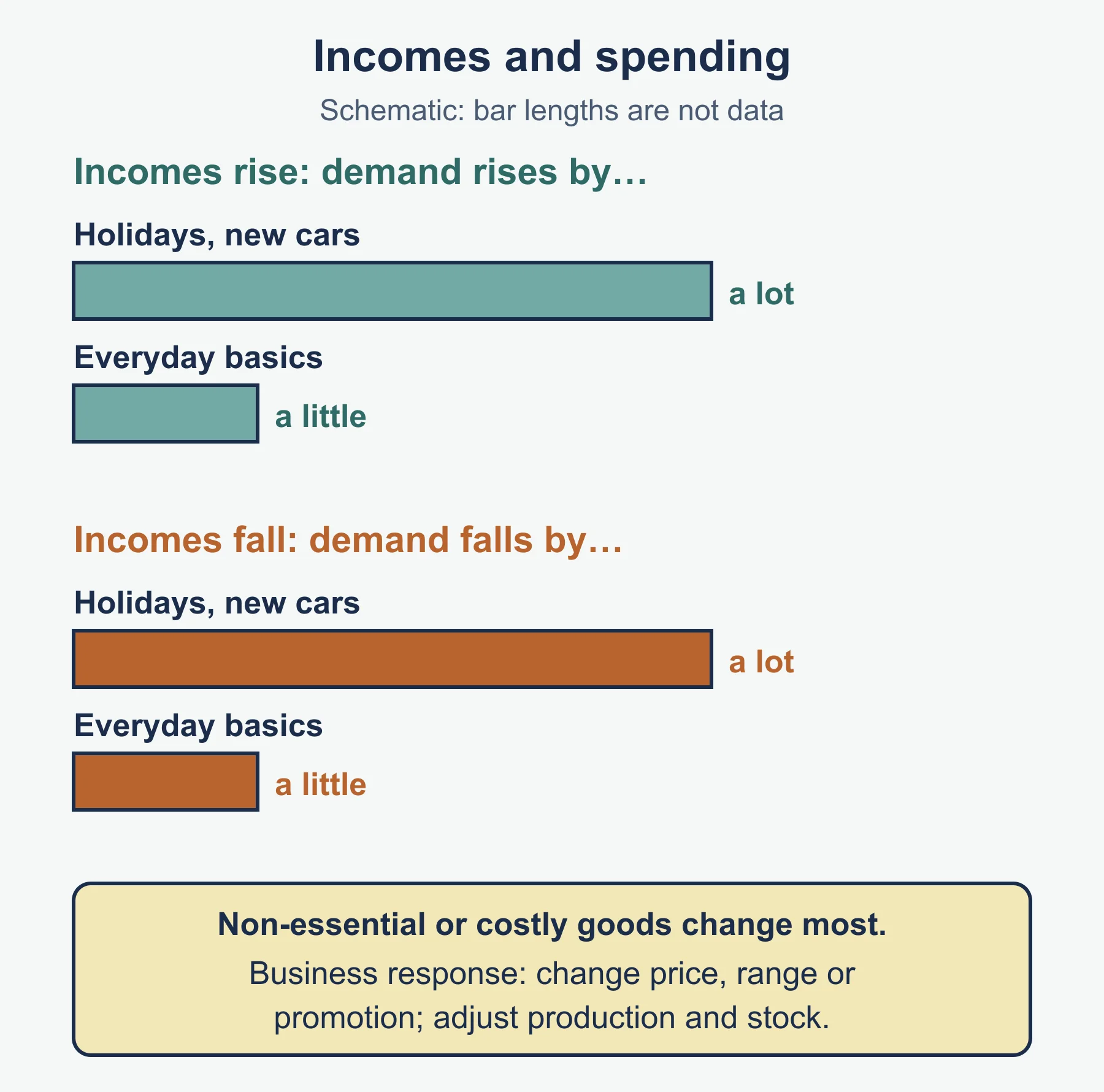
When incomes rise, people can spend more, and demand for many products grows. When incomes fall, spending is cut. In general terms, goods and services that people see as non-essential, or that cost a lot, such as holidays and new cars, change most with incomes. Everyday basics change less. Discuss by comparing the two, and say what the business should do: change prices, range or promotion, or adjust production and stock.
Common errors
- Writing “ethical” when you mean “legal”. The specification test is fair and honest in the eyes of stakeholders.
- Listing environmental benefits without a cost, or the reverse.
- Explaining why interest rates change. That is not required.
- Saying “higher interest rates are bad”. They hurt borrowers but reward savers, so say which business you mean.
- Skipping the judgement on a trade-off question.
Frequently asked questions
What is the trade off between ethics and profit? Ethical choices such as paying suppliers fairly often raise costs, so profit can fall in the short run. The benefit may be a better reputation and more loyal customers, so the judgement depends on how much customers value fair treatment.
Which sections of AQA GCSE Business (8132) does this guide cover? Section 3.2.2 Ethical and environmental considerations and section 3.2.3 The economic climate on businesses, which covers interest rates, the level of employment and consumer spending.
How does consumer spending change when incomes fall? Spending falls, especially on non-essentials and expensive items such as fitted kitchens, while demand for basics falls least.
Are higher interest rates always bad? No. They raise costs for borrowers but reward savers, so an answer should say who is affected and how.
Official syllabus
AQA GCSE Business (8132) specification, for first teaching from September 2017, published by AQA. Sections 3.2.2 and 3.2.3.
Get free revision emails (optional)
Occasional emails with practice questions, worked explanations and links to free resources for the qualification and subjects you choose. No spam, and you can unsubscribe from any email. The free tools on this site never need an email.
Related resources
-
Practice questions
AQA GCSE Business: Ethical and environmental considerations and The economic climate on businesses (8132) – Practice Questions
Original practice questions with worked answers on ethics, environment, sustainability, interest rates, employment and spending for AQA GCSE Business.
Business · AQA · GCSE
Try questions -
Revision notes
AQA GCSE Business: Ethical and environmental considerations and The economic climate on businesses (8132) – Revision Notes
Condensed recall notes on ethics, environmental considerations, sustainability, interest rates, employment and spending for AQA GCSE Business 8132.
Business · AQA · GCSE
Revise topic -
Study guides
AQA GCSE Business: Globalisation and Legislation (8132)
Study guide to globalisation, exchange rates and business law for AQA GCSE Business (8132), sections 3.2.4 and 3.2.5, with worked examples.
Business · AQA · GCSE
Read guide
Related articles
-
teaching
A Level tuition in Dubai: Cambridge or Pearson Edexcel International A Level?
Schools in Dubai and Abu Dhabi teach either Cambridge International AS & A Level or Pearson Edexcel International A Level. How the two are structured, why it matters for tuition, and how online classes from Lahore work.
9 October 2026
-
curriculum guides
Choosing subjects at IGCSE and A Level
How subject choices at 14 and 16 affect university options later, and how to keep pathways open without overloading a timetable.
28 July 2026
Studying this with a teacher
Working through Business GCSE?
This page is free and stays free. If you would rather be taught it, Marlbridge runs Business classes one-to-one and in small groups of up to 15, online in your own time zone. The first trial class is free. WhatsApp replies within an hour (8am–11pm Pakistan time, every day); email the same day.
AQA Business teachers at Marlbridge
