
Study Guides
AQA GCSE Business: Globalisation and Legislation (8132)
Study guide to globalisation, exchange rates and business law for AQA GCSE Business (8132), sections 3.2.4 and 3.2.5, with worked examples.
- Subject
- Business
- Level
- GCSE
- Topic
- Influences on business
- Author
- Marlbridge Academic Team
- Updated
- Reviewed by
- Salman Ahmad (what this means)
Aligned to AQA GCSE Business (8132), For first teaching from September 2017. Official specification .
Syllabus page (what it covers and how it is assessed): AQA GCSE Business.
Syllabus points this page covers
8132
- 3.2.4 Globalisation
- 3.2.5 Legislation
Found an error? Report a correction.
Need help with this topic? Request a free trial class for GCSE Business (8132).
This guide covers the AQA GCSE Business (8132) specification, section 3.2.4 Globalisation and section 3.2.5 Legislation, both part of 3.2 Influences on business. The specification says students must be aware of the impact of influences on the four functional areas: business operations, human resources, marketing and finance. Influences on business is listed as assessed on both written papers. The specification gives no tier labels for these sections, so everything here applies to every candidate.
Related pages: revision notes | practice questions | Technology and ethical/environmental considerations | course hub | printable checklist | free diagnostics
What the specification asks for
| Section | Content you must know | What you must be able to do |
|---|---|---|
| 3.2.4 | How UK businesses compete internationally: better designs, higher quality products at lower prices | Show knowledge and understanding of globalisation and its benefits and drawbacks for UK businesses |
| 3.2.4 | Exchange rates | Understand the effect on profit and sales of businesses that import and/or export. You are not asked to calculate exchange rate conversions |
| 3.2.5 | Employment law: national minimum wage/living wage, the Equality Act (2010) | Assess the impact of legislation on businesses: cost, training needs, recruitment, consequences of failure to follow it |
| 3.2.5 | Health and safety law: the Health and Safety at Work Act (1974) | Be aware of the benefits of a safe working environment |
| 3.2.5 | Consumer law, including trade descriptions | Only brief knowledge of each law is needed. More emphasis goes on the effects on businesses |
3.2.4 Globalisation
What globalisation means
The specification does not give a one-line definition, so here is the standard one. Globalisation is the growing connection between the economies and markets of the world, so that goods, services, money, ideas and people move across borders more easily. For a UK business it means the world is both a bigger market to sell into and a bigger field of rivals.
How UK businesses compete internationally
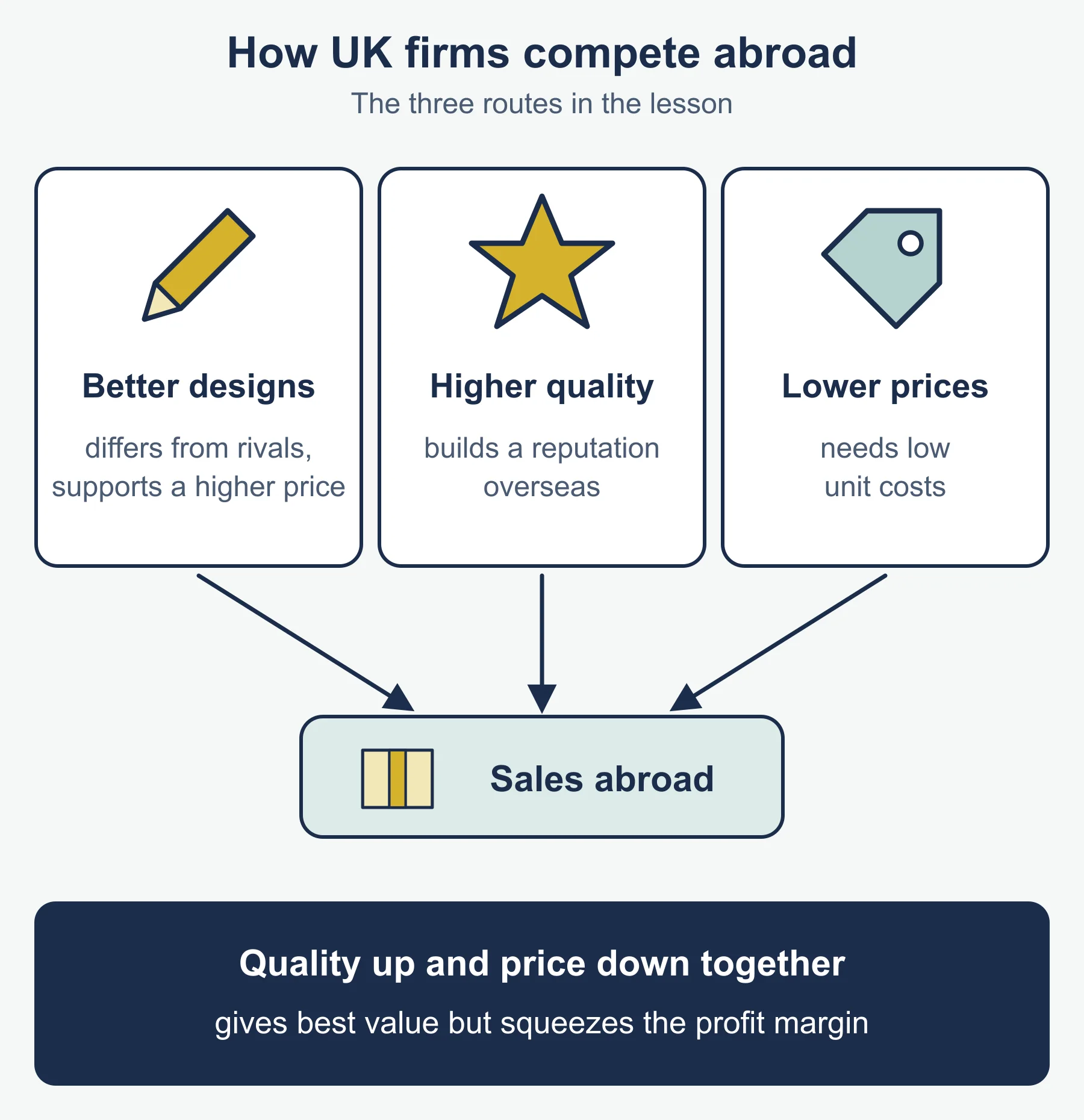
The specification lists two bullets: better designs, and higher quality products at lower prices. To analyse them, it helps to split the ideas into design, quality and price and treat each as a separate point.
- Better designs. A product that looks, feels or works differently from foreign rivals can earn sales abroad even if it costs more. Design is a form of differentiation, so it supports a higher price.
- Higher quality products. Reliable materials, careful finishing and good after-sales service build a reputation overseas. This is usually the strongest route for a UK maker whose labour costs are higher than those of rivals in some other countries.
- Lower prices. Price competition needs low unit costs, for example from bulk buying, large-scale production or cheaper imported components.
The specification pairs quality with lower prices, so the strongest firms offer good value: quality and price together. Be ready to explain why this is hard. A business that pushes its price down and its quality up at the same time squeezes its profit margin.
Benefits and drawbacks for UK businesses
| Benefits | Drawbacks | |
|---|---|---|
| Sales | Larger market through exports; sales are less tied to one economy | Foreign rivals can enter the UK market and take customers |
| Costs | Cheaper components or products from abroad; larger output can lower unit costs | Longer supply chains, transport costs and delays |
| Other | New ideas, skills and designs; a wider choice of suppliers | Language, cultural and legal differences; exchange rate changes; reputation risk if an overseas supplier behaves unethically |
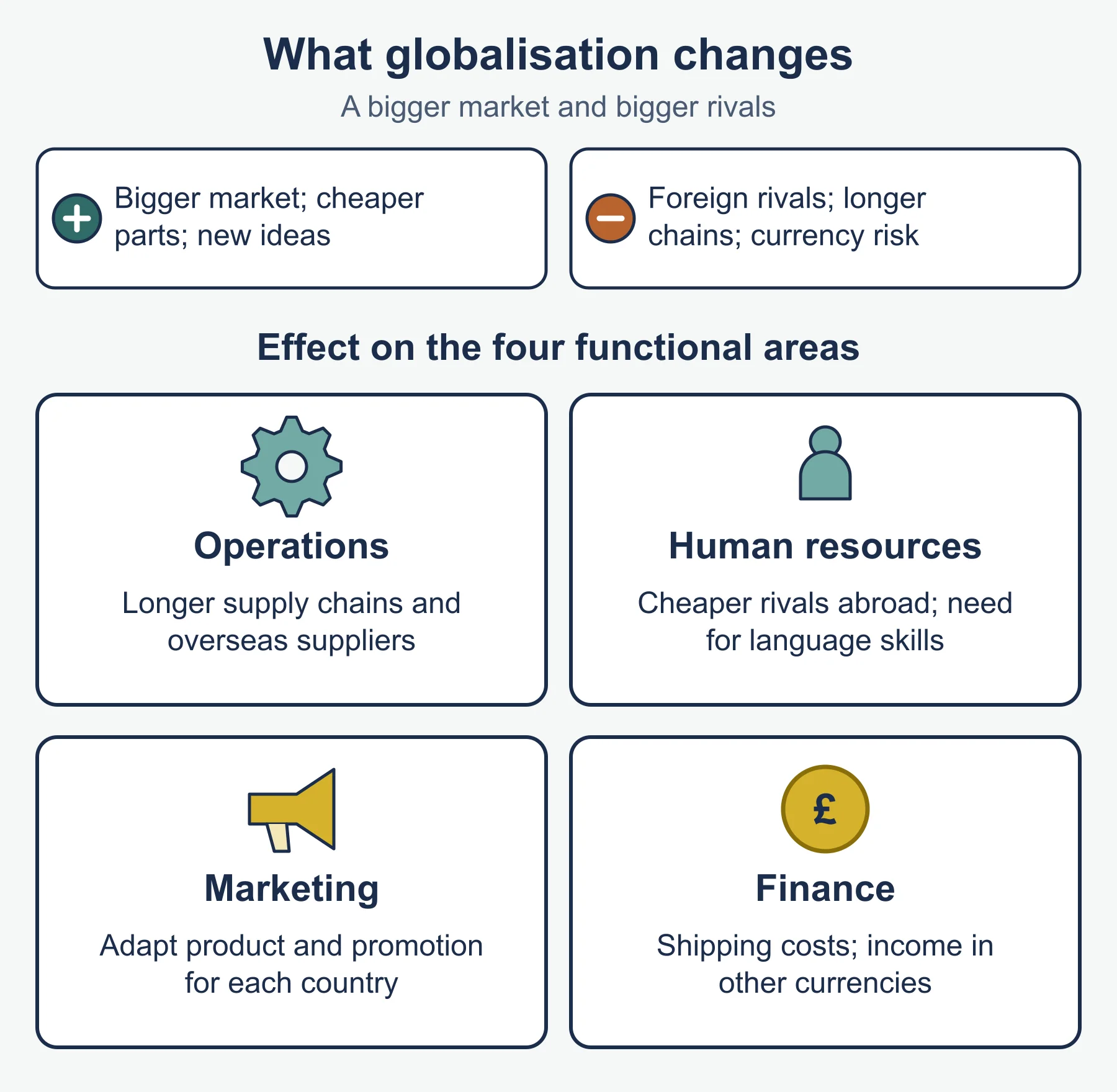
Effect on the four functional areas
- Operations: sourcing from overseas suppliers, managing longer supply chains, and perhaps producing abroad.
- Human resources: competing with cheaper overseas labour may push a firm to cut jobs or retrain staff; it may also need staff with language skills.
- Marketing: adapting the product, packaging and promotion for different countries, and selling online to overseas customers.
- Finance: higher costs of shipping and insurance, income in other currencies, and the risk of exchange rate swings.
Exchange rates
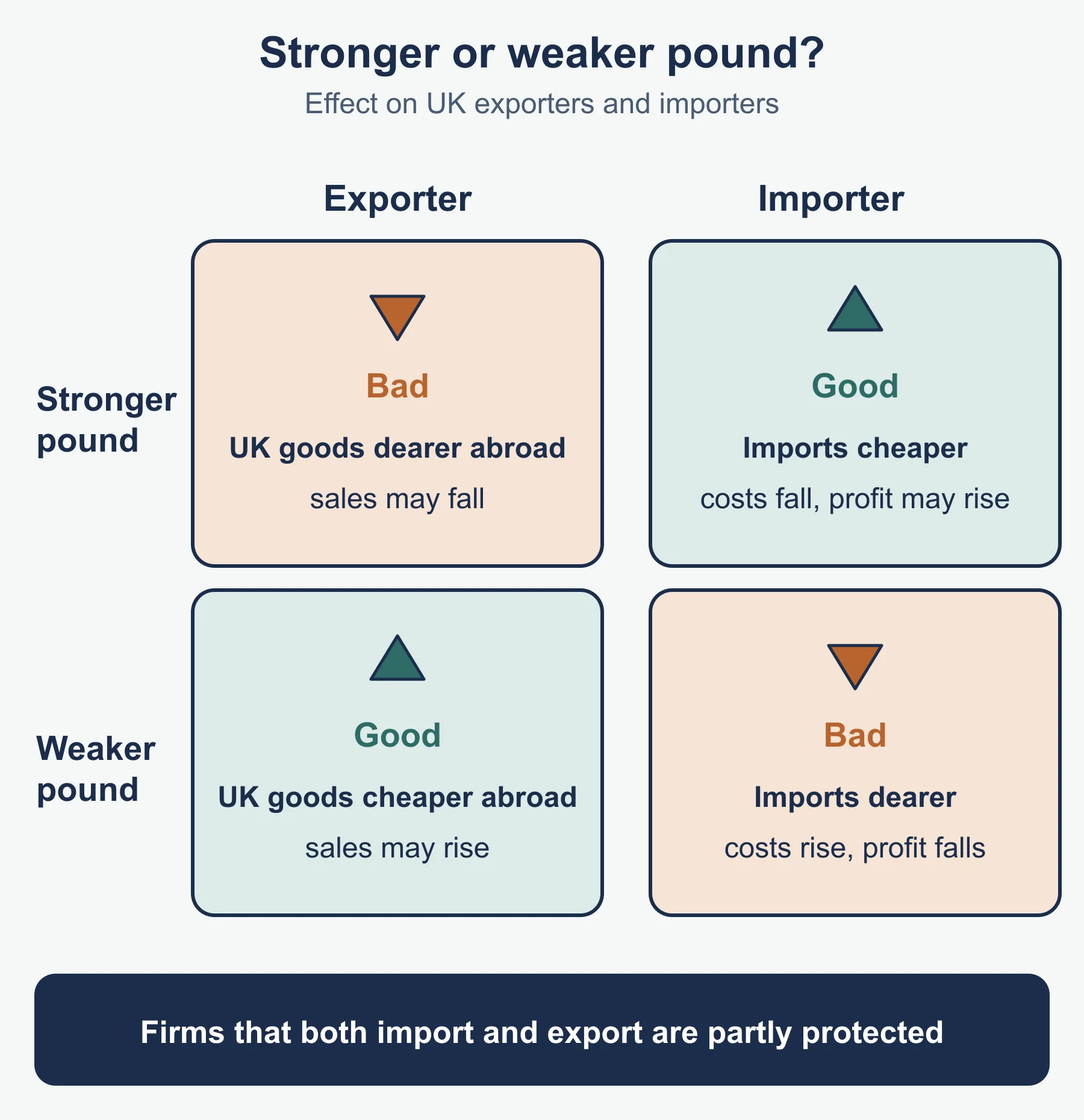
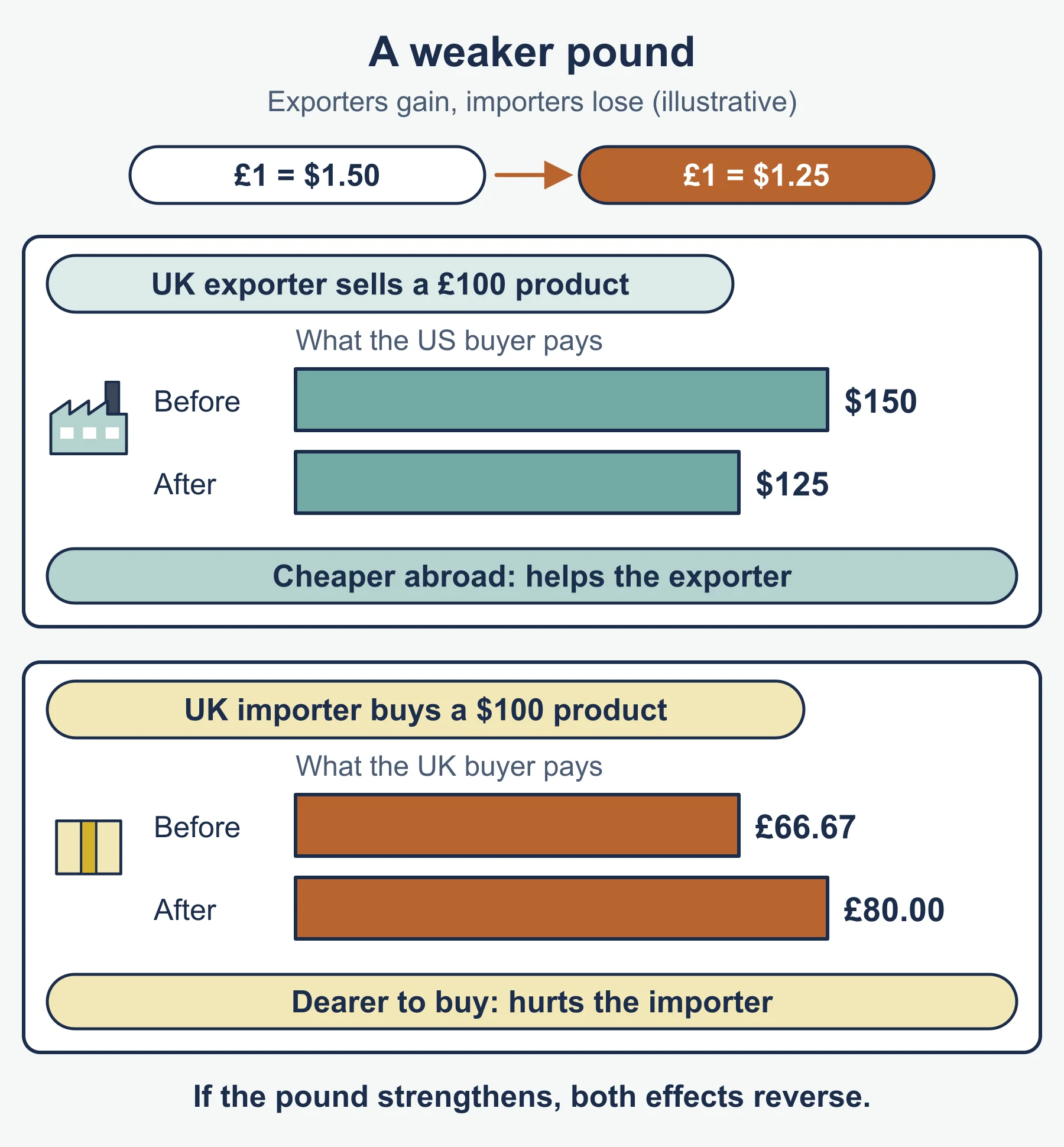
An exchange rate tells you how much of one currency you must pay to obtain a unit of another. If the pound becomes stronger, each pound buys more foreign currency. If the pound becomes weaker, each pound buys less. The specification says you will not be asked to do conversion calculations, so you only need the direction of the effect and its consequences.
| Pound is… | Exporter | Importer |
|---|---|---|
| Stronger | UK goods become dearer for overseas buyers. Sales may fall, or the firm cuts its price and profit per item falls | Imports become cheaper. Costs fall and profit may rise, or the firm can cut prices |
| Weaker | UK goods become cheaper abroad. Sales may rise | Imports become dearer. Costs rise and profit falls unless prices go up |
Many firms both import and export, so the two effects partly cancel. A business that buys parts abroad and sells finished goods abroad is more protected than one that does only one of them.
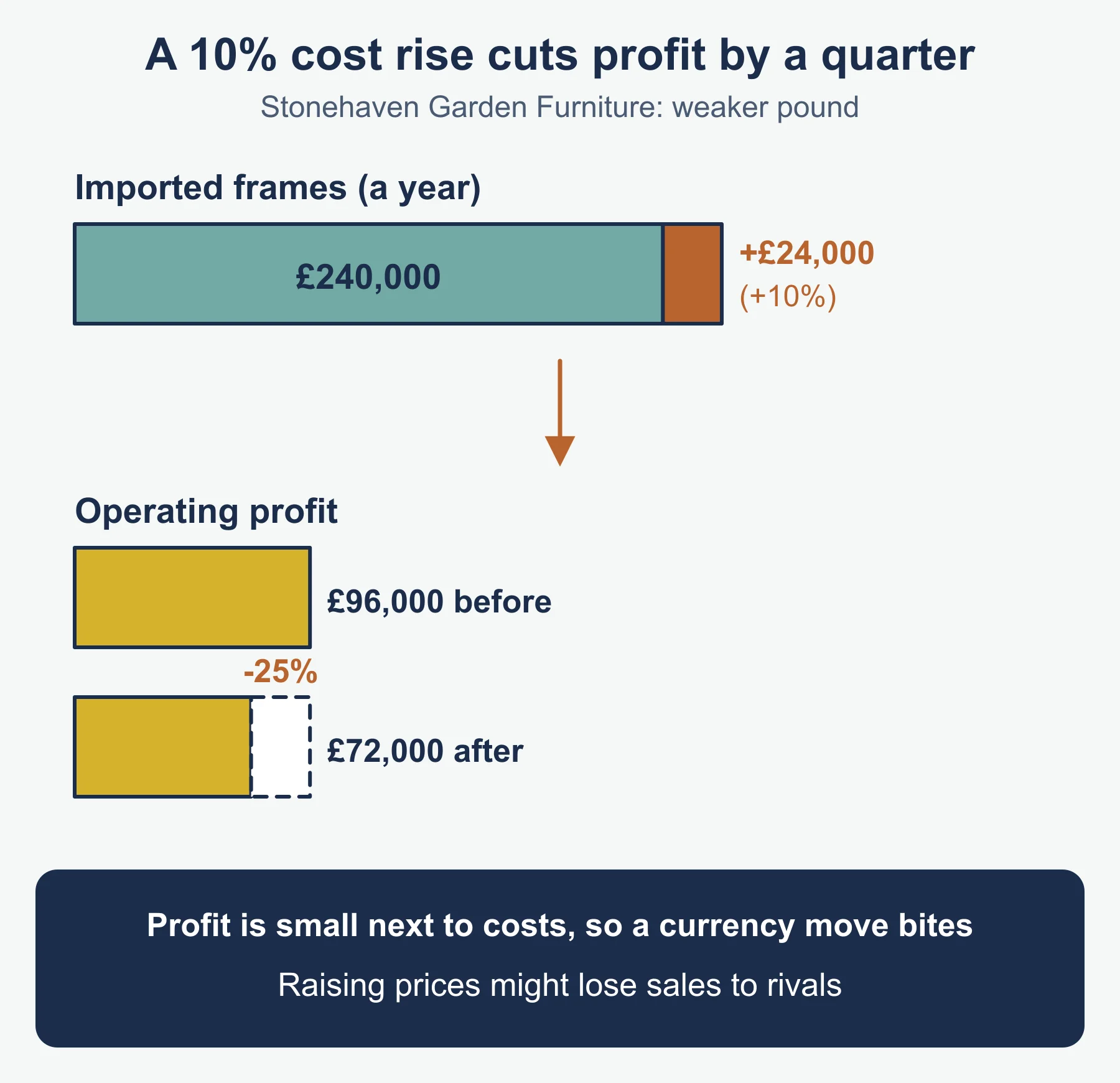
Worked example 1: an importer. Stonehaven Garden Furniture assembles tables in the UK from imported steel frames. Frames cost £240,000 a year. Operating profit is £96,000. The pound weakens and the frame bill rises by 10% with no change in volume.
- Extra cost = 10% of £240,000 = £24,000.
- New frame bill = £264,000.
- If Stonehaven keeps its prices, profit falls to £96,000 - £24,000 = £72,000.
- The fall is £24,000 out of £96,000, which is 25% of profit.
A 10% rise in one cost has cut profit by a quarter. This is the point to make in a case study: when profit is small compared with costs, a currency move has a large effect on profit. Stonehaven could raise prices, but that might lose sales to rivals.
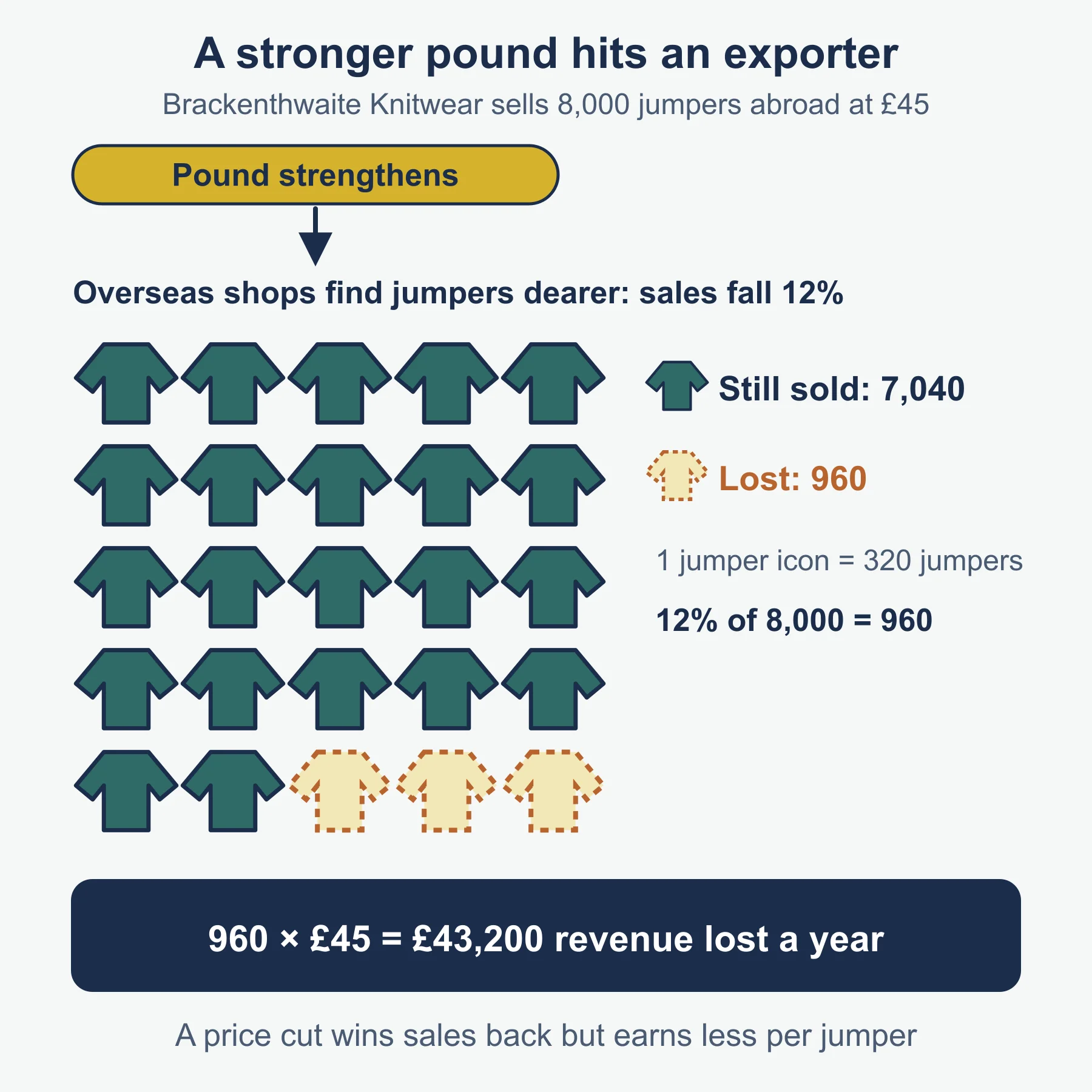
Worked example 2: an exporter. Brackenthwaite Knitwear sells 8,000 jumpers a year abroad for £45 each. The pound strengthens, and overseas shops find the jumpers dearer. Sales fall by 12%.
- Lost sales = 12% of 8,000 = 960 jumpers.
- New sales = 7,040 jumpers.
- Sales revenue lost = 960 x £45 = £43,200 a year.
The firm could cut its price to win back sales, but then each jumper earns less profit. It could also look for suppliers whose prices fall when the pound is strong, such as imported wool. Both answers show the same skill: link the exchange rate to sales, then to profit.
3.2.5 Legislation
Why law matters to a business
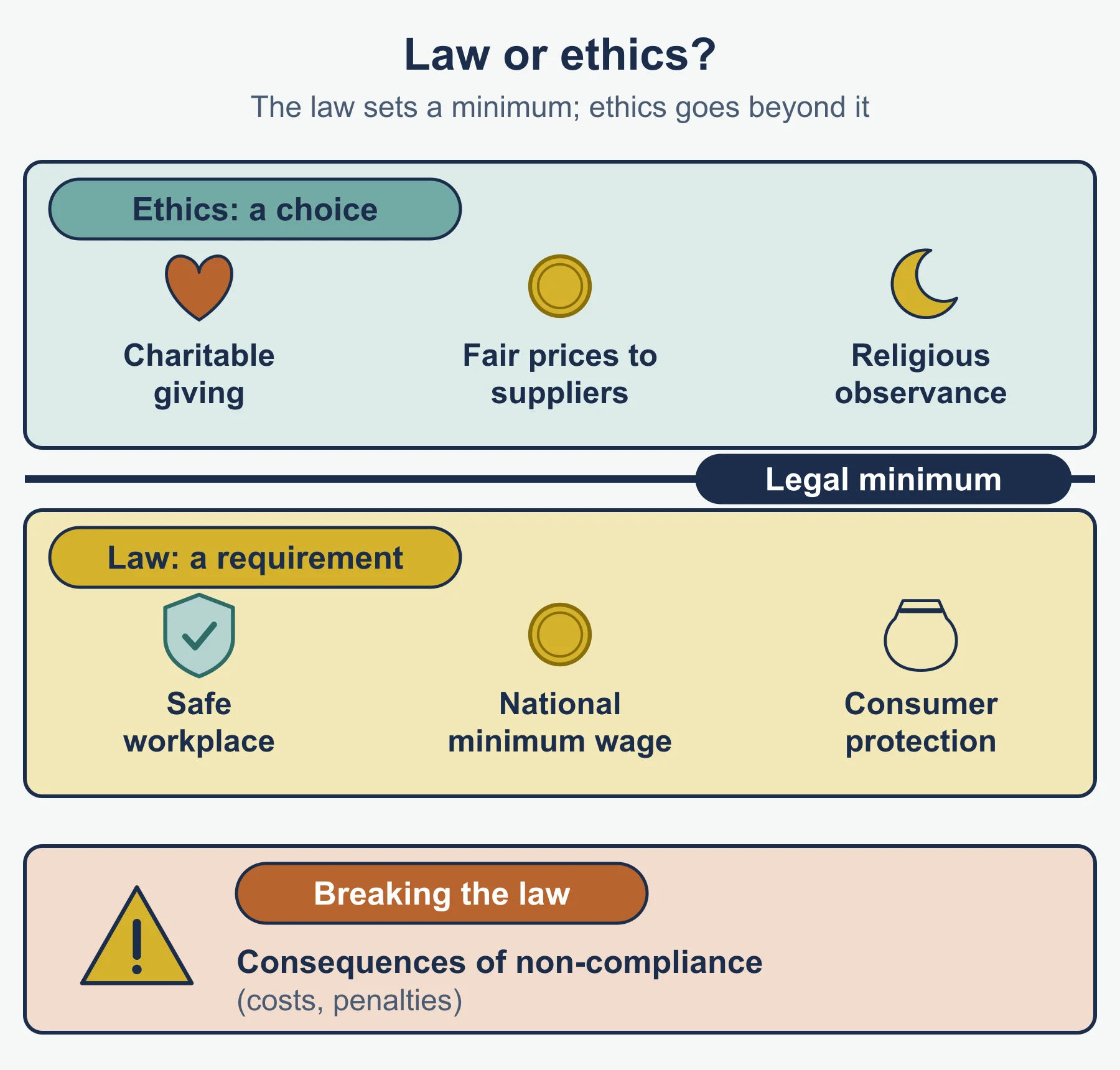
The specification asks you to assess the impact of legislation, giving as examples cost, training needs, recruitment, and the consequences of failing to follow the law. Use them as a checklist. You need only brief knowledge of each law, so spend your effort on the effects on the business. The effects touch every functional area: operations (safe processes), human resources (hiring and pay), marketing (honest claims) and finance (the cost of compliance and of penalties).
Employment law
National minimum wage and living wage. The government sets legal minimum hourly pay, and the rate depends on the worker, for example on age. Rates change over time, so check the current figures in your lessons rather than learning old ones. A business must pay at least the legal rate.
Effects on the business:
- Cost: the wage bill rises when the legal rate rises, and labour-intensive firms are hit hardest.
- Recruitment: a higher floor on pay can attract more applicants and reduce staff turnover, but the firm may hire fewer people.
- Prices: the extra cost may be passed to customers, which can reduce demand.
- Motivation: fairer pay can improve morale and productivity.
The Equality Act (2010). In general terms, the Act makes it unlawful to treat people unfairly because of personal characteristics such as age, sex, race, disability or religion. It applies to recruitment, pay, promotion and training.
Effects on the business:
- Recruitment: job adverts and interviews must be fair, so the firm may need clear selection criteria.
- Training: managers need training in fair treatment.
- Cost: the firm may need to adapt a workplace for a disabled employee.
- Benefit: a wider pool of talent and a better reputation.
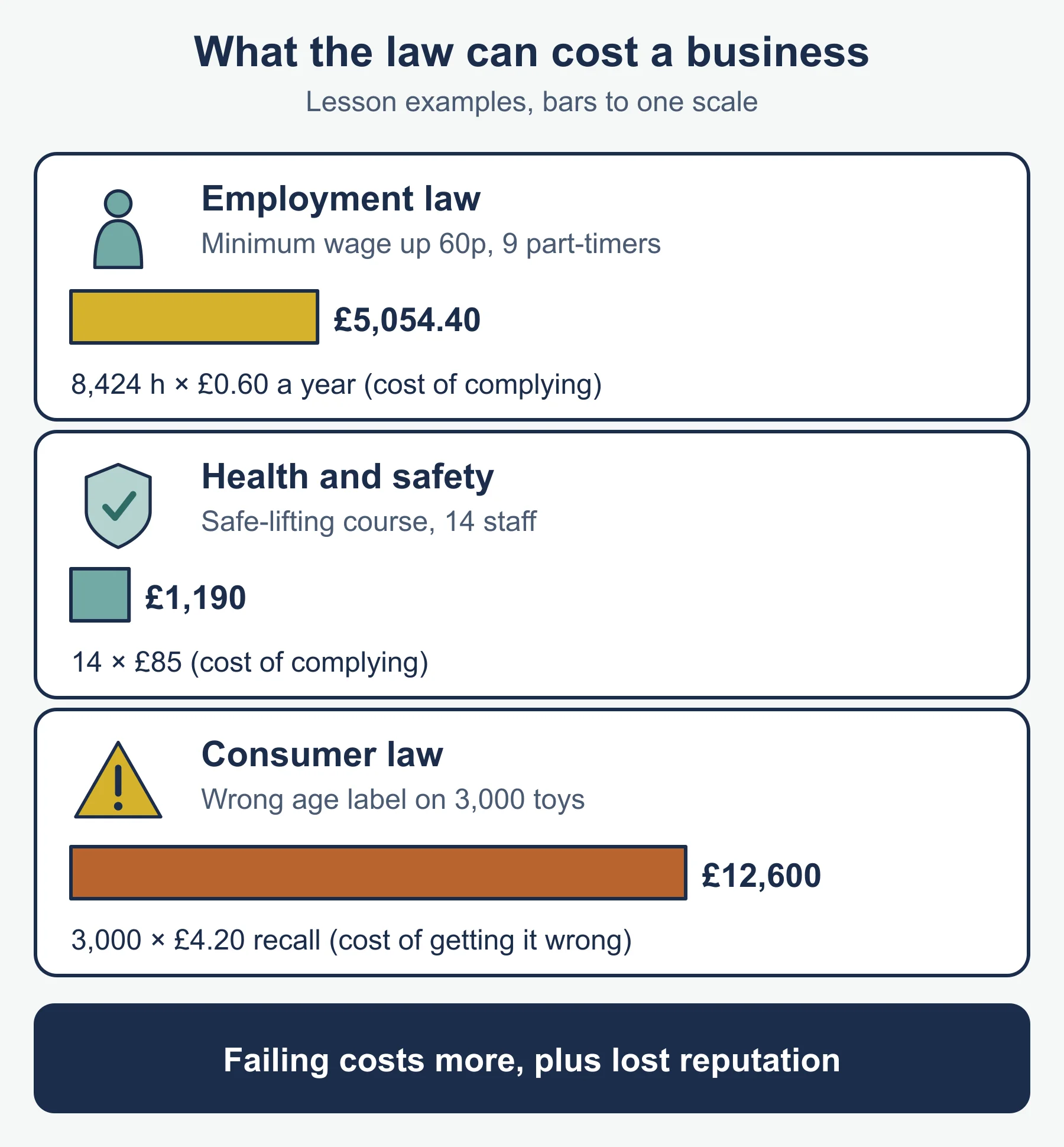
Worked example 3: a wage rise. Pennyfield Cafe has 9 part-time staff, each working 18 hours a week for 52 weeks a year. The legal minimum rate rises by 60p an hour and all 9 staff are on the minimum.
- Total hours a year = 9 x 18 x 52 = 8,424 hours.
- Extra wage cost = 8,424 x £0.60 = £5,054.40 a year.
The owner could raise prices, cut hours, or accept lower profit. A strong answer names the option and explains its effect, for example that cutting hours may lower service quality.
Health and safety law
In general terms, the Health and Safety at Work Act (1974) places duties on employers to keep the workplace reasonably safe, for example by assessing risks, providing safe equipment and giving staff the information and training they need. Employees must also take care.
The specification asks for awareness of the benefits of a safe working environment:
- fewer accidents, so less absence and lower cost of replacing staff
- better motivation, because workers feel valued
- a better reputation, which helps recruitment
- avoiding the cost of legal action or compensation
Costs are real: protective equipment, training time, repairs and inspections.
Worked example 4: training cost against risk. Davenmoor Pallets has 14 warehouse staff. A safe-lifting course costs £85 per person. The total is 14 x £85 = £1,190. The firm judges that one serious injury would cost far more in absence cover, repairs to its reputation and possible legal action. The cost is justified because it is small compared with the cost of failure.
Consumer law
The specification includes consumer law, with trade descriptions named. In general terms, what a business says about a product, in packaging, adverts or online, must be accurate and not misleading. Goods should also be as described and of acceptable quality.
Effects on the business:
- Marketing: claims need evidence, and wording in adverts needs checking.
- Operations: products need quality control so that they match their description.
- Finance: refunds, replacements, recalls and possible penalties cost money.
- Reputation: a firm found to mislead customers can lose trust and sales.
Worked example 5: the cost of a wrong label. Ivelmere Toys finds that 3,000 toys were labelled for an age group that the design does not suit. A recall and relabel costs £4.20 per toy. Total cost = 3,000 x £4.20 = £12,600, before any damage to its reputation. Checking labels before sale would have cost far less.
The consequences of failure
Across all three areas, a business that ignores the law can face financial penalties, compensation claims, legal costs, forced changes to its operations, damaged reputation and falling sales. Describe these in general terms. Do not quote figures for fines unless a case study gives them.
Writing about these topics
Case-study questions test application and analysis, then evaluation. A reliable pattern:
- Make a point about the law or the exchange rate.
- Link it to the business in the case study, using its figures or details.
- Explain the effect on profit, sales, costs or reputation.
- For evaluation, weigh both sides, consider the size and timing of the effect, and reach a judgement.
Common errors
- Writing that a stronger pound is “good” for everyone. It helps importers and hurts exporters.
- Trying to convert currencies. The specification says you will not need to.
- Listing laws without effects. Brief knowledge is enough; the marks are in the impact.
- Forgetting that compliance costs are weighed against the cost of failure and the benefits of a safer, fairer firm.
- Treating globalisation as only a threat. It also opens markets and lowers costs.
Frequently asked questions
What is globalisation in GCSE Business? Globalisation is the growing connection of the world’s economies and markets, so goods, services, money and ideas move more freely between countries. The AQA specification does not give a one-line definition, so this standard one is used.
Is globalisation only a threat to UK businesses? No. It brings more overseas rivals and longer supply chains, but it also opens bigger markets through exports and gives access to cheaper components and new suppliers.
What does the Health and Safety at Work Act (1974) mean for a business? In general terms, it places duties on employers to keep the workplace reasonably safe. AQA GCSE Business (8132) asks you to be aware of the benefits of a safe working environment, such as fewer accidents, less absence and a better reputation.
What happens if a business breaks consumer law on trade descriptions? It can face refunds, replacements, recalls and possible penalties, and a business found to mislead customers can lose trust and sales.
Official syllabus
AQA GCSE Business (8132), specification for first teaching from September 2017, published by AQA: sections 3.2.4 Globalisation and 3.2.5 Legislation, with the assessment overview. Check aqa.org.uk/8132 for the current version.
Get free revision emails (optional)
Occasional emails with practice questions, worked explanations and links to free resources for the qualification and subjects you choose. No spam, and you can unsubscribe from any email. The free tools on this site never need an email.
Related resources
-
Practice questions
AQA GCSE Business: Globalisation and Legislation (8132) – Practice Questions
Original practice questions with worked answers on globalisation, exchange rates, employment, health and safety and consumer law, AQA GCSE Business 8132.
Business · AQA · GCSE
Try questions -
Revision notes
AQA GCSE Business: Globalisation and Legislation (8132) – Revision Notes
Condensed revision notes on globalisation, exchange rates and employment, health and safety and consumer law for AQA GCSE Business 8132, 3.2.4-3.2.5.
Business · AQA · GCSE
Revise topic -
Practice questions
AQA GCSE Business: Technology and Ethical/Environmental Considerations — Practice Questions
Original practice questions with worked answers on e-commerce, digital communication and ethics and environment trade-offs for AQA GCSE Business (8132).
Business · AQA · GCSE
Try questions
Related articles
-
teaching
A Level tuition in Dubai: Cambridge or Pearson Edexcel International A Level?
Schools in Dubai and Abu Dhabi teach either Cambridge International AS & A Level or Pearson Edexcel International A Level. How the two are structured, why it matters for tuition, and how online classes from Lahore work.
9 October 2026
-
curriculum guides
Choosing subjects at IGCSE and A Level
How subject choices at 14 and 16 affect university options later, and how to keep pathways open without overloading a timetable.
28 July 2026
Studying this with a teacher
Working through Business GCSE?
This page is free and stays free. If you would rather be taught it, Marlbridge runs Business classes one-to-one and in small groups of up to 15, online in your own time zone. The first trial class is free. WhatsApp replies within an hour (8am–11pm Pakistan time, every day); email the same day.
AQA Business teachers at Marlbridge
